Exposure to a distressing event has been shown to be correlated with adverse psychological consequences, which are exacerbated by prolonged post-event adversity.Reference Chan and Rhodes1–Reference Le, Tracy, Norris and Galea3 Populations displaced by natural disasters face a multitude of challenges, including language and cultural barriers, prejudice, and other obstacles, many of which were documented in studies of the displaced after Hurricane Katrina.Reference Chan and Rhodes1, Reference Le, Tracy, Norris and Galea3–Reference Merdjanoff5 Displaced populations are distinctive because they not only face stressors directly related to the disaster, but also chronic stressors as a result of being displaced, including isolation, dependency on support networks, cultural differences, and barriers such as language.Reference Chan and Rhodes1, Reference Le, Tracy, Norris and Galea3, Reference Merdjanoff5
Language barriers can hinder the expression of loss and emotional pain during times of duress, make interactions with mental health professionals difficult, and impede the ability to obtain resources, putting displaced populations that do not speak the local language at risk for adverse psychological outcomes.Reference Dass-Brailsford4, Reference Kirmayer, Narasiah and Munoz6 After Hurricane Maria, nearly 135 000 residents of Puerto Rico were forced to leave to the continental United States.Reference Hinojosa and Meléndez7 The challenges faced by displaced hurricane survivors have been associated with depression, generalized anxiety disorder (GAD), and posttraumatic stress disorder (PTSD).Reference Chan and Rhodes1, Reference Merdjanoff5, Reference Wadsworth, Santiago and Einhorn8 These correlations have been well-documented in previous post-disaster investigations. Nevertheless, the psychological outcomes in the post-Hurricane Maria displaced Puerto Rican population (migrants) may be exacerbated given possible language barriers.
The purpose of this investigation is to identify possible differences in the prevalence of PTSD, depression, and anxiety disorders in those who left the island as a result of Hurricane Maria (migrants), compared with those who remained in Puerto Rico. We hypothesize that the prevalence of stress and anxiety disorders, and possibly PTSD, will be significantly higher in the post-Maria Puerto Rican population who migrated to the continental United States, when compared with those who remained on the island. This study will address the impact of the language of preference and English proficiency in the mental health of this displaced population. We hypothesize that a lower English language proficiency will be a predisposing risk factor for the development of mood and anxiety disorders for that subgroup of migrants. This preliminary study has the potential to further the current understanding of displaced populations affected by natural disasters, especially those facing language barriers after relocation.
METHODS
Participants
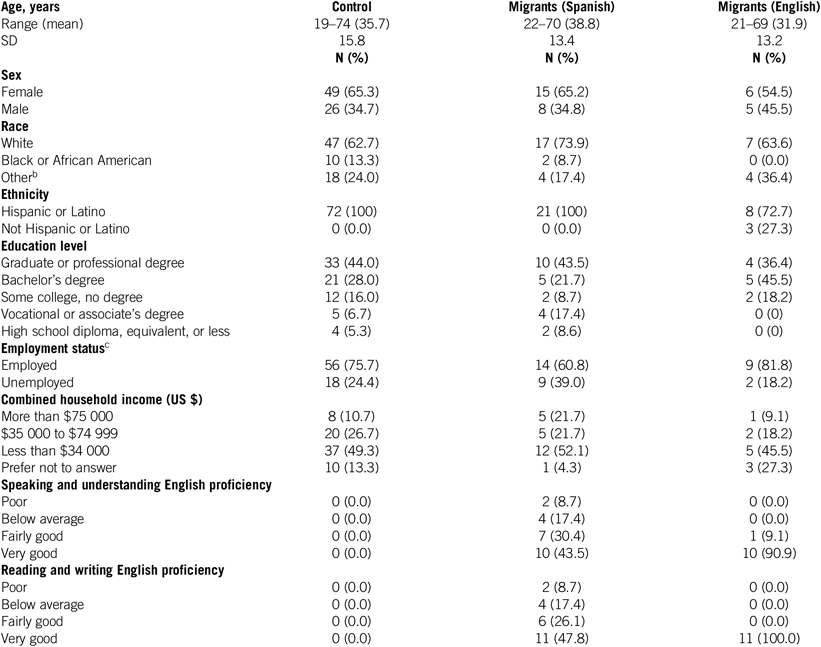
Participants were Puerto Rican residents who remained in Puerto Rico (control) and those who left the island immediately prior to or at any time after the landfall of Hurricane Maria (migrants). Inclusion in the migrants group was contingent upon having spent at least 3 successive months outside of Puerto Rico, regardless of whether those participants had returned. Participants meeting the following criteria were excluded from the study: (1) having a diagnosis of psychiatric diagnosis made by a health professional prior to Hurricane Maria; (2) being under the age of 18; and (3) failing to complete the survey past the “demographics” section. To reach migrants in the continental United States, partnerships were established with community and social groups, relief organizations, and academic institutions. On-site student team members were present in Florida, New York, Texas, Maryland, and Puerto Rico to facilitate the distribution of project materials. A total of 213 participants submitted surveys, including 148 in the control group and 65 in the migrants group; 73 controls and 31 migrants were removed from the sample based on exclusion criteria. The final sample included 75 controls and 34 migrants. Ages ranged between 19 and 74 years (mean = 35.3 years; SD = 15.0). Most participants were female (64.2%; n = 70), Hispanic or Latino (92.7%; n = 101), white (65.1%; n = 71), employed (72.5%; n = 79), with a graduate degree or professional degree (43.1%; n = 47), and had a combined household income of less than US $34 000 last year (49.5%; n = 54). A complete demographic profile is included in Table 1.
Demographics of Participantsa

a Total N = 109.
b “Other” includes participants who identified as Asian, American Indian or Alaskan Native, and “other.”
c “Employed” includes those who are employed full-time and part-time, and full-time students.
“Unemployed” includes participants who are retired, homemakers, and “other.”
Procedures
Data collection lasted 2 months from July to August 2018. A written informed consent was given by every participant in the study. No personal identifiers were used in the collection, interpretation, or reporting of data. The study was approved by the Institutional Review Board of the San Juan Bautista School of Medicine in Caguas, Puerto Rico.
Measures
Participants completed a self-reported hard-copy or digital survey that included 6 sections (103 total items). The sections included demographic characteristics, the recently validated Post-Hurricane Distress Scale (PHDS), and 4 clinically validated questionnaires available in English and Spanish for detecting signs of psychiatric disorders: the Kessler Psychological Distress Scale (K6), the GAD 7-item scale (GAD-7), the PTSD Checklist for DSM-5 (PCL- 5), and the Patient Health Questionnaire 9-item depression scale (PHQ-9). The investigation specifically focused on demographic characteristics and emotional and physical distress experienced by those who stayed in Puerto Rico versus those displaced to the continental United States due to Hurricane Maria. Distress directly attributable to the hurricane was assessed with the PHDS, a 26-item, self-reporting tool, which measures both acute and post-hurricane stressors.
Migrant participants were given the option to complete the questionnaire in their preferred language. To determine self-reported English language proficiency, the following 2 questions with 4-point Likert scale answers from 0 to 3 were included: “How good are you at daily speaking and understanding English when you need to?” and “How good are you at daily reading and writing English when you need to?” All control participants chose to complete the questionnaire in Spanish. The control group was not asked to self-report their English language proficiency as they remained in Puerto Rico, where Spanish continues to be the predominant language.
Statistical Analyses
Prevalence rates of probable PTSD, moderate to severe depression, severe mental distress, GAD, post-hurricane distress, exposure variables, and basic demographic means were identified using descriptive statistics. The chi-square test and Fisher’s exact test were used to assess differences in prevalence. Shapiro–Wilk testing was used to test for normal distribution of continuous variables, exposure data, as well as PHDS scores. Kruskal–Wallis tests were subsequently conducted to identify significant differences in the non-normally distributed datasets. Differences in self-reported English proficiency showed unequal variance and skewness; thus, these differences were demonstrated using the Mann–Whitney U test. Statistical analyses were conducted using GraphPad Prism 7.04 for Mac OS X (GraphPad Software, La Jolla, CA, USA) and IBM SPSS Statistics 25 for Windows (IBM Corp., Armonk, NY, USA).
RESULTS
Association Between English Language Proficiency, Preferred Participation Language, and Severe Mental Distress in Migrants
The English-preferring group means (± SEM) for written and spoken English proficiency were 3.0 ± 0.0 for both, and the Spanish-preferring group means were 2.1 ± 0.2 and 2.0 ± 0.2, respectively (Figure 1A). Mean scaled responses between the 2 preferred language groups showed significant differences in both written and spoken English proficiencies (Mann–Whitney U test = 55; P = 0.0024; n = 11, 23 and U = 60.5; P = 0.0049; n = 11, 23 – respectively), with higher values for the English-preferring group.
Comparative Prevalence of Possible Psychological Disorders 8-10 Months Post Hurricane Maria - Splitting Migrants by Language Preference

Severe mental distress, defined as K6 scores above 13, was identified in approximately 21% of the migrants (n = 34) compared with 9.6% of controls (n = 73; see Figure 1B). However, no significant differences were noted (χ2 = 2.47, P = 0.12). After partitioning the migrant group by participants’ preferred language, significant differences in prevalence of severe mental distress were found between the Spanish-preferring migrants (30.4%, n = 23), English-preferring migrants (0%, n = 11), and controls (9.6%, n = 73, Fisher’s exact test; P = 0.021) (see Figure 1C).
Prevalence of Stress and Anxiety Disorders in Migrant and Non-Displaced Hurricane Maria Survivors
No significant differences in prevalence of moderately severe and severe depression, defined as PHQ-9 scores above 14, were found (χ2 = 2.365, P = 0.124) between total migrants (12.1%, n = 33) and the non-displaced (4.1%, n = 73; see Figure 1B). Likewise, we did not detect significant differences (Fisher’s exact test, P = 0.065) among Spanish-preferring migrants (18.2%, n = 22), English-preferring migrants (0%, n = 11), and the non-displaced (4.1%, n = 73) (see Figure 1C).
Prevalence of anxiety disorders, defined as GAD-7 scores above 7, were not significantly different (χ2 = 1.367; P = 0.24) between total migrants (33.3%, n = 33) and controls (22.5%, n = 71) (see Figure 1B). A 3-group analysis comparing prevalence showed no differences (Fisher’s exact test, P = 0.187) among Spanish-preferring migrants (40.9%, n = 22), English-preferring migrants (18.2%, n = 11), and the non-displaced (22.5%, n = 71) (see Figure 1C).
Prevalence of high risk for PTSD, defined as PCL-5 scores above 32, was not significantly different (χ2 = 0.225; P = 0.64) between total migrants (14.7%, n = 34) and controls (11.1%, n = 70) (see Figure 1B). A 3-group analysis comparing prevalence showed no significant differences (Fisher’s exact test, P = 0.806) among migrants who preferred Spanish (17.4%, n = 23), migrants who preferred English (9.1%, n = 11), and the non-displaced (11.4%, n = 70) (see Figure 1C).
The PHDS exposure score for English-preferring migrants was 33.6 ± 22.2 (mean ± s, n = 11), 49.4 ± 25.3 (n = 22) for Spanish-preferring migrants, and 37.6 ± 18.4 for the non-displaced (n = 72); no significant difference was found among groups (Kruskal–Wallis test, H = 4.534; P = 0.067; n(Eng) = 11, n(Span) = 21, n(Con) = 74) (Supplementary material).
DISCUSSION
After Hurricane Maria, many Puerto Ricans were left in precarious conditions that forced many to leave the island for the continental United States. This displaced population encountered additional stressors associated with prolonged displacement, change in culture, and language barriers compared with those who remained on the island. Our study delved into the impact of language barriers on the mental distress experienced by the displaced Puerto Ricans. We found no significant differences between those who migrated and those who remained in Puerto Rico per any of the mental health assessments used (K6, GAD-7, PCL-5, PHQ-9, and PHDS). Although previous literature suggests that displacement due to natural disasters is associated with a higher risk for serious mental illnesses, anxiety, PTSD, and depression,Reference Lamond, Joseph and Proverbs2, Reference Le, Tracy, Norris and Galea3, Reference Merdjanoff5, Reference Kirmayer, Narasiah and Munoz6, Reference Wadsworth, Santiago and Einhorn8–Reference Myles, Swenshon and Haase10 our study does not demonstrate this.
Partitioning of the migrant group by language preference showed a significant difference in the prevalence of severe mental distress, as defined by the K6 above 13, between Spanish-preferring migrants, English-preferring migrants, and those who remained in Puerto Rico. Migrants who preferred to answer the questionnaire in Spanish appear to be at a higher risk for developing severe mental distress and depression. Using questions to gauge respondents’ self-reported comprehension, reading, and writing proficiency in the English language, those who responded in Spanish self-reported a significantly lower level of English proficiency when compared with those who responded in English. This supports the possibility that decreased language proficiency in post-disaster migrants may be an important risk factor for depression and serious mental illnesses.
These findings are not unexpected given that depression has been associated with cultural and language barriers in immigrants.Reference Kirmayer, Narasiah and Munoz6, Reference Forte, Trobia and Gualtieri9 Prior literature has reported that immigrants often suffer psychological distress mainly attributed to stressors such as language barriers, loss of social network, unemployment, exclusion, and financial problems.Reference Kirmayer, Narasiah and Munoz6, Reference Forte, Trobia and Gualtieri9 As US citizens, the displaced Puerto Rican residents are not considered immigrants. However, because the primary spoken language in Puerto Rico is Spanish, a language barrier exists for many Puerto Ricans moving to the continental United States where the primary language is English. To our knowledge, this is the first study showing that Puerto Ricans may have a significant additional burden created by language barriers when displaced to the continental United States after a natural disaster. This burden represents a serious risk factor for the development of negative psychological outcomes and potential health disparities in access to health care.
CONCLUSION
Currently, an interpretation of the results is primarily limited by the small sample size. Because this study involved the administration of self-reported questionnaires, the potential for selection bias exists. It is possible that there are confounding variables such as gender, education level, race, and socioeconomic status. We did not ask the control group about their English language proficiency, which resulted in a limitation to ascertain the self-reported English proficiency of those who remained in Puerto Rico. Despite these limitations, these results provide a novel understanding of the role of language proficiency in the risk for serious mental illnesses and depression in displaced Puerto Rican populations following a natural disaster such as Hurricane Maria.
Supplementary material
To view supplementary material for this article, please visit https://doi.org/10.1017/dmp.2019.22
Acknowledgments
We thank our collaborating psychiatrist, Lucero Rodriguez, for guidance throughout this project. Additionally, we thank Yaritza Inostroza Nieves, Estela Estapé, Raymond L. Tremblay, and Yocasta Brugal for their guidance and review of the manuscript.
Funding Source
This research is supported by an American Psychiatric Association Foundation Helping Hands Grants Program Award.
Conflict of Interest Statement
The authors have no conflicts of interest to declare.