Introduction
Complete Atrioventricular Canal Defect is a complex cardiac malformation in which there is a variable deficiency of the atrioventricular junction in the developing heart. Reference Rastelli, Kirklin and Titus1 This anomaly is characterised by the atrial, ventricular, and atrioventricular septa, and the left and right atrioventricular valves. Reference Calabrò and Limongelli2
During the 1970s and early 1980s, surgeons advocated palliation with pulmonary artery banding to delay surgical repair beyond infancy, aiming to prevent more elevation of pulmonary artery pressure. Reference Berger, Kirklin, Blackstone, Pacifico and Kouchoukos3 On the other hand, as operative techniques and post-operative care improved and cardiopulmonary bypass in infants became safer, Reference Hanley, Fenton and Jonas4,Reference Crawford and Stroud5 most cardiac centres abandoned this practice and opted for elective repair before 6 months of age in asymptomatic infants with CAVC. Reference Vida, Tessari and Castaldi6–Reference Michielon, Stellin, Rizzoli and Casarotto9 Delay beyond this age has recently been shown to be an incremental risk factor for death and reoperation for LAAV regurgitation. Reference Vida, Tessari and Castaldi6–Reference Michielon, Stellin, Rizzoli and Casarotto9 Infants with failure to thrive and with symptoms of heart failure requiring multiple medications should undergo surgery as soon as possible to permit normal growth and development. Reference Stellin10
Two standard methods for repair of CAVC defect are used: first, is the single-patch technique, where the same patch is used for closure of the atrial septal defect and ventricular septal defect, the AVV leaflets are resuspended onto this single patch, with a need for leaflet division. This allows patch placement for Rastelli type C, which by definition has a common superior leaflet. Reference St. Louis, Jodhka and Jacobs7,Reference Nicholson, Nunn and Sholler11,Reference Wilcox, Jones and Frantz12 Second is the double-patch technique; two separate patches are used, one for closure of the VSD and the other for closure of the ASD; the AVV leaflets are typically not divided. Reference Jonas and Mora13–Reference Maloney, Marable and Mudler15 In the mid-1990s, the modified single-patch technique was introduced, which is characterised by the obliteration of interventricular communication by direct closure of the bridging leaflet and septal crest and then closure of ASD using a single pericardial patch. Reference Jeong, Lee and Lee16
Aim of the work
To evaluate the early results of surgical total repair of Complete Atrioventricular Canal Defect in relation to three important risk factors, which are early repair in the first 6 months of life versus later repair, surgical technique (modified single-patch versus double-patch technique and adding posterior annuloplasty to the repair of left atrioventricular valve versus not), and Trisomy 21 versus Non-Trisomy 21 patients.
Materials and methods
A prospective study in which 70 patients with a CAVC underwent definitive surgical repair from July, 2016 to October, 2019 at the Cardiothoracic Surgery Department Paediatric Unit, Ain Shams University Hospitals. Follow-up was done for duration of 6 months post-surgery through regular outpatient visits with recent echocardiography. The study was approved with a waiver of consent by the Institutional Review Boards of the University of Ain Shams.
All patients were operated on via an elective basis; age ranged between 2 months and 24 months, and cases included Trisomy 21 and Non-Trisomy 21 patients. The selection criteria excluded patients refusing to participate in the study, patients who underwent previous pulmonary artery banding, patients with an incomplete canal defect (partial atrioventricular canal defect), patients with unbalanced complete atrioventricular canal defect not suitable for biventricular repair, patients with conotruncal complex anomalies (including tetralogy of Fallot, double outlet right ventricle, and pulmonary stenosis), and patients with a single ventricle.
All patients had preoperative echocardiography and multi-slice CT chest to confirm the diagnosis and exclude any associated complex anomalies. Surgical repair was performed through median sternotomy using cardiopulmonary bypass and moderate hypothermia with antegrade cardioplegia to achieve diastolic arrest. This was followed by right atriotomy and performing the repair.
Two techniques were used for repair as follows
The modified single-patch technique (Australian technique), similar to that described by Nunn and colleagues, Reference Nunn17 was used in 39 cases (55.7%) and a two-patch technique was used for closure of septal defects in 31 cases (44.3%). Gortex patches were used for the ventricular component and autologous pericardium for the atrial defect. In 40 patients (57.1%), cleft was closed and posterior annuloplasty was added to the repair. Intraoperative testing for the competency of the left AVV was done by injecting saline in the left ventricle.
Following completion of the repair, closure of right atriotomy and de-airing of the left side of the heart was performed through the aortic root, followed by weaning from cardiopulmonary bypass, routine haemostasis, and closure in layers.
The following data were recorded: age, weight, Trisomy 21 or Non-Trisomy 21 patient, cross-clamp time, total bypass time, technique used for repair: whether double or modified single patch and whether the repair was performed with posterior valve annuloplasty or not, and patient rhythm both on going off bypass and on discharge from the operating theatre.
During ICU stay, measurements included post-operative ventilation duration, incidence of re-exploration for bleeding, total ICU stay, incidence of arrhythmia, and heart block.
Other operative complications were also recorded including superficial wound infection, mediastinitis, pleural collection, lung collapse, chest infection, early reoperation (within 1 month of surgery). In-hospital mortality was also recorded.
Post-operative echocardiography was performed to detect the presence and degree of mitral valve regurgitation, left ventricular dimensions, presence of pericardial collection, presence of left ventricular outflow tract obstruction, and presence of residual septal defects.
Following 6 months from hospital discharge, chest X-ray, echocardiography, and mortality were also recorded.
Results
Thirty-seven and one percentage of patients were younger than 6 months old and 62.9 % were older than 6 months. Univariable analysis shows the only significant differences between the two groups were regarding ICU stay (3.6 days versus 5.04 days, p-value = 0.02) and post-operative complications (53.8 % versus 18.2, - value = 0.01). Modified single-patch technique was used in 39 cases (55.7%), whilst in 31 cases (44.3%), double-patch technique was used. Univariate analysis showed that surgical repair by modified single-patch technique showed a significant reduction in cross-clamp time (mean = 47.6 ± 9.227 min versus 73.55 ±21.087 min, p-value 0.001), shorter bypass time (mean = 71.13 ±13.507 min versus 99.19 ± 27.092 min, p-value = 0.001), and shorter duration of ICU stay (mean = 3.2 ± 1.657 days versus 5.3 ± 2.761 days, p-value = 0.01) compared to double-patch technique. Double-patch technique was used more in patients with a large VSD component (>8 mm) compared to the modified single patch (70.9 versus 23.4 % of cases, respectively, p-value = 0.001).
LAVV repair was performed by the closure of cleft only by interrupted prolene sutures in 30 patients (42.9 %), whilst the remaining 40 patients (57.1%) had additional posterior annuloplasty. Posterior annuloplasty compared to the closure of cleft only resulted in a significant reduction in the occurrence of post-operative valve regurgitation during the early period (LAVVR grade 2+=7 versus 43 %, p-value = 0.03) and at 6 months of follow-up (LAVVR grade 2+=0 versus 35.4 %, p-value = 0.01), respectively.
Within our study sample, 64.3% (45 patients) had Trisomy 21, whilst 35.7% (25 patients) were Non-Trisomy 21 patients. Univariate analysis showed that Trisomy 21 patients had significantly less incidence of post-operative moderate-to-severe LAVVR compared to Non-Trisomy 21 patients (LAVVR grade 2+ = 8.9 versus 24 %, p-value = 0.005, respectively).
LAVV dysplasia is defined as the presence of anomalies including thickened leaflets, elongated chordae, lack of leaflet tissue, a double-orifice LAVV, excessive leaflet tissue, and fusion of the commissures, and is traditionally diagnosed by echocardiography. Reference Stellin10 In our study group, there was a strong association between the incidence of LAVV dysplasia and Trisomy 21; (64 versus 13.3% in Trisomy 21 versus Non-Trisomy 21 patients, respectively (p-value = 0.001).
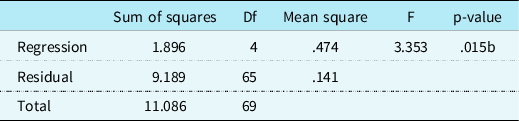
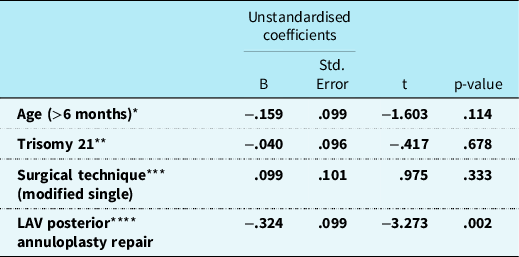
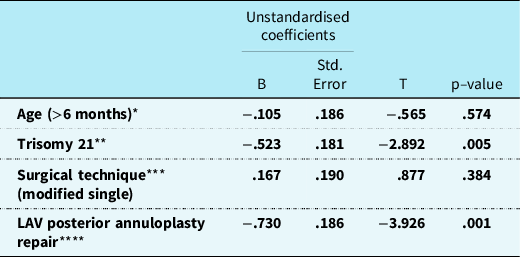
On multivariate regression analysis, Trisomy 21 was associated with significantly less moderate-to-severe LAVV regurgitation compared to Non-Trisomy 21 patients (p-value = 0.005). Mortality was comparable in Trisomy 21 versus Non-Trisomy 21 patients, (Tables 1–4).
Multivariate regression analysis for mortality within the cohort operated on

b = beta value.
Coefficients required for Table 1 which show multivariate regression analysis for mortality within the cohort, alongside p-values for compared fields

*Reference <1 6 ms group, **reference for non-trisomy 21 patients, ***reference for double patch, ****reference for closure of cleft without posterior annuloplasty.
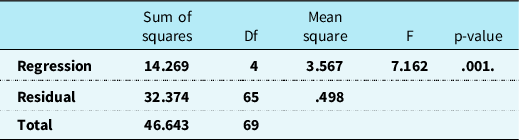
Multivariate regression analysis of 6 m LAVVR present post-operatively in the cohort

Coefficients required for Table 3 which show multivariate regression analysis of 6 mm LAVVR present post-operatively in the cohort, alongside p-values of compared fields

*Reference ≤1 6 ms group, **reference for non-trisomy 21 patients, ***reference for double patch, ****reference for closure of cleft without posterior annuloplasty.
When compared with other variables, posterior LAV annuloplasty was found to be significantly protective against 6 months’ moderate-to-severe LAVVR and short-term mortality. The addition of posterior annuloplasty to the closure of common AV valve cleft was associated with a significant reduction in the occurrence of post-operative LAVVR during 6 months of follow-up and a significant reduction in mortality (p-value = 0.001, p-value = 0.002, respectively).
Mortality was reported in 8.6% of patients (six patients), four early within hospital stay (two patients died from low COP and two from sepsis), whilst two died 6 months after discharge; one required readmission for a chest infection and died from sepsis, one died at home of unknown causes.
Discussion
The optimal age for surgical correction of CAVC defect has been addressed in several studies, most of which showed that successful repair at an early age was associated with competent AV valves at the time of diagnosis, even in the presence of a cleft in the LAVV component. Reference Yasui, Nakamura and Kado18,Reference Mavroudis, Weinstein, Turley and Ebert19 Patients repaired at older ages were found to be more likely presenting with an incompetent AV valve. Reference Mavroudis, Weinstein, Turley and Ebert19,Reference Günther, Mazzitelli, Haehnel, Holper, Sebening and Meisner20 This may be due to chronically elevated QP/QS playing an important role in the onset of annular dilatation and secondary LAVV incompetence. Reference Michielon, Stellin, Rizzoli and Casarotto9,Reference Mavroudis, Weinstein, Turley and Ebert19 Early correction has been proposed to reduce the incidence of LAVV regurgitation in the post-operative follow-up period. Reference Suzuki, Bove and Devaney21,Reference Atz, Hawkins and Lu22 This appears to be the most important factor affecting post-operative morbidity and mortality. Reference Stellin10 Avoiding irreversible pulmonary hypertension, which may develop before the age of 6 months particularly in the presence of Trisomy 21, is another reason to justify earlier repair. Reference Stellin10,Reference Suzuki, Bove and Devaney21 Some studies advocate that the optimal timing for surgical intervention in patients with CAVC defect is when symptoms of congestive heart failure cannot be managed by medical therapy. Reference Reddy, McElhinney and Brook23 Others believe that repair at the age of 4–6 months, before developing severe pulmonary hypertension, gives better results with no additional morbidities or mortality. Reference Suzuki, Bove and Devaney21,Reference Atz, Hawkins and Lu22,Reference Singh, Warren, Reece, Ellman, Peeler and Kron24
In our study, we found no statistical significant difference between early surgical repair of CAVC defect in the first 6 months versus later repair, both in regards to mortality and post-operative LAVVR. The only significant finding was in the ICU duration, which was longer in the younger age group. Stellin et al Reference Stellin10 performed a study assessing surgical treatment of CAVC defects in children before 3 months of age, with findings demonstrating that repair of CAVC under 3 months of age is the ideal approach to this malformation with a lower mortality rate at operation compared to older patients. Reference Stellin10,Reference Singh, Warren, Reece, Ellman, Peeler and Kron24 Logistic analysis showed that an operative age after 3 months is compared to an age before or equal to 3 months, an incremental risk factor for hospital mortality with an odds ratio of 4.8 (95% confidence limit 1–23.5) (p-value = 0.05). Reference Stellin10 In the long term, freedom from reoperation for LAVV incompetence is higher when compared to children repaired at an older age. Reference Stellin10
Parikh et al Reference Parikh, Shah, Myers, Kunselman and Clark25 found no differences between the early (<90 days) and late repair (>90 days) age groups at surgery for the outcomes of post-operative length of stay, heart block requiring pacemaker placement, rate of moderate or greater LAVVR, reoperation for LAVVR, and mortality. Reference Parikh, Shah, Myers, Kunselman and Clark25
Both modified single-patch and double-patch techniques can be used for the repair of CAVCD, with the former being superior in having shorter bypass time and cross-clamp time, making it more popular, Reference Nicholson, Nunn and Sholler11,Reference Fong, Winlaw and Orr26 although some surgeons believe that it may have associations with a higher incidence of LVOT obstruction.
In our study, when compared to the double-patch techniques, patients with a modified single patch had significantly shorter cross-clamp time, bypass time, and duration of ICU stay. Surgeons’ preference in deciding which technique to use in the surgical repair is one important factor, some surgeons tend to use double-patch technique with large VSD component, others favour the use of modified single-patch technique in complete AVSD with large VSD (larger than 0.8 mm and up to 1.5 mm), both, however, were found to have comparable results and outcomes . Reference Nicholson, Nunn and Sholler11,Reference Fong, Winlaw and Orr26
Addition of posterior annuloplasty to the common AV valve repair was suggested to prevent late reappearance of LAVVR. Reference Fong, Winlaw and Orr26 In this study, it showed a protective effect against moderate-to-severe LAVVR and short-term mortality 6 months post-operatively, when compared to the closure of cleft only. We believe that posterior annuloplasty maintains the valve competency and also restricts progressive dilatation of the LAVV, hence decreasing the need for reoperation. In a study performed by Myers et al, 219 patients were included to evaluate the impact of annuloplasty at CAVC repair on post-operative LAVV function. Reference Myers, del Nido and Marx27 The cleft was closed completely in 192 patients (88%). Sixty-five patients had annuloplasty (39 commissural, 32 posterior). There were five early deaths (2.3%). At discharge, four patients (1.9%) had more than mild regurgitation and no patients had significant inflow gradients. During a follow-up of 2.7 ± 2.1 years, there were 6 late deaths (2.8%), and 16 patients (7.3%) required LAVV reoperation. Two of 65 patients (3.1%) with annuloplasty required reoperation, compared to 14 of 148 without annuloplasty (9.5%, p = 0.16). In propensity matched analysis, annuloplasty was significantly protective of ≥ moderate LAVVR (OR 0.19, p = 0.008) and non-significantly of reoperation (OR 0.28, p = 0.099). Reference Myers, del Nido and Marx27
There was a significant difference between Trisomy 21 patients and Non-Trisomy 21 patients regarding post-operative, early, and 6 months follow-up LAVVR. Additionally, there was a significantly higher incidence of common AVV dysplasia and malformation in Non-Trisomy 21 patients when compared to Trisomy 21 patients. Similar findings were presented in Al-Hay et al, where 32% Non-Trisomy 21 compared to 11% with Trisomy 21 were reoperated (p = 0.005). Of the patients reoperated, survival probability was significantly higher in patients with Trisomy 21 versus Non-Trisomy 21 patients. Reference Al-Hay, MacNeill, Yacoub, Shore and Shinebourne28 The significant difference between post-operative LAVVR between the two groups may be due to the difference in AV valve dysplasia and malformations, which makes surgical repair of LAVV and maintenance of valve competency much more difficult, regardless of surgical technique used. In Al-Hay et al, a cardiac aberration identified as a major risk factor was the presence of a double-orifice AVV; patients with this cardiac abnormality had significantly lower survival rates. Reference Al-Hay, MacNeill, Yacoub, Shore and Shinebourne28 Meanwhile, in a case report by Mahadevaiah, discussion followed a neonate with Trisomy 21 in conjunction with AVSD as well as hypertrophic cardiomyopathy and pulmonary vein stenosis. Whilst pulmonary vein stenosis is a rare subject of medical literature, it resulted in fatal levels of hypoxia following catheterisation. Reference Mahadevaiah, Gupta and Ashwath29
Formigari et al found there were no significant differences in survival between Trisomy 21 and Non-Trisomy 21 patients with overall mortality being 7.7%. Reference Formigari, di Donato and Gargiulo30 Survival was 94% amongst patients with Trisomy 21 versus 86% of Non-Trisomy 21patients (p = 0.12). When comparing the incidence of reoperation due to post-operative LAVVR or LVOT obstruction, a higher prevalence of reoperation in CAVC was found in Non-Trisomy 21 patients (81.4 versus 94.6%, p = 0.04), due to the higher prevalence of anomalies of the mitral valve (4.9 versus 1.8%, p 0.03), as well as higher LVOT prevalence (7.3 versus 0%, p 0.01). Reference Formigari, di Donato and Gargiulo30
Kaza et al found some preoperative and intraoperative differences between the two groups but of no significance, and outcomes were found to be similar. Reference Formigari, di Donato and Gargiulo30 Hospital courses were also similar with the exception of a number of in-hospital complications (higher in the Non-Trisomy 21 group). Mortality at 6 months was identical at 4%, but there was a trend towards more reoperations in the first 6 months in the Non-Trisomy 21 group (13 versus. 2%, p = 0.06). Reference Kaza, Colan and Jaggers31 Moderate or severe LAVVR was more likely in the Non-Trisomy 21 group prior to AVSD surgery, however, the prevalence of LAVVR did not differ at 1 month and 6 months post-surgery. Reference Kaza, Colan and Jaggers31
We can conclude that Trisomy 21 is no longer a risk factor for adverse outcomes regarding post-operative LAVVR and mortality, so early intervention in the first 6 months in patients with Trisomy 21 is advocated to provide better results when compared to Non-Trisomy 21 patients, and gives comparable results compared to delaying surgery after 6 months.
Study limitations
In this study, we ensured that our methodology was coherent. We optimised our selection criteria to make our findings generalisable to a wider patient population. However, this study still has a number of limitations, namely a limited study sample and a short follow-up. Other limitations, owing to the retrospective nature of the study, included possible unaccounted confounders such as sex, ethnicity and the presence of comorbidities, heterogeneity of operations as well as information bias during data collection.
Conclusion
In our experience, early intervention by surgical repair in CAVC defect patients during the first 4–6 months had good outcomes and comparable results to delayed surgery at an older age. Trisomy 21 was not found to be a risk factor for early intervention and had better outcomes regarding post-operative LAVVR compared to Non-Trisomy 21 patients.
Double-patch technique was performed more often in patients with a large VSD component; however, the use of the modified single-patch technique in large VSD gave comparable results, shorter bypass, and cross-clamp time when compared with double-patch technique.
No significant difference was found regarding mortality and LAVVR between both surgical techniques used. Repair of common AV valve by cleft closure with posterior LAV annuloplasty showed better results with a significant decrease in post-operative LAVVR and short-term mortality in comparison with the closure of cleft only.
Acknowledgements
None.
Financial support
This research received no specific grant from any funding agency, commercial, or not-for-profit sectors.
Conflicts of interest
None.
Ethical standards
The study was approved with a waiver of consent by the Institutional Review Boards of the University of Ain Shams.