Inadequate ingestion and absorption of colostral immunglobulins contributes up to 50% of mortality observed in dairy calves (Tyler et al. Reference Tyler, Hancock, Thorne, Gay and Gay1999). Calves with serum immunoglobulin G (IgG) concentrations <1000 mg/dl had increased risk of mortality from diarrhoeal and respiratory diseases in the first 10–12 weeks of life (Wittum & Perino, Reference Wittum and Perino1995; Tyler et al. Reference Tyler, Hancock, Wiksie, Holler, Gay and Gay1998; Virtala et al. Reference Virtala, Grohn, Mechor and Erb1999), decreased rate of weight gain (Robison et al. Reference Robison, Stott and DeNise1988; Furman-Fratczak et al. Reference Furman-Fratczak, Rzasa and Stefaniak2011), lower milk production, and increased culling in the first lactation (Denise et al. Reference DeNise, Robison, Stott and Armstrong1989). Estimation of the quantity of colostral immunoglobulin absorbed following ingestion of colostrum by calves is essential for monitoring the effectiveness of colostrum feeding practices on dairy farms. Methods used to determine adequacy of colostral ingestion and absorption in dairy calves include assessment of serum total protein (TP) concentrations by refractometry (McBeath et al. Reference McBeath, Penhale and Logan1971) or immunoglobulin concentration determination through single radial immunodiffusion (sRID) (Fahey & McKelvey, Reference Fahey and McKelvey1965). Determination of TP concentrations is a practical method used on most dairy farms (Tyler et al. Reference Tyler, Hancock, Wiksie, Holler, Gay and Gay1998). In diagnostic laboratories and research settings, serum IgG concentration determination using sRID is considered the reference method (Fahey & McKelvey, Reference Fahey and McKelvey1965). A serum TP concentration of ≥5·2 g/dl was considered indicative of adequate transfer of passive immunity of colostral immunoglobulins in clinically healthy calves (Tyler et al. Reference Tyler, Hancock, Wiksie, Holler, Gay and Gay1998; Priestly et al. Reference Priestly, Bittar, Ibarbia, Risco and Galvao2013). Recent studies also reported that serum TP concentrations of 5·2 g/dl was predictive of death prior to 5 weeks of age while serum TP concentrations of 5·7 g/dl were predictive of bovine respiratory disease in dairy calves (Windeyer et al. Reference Windeyer, Leslie, Gooden, Hodgins, Lissemore and LeBlanc2014). Reported serum IgG concentrations indicating adequate transfer of passive immunity of colostral immunoglobulins in dairy calves were variable, ranging from ≥1000 mg/dl (Besser et al. Reference Besser, Gay and Pritchett1991; Furman-Fratczak et al. Reference Furman-Fratczak, Rzasa and Stefaniak2011) to ≥1200 mg/dl (Robison et al. Reference Robison, Stott and DeNise1988; Denise et al. Reference DeNise, Robison, Stott and Armstrong1989; Virtala et al. Reference Virtala, Grohn, Mechor and Erb1999). These endpoints for indicating passive transfer of colostral immunoglobulins status from previous studies were recommended 15–20 years ago based on production and targets levels for dairy calves during that period. In beef calves, serum IgG concentrations >1600 mg/dl (McGuire et al. Reference McGuire, Pfeiffer, Weikel and Bartsch1976) and >2700 mg/dl (Dewell et al. Reference Dewell, Hungerford, Keen, Laegreid, Griffin, Rupp and Grotelueschen2006) were considered optimum for production performance and health. To the authors’ knowledge, recent similar studies to determine optimum serum IgG concentration associated with adequate transfer of colostral immunity have not been performed in dairy calves.
Prevalence of dairy calves ingesting insufficient colostral immunoglobulins decreased from 35–40% in 1998 (Tyler et al. Reference Tyler, Hancock, Wiksie, Holler, Gay and Gay1998) to 19% in 2009 (Beam et al. Reference Beam, Lombard, Kopral, Garber, Winter, Hicks and Schlater2009), indicating significant positive improvements in colostral feeding practices on dairy farms. As a result, reduced levels of morbidity and mortality attributable to adequate ingestion of colostrum, among other factors, by calves have been observed (Beam et al. Reference Beam, Lombard, Kopral, Garber, Winter, Hicks and Schlater2009). Preliminary results of unpublished data suggested that calves with serum IgG concentrations of 1000–1600 mg/dl have increased risk for mortality compared to calves with serum IgG concentrations ≥1600 mg/dl on modern dairies. These preliminary study results are in contrast to the current recommendations for serum IgG concentrations of ≥1000 mg/dl as the endpoint indicating adequate transfer of passive immunity of colostral immunoglobulins in dairy calves. Therefore, we hypothesised that the current serum IgG concentration of ≥1000 mg/dl, recommended for indicating adequate transfer of passive immunity of colostral immunoglobulins in dairy calves is too low for modern dairies. The objective of this study was to determine the serum IgG and TP concentration endpoints for indicating adequate transfer of colostral immunoglobulins in dairy calves based on mortality events recorded over a 4-month period. The new recommendations will be reflective of the current production targets for mortality attributable to insufficient ingestion of colostrum in dairy calves.
Materials and methods
Study design
The study was performed using a prospective cohort study design. Sample size calculation was based on the current US national average prevalence of failure of passive transfer of colostral immunity of 19% in dairy heifer calves (Beam et al. Reference Beam, Lombard, Kopral, Garber, Winter, Hicks and Schlater2009). A risk of 1·3 for mortality in calves with serum TP of 5·2 g/dl (equivalent to 1000 mg/dl) (Tyler et al. Reference Tyler, Hancock, Wiksie, Holler, Gay and Gay1998) was considered. An anticipated 50% reduction in mortality in calves fed sufficient colostrum, power of 0·8, and a type I error rate of 0·05 were considered. Based on these assumptions, minimum sample of 985 calves was required. To account for a 20% drop out of calves from the study due to missing data or loss of follow-up, at least 1200 calves were enrolled in the study. The study was approved by the University of California, Davis Institutional Animal Care and Use Committee.
Animals
The study was performed on a single calf raising facility in Winton, California (Merced County) from September 2012 to April 2013. The farm was a calf-rearing facility for 48 dairy farms in central California. Approximately 50–100, 2-day-old Jersey and Holstein heifer calves were received by the farm, per week. Heifers were fed variable volumes of colostrum at the farms of origin. On arrival to the farm of study, calves were identified using radio frequency identification (RFID) ear tags. The heifers were raised in single calf hutches until 10 weeks of age; they were then weaned and housed in-group pens of 30–40 calves until 4 months age. Heifers were transported back to the farms of origin at 4 months of age.
Collection of samples
Blood samples were collected in 10-ml blood-collecting tubes containing no anticoagulant (Serum blood collection tubes, BD, Franklin Lakes, NJ, USA) by jugular venipuncture at 2 d of age from all enrolled heifers. Serum was collected from blood after centrifugation (4000 g, 5 min) after the blood was allowed to clot for 2 h at 4 °C. Serum TP concentration was determined using an electronic refractometer (Digital Refractometer, Sper Scientific, Scottsdale, AZ, USA). Serum samples were stored at −20 °C until serum IgG concentration determination.
Serum IgG determination
Although the sRID is the reference method for determination of serum IgG concentrations, the test results are only obtained after 24 h (Fahey & McKelvey, Reference Fahey and McKelvey1965). A farm adaptable immunoturbidimetric assay (ITA) (MBC QTII, Midlands Bioproducts, Boone, IA, USA) that quantitatively determines serum IgG concentration has been validated with acceptable accuracy, and test results are determined within 10–15 min (Alley et al. Reference Alley, Haines and Smith2012). To ensure external validity of the ITA in this study, serum IgG determination with both sRID and the ITA was performed on a proportion (81 samples) of serum samples. The ITA was performed according to the manufacturer's recommendations. Briefly, the serum samples and reagent vials were allowed to warm at room temperature. Ten microliters of the serum sample was added using a pipette to the reagent vial and gently mixed by inverting the vial. The reagent vial with the mixture of the serum sample and reagent sample was then incubated at room temperature for 5 min. Following incubation, the reagent vial was inserted into the portable analyser and serum IgG (mg/dl) concentration of the serum sample displayed. The range of measurement for the ITA was 300–1700 mg/dl. Samples with IgG concentration greater than 1700 mg/dl were diluted (1:2) with phosphate buffered saline by mixing 100 µl of the serum sample and 100 µl of phosphate buffered saline. Ten microliters of the mixture was then added to the reagent vial and the test repeated. Serum IgG determination by sRID was performed at the California Animal Health and Food Safety Laboratory (Davis, CA).
Serum IgG concentrations were determined using a commercial sRID kit with a serum IgG determination range of 196–2748 mg/dl, based on the manufacturer's recommendations (Bovine IgG test kit, 200–3000 mg/dl; Triple-J Farms, Bellingham, WA). Briefly, sRID plates containing specific anti-bovine IgG, agarose gel, 0·1 m phosphate buffer pH 7·0, 0·1% sodium azide as a bacteriostatic agent, and 1 µg/ml amphotericin B as an anti-fungal agent stored in a refrigerator at 4 °C were warmed at room temperature (20–24 °C) for 30 min. An aliquot (5 µl) of the provided reference serum at 3 different concentrations (196, 1402 and 2748 mg/dl) was pipetted into individual sRID wells on every plate used. An aliquot (5 µl) of serum samples were pipetted into individual sRID plate wells. The plates were incubated at room temperature (20–24 °C) for 24 h. The diameters of the zones of precipitation were measured using a digital sRID plate reader (Digital RID Plate Reader; The Binding Site, San Diego, CA) after 24 h. Serum IgG concentrations were determined by comparing the diameter of the zones of precipitation with a standard curve generated by the reference serum. The regression equation generated in this manner (R 2 = 0·97–0·99) accurately predicted the inoculum IgG concentration.
Mortality records collection
Mortality events in the enrolled heifers were recorded electronically into the farm recording system using the RFID ear tags. A licensed veterinarian recorded causes of mortality based on field necropsy. Causes of mortality were recorded as body system disease conditions (for instance, pneumonia). Morbidity events were not considered in the study because of inconsistencies in the diagnosis of clinical disease in sick heifers, treatment protocols and follow-up on treatments by the herdsmen.
Statistical analysis
Sensitivity, specificity, and 95% CI of the ITA were calculated using 2 × 2 frequency tables. Sensitivity of the ITA was defined as the probability of a serum sample test result indicative of inadequate colostrum ingestion at the current recommended endpoint (<1000 mg/dl) as determined by the sRID. The specificity of the ITA was defined as the probability of a serum sample test result indicative of adequate colostrum ingestion at the current recommended endpoint (≥1000 mg/dl) as determined by the sRID.
Initially heifers were assigned into one of the following strata based on serum IgG concentration as follows: <1000; 1000–1200; 1201–1400; 1401–1600; 1601–1800; 1801–2000; 2001–2200; 2201–2400; 2401–2600; 2601–2800; 2801–3000; >3000 mg/dl. An initial interval range of 199–200 mg/dl was chosen for stratification in this study because precolostral serum IgG concentrations in calves range from 16–234 mg/dl (Chigerwe et al. Reference Chigerwe, Tyler, Nagy and Middleton2008). Thus, serum IgG interval range of <200 mg/dl could occur by chance alone among the heifers. Likewise, heifers were initially assigned into one of the following strata based on serum TP concentrations as follows: ≤4·5; 4·6–5·1; 5·2–5·7; 5·8–6·3; 6·4–6·9; >6·9 g/dl. Descriptive statistics including correlation (Pearson) between sRID and serum TP results, cumulative mortality, proportionate mortality in each stratum for serum IgG, and TP concentrations were calculated.
Interval likelihood ratios were determined for each stratum of serum IgG or TP concentrations using the following formula (Newman et al. Reference Newman, Browner, Cummings, Hulley, Cummings, Browner, Grady, Hearst and Newman2001; Brown & Reeves, Reference Brown and Reeves2003; Gardner & Greiner, Reference Gardner and Greiner2006):
 $$\eqalign{{\hbox{Likelihood ratio(LHR)}} & = P\,({\hbox{Test result}} \vert {\rm Death})/ \cr & \quad P({\hbox{Test result}} \vert {\hbox{No death}})}$$
where, P (Test result|Death), probability of serum IgG or TP concentration test result in a calf given the presence of death; P (Test result|No death), probability of serum IgG or TP concentration test result in a calf given the absence of death.
Thus, practically LHR was defined as the likelihood of a calf with a serum IgG or TP concentration in a given strata will experience mortality. Confidence intervals for LHR were calculated as previously described (Simel et al. Reference Simel, Samsa and Matchar1991). Likelihood ratios were interpreted based on their magnitude. Likelihood ratios exceeding 1 were considered to favor occurrence of death and LHR close to 0 were considered to favor the absence of death in a calf (Simel et al. Reference Simel, Feussner, Delong and Matchar1987; Newman et al. Reference Newman, Browner, Cummings, Hulley, Cummings, Browner, Grady, Hearst and Newman2001; Gardner & Greiner, Reference Gardner and Greiner2006). A LHR of 1 had no effect on the odds of occurrence of death (Simel et al. Reference Simel, Feussner, Delong and Matchar1987; Newman et al. Reference Newman, Browner, Cummings, Hulley, Cummings, Browner, Grady, Hearst and Newman2001; Gardner & Greiner, Reference Gardner and Greiner2006).
Prediction of the probability of a mortality event (dependent variable) over the 120 d of rearing as a function of the different serum IgG concentrations (independent variable) was evaluated using a logistic regression. Estimates of the probability of survival as a function of entry into the study was performed using survival analysis. Survival analysis was performed for heifers with various serum IgG or TP concentrations strata, for instance heifers with serum <1200 mg/dl compared to heifers with ≥1200 mg/dl using the Cox proportional hazard model (Kleinbaum & Klein, Reference Kleinbaum, Klein, Gail, Krickeberg, Samet, Tsiatis and Wong2005). The proportional hazard assumption was evaluated using log-minus-log plots and the Schoenfield residuals (Kleinbaum & Klein, Reference Kleinbaum, Klein, Gail, Krickeberg, Samet, Tsiatis and Wong2005). Entry into the study was considered to be 2 d of age. The specified event of interest was death. Survival curves were generated at 2 exit time points; at weaning (70 d) and at 120 d. At each exit time point (70 d or 120 d) heifers that did not have the outcome of interest (death) were censored. The Wald-chi square static was considered to determine whether serum IgG and TP concentrations had an effect on survival of the heifers at 70 d or 120 d (Kleinbaum & Klein, Reference Kleinbaum, Klein, Gail, Krickeberg, Samet, Tsiatis and Wong2005). Each pair of survival distribution curves generated using various serum IgG or TP concentrations were compared to determine if they were different using the log-rank test (Kleinbaum & Klein, Reference Kleinbaum, Klein, Gail, Krickeberg, Samet, Tsiatis and Wong2005). Mortality resulting from trauma or other atypical disease events (for instance congenital defects) was excluded from the analyses. Data analyses were performed using commercial statistical softwares (SAS, SAS Institute, Version 9.4, Cary, NC USA; Prism 6, GraphPad Inc, La Jolla, CA, USA). For all analyses P < 0·05 was considered significant.
Results
An initial total of 1295 heifers were enrolled into the study. Cumulative mortality during the 4-month study period was 6·4% (83/1295). Five heifers that died from atypical disease events were excluded from the study. The heifers excluded from the study died as result of traumatic events (2 heifers) or congenital defects (3 heifers). Thus, a total of 1290 heifers with a cumulative mortality of 6·1% (78/1290) were considered for analysis. Mortality in heifers prior to weaning and after weaning was 4·5 and 1·6%, respectively. Based on the field necropsy diagnosis, 41 (53%), 21 (27%), 15 (19%), and 1 (1%) heifers died from gastrointestinal disorders, pneumonia, polyarthritis, and omphalophlebitis or otitis, respectively. Of the heifers that died, 59/78 (75·6%) died before weaning and 19/78 (24·4%) died after weaning.
Sensitivity (95% CI) and specificity (95% CI) of the ITA as determined by the sRID was 1 (1) and 0·98 (0·96, 0·99), respectively indicating acceptable diagnostic accuracy. Mean ± SD for serum IgG and TP concentrations for all heifers was 2202 ± 905 mg/dl and 5·5 ± 0·7 g/dl, respectively. A minimum detectable serum IgG concentrations based on the sRID was 196 mg/dl). Linear correlation between sRID and TP test results was 0·62. As a result of few mortality events in some of the initial strata, 5 strata for serum IgG (≤1000; 1001–1500; 1501–2000; 2001–2500 and >2500 mg/dl) and 4 strata for serum TP (<5·2; 5·2–5·7; 5·8–6·3 and >6·3 g/dl) concentrations were considered for final analysis. The LHR for heifers with different serum IgG and TP concentrations are summarised in Tables 1 and 2, respectively. Serum IgG concentration of 2001–2500 mg/dl favored absence of mortality in the heifers. The LHR for the other serum IgG concentrations strata included 1 in the confidence interval hence the ratios had no effect on the odds of occurrence of mortality (Table 1). Serum total protein concentrations of 5·8–6·3 g/dl favored absence of mortality in the heifers. The LHR for the other serum total protein concentrations strata included 1 in the confidence interval hence the ratios had no effect on the odds of occurrence of mortality (Table 2). The logistic regression predicting calf mortality as a function of serum IgG concentration is represented in Table 3. When the logistic regression was performed with serum IgG concentration of ≤1500 mg/dl as the baseline risk group variable (after combining the stratum of ≤1000 and 1001–1500 due to low mortality in these strata), the serum IgG stratum of 2001–2500 mg/dl was the only significant variable (P = 0·036).
Frequency of heifers in different strata, mortalities in each strata and interval likelihood ratios (LHR) for various serum IgG concentrations in 1290 dairy heifers

Frequency of heifers in different strata, mortalities in each strata and interval likelihood ratios for various serum total protein concentrations in 1290 dairy heifers

Logistic model predicting probability of a calf experiencing mortality in 1290 heifers

† When the logistic regression was performed with serum IgG concentration of ≤1500 mg/dl as the baseline risk group variable, the serum IgG stratum of 2001–2500 mg/dl was the only significant variable (P = 0·036).
‡ Serum IgG concentrations were considered the baseline favoring absence of disease in the heifers based on likelihood ratios.
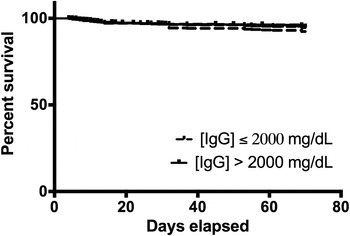
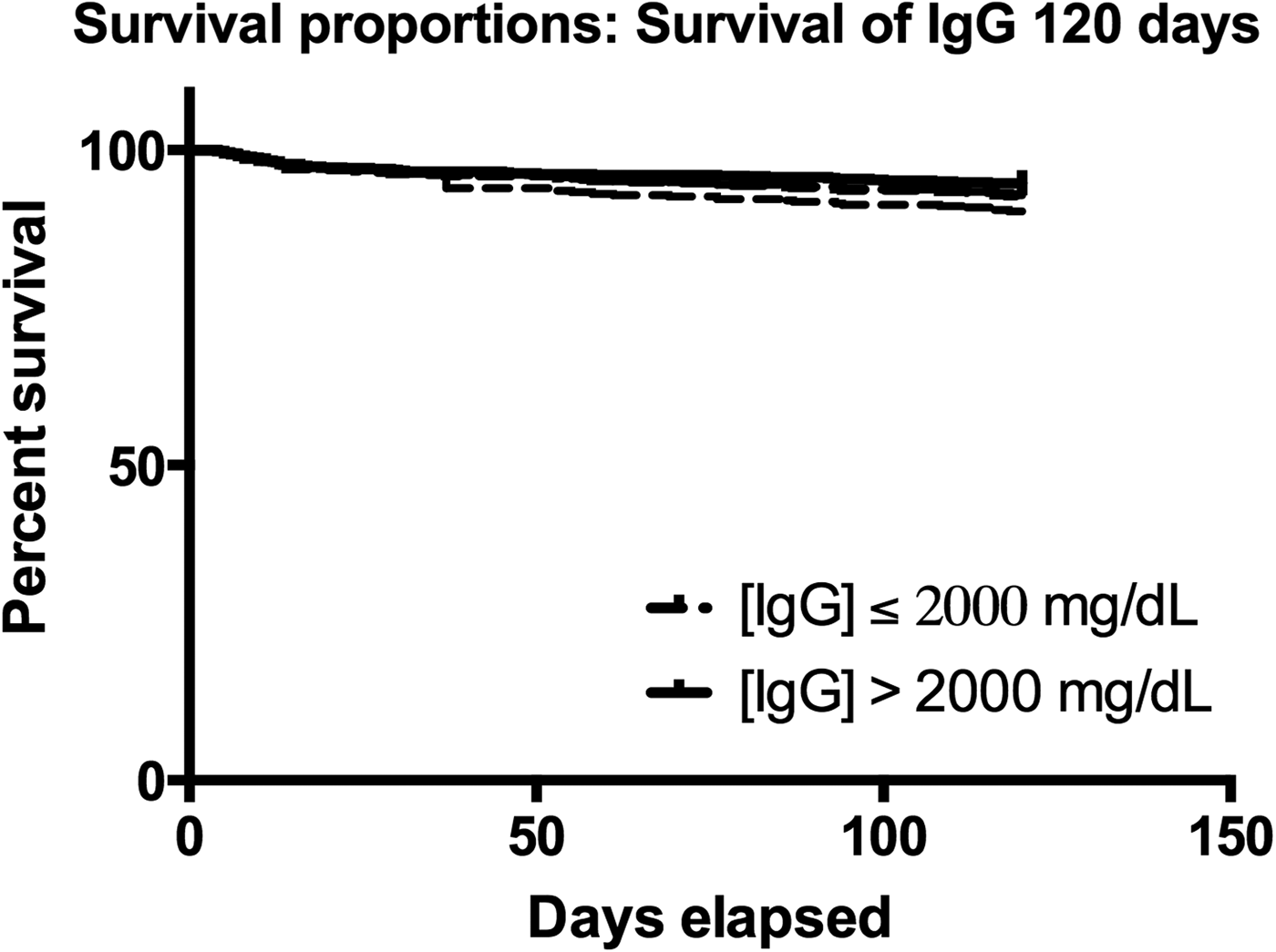
Serum strata of ≤1000, 1001–1500, 1501–2000 or >2500 were not significant predictors of mortality during the 120 d of rearing. Kaplan-Meier survival curves for the heifers at 70 and 120-d exit points are represented in Figs 1, 2, respectively. Serum IgG concentration was not a significant predictor of hazard for mortality at 70 d (hazard ratio = 1·05, 95% CI 0·64–1·71) or 120 d (hazard ratio = 1·38, 95% CI 0·88–2·17). The survival curves were not different at 70 d (P = 0·843) or 120 d (P = 0·165).
Kaplan-Meier curves for 1290 heifers depicting percentage survival of heifers at 70 d.

Kaplan-Meier curves for 1290 heifers depicting percentage survival of heifers at 120 d.

Discussion
The results of this study indicated that serum IgG concentrations of >2001–2500 mg/dl are optimum for indicating adequate passive transfer of colostral immunity in dairy heifers based on the LHR. A serum IgG concentration interval of 2001–2500 mg/dl favored absence of mortality (LHR < 1). Additionally when the serum stratum of ≤1500 mg/dl in the logistic regression, the stratum of 2001–2500 mg/dl was the only significant variable consistent with the results of the LHR determination. The findings in this study indicate that using the higher cut-off of 2001–2500 mg/dl is superior to the current recommended serum IgG concentration of ≥1000 mg/dl to indicate adequate transfer of colostral immunoglobulins on modern dairies. The results of this study differ from previous recommended endpoints for indicating adequate transfer of colostral immunity to prevent calf mortality from birth to weaning. Previous studies that recommended serum IgG concentrations of ≥1000 mg/dl (Besser et al. Reference Besser, Gay and Pritchett1991) and ≥1200 mg/dl (Robison et al. Reference Robison, Stott and DeNise1988) as optimum for health and performance in dairy calves were based on a single endpoint to indicate adequate transfer of colostral immunity. Additionally, other studies recommended an optimum serum IgG concentration endpoint of ≥1200 mg/dl based on risk for morbidity for respiratory disease only (Virtala et al. Reference Virtala, Grohn, Mechor and Erb1999). Furthermore, recent studies suggested a serum IgG concentration of ≥1000 mg/dl as the optimum endpoint for performance in dairy calves based on serum IgG concentration determined at 30–60 d of age, and only morbidity events in the group of calves were considered (Furman-Fratczak et al. Reference Furman-Fratczak, Rzasa and Stefaniak2011). In this study, the recommendations were based on mortality only and interval LHR. One possible explanation for the differences in recommended endpoints is that improvement of passive immune status will decrease calf mortality up to a threshold that approaches baseline mortality, and calves can still experience mortality due to environmental and or pathogen factors despite ingesting and absorbing sufficient colostral immunoglobulins. It is important to note that an increase in serum IgG concentration above the range of 2000–2500 mg/dl is unlikely to be of practical benefit because protection from morbidity and mortality achieved by adequate passive immunity plateaus at this IgG concentration. Thus beyond a certain IgG concentration level other factors, mainly environmental and pathogen factors are more likely to be attributed to morbidity and mortality.
Serum total protein concentrations of 5·8–6·2 g/dl indicated adequate transfer of passive colostral immunity in this study, which is higher than recommendations from previous studies of ≥5·2 g/dl (Tyler et al. Reference Tyler, Hancock, Wiksie, Holler, Gay and Gay1998; Priestly et al. Reference Priestly, Bittar, Ibarbia, Risco and Galvao2013; Windeyer et al. Reference Windeyer, Leslie, Gooden, Hodgins, Lissemore and LeBlanc2014). Serum total protein ranges of 5·8–6·2 favored absence of death in the heifers (LHR < 1). The correlation between sRID and TP test results in this study (0·62) was lower compared to previous studies, which reported a correlation of 0·72 (McBeath et al. Reference McBeath, Penhale and Logan1971) and 0·87 (Tyler et al. Reference Tyler, Hancock, Parish, Rea, Besser, Sanders and Wilson1996). The results of this study are consistent with previous studies, which indicated that serum TP concentrations of 5·7 g/dl were predictive of bovine respiratory disease in dairy calves (Windeyer et al. Reference Windeyer, Leslie, Gooden, Hodgins, Lissemore and LeBlanc2014). However studies by Windeyer et al. (Reference Windeyer, Leslie, Gooden, Hodgins, Lissemore and LeBlanc2014) also reported that serum TP concentrations of 5·2 g/dl was predictive of death prior to 5 weeks of age, which is consistent with other previous studies (Tyler et al. Reference Tyler, Hancock, Wiksie, Holler, Gay and Gay1998; Priestly et al. Reference Priestly, Bittar, Ibarbia, Risco and Galvao2013). Other studies indicated that heifer calves with serum TP < 5·0 were 2·4 times more likely to experience mortality compared to calves serum TP between 5·0 and 6·0 g/dl (McCorquodale et al. Reference McCorquodale, Sewalem, Miglior, Kelton, Robinson, Koeck and Leslie2013). Additionally, studies by McCorquodale and others reported that serum TP > 7·0 g/dl appeared to provide a protective effect against mortality. It is important to note that previous studies only evaluated serum TP concentrations to assess passive immunity while the serum IgG concentrations determination was performed in this study. Serum IgG concentration determination is considered the reference method for assessing passive transfer in calves because correlation between TP and serum IgG concentrations is significantly variable. The prevalence of mortality in the heifers enrolled in this study prior to weaning (4·5%) and after weaning (1·6%) is consistent with the national average, which indicated a pre-weaning mortality of 4·2% and a post weaning mortality of 1·6% (U.S. Department of Agriculture, 2012).
Various serum IgG concentrations included in the logistic regression were not significant predictors of mortality (Table 3). However it should be noted that only serum IgG concentrations was evaluated in the logistic regression. Other factors were not evaluated in this study, including medical treatment of sick heifers, environmental and pathogen factors that are important predictors of calf mortality. Results of the survival analysis showed no differences between times to occurrence of death in heifers with various serum IgG concentrations regardless of the exit point (70 or 120 d). One possible reason for this observation is that mortality was spread throughout the 70 or 120 d. Additionally, low exposure to pathogens and optimum management of heifers possibly reduced the incidence of mortality in heifers with lower serum IgG concentrations compared to higher serum IgG concentrations, which resulted in insignificant differences in mortality between the groups of heifers.
It is important to note the limitations of this study. Morbidity events were not considered due to inconsistencies in case definition determined by the herdsman. Thus the effect of treatment of sick heifers on mortality or interactions between serum IgG concentration and treatment was not evaluated. The study was performed on a heifer calf raising facility (calf ranch), and is likely to receive calves that have ingested sufficient colostrum. However the result of this study are applicable to conventional dairies with similar colostral management practices. Additionally the farm of study provided incentives that encouraged producers to deliver heifers likely to have ingested sufficient colostrum at the farms of origin. A calf ranch was chosen in this study in order to increase the variations in serum IgG or TP concentrations to allow stratification during sampling. Additionally, the study was performed on heifers from 48 farms; hence the recommendations may be most applicable to a limited geographical state in the country. Practically, serum IgG concentrations of 2001–2500 mg/dl in heifers at 2 d may not be achievable on calf raising facilities where colostrum management practices are insufficient. Thus, the recommendations to consider serum IgG concentrations of 2000–2500 mg/dl to indicate optimum transfer of colostral immunoglobulin transfer may be applicable only to farms with well implemented colostrum administration practices. Farms with insufficient colostrum feeding practices may choose to use lower cut off points for serum IgG concentrations (≥1000 mg/dl) or serum TP concentrations of ≥5·2 g/dl. Although the focus of this study was to determine TP and serum IgG concentrations, other variables that can affect mortality in the heifers including farm of origin, birth weight, weaning weight and breed were not evaluated because the information was confidential between the farms of origin and the farm of study.
In conclusion, the recommended serum IgG concentration indicating adequate transfer of passive colostral immunity as assessed by calf mortality in dairy heifers is serum IgG concentrations of 2000–2500 mg/dl or TP concentrations of 5·8–6·3 g/dl. It is anticipated that most modern dairies will be able to feed colostrum to achieve serum IgG concentrations of 2000–2500 mg/dl or TP concentrations of 5·8–6·3 g/dl based on the positive improvements made in colostral feeding practices in the dairy industry.
The authors would like to thank Peter Koch, Rosa Alvarado and Dr Craig Meadows for their technical assistance. The research was supported by USDA National Institute of Food and Agriculture (Formula Funds).