Adolescence is a significant stage in the development of personality and future character (Erikson, Reference Erikson1972). Recognizing individual strengths and weaknesses at this stage and studying them as a whole can contribute to the design of interventions that use strengths as protective factors against future difficulties (Ferragut, Blanca, & Ortiz-Tallo, Reference Ferragut, Blanca and Ortiz-Tallo2013). In this manner, positive psychology is based on the supposition that human goodness and excellence are as meaningful in the study of scientific psychology as disorders and discomfort (Seligman & Csikszentmihalyi, Reference Seligman and Csikszentmihalyi2000).
Within the context of positive psychology, individual character strengths have had researchers’ attention for many years, but have been treated in isolation, as unrelated variables (Linley et al., Reference Linley, Maltby, Wood, Joseph, Harrington, Peterson, Park and Seligman2007). However, Peterson and Seligman (Reference Peterson and Seligman2004) have focused on the study of character strengths and virtues, from the perspective that these variables can be understood as a collective entity that share key defining characteristics, and can be understood in relation to each other as part of a larger defining framework.
The authors of such research understand “good character” as a set of traits reflected in thoughts, feelings and behaviors. These virtues are positive personality traits, relatively stable over time but flexible, and considered universal. Peterson and Seligman (Reference Peterson and Seligman2004) describe six virtues that are wisdom, courage, humanity, justice, temperance, and transcendence. The concrete characteristics that are part of these virtues are called character strengths, and are defined as the identifiable psychological manifestations of these classical virtues that are widely studied by philosophers. The authors refer a total of 24 character strengths: appreciation of beauty, bravery, creativity, curiosity, fairness, forgiveness, gratitude, authenticity, hope, humor, persistence, open-mindedness, kindness, leadership, love, love of learning, modesty, prudence, self-regulation, social intelligence, religiousness, teamwork, perspective and zest. Within this theoretical framework, Park and Peterson (Reference Park and Peterson2006) have developed a method for evaluating these strengths in adolescents, the Values in Action for Youth (VIA-Y), from which scores are obtained for the 24 character strengths.
In studies using the VIA-Y with adolescents, gender differences have been detected for most of these strengths. Girls obtain the highest scores across various cultures and countries (Ferragut et al., Reference Ferragut, Blanca and Ortiz-Tallo2013; Giménez, Reference Giménez2009; Karris, Reference Karris2009; Park & Peterson, Reference Park, Peterson, Moore and Lippman2005, Reference Park and Peterson2006; Ruch, Weber, Park, & Peterson, Reference Ruch, Weber, Park and Peterson2014; Shimai, Otake, Park, Peterson, & Seligman, Reference Shimai, Otake, Park, Peterson and Seligman2006; Toner, Haslam, Robinson, & Williams, Reference Toner, Haslam, Robinson and Williams2012). Although the number of strengths that differ between males and females varies in each study, girls scored always significantly higher than boys on beauty, fairness, kindness, and perspective. On the other hand, in some of these studies it is found that boys do not score higher in any of the strengths (Ferragut et al., Reference Ferragut, Blanca and Ortiz-Tallo2013; Park & Peterson, Reference Park and Peterson2006; Ruch et al., Reference Ruch, Weber, Park and Peterson2014; Toner et al., Reference Toner, Haslam, Robinson and Williams2012). Most of the studies that included this gender differences are based on the perspective taken by Wood and Eagly (Reference Wood and Eagly2002), which consider that the origin of behavioral gender differences is based on various factors, including the developmental characteristics differences between men and women and social implications.
These character strengths have also been related to other variables that reflect beliefs and attitudes toward others and toward violence. For example, the strength of hope has been linked to the ability to confront prejudices (Wellman, Czopp, & Geers, Reference Wellman, Czopp and Geers2009). Other oriented strengths predicted less depression (Gillham et al., Reference Gillham, Adams-Deutsch, Werner, Reivich, Coulter-Heindl, Linkins, Winder and Seligman2011). The strengths of forgiveness, modesty, prudence and self-regulation have been related to quality in intimate couple relationships (Vohs, Finkenauer, & Baumeister, Reference Vohs, Finkenauer and Baumeister2011) and other studies show how some character strengths play a significant role in adolescent romantic relationships and life satisfaction (Weber & Ruch, Reference Weber and Ruch2012). Temperance strengths seem to be related with negative affect. Regulating one’s own feelings and behavior (self-regulation), thinking before executing actions (prudence), and completing what has begun (perseverance) help avoiding negative affect (Weber, Ruch, Littman-Ovadia, Lavy, & Gai, Reference Weber, Ruch, Littman-Ovadia, Lavy and Gai2013). Self-regulation has also been linked to the perpetration of gender violence in adolescents (Finkel, DeWall, Slotter, Oaten, & Foshee, Reference Finkel, DeWall, Slotter, Oaten and Foshee2009).
Recent studies specific to the stage of adolescence have reported a negative relationship between psychological virtues as a whole and sexist attitudes and beliefs toward women (Ferragut et al., Reference Ferragut, Blanca and Ortiz-Tallo2013). Other studies had previously investigated discriminatory behaviors and the perpetration of violence on this population (Carrión, Reference Carrión2010; Díaz-Aguado, Reference Díaz-Aguado2004), highlighting the importance of these variables for the prevention of violence in the adolescent stage.
Regarding these variables, Viniegra (Reference Viniegra2007) conducted a study using the Questionnaire on Attitudes toward Diversity and Violence (CADV, based on its initials in Spanish) and found that girls express less agreement with intolerant beliefs and the justification of violence in general compared with boys. Similarly, in research for the Spanish Institute for Women, Díaz-Aguado (Reference Díaz-Aguado2004) found that boys tend to justify violence the most. Girls, on the contrary, obtain higher scores from the perspective of the rejection of violence and sexist beliefs (Díaz-Aguado, Reference Díaz-Aguado2003).
These attitudes toward diversity and violence are also linked to sexism, one of the major associations sustaining gender inequality (Moya, Reference Moya, Barberá and Martínez-Benlloch2004). Sexism in adolescence has been studied as a precursor to sexist behaviors and domestic violence in adult life (De Lemus, Moya, & Glick, Reference De Lemus, Moya and Glick2010; Glick & Hilt, Reference Glick, Hilt, Eckes and Trautner2000). Glick and Fiske (Reference Glick and Fiske2011) identified two forms of sexism that exist simultaneously: hostile sexism, which refers to beliefs about women as an inferior group with negative stereotypes, and benevolent sexism, which identifies women as a weak group that should be protected by men. Significant gender differences have also been found in these variables for adolescents, finding that girls consistently obtain lower scores than boys with respect to hostile sexism (De Lemus, Castillo, Moya, Padilla, & Ryan, Reference De Lemus, Castillo, Moya, Padilla and Ryan2008; Ferragut, Ortiz-Tallo, & Blanca, Reference Ferragut, Ortiz-Tallo and Blanca2011; Garaigordobil & Aliri, Reference Garaigordobil and Aliri2011; Glick & Fiske, Reference Glick and Fiske2011; Rodríguez, Lameiras, Carrera, & Faílde, Reference Rodríguez, Lameiras, Carrera and Faílde2010). In the case of benevolent sexism, the scientific production has found different results, including cases finding a lack of differences (De Lemus et al., Reference De Lemus, Castillo, Moya, Padilla and Ryan2008) and cases in which girls score higher (Ferragut et al., Reference Ferragut, Ortiz-Tallo and Blanca2011) or boys obtain higher scores (Rodríguez et al., Reference Rodríguez, Lameiras, Carrera and Faílde2010).
Much of the research that has been conducted in the field of these variables has targeted the adult population. Because adolescence is a significant stage in the development of personality, beliefs and attitudes, it was deemed relevant to conduct in-depth research into these variables at this developmental stage.
Therefore, following a gender approach, this study aims at analyzing the profiles of boys and girls in the early stages of adolescence in the variables of character strengths, attitudes toward diversity and violence, and sexism. According to previous evidence described above, we expect girls will obtain higher scores than boys in character strengths (at least in appreciation of beauty, fairness, kindness, and perspective); whereas girls will get lower levels of attitudes toward violence and sexism, compared to boys. Finally, we also explore, since there is not previous empirical evidence, both whether there are differences in the scores of the variables in each set and whether profiles depend on gender.
Method
Participants
The participants in the study were 527 students in their first year of compulsory secondary education (257 boys and 270 girls), with a mean age of 12.21 and standard deviation of 0.53, from 27 classrooms in eight schools in the city of Málaga, Spain.
Family and demographic data for the participants indicate that 88% of the participants had siblings and that 76.1% had one or two siblings. Approximately 80.1% of the children were living with their original family, parents and siblings, 11% with their mother and siblings, and 5.2% with reconstituted families (that is, their parents had remarried). With regard to the country of origin, 89.2% were from Spain and 7.1% were from Latin American countries.
The inclusion criteria were that the participants needed 1) to be currently studying in the first year of compulsory secondary education and 2) to have completed the questionnaires correctly. The exclusion criteria included 1) not having correctly completed some part of the questionnaire, 2) having been specifically diagnosed by the school as having some type of psychological disorder, 3) being older than 14 and 4) not understanding Spanish or having difficulty expressing themselves in Spanish.
Instruments
Character strengths
The Values in Action for Youth questionnaire (VIA-Y) (Park & Peterson, Reference Park and Peterson2006) in its Spanish adaptation by Vázquez and Hervás (Reference Vázquez and Hervás2007) was used to evaluate the character strengths. The questionnaire has 198 items with Likert response options from 1 (very much unlike me) to 5 (very much like me), and it evaluates the following 24 character strengths which scores range from 1 to 5 points Footnote 1 : appreciation of beauty (α = .73), bravery (α = .61), creativity (α = .74), curiosity (α = .62), fairness (α = .66), forgiveness (α = .77), gratitude (α = .68), authenticity (α = .77), hope (α = .72), humor (α = .69), persistence (α = .78), open-mindedness (α = .65), kindness (α = .71), leadership (α = .69), love (α = .70), love of learning (α = .76), modesty (α = .60), prudence (α = .62), self-regulation (α = .70), social intelligence (α = .60), religiousness (α = .79), teamwork (α = .77), perspective (α = .67) and zest (α = .70).
Attitudes toward diversity and violence
The Questionnaire on Attitudes toward Diversity and Violence (CADV) (Díaz-Aguado & Martínez-Arias, Reference Díaz-Aguado and Martínez Arias2004) was administered to evaluate attitudes on diversity and violence. The CADV has 56 items scored with a Likert scale format with options ranging from 1 (completely disagree) to 7 (completely agree), and the questionnaire provides scores for four factors: Justification of peer violence as reaction and bravery, which refers to the attitude of justifying violence between peers as a show of one’s own value (e.g., “It is right to hit someone who has offended you”) (α = .85); Sexist beliefs and justification of domestic violence or attitude of justification of patriarchal domination, sex discrimination, child abuse and violence against women (e.g., “Women have to endure violence from their husbands or partners for the sake of the children, they should not denounce”) (α = .81); Intolerance and justification of violence as punishment against minorities, or attitudes favorable towards xenophobia, racism, rejection of diversity and justification of violence against minorities (e.g., “Immigrants cause increased crime and drug consumption”) (α = 0.78); and Agreement with tolerant beliefs and rejection of violence, which refers to the extent of rejection of violence and agreement with attitudes of tolerance (e.g., “The problem of violence against women within couples affects the whole of society”). Contrary to the other three factors, a high score reflects attitudes of tolerance (α = .50). Respective total scores were divided by the number of items to ensure that all factors would be using the same scale. Hence, final scores range from 1 to 7 points.
Sexism
Finally, the Ambivalent Sexism Inventory for Adolescents (ASI) (De Lemus et al., Reference De Lemus, Castillo, Moya, Padilla and Ryan2008) was administered. The inventory has 20 items with Likert response scores from 1 (completely disagree) to 6 (completely agree). This inventory obtained a Cronbach’s alpha of 0.84 for each type of sexism: (a) Hostile sexism or negative attitudes toward women (e.g., “Boys should control with who do their girlfriends go out”); and (b) Benevolent sexism or attitudes of protection toward women, who are stereotyped as weak and undervalued (e.g., “At night boys must accompany girls to their houses so that nothing wrong happens to them”). Scores in both factors were divided by 10 and thus range from 1 to 6 points.
Procedure
The researchers informed principals, superintendents and the parents’ association of the study’s objectives and procedures. The schools that accepted the invitation to participate in the research were responsible for obtaining parental authorization.
Data were collected during the first term of the 2010–2011 school year in two one-hour sessions and was approached as an anonymous and voluntary group activity within the school, completing the numbered tests in their respective classrooms during the class schedule.
Data analysis
Profile analysis (Tabachnick & Fidell, Reference Tabachnick and Fidell1989) was performed on each of the three sets of variables. Profile analysis is an application of the multivariate analysis of variance (MANOVA) in which the various dependent variables are measured on the same scale for different groups. The analysis shows a) whether there are differences between groups in the complete group of dependent variables, b) whether there are differences between the means of the dependent variables when considering both groups together, and c) whether the profiles of the two groups differ (interaction effect).
The variables were the 24 character strengths, the four factors of the CADV questionnaire on attitudes toward violence and the two types of sexism. Gender was the grouping factor.
A Student’s t-test for independent samples was also performed to compare the means between boys and girls for each of the variables, and the Bonferroni adjustment was used to control alpha for all contrasts.
Results
Character strengths
The sample in the analysis of strengths was reduced to 243 boys and 259 girls, corresponding to those who correctly completed the questionnaires with no missing values. The results showed gender differences in the entire group of strengths [F(1, 500) = 20.02, p < .001, η2 partial = .04], differences among the means of the strength scales [F(23, 478) = 83.01, p < .001, η2 partial = .80] and a significant interaction between both factors [F(23, 478) = 5.46, p < .001, η2 partial = .21], indicating different strength profiles for boys and girls.
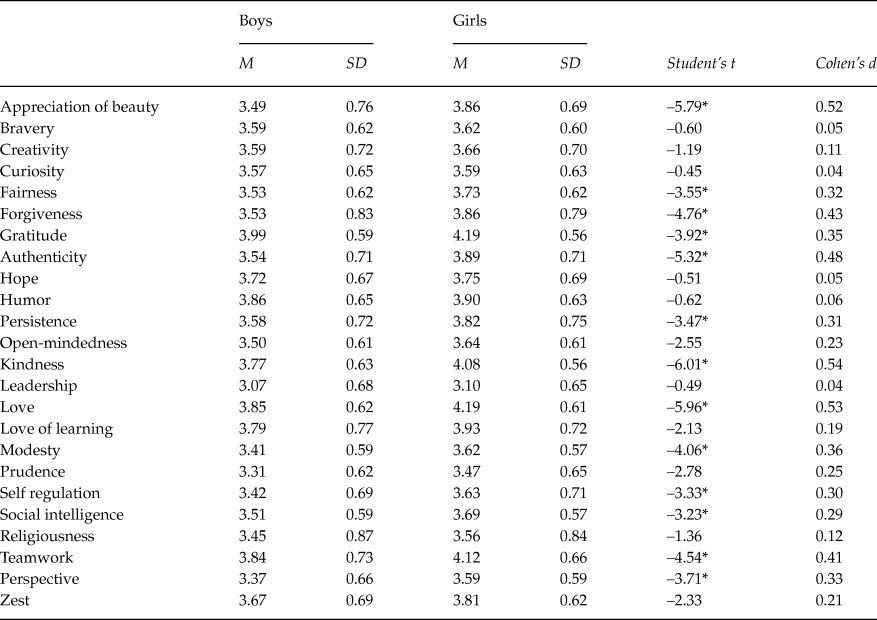
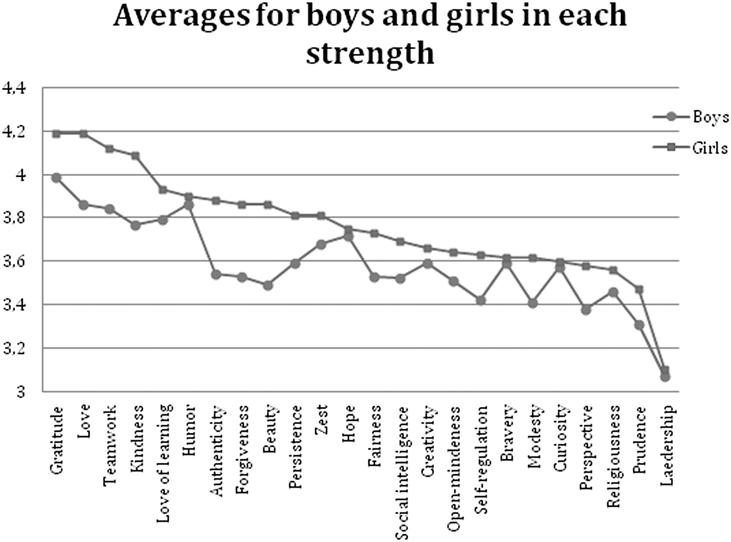
Because the interaction was significant, the subsequent analysis focused on gender differences in each of the strengths. Thus, a Student’s t-test for independent samples was conducted using an alpha of .0021 for each contrast. The results are presented in Table 1 and Figure 1, showing gender differences with respect to the appreciation of beauty, fairness, forgiveness, gratitude, authenticity, persistence, kindness, love, modesty, self-regulation, social intelligence, teamwork and perspective; in all of these strengths, girls consistently obtained higher scores than boys.
Means (M) and Standart Deviation (SD) for boys and girls in character strengths, Student’s t and Cohen’s d

* p < .0021 (Bonferroni adjustment); n boys = 243; n girls = 259.
Means for boys and girls in character strengths.

In the girls’ group, the highest scoring strengths are gratitude, love, teamwork and kindness, whereas the boys scored highest in gratitude, love, teamwork and humor. The lowest scores for both groups were obtained for prudence and leadership.
Attitudes toward diversity and violence
Data for the complete sample (270 girls and 257 boys), with no missing values, were used in the analysis of attitudes toward diversity and violence. The results showed gender differences in the entire group of variables [F(1, 525) = 64.50, p = < .001, η2 partial = .11], differences between mean attitudes toward violence [F(3, 523) = 466.33, p < .001, η2 partial = .73] and a significant interaction effect [F(3, 523) = 12.39, p < .001, η2 partial = .07], indicating differences between the profiles for boys and girls.
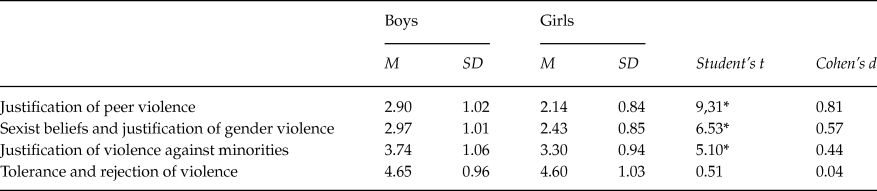
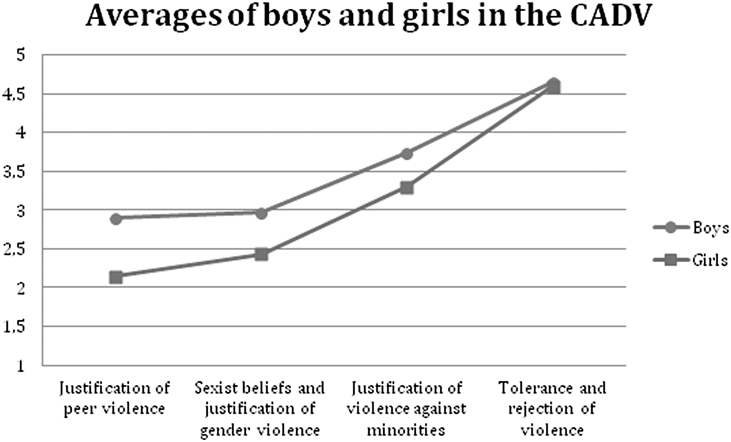
Given that the interaction was significant, the subsequent analysis focused on gender differences in each of the attitudes toward violence using Student’s t-test for independent samples with an alpha of .0125 for each (Table 2 and Figure 2) contrast.
Means (M) and Standard Deviation (SD) for boys and girls in the four factors of the CADV, Student’s t and Cohen’s d

* p < .0125 (Bonferroni adjustment); n boys = 257; n girls = 270.
Means for boys and girls in attitudes toward diversity and violence (CADV).

The results showed gender differences in the justification of peer violence, sexist beliefs and the justification of gender violence, and the justification of violence against minorities. No differences for tolerance and the rejection of violence were found. In turn, lower scores were found in both sexes in the justification of peer violence and in sexist beliefs and justification of violence and gender violence, followed by low scores for the justification of violence against minorities and, finally, for the tolerance and rejection of violence.
Sexism
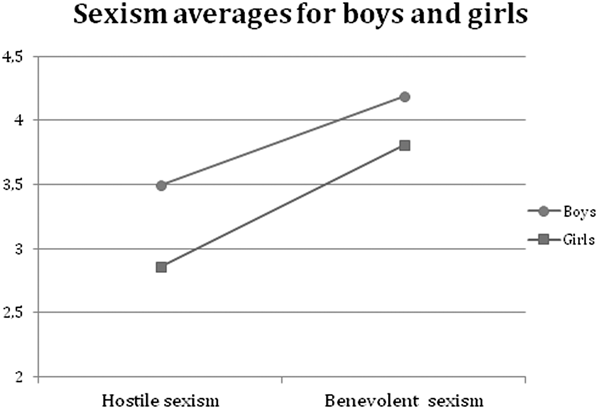
For the analysis of sexism, the sample included 253 boys and 265 girls who completed the questionnaires with no missing values. The results showed gender differences in the entire group of sexism variables [F(1, 516) = 37.15, p < .001, η2 partial = .07], differences between the means of the two variables [F(1, 516) = 433.79, p < .001, η2 partial = .46] and significant interaction effects [F(1, 516) = 9.72, p < .001, η2 partial = .02], indicating that the sexism profiles differ by gender. The Student’s t-test with an alpha of .025 for each contrast showed that boys obtained higher scores than girls in terms of both hostile and benevolent sexism. In turn, the scores for benevolent sexism were higher than those for hostile sexism in both (Table 3 and Figure 3) sexes.
Means (M) and Standard Deviation (SD) for boys and girls in the two types of sexism on the ASI, Student’s t and Cohen’s d

* p < .025 (Bonferroni adjustment); n boys = 253; n girls = 265.
Sexism means for boys and girls (ISA).

Discussion
The objective of this paper was to analyze the profiles of boys and girls in an early stage of adolescence according to the variables of character strengths, attitudes toward diversity and violence, and sexism. The study explores whether the differences encountered in adults and adolescents are evident from this early developmental stage, whether the variables of each group differ among one another and whether these differences are maintained in equal profiles for both sexes. Thus, an analysis of profiles was performed for each of the three groups of variables. We discuss the hypothesis for each one of the set variables.
Character strengths
It was expected from girls to obtain higher scores in character strengths (at least in appreciation of beauty, fairness, kindness, and perspective). The results in this group of variables confirm this hypothesis, showing gender differences in 13 of the 24 strengths: appreciation of beauty, fairness, forgiveness, gratitude, authenticity, persistence, kindness, love, modesty, self-regulation, social intelligence, teamwork and perspective. In all of these variables, the girls’ scores were invariably higher, a result confirming the findings that have been obtained in prior research on adolescents. Although the number of strengths in which these differences are detected vary from one study to another, differences are consistently found in the strengths of fairness, kindness and perspective in different countries, like Spain (Ferragut et al., Reference Ferragut, Blanca and Ortiz-Tallo2013; Giménez, Reference Giménez2009), the United States (Karris, Reference Karris2009; Park & Peterson, Reference Park, Peterson, Moore and Lippman2005, Reference Park and Peterson2006), Japan (Shimai et al., Reference Shimai, Otake, Park, Peterson and Seligman2006) and Germany (Ruch et al., Reference Ruch, Weber, Park and Peterson2014). These results clearly show that from early adolescence, women show higher levels in the strengths related to others, including those oriented toward principles of fairness, helping others and making sense of their own lives and those of others. These findings are consistent with studies in which higher levels of empathy are found in girls (Mestre, Samper, & Frías, Reference Mestre, Samper and Frías2002), who reported greater best friend intimate support (Jenkins, Goodness, & Buhrmester, Reference Jenkins, Goodness and Buhrmester2002) as well as values linked to interpersonal relationships (Casas et al., Reference Casas, Buxarrais, Figuer, Goncález-Carrasco, Tey, Noguera and Rodríguez2005). Most of the studies that have included this gender differences are based on the perspective taken by Wood and Eagly (Reference Wood and Eagly2002). These authors consider that the origin of behavioral differences between women and men lie in various factors, including the developmental characteristics differences between men and women and social implications.
It should be noted that the mean scores for the strengths were never below three points (on a scale of five) in this population, which is consistent with previous studies in the Spanish population (Giménez, Reference Giménez2009) and with initial findings in North American research (Park & Peterson, Reference Park, Peterson, Moore and Lippman2005, Reference Park and Peterson2006) or other countries like Germany (Ruch et al., Reference Ruch, Weber, Park and Peterson2014). The finding that the strengths of gratitude and love are always among the five highest means is common to all studies from all countries. These strengths are related to maintaining intimate and stable relationships with others and are of great importance among peers at this stage and to one’s well-being and family relationships (Froh, Yurkewizc, & Kashdan, Reference Froh, Yurkewicz and Kashdan2009; Giménez, Reference Giménez2009; Park & Peterson, Reference Park, Peterson, Moore and Lippman2005).
Although the profiles of both genders contrast with one another in the various strengths, they do coincide in the strengths obtaining the lowest means, which are prudence and leadership, both of which are related to caution when taking action and the ability to make decisions and keep a group united. Although these means are not low, these strengths are obviously less developed at this age in both sexes compared with the other strengths.
Attitudes toward diversity and violence
For this set of variables, girls were expected to obtain lower levels of attitudes toward violence, and the results, again, confirm this hypothesis. Gender differences were found in three of the four factors of this group of variables, that is, the three factors pertaining to the justification of violence. Boys tend to agree with justifying violence, whether in peer violence, domestic violence or violence against minorities. Beliefs justifying peer violence do obtain a greater difference with a high-magnitude effect. Other authors have identified this same tendency in which boys show greater agreement with beliefs that justify violence than girls, therefore showing increased risk of perpetrating violence or of being aggressors (Díaz-Aguado, Martínez-Arias, & Martín-Seaone, Reference Díaz-Aguado, Martínez Arias and Martín Seaone2004; Viniegra, Reference Viniegra2007). These results continue to support the recurring evidence in research that men use violence to a greater extent than women, and this finding can be observed in varying spheres and ages, including the academic context (Carlson & Grant, Reference Carlson and Grant2008; Defensor del Pueblo, 2000; Sarandoglio et al., Reference Sandroglio, Martínez, Martín, López, Martín, San José and Martín2002) and this result can be found in other nationalities (Bhatt et al., Reference Bhatt, Tweed, Dooley, Viljoen, Douglas, Gagnon and Besla2012; Foshee, Linder, MacDougall, & Bangdiwala, Reference Foshee, Linder, MacDougall and Bangdiwala2001).
In interpreting the CADV, it is essential to recall that the first three factors are oriented negatively, such that higher scores indicate greater tendencies to justify violence. In contrast, the fourth factor is oriented positively; hence, higher scores indicate greater tolerance. For the sake of comparison, let us focus on the factors evaluating beliefs justifying violence. Although the profiles for the sexes differ, boys and girls have in common that the factor with the highest scores is that of the justification of violence against minorities (both above 3 points in a scale over 7), followed by sexist beliefs and the justification of gender violence and, finally, the justification of peer violence. Thus, both boys and girls show greater agreement with attitudes of xenophobia, racism, rejection of diversity and justification of violence against minorities, whereas the attitude of justification of peer violence as a demonstration of one’s bravery is the factor in which adolescents show the least agreement. In other research, comparisons between these factors are not made because the factor scales differ from one another and because corrections have not been made for comparisons as in the present study.
Sexism
Finally, in the area of sexism, girls were expected to obtain lower levels of sexism, and again this hypothesis is confirmed. Boys obtain significantly higher scores than girls both in hostile sexism and in benevolent sexism. In hostile sexism, systematic gender differences have been found in various studies of adolescent populations (De Lemus et al., Reference De Lemus, Castillo, Moya, Padilla and Ryan2008; Ferragut et al., Reference Ferragut, Blanca and Ortiz-Tallo2013; Glick & Fiske, Reference Glick and Fiske1996), and although contradictory results have been collected for benevolent sexism, other related research is consistent with the present study in that boys also exhibit higher levels of this type of sexism (Ferragut et al., Reference Ferragut, Blanca and Ortiz-Tallo2013; Glick & Fiske, Reference Glick and Fiske2011). Thus, girls always exhibit less sexist attitudes, whether relative to the most explicit sexism, which considers women inferior, or to the type of sexism that stereotypes women as needing protection.
The only score below 3 points on a 6-point scale is those of the girls with respect to hostile sexism; the values are medium-high. As in other related research, the scores for benevolent sexism are higher than those for hostile sexism in both sexes (Lameiras, Rodriguez, & Sotelo, Reference Lameiras, Rodríguez and Sotelo2001), which indicates that there is greater agreement on attitudes of protection toward women than for the more explicit type of sexism.
The work presented here describes a large population in these three groups of variables that have never been studied jointly before. It is focused on adolescents and it provides their profiles results taking into account gender differences. In sum, the results of the present study indicate that boys and girls differ in their character strengths, particularly girls present greater strengths related to pro-social behavior and peer relationships. Moreover, boys justify attitudes of violence to a greater extent and show greater agreement with sexist beliefs.
The causes of these gender differences have been studied by Wood and Eagly (Reference Wood and Eagly2002) and can be traced to human evolutionary history, especially the ways that both biology and environments influence the division of labor. These authors have studied how in every human culture or society, there is a division of tasks so that men do some things in society and women do others. These specific activities in a society depend on what tasks can be performed most efficiently by each sex, given men's greater size, physical strength and speed, and women's bearing and nursing children. For example, given that women perform more childcare than men in most industrialized societies, women are believed to be especially nurturing and caring, and they would improve social characteristics like character strengths directed to others, according to this theory (Wood & Eagly, Reference Wood and Eagly2002).
The main objective here is to supply a wide description of the actual state in the variables evaluated, which is necessary as a first step before further analysis. The research suggests that it would be of interest to encourage development in character strengths at this age. Intervention could be approached as essential in preventing certain attitudes towards violence and sexism, particularly in boys, and in addressing equality and preventing violence from adolescence onward.
This study has some limitations. First, data is from Spanish population and it would be interesting to continue evaluating these variables in other countries, increasing the sample comparing the results to test if they are generalized. Also, it is important to notice that this is a first study from a longest and longitudinal research. Although much more analysis could be made, these results reflect the profile and situation of a wide sample of secondary students, evaluating three different measures. For future researches, more variables should be taken into account like well-being or quality of life, which have demonstrated their implication in psychological and physical adolescence`s health (Zullig, Valois, Huebner, & Drane, Reference Zullig, Valois, Huebner and Drane2005).
Youth is a formative period for cultivating a sense of purpose, and the value of purpose to the self continues well beyond the adolescent period, indeed, throughout the rest of the life-span (Damon, Menon, & Bronk, Reference Damon, Menon and Bronk2003). The authors would like to emphasize the importance of promoting research and prevention programs that account for the variables examined here. With this intention, Giménez, Vázquez, and Hervás (Reference Giménez, Vázquez and Hervás2010) conducted a theoretical review emphasizing the need to conduct scientific research based on the common framework of character strengths and to relate these strengths to other variables. This is the main aim of this study and it may be an important step for beginning to understand what is the situation of Spanish adolescent, how they feel about their character strengths and their attitudes against violence and sexism.