Commonly heard in the study of politics in America is an exhortation for theoretical perspectives that go “beyond black and white,” ones that consider the multiracial and multiethnic realities of the United States. In some paradigms of political science, the exhortation continues to echo. Deracialization, a widely-discussed theory of election campaigns involving minority candidates, is one example.Footnote 1 Yet as Latino and Asian American populations grow and challenge established whites and African Americans in areas like Los Angeles, Miami, Oakland, Denver, and Jersey City, we are beginning to see the limits of the deracialization concept and question its utility.Footnote 2 Asian American candidates are a particularly curious test of deracialization, given their likelihood to emerge successful in constituencies that are predominantly non-Asian.Footnote 3 This compels us to explore ways in which a theory can be developed to account for candidates, voters, and campaign dynamics that in many areas are becoming increasingly diverse and multipolar.Footnote 4
In this article, I challenge the future application of deracialization—and suggest an alternative way to think about race and ethnicity in the electoral process and how minority candidates avoid—and use—it to their strategic advantage. I call it toggling. As minority candidates are often linguistically and socially adept in multiple cultures, I develop the idea to explain how and why politicians try to balance the need for racial and ethnic solidarity with the pragmatic need for out-group votes. I use the case of Vietnamese American candidates for local and state office in Orange and Santa Clara counties, California, to illuminate the toggling strategy. I conclude with a consideration of the impact of toggling on equality in the democratic process—and suggest some avenues for future research.
The Boundaries of Deracialization in Contemporary Electoral Milieus
What Is Deracialization?
It was the seeming paradox of Black Tuesday in 1989, when African American candidates won historic mayoralties in Seattle, Cleveland, and New York—as well as Douglas Wilder's victory in the Virginia gubernatorial race—that precipitated the discussion of deracialization in urban elections. In Dilemmas of Black Politics, the first volume devoted to the idea, Georgia Persons asked, “Is it or is it not black politics?” suggesting both the possibilities and controversy behind the apparently “new” concept.Footnote 5 McCormick and Jones note that, although the electoral manifestation (and apparent success) of deracialization may be a 1980s and 1990s phenomenon, the idea itself is rooted in the post-civil rights reconsideration of protest and poverty by African Americans, from the work of Charles V. Hamilton to William Julius Wilson.Footnote 6
Separating the electoral strategy from its twin, the agenda-setting (or governing) strategy, McCormick and Jones' definition has since become the oft-cited theoretical basis of deracialization:
conducting a campaign in a stylistic fashion that defuses the polarizing effects of race by avoiding explicit references to race-specific issues, while at the same time emphasizing those issues that are perceived as racially transcendent, thus mobilizing a broad segment of the electorate for purposes of capturing or maintaining public office.Footnote 7
Deracialization, thus, is seen as operating on three different dimensions of campaign politics. Foremost is the electoral context. McCormick and Jones say deracialization is a strategy that occurs in a polarized environment—understood by scholars since Gingles as one where different racial or ethnic groups vote en bloc for different candidates over a pattern of elections.Footnote 8 Exactly what level of solidarity constitutes a bloc, and how long bloc voting must persist, remains open to interpretation.Footnote 9 Nonetheless, deracialization is, to borrow from the Downsian lexicon, a median voter strategy—one compelled by a situation of bipolarity and the desire to capture sufficient votes in such a climate to win. It may be more precise to add the qualifier “perceived” to bipolarity, since it is the candidate's perception of his constituency—and the votes he and his campaign thinks he can secure—that may determine the appearance of a deracialized strategy.
The second dimension relates to issues. A deracialized platform, contend McCormick and Jones, is one that avoids issues like affirmative action and favors those thought to cut across multiple groups, reaching toward a “mainstream” majority. What does a deracializing candidate favor? There is no simple answer, a problem that I shall discuss in further detail. But using the variety of case studies on African American candidate behavior,Footnote 10 we can summarize a deracialized platform as focusing on quality of life, even postmaterialist, issues:
• abortion, both pro and anti (e.g., L. Douglas Wilder, David Dinkins, Gary Franks, Troy Carter)
• “Law and Order”/”Tough on Crime”/”War on Drugs” (e.g., Wilder, Dinkins, Norman Rice, John Daniels)
• economic growth (“pro-growth”), jobs and low taxes (e.g., Andrew Young, Tom Bradley, Wellington Webb, Kurt Schmoke)
• education (e.g., Carter, Rice)
• competence, accountability and access in government (e.g., Rice)
• emphasis on personal qualities as healer and uniter and bridge-builder/“A candidate for all the people” (multiple examples)Footnote 11
The last dimension concerns candidate behavior and communications. To “mobilize a broad segment” of the electorate, McCormick and Jones argue, deracializing candidates adopt an image that is “nonthreatening,” and move from the “fiery controversial political style that tended to characterize many of the first wave of black politicians.”Footnote 12 George Forbes in Cleveland might represent the “old” confrontational style, where charges of white racism and group solidarity were continually manifest; Carl Stokes, in turn, might represent the “new,” tempered style, conscious of the white backlash. There is something more. Candidates pursuing a deracialized strategy may also communicate images and messages that emphasize independence from their racial or ethnic group, as Stokes did himself when he resisted publicity of black voter registration drives conducted on his behalf by Martin Luther King, the Southern Christian Leadership Council, and the Committee for Racial Equality.Footnote 13 Similarly, Davis and Willingham note how Andrew Young used a well-covered speech to “release” the Georgia Legislative Black Caucus “from any obligation to support him in the [1990 gubernatorial] election.” Completing the image of detachment, Young put white males at the head of his campaign organization.Footnote 14
Limitations of the Idea and Some Unanswered Questions
Widely-discussed and influential, deracialization has not been without critics. Where some have viewed it as simply the work of practical, “mature” black politicians, others have focused on the implications of deracialization, questioning whether the strategy means the abandonment of mobilization.Footnote 15 Smith eloquently wonders if deracialization renders the black candidate himself “a shell … more like a Prince or Michael Jackson than a B.B. King or a Bobby Bland.”Footnote 16 I wish, however, to leave the pragmatism-versus-purity debate aside, a controversy rooted in the still poorly-understood relationship between campaigns and policymaking, as well as the persistent debate over whether social-democratic or neo-liberal policies are the better approach to persistent racial inequalities. Rather, my goal is akin to Starks': to focus instead on the many questions the deracialization literature leaves unanswered.Footnote 17 But where Starks, like Smith, is ultimately concerned with the structure and status of group power, my objective is to begin a search for an alternative framework for understanding and generalizing minority campaigns and candidate behavior, particularly in the midst of a transformation that is producing urban political milieus that are becoming notably different from those in which deracialization-as-electoral-strategy was conceived. Bipolarity may have been a predominant electoral context as recently as 20 years ago as the Voting Rights Act began to bear fruit, but a variety of evidence points toward change and the emergence of metropolitan electorates that are more diverse and less clearly defined.Footnote 18
One problem from which deracialization theory suffers is the difficulty scholars have had in identifying and delimiting the phenomenon. The avoidance side of the McCormick/Jones equation is more empirically discernable; a minority candidate can simply evade the subject of race altogether or not reveal a clear position on a policy such as affirmative action. But problems arise when we try to develop a consistent set of issues that constitute either a racial or “racially transcendent” platform. Is Dinkins, to take but one example, a deracializing candidate when he opts to discuss crime over poverty? Would a discussion about economic growth and jobs, when unemployment in a city falls disproportionately on one group, fit on a racialized or deracialized plank? What about when racial harmony itself becomes a campaign issue, as it did in the 1989 New York mayor's race? Henderson addresses the problem, suggesting a left-right continuum where the appearance of race in a campaign ranges from “nonracial” to “hyperracial.”Footnote 19 A similar effort is made by Albritton and his colleagues, who distinguish between “race-specific,” “modified race-specific,” “race-neutral,” and “extremely race neutral” campaigns. But in the end such typological efforts, while interesting, can do little to expand deracialization theory since the theory itself has never adequately addressed the seminal question: what is “race” in the context of an election campaign?
Deracialization suffers from a second problem: accounting for the dynamics that are fundamental to campaign politics. It not only assumes that candidates perceive their constituency to be racially polarized, but assumes that candidates wish to mitigate racial and ethnic bloc voting through moderated campaign communications. It assumes further that candidate perceptions—and hence, their strategies—are fixed during the course of a campaign. How can it then account for the candidate who, like Harold Washington in 1983, begins with a strategy “to campaign in the entire city,” but then is
forced to modify it when it became clear that he would not attract much white and Latino support. In order to motivate more blacks to register and go to the polls, Washington increasingly began to present himself as a symbol of black pride and progress?Footnote 20
Insofar as campaigns are fluid exercises in democratic competition, where candidate/party positions, issues, and public opinion change over time,Footnote 21 it seems, in the end, difficult to label any strategy as either “deracialized,” “nonracial,” “race-neutral,” whatever. In some cases, deracialization may be a determined approach from the outset of a campaign, rooted in the innate beliefs and personality of the candidate. But it is just as realistic to think of deracialization as merely one part of a multifaceted effort to attain office, a variable that will depend on the competitive context in which the candidate finds him or herself at any given time during the campaign. Depending on the electoral rules governing party primaries, runoffs, and the like, it seems quite plausible for a candidate to employ deracialized and racialized strategies in the same electoral quest.
This gives rise to a third factor. Several case studies, including some in the deracialization literature itself, find deracialization and group mobilization moving in simultaneity, forming the pillars of a dialectical strategy to build a majority or plurality (usually “liberal”) coalition.Footnote 22 Some, for example, have labeled Wilder as “extremely race-neutral,” but others note nonetheless how the candidate won between 76 and 99 percent of the vote in predominantly black Virginia precincts.Footnote 23 Summers and Klinkner present similar data in New Haven's black precincts for Daniels during his 1989 campaign; Thompson shows New York's black voters overwhelmingly supporting Dinkins.Footnote 24 We can see this simultaneity in the precursors to Black Tuesday as well. In Carl Stokes' 1967 campaign, Ardrey describes “a ‘dual strategy’ campaign (one for the black community and quite another for the white ward(s) to address the [candidate's] shortcomings…
The strategy in the black community was to capitalize on the growing sense of racial pride … selling ‘blackness' and support for a brother became the key to guaranteeing a high turnout … the objectives and tasks in the white neighborhoods … were a bit more complicated… Basically, Stokes’ theme was one of assurance: assurance that he would be a mayor for all the people and that he was the only man who could resolve major conflicts facing the city.Footnote 25
A key element in the strategy was the involvement of the Cleveland Call and Post, at the time the most prominent black newspaper in Ohio. The Call and Post, notes Jones Ross, “followed Stokes' campaign from the time he solicited the required signatures for candidacy to victory” and published editorials, sometimes on the front pages, that exhorted African American voters to “exercise their voting power.” After Stokes won the primary, an editorial “congratulated Black Clevelanders for showing unity,” but the paper continued to remind “readers not to miss the big opportunity to make history in the general election.”Footnote 26
Sonenshein notes how Tom Bradley, in his first successful run for mayor of Los Angeles in 1973, adopted a similar approach. He
utilized a two-track campaign, involving mass mobilization of the black community and a city-wide, media-based appeal that targeted liberal and moderate non-Black voters.Footnote 27
Bradley, like Stokes, won—in large part because the “two track strategy had worked. The quiet mobilization of the Black community, conducted without citywide media coverage, had not generated a white countermobilization.”Footnote 28
Deracialization then can be thought of, in a most general sense, as an effort at minimizing perceived political risk through the control of campaign communications. Perhaps it comes as little surprise then that the reduction-of-race strategy should often be observed, as McCormick and Jones suggest, in higher-level, more expensive elections, for it is in such races that the competitive context intensifies and the socioeconomic profile of the median voter is likely to change. Moreover, the consequences of defeat become larger for one's party as well as one's career.Footnote 29 As much is suggested with their ambition hypothesis: the idea that deracialization stems from a candidate's desire to win rather than make a protest statement.Footnote 30 But where Starks argues that deracialization has been manifest throughout black political history, it is worth noting that the electoral phenomenon attracted attention in an era where campaigns became increasingly professionalized and candidate-centered.Footnote 31 Thought of in the broader American context, deracialization, if it indeed represents a turn in minority politics, may be as much the product of polls and focus groups—as well as the need to pay consultants to use and interpret such tools—as it is a shift in the philosophy or policy views of African American elites. A system that not only requires candidates to possess vast sums of money, but severely restricts party alternatives may also have a hand, as well as the homogenizing machinations within parties that compel the selection of candidates most capable of winning over those who most forcefully project the party's ideology.
Deracialization anticipates that the response of white candidates will be to bait their non-white opponents into a discussion of race—Jesse Helms' response to Harvey Gantt in the 1990 Senate race in North Carolina being the prototype. What happens when a white candidate takes the “high road,” or when the challenger is not black? Starks puts it this way: “The particularity of this construct is highlighted by the fact that it can only be applied to black candidates.”Footnote 32 This leaves us with ongoing difficulty in making generalizable claims, across elections, competitive contexts, candidates of diverse racial and ethnic origins. In the case of Latinos, deracialization has been hypothesized to have an impact on electoral outcomes; the results have been inconsistent. Underwood, for example, finds that four successful Latino council candidates in Los Angeles used elements of a deracialization strategy, but that explicit Latino mobilization—including an absentee ballot campaign run by professional consultants—was the key to their success.Footnote 33 Federico Peña's successful campaign in 1982 to become the first Latino mayor of Denver was attributed, in part, to its broad emphasis on “‘leadership’, ‘vision’ and [portraying] ‘Denver as an open city’”,Footnote 34 but Wright-Austin and Middleton find the same strategy as being a detriment to Antonio Villaraigosa in his first 2001 mayoral campaign in LA.Footnote 35 The Latino share of the population in Denver in 1982 was 18 percent; in LA in 2000 it was 46 percent.
Asian Americans: Does Deracialization Fit?
Though the two have rarely appeared together in the literature, deracialization would appear, at first glance, to fit well within Asian American politics. Because much of their mainland electoral success has been in predominantly white or multicultural constituencies,Footnote 36 scholars have speculated that Asian American politicians possess “crossover ability” that “[challenges] traditional notions of racial and ethnic cleavages that were part of multiracial coalitions in the late twentieth century.”Footnote 37 Pragmatists suggest they have little choice, due to the small size and dispersion of the population. “Given the demographic composition of their districts,” Espiritu writes, “it would be political suicide for Asian American candidates to pursue solely Asian American votes.”Footnote 38 While Asian American political behavior is said to “weakly mimic” whites,Footnote 39 Saito underscores that Asian American—like black and Latino—candidates nonetheless remain concerned about backlash and polarization. In the context of the suburban Chinatown in Monterey Park, California, he notes that “ethnic candidates … must be careful about the issues they advocate” as they “might alienate white constituents.”Footnote 40 Wang is more blunt. “African American candidates [can] openly and forcefully speak of representing black interests,” he writes. But “Asian American candidates must go out of their way to prove to the voters that … they represent no Asian American interest… Denying one's ethnicity is a precondition for gaining legitimacy and acceptance by white voters and winning elections”Footnote 41 Along with district configurations and competitive contexts that are inclined to pit them against whites, aspiring Asian American politicians, in a larger sense, face the chronic perception of “foreignness.”Footnote 42 As first or second generation immigrants, they face a triangulated position as racially subordinate and as perpetual outsiders.Footnote 43
Case studies of Asian American campaigns remain few, rendering the literature scant. Given such limitations, we might reasonably hypothesize that Asian American electoral success would be predicated heavily on deracialization. But a closer look at Gary Locke's successful campaign for governor of Washington—the first Asian American to win an executive position in a mainland state—challenges this line of thinking.
Judy Yu and Grace Yuan, who worked as consultants on the successful 1996 effort, describe the candidate's overall approach as having
concentrated on appealing to the values of the moderate and middle-class voter. In addition to his “tough on crime” and “high on education” messages, Locke's personal story of achieving the “American Dream” was promoted, both with Washington voters and with the Asian American community.Footnote 44
Locke is a third-generation Chinese American who Anglicized his surname from the Cantonese/Mandarin-pronounced Lok. Footnote 45 Yet at the same time he incorporated his immigrant heritage into a “mainstream/unity” campaign—the Asian American population in Washington at that time was 4 percent—Yu and Yuan note that for fundraising and volunteer support
Locke relied on community networks, Asian American organizations and Chinese family associations. His campaign worked with local Asian American communities around the country to connect with their leadership and their personal contacts. Many supported Locke out of a sense of ethnic pride; others out of a sense of duty.Footnote 46
In such contexts, Locke
clearly appealed to the Asian American community with his good looks and serious demeanor, and his speeches articulated his desire to bring more Asian Americans “to the table where decisions are made.” He promised to advocate issues such as welfare reform and affirmative action. He also paid a great deal of respect to his wife … and to his parents …Footnote 47
It is unclear whether the Locke campaign perceived polarization in the Washington electorate or anticipated a white backlash. A study of his mainstream newspaper coverage concludes that little attention was paid to race in his campaign, but that “it seems like the model minority stereotype guided reporters' description of Locke.”Footnote 48 Yu and Yuan contend that being seen as “hard-working, family-oriented, strongly supportive of education and possessing fiscal management skills … proved to be an advantage to Locke because it placed him solidly in line with middle-class values.”Footnote 49 Thus Locke, in a classic deracialization scenario, actively reinforced the model-minority myth in appealing to the “mainstream”. Yet, at the same time, like Stokes and Bradley he “quietly” evoked group interests to mobilize his core Asian American constituency.
In its exclusive focus on the “mainstream” message, the discussion of deracialization fails to recognize how, for a challenger or first time candidate like Locke, a failure to “maintain the base” can have consequences for minority candidates. McCormick and Jones note how
within the African American community there has been a relatively low level of mass trust in the leadership of this community and an ever present fear of a “sellout.” As such, some African Americans are worried about the consequences of a deracialized electoral strategy…Footnote 50
The same principle applies to any group in the minority. Wright-Austin and Middleton note how Villaraigosa's deracialized strategy in 2001 failed, in part, “because he neglected his Latino base which led to Latino apathy and a low turnout.”Footnote 51 Ted Dang, a candidate for mayor of Oakland in 1994, had similar problems with Chinese and Asian Americans. After finding early success with an outsider campaign against incumbent Elihu Harris, Dang suffered when he got to the runoff. An aggressive, anti-politician style that had appealed initially to affluent white liberals was perceived as divisive by the city's majority-minority. As a result, he not only alienated African Americans, but failed to win key endorsements from Asian American elites and Chinatown business leaders.Footnote 52 Harris defeated him easily.
What becomes increasingly evident is that race and ethnicity are fundamental and irrepressible elements in the quest for office, regardless of whether the candidate is black, Latino, or Asian. Candidates may, as Wang contends, attempt to “deny their ethnicity” in an effort to attract crossover votes and, given their triangulated position in America's racial hierarchy, contestants of recent immigrant background may exaggerate their American-ness to blunt suggestions that they are outsiders. But this so-called mainstreaming does not constitute the totality of their strategy, nor does it consider the implicit, unspoken role race can play in the campaign environment—through images, statements, endorsements, even surnames on the ballot.Footnote 53 As we have seen, minority candidates may selectively advertise their race and employ group-oriented rhetoric, because group solidarity and mobilization is a vital strategic resource. At the same time, race and ethnicity often do not have to be directly engaged by candidates; they are tacit for those susceptible to the cue. This is particularly so in low-information elections.Footnote 54 The experience of Judy Chu, first a Monterey Park, California, councilwoman and then State Assemblywoman, is instructive. Saito explains how
Chu never had to make explicit ethnic or racial appeals to Chinese or other Asian Americans to capitalize on her ancestry. Her name, appearance and well-known history of community work made that obvious, and such appeals would have alienated many non-Asians… [But] even though candidates in Monterey Park stress issues that have broad-based appeal and do not focus on racially specific issues, that fact does not reveal who supplies campaign resources… Politicians may use a deracialized strategy, but their campaign may be funded primarily by a particular racial or ethnic group.Footnote 55
For both the Latino and Asian American case, thus, deracialization seems to again fall short. Looking at campaigns through the lens of deracialization gives us only part of the story and fails to recognize the dynamic nature of elections. Whether through direct mobilization or implicit cues, race and ethnicity remain a fundamental part of a minority electioneering strategy—even those that may be coupled with neutered policy positions designed to attract the median voter. Scholars of elections, particularly at the urban level, must therefore account for the reality of such duality, and take into consideration the importance of racial and ethnic group mobilization in electoral success.
An Alternative Approach: Toggling
The biggest indictment of deracialization, in my view, is that it forces us to think about race and ethnicity in campaigns as zero-sum, one where minority candidates must choose between mobilizing her/his racial/ethnic base by fanning racial flames or reaching out for potential crossover votes by asphyxiating them. But, as I have argued to this point, two stylized facts remain: deracialization is rarely the sole strategy of any campaign, and race and ethnicity remain an inherent part of any election in which a minority candidate is a contestant or minority voters constitute a significant part of the electorate. From Carl Stokes to John Daniels to Antonio Villaraigosa to Gary Locke, one recognizes that, in most competitive contexts, elections cannot be reduced to a strategic choice between white and non-white voters. More often than not, candidates, particularly those running without the benefit of incumbency, must both mobilize and assuage. This is the persistent challenge for any office-seeker in any multicultural constituency.
Toggling Defined
One possible way out of the zero-sum problem, and other dilemmas that deracialization poses, is to place greater emphasis on how candidates, in environments where bloc voting may occur, attempt to piece together their winning coalitions—and how, in the fluidity of a campaign, they adapt their strategy to do so. This is at the heart of what I call toggling, which I define as
a strategy that seeks to build or maintain a victorious electoral coalition in a potentially polarized, multicultural environment through the balanced communication of broad- (i.e., “mainstream”) and narrow-cast messages, symbols, issue positions, personal characteristics and socio-cultural cues to specific racial and ethnic groups.Footnote 56
This concept is distinguished in several ways. First, it recognizes the common observation that minority candidates often employ multi-track strategies where race is simultaneously emphasized and de-emphasized. Put simply, toggling accepts race and ethnicity as a fundamental part of any given election involving minority candidates. Second, the idea accounts for the dynamic nature of campaigns, suggesting that candidates may toggle at any given time depending on their perceptions of support within the targeted community. Third, toggling is inherently self-bound, defined by the issues and messages in which candidates undertake to mobilize the given constituency. A candidate can therefore be “tough on crime” and promise “more cops on the street” to a broadcast audience, but emphasize the group-benefits of the same policies (e.g., “better representation on the police force”) to a narrowcast audience. Conversely, in appealing to an immigrant community, candidates may emphasize specific actions and employ intensified rhetoric on foreign policy (e.g., “fight the communists”) but discuss broader values (e.g., “human rights,” “democratic values,” etc.) when presenting themselves to the mainstream. Finally, toggling avoids Starks' “particularity” problem; it is a strategy that may be pursued by any candidate of any background. This does not mean, however, that every candidate possesses equivalent toggling skills—or that every toggled message will reach its intended audience with equivalent impact.
It may have been in 1967 or 1973, that it was possible for a candidate to run a “two-track” or “dual” campaign, one where mobilization efforts in a minority community could remain invisible to mainstream corporate media—and thus out of the information banks of many white voters. One wonders whether this is possible today. The increasing convergence of campaigns and news on the Internet—a medium further relied upon by candidates for advertising, fundraising, organizing as well as opposition research—also means increased exposure for campaign activities. The unfiltered reports of an alternative media source, now even an independent blogger, can easily be picked up and amplified by a more powerful media source, thus revealing to all information that may have been intended to reach a targeted few.
At the same time, it remains useful to be aware of the potential biases in the very idea of thinking about or labeling minority mobilization as a stealthy occurrence. If one were to examine the Stokes campaign strategy using the Call and Post as a methodological premise, one's conclusions about the efforts to mobilize Cleveland's black community would be quite different than if the Plain Dealer is the primary source relied upon. Such biases in the interpretation of elections may be exacerbated when available sources within the ethnic community are not available in English (or other languages in the researcher's toolbox). What I wish to suggest here is that an overreliance on “mainstream” sources, in turn, may lead to potential exaggeration in the discernment and incidence of a “mainstream” electoral strategy. In turn, it may understate the vigorous efforts—and the open discussion of race—that actually take place in the minority community. In this way, what I am suggesting with the toggling concept is a methodological approach that is more holistic: one that acknowledges that deracialization may, in fact, occur at one level, but that racialization and ethnicization may be simultaneously occurring at another. Put another way, simply because observers do not “see” race or ethnicity in a campaign certainly does not mean that it is not a major component of a candidate's strategy.
The Significance of Toggling
The attempts by ambitious politicians to appeal to ethnic constituencies through tailored messages is a practice perhaps as old as urban politics itself, reaching back at least to the early waves of European immigration in the mid-nineteenth century. Wolfinger notes how machine politicians “found it convenient and efficient to classify the electorate by national origins and to develop strategies and dispense rewards on this basis” —among them tangible rewards and symbolic recognition (“advice, favors, gifts, flattery and jobs.”)Footnote 57 What is different about the toggling strategy in today's environment, however, is how it is practiced by ambitious minority politicians themselves—and the way in which it utilizes traditional urban enclave institutions, technology, and professionalized electioneering techniques to strategically meld mobilization with coalition-building in a candidate-centered campaign. Interpreting my definition strictly, one might conclude that toggling would not necessarily be reserved for minority candidates; even the most conservative white Republican, to use now common examples, may place an en español link on his website, run a translated ad, attend a cultural celebration wearing traditional ethnic attire. This might leave the skeptic muttering, “plus ça change. . .” But to cite such examples as evidence of toggling is to undermine the nuance of the strategy. At the heart of toggling is a candidate's instinctive ability to establish trust across white and minority constituencies through the selective use of language, symbols, cultural practices, policies and personal biography. As such, I would argue, it is relatively easier for a Chinese American running in a multicultural context to be more effectively “white” in manner, all other things being equal, than it is for a white candidate to become more effectively “Chinese.” Toggling, therefore, can be seen as a strategy where a minority contestant, particularly one possessing the political experience and resources to professionalize their candidacies, has an upper hand—due to her or his experience with the ethnic community, knowledge of its norms, language, and cultural practices, and deeper connections with its key players.
The Role of Ethnic Media in the Toggling Strategy
Like any political strategy, toggling is driven by the competitive conditions in which the minority candidate finds him or herself: resource availability; the nature and tactics of the opposition; the political history and characteristics of the constituency being sought. This article recognizes that election-specific dynamics heavily determine a candidate's strategic approach and, as such, does not attempt to offer a set of specific hypotheses for when toggling may occur.
At the same time, I would like to discuss an important structural factor that makes the toggling strategy a useful approach for minority candidates—particularly those seeking to penetrate a level of incorporation for the first time: alternative media.
The growing costs of running for office may be particularly onerous to a contestant from an underrepresented minority or newly arrived immigrant group. Candidates have traditionally relied on racial or ethnic networks to compensate. Considering Asian American candidates in particular, Tam Cho's important work not only underscores the heavily ethnic nature of contributions made on their behalf, but also the propensity for donations to be geographically concentrated—evidence, she argues, “that Asian Americans are tending … toward a more complex and involved networked model of [political] behavior.”Footnote 58
Innovations in, and access to, technology can certainly facilitate such networks, by helping to redefine “constituency” by linking neighborhoods into enclaves, and enclaves into larger racial and ethnic informational, donor, and activist communities.Footnote 59 Yet, as scholars have been attuned to the increasing use of the Internet in American politics since the late 1990s, the extent to which new media are being effectively deployed in minority candidate campaigns or helping to mobilize minority voters remains unclear.Footnote 60 The implications of technology on incorporation may be somewhat greater for Asian Americans, however, given that their access to both computers and the web is reported to be higher than the national average.Footnote 61
The main factor underlying the heightened political risk implicit in the deracialization scenario is the commonality of language. To reiterate: deracialization rests on the assumption that the discussion of race in a campaign, or the representation/advocacy of specific group interests, will deter perceived-to-be-needed votes from groups that may be alienated or otherwise antagonized by the targeted mobilization effort. In doing so, it implies that campaign communications are accessible to all voters, operating on the plane of a shared tongue—English.
The reality is that racial and ethnic media—print, broadcast, and electronic news sources in the United States owned by, or whose target market is, a racial or ethnolinguistic minority—have long been at the center of urban communities, providing a vital linkage between minorities/immigrants and American society.Footnote 62 One branch of research, beginning with Park,Footnote 63 views ethnic media as facilitators of assimilation—helping immigrants understand the laws and norms of American life and providing practical information in a native language about how, when and where to cast a ballot. A second sees ethnic media as reinforcers of ethnic pride and solidarity—a “pluralistic” function, according to Subervi-Velez.Footnote 64 Viswanath and Arora note, for example, how ethnic media serve as both “boosters” and “sentinels,” celebrating the causes of the community and giving attention to threats against it.Footnote 65 Both sides, assimilationists and pluralists, agree that ethnic media play a strong role in the perseverance of transnational ties, keeping new Americans in touch with the politics of their home country.Footnote 66
It has been claimed that ethnic media outlets and usage are expanding as a result of ongoing immigration flows.Footnote 67 Regardless, they remain a low cost resource for candidates who want to reach specific segments of voters. Because of their tendency to be “boosters,” they may provide unpaid benefits to candidates emanating from the said community, giving them favorable coverage or defending a candidate who might become embroiled in racial conflict. At the same time, a candidate may run a risk, as some ethnic media operate on informal journalistic standards that differ from the professionalized, “mainstream” media—standards that have been criticized as “vulgar, gossipy, corrupt.”Footnote 68 Content analyses comparing ethnic with larger, corporate media have shown the former's tendency to frame issues as “heroes” versus “villains,” to give predominant emphasis to members within the community, and to have frank discussions about racial conflict.Footnote 69
The point to emphasize is that a campaign occurring in ethnic media may differ considerably from that which appears in “mainstream” forums. Segal shows how, in Spanish campaign advertising, positive, family, and homeland-oriented messages predominate; negative spots rarely appear (often only when both candidates are Latino).Footnote 70 Jarvis and Connaughton provide evidence showing how the content of candidate debates may also depend on the language in which they are conducted.Footnote 71 Voters who posed questions in English focused more on partisanship and accountability; those posing questions in Spanish focused instead on personal characteristics and race and ethnicity.
As I have argued, the toggling strategy favors the candidate who is able to exercise more control over the flow of information reaching voters. The courtship, and active use, of both free and paid ethnic media is, therefore, the sine qua non of toggling, because group-oriented messages may remain out of the reach of those who do not (or cannot, due to language barriers) consume this information. With discussions of race and ethnicity “confined” to an audience where its salience is higher and importance is self-evident, minority candidates can mobilize and engage with minimal risk of alienating out-group voters.Footnote 72
The Case of Vietnamese Americans in Orange and Santa Clara Counties
To make the toggling strategy more concrete, I illustrate the experience of two candidates—Van Tran and Madison Nguyen—who ran for office in Orange and Santa Clara County, California, in 2004 and 2005, respectively. The two postsuburban areas—along with the Vietnamese American population itself—are useful for understanding toggling, given their diversity and recent emergence on the political landscape. In analyzing the campaigns, I draw upon interviews with the candidates and their managers, state and city records, campaign literature, internal documents, and electronic communications. Field research was conducted in Orange County in October 2000 and 2004 and in San José in September 2005.
To analyze the outcome of their races, I employ surname-coded county registration data. The procedure codes individual records by ethnic surname and place of birth; if a voter met one of the two criteria—possessing a Vietnamese surname or being born in Vietnam—they were flagged as a Vietnamese voter. Although the technique is commonly used, it does carry limitations. Among them are the possibility of misidentification as a result of overlapping surnames (e.g., Lee) and name changes as a result of marriage or Anglicization (e.g., “Nguyen” to “Winn”). I underscore that the analysis provided here is not intended to suggest that the outcome was determined solely by the toggling strategy undertaken; as with any election, a variety of factors are likely to be at play.
Focusing exclusively on one ethnic group brings other limitations. At the same time, by comparing the Northern and Southern California Vietnamese communities, as well as a Republican male (Tran) and Democratic female (Nguyen), we can see how toggling is a strategy that transcends party, gender and, to some degree, political context. Orange County is predominantly Republican, with a history of electing white conservatives; San José is a more independent constituency in terms of party registration, with a history of electing Democrats and minorities. While few Orange County cities outside of Santa Ana have elected minorities as mayors, San José elected the first Asian American mayor of a major city in 1971 (Norman Mineta) and in 1999 elected its first Latino (Ron Gonzalez).
Background on the Two Communities
In the last quarter century, Orange and Santa Clara counties have exemplified the nationwide trends I noted above, having experienced considerable multicultural growth due to immigration. In 1980, 3 in 4 residents in San José, in the heart of Santa Clara County, were white, 1 in 5 were of Hispanic origin. Less than 1 in 100 were Vietnamese. By 2000, with a population (894,943) that far surpassed that of nearby San Francisco, whites constituted 47 percent, Latinos 30 percent, and Asian Americans 27 percent. One in 10 residents was of Vietnamese descent. According to the 2004 American Community Survey, San José ranks fourth among major metropolitan areas in proportion that are foreign born (38 percent) and fifth in proportion who speak a foreign language (54 percent).
The neighboring cities of Westminster (88,207) and Garden Grove (165,196) in central Orange County have seen similar trends. The white population declined from 84 and 86 percent, respectively, in 1980, to 49 and 50 percent in 2000. The share of Latinos grew, over the same period, from 12 to 22 percent in Westminster and 14 to 32 percent in Garden Grove. The Vietnamese community has developed even more rapidly. In 1980, Vietnamese constituted 3 percent of Westminster's population, 2 percent of Garden Grove's. Twenty years later, Vietnamese constituted 32 and 22 percent, respectively. As Latinos have concentrated their political energies in nearby Santa Ana—where more than 3/4ths of the population and the Mayor and council majority are Latino—the competition for power in Westminster and Garden Grove has, in recent years, been primarily (though not exclusively) between whites and Vietnamese.
Immigrant Voters and Candidates in a Potentially Polarized Environment
One of the youngest ethnic groups in the United States, Vietnamese Americans benefited from immigration policies that hastened their en masse arrival following America's involvement in Southeast Asia during the Cold War. Arriving impoverished, they have, according to the 2000 Census, become socioeconomically diverse. At the same time, with a voting age population that is overwhelmingly foreign born, they continue to deploy Vietnamese in social contexts and rely heavily on ethnic media.Footnote 73 Akin to Cuban Americans, Vietnamese American community politics once focused exclusively on deposing Vietnam's communist government, establishing a democratic regime, and returning to the homeland.Footnote 74 But as they have become more settled in America, Vietnamese Americans have become increasingly active in domestic politics, due, in part, to a high naturalization rate that has driven large numbers of registered voters.Footnote 75
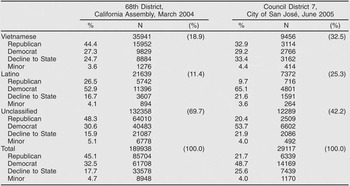
Once a scant proportion of the electorate, Vietnamese Americans were, as of 2005, more than 5 percent of Orange County voters and nearly 8 percent of Santa Clara's. In the cities of Westminster, Garden Grove, and San José, their proportion is substantially higher. As of 2004, Vietnamese constituted 37 percent of registered voters in Westminster and 27 percent in Garden Grove (by contrast, Latinos constituted 9 and 15 percent in both cities, respectively). Citywide in San José, the Latino share of the electorate exceeds the Vietnamese share, 15 to 11 percent (as of 2005). But in three of the ten council seats—Districts 7, 4, and 8—the Vietnamese share is 33, 22, and 21 percent respectively, compared to 25, 12, and 17 percent for Latinos.
In 1992 the first Vietnamese American in the United States was elected (in Westminster), but it was not until the 2000s that the field of candidates began to diversify. In 2000, Tran won a seat on Garden Grove's City Council. Graduate student Madison Nguyen became the first Vietnamese American woman to hold elective office in California (in San José), when she won a seat on the Franklin-McKinley School Board in 2002. In 2004 Tran was elected to the California State Assembly; a year later, Nguyen was elected in a special election in San José's City Council District 7. Both represented “firsts” for Vietnamese Americans.
As Vietnamese Americans have emerged politically, there has been evidence of racial polarization. In previous work, I find that in Westminster and Garden Grove council races between 1998 and 2002, the estimated proportion of Vietnamese who voted for Vietnamese American candidates ranged from 60 to 68 percent while the proportion of whites doing so never exceeded 18 percent. In multiseat council races, Vietnamese Americans consistently ranked their candidates as their top choices; white voters consistently ranked them at the bottom. (In San José, there have been fewer cases on which to test this hypothesis.)
Below, I analyze the strategies of Tran and Nguyen. To isolate the potential effects of race and ethnicity (and control party), I choose to analyze Tran's council race in 2000 and his subsequent campaign for the GOP nomination for the Assembly in 2004. Nguyen's council race is ostensibly non-partisan. I divide the analysis into four dimensions. First are the issues they discussed in their campaigns and what Fenno refers to as “the presentation of self”.Footnote 76 Second, I discuss their strategic use of ethnic media. Third, I discuss their fundraising. I conclude with an analysis of electoral outcome—how their toggling strategy may have affected their vote along racial and ethnic lines—using ecological inference, or EI.Footnote 77 As the toggling strategy seeks to combine a strong racial/ethnic bloc with a sufficient number of crossover votes, we would expect to see less polarization and more moderation in the results.
“Victory through Unity”: Van Tran's Campaigns for Garden Grove City Council and California Assembly
Race, issues and presentation of self. Van Tran's first two campaigns for public office—for the Garden Grove City Council in 2000 and for the Republican nomination for the California State Assembly in 2004—typify the toggling strategy as it has been practiced in the Vietnamese American community. In the former, where he ran as a community lawyer, he used glossy blue, red and white mailers in English to portray a hardworking, mainstream candidate eager to serve the public. Photos showed a rolled-up-sleeves candidate talking to groups of white seniors or posing with a local white or Latino officeholder. He outlined a platform that would:
• “Keep our schools and streets safe”
• “Create more jobs for Garden Grove residents”
• “Oppose utility taxes”
• “Continue road repairs and public improvements”
In his candidate statement, the word Vietnam never appears. But Republican Tran, reminiscent of Democrat Locke, explains that
I emigrated to the United States at the age of 10. I learned English, studied hard, worked diligently to build a successful business and become a productive citizen of this country… As a victim of communism, I do not take our basic freedoms for granted. Freedom is not free.
Focusing only on the English message, one might label it as classic deracialization. But where Tran portrayed himself as a nonthreatening, experienced worker to a primarily white audience, his Vietnamese campaign focused heavily on his status within the ethnic community. He explains how
in the Vietnamese community, being a lawyer is a mark of prominence. If you're a lawyer or an engineer, literally it's translated as ‘lawyer so-and-so’ or ‘engineer so-and-so’. If you have a title in front of you, people tend to give you credibility. It's not automatic. But it helps to give you a little more gravitas.Footnote 78
Two of his pieces in Vietnamese are telling. On the first, Tran appears next to Governor George Deukmejian during the presentation of the “Little Saigon, Next Exit” sign on the 405 freeway; on the inside of the mailer is a fully-translated absentee ballot request postcard. On the second piece, Tran displays a standard biography the campaign had distributed in English. But, in the Vietnamese version, he adds:
• “He participated in many missions fighting for human rights and democracy for Vietnam for more than 15 years”
• “He contributed to protecting the legal principle of protestors arrested by the police during the struggle against Truong Tran [a suspected communist sympathizer] in 1999”
• “He fought for, negotiated, and helped draft various bills, resolutions in Congress and the State Assembly to protect and assist Vietnamese boat people in refugee camps throughout the 1980s and 1990s”
• “He helped garner support for the official recognition of Little Saigon in California”
• “He participated in political, social, and cultural missions that contribute to the greater good of the Vietnamese American community”
Tran never received an English newspaper endorsement for the non-partisan council race. It is therefore likely that much of the information that non-Vietnamese voters possessed about him came from direct mail. He was the top vote-getter of nine council candidates overall and captured the seat. According to estimates, Tran received between 68 and 69 percent of the Vietnamese vote. But he earned just 16 to 18 percent of the white vote and was ranked fourth by white voters. In the absence of the Vietnamese American community's bloc support, he would have lost decisively.Footnote 79
When Tran decided to run for an open seat in the 68th California Assembly District three years later, it was therefore apparent that he would need a unified Vietnamese American community to make the move up. It was also apparent that, with only 19 percent of the constituency made up of Vietnamese American voters, he would need to make a substantial appeal to the conservative voters who would dominate the race. As it so happened, Tran faced one opponent for the pivotal GOP nomination: fellow Garden Grove Councilmember Mark Leyes, known for his opposition to erecting a monument sign denoting Little Saigon's business district in the heart of the enclave on Brookhurst Avenue.
Characteristics of registered voters in constituencies of interest

Source: Author analysis of surname-coded voter registration records provided by the Counties of Orange and Santa Clara. Surname lists were developed from Lauderdale and Kestenbaum Reference Lauderdale and Kestenbaum2000, supplemented by Word and Perkins Reference Word and Perkins1996, and Nguyễn Reference Nguyễn1998.
The campaign had strong racial overtones. Leyes distributed a mailer early in the race focusing on Tran's registration of Vietnamese American voters. The piece, which consistently referred to “criminal lawyer Van Thai Tran,” alleged that the candidate's non-partisan effort to register ethnic voters had compromised the purity of the Republican Party, since, in the process, he also registered Democrats and non-partisans. A highlighted quote of Tran's in the centerfold of the mailer read, “We realize that we must reassert ourselves through voting power.” Leyes sent another piece in English, “A Postcard from Van Tran,” that was addressed to “Mr. and Mrs. Voter, Little Saigon, CA.” It showed a photo of the monument sign Leyes had opposed, as well as a compare-and-contrast table that juxtaposed the two candidates' endorsements. Leyes' side was comprised mostly of names of current and former white officeholders; Tran's was almost entirely Vietnamese—belying the fact that much of the California GOP establishment was backing Tran. “Mark Leyes—One of Us,” read the bottom of the piece.
Tran maintained a toggling strategy. His literature in English, again in red, white, and blue as shown in figure 1a, emphasized mainstream ties and included photos with President George W. Bush and incumbent members of Congress (both Democrat and Republican); in it, he touted endorsements and emphasized a platform that, similar to his council campaign, was “tough on crime” and would impose “no new taxes.” In English, he never responded to Leyes' attacks—a classic deracialization tactic. But through Vietnamese media, he responded directly. One press release dated, February 23, 2004, that was distributed to Vietnamese radio, print, and online media (but never distributed nor reported in English) read:
Recently, Attorney Van Tran's campaign opponent has slandered and smeared the voter registration efforts and election participation in the Vietnamese community. These are nothing but dirty political tricks from this particular candidate in the last stage of the election race. These actions only attempt to confuse voters of Vietnamese descent, especially those who are voting for the first time…
Attorney Van Tran's Campaign Committee strongly opposes these sabotaging schemes and calls upon the Vietnamese voters to remain steadfast in their trust and not pay attention to these groundless accusations…We understand that the Vietnamese voters' absolute support for Attorney Van Tran in this election is stirring fear in the opponent and will continue to be the target of attacks and smear campaigns not only from the campaign opponents of Attorney Van Tran, but also from other political factions that want to oppose the rights and growth of the community.
The Campaign Committee also understands that this is a collective campaigning effort of the entire Vietnamese community, and not just of Attorney Van Tran. Therefore, protecting the good name and honor for the Vietnamese community and the voters of Vietnamese descent is of utmost importance.
Attorney Van Tran's Campaign Committee hopes to receive the continuous support and trust of the Vietnamese community during this intense election that is very important to the future of our Vietnamese community. The only effective response from the Vietnamese voters is to actively participate in the voting process in full numbers in order to protect the voice and future of the community in any situation.
The lawyers from the Campaign Committee are investigating whether this spread rumor, intended to threat and cause confusion, violates voting regulations, or is racist in nature.Footnote 80
As with his council race, Tran's toggling strategy focused on mobilizing by way of issues relevant to Vietnam and its communist government. But he also stressed the power of ethnic unity, as we see in the press release and in figure 1b, where a slate of Vietnamese American candidates were shown together in front of a South Vietnamese flag and behind the famous sign demarking Little Saigon.
Campaign Literature of Van Tran for California State Assembly, 2004

Use of ethnic media
The Vietnamese media, therefore, provided “cover” for the open discussion of race and the avenue to mobilize minority voters through ethnic cues. Tran explains,
It really is two different campaigns. Basically, the concept is the same. It's about increasing your name and voter contact. Within the Vietnamese community, you have campaign signs, drop off mail. You don't do precinct walks…Given the fact that I've been involved in the [Vietnamese] community over two decades, it's not like I'm just coming out. People know who I am.
With the non-Vietnamese, you have to build your name from square one. I approach them from the sense of “I am one of your own. I have roots in the district.” You establish your hometown roots by saying “I've been here for a long time.” With the non-Vietnamese voters, you always have to overcome the inherent suspicion that you don't represent them. You do that in many ways. Number one, a number of issues transcend any ethnic group. Taxes, quality of life, accountability in government. Those are issues a white person or Hispanic person can understand. Number two, you get as many endorsements as you can. That will say “Van is a stand up guy.” So you can gain the trust directly, as well as indirectly, through various means.
Radio, TV, and print media are extremely important in the Viet community. I was able to mobilize the entire community to get out to vote via these media outlets. The campaign informed the voters how to register to vote, how to apply for absentee ballots, how to get to their polling places, who to vote for and when, and where. In short, we did a very substantial amount of voter registration, voter education, and GOTV through all these media outlets.Footnote 81
According to his expenditure reports, Tran spent a total of $126,635.25 on broadcast and print advertising. The sum was nearly equally divided between direct ad buys from Vietnamese media outlets (e.g., Người Việt Daily News, Việt Báo, Little Saigon Radio, Nha Magazine—$61,257.50) and his Sacramento consultant, JohnsonClark Associates, who coordinated “mainstream” advertising through TimeWarner cable television ($65,377.75). Nearly all of the $13,682 itemized for “voter registration” went to individuals with Vietnamese surnames ($12,682).
Fundraising networks
Tran raised $598,771 through March 1, 2004—the last filing deadline before the primary election. More than 80 percent of his individual contributions came from discernibly Vietnamese sources—an effort facilitated by the use of e-mail, listservs, and the candidate's website (refer to table 2). His opponent raised $162,492.
Campaign fundraising by Van Tran and Madison Nguyen

Source: Campaign disclosure reports gathered from Cal-Access (cal-access.ss.ca.gov) and City Clerk, City of San José. Ethnicity coded for each donor on the basis of a surname list provided by Lauderdale and Kesetenbaum (Reference Lauderdale and Kestenbaum2000), supplemented by Word and Perkins Reference Word and Perkins1986, and Nguyễn Reference Nguyễn1998.
Outcome
On election day, Tran won 57 percent to 43 percent; he went on to win the general election in the fall to become the first Vietnamese American member of the State Assembly. Using EI, we find that Tran won 95 percent of the Vietnamese vote and 46 percent of the non-Vietnamese vote.Footnote 82 A tomographic plot generated by King's EI program in displayed in figure 2. It shows the EI-derived estimates for the quantities of interest: the proportion of Vietnamese voting for Tran (or βiv, to adapt King's notation) on the y axis and the proportion of non-Vietnamese voting for Tran (βiw) on the x axis. The lines represent all feasible EI predicted values for βiv and βiw; the concentric circles tell us their convergence—i.e., the “true” (βiv,βiw)—lies within the said region at 95 percent and 90 percent confidence levels, respectively. Put another way, had Tran failed to mobilize Vietnamese Americans, the circles would be in the left hemisphere of the graph; had he failed to garner votes from non-Vietnamese, the circles would be in the lower hemisphere. Instead, what we see is a convergence point on the far right and in the center: a strong ethnic bloc combined with a moderate level of support from non-ethnics. In a race that threatened to be racially polarized, Tran's toggling strategy helped to secure nearly all of the eligible Vietnamese American vote (only Republicans and Decline-to-State registrants could vote in the modified open primary) and approached half of the non-Vietnamese vote, resulting in his victory.Footnote 83
Tomographic plots of Vietnamese and non-Vietnamese vote for Van Tran, California State Assembly 68th District Primary, March 2004 (N = 196 precincts)

“I Will Work Hard”: Madison Nguyen and the 2005 Special Election for the San José City Council
Running as a woman, a progressive Democrat and in a different competitive context, Madison Nguyen's campaign for a vacated seat on the San José City Council in 2005 is a strategic parallel to Tran's first two runs for office. Nguyen never faced a significant white opponent head-to-head. But she employed a toggling approach nonetheless—a balanced strategy of becoming, as she explained, “more Vietnamese” while assuaging “the mainstream” with a diligent, non-threatening “Americanized” image.Footnote 84 At the time of the non-partisan special election, which was compelled by the resignation of scandal-plagued incumbent Terry Gregory, the demographic makeup of registered voters in District 7 was 33 percent Vietnamese and 25 percent Latino, as seen in table 1. Nguyen thus faced a different competitive scenario than Tran, but her strategy remained essentially the same.
Race, issues and presentation of self
Like Tran, Nguyen's “mainstream” campaign focused on obtaining endorsements, solidifying Democratic Party support, and establishing her experience as an elected school board member. In appealing specifically to “non-Vietnamese” voters, she reveals that
most of the time I just talk about my history as a refugee and try to obtain their sympathy about how difficult it was for us to get here…I think that when I talk about that, people start to understand because obviously people know what happened after the Vietnam War. I didn't have to do a lot of outreach to the non-Vietnamese community in that regard because they understood.Footnote 85
Two pieces of literature are telling. On the cover of one in English, Nguyen, dressed in a blue business suit with a red and white striped background, emphasizes “Experience. Leadership. Integrity” (refer to figure 3a). Inside, voters read “Madison knows the American Dream”:
Arriving with little, Madison's parents worked in the fields picking fruit to make ends meet. At age 12, Madison joined them—helping to feed her 8 brothers and sisters…
Education breeds opportunity. Madison's parents taught her that education was the key to success. She worked hard—putting herself through UC Santa Cruz and earning an MA from the University of Chicago.
The second, a mailer entitled “I will work hard—for the community,” continues the theme, but illustrates the different messages that she wished to convey to Vietnamese-reading voters (refer to figure 3b). Voters see photos of Nguyen, first as a youth soccer player, then as a student, and finally as a college lecturer. The toggled communications on the inside of the mailer in Vietnamese can be seen in the right panel. Nguyen appears with the flag of the former South Vietnam—the highly emotive symbol of the overseas Vietnamese community. The presentation of self also differs, as with Tran's pieces, depending on the language. In English, voters read again about “the American dream” and the candidate's platform of “quality education,” “good jobs,” and “safer neighborhoods.” The side in Vietnamese, however, tells readers that
On November 11, 2002, Madison Nguyen campaigned and was elected, with the highest number of votes from Vietnamese American voters and voters of other ethnic heritages, to the Franklin-McKinley School District's Board of Education.
She then, like Tran, lists specific achievements for the Vietnamese American community. Among others, she
• campaigned the San José City Council to pass the resolution honoring the yellow flag with three red stripes [as the official flag for the Vietnamese American community]
• founded the Vietnamese-American Center
• demanded rights for the former Republic of South Vietnam's veterans.
Literature of Madison Nguyen for San José City Council, 2005

Asked about the difference between appealing to Vietnamese and non-Vietnamese voters, she explains that
being a Vietnamese politician…you treat your community like your family. They criticize you as if you are a family member…So while I try to make the Vietnamese community feel special, I tell them “Look, I am a Vietnamese politician. You elect me to serve your needs” and, at the same time, telling the non-Vietnamese community that “I'm a politician who happens to be Vietnamese American.” Do you see the difference? “So, whether you see me as a Vietnamese American or not—that's not what I'm about. I am your representative.” Constantly you think that. But then you have to act it. It's the acting—the process of acting—that whether or not you're able to convince [non-Vietnamese] people that I'm a politician who happens to be Vietnamese American. Then you go to the Vietnamese American community and say “I'm a Vietnamese politician.” You have to be able to successfully act those two roles out in those two different communities.Footnote 86
Use of ethnic media
Nguyen, according to city expenditure filings, spent a total of $24,239 on radio and newspaper advertising between February 8 and September 6, 2005. All was spent on Vietnamese media outlets (e.g., Quê Hu,o,ng Radio, Little Saigon Radio, Saigon USA Newspaper, etc.). There are no itemized expenditures for voter registration. However, she did pay $39,773 to a consultant, Darren Seaton (dba DFS Associates), to produce and distribute both “mainstream” and Vietnamese literature. She explains how the lack of accessibility to the larger media in the city compelled her to focus her resources on Vietnamese radio and newspapers, which sheds some light on the alleged “gossipy, corrupt” tendency of ethnic media:
We tried to contact the [mainstream] media, the more prominent media groups and network. But they only write news when they want to. So it was kind of fruitless.
With the Vietnamese media, it's all about money. In order to get them to do a talk show, we went over there and said, “We want to place this many ads for one month or so.” And, by buying ads, later on, we would ask them, “Can we do a talk show?” or “Can you throw in a freebie or a bonus?” Because for talk shows, every 30 seconds is twenty bucks. And there's absolutely no way you can afford that. Because each talk show could last up to 15 or 30 minutes, depending on how interesting the conversation goes. And so how we approached it was to buy ad spots and then after that, they feel, “OK, well this campaign is kind of contributing a lot to the radio station” then, most likely, they'll give us a couple of spots on a talk show.Footnote 87
Fundraising networks
Looking back at table 2, we see that Nguyen raised a total of $165,617 for the race. More than 60 percent of the $125,697 raised in individual contributions came from donors with Vietnamese surnames. Overall, looking at the bottom of the table, we see that the Vietnamese American community, including Nguyen's own initial “start up” loan of $1,100, provided roughly half (49 percent) of the campaign's resources.
Outcome
Nguyen was the top vote-getter with 44 percent in the first special election on June 7. Examining her vote in the first round, we see, as with Tran, bloc support from Vietnamese Americans. EI estimates the proportion of Vietnamese voting for Nguyen to be 91 percent and the non-Vietnamese vote to be 20 percent. As the race featured three Latino, two white, one Pacific Islander, and two Vietnamese American candidates, it appears as if racial bloc voting occurred across the board.
Since Nguyen failed to capture a majority of votes cast, she went to a runoff on September 13. Due to a high turnout among politically awakened Vietnamese Americans, she was pitted against Linda Nguyen, who attracted enough Vietnamese and crossover votes to land in second place (the most prominent Latino candidate, Beth Gonzales, finished third). Dubbed by local media as a “Nguyen-Nguyen situation” for the Vietnamese community, the head-to-head match up compelled Madison, despite the already evident ethnic support, to renew her focus on Vietnamese homeland issues. It was in this context that support for a resolution recognizing the flag of the former South Vietnam—now known as the Vietnamese American Freedom and Heritage Flag by the diasporic community—emerged as the primary issue in what resulted in a personal and internecine campaign.
At the same time, Nguyen toggled. After receiving scant votes from Latino voters in the first round, she added a third prong to the strategy by garnering Gonzales' endorsement and producing a mailer in Spanish. The front shows, in a large font, the names of local Latino officeholders, including Gonzales, from whom she received endorsements; the back focuses entirely on education. The basic “hardworking” and “experienced” themes remain. But the piece reveals nuances like “increased parental involvement” and “Madison believes actions are more louder than words” that are not apparent in other communications. She also mentions her poor family background and personal experience as a farm worker: “Madison decidió usar su educación para ayudar a familias de escasos recursos como las familias de campesinos con las que se erió.”Footnote 88
Nguyen won the runoff with 62 percent. Looking at her vote, displayed visually in figure 4, we see the same pattern as in Tran's Assembly race: bloc ethnic support combined with substantial crossover. EI estimates βiv (on the vertical axis) at .83 (ɛ = .04) and βiw at .52 (ɛ = .01), resulting in a likely convergence point in the same general position as with Tran in figure 2b—in the right hemisphere, toward the center.Footnote 89 Put another way, Nguyen, reflecting a successful toggling strategy, won a majority of votes from both Vietnamese and non-Vietnamese communities and captured the seat.
Tomographic plot of Vietnamese and non-Vietnamese vote for Madison Nguyen, San José City Council District 7, September 2005

When asked about the dynamics of race in the campaign, and how she addressed them, Nguyen explained things from the perspective of the Vietnamese American community. Race, she says,
is actually a bigger problem in the Vietnamese community because they always see me as someone who is very Americanized and might not understand the true Vietnamese issues … [In mainstream forums] I try not to use race as an arguing point all of the time, when we talk about racial profiling with the police department—stuff like that. I'm very careful about not using race in my debates, my deliberation or articulation, because I don't want to come off as “There she goes again, talking about race.” I don't want to have the reputation of having this as my only strong point in terms of making my argument and this is the reason why I care about some things… That's why I focus so much time within the Vietnamese community—more so than in the non-Vietnamese community—because I feel that I'm confident enough in the non-Vietnamese community. But in my community, [the issue of race] needs a lot of attention.Footnote 90
From Tran and Nguyen, we thus see how two new candidates were able to achieve representation under conditions that may have otherwise discouraged their candidacies. In neither case did the Vietnamese American candidate possess a numerical majority of registered voters; only in the former did the opponent attempt to mobilize a white backlash. Yet, by undertaking toggling strategies, both developed a coalition sufficient for victory.
Discussion: Race and Ethnicity, and the Persistent Question of Equality in the Democratic Process
Minority candidacies and the role they play in mobilizing minority voters are understudied facets of American politics, a deficit that the lengthy discussion over the deracialization strategy has helped to reduce. Although it has generated controversy, deracialization has, to its credit, put the candidate into focus as an important catalyst for bringing about minority representation in electoral environments where it was not thought possible. Too often in pursuing the question of minority group participation, the actual candidates—their style, strategy and message—have been overlooked.
What I have argued here is that while deracialization is a start, it remains incomplete—and is becoming increasingly vulnerable as American politics moves toward greater diversity and competition. We have examined the experience of Asian Americans—one of the newest minority groups on the U.S. political scene—and seen how candidates from Locke to Tran to Nguyen have been able to transform their immigrant status into a deracialized appeal that incorporates the message of “unity” and the symbolism of the American Dream. We have also seen how they rely heavily on—and skillfully mobilize—ethnic (and panethnic) constituencies based on strong group appeals, as did Carl Stokes, Tom Bradley, and other path-breaking candidates before them. Race and ethnicity may not always be discussed openly throughout a campaign to all audiences. But scarcely is it suppressed altogether. Its continuing reliability as vote predictor across many urban contexts only underscores the point: race and ethnicity matter.Footnote 91 For new immigrant populations like Vietnamese Americans making their first efforts in democratic politics, it more than matters. It is essential.
When the aforementioned urban trends are combined with the movement of political institutions in recent years away from race or ethnic based districting (e.g., Shaw v. Reno), it seems that toggling may become increasingly relevant. Regardless of background, ambitious candidates are strategic; they calculate before throwing their hat in the ring. Naturally, numbers matter. And with emergent Asian Americans in particular, a political reality remains: the pathway to incorporation will (for the time being, at least) run through established neighborhoods where high propensity, non-ethnic voters are likely to reside. Underrepresented groups cannot be as secure that their voters, many of whom may be new to the process, will turn out. As such, candidates will continue to seek and hone messages that both assuage and mobilize. They will toggle.
When minority candidate strategies for co-ethnic mobilization are given inadequate attention, it may be a reflection of the limitations of current scholarly approaches. One of the substantial limitations of this initial foray into the toggling strategy is that it focuses on the experience of one ethnic group—a population that may be considered unique due to its refugee experience and residential concentration. At the same time, the basic precept of toggling—minority candidates using different media, language, and style to both mobilize their base to vote as a bloc and to attract crossover votes—would seem prima facie to apply to any contestant finding themselves in a situation where they are forced to compete for votes across racial/ethnic communities. Additional case studies of Asian American, Latino, Afro-Caribbean and other campaigns would help to illuminate similarities and differences among candidates across communities. Does a Mexican, Cuban or Korean American candidate speak to a Mexican, Cuban, or Korean American voter in the same way? Is toggling unique to first-time or 1.5 generation (foreign born, American socialized) candidates? And how is the strategy shaped by the size of the respective groups in the given constituency? In this article, we find toggling occurring in constituencies where the Vietnamese population ranged from 19 to 33 percent; future work may help to define, with greater precision, the strategic conditions under which toggling may occur.
As scholars have pursued the question of whether deracialization is or is not effective, toggling delves into the factors and qualities that may compel successful minority candidates into office. Is toggling a requisite strategy for the mobilization of new groups? Do new voters in a given multicultural community, cateris paribus, prefer a candidate and representative who can toggle? How do different blocs of voters discern toggled messages—and what is the impact on urban democracy?
At the same time that it helps us rethink the role of minority candidates, toggling raises questions about equality and the incorporation of minority interests. Where deracialization theory has raised important concerns about whether African American candidates are representing black interests, toggling highlights possibilities for the perpetuation of internal enclave politics and, as such, may generate controversy over a supposed “delayed investment” in domestic affairs for new citizen voters. Virtually “segregated” campaigns waged outside and inside racial and ethnic communities may enhance minority mobilization and permit the election of minority officeholders in multicultural constituencies. At the same time, they place burdens on the candidates themselves. I note in previous work the structural disadvantage that has faced minority candidates—the tendency of Asian Americans, in particular, to dramatically outspend their white opponents in order to attain the same number of votes.Footnote 92 One could argue further that toggling may disaggregate messages and policy commitments to the point where different blocs of voters are no closer, in terms of policy, than they were before the campaign, thus calling into question the argument that America's two-party system and majoritarian democracy serve to harmonize disparate interests. Toggling, therefore, deserves at least as much consideration in the realm of governance as it does in the realm of elections for if toggling, in the end, amounts to particularized machine-style politics practiced by minority politicians themselves with a modern, professionalized veneer, the result may be the perpetuation of mass inequalities.