Effective and economical weed management is crucial to a profitable cotton production system. Weeds decrease cotton lint yield and quality by competing for nutrients, water, and light (Stuart et al. Reference Stuart, Harrison, Abernathy, Krieg and Wendt1984). In 1997, the release and subsequent wide adoption of glyphosate-resistant cotton changed weed management systems in the crop. Glyphosate-resistant cotton systems provided growers with broad-spectrum weed control and flexibility in application timings (Norsworthy et al. Reference Norsworthy, Smith, Scott and Gbur2007). These systems also were widely adopted due to their simplicity and convenience.
Prior to the release of glyphosate-resistant cotton, weed management in the crop was dominated by soil residual herbicides. From 1992 to 1999, trifluralin and fluometuron were applied to over 50% and 25% of the cotton acres, respectively (Young Reference Young2006). However, glyphosate use started to increase rapidly in 1998, the year after the commercial introduction of glyphosate-resistant cotton. By 2000, glyphosate had replaced trifluralin as the herbicide applied to the greatest percentage of cotton hectares (Young Reference Young2006).
A survey conducted in the spring of 2006 indicated that approximately two-thirds of cotton producers in the southern United States had planted glyphosate-resistant cotton continuously for 3 to 5 years (Foresman and Glasgow Reference Foresman and Glasgow2008). Of the cotton producers surveyed, 21% applied glyphosate alone, 21% applied glyphosate in a tank mixture, and 52% applied glyphosate after a PRE herbicide. This increase in glyphosate use decreased tillage (Young Reference Young2006) and increased the selection pressure for glyphosate resistance in Palmer amaranth and other weeds frequently found in cotton cropping systems (Neve et al. Reference Neve, Norsworthy, Smith and Zelaya2011).
Glyphosate-resistant Palmer amaranth was confirmed on the Texas High Plains in 2011 (Heap Reference Heap2017), although confirmation in Georgia occurred seven years earlier (Culpepper et al. Reference Culpepper, Grey, Vencill, Kichler, Webster, Brown, York, Davis and Hanna2006). Since being confirmed in Georgia, glyphosate-resistant Palmer amaranth has moved west to California and has been confirmed in 27 US states (Heap Reference Heap2017). Resistant Palmer amaranth biotypes also have increased and spread throughout the Texas High Plains, causing growers to change their management inputs in order to maintain sustainable cotton weed management systems. Growers who are successful at controlling weeds including Palmer amaranth are using a systems approach that involves multiple application timings, multiple herbicide modes of action, and the addition of soil residual herbicides, as well as the incorporation of mechanical, cultural, and biological methods where appropriate.
The list of available modes of action in cotton will increase in the 2017 growing season with the registration of EnlistTM technology developed by Dow AgroSciences. EnlistTM technology utilizing tolerance to 2,4-D choline plus glyphosate and glufosinate has the potential to effectively manage glyphosate-resistant Palmer amaranth. Cotton tolerance to 2,4-D choline was conferred by the insertion of a gene (AAD-12) that codes for an aryloxyalkanoate dioxygenase enzyme (Wright et al. Reference Wright, Shan, Walsh, Lira, Cui, Song, Zhuang, Arnold, Lin, Yau, Russell, Cicchillo, Peterson, Simpson, Zhou, Ponsamuel and Zhang2010). Plants transformed to include this gene can metabolize certain synthetic auxin herbicides, including 2,4-D, to a nonlethal form (Richburg et al. Reference Richburg, Wright, Braxton and Robinson2012). The availability of EnlistTM cotton will provide growers with a new tool to effectively manage glyphosate-resistant Palmer amaranth, Russian-thistle (Salsola tragus L.), and other difficult-to-control weeds in Texas High Plains cotton.
Understanding how to maximize the use of this technology with existing herbicides has the potential to not only improve weed management and cotton yield, but also may reduce selection pressure for 2,4-D resistant weeds. The objective of this study was to identify effective weed management systems for the control of Palmer amaranth in EnlistTM cotton.
Materials and Methods
Field experiments were conducted in 2013, 2014, and 2015 in Lubbock, Texas at the Texas Tech New Deal Research Farm (33.441376°N, 101.435804°W; elevation 994 m). The cultivar ‘Phytogen® 490 W3FE’ (Dow AgroSciences, Indianapolis, IN) was planted with a John Deere 1700 MaxEmerge XP Planter on May 16, 2013, June 3, 2014, and June 4, 2015, at 10 seeds per meter of row, in rows spaced 101 cm apart. The soil type was a Pullman clay loam (fine, mixed, superactive, thermic Torrertic Paleustolls) with less than 1% organic matter and pH of 7. All studies were arranged in a randomized complete block design with four replications. Individual plots were 4.1 m wide by 6.1 m in length. In-season rainfall was 292 mm in 2013, 460 mm in 2014, and 354 mm in 2015. Water was applied as needed through subsurface drip irrigation. In-season irrigation was 318, 36, and 244 mm in 2013, 2014, and 2015, respectively.
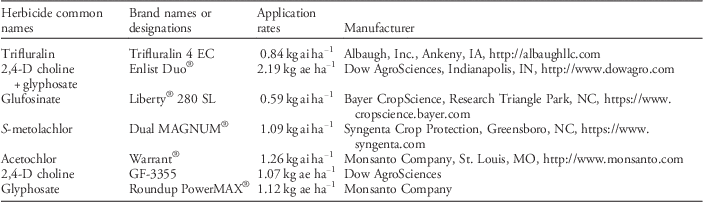
Weed control systems included trifluralin applied preplant and incorporated 5 to 8 cm with a rolling cultivator. Early POST applications consisted of 2,4-D choline plus glyphosate; 2,4-D choline plus glyphosate plus glufosinate; glufosinate; S-metolachlor plus glufosinate; acetochlor plus glufosinate; 2,4-D choline plus glyphosate plus acetochlor; 2,4-D choline plus glufosinate; and glyphosate. Mid-POST applications consisted of 2,4-D choline plus glyphosate; 2,4-D choline plus glyphosate plus glufosinate; glufosinate; 2,4-D choline plus glufosinate; and glyphosate. Herbicides and application rates are listed in Table 1.
Herbicides and application rates for 2013, 2014, and 2015 systems trials near Lubbock, TX.

Early POST applications were made when Palmer amaranth was approximately 5 to 10 cm in height while mid-POST applications were made 21 days after early POST applications. Palmer amaranth was the dominant weed species at the site. The nontreated control did not receive any herbicide applications. All applications were made with a CO2-pressurized backpack sprayer equipped with AIXR11002 spray tips (TeeJet® Technologies, Glendale Heights, IL) calibrated to deliver 140Lha−1 at 205 kPa. No adjuvants were included with any application. Insect control, fertilization, and defoliation practices were standard for cotton production in the Texas High Plains (Bronson Reference Bronson2004; Kelley et al. Reference Kelley, Keeling, Keys and Morgan2014; Kerns et al. Reference Kerns, Sanson, Siders and Baugh2009).
Visual control estimates were recorded 14, 21, and 28 days after treatment using a scale of 0% to 100%, where 0% equals no weed control and 100% equals complete control (Frans et al. Reference Frans, Talbert, Marx and Crowley1986). Cotton was harvested with a small-plot stripper on October 31, 2013, November 11, 2014, and November 6, 2015.
A univariate analysis was performed on all responses in order to test for stable variance (version 9.3, SAS Institute Inc, SAS Campus Drive, NC). No data sets were transformed as transformation did not increase stabilization. Data sets were analyzed using PROC MIXED with the pdmix 800 macro described by Saxton (Reference Saxton1998), and treatments were separated by Fisher’s protected LSD at an alpha level of P<0.05.
In the model, fixed effects included year and herbicide system and random effects included replication.
Results and Discussion
Palmer amaranth visual control estimates for 2014 and 2015 were averaged over year because there was no significant year effect (P>0.05), while 2013 estimates were analyzed independently. For seedcotton yield, 2013 and 2015 trials were averaged over year because there was no significant year effect (P>0.05), and the 2014 trial was analyzed independently.
Palmer Amaranth Control
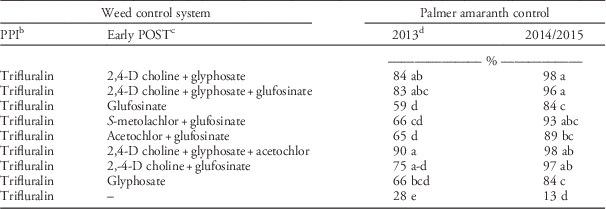
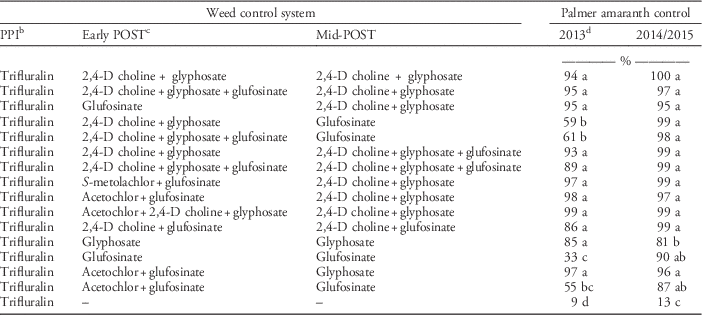
In 2013, Palmer amaranth control 21 days after the early POST application ranged from 75% to 90% for all treatments that included 2,4-D choline plus glyphosate, 2,4-D choline alone, or 2,4-D choline in a tank-mixture (Table 2). Treatments that did not include 2,4-D choline plus glyphosate or 2,4-D choline early POST controlled Palmer amaranth only 59% to 66%. Palmer amaranth control 28 days after the mid-POST application ranged from 85% to 99% for all systems with the exception of treatments that included glufosinate only at the mid-POST timing, where control did not exceed 61% (Table 3).
Palmer amaranth control 21 days after the early POST application in 2013, 2014, and 2015 systems trials near Lubbock, TX.Footnote a

a Abbreviation: PPI, preplant incorporated.
b Trifluralin was applied at 0.84 kgaiha−1. Premixed 2,4-D choline+glyphosate; glufosinate; glyphosate; S-metolachlor; acetochlor; and 2,4-D choline applied at 2.19, 0.59, 1.12, 1.09, 1.26, and 1.07 kgha−1, respectively.
c Early POST application made once Palmer amaranth reached 5 to 10 cm in height.
d Means within a column followed by the same letter are not significantly different according to Fisher’s protected LSD test at P<0.05. Data pooled over 2014 and 2015.
Palmer amaranth control 28 days after the mid-POST application in 2013, 2014, and 2015 systems trials near Lubbock, TX.Footnote a

a Abbreviation: PPI, preplant incorporated.
b Trifluralin was applied at 0.84 kg ai ha−1. Premixed 2,4-D choline + glyphosate; glufosinate; glyphosate; S-metolachlor; acetochlor; and 2,4-D choline were applied at 2.19, 0.59, 1.12, 1.09, 1.26, and 1.07 kg ha−1, respectively.
c Early POST application made once Palmer amaranth reached 5 to 10 cm in height; mid-POST application made 21 days after the Early POST application.
d Means within a column followed by the same letter are not significantly different according to Fisher’s protected LSD test at P<0.05. Data pooled over 2014 and 2015.
When averaged over the 2014 and 2015 growing seasons, Palmer amaranth control 21 days after the early POST application was at least 96% for all systems that included 2,4-D choline plus glyphosate, 2,4-D choline alone, or 2,4-D choline in a tank-mixture (Table 2). All other early POST treatments controlled Palmer amaranth 84% to 93%. Palmer amaranth control 28 days after the mid-POST application ranged from 95% to 100% for all systems with the exception of the trifluralin-only system (13%), preplant incorporated trifluralin followed by glufosinate with or without acetochlor early POST followed by glufosinate mid-POST (87% and 90%), and preplant incorporated trifluralin followed by glyphosate early POST followed by glyphosate mid-POST (81%) (Table 3).
Craigmyle et al. (Reference Craigmyle, Ellis and Bradley2013) and Merchant et al. (Reference Merchant, Culpepper, Eure, Richburg and Braxton2014) also observed increased weed control with the addition of 2,4-D to POST applications of glyphosate and/or glufosinate. When comparing 2,4-D, glyphosate, and glufosinate systems in Georgia cotton, Merchant et al. (Reference Merchant, Culpepper, Eure, Richburg and Braxton2014) found that Palmer amaranth was controlled 98% to 99% at harvest when a PRE herbicide was followed by sequential applications of 2,4-D plus glufosinate, and Palmer amaranth was controlled 95% to 96% following sequential applications of 2,4-D plus glyphosate. In Missouri soybean, Craigmyle et al. (Reference Craigmyle, Ellis and Bradley2013) found that the addition of 2,4-D to POST applications of glufosinate improved control of common waterhemp (Amaranthus rudis Sauer) and common cocklebur (Xanthium strumarium L.) up to 6% and 11%, respectively.
Seedcotton Yield
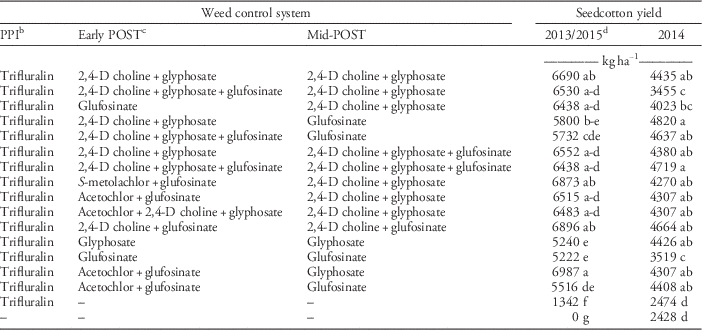
In 2013 and 2015, seedcotton yield ranged from 6,438 to 6,896 kgha−1 for all treatments with the exception of glyphosate- or glufosinate-only systems and systems that relied on glufosinate alone at the mid-POST timing (5,222 to 5,800 kgha−1). The nontreated control and trifluralin-only systems also resulted in low yield of 0 to 1,342 kgha−1 (Table 4). In 2014, seedcotton yield ranged from 3,455 to 4,820 kg ha−1 for all treatments with the exception of trifluralin-only systems and the nontreated control, in which yield ranged from 2,428 to 2,474 kgha−1. Although 2014 yield was similar among systems, Merchant et al. (Reference Merchant, Culpepper, Eure, Richburg and Braxton2014) consistently found that the greatest yield was achieved when systems included a PRE herbicide followed by sequential POST applications of 2,4-D plus glyphosate or 2,4-D plus glufosinate, or when glufosinate plus 2,4-D was the POST option.
Seedcotton yield in 2013, 2014, and 2015 systems trials near Lubbock, TX.Footnote a

a Abbreviation: PPI, preplant incorporated.
b Trifluralin applied at 0.84 kg ai ha−1. Premixed 2,4-D choline + glyphosate, glufosinate, glyphosate, S-metolachlor, acetochlor, and 2,4-D choline applied at 2.19, 0.59, 1.12, 1.09, 1.26, and 1.07 kg ha−1, respectively.
c Early POST application made once Palmer amaranth reached 5 to 10 cm in height; mid-POST application made 21 days after the Early POST application.
d Means within a column followed by the same letter are not significantly different according to Fisher’s protected LSD test at P<0.05. Data pooled over 2014 and 2015.
Cotton technology with tolerance to glyphosate, 2,4-D, and glufosinate will improve grower flexibility and POST management of Palmer amaranth (Merchant et al. Reference Merchant, Culpepper, Eure, Richburg and Braxton2014). In these studies, numerous effective systems were identified; however, systems containing 2,4-D choline plus glyphosate or 2,4-D choline early POST and/or mid-POST were among the most effective, providing 86% to 100% Palmer amaranth control. Glyphosate or glufosinate-only systems, or systems that relied on glufosinate alone at the mid-POST timing, controlled Palmer amaranth the least. Control of certain weeds, such as Amaranthus species, with glufosinate has been inconsistent, especially under low relative humidity (Coetzer et al. Reference Coetzer, Al-khatib and Loughin2000), which is commonly observed in the Texas High Plains.
Acknowledgements
The collaborators in this research are grateful for funding provided by Dow AgroSciences and the Texas State Support Committee, Cotton Incorporated. Work on this project also has been enhanced by the technical support and expertise of the following people: Shay Morris, Seth Taylor, and Mike Lovelace.