

Since the Supreme Court decided United States v. Windsor (2013), which struck down Section 3 of the Defense of Marriage Act (DOMA) defining marriage as a union between one man and one woman, over 40 state and federal courts to consider the question of marriage equality have ruled in its favor. Footnote 1 Windsor compelled the federal government to recognize same-sex marriages in states that already did so; it did not force states that did not recognize same-sex marriage to do so. Subsequently, litigation challenging state bans has proceeded in all states that still maintain them, and judges have struck these bans down at a record pace. Footnote 2 Indeed, in his Windsor dissent, Justice Antonin Scalia predicted that the ruling would have this effect: “The real rationale of today’s opinion, whatever disappearing trail of its legalistic argle-bargle one chooses to follow is that DOMA is motivated by ‘bare … desire to harm’ couples in same-sex marriages. How easy it is, indeed how inevitable, to reach the same conclusion with regard to state laws denying same-sex couples marital status.” Footnote 3 Media outlets similarly have remarked on the rapidly changing marital landscape post-Windsor: “States have been falling for marriage equality so fast this week it's hard to come up with the right analogy to express the speed. How fast have they been falling—like dominoes, in a parlor game with the rather high stakes of American civil rights?” Footnote 4
These characterizations give marriage equality, as well as the myriad other rights demands of the gay and lesbian movements, an air of inevitability. Footnote 5 Contemporary gay and lesbian rights mobilization comports with a narrative of collective mobilization for rights that ultimately succeeds in fulfilling constitutional ideals. Footnote 6 And, Barack Obama maintained this construction in his 2012 presidential inaugural address when he stamped the gay rights movement with the legitimating imprimatur of the civil rights and women’s rights movements that preceded it:
We, the people, declare today that the most evident of truths—that all of us are created equal—is the star that guides us still; just as it guided our forebears through Seneca Falls, and Selma, and Stonewall; just as it guided all those men and women, sung and unsung, who left footprints along this great Mall, to hear a preacher say that we cannot walk alone; to hear a King proclaim that our individual freedom is inextricably bound to the freedom of every soul on Earth. Footnote 7
Such statements call to mind T.H. Marshall’s classic liberal conception of citizenship as a matrix of mutually constitutive rights. Footnote 8 Those who have rights are citizens; those who do not are not. Once one is a citizen, she holds all rights and responsibilities that other citizens are recognized to have. Inclusion in the polity as citizen confers equal rights. It is hardly surprising that predominant strategies for lesbian, gay, bisexual, and transgender (LGBT) equality in the United States draw on a discourse of rights and make historical parallels to struggles for African-American civil rights, labor rights, and women’s rights. Footnote 9
Nevertheless equality and inclusion within the political community as a recognized citizen, much less a recognized person, for any member of a discriminated group has hardly followed a smooth trajectory. Institutional and policy obstacles undermine constitutional text or statutory intention. And, the realization of equality is not only a matter of changing opinion, belief, or attitude. As Rogers Smith cogently expressed, when describing the persistent history of racism and gender bias, “these beliefs were not merely emotional prejudices or ‘attitudes.’ Over time, American intellectual and political elites elaborated distinctive justifications for these ascriptive systems … Many adherents of ascriptive Americanist outlooks insisted that the nation’s political and economic structures should formally reflect natural and cultural inequalities, even at the cost of violating doctrines of universal rights.” Footnote 10 Generalizing the assessment, Joseph Lowndes, Julie Novkov, and Dorian Warren contend that we limit our understanding of inequality—its sources and potential policy remedies—when we consider it as only an artifact of attitudes. In their critique of political scientific accounts of racism, they write, “much work on racial attitudes and political behavior proceeds as if in a historical, contextual and institutional vacuum devoid of either a causal, constitutive or discursive narrative about racialized politics or racialized development.” Footnote 11 Paul Frymer echoes this criticism: “By treating race and racism merely as an evil deriving from individual sickness, it makes it difficult if not impossible, for politics to regulate race and racism, and denies the ways that our political institutions are active in not just enabling but creating racist thought and behavior.” Footnote 12 In short, discrimination is institutionally embedded and can be made manifest in how various laws and policies recognize or refuse to recognize citizens and persons.
Consequently demonstrating citizenship status in the Marshallian sense—either by claiming rights or participating in civic life—is not enough to establish equality. These performances of citizenship are linked by a common idea, which is logically prior to enacting citizenship. Each requires recognition by a governing authority. As queer political theorist Shane Phelan points out,
whether an action fosters citizenship depends upon the interplay between the actor and those with and toward s/he acts. It is never a matter simply between individuals or even between groups, but is a contest among and within polities concerning the constitution of those polities … Although dissent may be an important vehicle for expressing citizenship, dissent in the face of total rejection is not citizenship but rebellion. Such rebellion becomes citizenship not simply when the rebel claims to be a member of the polity [e.g., by making a rights claim or participating in the lawmaking process] but when the other members of that polity recognize her as such. Footnote 13
Defining citizenship as grounded in acknowledgment, Phelan writes, “citizenship status is the basic indicator of membership; the specific rights and obligations of citizens may vary from state to state, but recognition of members is prerequisite to a claim on any configuration of rights and duties.” Footnote 14 Citizenship is rendered through the processes whereby “the polity decides who is eligible” for those rights and duties. Footnote 15 Equality is not only a consequence of pervasive attitudes and beliefs nor of formal textual guarantees, but also of institutionalized regulatory recognition.
For any individual to enact citizenship, she must be recognized as a person and a citizen. Footnote 16 And, redirecting the operative conception of citizenship from based on rights to centered in regulatory recognition can alter the analytical focus. A rights framework targets inquiry to a normative justification of the right or to an argument about strategic framing: should a gay rights claim be pursued through legislation or litigation, Footnote 17 or should the claim be framed as flowing from Fourteenth Amendment due process liberty, Fourteenth Amendment equal protection, or First Amendment expression claim, Footnote 18 or as sex discrimination or sexual orientation discrimination? Footnote 19 By contrast, citizenship as derived from processes of recognition directs attention to the governing institutions that regulate, construct, and cabin its meaning. The relationship between the individual and the state may be brought into sharper focus. Citizenship is then a status by which the state acknowledges an individual to fall within its responsibility to protect and regulate through key sites, e.g., market, military, family, immigration, etc. Footnote 20 The citizen is subject to the state’s sight, or its recognition, identification, and classification. Footnote 21 A citizen is included in and acknowledged by the body politic. Footnote 22 She can make “a claim on the public attention and concern.” Footnote 23
Studies of citizenship increasingly intersect with scholarship in American political development (APD). Footnote 24 Nevertheless, Suzanne Mettler and Andrew Milstein posit that APD’s focus has been primarily elsewhere:
APD research has probed deeply into the processes of state-building and the creation and implementation of specific policies, yet has given little attention to how such development affects the lives of individuals and the ways in which they relate to government … APD scholars, being deeply engaged in questions about institutional development and historical processes, are well equipped to illuminate much about the relationship between citizens and government. The problem is that, to date, they have largely refrained from doing so. Footnote 25
Studying gay and lesbian sexuality goes some way toward filling this research gap. Again, if rights are to be enforced by regulatory authorities, those authorities must first recognize the individual as a person endowed with such rights. If homosexuality is viewed as an act and not personhood, as the US Supreme Court considered it until at least 1996, then the homosexual may have no rights much less any privileges or immunities that may follow from her citizenship status. Footnote 26 Without recognition as a person, a claim to rights is not cognizable by the state. As such, tracing changes over time in institutional recognitions is necessary to track changes to meaning and content of gay and lesbian personhood and citizenship status. Furthermore, as detailed later, APD scholars’ general lack of consideration of sexual identity as related to state development is a significant oversight since, while sexuality rests at the core of personal identity, the state has managed it through a variety of laws, policies, customs, norms, and institutions. In particular, homosexuality has been regulated in the United States by the legal system (consensual homosexual sex was not fully de-criminalized until 2003 and public relationship recognition varies by state), the medical field (homosexuality was classified as a psychological disorder until 1973, and the AIDS crisis reignited the association of homosexuality with disease), religion (open homosexuality is considered a sin in much non-reformed Judeo-Christian traditions), the private and public workplace (employment non-discrimination statutes vary by state), and the military, where, until 2010, open homosexuality was deemed incompatible with service. Consequently, the political development of gay and lesbian politics in the United States is important and ought to receive much more attention, especially as “some skepticism about its legitimacy and scholarly worth” troublingly persists among political scientists. Footnote 27 Doing so would shed light upon more general dynamics of American political development.
Since citizenship is here defined as a relational identity with its meanings and content proscribed by state regulatory authorities, I draw on notions of political change as defined in APD scholarship, to explain why, even as public opinion shifts in favor of gay and lesbian equality and new rules mandating equal treatment are put into place, inequalities persist. Attempts to establish legal equality often expose previously unseen inequities. My intention is not to examine why public opinion toward various gay and lesbian rights concerns—decriminalization, marriage, military service, adoption rights—has turned favorable in recent years or to question its necessary if not sufficient role in explaining the successes of gay rights activism. Footnote 28 Rather, I seek to account for how inequalities persist despite this opinion change and despite active attempts and successful alterations in policy and formal rules and statutes to guarantee equal treatment.
Some of this inequality can be explained by the institutional design of federalism. Footnote 29 The history of state-by-state sodomy decriminalization until the Supreme Court ruled in 2003 that criminal bans on consensual homosexual relations between two adults were unconstitutional is illustrative. Footnote 30 And, on a range of contemporary concerns, including but not limited to non-discrimination in employment, adoption access and parental rights, and marriage recognition, the states form a patchwork of dissimilar status across space.
Nevertheless, such variation is not only a consequence of federalism. Rather, as I will show, the variation stems from the very dynamics of political change itself. My argument rests on a conception of the polity offered by political development scholars, particularly Karen Orren and Stephen Skowronek. They describe the normal condition of the polity as fractured, with different policies adopted at different times such that unexpected and unforeseen frictions may continuously arise. As new policies are layered upon those already in place, the juxtaposition and lack of integration suggests “interplay of multiple institutions as a source of both tensions and opportunities.” Footnote 31 From this friction-inducing dynamic spring opportunities, which entrepreneurial actors may seize to push for durable shifts in governing authority that constitute political development. Footnote 32 The most fundamental trait of the developmental polity is this incongruence of the institutions: “the institutions of a polity are not created all at once, in accordance with a single ordering principle; they are created instead at different times, in light of different experiences, and often for quite contrary purposes.” Footnote 33 Politics is constituted by the interaction of multiple regulatory authorities, constructed at different times, potentially overlapping and conflicting with one another, and which are implicated and engaged in the definition of fundamental human attributes and relationships, including sexuality.
Given the polity’s qualities of fragmentation and internal institutional and ideational tensions, acknowledgment by the polity, or whether or how a person or citizen may be recognized, is likely not to be all at once or of a piece. Rather, as Phelan contends, “we may, then, expect to see that exclusions at certain points coexist with cautious inclusions at some other sites and comfortable equality at yet others.” Footnote 34 I demonstrate this fragmented citizenship status, which has different content and meaning across space, time, and issue. I first lay out basic concepts and impulses of APD scholarship, then highlight the call for more APD scholarship to engage with topics and questions about gay and queer sexualities and transgender identities and examine research in this area. I next apply a developmental approach through two cases, which illustrate the idea of variable or incongruous regulatory recognition of gay and lesbian citizenship status across time, space, and issue. The first case examines how the Department of Defense (DoD) has redefined the status of gay, lesbian, and bisexual service members since the repeal of Don’t Ask, Don’t Tell (DADT), and how its efforts to treat soldiers equally have grated against various orders of authority concerning family and marital recognition, employment, and religious expression. The second describes emerging legal tensions between equal marriage recognition and parental recognition. One legal outcome, whereby married same-sex couples were not permitted to adopt their children as to do so would suggest that the same-sex marriage is unequal to a cross-sex marriage since cross-sex parents do not need to adopt their children, illustrates how liberal conceptions of citizenship as equal under the law are too thin to support equality in practice. I conclude by summarizing the main arguments and by pointing to possibilities for future research.
Ultimately, I argue that grappling with how governing regulatory authorities may define citizenship status differently across time, space, and issue—how they may come to see an individual distinctly depending on these temporal, spatial, and issue contexts—provides insight into dynamics of American political development. A developmental approach compels a certain rethinking of citizenship, what it connotes, and how it is determined. Evaluating the role and nature of state authority in how gay and lesbian personhood and citizenship status has changed over time and remains inconsistent across institutional spaces and policy concerns promotes a richer notion of citizenship, one that supports the ongoing call in citizenship studies to re-conceptualize this status as grounded in neither liberal notions of rights Footnote 35 nor republican notions of civic responsibilities, Footnote 36 but instead in recognition. Footnote 37 And it offers a conception of citizenship that is hardly the whole natural rights-endowed being who is the foundation of much constitutional theory. Footnote 38 Rather, citizenship is fractured and fragmented by the very dynamics endemic to politics and which delimit the development of the polity.
American Political Development: The Fragmented Polity
A developmental approach to the study of politics is deeply embedded in temporal context, considers change and instability rather than equilibrium as the critical character of politics, and studies processes—often slow-moving, path dependent, nonlinear, and non-rational—of policy, institutional, and ideational change over time. Footnote 39 APD scholars strive to elucidate the patterns that help to differentiate between periods of change and continuity. Footnote 40 They approach politics less as a system of rules and institutions designed to foster order and respond to the rational choices of various actors and more so insist “on treating every state of affairs as in transition, a state, as it were, in the process of becoming.” Footnote 41 Change is the constant; instability is the rule. This principle follows from institutions, laws, and policies never designed all at once, but instead created at different points, layered upon those that already exist, and thereby fostering new and often unexpected interactions and tensions. Footnote 42 APD scholarship relaxes the assumption that the state is a composite of stable, orderly institutions and regularized behaviors. Footnote 43 Instead, the state is a composite of multiple orders of authority where each order is “a durable mode of organizing and exercising political power … with distinct institutions, policies, and discourses.” Footnote 44
This conception of the polity as comprised of distinct institutions, ideas, laws, and policies designed and implemented at different points of time yielding unexpected consequences is often referred to by APD scholars as multiple governing or regulatory orders in tension. These orders include the laws, policies, norms, and discourses that regulate government interaction between church and state, regulate familial relations, or regulate employee–employer interactions. Footnote 45 Each order has an internal consistency or “a regular, predictable, and interconnected pattern of institutional and ideological arrangements that structures political life in a given place at given time.” Footnote 46 As King and Smith define, institutional orders are “coalitions of state institutions and other political actors and organizations that seek to secure and exercise power in demographically, economically and ideologically structured contexts that define the range of opportunities open to political actors.” Footnote 47 King and Smith limit their discussion to racial orders, which they define as “ones in which political actors have adopted (and often adapted) racial concepts, commitments, and aims in order to help bind together their coalitions and structure governing institutions that express and serve the interests of their architects.” Footnote 48 We might similarly conceptualize sexuality orders whereby political institutional rules and actors’ behaviors are evidence of a particular view about lesbian, gay, and bisexual sexuality, e.g., as a criminal act only, as a permitted act only, or as a marker of an unjustly discriminated class, etc. Footnote 49 Such distinct views would constitute different regulatory recognitions and institutional practices with subsequent implications for whether and how institutions acknowledge and maintain lesbian, gay, and bisexual personhood and citizenship status. Footnote 50
Since multiple orders make up the polity, there is no reason to assume that all orders are congruent, compatible, or fit together in a coherent fashion. The existence of multiple governing orders existing concurrently suggests the possibility of “tension or complementarity among patterns that might more plausibly drive the dynamics of political development.” Footnote 51 Consequently, politics is the interplay of multiple institutional orders, where orders are “constellations of rules, practices, institutions, and ideas that hold together over time.” Footnote 52 Multiple orders exist simultaneously, each having an effect on some aspect of an individual citizen’s experience of and ability to enact her citizenship. Therefore, to call for APD scholars to attend to lesbian, gay, or bisexual sexualities more intentionally is not to call for new political histories of these subcultures or political mobilization. Much work has been done to uncover such histories. Footnote 53 Instead, a developmental approach would consider how attention to sexuality as an ordering concern of governance and regulation enriches our understanding of institutional change, policy development, and changes in institutional recognition of personhood and citizenship status.
APD Considers Lesbian and Gay Sexualities
In a recent review of scholarship on gay and lesbian studies within political science, Richard Valelly noted a curious silence. Far too little scholarship on LGBT politics evaluates links between sexuality and state development or employs an APD perspective. As he saw it,
APD has largely neglected both LGBT politics and the parallel backlash … the silence of APD on the subject of sexuality politics is noticeable. Since they began publishing in the late 1980s, the two leading journals associated with APD, Studies in American Political Development and the Journal of Policy History, have published fewer articles on LGBT politics (e.g., Bell 2010, Engel Reference Engel2007) than other leading political science journals. Footnote 54
Other APD scholars share Valelly’s assessment. While acknowledging that “a small group of scholars has worked in recent years to consider LGBT issues as they relate to politics, public opinion, and the state,” Julie Novkov contends, “scholars have not yet produced a full historical institutional analysis of the relationship between LGBT identity and the state comparable to the literature on the relationship between processes of racialization and the state. As in studies of race and the state, we must distinguish between discriminatory individual attitudes (however deeply and structurally embedded) and institutionalized structures of subordination and control.” Footnote 55
Valelly and Novkov have defined possible parameters of this research agenda. Novkov, with Priscilla Yamin and Nancy Berlage, suggests that the time is ripe for more systematic developmental approaches to sexual identities. APD research must “encompass a further set of questions about the significance of identity in shaping institutional interests in defining and managing identifiable subsets of a population,” which ultimately serve to “expand the site of the political” and “press a more integrated analysis of culture and politics, of power and agency, and of institutions and ideology.” Footnote 56 Valelly calls for evaluation of a politico-sexuality regime in the United States whereby “government and sexual orientation developed an intimate relationship around the middle of the twentieth century.” Footnote 57 And, he offers ideas on how the intentional political construction of this regime might be studied: “quantitative mapping” of congressional debates over homosexual exclusion from military and civil service, assessing “state, local, and private sector responses to the signals from Washington,” comparing policies in the US with other western liberal nations over time, and assessing changes in the influences of support on African-American civil rights and second-wave feminism on public opinion about gay rights claims. Footnote 58
The conceptual connection between sexuality and the state does not only draw on the observation that sexuality has been subject to oversight by state power via instruments as diverse as criminal law, immigration policy, welfare policy, public health policy, education practice, and military code, among others. The connection also lies, at least in part, in temporal overlap. Federal administrative state development and the modern defining of the homosexual as more person than practice both began at the turn of the twentieth century and has continued since. Footnote 59 Margot Canaday makes much of this synchronicity in her book, The Straight State: Sexuality and Citizenship in Twentieth-Century America. She describes how, through immigration and welfare policy, state authorities rendered homosexuality legible, and ultimately created a homosexual identity (adopted by homosexuals themselves in decades of social movement struggle for equal rights since at least the early 1950s), and how that work required the simultaneous construction of administrative apparatus. According to Canaday, “the state’s identification of certain sexual behaviors, gender traits, and emotional ties as grounds for exclusion … was a catalyst in the formation of homosexual identity. The state … constituted homosexuality in the construction of a stratified citizenry.” Footnote 60 Administrative state development is necessarily a story of recognizing and excluding the homosexual person. Canaday asks how the United States, known for its sluggish development, built the capabilities for policing homosexuality. Footnote 61 The answer lies in the temporal conjuncture of state-building and medical recognition of homosexuality.
Canaday details processes of bureaucratic learning through which governing officials engaged with the medical research at the time, and, on the basis of which, created immigration, military, and welfare policies that entrenched concerns about homosexuality into the objectives of the burgeoning administrative state. She reveals evidence that well before a clear policy of excluding homosexual immigrants was implemented in the 1950s, “aliens were occasionally excluded or deported for sexual perversion … and it is possible to see in such cases the development of a rudimentary apparatus to detect and manage homosexuality among immigrants.” Footnote 62 The state “lacked not only an adequate regulatory apparatus but conceptual mastery over what it desired to regulate.” Footnote 63 Only with time and entrepreneurial action of bureaucrats versed in the then-new psychology of homosexuality did “the state’s work of discovery and creation … gel into something much more recognizable as homosexuality.” Footnote 64 In short, Canaday describes the earliest efforts of the state to come to know and define the homosexual as a threat to the national community. Identification and exclusion required monitoring, which required more state-sponsored research and more enforcement officials.
Insofar as political scientists and socio-legal scholars have tended to study lesbian and gay politics mostly as a politics of social movement, an APD approach, such as Canaday employs, would seem improbable by definition. Footnote 65 According to Orren and Skowronek, social movements are not the focus of a developmental study: “The point is not to exclude … social movements … from their role in political development or to deny economic and cultural changes as important influences on political development. It is to locate development and nondevelopment as it occurs, to identify changes and continuities in an ongoing organization of authority.” Footnote 66 The movement is not the development; it is a means to a policy or legal reform. The policy change is the development; the policy is the manifestation of the durable shift in governing authority. Because Canaday examined the years before any modern American gay rights movement developed (whether that is dated to the immediate post-World War II homophile movement or the post-Stonewall gay liberation movement), Footnote 67 she shifted the unit of analysis from lesbian and gay movement or movement community to a more explicit focus on individual citizenship status. And, the concept of citizenship and how its meaning and content has changed over time brings state authority and political development into sharper relief because it is a status that links the individual to the state.
I follow that lead. And, in doing so, I focus less on macro-level rights-based movement narratives and more on contradictions in policies of recognition. In this way, I hope to also de-emphasize formal or textual inclusion (which is hardly enough to realize equality in practice), which the literature on social movements either under-examines by focusing so much on formal inclusion as the goal and marker of success or criticizes it as expansion of an already exclusionary conception of citizenship. Footnote 68
The two case studies that follow describe institutions—military and marriage—rather than mobilization for individual rights to military access or marriage recognition in order to illustrate how different notions or recognition of citizenship are embedded in different state projects and how those diverse notions can clash, yielding unstable status for gays, lesbians, and bisexuals. These two cases were selected for various reasons. First, gay and lesbian interests groups have advocated for military access and marriage equality since the 1990s. Footnote 69 Second, the military is one of the primary institutions not only by which state development is measured, but also with which citizens directly interact; access and participation within it is one of the key ways in which citizenship is marked or conferred. Footnote 70 Similarly, despite popular rhetoric and legal discourse framing marriage as a fundamental right, civil marriage, since the late nineteenth century, has functioned as a classificatory tool through which state regulatory authorities define the boundaries and parameters of citizenship. Those whom the state deems capable of marriage not only gain access to rights and benefits, but also acquire responsibilities to make and maintain civil community through their marriage. Footnote 71 Marriage is not just a right afforded to those considered full citizens; it is an institutionalized regulatory policy through which the state classifies, tracks, and produces citizens. Third, how marriage and military regulations construct citizen identity as well as how that regulatory recognition reciprocally often demands further development of each institution has been a topic of interest to many American political development scholars. Footnote 72
Recognition by the Department of Defense: Moves toward Equality Reveal Inequities
The military has long-excluded individuals for sexual behavior; the first recorded discharge for same-sex relations was in 1778. Footnote 73 During World War I, discharges were issued when soldiers were found guilty of forcible sodomy. Footnote 74 During World War II, draftees were questioned about homosexual tendencies and excluded if considered homosexual. Footnote 75 After World War II, the exclusion was justified by constructing homosexuals as a security risk, and then, by the 1980s, the policy was based on the idea that homosexuality was “incompatible with military service” because it allegedly threatened soldier morale and discipline. Footnote 76
New opportunity for attention to the issue arose when, campaigning for the presidency, Bill Clinton took up the repeal banner to gain credibility with lesbian and gay communities against his rivals, Paul Tsongas and Jerry Brown, who had demonstrably stronger records of supporting gay rights. Footnote 77 Once in office, Clinton’s promise to lift the ban encountered opposition from military personnel, the Joint Chiefs, and members of Congress. He settled on a compromise executive order, “Don’t Ask, Don’t Tell, Don’t Pursue, Don’t Harass” (DADT), in 1993, and Congress passed it into law a year later. Under the policy, service members could not be asked about their sexuality, they were to not disclose it, their superiors could not investigate it without credible grounds, and service members were prohibited from harassing one another about it. Footnote 78 But even as the state now refused to see the homosexual in theory, the military continued its discharge policy and gays, lesbians, and bisexuals were discharged at increasingly high rates over the lifetime of DADT. Footnote 79 DADT was heavily criticized, lost public support, and Congress abolished it in 2010. Footnote 80
Formal equality of access to military service clashed with existing federal marriage law, namely the Defense of Marriage Act (DOMA), such that gays and lesbians with spouses were not eligible for services afforded their straight counterparts. The Department of Defense developed policies to work around DOMA. Ultimately, Windsor rendered some of these circumventions moot. Nevertheless, new inequities continued to emerge. First, some states refused to disburse benefits to same-sex military couples. Second, gay and lesbian soldiers have been deemed ineligible for other services and no remedy has yet been found. In short, despite formal rules of equality being established since 2010, previously unseen challenges to equality have come to the fore.
When DADT was repealed new questions arose regarding services that the military provides these soldiers’ partners. As the federal government, under DOMA, did not recognize same-sex marriage, same-sex partners of military personnel did not receive increased housing allowances allotted to their heterosexual counterparts; they did not receive dependent identification cards so partners faced hurdles to visitation in hospitals; and, they were not entitled to survivor benefits if the service member was killed in action. Footnote 81 The military provided services to the families of straight service members, but the move toward equality in one order (military regulation) brought to the surface new inequities given the persistence of and interaction with an established order (marriage regulation) that had not been altered concurrently.
The Office of Personnel Management issued a new rule on July 20, 2012, to go into effect on August 20, 2012, that would resolve some of this tension. It issued “final regulations to establish that an employee’s same-sex domestic partner qualifies as a family member for purposes of eligibility for non-competitive appointment based on overseas employment. The intended effect of this regulation is to ensure that same-sex domestic partners are treated as family members.” Footnote 82 Nevertheless, due to DOMA, full military benefits extended to opposite-sex spouses of service members cannot be extended to same-sex spouses of service members.
A February 13, 2013, DoD memo detailed an extensive review of benefits provided to the married spouses of service members and indicated that the Department would provide same-sex partners a set of benefits including but not limited to dependent ID cards; commissary privileges; exchange privileges; morale, welfare, and recreation programs; surveys of military families; emergency leave; youth programs; family center programs; joint duty assignments; exemption from hostile-fire areas; child care; and legal assistance. The memo states
At the direction of the President, the Department has conducted a careful and deliberative review of benefits currently provided to the families of Service members. We have now identified additional family member and dependent benefits that we can lawfully provide to same-sex domestic partners of Military Service members and their children through changes in Department of Defense policies and regulations.
These benefits would be extended no later than August 31, 2013. The memo does not make clear how and why these new recognitions are not in tension with DOMA (although the distinction likely relies on differences between benefits and statutorily enforced entitlements). Footnote 83 It does indicate that full equality is precluded by DOMA: “Additional benefits, such as health care and housing allowances, are by statute currently only available to spouses and therefore cannot be made available to same-sex domestic partners of Service members under current law.” Footnote 84
In other words, the memo put into clear policy language the tensions arising when change is not comprehensive and when distinct institutional orders—those that regulate marriage and those that regulate military policy—adopt distinct frameworks to recognize gay and lesbian status. The military seeks to treat service members as equal citizens as other institutions prevent this by limiting marriage recognition and employment non-discrimination. Nevertheless, the memo holds out the prospect for bringing these orders into alignment through a repeal of DOMA: “In the event that the Defense of Marriage Act is no longer applicable to the Department of Defense, it will be the policy of the Department to construe the words ‘spouse’ and ‘marriage’ without regard to sexual orientation, and married couples, irrespective of sexual orientation, and their dependents, will be granted full military benefits.” Furthermore, the memo stipulates that the tension between marriage and military access may continue even if DOMA is repealed because of state laws and constitutional amendments banning same-sex unions of any kind. It therefore acknowledges that potential problem and highlights an intent to solve it: “In addition, the benefits of changes directed by this memorandum will be re-assessed at that time [when “the Defense of Marriage Act is no longer applicable to the Department of Defense”] to determine whether other changes are needed or appropriate, to include whether unmarried same-sex domestic partnerships should be a basis for eligibility for benefits in the future.” Footnote 85
The challenges confronted by the military in its efforts to provide spousal and familial recognition for all service members up to the limits and, perhaps, in spite of DOMA, are responses to what Orren and Skowronek call “the normal condition of the polity will be that of multiple, incongruous authorities operating simultaneously.” Footnote 86 And the Windsor ruling has hardly resolved these tensions. The DoD has interpreted that decision to compel all military spousal benefits be extended to same-sex married couples. In a memo released on August 13, 2013, Secretary of Defense Chuck Hagel “welcome[d] the Supreme Court’s recent decision declaring section 3 of the Defense of Marriage Act, which prevented Federal recognition of same-sex marriages to be unconstitutional.” And he detailed that the DoD would develop new rules so that “all spousal and family benefits, including identification cards, will be made available to all same-sex spouses no later than September 3, 2013.” Footnote 87
Even with this policy in place, military couples serving on bases in states with constitutional bans on same-sex marriage encountered barriers to accessing the federal benefits. In October 2013, Hagel, responding to pressure from Congress, publicly specified that states taking such action violated federal law. Footnote 88 Separately, the Pentagon indicated that these states included Texas, Indiana, Georgia, Florida, Mississippi, Louisiana, Oklahoma, South Carolina, and West Virginia. Footnote 89 Some governors maintained that extending benefits violated their state’s constitutional bans on same-sex marriage. Therefore, service members seeking to apply for benefits would have to travel to federal installations to do so; state-maintained bases would not process these benefits. Footnote 90 Just as the February memo predicted, the institutionalized fragmentation created by federalism maintained policy incongruities as the older marriage recognition order is not fully displaced by the Windsor ruling. Rather, the newer variable order of diverse forms of state-based relationship recognition was only further entrenched by the Windsor ruling.
The DoD did not directly deal with states that refused to disburse benefits to same-sex married military couples. Despite calls by members of Congress that the DoD take direct action against these states, the DoD instead accommodated evasion. First, in Texas this challenge was overcome when the Pentagon agreed to send federal officials and equipment to state military installations to process benefits requests. Since no Texas state official would be involved, they could not be liable for a constitutional violation. Footnote 91 In Oklahoma, the state stopped disbursing benefits to all military spouses, whether gay, lesbian, or straight, forcing all service members to apply for those benefits at federal facilities. Oklahoma Governor Mary Fallin defended the new policy of blanket non-recognition: “The state of Oklahoma does not recognize same-sex marriages, nor does it confer marriage benefits to same-sex couples. The decision reached today allows the National Guard to obey Oklahoma law without violating federal rules or policies.” Footnote 92 Political creativity has certainly been evident as some state actors sought to maintain established modalities of regulatory recognition of lesbian, gay, and bisexual citizens while others supported new forms of recognition. Footnote 93
And even these DoD attempts to circumvent recalcitrant states did not solve the problem; more policy innovation was necessary. The August 2013 memo recognized that same-sex couples stationed in states where marriage was not recognized “would have to travel to another jurisdiction to marry” to attain federal recognition. Footnote 94 The DoD maintains a “place of celebration” standard, but the places where same-sex marriage can be celebrated are often significant distances from a base where an LGB soldier is stationed. As Windsor did not compel state recognition of same-sex marriage, because the Obama administration has sought to provide access to federal rights and benefits to as many same sex-couples as possible, and because the DoD has maintained a celebration standard, the military altered its leave policy:
the Secretary concerned may grant an administrative absence to a Service member who is part of a couple that desires to get married, but is assigned to a duty station located more than 100 miles from a U.S. state, the District of Columbia, or other jurisdiction that allows couples to marry. When two service members are part of a couple and desire to get married, both members may be granted an administrative absence, if qualified. Footnote 95
The policy allows for administrative absences to be up to seven days for a service member living in the continental United States, and up to ten days outside the continental United States. The policy responds to the ongoing patchwork of marriage recognition. It creates a differential leave policy to meet circumstances permitted by Windsor in order to maintain “the Department’s policy to treat all military personnel equally and to make the same benefits to all qualified members.” Footnote 96 While the policy meets the needs of individual soldiers trapped in divergent orders of regulatory recognition that create inequalities rather than resolves them, it also highlights how some form of resolution is ultimately necessary.
Even as gay, lesbian, and bisexual military personnel with married partners have come to expect equal treatment in terms of access to spousal and familial benefits and support programs, they have encountered unexpected challenges due to the maintenance not only of the older order of limited marriage recognition but also older orders of employment regulation. For example, the US Army offers spousal counseling through its multi-faith Chaplain Corps. Footnote 97 The Corps offers a program known as Strong Bonds, which the US Army describes as
a unit-based, chaplain-led program which assists commanders in building individual resiliency by strengthening the Army Family. The core mission of the Strong Bonds program is to increase individual Soldier and Family member readiness through relationship education and skills training. Strong Bonds is conducted in an offsite retreat format in order to maximize the training effect. The retreat or “get away” provides a fun, safe, and secure environment in which to address the impact of relocations, deployments, and military lifestyle stressors. Footnote 98
A married lesbian couple, one recognized as fully qualified to receive spousal benefits by the Department of Defense following the Windsor ruling, was denied entry into the Strong Bonds program. Footnote 99 The couple was considered ineligible due to their sexual orientation. The Corps operates under constraint of religious authorities from Baptist and Roman Catholic faiths, both of which have announced that ordained chaplains of those faiths would lose their endorsements should they in any way recognize same-sex marriage as legitimate. Footnote 100 Therefore, an older regime of religious authority upbraids against a newer regime of marriage recognition. The restrictions on entrance to Strong Bonds directly clash with the February 2013 memo indicating equality of access to morale programs.
Former military chaplains published commentary to counsel chaplains on how to proceed in the wake of DADT’s repeal. Footnote 101 Chaplain and Major General Douglas Carver, the 22nd Army Chief of Chaplains, considers the repeal of DADT as broadly representative of how “the American church stands at the crossroads today perhaps unlike any other generation of Christians in recent history. An increasing tension exists between the church and the culture.” Footnote 102 This particular volume of commentary assessing the repeal of DADT and how the military chaplains should respond begins with the statement that “religious liberty is under attack in America today,” and contends that “opponents of homosexual service saw DADT as just the initial step in an all-out assault upon traditional values, and were concerned that it would eventuate in open service of homosexuals.” Footnote 103 Yet, despite this initial claim that DADT’s repeal violates first amendment protections of free speech or free exercise, the chaplains later admit that this position is unsustainable:
This argument, while raising legitimate areas of concern for dialogue and debate, is somewhat premature, since the mere presence of homosexuals in the military does not, in itself, constitute a violation of anyone’s free speech. The repeal would have to entail some sort of regulation of speech regarding homosexuality, and it does not. Further, legal arguments can only be brought if there is harm, and none exists as yet. Footnote 104
The DADT repeal in no way, at present, forces the chaplaincy to condone homosexuality, despite various concerns voiced by chaplains prior to the repeal. Tension between religious expression and gay rights claims represents more than a philosophical debate between religious liberty and equal rights as it is so often presented. Footnote 105 It is not merely a matter of a clash between religious order and a newer marital order; it also embodies tensions between a newer marital order and established regulations and policies governing employment.
Despite the repeal of DADT, gay, lesbian, and bisexual soldiers are not protected by federal law from discrimination. Existing employment policy within the Department of Defense, which follows federal employment regulation, does not explicitly protect against discrimination of military personnel on the basis of sexual orientation; civilian personnel, however, are protected by terms of a Department of Defense directive issued in February 2009. Footnote 106 In short, gay, lesbian, and bisexual military personnel are recognized as married and eligible for some spousal benefits but go unrecognized and ineligible for others due to the frictions created by the layering upon and interaction among multiple orders of regulation: marriage, access, religion, and employment. The polity as multiple incongruent orders resulting from partial and incomplete change and the consequent abrasion between new and existing laws, regulations, policies, and customs is fully evident.
Thus, even as the movement for marriage equality charges ahead, the Employment Non-Discrimination Act (ENDA), which would provide for a ban on discrimination on the basis of both sexual orientation and gender identity, and which the Senate passed in November 2013, has been blocked from consideration in the House of Representative. Footnote 107 Speaker of the House, John Boehner (R-OH) has called it “unnecessary,” even as it remains legal to fire or deny promotion on the basis of gender identity in 34 states and on the basis of sexual orientation in 29 states. Footnote 108 The challenges faced by gay and lesbian soldiers and their married partners indicate that the repeal of DADT and the implementation of Windsor have not yet fostered full and equal recognition of gays’ and lesbians’ citizenship. As policy change is always partial, a shift in one set of policies reveals incongruities and tensions with another, thereby bringing attention to unseen inequalities.
The repeal of DADT, while formally enabling equality of access to military service and thereby granting equal right to serve, did not suffice to establish the equal treatment of all service members. Potential unintended clashes with orders that have not yet been reformed to be congruent with this shift may likely follow. This possibility is brought to the fore by a developmental understanding of political change, which first characterizes the polity as comprised of multiple potentially conflicting orders of governing authority and second reveals how political change is never comprehensive.
Additionally, the case study lends empirical evidence to the normative critique to consider citizenship as more than a legal guarantee of certain rights. Republican and communitarian scholars have suggested that limiting the meaning of citizenship to rights diminished the former concept, leaving it bereft of the responsibilities that a democratic citizen has to strengthen community. Footnote 109 Regardless of which qualities of citizenship are endorsed, each conception captures a more basic claim. At the heart of any citizen’s potential to enact citizenship, the individual must be recognized as a citizen. Political theorist Judith Shklar, while still maintaining the paradigm of citizenship as inclusion, suggests that inclusion rests on a more fundamental status of standing: “The struggle for citizenship in America has, therefore, been overwhelmingly a demand for inclusion in the polity, an effort to break down excluding barriers to recognition, rather than an aspiration to civic participation as a deeply involved activity.” Footnote 110 As I show here, shifting the operative conception of citizenship from individual rights to institutional or regulatory recognition also alters the analytic focus. Shifting analytical attention from individual right to political institutions opens the way for a developmental account of citizenship by tracing how regulatory authorities differently recognized citizens over time, across space, and by issue concern.
Liberal Legal Equality Is Not Enough: Evidence from Marriage
As the polity is comprised of multiple orders, “changing any aspect of politics entails bumping against authority already in existence.” Footnote 111 The definition of political development assumes clashes and negotiation, struggles over redefinition and the rearrangement of priorities and ideas that comes with new policy. The many institutions that comprise the polity are hardly synchronous, and entrenched interests battle new changes at every turn. Not only are new conceptions of citizenship confronted by counter-movements—a dynamic amply explored in the history of gay and lesbian rights mobilization Footnote 112 —but also, and here is a key point, the regulatory institutions that recognize and define citizenship operate with different conceptions of citizenship. If the polity is institutionally fragmented and in a continuous state of internal tension, and citizenship is grounded in the recognition that these distinct and likely incongruent institutions might offer, then citizenship itself is likely to be fragmented.
Nowhere is this fragmented status more fully evident than in contemporary marriage recognition. As Michael Warner suggests, when he warns against “speak[ing] of inclusion as if it were synonymous with equality and freedom,” the expansion of marriage to include gays and lesbians should not be only construed as the expansion of rights, but more so as the expansion of state power, particularly the power to recognize, construct, define, and limit its citizenry in ever-changing ways. Footnote 113 Civil marriage, since the late nineteenth century, has been a tool through which the state defines the boundaries and parameters of citizenship. Footnote 114 At stake is not only a right to marry, but also a change in status, a status conferred and regulated by the state.
Contemporary marriage policy exemplifies the policy diversity that can flourish in a federalist system. According to Eskridge and Spedale, “a regime where different states take different legal stances toward same-sex marriages is where we are heading, and such a regime easily fits within the American tradition of diverse state definitions of marriage.” Footnote 115 The Windsor ruling reinforced this variation. And in October 2014 the Supreme Court, by denying to hear appeals to decisions striking down constitutional bans on same-sex marriage and thereby refusing to evaluate whether such bans violate the federal constitution’s Fourteenth Amendment guarantees of equal protection and due process, continued to permit the diversity of full-same sex marriage states and non-same-sex marriage states. Footnote 116 This variation has triggered more questions. For example, if a same-sex couple marries in New York (where the marriage is recognized), but is transferred by an employer to Texas or Tennessee (where it is not), would that couple retain federal rights but lose state rights? Footnote 117
In summarizing the federal government’s response in the year since Windsor, Attorney General Eric Holder noted that most federal agencies moved to a standard enabling federal marriage rights and benefits to apply to citizens married in states that recognize such marriages even if they do not reside in those states. While a number of federal agencies already used this celebration standard, others used a residency standard, such that a person is married only if the state in which she currently lives recognized her as such. Footnote 118 According to Holder,
the impact of the Windsor decision and the government-wide implementation efforts cannot be overstated. The Internal Revenue Service [now] permits same-sex couples to file joint tax returns. The Department of Defense permits same-sex spouses of military service members to receive the same benefits as opposite-sex spouses. Our immigration system permits citizens and lawful permanent residents to sponsor same-sex spouses for immigration benefits. And the Department of Justice will recognize the validity of same-sex marriages in courtrooms and proceedings in which its lawyers appear to the greatest extent under the law. Footnote 119
While these moves have been made, attempts to implement the Windsor ruling via a celebration standard so that the federal government may “recognize lawful same-sex marriages as broadly as possible,” have revealed persistent barriers to equality. Footnote 120 The Social Security Administration and the Department of Veterans Affairs are banned by statute from utilizing a celebration standard. Footnote 121 Marriage-related benefits conferred by both federal agencies are “based on the law of the state in which the married couple resides or resided.” Footnote 122 Windsor, which only compelled federal recognition of same-sex marriages where they were already recognized by the states, not only maintained a federal patchwork of recognition and bolstered how marital status could shift from state to state, it also exposed rules that perpetuate inequities in federal recognition given the two distinct standards of marital recognition as either celebration or residency. Footnote 123
As Windsor remained agnostic on how states might recognize same-sex couples via policies distinct from cross-sex civil marriage, e.g., civil unions and limited domestic partnerships, the persistent challenge is that no federal civil union law exists. On July 8, 2013, the Obama administration declared that same-sex couples with civil unions remain excluded from federal marriage recognition. Footnote 124 However, the Social Security Administration has indicated that if the state civil union law permits recognition of the partner as eligible to inherit on the same terms as a married spouse would be, then the SSA will act similarly for federal inheritance tax purposes. Footnote 125 The administration’s refusal to recognize civil unions, while strategically supportive of full marriage recognition, also fostered inequities. If a couple moved from marriage state to a civil union state in the 16 months between the Windsor ruling and October 2014 (when the last state to offer civil unions embraced marriage equality) the couple remained married in the eyes of the federal government even as their marriage was viewed by the state as a civil union.
The fallout of Windsor highlights the diversity of rules among federal agencies that confer rights and benefits. And it exposes the variation in powers that govern these rules in terms of who has authority to alter them and by what processes they are altered. The variation illustrates not only the vertical federalist relation between the states and the federal government, but also the horizontal separation of powers dynamic that constrains the abilities of the respective branches to act unilaterally. The Windsor ruling has cast a bright light on how not only the country but the federal administrative state remains a patchwork. Partial change resulting in patchwork policies rather than comprehensive reform is an important dynamic of political development. Footnote 126 The state—the composite of regulatory authorities that define and recognize the meaning and content of citizenship—is hardly unified in its regulatory vision. This results from the nature of political change, which is never comprehensive and always “proceeds on a site, a prior political ground of practices, rules, leaders, and ideas” that is never fully displaced. Footnote 127 New policies are layered upon those already in place creating potential for unexpected and unintended outcomes.
The unanticipated effects of this layering are evident in clashes between recognizing same-sex marriage and recognizing parental rights of a same-sex couple. At oral arguments in Windsor the Justices and some amicus briefs focused on whether recognizing same-sex marriage would harm children or whether not recognizing those unions would commit even more harm to children of same sex-couples. Footnote 128 In issuing the Court’s ruling, Justice Kennedy articulated the harm of non-recognition: DOMA “humiliates tens of thousands of children now being raised by same-sex couples. The law in question makes it even more difficult for the children to understand the integrity and closeness of their own family and in concord with other families in their community and in their daily lives.” Footnote 129
Even in states that recognize same-sex marriage, this change in the order of marriage recognition has clashed with older regulatory orders governing intimate associations and responsibilities, particularly regarding parenting, creating new tensions and demands for reform. As of June 2014, 23 states and the District of Columbia permitted second-parent adoption as an option for same-sex couples, which marks a more than 100 percent increase in less than a decade. Increasing recognition of a second same-sex parent does then seem to align with changing state recognitions of same-sex marriages of gay and lesbian parents. Footnote 130 And courts are increasingly recognizing parenting as defined by caretaking and not only by formal biological contribution of sperm and egg in custody disputes. Footnote 131 Indeed, various state-level attempts to prevent same-sex parent adoption and foster care have failed to pass even as states passed statutory and constitutional bans on same-sex marriage. Footnote 132 Nevertheless, these attempts have continued even as marriage recognition has spread. For example, in 2007, four states introduced legislation opposing same-sex parenting. Footnote 133 And in 2008, voters in Arkansas approved a ballot measure preventing gay or lesbians couples from adopting, which was overturned by the state’s supreme court in 2011. Footnote 134
Obstacles faced by same-sex parents were strikingly evident in June 2014 when a Texas family court judge ruled that the parents of twin sons could not be named on those children’s birth certificates. Jason Hanna and Joe Riggs reside in Dallas, but they were married in Washington, DC, in 2012, and as such, they are eligible for whatever federal marriage rights follow from “place of celebration” status. They used a surrogate to father two sons. Each father donated sperm, and the twins share an egg donor who is not the surrogate. Only the surrogate, who is not the biological mother since she did not produce the egg, but did carry the fertilized embryos and fetuses to term, is listed on the birth certificate even as Hanna and Riggs are each, by definition, the biological father of one of the twins. Texas is one of nineteen states where the potential for joint adoption by same-sex couples is “unclear,” meaning that it can vary from county to county and is at the discretion of the judge. Footnote 135 The clash with marriage recognition is obvious: under current Texas law, second-parent adoption is conferred only to married couples. According to Hanna, “in order to grant a second-parent adoption, it has to be between two married people. And so, considering we’re not legally married in the eyes of Texas, they don’t have to grant that second-parent adoption because they don’t recognize our marriage … It’s up to the judge’s discretion on whether or not to grant it.” Footnote 136 If Windsor had compelled Texas to recognize same-sex marriages as equal to cross-sex marriages, the Texas legislature would have had to pass a law explicitly banning second-parent adoption by same-sex spouses for this situation to have arisen.
As legal scholar Susan Sterett writes, “expecting that recognition of one’s self as a parent requires the stamp of authority from official paper is part of the late modern state, in which registration makes people visible to a plethora of officials. Legality is not dichotomous in a world in which there are extended family members, children’s schools, the pediatrician’s office, and human resource benefits offices, all of which can recognize one as a parent or not.” Footnote 137 Official listing of parental status on a birth certificate is a necessary step to secure recognition by public and private regulatory authorities that govern people’s access to various necessary services. Without formal recognition that follows from the state-issuance of birth certificate, the choice of recognition remains with the governing authority. In the absence of clear public policy or private institutional policy to the contrary, a school principal, hospital administrator, or human resource director can choose to recognize a non-biological lesbian mother or gay father as, in fact, a mother or father to his or her child. And, the emerging regulatory order of marriage that recognizes same-sex marriage has created possible challenges for and limits to parental and same-sex family recognition. One challenge has arisen as part of a backlash to marriage equality while another follows from requirement of equality that marriage recognition demands.
The Iowa Department of Public Health refused to list two people of the same-sex, even if married, as parents of a child born to that couple. It maintained this policy—not triggered in a cross-sex context—because of a statute providing that only biological parents can be listed on a birth certificate; this law was on the books well before the state recognized same-sex marriages. Footnote 138 Boundaries of exclusion are redefined but not eliminated. A lower court ruling in the Iowa litigation process, Gartner v. Department of Public Health (2012) found in favor of the same-sex couple, ordering that the Iowa Department of Public Health list the same-sex parents as the legal parents of the child in question. Yet the state appealed, signaling its desire to maintain some zone of community and recognition beyond the reach of lesbian and gay citizens. Footnote 139 Ultimately, the Iowa Supreme Court found against the state and ordered that both same-sex spouses be listed as parents on birth certificates. Footnote 140
Since adoption cases are often left to judicial discretion under the best-interests-of-the-child principle, access to and recognition of same-sex parenting varies widely across the United States. According to Lambda Legal, this uneven recognition “leaves parents in many states legally unrecognized or severely disadvantaged in court fights with ex-spouses, ex-partners or other relatives.” Footnote 141 And this disadvantage not only comes to the surface when the state, like Iowa, actively battles against recognizing same-sex parents, but also when the state claims to recognize the full equality of same-sex relationships. In other words, problems of regulatory recognition are not only the consequence of counter-movements seeking to halt gay rights advances. They can result from implementing principles of formal equality.
A recent ruling in New York called parental recognition into question not because the state sought to prevent it, but because a judge ruled that formal adoption recognition was no longer necessary because of the marriage recognition already extended. The case involved a lesbian couple, married in 2011 when same-sex marriage was legalized in New York. One spouse gave birth to the couple’s son, and both parents were listed on the child’s birth certificate. The other spouse began the adoption process since, even as she was listed on the birth certificate, she had no biological connection to her son. But on January 6, 2014, a Brooklyn Surrogate’s Court judge ruled that the adoption process could not proceed because the non-biological mother was already listed on the child’s birth certificate. Footnote 142
According to the judge, the adoption was unnecessary and if she did grant it, she would undermine the marriage because the ruling would imply that same-sex married parents need to adopt their children while straight married parents do not. A ruling to this effect would mean that “true marriage equality remains yet to be attained” and that “a same-sex marriage remains somehow insufficient to establish a parent-child relationship.” Footnote 143 After issuing the ruling, the judge defended the refusal to grant the adoption: “This is a straightforward child born of marriage. Think of all your friends who are married and have children. They don’t go to court to seek an adoption. There is a presumption of parentage.” Footnote 144
The judge’s rationale was premised on the equality that flows from marriage recognition. By contrast, Iowa’s refusal to allow the names of the same-sex parents on a child’s birth certificate is emblematic of backlash politics. Nevertheless, the New York judge’s ruling creates similar hardships precisely because Section 2 of the federal Defense of Marriage Act is still in place. That section, not at issue in the Windsor litigation, permits states that do not currently recognize same-sex marriage to continue to do so, essentially invalidating a marriage of a same-sex couple should they be under that non-recognition state’s jurisdiction, e.g., move or travel to a non-recognition state. If a same-sex married couple has a child, their marriage does not translate across state boundaries, and therefore a presumption of parentage also does not carry over. If the child is hospitalized in a non-recognition state, then the non-biological parent may be denied access. If the couple splits up, then the non-biological parent may have no custody claim. In other words, the thin liberal notion of equality evident in New York and Windsor’s recognition of a marital right in no way ensures a reality of equal treatment because the underlying regulatory recognition of the lesbian couple remains uneven across space and policy issue. Summing up all the consequences of these incongruous forms of recognition, Susan Sommer of Lambda Legal Defense, notes that since “we continue to live in a country that has a patchwork of respect and disrespect of same-sex couples,” then it becomes imperative “for this couple to have an adoption, because the presumption of parentage may not be respected if they leave the state.” Footnote 145 The order of family law is hardly unified. And as familial status has become a key mechanism for the disbursement of federal benefits and responsibilities, non-recognition of same-sex families can wreak havoc on the aim of consistent policy implementation to ensure equal treatment. Footnote 146 The Windsor ruling and the more general shift in marriage recognition of which it has been a part have exacerbated that circumstance.
Explanations of changes in regulatory recognition of sexuality citizenship are not limited to the interactive dynamics of movement/countermovement mobilization. They must also consider how the character of political change is always partial and that textual guarantees that accord with the principles of liberalism are often too thin to guarantee equal treatment in practice. Ironically, same-sex families remain highly unstable from two directions: first, the refusal of states to recognize them, and second, and seemingly ironically, the attempts of state officials, like judges, to follow the principles of formal liberal equality. Indeed, the first dynamic—that of backlash against inroads made by gay and lesbian rights advocates—does not appear all that successful. Only a small number of anti-parenting backlash efforts were implemented between 1996 and 2006, when about forty anti-marriage recognition laws were passed. Public law scholar Alison Gash has convincingly argued that this divergence is explained, in part, by marriage advocacy being far more visible than the struggle for same-sex parenting rights. The latter was confined to family courts, framed in traditional “best interests of the child” rationales rather than through a discourse of gay and lesbian rights, and tended to rest on statutory rather than constitutional law, all of which were dynamics that tended to shield it from public concern. Footnote 147 Nevertheless, Gash notes that as same-sex marriage recognition has spread since 2011, when less than 10 states recognized it, to now over 35 states and the District of Columbia three years later, the potential to mobilize anti-same-sex parenting remains on the horizon: “Recent state court rulings in North Carolina, Arkansas, and Kansas certainly validate these fears. Although marriage equality is reaching the point of inevitability, its visibility—and its increased linkages to parenting—may inspire, smaller, localized pockets of anti-parenting backlash. Opponents seem to realize that the only way to fight incremental gains in parenting is through incremental opposition—on case at a time.” Footnote 148
To sum up, the instability of same-sex parenting recognition is neither just a consequence of federalism nor only an outcome of countermovement mobilization attempting to halt gay rights advances. It is also fostered by the nature of political change, as the situation in New York reveals. While new rules of marriage recognition develop and alter the marital order, that order has upbraided against other dimensions of familial recognition, which have not been so altered. Resulting frictions spur confusion and opportunities for political and legal change. Discontinuities among different orders of regulatory recognition create the opportunities for ongoing political change.
Conclusion and Extensions
Given the polity’s qualities of fracture, fragmentation, and internal institutional and ideational tensions, extensions of acknowledgment by the polity or how a citizen may be recognized in full dimension are likely not to be all at once or of a piece. Insofar as a citizen holds rights within the boundaries of a given polity, it is because the citizen is recognized as a member; citizenship is a construction as is the polity itself.
As APD scholarship has fruitfully demonstrated, laws and policies that structure citizens’ lives are never developed all at once; governance is not invented of a piece on a clean slate. More often than not political change is incremental, limited, and layered. A change in one domain of governance, like marriage laws, might have unanticipated effects on a different already existing domain of governance, like employment law. Consequently, the various policies, laws, and customs that confer the recognition that defines citizenship may not be fully congruent with one another. I have applied here the APD characterization of the polity—as multiple and potentially clashing entities pursuing different projects, originating at different times, and offering distinct forms of regulatory recognition to the same individual—to a relatively under-examined area within APD scholarship: gay and lesbian politics. I have attempted to show how citizenship (and even recognition as a person) manifests itself in different institutional orders across space, time, and policy issue.
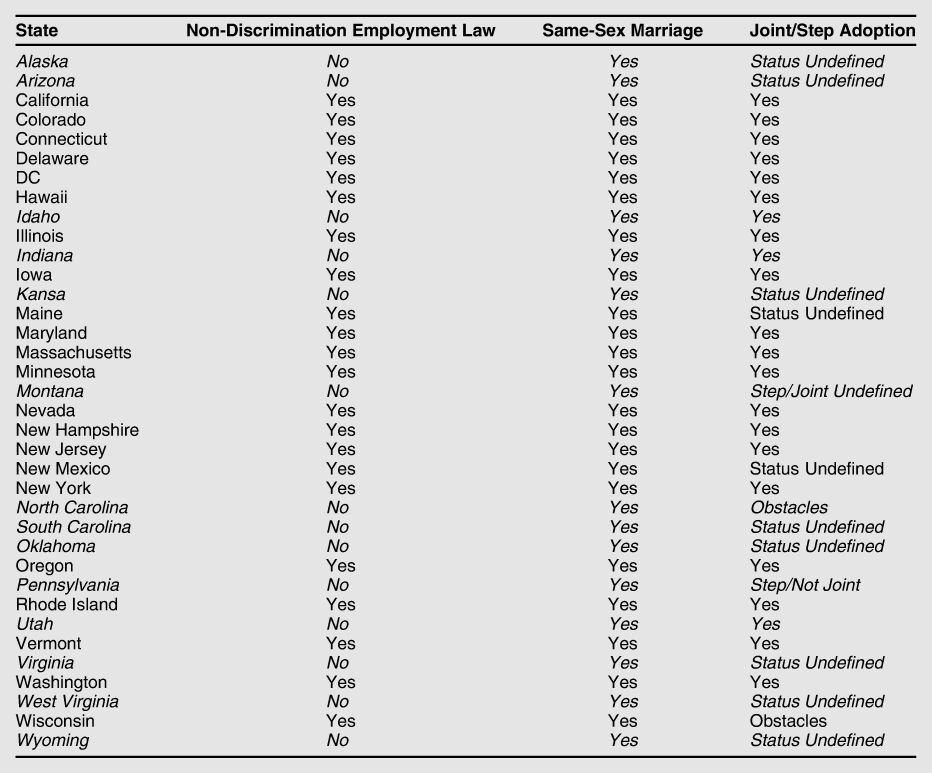
Since rights are not just tangible forms of legal access and guarantee, but also function as sites through which the state makes citizens cognizable to politico-legal institutions and to other community members, any analysis of rights should be coupled with a parallel evaluation of the changing nature of state power. The development of an expanded field of secured gay rights is not only a matter of socio-political and legal mobilization, but of how governing or regulatory authorities have recognized the meaning and content of sexuality citizenship. Citizenship, because it is a status that relies upon recognition by others, can serve as a means to uncover the changing relationship between the individual and the state on various dimensions, including sexuality. In the United States, the status of the lesbian, gay, bisexual, and transgender-identified citizen is far from wholly or consistently recognized, as table 1 details. It varies over time, across space, and by policy issue.
Finally, the actors of interest in this explication of the changing nature of sexuality citizenship in the United States are not necessarily or not only social movement actors—interest groups, legal organizations, protest mobilizers, subcultural institutions—that have comprised the lesbian and gay rights movements of the last seventy years. Given the focus here on how regulatory authorities see and define the citizen, the particular authority of interest might be a legislature, a bureaucratic agency, a judge, a lawyer in the Department of Defense or other cabinet department, or a private-sector human resource manager. Clearly, actors who mobilize in the name of sociopolitical and legal reform play a role in their own self-definition; they compel shifts in how regulatory authorities might define them. Nevertheless, I draw attention to the type and scope of public regulatory recognition that has defined the boundaries of sexuality citizenship, i.e., how the state sees the citizen, particularly regarding how it has defined and regulated citizens’ sexuality in different ways over time.
The notion of governance—as constituted by a set of distinct rules, regulations, laws, and policies that can exist in tension with one another such that policy moves toward equality continue to reveal persistent inequities—is aptly illustrated by shifts in military regulations toward gay, lesbian, and bisexual service members. Gay, lesbian, and bisexual military personnel are recognized as married and eligible for some spousal benefits but go unrecognized and ineligible for others due to the frictions created by interactions among multiple orders of regulation: marriage, access, religion, and employment. The polity as multiple incongruent orders resulting from partial and incomplete change and the consequent abrasion between new and existing laws, regulations, policies and customs is fully evident.
Additional opportunities for research follow from this developmental conception of the polity and its implications for considering citizenship as temporally and spatially fragmented. First, in the United States, regulatory recognition is not a matter of state institutions alone. Different institutions power over and operate upon the citizen at different stages in the life cycle. The site of regulatory authority changes over the lifecycle as individuals become employed, marry, have children, etc., and as such, recognition and indeed the target of social reform may correspondingly shift. Footnote 149 Citizens’ lives are regulated by non-state authorities; access to healthcare, life insurance, and other resources of family care are regulated often through private employment. These private regulatory authorities should be examined as to how they shape recognition of lesbian and gay citizens as well as how those recognitions interact with, confound, or supplant similar or oppositional state or public policies. Footnote 150
Second, table 1 reveals new potential for unequal treatment. In 2014, marriage recognition began in states that do not maintain statutory protections from discrimination for gays or lesbians in employment, housing, or public accommodations; before 2014, states that recognized same-sex marriage also tended to protect gays and lesbians from discrimination as well as provide parental rights via adoption. This new circumstance poses significant instability for gay and lesbian citizens especially in the wake of the Supreme Court’s ruling in Burwell v. Hobby Lobby (2014), which permitted privately-owned corporations to not provide contraception, as mandated by the Patient Protection and Affordable Care Act, should provision violate owners’ religious beliefs. Footnote 151 Implications for gay and lesbian rights claims are obvious: an employer could legally fire a gay or lesbian employee and claim cover of religious belief. As getting married to a same-sex partner expresses gay or lesbian identity, getting married potentially threatens livelihoods in certain states. In Hobby Lobby, Justice Alito indicated that the ruling could not be used as cover for discrimination claiming that the ruling “provides not such shield [as] the Government has a compelling interest in providing equal opportunity to participate in the workforce without regard to race, and prohibitions on racial discrimination are precisely tailored to achieve that critical goal.” Footnote 152 However, as the federal government and many states do not ban employment discrimination on the basis of sexual orientation or gender identity, the Hobby Lobby ruling creates a very real potential to which Alito’s assurance does not speak. The ruling highlights once more how changes toward equality in one governing order (marriage) can create conflict with another (employment). And these tensions should be examined further.
Variation in LGB law and policy in the United States (as of November 21, 2014)

Notes: In the 14 italicized states getting married—thereby outing oneself as gay or lesbian—could threaten employment; no statutory protections from discrimination on the basis of sexual orientation exist in those states. States not listed do not (at time of writing) recognize same-sex marriage nor protect from discrimination in employment.
Marriage data from “Same-Sex Marriage State-by-State,” 20 October 2014, http://www.pewforum.org/2014/10/20/same-sex-marriage-state-by-state/ (accessed 23 October 2014). Employment statute data from “Statewide Employment Laws and Policies,” Human Rights Campaign, updated 9 October 2014, http://hrc-assets.s3-website-us-east-1.amazonaws.com//files/assets/resources/statewide_employment_10-2014.pdf (accessed 16 October 2014). Adoption Laws (either second-parent/stepparent or join) vary widely. On joint see “Parenting Laws: Joint Adoption,” Human Rights Campaign, updated 10 June 2014, http://hrc-assets.s3-website-us-east-1.amazonaws.com//files/assets/resources/parenting_joint-adoption_082013.pdf. On second-parent adoption see “Parenting Laws: Second Parent or Stepparrent Adoption,” Human Rights Campaign, updated 10 June 2014, http://hrc-assets.s3-website-us-east-1.amazonaws.com//files/assets/resources/parenting_second-parent-adoption_2-2014.pdf.
The Utah State Supreme Court lifted a stay on a ruling permitting same-sex parental adoption on October 23, 2014. Molly Reilly, “Utah Supreme Court Lifts Hold on Same-Sex Adoptions,” The Huffington Post, 23 October 2014, http://www.huffingtonpost.com/2014/10/23/utah-same-sex-adoptions_n_6037978.html (accessed 23 October 2014).
Status Undefined means that second-parent adoption or adopting the child of one’s partner and joint or adopting a child from its biological parents or from the state is not clearly defined in the context of same-sex couples. In other words, there is no explicit allowance for same-sex adoption but also no explicit ban.
Third, the critical developmental insight—the polity as made up of multiple clashing orders—is in no way a phenomenon limited to the United States. While it may be more evident in federalist systems, it is a function of political change, change that is always incomplete and hardly comprehensive. While the characterization of US state development as exceptional remains hotly contested, more recently scholars have demonstrated strong national government action and development where previous scholars saw little. Footnote 153 Given possibilities of developmental congruence, there is ample reason to explore how the fracturing of citizenship may be evidence cross-nationally. Countries that have similarly attempted to provide equal access to the military and various forms of relationship recognition to gay and lesbian citizens, e.g., the United Kingdom, France, and Germany, among others, may be a place to start.
And, fourth, just as the concept of sexuality orders in the United States introduced here draws on King and Smith’s notion of racial orders, fragmented citizenship—the idea that the regulatory recognition of an individual’s status can vary across time, can vary across space at a given moment in time, and can vary according to policy domain (e.g., parental rights, employment protection, criminal status, marital recognition, etc.)—is a phenomenon not limited to gays, lesbians, bisexuals, or transgendered persons. The case of lesbian, gay, and bisexual recognitions was utilized here to demonstrate how APD concepts can be fruitfully applied to yield new insights and thus, how much can be gained by increased developmental attention to gay and lesbian politics.
If citizenship is neither a comprehensive bundle of rights derived from nature nor a set of participatory responsibilities to maintain functional governance, but instead is a constructed, relational, and institutionally-recognized status that enables the claim to rights as well as the expectation of an ability to participate, then how we think about those institutions—both state and private regulatory authorities—influences how we understand the nature, meaning, and experience of citizenship. If the polity is neither complete nor “at equilibrium,” but is, as developmental accounts suggest, always already in tension across its multiple orders, then this condition suggests that citizenship is not only temporally and spatially contingent but also fragmented. If the set of institutions, ideas, and rules on which citizenship derives its meaning is always in flux, then citizenship is perhaps better conceptualized as inherently unstable as well.