Differentiating asymptomatic bacteriuria from urinary tract infection (UTI) is a common diagnostic challenge among hospitalized patients. Data on the epidemiology of bacteriuria and pyuria in the inpatient setting are limited. For patients with urinary catheters, the incidence of bacteriuria is 3%–8% per day, with nearly all catheterized patients becoming bacteriuric after 1 month.Reference Hooton, Bradley and Cardenas 1 – Reference Warren, Tenney, Hoopes, Muncie and Anthony 3 In a study of hospitalized patients, the rate of bacteriuria in catheterized patients was 51% versus 18.6% among noncatheterized patients.Reference Leis, Rebick and Daneman 4
Because the diagnosis of UTI relies on clinical and laboratory findings, a positive urine culture alone is insufficient. Urine culture interpretation in hospitalized patients is complicated by concurrent illnesses; thus, findings from urinalysis and/or urine microscopy can be a useful diagnostic aid. In a study of outpatient women with uncomplicated UTI symptoms, the combination of negative leukocyte esterase and nitrite on urinalysis had a negative predictive value of 98.3% for bacteriuria of ≥105 colony-forming units (CFU)/mL.Reference Semeniuk and Church 5 In another study of inpatients and outpatients, the same combination had a 100% negative predictive value for bacteriuria of ≥105 CFU/mL.Reference Oneson and Groschel 6
Guidelines support the use of urinalysis and/or urine microscopy to help differentiate UTI from asymptomatic bacteriuria.Reference Hooton, Bradley and Cardenas 1 , Reference Nicolle, Bradley, Colgan, Rice, Schaeffer and Hooton 7 However, data on the use of these tests in inpatients are limited. Most studies have been performed either among outpatients or catheterized inpatients, populations that differ significantly from the general inpatient population.Reference Wilson and Gaido 8 – Reference Trautner, Patterson and Petersen 14 Here, we describe the frequency of urine cultures performed in inpatients without additional testing for pyuria by urinalysis or urine microscopy.
METHODS
Study Design and Participants
We conducted a retrospective, cohort study at Barnes-Jewish Hospital (BJH), a 1,250-bed academic hospital in St Louis, Missouri. The study cohort comprised patients who had at least 1 urine culture performed during admission. Patients were selected from 4 general medical wards, 2 surgical wards, the medical intensive care unit (MICU), and the surgical intensive care unit (SICU). We included patients admitted to the medical or surgical wards between January 2008 and December 2013, or to the MICU or SICU between January 2012 and December 2013.
Data Collection
We abstracted urine diagnostic data from the BJH electronic medical informatics database, including culture collection date, location (the unit on which the culture was obtained), culture result, and specimen type (clean catch versus catheterized), as well as any urinalysis and urine microscopy with test date, location, and results. For cultures with accompanying urinalysis or microscopy, the difference in calendar days between the culture and urinalysis and/or microscopy was calculated. The presence of a urinary catheter at the time of culture was identified based on specimen type per the hospital’s computerized provider order entry (CPOE) system.
Patient data abstracted from the medical informatics database included demographic data and length of stay. Admission-associated comorbidities and genito-urologic procedures were identified by abstracted International Classification of Diseases 9 th Revision Clinical Modification (ICD-9-CM) codes (Supplementary Table).
Outcomes and Definitions
The primary study outcome was the proportion of urine cultures obtained as isolated cultures. We defined an isolated urine culture as a one without an associated urinalysis and/or urine microscopy performed within 1 calendar day before or after the culture. The secondary outcome was the proportion of catheter-associated urinary tract infections (CAUTIs) identified among ICU patients with isolated urine cultures.
The first urine culture obtained from the patient during the hospital admission was termed the “initial” culture. Urine cultures performed after the first culture of an admission were “subsequent” cultures. A positive culture was defined as any bacterial or fungal growth according to routine hospital laboratory protocols. The primary analysis included both initial and subsequent cultures.
CAUTI surveillance was conducted by the hospital’s infection prevention department and was initiated in BJH ICUs in January 2012. CAUTI was defined according to National Healthcare Safety Network definitions. 15 , 16
Statistical analysis
Data were analyzed using SAS version 9.3 software (SAS Institute, Cary, NC). Descriptive statistics described the proportion of isolated urine cultures in patient subgroups. For categorical variables, between-group differences were analyzed using χ2 or univariable logistic regression where appropriate. For continuous variables, differences were assessed using the Student t test and the Wilcoxon signed-rank test.
To determine independent risk factors associated with performance of isolated urine cultures, we conducted a per-patient analysis. We categorized patients based on their initial culture of the admission to limit bias from overrepresentation of patients with multiple urine cultures. Forward, stepwise, multivariable logistic regression analysis was used to identify risk factors for isolated culture. A P value ≤.15 was used to allow variable entrance into the model, and a P value ≤.05 was required to remain in the final model.
We determined the proportion of CAUTIs identified by an isolated urine culture within the MICU and SICU. For the CAUTI assessment, we again only used the initial culture of the admission to avoid bias from overrepresentation.
P values<.05 were considered statistically significant for all tests. The Washington University Human Research Protection Office approved this study.
RESULTS
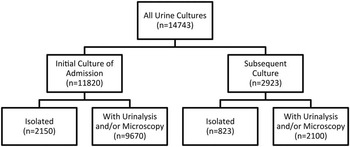
During the study period, 11,826 admissions met the inclusion criteria. We excluded 6 admissions due to incomplete data. In total, 14,743 cultures (11,820 initial and 2,923 subsequent cultures) performed during 11,820 admissions were analyzed (range, 1–12 cultures per admission) (Figure 1).
Summary of urine cultures performed in the study units.

Subsequent cultures were more likely to be ordered for patients with urinary catheters than were initial cultures (27.1% vs 12.2%; P<.001). Of the 14,743 urine cultures obtained, 6,452 (43.8%) were positive for microbial growth. Initial cultures were more likely to be positive than subsequent cultures (44.4% vs 41.2%; P=.002).
The overall urine culture rate was 63.5 cultures per 1,000 patient days. The MICU had the greatest frequency of urine cultures (133.5 per 1,000 patient days), followed by the medical wards (63.5 per 1,000 patient days), the SICU (53.8 per 1,000 patient days), and the surgical wards (53.6 per 1,000 patient days). ICUs had a higher incidence of urine cultures than non-ICU units (85.7 vs 58.8 per 1,000 patient days; P<.001), as did medical versus surgical units (63.5 vs 53.6 per 1,000 patient days; P<.001).
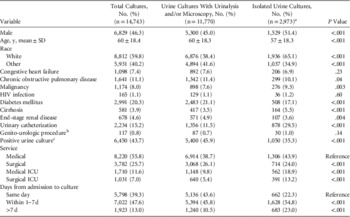
In total, 2,973 urine cultures (20.2%) were isolated cultures, (ie, sent without urinalysis and/or urine microscopy), for a rate of 12.8 isolated cultures per 1,000 patient days (Table 1). Isolated cultures were most common in the SICU (37.9% of urine cultures obtained), followed by the MICU (32.9%), surgical wards (18.9%), and medical wards (15.9%). Subsequent cultures were more likely to be isolated cultures than initial cultures (28.2% vs 18.2%; P<.001). In catheterized patients, 878 cultures (39.3%) were isolated, and 30 cultures (25.6%) in patients with genitourologic procedures were isolated. Of the 2,973 isolated cultures, 1,050 (35.3%) were positive for microbial growth.
Characteristics of 14,743 Urine Cultures Obtained From Patients on Study Units

NOTE. SD, standard deviation; HIV, human immunodeficiency virus; ICU, intensive care unit.
a Cultures without associated urinalysis or urine microscopy performed within 1 calendar day of the culture.
b As defined by the National Healthcare Safety Network 15 , 16 based on ICD-9-CM procedure codes; includes kidney and prostate procedures, and vaginal hysterectomy.
c Culture positive for bacterial or fungal growth.
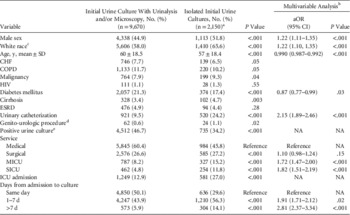
We identified 2,150 (18.2%) initial urine cultures of each admission as isolated cultures (Table 2). Several factors were independently associated with isolated initial urine culture: male sex, white race, ICU admission, urinary catheterization, and culture sent ≥1 calendar day after admission. Older age and diabetes mellitus conferred a lower risk of isolated urine cultures being obtained. We performed a sensitivity analysis comparing isolated urine cultures redefined as those without a urinalysis and/or microscopy sent within 2 calendar days to the original definition of 1 calendar day. This resulted in a slight decline in the proportion of isolated cultures (1,984 [16.8%] vs 2,150 [18.2%]). We also compared patients who had only isolated cultures obtained during their admission to those having at least 1 culture sent with accompanying urinalysis or microscopy, with no significant change in our findings (data not shown).
Comparison of Patient Risk Factors for Isolated Initial Urine Cultures

NOTE. aOR, adjusted odds ratio; SD, standard deviation; CHF, congestive heart failure; CI, confidence interval; COPD, chronic obstructive pulmonary disease; ESRD, end-stage renal disease; HIV, human immunodeficiency virus; ICU, intensive care unit; MICU, medical intensive care unit; NA, not applicable; SICU, surgical intensive care unit.
a Isolated cultures were defined as cultures without associated urinalysis or urine microscopy performed within 1 calendar day of the culture. Initial cultures were defined as the first culture drawn in a given admission.
b Variables with a significance of ≤0.15 were considered for entry into the model, with a significance level of ≤0.05 required to stay in the model. The variables “positive urine culture” and “ICU admission” were not used in constructing the model. All other variables without adjusted odds ratios reported were not included in the final model. See the Methods section for a full description.
c Other races, as number (%) of total initial urine cultures: 3,982 (33.7%) black, 695 (5.9%) other unspecified, 104 (0.9%) Asian, 17 (0.1%) Native American, 4 Hispanic, 1 Pacific Islander, 1 Alaskan Native.
d As defined by the National Healthcare Safety Network, 15 , 16 based on ICD-9-CM procedure codes. Includes kidney and prostate procedures, and vaginal hysterectomy.
e Culture positive for bacterial or fungal growth.
Infection prevention surveillance identified 61 CAUTIs in the ICUs during the study period, representing 2.2% of all ICU cultures performed. The SICU had significantly more CAUTIs identified per culture than the MICU (37 of 1,031 vs 24 of 1,710, P=.002). Of the 61 CAUTIs identified, 31 (50.8%) were based on an isolated culture. There was no significant difference between the MICU and SICU in the proportion of isolated urine cultures identified as CAUTIs (14 of 562 [2.5%] vs 17 of 391 [4.3%]; P=.112).
DISCUSSION
Urine culturing was a frequent practice in our study units. Although the majority of urine cultures were accompanied by orders for urinalysis and/or urine microscopy, 1 in 5 cultures was sent without additional workup. Among catheterized patients, more than one-third of cultures were sent without an associated urinalysis or microscopy. Approximately 50% of CAUTIs identified in the ICUs during the 2-year study period were identified on the basis of an isolated culture.
Urine culture rates varied by unit type, with higher rates noted on medical versus surgical units. The MICU had a urine culture rate more than double the composite rate. A recently published study from 2 Veterans Affairs hospitals reported baseline urine culture rates of 41.2 and 43.9 per 1,000 patient days, respectively, while a study of adult ICUs at an academic medical center in Maryland found a baseline rate of 139 cultures per 1,000 patient days.Reference Trautner, Grigoryan and Petersen 17 , Reference Sarg, Waldrop and Beier 18 These reports demonstrate the high variability in culture rates among and within institutions.
In our study, male sex, white race, ICU admission, catheterization, and culture performed ≥1 calendar day after admission were all independent risk factors for an isolated urine culture, with the largest differences seen in the latter 3 categories. Interventions targeted to ICUs, catheterized patients, and postadmission cultures may therefore have the greatest effect in decreasing isolated culture rates. Positive urine cultures were more common among initial cultures versus subsequent cultures, and in cultures sent with urinalysis and/or microscopy. Our analysis of this finding was limited by the inability to assess the clinical indications for culture. However, these data suggest a potential positive relationship between the clinical assessment of UTI and the ordering of an appropriate workup.
The odds of a culture being performed without urinalysis or microscopy may also be affected by the structure of the hospital’s CPOE system. The presentation of testing options to the provider by the CPOE system may alter ordering practices. For example, at the time of the study, the medicine service’s admission order set for non-ICU patients contained check boxes for urine microscopy and urine culture, potentially prompting providers to order both tests simultaneously. We were unable to assess specific methods of order entry in our study, such as the use of order sets or provider responses to presented order options. However, further research on provider behaviors within CPOE systems could improve the design of such interventions.
With the increasing focus on reimbursement of healthcare-acquired infections, it is concerning that half of the CAUTIs identified in study ICUs were based on an isolated urine culture. Even adjusting for catheterization status, ICU patients were at greater risk of having isolated cultures. Without chart review, we cannot comment on the concordance between CAUTI surveillance definitions and clinical illness, nor can we infer how performing urinalysis or microscopy may impact CAUTI rates. Also, we could not directly assess a provider’s rationale for ordering an isolated culture in the ICU. Given the higher proportion of ICU patients with urinary catheters and the surveillance focus on ICU CAUTIs, a better understanding of provider practices in this context is needed.
Our study was limited by the absence of chart review, which prevented us from evaluating testing indications, treatment, provider characteristics (eg, level of training), and other aspects of provider behavior. Certain cultures may have been performed for reasons other than UTI diagnosis, as in pregnant women and in certain preprocedure protocols. Although we attempted to limit such cultures by excluding gynecologic, obstetric, and urology wards, we were unable to assess all cultures for these indications. Additionally, comorbidities and genito-urologic procedures were identified based only on ICD-9-CM codes. CAUTI surveillance was not routine on medical and surgical floors during the study period, so CAUTI rates for these units were unavailable. We did not include data on antibiotic use; thus, we were unable to assess the impact of a positive culture with or without urinalysis on treatment. The setting of a single academic hospital also limits the generalizability of results. Strengths of our study include a large sample size and the inclusion of key clinical data, such as catheterization status and recent genito-urologic procedures. Using electronically available data, automated tracking of future interventions is feasible.
Our data suggest that interventions aimed at improving culturing practices may result in better diagnosis of inpatient UTIs. Knowledge of the variability of culturing practices across wards and patients assists in identifying those groups where interventions may be most beneficial. Further research is needed on testing practices across institutions, provider-related variables impacting urine culturing practices, and the effects of testing variability on antibiotic usage and clinical outcomes.
ACKNOWLEDGMENTS
The authors thank Dr Carey-Ann Burnham, Dr Jane Garbutt, and the staff of Barnes-Jewish Hospital Infection Prevention for their assistance and critical review of the manuscript. We also thank the staff of Barnes-Jewish Hospital Clinical Laboratories, who performed all laboratory and microbiological testing.
Financial support: Research reported in this publication was supported by the Washington University Institute of Clinical and Translational Sciences (grant no. UL1 TR000448), the Division of Infectious Diseases Institutional Training (grant no. T32 AI007172-35 to A.L.C.), and the CDC Prevention Epicenter Program (grant no. 1U 54CK000162 to D.K.W.). The content is solely the responsibility of the authors and does not necessarily represent the official views of the National Institutes of Health or the Centers for Disease Control and Prevention.
Potential conflicts of interest: All authors report no conflicts of interest relevant to this article.
SUPPLEMENTARY MATERIAL
To view supplementary material for this article, please visit https://doi.org/10.1017/ice.2016.311