Introduction
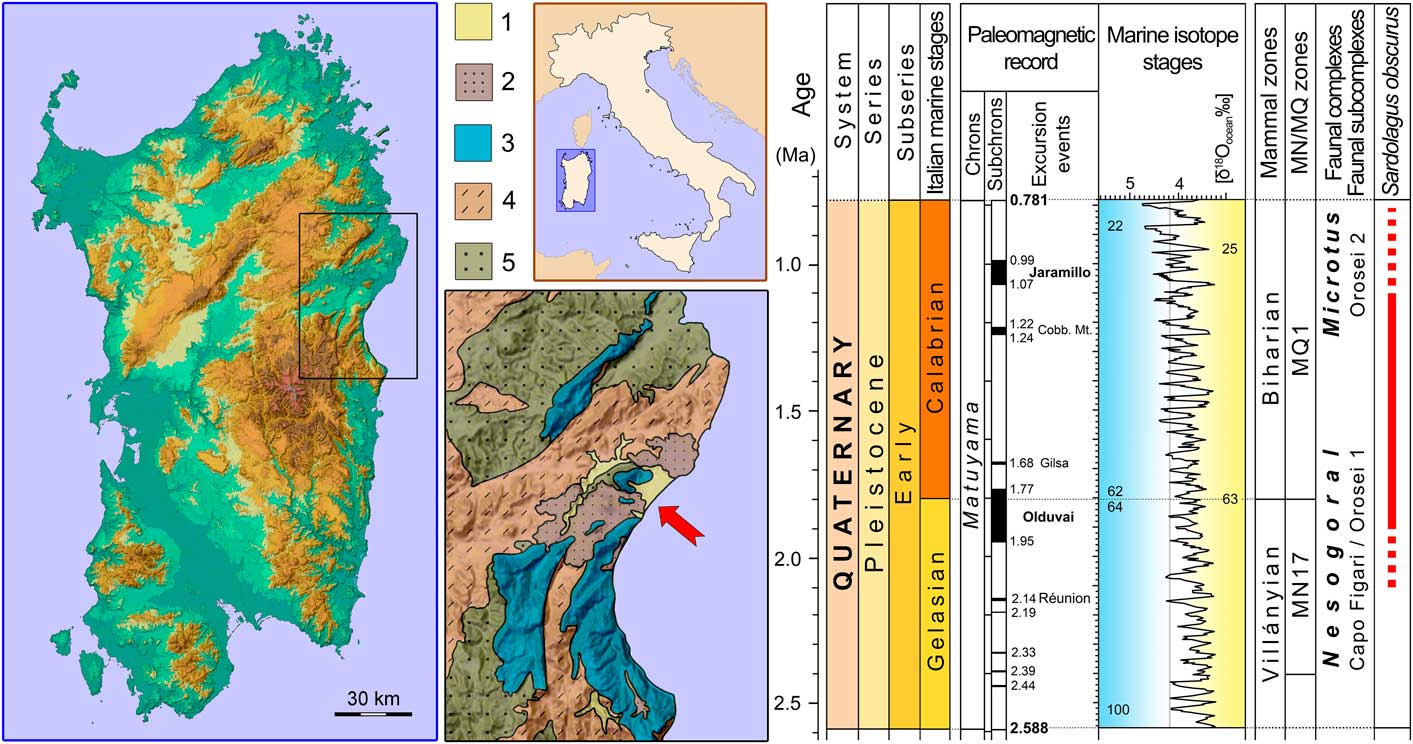
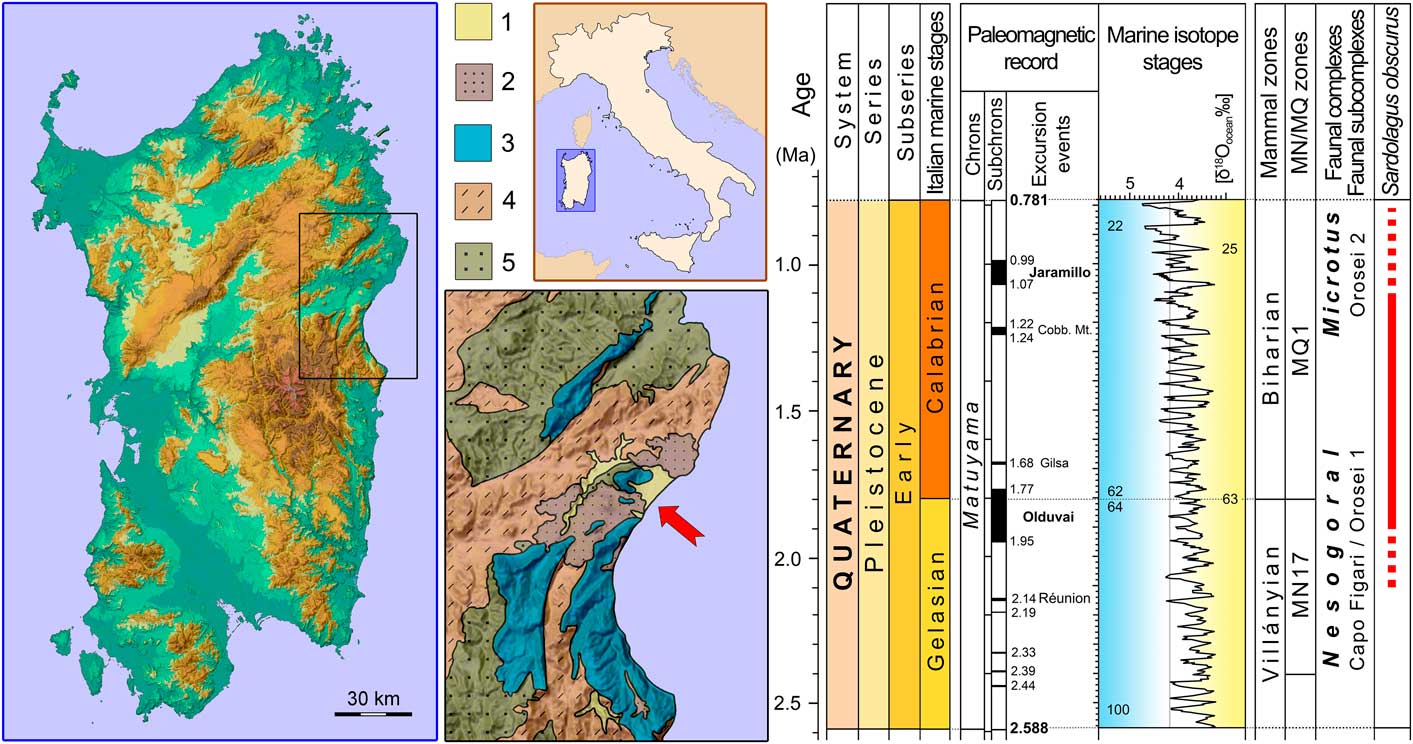
The first overviews of the Monte Tuttavista fossiliferous karst complex date back to the early years of the twenty-first century (Rook et al., Reference Rook, Abbazzi, Angelone, Arca, Barisone, Bedetti, Delfino, Kotsakis, Marcolini, Palombo, Pavia, Piras, Torre, Tuveri, Valli and Wilkens2003; Abbazzi et al., Reference Abbazzi, Angelone, Arca, Barisone, Bedetti, Delfino, Kotsakis, Marcolini, Palombo, Pavia, Piras, Rook, Torre, Tuveri, Valli and Wilkens2004). Discovery of the Monte Tuttavista karst complex (E Sardinia, Italy) (Fig. 1) was extremely important for understanding the paleobiological history of Sardinia because of the extreme abundance of vertebrate fossil material, a very high taxonomical diversity, but mainly the time span covered (early Pleistocene to Holocene). Actually, fossil sites older than Late Pleistocene are rare in Sardinia and Corsica. Discovery of the Monte Tuttavista fossil assemblages provides a remarkably deeper insight of the Quaternary fauna of Sardinia. Several species noted in the Monte Tuttavista fissure fillings have been reported for the first time in Sardinia. As far as lagomorphs are concerned, the Monte Tuttavista quarries provided remarkable material for the study of insular endemic Sardinian ochotonids (Angelone et al., Reference Angelone, Tuveri, Arca, López Martínez and Kotsakis2008), and led to the discovery of the remains of a new early Pleistocene leporid. This leporid was first reported and preliminarily classified in Rook et al. (Reference Rook, Abbazzi, Angelone, Arca, Barisone, Bedetti, Delfino, Kotsakis, Marcolini, Palombo, Pavia, Piras, Torre, Tuveri, Valli and Wilkens2003) and Abbazzi et al. (Reference Abbazzi, Angelone, Arca, Barisone, Bedetti, Delfino, Kotsakis, Marcolini, Palombo, Pavia, Piras, Rook, Torre, Tuveri, Valli and Wilkens2004) as Oryctolagus aff. O. lacosti. Detailed studies of the original material and of recent findings allowed us to erect a new leporid taxon, Sardolagus obscurus n. gen. n. sp., here described in the framework of coeval peri-Mediterranean leporids.
Geographical location of Monte Tuttavista and age span of Sardolagus obscurus n. gen. n. sp. Legend of lithology: (1) Quaternary deposits; (2) Pliocene within-plate basalts; (3) Permian to early Eocene volcano-sedimentary rocks; (4) late Variscan magmatic complex; (5) Variscan metamorphic basement (modified from Carmignani et al., Reference Carmignani, Oggiano, Funedda, Conti and Pasci2016).
Materials and methods
Dental terminology, metrics, and morphotype classification used to describe teeth follow Sych (Reference Sych1965), Palacios and López Martínez (Reference Palacios and López Martínez1980), Fladerer (Reference Fladerer1987), Fladerer and Reiner (Reference Fladerer and Reiner1996), and Čermák et al. (Reference Čermák, Angelone and Sinitsa2015). The original scheme of P2 morphotypes by Fladerer and Reiner (Reference Fladerer and Reiner1996), originally used for Hypolagus, was extended here by adding the BMR-morphotype “C” (characterized by very long hypoflexus) in order to be applicable also to advanced/modern taxa of Leporidae. For a quantification of degree of P2 complexity, we assigned to the morphological classes I→II→III→IV→V→VI of the LL-morphotype and to the classes 0→A→B→C of the BMR-morphotype the nominal values 1–2–3–4–5–6 and 1–2–3–4, respectively, indicating the number of evolutionary steps. The quantification of P2 complexity is given by the sum of nominal values of assigned LL- and BMR-morphotypes. Drawings and measurements of teeth were made using a camera lucida and an ocular micrometer on a binocular microscope. Measurements of cranial and postcranial elements were made using a digital caliper (error: 0.05 mm). All length dimensions are given in millimeters (mm) and weight estimates in grams (g). We reserve the formal term ‘crown Leporinae’ for the group of extant hares and rabbits; the formal term ‘Leporinae’, or informally ‘leporines’, for the leporid group, including Alilepus Dice, Reference Dice1931 and presumed descendants; and fossil genera closely related to that radiation are ‘stem Leporidae’ or informally ‘modern leporids’ (Flynn et al., Reference Flynn, Winkler, Erbaeva, Alexeeva, Anders, Angelone, Čermák, Fladerer, Kraatz, Ruedas, Ruf, Tomida, Veitschegger and Zhang2014; Čermák et al., Reference Čermák, Angelone and Sinitsa2015). For geologically older genera distantly related to the modern radiation, we informally use the term ‘leporid,’ or simply ‘lagomorph.’ Biostratigraphic terminology follows Palombo (Reference Palombo2009). All nomenclatural acts presented here conform to the mandatory provisions of the International Code of Zoological Nomenclature (ICZN, 1999). Country abbreviations follow ISO 3166-1 alpha-2 codes.
We analyzed samples from Monte Tuttavista fissure fillings VIIbs, X4, and part of the material from IVm. Because our preliminary analyses did not show taxonomic differences between the leporid samples extracted from different karst fissures, we analyzed the material in its entirety. For taxonomic considerations, we used dental and cranial material; for BM estimation the postcranial one. We followed the methodology for BM estimation described and illustrated by Moncunill-Solé et al. (Reference Moncunill-Solé, Quintana, Jordana, Engelbrektsson and Köhler2015, fig. 1). Due to the poor number of postcranial specimens, only the following measurements were taken on this new species of leporid: femur length, proximal femoral transversal diameter, distal femoral anteroposterior diameter, distal femoral transversal diameter, distal humeral anteroposterior diameter, distal humeral transversal diameter, proximal tibia anteroposterior diameter, proximal tibia transversal diameter, and distal tibia transversal diameter. Once the BM was obtained for each specimen, we calculated an arithmetic mean and a confidence interval for each specific measurement. Finally, we performed an arithmetic average to estimate the weight of the species.
Repositories and taxa under comparison
The material is curated in the Laboratorio di Paleontologia, Dipartimento di Scienze, Università Roma Tre (Italy). The interspecific comparisons were made with the following taxa, based on original material (indicated by “*”) or on a bibliographical basis (unless otherwise stated, data were taken from the original descriptions of species):
*Ali lepus laskarewi (Khomenko, Reference Khomenko1914) from Tarakliya (type locality) (MD), Chimishliya (MD), and Egorovka 2 (UA)—late Miocene (middle Turolian, MN 12); collections: National Museum of Natural History, V. Topachevsky Paleontological Museum (Kiev); Odessa I.I. Mechnikov National University, Paleontological Museum; National Museum of Ethnography and Natural History (Kishinev).
Alile pus turolensis López Martínez, Reference López Martínez1977 from El Arquillo (type locality) (ES)—late Miocene (late Turolian, MN13).
*Ali lepus meini Angelone and Rook, Reference Angelone and Rook2011 from Ribardella (type locality) (I)—late Miocene (late Turolian, MN13); collections: “Museo di Storia Naturale“ (Geology and Palaeontology Section) at the University of Florence.
*Nur alagus rex Quintana et al., Reference Quintana, Köhler and Moyà-Solà2011 from Punta Nati 6 (type locality) (ES, Minorca)—late Neogene (post-Messinian, Pliocene); collections: Museu de l’Institut Català de Paleontologia Miquel Crusafont (Sabadell).
Hypol agus peregrinus Fladerer and Fiore, Reference Fladerer and Fiore2003 from Monte Pellegrino (type locality) (I, Sicily)—early Pleistocene.
*Hyp olagus petenyii Čermák and Fladerer in Čermák, Reference Čermák2009 from Hosťovce 2 (SK), Ivanovce 1 (SK), Měňany 3 (CZ)—Pliocene (late Ruscinian–early Villányian, MN 15b–16a); collections: temporarily in the Institute of Geology of the Czech Academy of Sciences (Prague).
*Hyp olagus brachygnathus (Kormos, Reference Kormos1930) from Chlum 4, 6, 8 (CZ), Gombasek (SK), Holštejn (CZ), Lažánky 2 (CZ), Mladeč 3–point [7/10] (CZ), Stránská skála (CZ) and Včeláre 4E, 6/8 (SK)—early Pleistocene (Biharian); collections: temporarily in the Institute of Geology of the Czech Academy of Sciences (Prague).
*Hyp olagus balearicus Quintana et al., Reference Quintana, Bover, Alcover, Agusti and Bailon2010 from Caló d’en Rafelino (type locality) (ES, Mallorca)—earliest Pliocene?; collections: Institut Mediterrani d’Estudis Avançats (Esporles).
Seren getilagus tchadensis López Martínez et al., Reference López Martínez, Likius, Mackaye, Vignaud and Brunet2007 from Toros Menalla (type locality) (TD)—late Miocene.
*Sere ngetilagus praecapensis Dietrich, Reference Dietrich1941 from Laetoli (TA)—Pliocene; collections: Museum für Naturkunde (Berlin).
*Plio pentalagus dietrichi (Fejfar, Reference Fejfar1961) from Ivanovce (*type locality) (SK), Muselievo (BG), and Budǎi (MD) (see Čermák and Wagner, Reference Čermák and Wagner2013 for details)—early Pliocene (late Ruscinian, MN15b).
Pliop entalagus huainanensis Jin, Reference Jin2004 from Laodong cave (type locality) (CN)—late Miocene.
Pliop entalagus dajushanensis Tomida and Jin, Reference Tomida and Jin2009 from Xindong cave (type locality) (CN)—early Pliocene.
Pliop entalagus anhuiensis Tomida and Jin, Reference Tomida and Jin2009 from Tiesiju cave (type locality) (CN)—late Pliocene.
Trisc hizolagus crusafonti (Janvier and Montenat, Reference Janvier and Montenat1971) from La Alberca (type locality) (ES)—late Miocene (MN13).
Trisc hizolagus maritsae De Bruijn et al., Reference De Bruijn, Dawson and Mein1970 from Maritsa (GR, Rhodes)—late Miocene/?early Pliocene (MN 13/?14).
Trisc hizolagus dumitrescuae Radulesco and Samson, Reference Radulesco and Samson1967 from Măluşteni (type locality) (RO) and Bereşti (RO)—early Pliocene (MN14b–15a). Supplementary, still unpublished material of Trischizolagus from other Pliocene localities is tentatively referred to as Trischizolagus sp. (Čermák, unpublished data).
Oryc tolagus laynensis López Martínez, Reference López Martínez1977 from Layna (ES)—early Pliocene (MN15).
*Ory ctolagus valdarnensis (Weithofer, Reference Weithofer1889) from Valdarno (type locality) (I) and Pirro Nord (I)—early Pleistocene; collections: Basel Naturhistorisches Museum; “Museo di Storia Naturale“ (Geology and Palaeontology Section) at the University of Florence.
Oryc tolagus giberti De Marfà, Reference De Marfà2008 from Cueva Victoria (type locality) (ES)—early Pleistocene.
Oryc tolagus lacosti (Pomel, Reference Pomel1853) from Perrier-Étouaries (type locality) (FR), Saint Vallier (FR), and El Carmel (ES)—early–Middle Pleistocene (MN17–MQ2); data taken from López Martínez (Reference López Martínez1989), De Marfà (Reference De Marfà2009), and De Marfà and Mein (Reference De Marfà and Mein2007).
Oryc tolagus burgi Nocchi and Sala, Reference Nocchi and Sala1997 from Grotta Valdemino (type locality) (I), data taken from De Marfà (Reference De Marfà2009)—Middle Pleistocene.
*Ory ctolagus cuniculus (Linnaeus, Reference Linnaeus1758); recent populations of Central Europe; collections: National museum (Prague).
*Lep us europaeus Pallas, Reference Pallas1778; recent populations of Central and Eastern Europe; collections: National museum (Prague), Zoological Institute, Russian Academy of Sciences (Saint Petersburg).
*Lep us timidus Linnaeus, Reference Linnaeus1758; recent populations of Northern Europe; collections: Museum für Naturkunde (Berlin).
Abbreviations.—IVm=fissure filling IV Macaca; VIIbs=fissure filling VII blocco strada; X4=fissure filling X4; BM=body mass; FAD=first appearance datum; FC=Faunal Complex; FSC=faunal subcomplex; IC=confidence interval; N=number of specimens; OR=observed range; x̄=arithmetic mean.
Systematic paleontology
Anatomical and dimensional abbreviations.—BMR=buccal mesial reentrant (mesoflexus) of P2; I/i=upper and lower incisors; L=length; LL=lingual lobe (hypercone) of P2; M/m=upper and lower molars; P/p=upper and lower premolars; W=width.
Order Lagomorpha Brandt, Reference Brandt1855
Family Leporidae Fischer, Reference Fischer1817
Genus Sardolagus new genus
Type species
Sardolagus obscurus new species.
Diagnosis
As for type species by monotypy.
Etymology
After Sardinia, the location region.
Occurrence
As for type species.
Remarks
The Sardinian leporid shows some peculiar characters, mainly the discrepancy in p3 and P2 evolutionary stages. The combination of advanced and primitive morphotypes in upper and lower tooth rows is not a novelty in lagomorph evolution, however, in the case of the Sardinian leporid, the difference is very marked and the combination unique among leporines. Such combination is not compatible with any known genus and justifies ascription of the Sardinian leporid to a new genus.
Sardolagus obscurus new species
Figures 2–Reference Angelone, Tuveri and Arca7, Tables 1–3
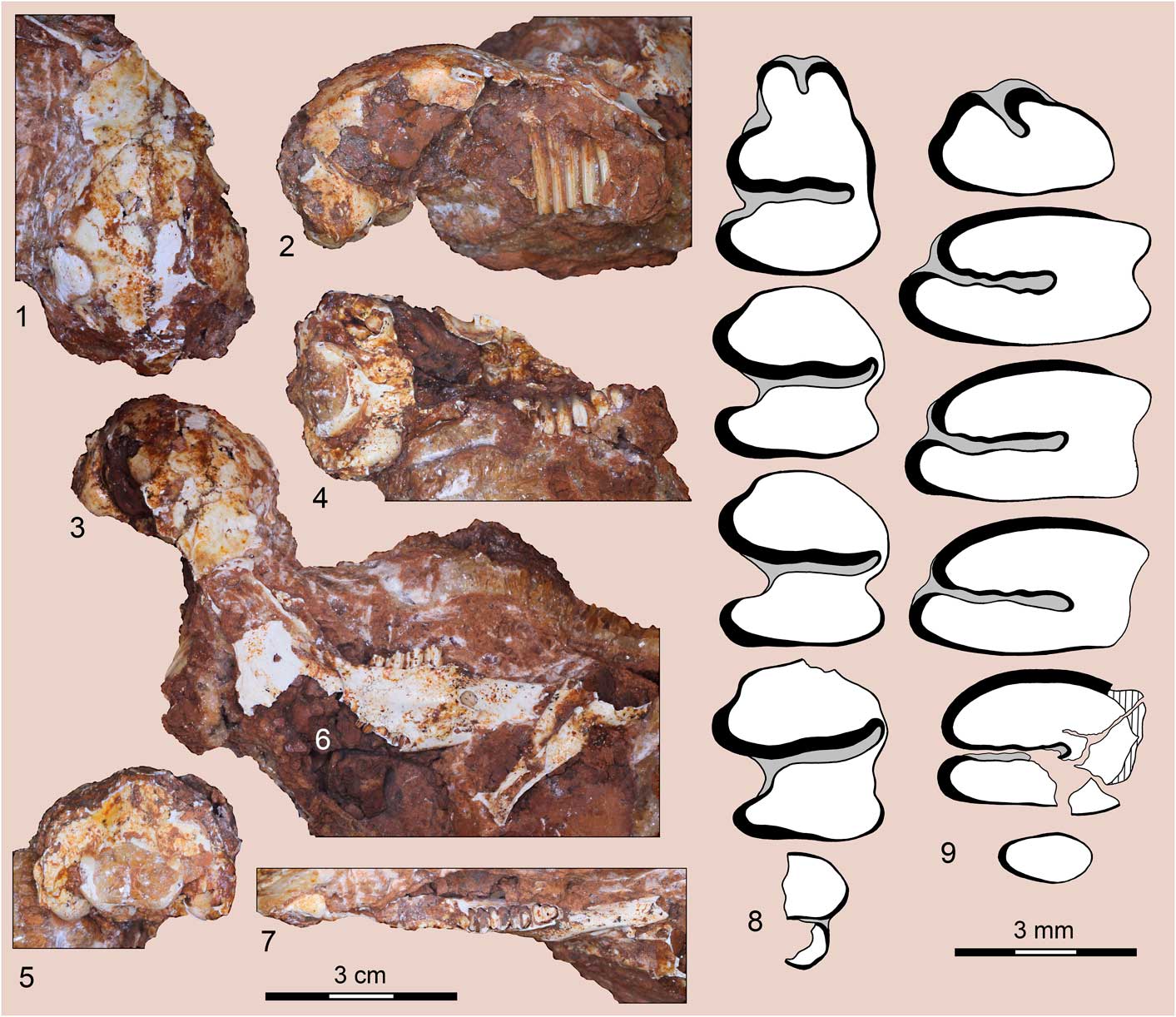
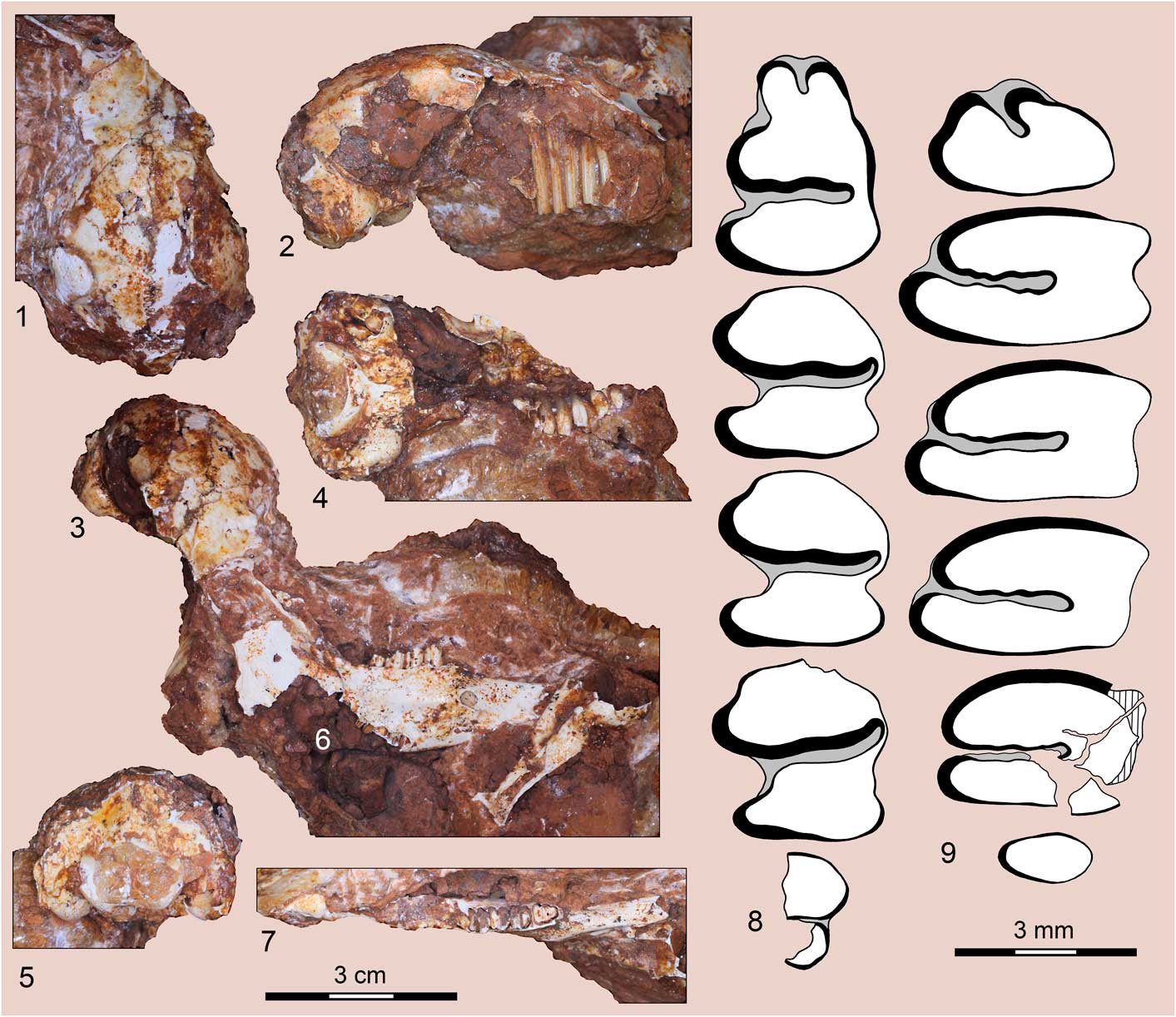
Sardolagus obscurus n. gen. n. sp. (1–5, 9) paratype (DSG/URT-053/504), incomplete cranium with left P2-M3 (9) in dorsal (1), lateral (2), rostral (3), ventral (4), and caudal (5) views; (6–8) holotype (DSG/URT-053/503), left incomplete hemimandible with p3-m3 (8) in lingual (6) and dorsal (7) views.
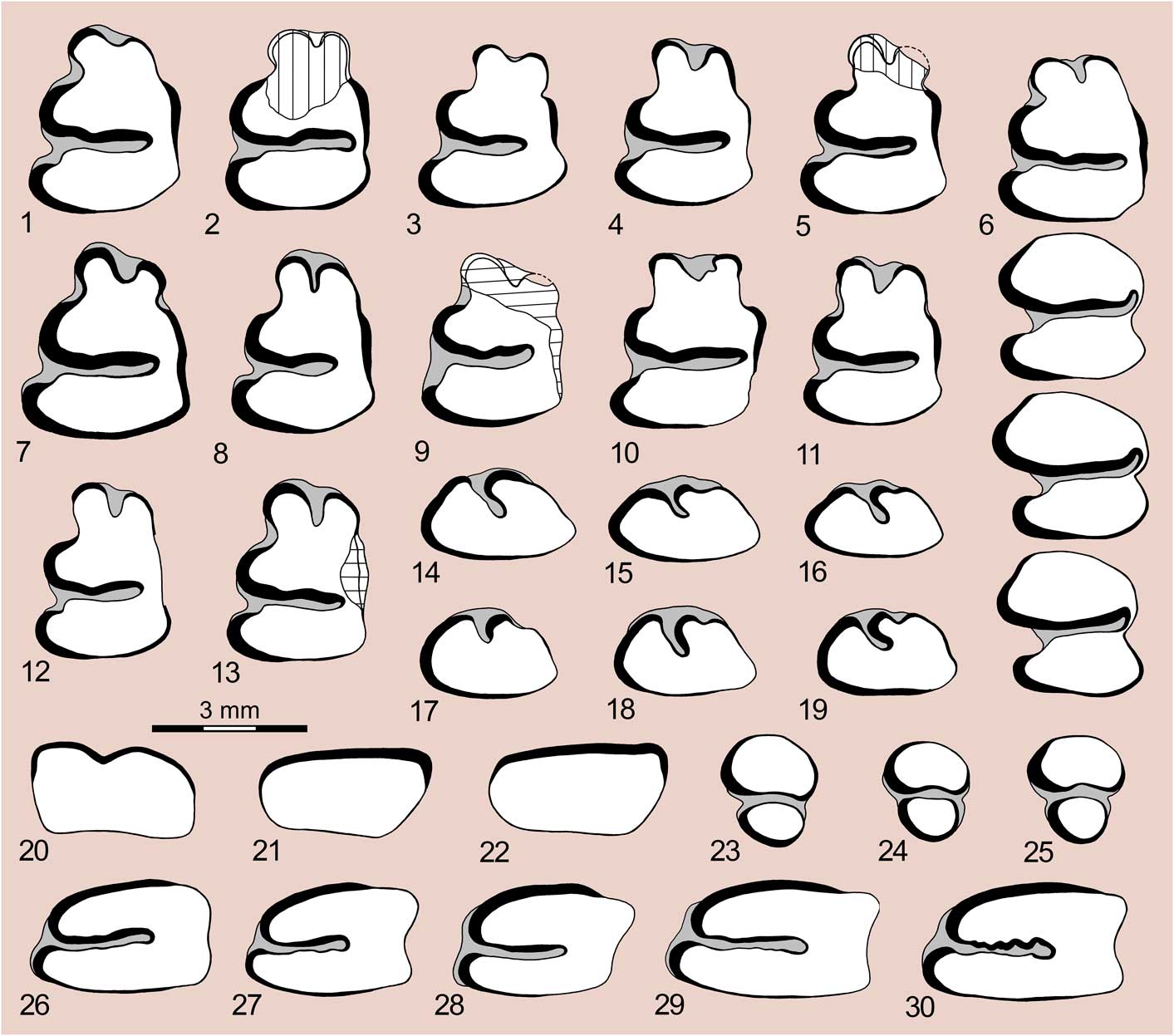
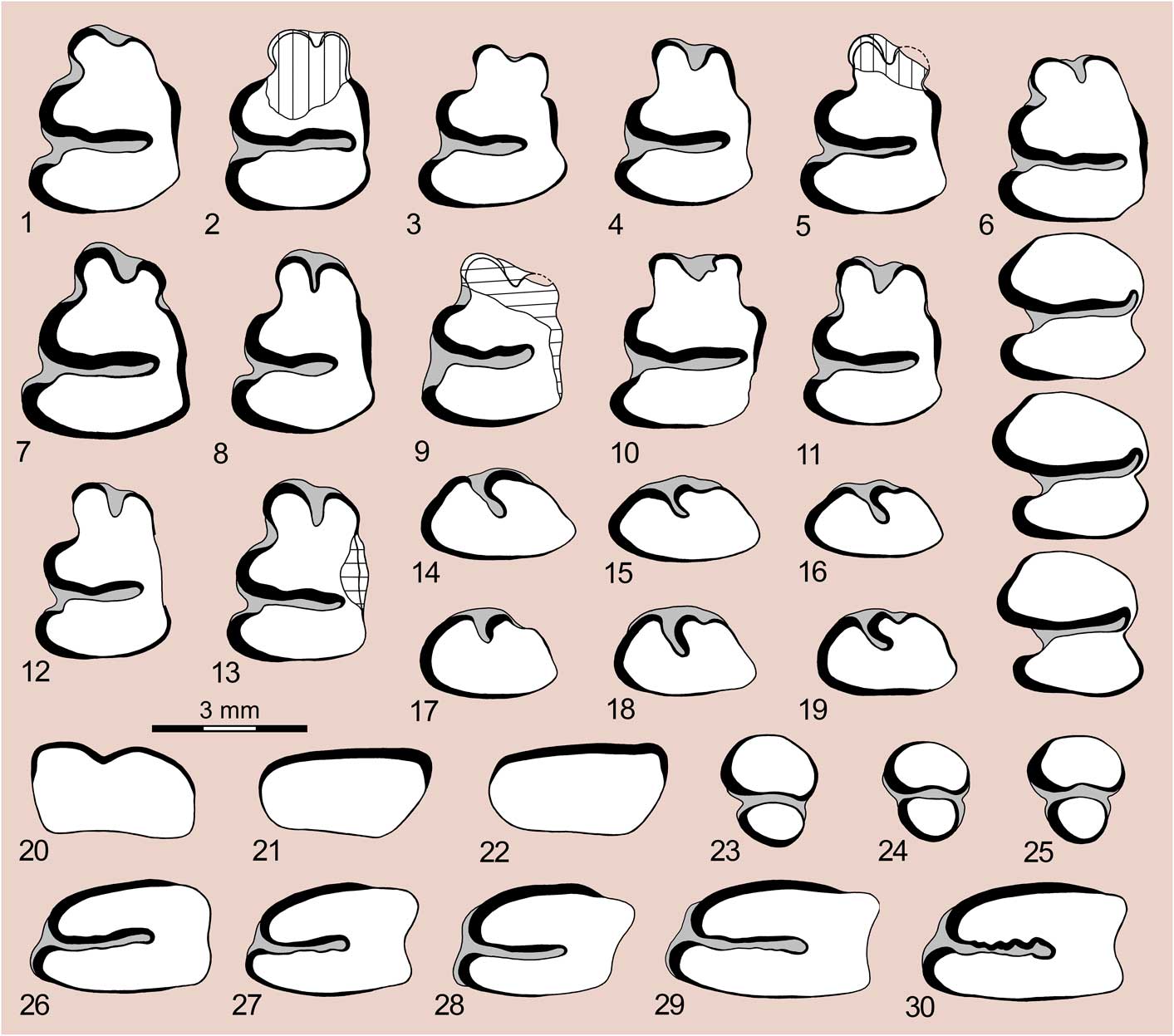
Occlusal morphology of teeth in Sardolagus obscurus n. gen. n. sp. (1) left p3, DSG/URT-053/474; (2) left p3, DSG/URT-053/495; (3) right p3, DSG/URT-053/420, reversed; (4) left p3, DSG/URT-053/422; (5) left p3, DSG/URT-053/424; (6) left tooth row p3-m2, DSG/URT-053/476; (7) right p3, DSG/URT-053/418, reversed; (8) left p3, DSG/URT-053/423; (9) left p3, DSG/URT-053/481; (10) right p3, DSG/URT-053/421, reversed; (11) right p3, DSG/URT-053/419, reversed; (12) left p3, DSG/URT-053/494; (13) left p3, DSG/URT-053/475; (14) right P2, DSG/URT-053/498, reversed; (15) right P2, DSG/URT-053/429, reversed; (16) left P2, DSG/URT-053/425; (17) left P2, DSG/URT-053/426; (18) left P2, DSG/URT-053/428; (19) left P2, DSG/URT-053/427; (20) right I1, DSG/URT-053/487, reversed; (21) left i1, DSG/URT-053/481; (22) left i1, DSG/URT-053/482; (23) left m3, DSG/URT-053/488; (24) left m3, DSG/URT-053/489; (25) left m3, DSG/URT-053/490; (26) right P3, DSG/URT-053/492, reversed; (27) right P4, DSG/URT-053/492, reversed; (28) right M2, DSG/URT-053/447, reversed; (29) right upper molariform, DSG/URT-053/500, reversed; (30) left upper molariform, DSG/URT-053/441.
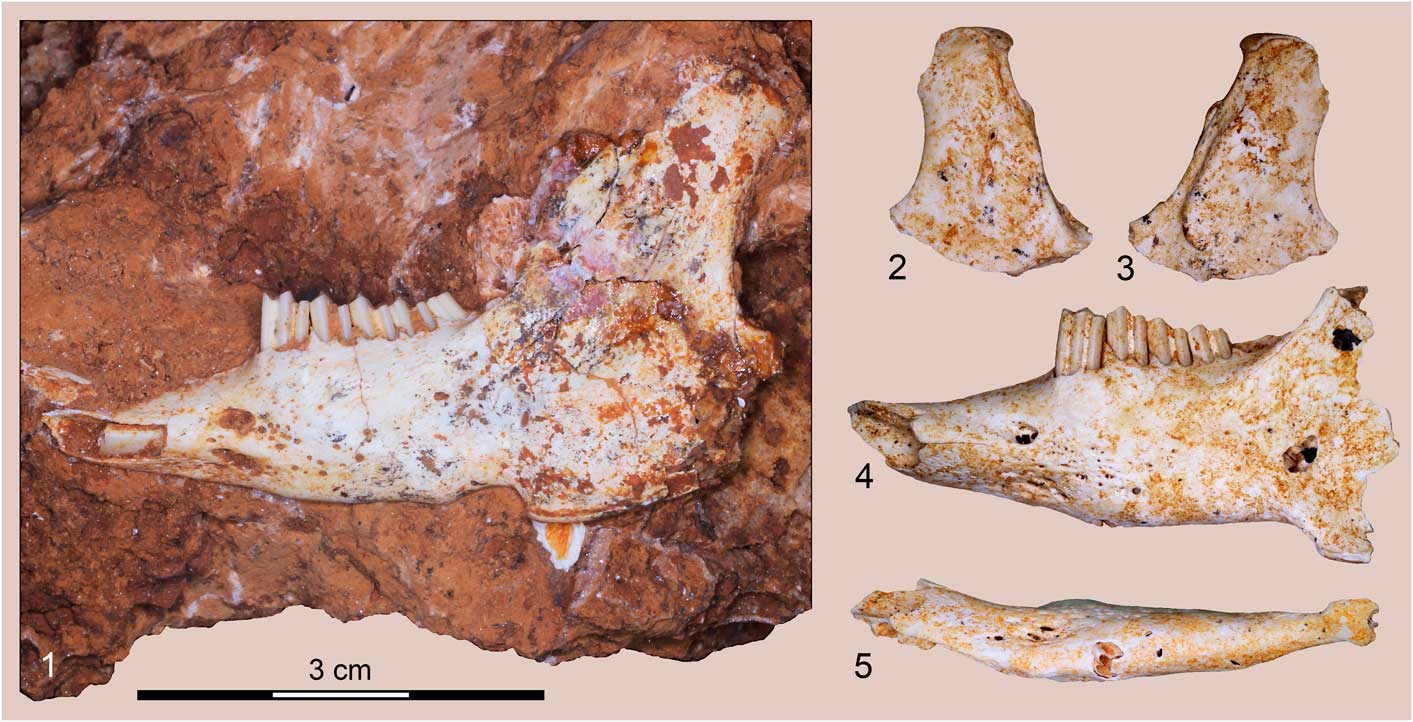
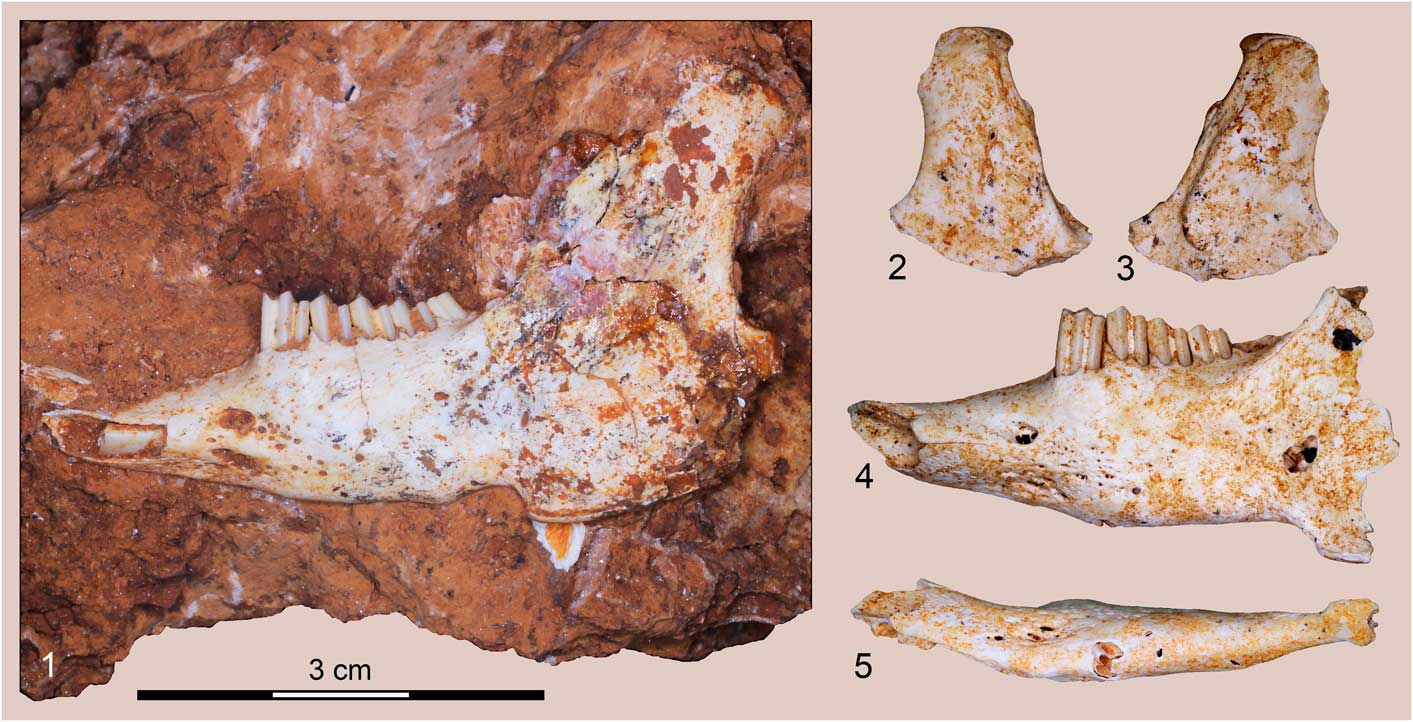
Mandibles of Sardolagus obscurus n. gen. n. sp. (1) Left hemimandible with i1, p3-m3 (DSG/URT-053/505) in buccal view; (2, 3) right mandibular ramus (DSG/URT-053/479) in lateral and medial views, respectively; (4, 5) left hemimandible with p3-m2 (DSG/URT-053/476) in buccal and ventral views, respectively.
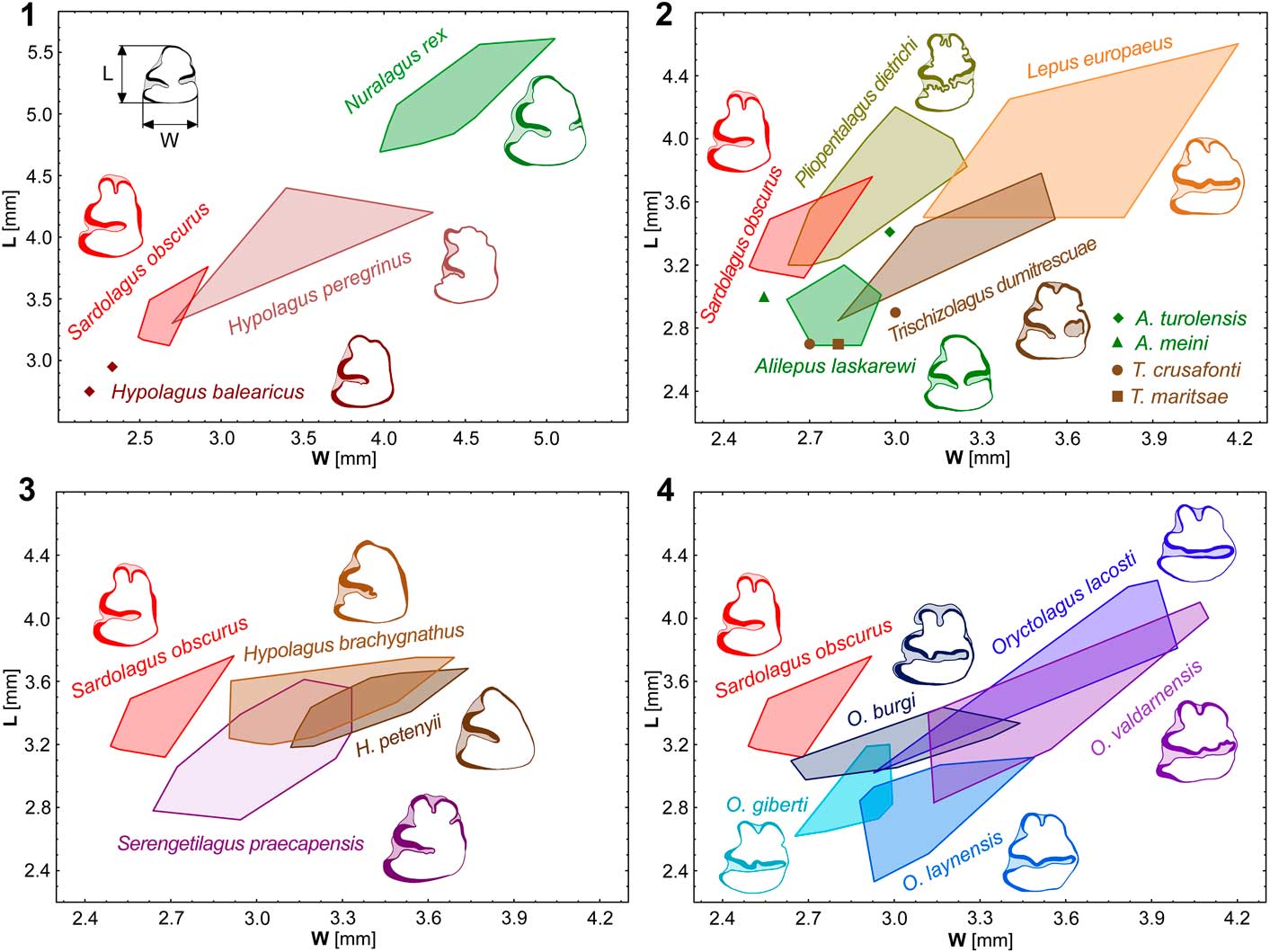
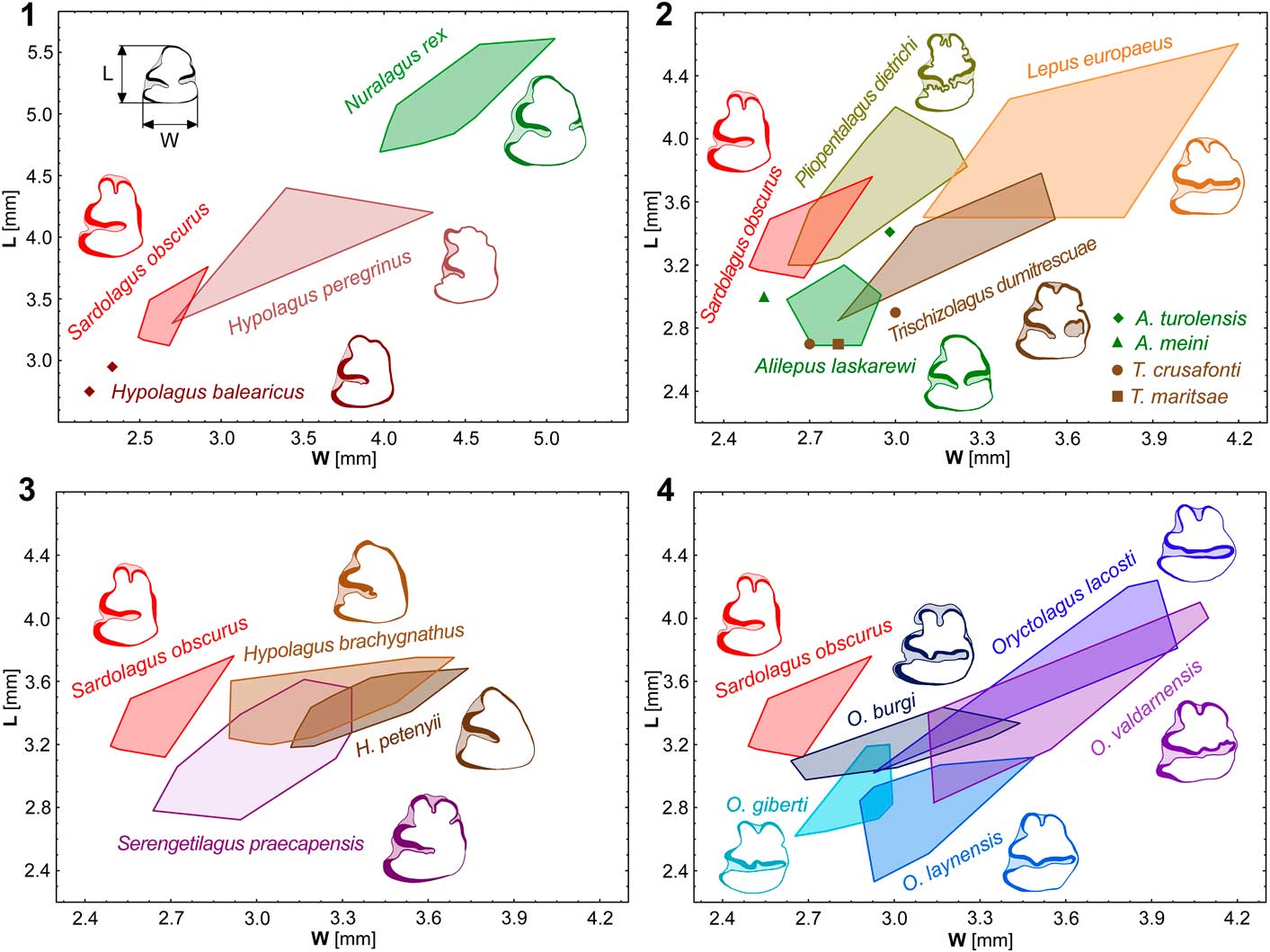
Comparison of p3 size and L/W ratio of Sardolagus obscurus n. gen. n. sp. with those in (1) insular endemic leporids of Western Mediterranean islands and (2–4) selected continental Old World species of Hypolagus, Serengetilagus, Alilepus, Pliopentalagus, Trischizolagus, Oryctolagus, and Lepus. L=length, W=width.
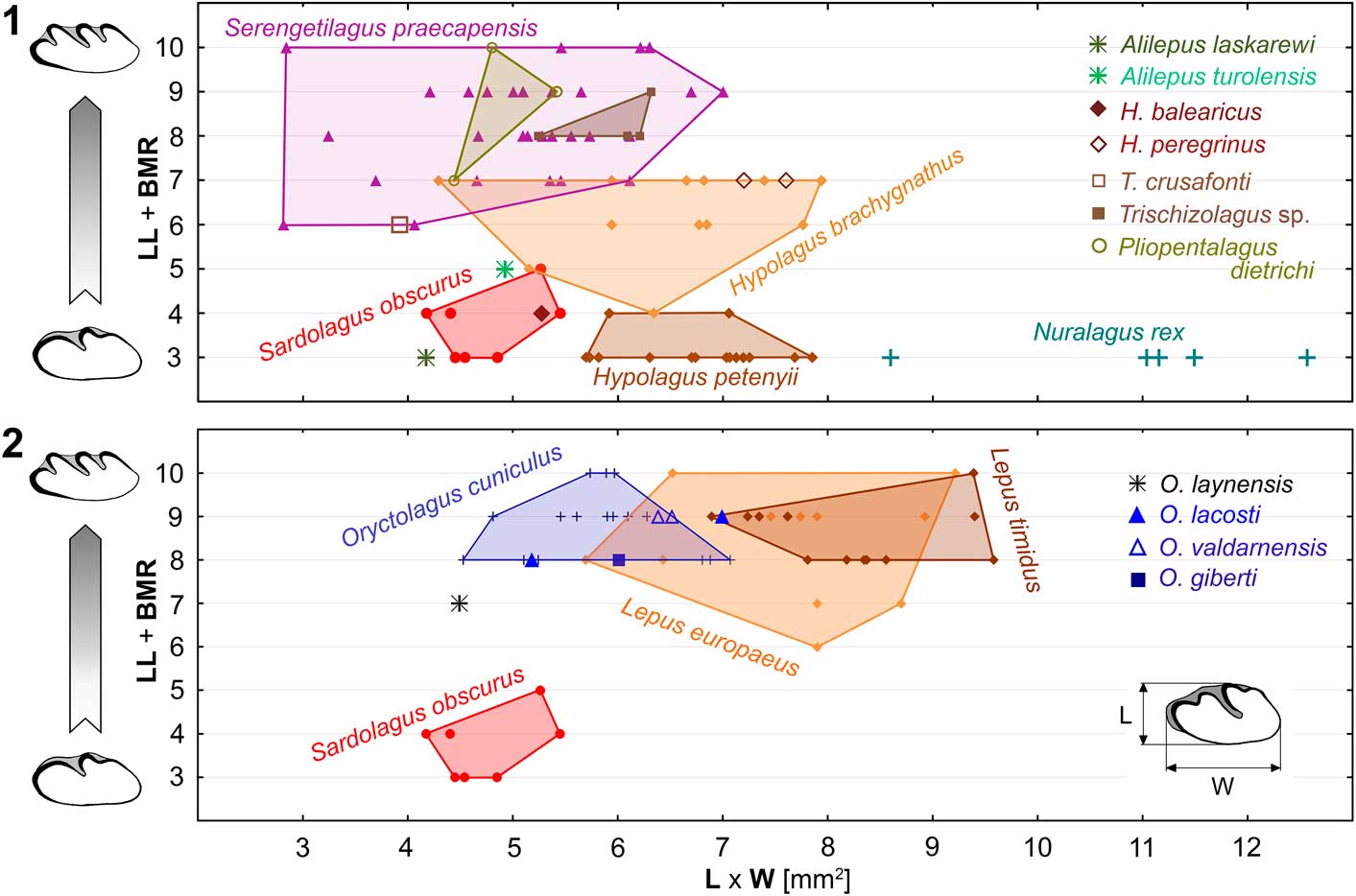
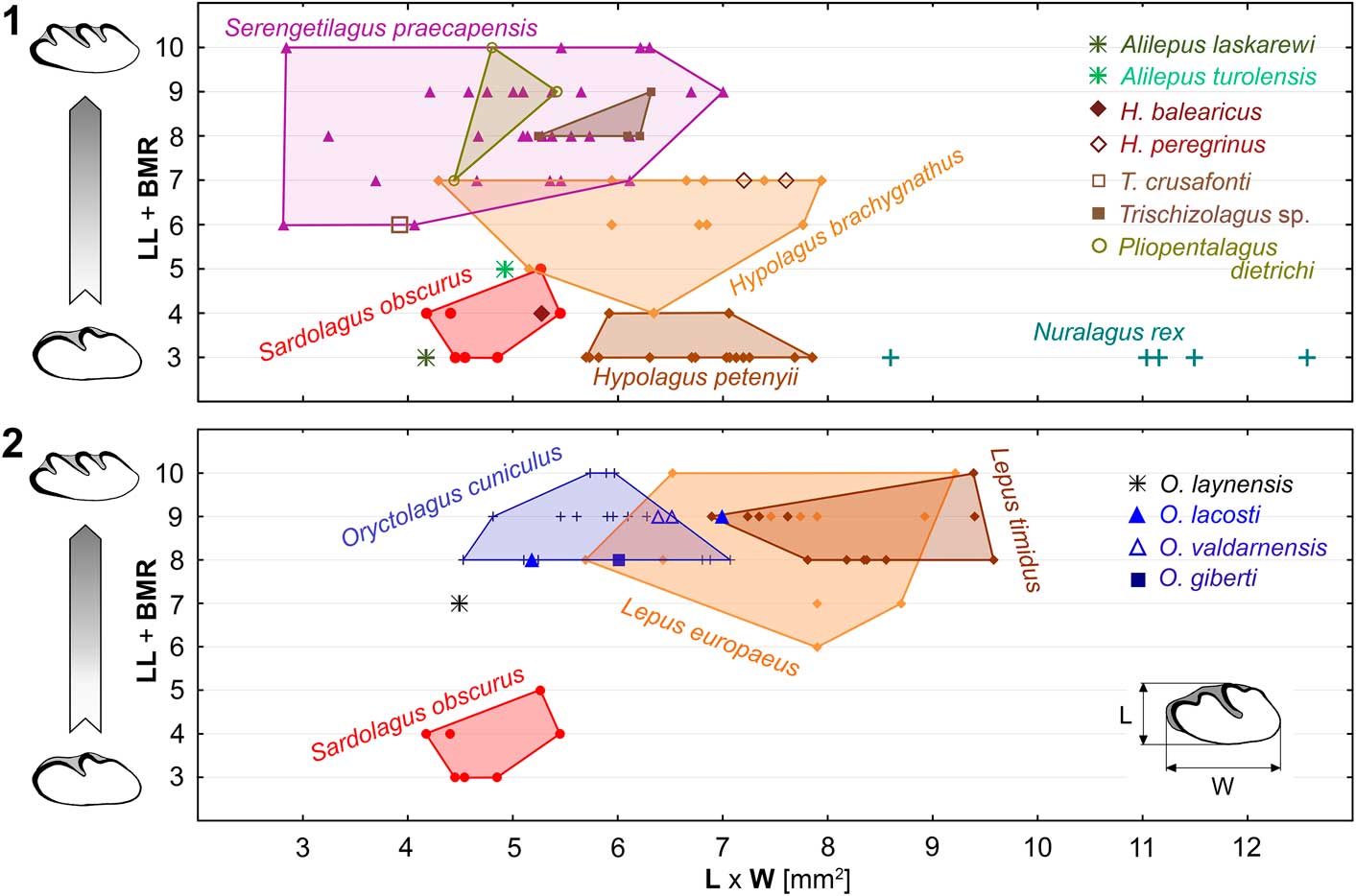
Comparison of relationships between occlusal complexity (LL + BMR morphotypes) and size (L multiplied by W) of P2 in Sadolagus obscurus n. gen. n. sp. with those in (1) selected Old World species of Hypolagus, Serengetilagus, Alilepus, Pliopentalagus, Trischizolagus, and Nuralagus and (2) recent species Lepus europaeus, L. timidus, and Oryctolagus cuniculus (including fossil species of the genus). L=length, LL=lingual lobe, BMR=buccal mesial reentrant, W=width.
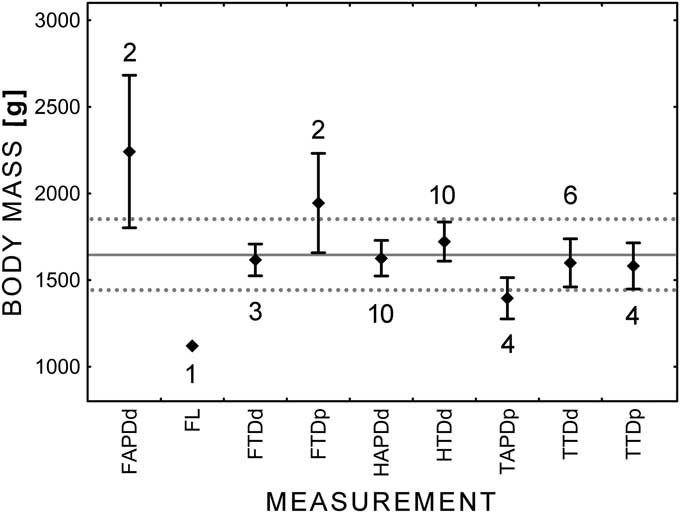
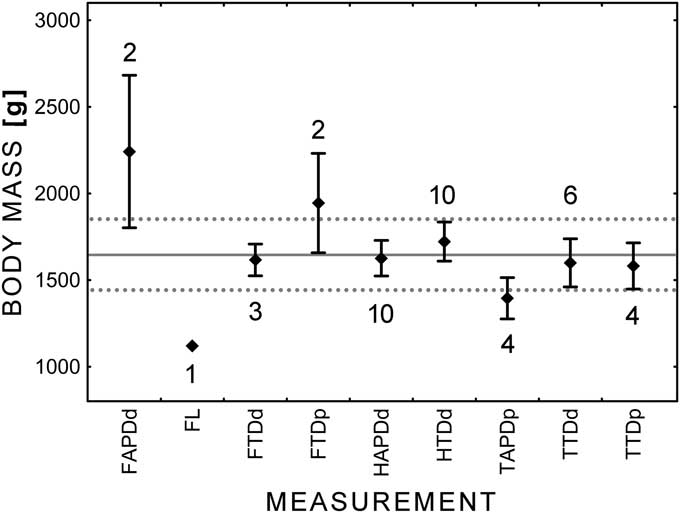
Average body mass (= BM, solid gray horizontal line) and interval of confidence (= IC, delimited by dotted gray lines) of Sardolagus obscurus n. gen. n. sp. BM estimations (average BM, indicated by the black diamond, and IC, indicated by the vertical solid line) based on different postcranial measurement are reported above each estimator (x axis). The numbers below or above estimations indicate the sample size of each measurement. FAPDd=distal femoral anteroposterior diameter, FL=femur length, FTDd=distal femoral transversal diameter, FTDp=proximal femoral transversal diameter, g=grams, HAPDd=distal humeral anteroposterior diameter, HTDd=distal humeral transversal diameter, TAPDp=proximal tibia anteroposterior diameter, TTDd=distal tibia transversal diameter, TTDp=proximal tibia transversal diameter.
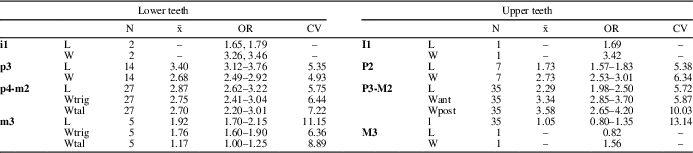
Dental measurements (mm) of Sardolagus obscurus n. gen. n. sp. CV=coefficient of variation (%), l=width of antero–posteroloph isthmus, L=length, N=number of specimens measured, OR=observed range, W=width, Want=anteroloph width, Wpost=posteroloph width, Wtal=talonid width, Wtrig=trigonid width, x̄=arithmetic mean.

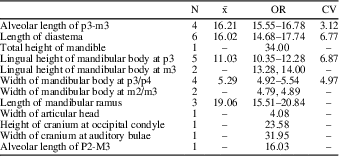
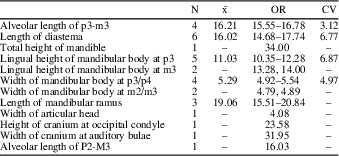
Mandibular and cranial measurements (mm) of Sardolagus obscurus n. gen. n. sp. CV=coefficient of variation (%), N=number of specimens measured, OR=observed range, x̄=arithmetic mean.
Results of body mass estimation (in grams) by postcranial element. IC-L=lower interval of confidence, IC-U=upper interval of confidence, N=number of specimens measured, x̄=arithmetic mean.

2003 Oryctolagus aff. O. lacosti (Pomel); Reference Rook, Abbazzi, Angelone, Arca, Barisone, Bedetti, Delfino, Kotsakis, Marcolini, Palombo, Pavia, Piras, Torre, Tuveri, Valli and WilkensRook et al., p. 25, tab. 11.
2004 Oryctolagus aff. O. lacosti (Pomel); Reference Abbazzi, Angelone, Arca, Barisone, Bedetti, Delfino, Kotsakis, Marcolini, Palombo, Pavia, Piras, Rook, Torre, Tuveri, Valli and WilkensAbbazzi et al., p. 693, fig. 9, fig. 16, tab. 4.
2005 Leporidae; Reference Palombo, Abbazzi, Angelone, Bedetti, Delfino, Kotsakis, Marcolini and PaviaPalombo et al., p. 225.
2006 Oryctolagus aff. O. lacosti (Pomel); Reference PalomboPalombo, p. 51, fig. 2.
2008 Leporidae n. gen. n. sp.; Reference PalomboPalombo, p. 45, tab. 2.
2008 Leporidae n. gen. n. sp.; Reference Palombo, Kotsakis, Marcolini, Angelone, Arca and TuvieriPalombo et al., p. 80.
2009 Leporidae n. gen. n. sp.; Reference PalomboPalombo, p. 369, fig. 2.
2010 Oryctolagus n. sp.; Reference Angelone, Tuveri, Arca, López Martínez and KotsakisAngelone et al., p. 5.
2014 Leporidae n. gen. n. sp.; Reference Palombo and RozziPalombo and Rozzi, p. 140, fig. 3.
2015 cf. Oryctolagus aff. lacosti (Pomel); Reference Angelone, Čermák and KotsakisAngelone et al. p. 293.
Holotype
Left incomplete hemimandible with p3-m3 (Fig. 2.6–2.8), DSG/URT-053/503; early Pleistocene, MN17 (Capo Figari/Orosei 1 FSC of the Nesogoral FC); Monte Tuttavista VIIbs (Orosei, E Sardinia, Italy).
Paratype
Incomplete cranium with left P2-M3 (Fig. 2.1–2.5, 2.9), DSG/URT-053/504; early Pleistocene, MN17 (Capo Figari/Orosei 1 FSC of the Nesogoral FC); Monte Tuttavista VIIbs (Orosei, E Sardinia, Italy). The cranium is associated with the holotype in a block of breccia, and they probably belong to one individual.
Diagnosis
Small-sized leporid with the following features: simple P2 without or with incipient hypoflexus (prevailing LL-morphotype I) and very shallow mesoflexus (prevailing BMR-morphotype A); significantly elongated p3 with exclusively of A1/PR3 morphotype, p3 hypoflexid short (within A1/PR3; ~70–90% of W) with feeble or missing anterior tip and gradual transition from thick to thin enamel in its lingual end, p3 anteroconid morphologically variable with anteroflexid of variable depth (~5–20% of total L); I1/i1 markedly flattened anteroposteriorly; anterior and anterobuccal walls of p3-m2 talonids smooth; p4-m2 trigonid without anteroexternal reentrant; mandibular body and ramus robust, diastema relatively short, of almost the same length as the alveolar row of p3-m3; root end of lower incisor reaching the posterior part of p3; P3-M2 hypoflexus quite short (~70% of W), generally smooth.
Differential diagnosis
The combination of advanced p3 (A1/PR3) and primitive P2 (absent/incipient hypoflexus, shallow mesoflexus) discriminates Sardolagus obscurus n. gen. n. sp. from the Old World: (1) species of Hypolagus bearing p3 with A0/PR0+P2 with absent–medium hypoflexus and incipient–medium mesoflexus; (2) species of Serengetilagus bearing p3 with A0–1/PR0+P2 with incipient–deep hypoflexus and shallow/medium mesoflexus; (3) Nuralagus rex bearing p3 with A0/PR0–1+P2 with absent hypoflexus and incipient/shallow mesoflexus; (4) species of Alilepus bearing p3 with A0/PR1–2+P2 with absent/shallow hypoflexus and mesoflexus; (5) species of Pliopentalagus bearing p3 with A1/PR1–2+P2 with medium/deep hypoflexus and mesoflexus; (6) species of Trischizolagus bearing p3 with A0–1/PR0–1–2+P2 with medium/deep hypoflexus and mesoflexus; and (7) species of Lepus and Oryctolagus bearing p3 with A1/PR3+P2 with medium/deep hypoflexus and mesoflexus.
Occurrence
Sardinia (Italy), Monte Tuttavista fissure fillings X4, IVm, and VIIbs; early Pleistocene, MN17–MQ1, Capo Figari/Orosei 1 FSC of the Nesogoral FC and Orosei 2 FSC of the Microtus (Tyrrhenicola) FC.
Description
We based the taxonomic analyses on isolated teeth, a few mandibular/maxillary fragments, and one incomplete cranium. Dental measurements are given in Table 1, mandibular and cranial measurements in Table 2.
Cranium (Fig. 2.1–2.5).—An incomplete cranium lacking its right lateral portion (jugale [zygomatic arch], squamosal, alisphenoid), rostrum (premaxillae, nasals, right maxilla), palatine bones, pterygoid, and basisphenoid. Parietals and frontals largely preserved, the latter lacking contact with nasals; skull roof convex; dorsal sutures well preserved, not ossified—sagittal and frontoparietal ones corrugated, the latter of “type 4” (sensu Palacios, Reference Palacios1989); unfused interparietal present but not well preserved; occipital condyle small; auditory bullae relatively large.
I1 (Fig. 3.20).—Anteroposteriorly flattened, roughly rectangular shape, anterior enamel of moderate thickness with no substantial variation; anterior notch shallow, V-shaped with widely opened walls, not filled with cement, dividing the tooth in two parts of approximately equal anterior prominence, the internal one (~43% of W) anteriorly flattened and rather symmetrical with respect to its anteroposterior axis, in contrast to the curved and asymmetrical external one.
P2 (Figs. 2.9 [in part], 3.14–3.19).—Simple hypercone, relatively narrow and anteriorly tapered, without or with incipient hypoflexus, LL-morphotype I (sensu Fladerer and Reiner, Reference Fladerer and Reiner1996) dominant (I: 57%, II: 29%, III: 14%, IV, V, and VI: 0%; N=7). Lagicone with shallow mesoflexus, BMR-morphotype A (sensu Fladerer and Reiner, Reference Fladerer and Reiner1996) dominant (A: 86%, B: 14%; BMR-morphotype 0: not observed; N=7). Simple paraflexus with variable length (very short in 2 cases). Enamel quite thick on anterior and lingual parts.
Upper molariforms (Figs. 2.9 [in part], 3.26–3.30).—Narrow teeth (low W values); relative length of mesial and distal hyperlophs variable; quite short hypoflexus (71% of W; N=35), usually very slightly undulated or smooth. Abundant cement at the lingual end of the hypoflexus. Thick enamel on the anterior part of the mesial hyperloph and the lingual tips of hypercones; the thickness of enamel in the anterior part of the hypoflexus is variable. Differences in enamel thickness do not depend on tooth positions.
Mandible (Figs. 2.6, 2.7, 4).—Mandibular body and ramus robust; diastema relatively short, of almost the same length of the alveolar row of p3-m3; in buccal view, the alveolar row of p3-m3 appears straight along most of the length; dorsal surface of the mandibular body convex with a distinctive swelling below p3-p4; root end of lower incisor reaching the posterior part of p3; large, anterobucally directed mental foramen placed in the buccal side beneath the p3; area below mental foramen and p3 richly fenestrated; masseteric fossa large compared to the size of the jaw.
i1 (Fig. 3.21, 3.22).—Quadrangular, markedly shortened anteroposteriorly; enamel uniformely thick on the anterior part.
p3 (Figs. 2.8 [in part], 3.1–3.5, 3.6 [in part], 3.7–3.13).—Elongated tooth; adult specimens show A1/PR3 pattern stable along the entire tooth crown; one juvenile tooth shows A1/PR4 pattern in the occlusal surface evolving in A1/PR3 in radical side (cf. Averianov and Tesakov, Reference Averianov and Tesakov1997, p. 152). Depth of anteroflexid variable from 6% to 21% of L (average=14%; N=14). The anteroconid length ranges from 24% to 31% of L (average=28%; N=14); the labial anteroconid tends to be anteriorly more prominent, symmetrical and slightly larger than the lingual one. Protoflexid simple and quite wide, roughly right-angled in most cases; its depth varies from 12% to 21% of W (average= 15%; N=14). A shallow paraflexid or concavity is present in 86% of specimens, and in two cases the notch is filled with cement. Hypoconid and protoconid are massive. The hypoflexid is not crenulated, substantially perpendicular to the anteroposterior axis of the tooth, and shallow if compared to other taxa with A1/PR3 pattern of p3, as it ranges from 73% to 90% of W (average=82%; N=14). Extremely feeble or absent hypoflexid anterior tip; the hypoflexid lingual end is simple with gradual transition from thick to thin enamel. Labial tip of the hypoconid simple, usually deformed by a shallow notch (in 71% of morphotype “c” [sensu Fladerer, Reference Fladerer1987], N=14).
Lower molariforms (Figs. 2.8 [in part], 3.6 [in part]).—Bulky trigonid with smooth anterobuccal corner (no flexid present); labial part of the talonid frequently deformed by a shallow notch and showing smooth enamel band on the anterior wall; isthmus between trigonid and talonid thin, straight, and short; flexid between trigonid and talonid straight, perpendicular to the anteroposterior axis of the tooth, except for its lingual end (anteriorly curved). Very thick enamel on the labial part of the tooth and on the trigonid posterior edge.
m3 (Fig. 3.23–3.25).—Bean-shaped trigonid, larger and wider than the oval talonid. Enamel thicker on labial edges.
Etymology
After its obscure origin and phylogenetic position.
Material included
(catalog number prefix DSG/URT-053/). X4: one fragment of right maxilla, 492; one right I1, 487; two right P2, 428, 429; three left P2, 425–427; 11 right upper molariforms (P4/M1/M2), 445–455; 15 left upper molariforms (P4/M1/M2), 430–444; two fragments of left hemimandible, 485, 486; four right p3, 418–421; three left p3, 422–424; three right p4, 460–462; four left p4, 459, 463, 466, 473; one right m1, 465; six left m1, 456–458, 464, 467, 470; four left m2, 468, 469, 471, 472; one right m3, 491; three left m3, 488–490. IVm: one right upper molariform, 484; one left hemimandible, 505; four fragments of left hemimandible, 476–478, 481; one rostral part of right hemimandible, 480; one right mandibular ramus, 479; one left i1, 482; two left p3, 474, 475; one left m3, 483; eight distal epiphyses of humerus, 518–524, 531; one femur, 509; one distal epiphysis of femur, 510; two proximal epiphyses of tibia, 516, 517; four distal epiphyses of tibia, 527–530. VIIbs: one incomplete cranium with left P2-M3 (paratype), 504; one fragment of right maxilla with P2-P4, 498; three right upper molariforms (P4/M1/M2), 499–501; one left upper molariform (P4/M1/M2), 502; one left incomplete hemimandible with p3-m3 (holotype), 503 ; two left p3, 494, 495; one left p4, 496; one left m2, 497; two distal epiphyses of humerus, 525, 526; three distal epiphyses of femur, 506–508; three proximal epiphyses of tibia, 511, 512, 515; two distal epiphyses of tibia, 513, 514.
Remarks on morphology
The extremely flattened incisors are a character unique to the Sardolagus n. gen. The incisor “radical” pocket, that in Sardolagus n. gen. reaches the posterior part of p3, is a primitive feature often found in Hypolagus Dice, Reference Dice1917 and Serengetilagus Dietrich, Reference Dietrich1941. The p3 characters are mainly compatible with advanced leporines with PR3 morphotype (Fig. 5) always bearing advanced P2 (e.g., Oryctolagus Lilljeborg, Reference Lilljeborg1874; Lepus Linnaeus, Reference Linnaeus1758) (Fig. 6). Whereas the P2 of Sardolagus, lacking deep flexa, is compatible with primitive taxa such as Alilepus and Nuralagus Quintana et al., Reference Quintana, Köhler and Moyà-Solà2011, and primitive species of Hypolagus (e.g., H. petenyii and H. balearicus) (Fig. 6). Compared with advanced genera with PR3 morphotype, the p3 hypoflexid of Sardolagus is quite short and shows an extremely weak or absent hypoflexid anterior tip. Moreover, with respect to p3 of most leporine genera, Sardolagus shows an extreme variability of the anteroflexid depth, shape, and inclination.
Remarks on p3/P2 dimensions
The p3 of Sardolagus obscurus n. gen. n. sp. is relatively small among western Mediterranean leporids (i.e., between Hypolagus balearicus and H. peregrinus) (Fig. 5.1). Among the late Miocene–Pleistocene leporids of continental Europe, the L p3 of S. obscurus attains values compatible with those of medium-sized taxa, whereas its W p3 is sensibly lower (Fig. 5.2–5.4). In general, the p3 of Sardolagus obscurus n. gen. n. sp. has very elongated overall proportions. Its relatively high L/W p3 ratio is comparable with those in other insular endemic leporids of western Mediterranean islands (i.e., their mean values show a linear relationship) (Fig. 5.1). This may suggest a common trait among these taxa. On the other hand, L/W p3 ratios in leporids of continental Europe are lower (Fig. 5.2–5.4). The only exception is Pliopentalagus Gureev and Konkova in Gureev, Reference Gureev1964 (Fig. 5.2), which shows overall p3 proportions similar to Sardolagus obscurus n. gen. n. sp.
The P2 of Sardolagus obscurus n. gen. n. sp. is relatively small if compared to other leporine genera, similar to small-sized fossil taxa Hypolagus balearicus (L x W=1.69 x 3.12), Alilepus laskarevi (L x W=1.48 x 2.82), A. turolensis (L x W=1.49 x 3.30), Serengetilagus praecapensis (x̄ of L x W=1.65 x 3.05, N=34/33), and Pliopentalagus dietrichi (x̄ of L x W=1.66 x 2.94, N=3). The P2 size of Sardolagus obscurus falls in the lower range of extant Oryctolagus cuniculus (OR of L x W=1.57–2.09 x 2.74–3.96, N=17).
BM estimation
The BM of the Sardinian leporid is estimated ~1650 g (IC=1443–1856 g; Table 3, Fig. 7). BM estimations extrapolated from measurements performed on tibiae and humeri are quite consistent with this interval, whereas those extrapolated from femora are more erratic. The small sample size (N) of femora (1–3 specimens, depending on the measurement; Table 3) is likely to have biased the results, giving a wider IC. Considering humeri and tibiae, a distal humeral transversal diameter is the measurement that estimated the highest BM. In previous studies of BM estimations of insular leporids, Moncunill-Solé et al. (Reference Moncunill-Solé, Quintana, Jordana, Engelbrektsson and Köhler2015) noticed that in Nuralagus rex the distal humeral transversal diameter also overestimated the BM of this species.
Discussion
Temporal and geographical distribution of Sardolagus obscurus
To date, Sardolagus obscurus n. gen. n. sp. has been reported only from a few fissure fillings of the Monte Tuttavista karst complex, thus its distribution seems limited to central eastern Sardinia. This could be due to the extreme scarcity of pre-Middle Pleistocene fossil assemblages in Sardinia and Corsica. However, leporids are unknown even in the well-studied, long-known Capo Figari infillings (see Van der Made, 1999 and references therein), the age of which partly overlaps with the Monte Tuttavista ones.
The material of Sardolagus obscurus analyzed in this paper covers the Capo Figari/Orosei 1 FSC of the Nesogoral FC and the Orosei 2 FSC of the Microtus (Tyrrhenicola) FC (e.g., the early Pleistocene) (Fig. 1). Additional material not taken into consideration here (see Abbazzi et al., Reference Abbazzi, Angelone, Arca, Barisone, Bedetti, Delfino, Kotsakis, Marcolini, Palombo, Pavia, Piras, Rook, Torre, Tuveri, Valli and Wilkens2004) is referable to the same FSCs. We lack a quantitative age datum to define the exact age of the fissures. Biochronological considerations based on fossil mammals seem to point out that every single infilling of Monte Tuttavista karst complex was accumulated in a relatively short time span, with a few exceptions (Angelone et al., Reference Angelone, Tuveri, Arca, López Martínez and Kotsakis2008). This evidence allowed determination of a relative chronological arrangement of the infillings by interpolating the results obtained from several papers mainly centered on single taxa (Palombo, Reference Palombo2009). Single taxa, in fact, may not follow the general trend. For example, according to Palombo (Reference Palombo2009), IVm should be younger than X4, whereas preliminary data in Angelone et al. (Reference Angelone, Tuveri and Arca2009) provide the opposite result (i.e., IVm older than X4, a hypothesis tentatively followed also by Palombo and Rozzi, Reference Palombo and Rozzi2014).
If we follow Palombo (Reference Palombo2009), the time span covered by the findings of Sardolagus here analyzed is of ~1 Ma (~2.1–1.1 Ma), whereas it is slightly shorter (~1.9–1.1 Ma) if we follow Palombo and Rozzi (Reference Palombo and Rozzi2014). If the additional, unpublished leporid remains reported from other Monte Tuttavista infillings (Abbazzi et al., Reference Abbazzi, Angelone, Arca, Barisone, Bedetti, Delfino, Kotsakis, Marcolini, Palombo, Pavia, Piras, Rook, Torre, Tuveri, Valli and Wilkens2004) should pertain to Sardolagus obscurus n. gen. n. sp., the youngest record of S. obscurus could be at ~0.8 Ma. Similarly, if the undetermined leporid from Capo Mannu D1 (Angelone et al., Reference Angelone, Čermák and Kotsakis2015) could be related to Sardolagus obscurus n. gen. n. sp., its first report could be backdated to the earliest late Pliocene (~3.6 Ma) and its known temporal distribution could be extended to western central Sardinia.
Peculiarities of the dental pattern of Sardolagus obscurus.
The main evolutionary changes of leporine teeth take place in the anterior parts of their tooth rows, and can be very well observed in the occlusal surface of p3 and/or P2. These changes are formed predominantly by: (1) a selection in tooth structural clusters among the phylogenetic morphoclines leading to a presence of discontinuous p3 patterns (i.e., PR0–4 morphotypes), and (2) a continuous development of morphologies between two morphological states of particular tooth parts (e.g., lengths of flexids/flexa). An effect of the above phenomena on P2 and p3 is generally different, but an overall evolutionary degree of both tooth positions is more or less concordant in the vast majority of leporid taxa.
However, as highlighted in the taxonomic discussion, a significantly discrepant evolutionary degree between p3 and P2 has been observed in Sardolagus obscurus n. gen. n. sp. This implies two possible alternative hypotheses: (H1) Sardolagus obscurus n. gen. n. sp. developed from an ancestor bearing a primitive dental pattern and maintained a primitive P2 morphotype (LL-II / BMR-A) typical of Archaeolaginae Dice, Reference Dice1929 and primitive Leporinae, and independently developed a p3 of PR3 type; or (H2) the ancestor of Sardolagus obscurus n. gen. n. sp. was a leporine with advanced P2 and p3 morphotypes (e.g., as in Oryctolagus), which underwent a selective reverse morphocline that led to the shortening of P2 flexa and of p3 hypoflexid.
In the case of a selective “reversal morphocline” of some characters (hypothesis H2), one may expect in the relatively large sample under study, the occurrence (though in limited percentage) of specimens of Sardolagus n. gen. showing the hypothetical “original” advanced morphology (see Palacios and López-Martínez, Reference Palacios and López Martínez1980; Averianov and Tesakov, Reference Averianov and Tesakov1997), but this does not occur. This means that the P2 of Sardolagus obscurus n. gen. n. sp. shows no trace of the morphology of a hypothetical advanced leporine supposed to be its ancestor. Contrarily, the available P2 phenotype implies an affinity to Archaeolaginae or primitive Leporinae, such as Hypolagus or Alilepus. The position of the incisor pocket of Sardolagus n. gen. reinforces a possible affinity with Archaeolaginae. Such considerations fit with hypothesis (H1).
The presence of morphologically simplified teeth is often explained by paedomorphosis, which is a common evolutionary strategy in lagomorph. The phenomenon is well manifested and described in the extant taxa Nesolagus Forsyth-Major, Reference Forsyth-Major1899 and Brachylagus Miller, Reference Miller1900 (Averianov et al., Reference Averianov, Abramov and Tikhonov2000). Their dentitions are highly paedomorphic along the entire tooth rows, both upper and lower. In particular, we note a PR4 morphotype of p3 lacking anteroflexid, a reduced P2 with one reentrant, and P3-M2 with very short and simple hypoflexus (see Averianov et al., Reference Averianov, Abramov and Tikhonov2000). In contrast to that, Sardolagus n. gen.: (1) exclusively has p3 with “non-paedomorphic” PR3 morphotype; and (2) does not bear any paedomorphic traits of simplification and/or shortening of reentrants in upper and lower teeth.
The relevant question is whether the simple morphology of P2 in Sardolagus n. gen. may be explained merely by its small size. In P2, the relationship between size and morphological complexity is very important because genus/species differences are established on the continuous elongation of hypo- and mesoflexus and not on the presence of discontinuous patterns, as mostly in p3 (i.e., PR0–4 morphotypes). Simplified occlusal morphology of P2 with relatively less-developed reentrants is often present in juvenile specimens with a conical tooth shaft where the small-sized simplified occlusal outline differs from the one visible on the root side and disappears during ontogeny (=ontogenetically dependent changes). However, this is not the case for the Sardolagus n. gen. material. All analyzed P2s are represented by small-sized prismatic teeth with stable morphology along the entire tooth shaft and belong to adult specimens. So we explored the morpho-dimensional variability and differences among adult P2s pertaining to selected extinct and extant leporid taxa (Fig. 6). The morphology (LL+BMR morphotypes) of prismatic P2 plotted against the tooth size (length multiplied by width) clearly shows that complexity of adult P2 does not depend on size, neither within species nor across species. P2 with a simple pattern increases its size across ancient species in a sequence (from smallest to largest): Alilepus laskarevi, A. turolensis, Sardolagus obscurus n. gen. n. sp., Hypolagus balearicus (all four are of comparable P2 size), H. petenyii, Nuralagus rex (Fig. 6.1). On the other hand, in the comparably small-sized species Serengetilagus praecapensis and Pliopentalagus dietrichi, the P2 is significantly more advanced (Fig. 6.1). Analyzed recent species Oryctolagus cuniculus, Lepus europaeus, and L. timidus possess comparably advanced P2, but significantly more advanced than in Sardolagus; this is also true for all fossil species of Oryctolagus (Fig. 6.2). The difference between Oryctolagus and Lepus is expressed particularly in their P2 size: the P2 of Oryctolagus is smaller than in Lepus, and dimensionally close to Sardolagus n. gen. It is thus evident that in all the analyzed species represented by more abundant material, within intraspecific variability, a degree of P2 complexity is not dependent on its size.
An interesting feature observed in the p3 of Sardolagus obscurus n. gen. n. sp. is the lack of the hypoflexid anterior tip, coupled with a relatively shallow hypoflexid. This is quite unusual for a PR3-type leporid, and it is not a secondary detail. It may imply either: (h1) a secondary simplification that follows the above-mentioned paedomorphosis pattern, or (h2) a different genesis for PR3 morphotype in Sardolagus n. gen. (i.e., the lingual elongation of a short hypoflexid).
The latter evolutionary hypothesis (h2) about the origin of PR3 pattern in Leporidae has already been formulated by Corbet (Reference Corbet1983). In contrast to Hibbard (Reference Hibbard1963), who hypothesized that the PR3 pattern of p3 in leporines was derived from PR1 through the morphocline PR1→PR2→PR3 (i.e., Alilepus→Nekrolagus Hibbard, Reference Hibbard1939b→Lepus morphotypes; sensu Averianov and Tesakov, Reference Averianov and Tesakov1997), Corbet (Reference Corbet1983) regarded as more probable a direct derivation of the PR3 pattern from PR0 (i.e., Hypolagus morphotype; sensu Averianov and Tesakov, Reference Averianov and Tesakov1997) by the elongation of a shallow hypoflexid. This conclusion was probably preferred, invoking the parsimony principle, because it requires fewer transformations and is supported by an analogy with p4-m2. Corbet’s model was rejected by Averianov and Tesakov (Reference Averianov and Tesakov1997). They argued that such a model is not supported by fossil evidence and does not fulfil the parsimony principle because the choice of the hypothesis implying fewer transformations must be done among hypotheses equally supported by facts. We agree that Hibbard´s hypothesis is supported by paleontological evidence, however, in our opinion, the lower probability of Corbet’s hypothesis does not exclude its possibility, also because Hibbard’s model can not be looked upon as a general phenomenon in all leporine lineages. In fact, Averianov and Tesakov (Reference Averianov and Tesakov1997) themselves and Čermák et al. (Reference Čermák, Angelone and Sinitsa2015) demonstrated the limited validity of Hibbard’s hypothesis. Indeed, it is well documented, particularly in the late Cenozoic North American populations of the lineage Hypolagus parviplicatus Dawson, Reference Dawson1958–Alilepus hibbardi White, Reference White1991–Nekrolagus progressus (Hibbard, Reference Hibbard1939a)–Lepus ssp./Sylvilagus ssp. Averianov and Tesakov (Reference Averianov and Tesakov1997) suggested at least two independent parallel developments to explain the origin of the long p3 hypoflexid of advanced leporines: from Nekrolagus and from Trischizolagus Radulesco and Samson, Reference Radulesco and Samson1967.
The current fossil record of leporines suggests that the above-mentioned morphodynamic gradients (both continuous and discontinuous ones) took place independently and, most probably, with a different “trigger” (cf., different evolutionary stages of reentrants in Hypolagus species limited exclusively to the PR0 p3 morphotype or variable flexa coupled with PR0-PR1-PR2 morphotypes). The length/morphological evolution of p3/P2 reentrants, particularly the anterior ones, seems to be more conditioned by environmental selection pressures than by the basic p3 patterns (PR0–4). Generally, in lagomorphs, the anterior part of tooth row (i.e., P2 and p3) supports a large part of masticatory stress (see the application of Greaves, Reference Greaves1978 schemes to the ochotonid Prolagus in Mazza and Zafonte [Reference Mazza and Zafonte1987, p. 228, fig. 5], in which p3 is the tooth where the highest muscle resultant is applied). Changes in environmental conditions are steadily and swiftly reflected in these teeth, and because evolutionary pressure should have similar “intensity” in the same part of tooth row, we theoretically expect similar evolutionary degrees in P2 and p3. In fact, fossil and recent species of Oryctolagus and Lepus possess p3 of PR3/A1 pattern, and concordantly well-developed p3 anteroflexid and P2 hypo-/mesoflexa. The continental endemic extant leporid Lepus castroviejoi Palacios, Reference Palacios1977 deserves a special mention; in this species, p3/P2 with advanced morphotypes coexist with p3/P2 with “regressed” characters (Palacios and López Martínez, Reference Palacios and López Martínez1980). However, the concordance seems to be important, at least considering the population in its entirety.
The reason why in Sardolagus n. gen. a PR3 p3 with well-developed anteroflexid is coupled with a simple P2 with shallow/absent hypo-/mesoflexa for the moment remains unclear. Such dramatic discrepancy in the evolutionary degrees of p3 and P2 in Sardolagus can not be related to insular endemism. In fact, in other western Mediterranean fossil leporids, the concordance of the evolutionary degrees of P2 and p3 is important: (1) in Nuralagus rex, the degree of anterior reentrants development in P2/p3 is concordant; in fact in p3 the anteroflexid is missing; in P2 the hypoflexus is missing and the mesoflexus is incipient (it is worth noting, though, that among PR0–PR1/A0 p3, the anteroconid of N. rex is relatively advanced [morphotypes III–V sensu Fladerer and Reiner, Reference Fladerer and Reiner1996; see Quintana et al., Reference Quintana, Köhler and Moyà-Solà2011, fig. 6]); (2) H. balearicus has the same (concordance of reentrants development in P2/p3) as in Nuralagus rex, however H. balearicus dental pattern appears slightly more primitive, showing a PR0/A0 p3 with anteroconid of morphotype III (instead of III–V, as in N. rex); and (3) in H. peregrinus, the degree of anterior reentrant development in P2/p3 is concordant, but with more advanced, shallow anterior reentrants (Fladerer and Fiore, Reference Fladerer and Fiore2003, fig. 2).
The BM of Sardolagus obscurus in the context of western Mediterranean lagomorphs
In insular environments mammals largely undergo Foster’s rule: small mammals increase their BM, whereas large ones undergo the opposite destiny (Foster, Reference Foster1964; Van Valen, Reference Van Valen1973). At present, the reasons for these BM shifts have not been fully clarified (see Lomolino et al., Reference Lomolino, Sax, Palombo and van der Geer2012). The response of middle-sized mammals as lagomorphs is not as clear as Foster (Reference Foster1964) suggested: extant leporids show a BM shift mostly directed to a reduction of size, but extant ochotonids are not represented in islands and their pattern is unknown (Lawlor, Reference Lawlor1982; Lomolino, Reference Lomolino1985). Assessing the fossil lagomorphs of western Mediterranean islands, we can shed light on this particular biological trend. Indeed some extinct insular ochotonids of the Mediterranean area appear quite large with respect to continental congeneric taxa (Moncunill et al., Reference Moncunill-Solé, Quintana, Jordana, Engelbrektsson and Köhler2015, Reference Moncunill-Solé, Orlandi-Oliveras, Jordana, Rook and Köhler2016a, Reference Moncunill-Solé, Tuveri, Arca and Angeloneb). However, the authors could not undertake direct comparison with the BM of their forebears because, given the present state of the art, they are unknown or their postcranial material is not (well)-preserved. As for insular leporids, they also seem to increase their BM compared to their continental ancestors, but in varying degrees. The western Mediterranean area offers some remarkable case studies. Nuralagus rex is considered the largest lagomorph ever with an average BM ~8250 g (see Quintana et al., Reference Quintana, Köhler and Moyà-Solà2011; Moncunill-Solé et al., Reference Moncunill-Solé, Quintana, Jordana, Engelbrektsson and Köhler2015), whereas Hypolagus balearicus is quite small (BM: ~1300–2700 g, Quintana and Moncunill-Solé, Reference Quintana and Moncunill-Solé2014a). The average weight of the species described in this paper, Sardolagus obscurus n. gen. n. sp., is ~1650 g (i.e., similar to H. balearicus and the two extant insular leporids Nesolagus netscheri [Schlegel, Reference Schlegel1880] [~1500 g; Sumatra Island] and Pentalagus furnessi [Stone, Reference Stone1900] [~2000–2800 g; Kawauchi, Sumiyo, Amami-Ohshima Island], Yamada and Cervantes, Reference Yamada and Cervantes2005). For the moment, it is not possible to undertake direct comparison with its ancestor (see above and below).
Jointly with changes in BM, insular species endure other biological adaptations (Van der Geer, Reference Van der Geer2014). Morphologically, insular lagomorphs are characterized by a stiff vertebral column, low sacropelvic angles, and other traits that enable a low gear locomotion (Yamada and Cervantes, Reference Yamada and Cervantes2005; Quintana et al., Reference Quintana, Köhler and Moyà-Solà2011). Moreover, several investigations have noticed that insular lagomorphs show a life history shift towards the slow end (Yamada and Cervantes, Reference Yamada and Cervantes2005; Riyahi et al., Reference Riyahi, Köhler, Marín-Moratalla, Jordana and Quintana2011; Köhler et al., Reference Köhler, Koyabu, Moncunill-Solé, Orlandi-Oliveras and Jordana2015; Moncunill-Solé et al., Reference Moncunill-Solé, Orlandi-Oliveras, Jordana, Rook and Köhler2016a). The material of Sardolagus obscurus n. gen. n. sp. is too poor and we can only make some preliminary inferences about its biology. The allometric analysis evidenced a large distal diameter of the humerus (high humeral epicondylar index). This trait is related with fossorial or burrower lifestyle (digging and scrabbling the ground, or digging holes for habitation) in both rodents (Samuels and van Valkenburgh, Reference Samuels and van Valkenburgh2008) and lagomorphs (Reese et al., Reference Reese, Lanier and Sargis2013). A large distal diameter of the humerus is also substantial in other extinct insular mammals (e.g., N. rex and the rodents Hypnomys morpheus and Canariomys bravoi; see Bover et al., Reference Bover, Alcover, Michaux, Hautier and Hutterer2010; Quintana et al., Reference Quintana, Köhler and Moyà-Solà2011; Michaux et al., Reference Michaux, Hautier, Hutterer, Lebrun, Guy and García-Talavera2012; Quintana and Moncunill-Solé, Reference Quintana and Moncunill-Solé2014b). For the moment, the fossorial or burrower lifestyles of insular dwellers have been interpreted as the requirement of searching for alternative food sources under the low-resource conditions of islands (Köhler, Reference Köhler2010).
It is interesting to highlight that the analysis of teeth size, particularly p3 measurements, is a very common methodology to compare fossil European leporids, due to the abundance of well-preserved dental remains with respect to jaws and postcranials. Such method must be carefully weighted as far as insular endemic lagomorphs are concerned, because of the higher allometric response of dental elements (and especially of the p3) to body size variations with respect to postcranials (Moncunill-Solé et al., 2015, 2016a, Reference Moncunill-Solé, Tuveri, Arca and Angeloneb). For this reason, all the procedures of BM estimations of Sardolagus obscurus n. gen. n. sp. were carried out with postcranial material.
Sardolagus in the context of European leporid record
The appearance of stem Leporidae in Eurasia is a result of the late Miocene migration(s) from North America via the northern land connection of Beringia (López Martínez, Reference López Martínez2008; Flynn et al., Reference Flynn, Winkler, Erbaeva, Alexeeva, Anders, Angelone, Čermák, Fladerer, Kraatz, Ruedas, Ruf, Tomida, Veitschegger and Zhang2014). The oldest record appears to be a species of Alilepus (Čermák et al., Reference Čermák, Angelone and Sinitsa2015). Hypolagus is encountered in Eurasia somewhat later in the fossil record (Čermák, Reference Čermák2009). The relatively rapid spread of leporids across the Old World at ~8 Ma was an important Turolian event and is called the “Leporid Datum” (Flynn et al., Reference Flynn, Winkler, Erbaeva, Alexeeva, Anders, Angelone, Čermák, Fladerer, Kraatz, Ruedas, Ruf, Tomida, Veitschegger and Zhang2014). The MN13 record of Leporidae in Europe is relatively rich and available throughout the continent in many localities, but already in the MN12 the record is relatively rare, and limited only to Leporinae. Only a few, very fragmentary findings, undoubtedly indicate the appearance of advanced leporids in Europe before MN12 (Flynn et al., Reference Flynn, Winkler, Erbaeva, Alexeeva, Anders, Angelone, Čermák, Fladerer, Kraatz, Ruedas, Ruf, Tomida, Veitschegger and Zhang2014; Čermák et al., Reference Čermák, Angelone and Sinitsa2015). There are also a few, still questionable fossil occurrences suggesting that leporids were present in Europe prior to MN11. Nevertheless, in most cases the relationship of such “early leporid findings” with the accompanying faunal assemblages is not clear or doubtful, making a further evaluation of their age and taxonomy necessary (see Flynn et al., Reference Flynn, Winkler, Erbaeva, Alexeeva, Anders, Angelone, Čermák, Fladerer, Kraatz, Ruedas, Ruf, Tomida, Veitschegger and Zhang2014). It is particularly noteworthy that the leporid reports from Sansan (France, MN6, López Martínez, Reference López Martínez2012) and Can Poncic (Spain, MN9; López Martínez, Reference López Martínez1989) are distinctly anomalous in age. Such occurrences of relatively advanced leporids in the mid-Miocene are not fully compatible with present state of the art on evolution and paleobiogeography of Old World leporids and must be evaluated by future works. At any rate, this record pro tempore, suggests two possible hypotheses (Flynn et al., Reference Flynn, Winkler, Erbaeva, Alexeeva, Anders, Angelone, Čermák, Fladerer, Kraatz, Ruedas, Ruf, Tomida, Veitschegger and Zhang2014): (Hh1) in the mid-Miocene of southwestern Europe some archaic lagomorphs could have developed some derived features typical of leporids independently to North American genera; and (Hh2) the “early European leporids” derive from a limited dispersal of leporids into Eurasia prior to the successful late Miocene influx (indeed, advanced leporids could have crossed Beringia before the late Miocene invasion [~8 Ma], leaving only a scattered record.
As for the first hypothesis (Hh1), the relatively rich Miocene record does not support evidence of the independent appearance in Europe of forms with “leporine” characters. The second hypothesis (Hh2) seems the more likely between the two. However, mammalian dispersals from North America into Eurasia were uncommon during Miocene compared to those in the opposite direction (Dawson, Reference Dawson1999), thus the migration of advanced leporids into Eurasia prior to the “Hipparion datum” (see Sen, Reference Sen1989 for details) seems to be extremely improbable. Moreover, the FADs of North American taxa phenotipically matching European ones (see Dawson, 1958, Reference Dawson2008; White, 1988, Reference White1991; Voorhies and Timperley, Reference Voorhies and Timperley1997) do not fit in this model.
The European record of Leporidae, including Archaeolaginae and Leporinae subfamilies, comprises the seven genera listed below accompanied by their FADs in Europe:
Alilepus—reliable from MN12 (Čermák et al., Reference Čermák, Angelone and Sinitsa2015);
Hypo lagus—reliable from MN13 (Averianov, Reference Averianov1996; Čermák, Reference Čermák2009);
Tris chizolagus—reliable since MN14; the genus has been reported from ?MN13 (with PR0/A1/Pa0 morphotype), however the late Miocene appearance is very poorly recorded and still remains questionable (López Martínez et al., Reference López Martínez, Likius, Mackaye, Vignaud and Brunet2007; Čermák and Wagner, Reference Čermák and Wagner2013);
Nura lagus—recorded from the early Pliocene type locality only (Quintana et al., Reference Quintana, Köhler and Moyà-Solà2011);
Plio pentalagus—exclusively limited to MN15, though known also from late MN13 in Eastern Asia (Tomida and Jin, Reference Tomida and Jin2009);
Oryc tolagus—reliable from the early MN16 (López Martínez, Reference López Martínez2008);
Lepus—reliable from the late MN17 (López Martínez, Reference López Martínez2008).
Arrival of Sardolagus obscurus in Sardinia: an open issue.—Sardinian faunal assemblages were mainly the result of several migrations from the mainland. Early Eocene findings probably are continental endemic taxa whose differences from mainland ones were due to ecological (?filtering) barriers (Kotsakis, Reference Kotsakis1986, p. 28; reprised in Palombo, Reference Palombo2009, p. 379). Evidence of a late Oligocene migration from the mainland can be recognized in Corsica (Ferrandini et al., Reference Ferrandini, Ginsburg, Ferrandini and Rossi2000), but not in Sardinia, due to the lack of fossil evidence. In Sardinia, the first known migration should have occurred ~20 Ma (MN3), based on the study of the vertebrates from Oschiri (Van der Made, Reference Van der Made2008). It must be noted though that the assemblage from Oschiri includes elements of multiple migrations and, very likely, elements that could have been passively transported (e.g., the talpids, De Bruijn and Rümke, Reference De Bruijn and Rümke1974) during rotation of the plate. According to Van der Made (Reference Van der Made2008), the next immigration recorded in Sardinian territory should have occurred ~11 Ma, correlating with a pronounced regression. Other immigrations possibly occurred during the several middle Miocene marine lowstands, however the hiatus in the Sardinian mammalian fossil record between ~20–11 Ma prevents a verification of this possibility (Van der Made, Reference Van der Made2008). An earliest late Miocene immigration is recorded by the fossil assemblages referable to the Tusco-Sardinian paleobioprovince, including territories today corresponding to Sardinia and part of Tuscany. The Tusco-Sardinian paleobioprovince remained isolated until the Messinian, apart from some occasional arrivals from the mainland. Several arrivals are recorded in the Baccinello-Cinigiano Basin between 8.3 Ma and 6.7 Ma (Rook et al., Reference Rook, Oms, Benvenuti and Papini2011; Benvenuti et al., Reference Benvenuti, Moratti, Sani, Bonini, Oms, Papini, Rook, Cavallina and Cavini2015). According to Van der Made (Reference Van der Made2008), the migrational wave that occurred at ~8 Ma was of particular importance. Because the Tusco-Sardinian PB probably was fragmented in an archipelago (Engesser, Reference Engesser1989), inputs from the mainland did not always reach all the islands, especially the territories corresponding to modern Sardinia (see also Casanovas-Vilar et al., Reference Casanovas-Vilar, van Dam, Trebini and Rook2011). During the Messinian, Tuscany connected to Italian mainland; in fact, the endemic insular species gave way to continental species, although the region maintained some degree of continental isolation, as demonstrated by the presence of new endemic non-insular species (Angelone and Rook, Reference Angelone and Rook2011 and references therein). Sardinia received a wave of continental immigrants during the Messinian and during the early/late Pliocene transition (Angelone and Kotsakis, Reference Angelone and Kotsakis2001; Angelone et al., Reference Angelone, Čermák and Kotsakis2015). Later migrations are hypothesized by Palombo (Reference Palombo2009) to have occurred during the Piacenzian regressive phase (~2.9 Ma) and at the end of the Gelasian (possibly ~2.1 Ma; extrapolated from Palombo, Reference Palombo2009, p. 369, fig. 2). The first reports of the canid Cynotherium at ~1.2 Ma come out in favor of the presence of a landbridge between Sardinia and mainland due to the ecological requirement of carnivorans. Other mammals appear in Sardinia together with or sligthly after Cynotherium, reinforcing the evidence of a migrational wave from the mainland. The arrival of Mammuthus lamarmorai (Forsyth-Major, Reference Forsyth-Major1883), which occurred at the end of the Middle Pleistocene, probably did not require a fully emerged land connection. Indeed, M. lamarmorai is the only “foreign” terrestrial taxon that appears in Sardinia in that period (the other new occurrences are lutrins; Palombo and Rozzi, Reference Palombo and Rozzi2014).
Lagomorphs need a landbridge to reach isolated domains (Angelone, Reference Angelone2007). There is no trace of leporids in Sardinia before Leporidae indet. from Capo Mannu D1, however this does not exclude their presence. In the improbable hypothesis that Sardolagus n. gen. is related to pre-Turolian leporids, the ~11 Ma regression could be the moment of its immigration. If we relate instead Sardolagus n. gen. to modern leporids (which appeared in Europe ~8 Ma; Flynn et al., Reference Flynn, Winkler, Erbaeva, Alexeeva, Anders, Angelone, Čermák, Fladerer, Kraatz, Ruedas, Ruf, Tomida, Veitschegger and Zhang2014), we could link the arrival in Sardinia of its ancestor to one of the following.
(1) The major migration episode reported at ~8 Ma (Van der Made, Reference Van der Made2008). However, in the Turolian Tusco-Sardinian paleobioprovince, lagomorphs seem completely missing from the Sardinian record (i.e., Fiume Santo; Casanovas-Vilar et al., Reference Casanovas-Vilar, van Dam, Trebini and Rook2011) and the Tuscanian record is monopolized by Paludotona.
(2) The Messinian desiccation of the Mediterranean. It is common opinion that the endemized taxa present in the earliest late Pliocene assemblage of Capo Mannu D1 (the murid Apodemus mannu and the glirid Tyrrhenoglis aff. T. figariensis), could have arrived during the Messinian (Angelone and Kotsakis, Reference Angelone and Kotsakis2001 and references therein). In this case, a relationship of Sardolagus n. gen. with European continental Alilepus (whose record is proven since MN12) or Hypolagus (proven since MN13) or a taxon closely related to Oryctolagus stock (the first record of Oryctolagus is at ~3.5; López Martínez, Reference López Martínez2008) could be invoked. A favored migration path could have been through the Italian peninsula, whose Messinian record accounts for some leporids (Alilepus meini and the leporid from Brisighella provisionally classified as Trischizolagus cf. maritsae), which could represent the source of Sardolagus n. gen. However, PR1 and PR2 p3 patterns, typical of Trischizolagus, are completely lacking in the sample of Sardolagus n. gen., thus excluding any close affinity to typical Trischizolagus, which also has a more advanced and more variable P2.
(3) The early–late Pliocene regression (~3.6 Ma, age of Capo Mannu D1 assemblage, in which a leporid is recorded). Sardolagus n. gen. ancestor could have colonized Sardinia together with the ochotonid Prolagus sorbinii Masini, Reference Masini1989 from mainland Italy (Angelone et al., Reference Angelone, Čermák and Kotsakis2015). The Capo Mannu D1 leporid does not provide any additional weight to this hypothesis, being a sole, broken, non-diagnostic tooth. Nevertheless, though not strictly testable, a direct relationship between Leporidae indet. from Capo Mannu D1 and Sardolagus n. gen. is the most parsimonious hypothesis. From the taxonomic perspective discussed above, the most probable continental ancestor in this case should be sought among the earliest forms or an ancestral stock of Oryctolagus, whose first appearance should be at ~3.5 Ma (López Martínez, Reference López Martínez2008). In this case, the evolutionary scenario would imply a reversal of morphoclines.
Considering the phylogenetic relationship between Leporidae indet. from Capo Mannu D1 and Sardolagus n. gen. as the most probable scenario, we consider extremely unlikely the arrival of the ancestor of Sardolagus in Sardinia at 2.9 Ma and in all later migration events recorded up to now. Most probably the ancestor of Sardolagus n. gen. arrived in Sardinia between ~8 Ma and ~3.6 Ma.
Conclusions
After a century of paleontological studies, the report of a fossil leporid in the first years of the twenty-first century (Rook et al., Reference Rook, Abbazzi, Angelone, Arca, Barisone, Bedetti, Delfino, Kotsakis, Marcolini, Palombo, Pavia, Piras, Torre, Tuveri, Valli and Wilkens2003) represented a novelty for the vertebrate paleobiodiversity of Sardinia. The remains were provisionally ascribed to the genus Oryctolagus. However, our analyses indicated a completely new perspective about its taxonomy, which made the erection of the endemic insular taxon Sardolagus obscurus n. gen. n. sp. necessary. The analyzed material was recovered from a few fissure fillings of the Monte Tuttavista karst complex (E Sardinia), referable to the Capo Figari/Orosei 1 FSC and to the Orosei 2 FSC (early Pleistocene, ~2.1–1.1 Ma or ~1.9–1.1 Ma, following either Palombo, Reference Palombo2009, or Palombo and Rozzi, Reference Palombo and Rozzi2014, respectively). Additional leporid remains have been found also in other Monte Tuttavista infillings. If such remains pertain to Sardolagus obscurus n. gen. n. sp., following the biochronological schemes proposed by Palombo (Reference Palombo2009) and Palombo and Rozzi (Reference Palombo and Rozzi2014), the youngest record of Sardolagus obscurus n. gen. n. sp. should be at ~0.8 Ma.
A peculiar combination of advanced and primitive features characterizes Sardolagus obscurus n. gen. n. sp. A quite primitive P2 lacking deep flexa (predominance of morphotypes LL II and BMR A, after Fladerer and Reiner, Reference Fladerer and Reiner1996) similar to the P2 of Alilepus and Hypolagus, is coupled with a p3 showing an advanced morphology (PR3 after Čermák et al., Reference Čermák, Angelone and Sinitsa2015) comparable to extant Lepus and Oryctolagus. The discrepancy in the evolutionary degrees of P2/p3 differentiates Sardolagus obscurus n. gen. n. sp. from continental leporids of the Miocene–Pleistocene of Europe and from the other insular endemic leporids of western Mediterranean islands (e.g., Nuralagus rex, Hypolagus balearicus, H. peregrinus), all characterized by a concordant pattern. Sardolagus obscurus n. gen. n. sp. differs from other leporids from western Mediterranean islands also by its smaller p3 size, with the exception of H. balearicus. An interesting character shared by Sardolagus obscurus n. gen. n. sp. and other leporids from western Mediterranean islands, in contrast to continental genera (except for Pliopentalagus), is the elongated p3. Unique to the new taxon is the p3 with very variable anteroflexid and unusually, among the PR3 motphotype, short hypoflexid without anterior tip.
The size of p3 is not directly correlated with BM, as highlighted by the study of other insular endemic fossil lagomorphs (Moncunill-Solé et al., Reference Moncunill-Solé, Tuveri, Arca and Angelone2016b). It is possible to compare the BM of Sardolagus obscurus n. gen. n. sp. (average BM: ~1650 g) with other two insular endemic leporids: N. rex, which is noticeably larger (Quintana et al., 2005, Reference Quintana, Köhler and Moyà-Solà2011; Moncunill-Solé et al., Reference Moncunill-Solé, Quintana, Jordana, Engelbrektsson and Köhler2015), and H. balearicus, for which the BM range includes that of S. obscurus (Quintana and Moncunill-Solé, Reference Quintana and Moncunill-Solé2014a).
The mix of archaic and modern features observed in Sardolagus obscurus n. gen. n. sp. may have been attained in two ways: (1) after convergent evolution, which led to an independent origin of PR3 pattern of p3 from an archaeolagine/leporine ancestor bearing a PR0/1 p3; or (2) after a selective reversal morphocline from an Oryctolagus-like leporine with advanced P2 and p3 morphotypes. However, given the present state of knowledge, neither hypothesis can be conclusively rejected.
Given the taxonomic framework, it is quite difficult to identify the continental ancestor of Sardolagus obscurus n. gen. n. sp. and the moment of its arrival in Sardinia. Crossing the European leporid record and evidence of migrations to Sardinia, we identified three possible moments between ~8 Ma and ~3.6 Ma in which the ancestor of Sardolagus obscurus n. gen. n. sp. may have arrived in the Island.
(1) ~8 Ma: Indeed the appearance of modern leporids in Europe marks a biochronological event at ~8 Ma (“Leporid Datum”; Flynn et al., Reference Flynn, Winkler, Erbaeva, Alexeeva, Anders, Angelone, Čermák, Fladerer, Kraatz, Ruedas, Ruf, Tomida, Veitschegger and Zhang2014), which is the same age of a major migrational event to the Tusco-Sardinian PB (Van der Made, 2008). In this case, the ancestor for Sardolagus obscurus n. gen. n. sp. should be sought among the most ancient “true” leporids of Europe.
(2) Messinian: The arrival of the ancestor of Sardolagus obscurus n. gen. n. sp. during the Messinian would imply its relationship to Alilepus or Hypolagus stock (whose presence in continental Europe is certain since MN12 and MN13, respectively). Unfortunately, there is no trace of leporids in Sardinian assemblages up to Capo Mannu D1 (MN15/M16 boundary, Angelone et al., Reference Angelone, Čermák and Kotsakis2015) to support this hypothesis.
(3) Early/late Pliocene regression: If the absence of leporids up to Capo Mannu D1 is an actual datum and not the consequence of the extreme scantiness of the Sardinian fossil record in pre-Pleistocene times, we may postulate an alternative hypothesis about the arrival in correspondence of the early/late Pliocene regression. In this case, the ancestor of Sardolagus obscurus n. gen. n. sp. would be among the earliest forms of Oryctolagus and imply a reversal of P2 and p3 morphoclines.
In fact, “true” Oryctolagus is known from early MN16 (~3.5 Ma). In this context, the relationship of Sardolagus obscurus n. gen. n. sp. with the fragment of a tooth referred to Leporidae indet. collected in Capo Mannu D1 (early/late Pliocene boundary; Angelone et al., Reference Angelone, Čermák and Kotsakis2015) is, for the moment, impossible to unravel. The most parsimonious hypothesis would be an ancestor-descendant relationship.
Acknowledgments
We would like to thank the firms that perform quarrying activities at Monte Tuttavista for their kind collaboration; M. Asole, P. Catte, A. Fancello, G. Mercuriu, G. Puligheddu, and A. Useli for the careful work of preparation of the analyzed fossils; and the Superintendents F. Lo Schiavo, F. Nicosia, and M.A. Fadda of the Soprintendenza Archeologia, Belle Arti e Paesaggio per le prov. di Sassari, Olbia-Tempio e Nuoro, who allowed the study of the material here analyzed. We thank also two anonymous reviewers for constructive criticism and H.-D. Sues for careful editorial work. CA has been supported by the Agencia Estatal de Investigación (AEI) from Spain and the European Regional Development Fund of the European Union (CGL2016-76431-P) and by the CERCA Program, Generalitat de Catalunya; SČ by the RVO67985831 of the Institute of Geology of the Czech Academy of Sciences; BMS and JQ by the Spanish Ministry of Economy and Competitiveness (CGL2015-63777-P).