Introduction
Contradictions represent one of the key characteristics of human society. According to sociologist Luhmann (Reference Luhmann1988: 154): ‘There are paradoxes everywhere, wherever we look for foundations.’ It is therefore not surprising that contradictions represent one of the fundamental characteristics of organisation and organising (Farjoun, Reference Farjoun, Langley and Tsoukas2016) and a key challenge for managers and those being managed. The increasing complexity of the modern business requires organisations to coordinate multiple, divergent stakeholders' demands simultaneously. As such, it is important to recognise, understand and manage the tensions within the organisation (Gao and Bansal, Reference Gao and Bansal2013; Hahn, Pinkse, Preuss, & Figge, Reference Hahn, Pinkse, Preuss and Figge2015; Hahn, Figge, Pinkse, & Preuss, Reference Hahn, Figge, Pinkse and Preuss2018; Lewis, Reference Lewis2000). Indeed, the organisational tensions or contradictionsFootnote 1 (e.g. short-term/long-term; profit/responsibility; change/stability) that characterise different organisational aspects represent the key leverage for organisational development (Handy, Reference Handy1994) and a challenge for those charged with leading the organisation. It is no surprise therefore that the importance of organisational tensions is recognised by managers, CEOs (Morris et al., Reference Morris, White, Smets, Cowan, Athanasopoulou, Malloch and McQuater2015) and organisational scholars alike, yet there still remains a significant gap in truly understanding the forms and types of organisational dualities.
Indeed, Smith, Binns, and Tushman (Reference Smith, Binns and Tushman2010: 448) states that ‘as our world becomes more global, fast paced and hypercompetitive, competitive advantage may increasingly depend on success in managing paradoxical strategies [dualities] – strategies associated with contradictory yet integrated tensions’. The same view is shared by Mitroff when he claims: ‘the management of paradox is one of the most crucial of all human activities, and as such, necessitates radically different notions of management.’ (Reference Mitroff1995: 749). So, this raises the questions of what elements are viewed as dualities and how they are perceived.
According to Achtenhagen and Melin (Reference Achtenhagen, Melin, Pettigrew, Whittington, Melin, Sanchez-Runde, van den Bosch, Ruigrok and Numagami2003) organisational dualityFootnote 2 represents two qualitatively different characteristics or elements, simultaneously opposite and complementary, that complete and do not exclude each other. Dualities are thought to be conflicting because their poles demand different resources and routines, prosper in different contexts, and produce different organisational outcomes. At the same time, however, the two poles define each other, and both are critically needed for an organisation to be effective and efficient in the short and long run. Such tensions are well represented by the well-known exploring–exploiting duality (Levinthal & March, Reference Levinthal and March1993) where decision makers may choose to primarily explore or exploit their markets and organisational resources. However, too much exploring could compromise short-term profits, and too much exploiting could compromise long-term profits. In effect, classical organisational theory is positioning dualities as a form of unavoidable ‘evil’ of either/or and indispensable for the long-term survival of the organisation (Lüscher and Lewis, Reference Lüscher and Lewis2008). It is not surprising therefore that, as Farjoun (Reference Farjoun, Langley and Tsoukas2016) claims, ‘organisational analysts and practitioners [are encouraged] to distrust dualisms, to avoid simplification and to think and act in novel ways’ (p. 87). Yet, at the same time, researchers recognise that the traditional ways of coping with dualities as an ‘either/or’ choice does not work well anymore (Tetenbaum, Reference Tetenbaum1998) causing researchers (He & Wong, Reference He and Wong2004; Raisch, Birkinshaw, Probst, & Tushman, Reference Raisch, Birkinshaw, Probst and Tushman2009; Smith, Binns, & Tushman, Reference Smith, Binns and Tushman2010) to claim that successful organisations tend to employ a more complex ‘both/and’ reflexive approach, that seeks to embrace and engage competing demands simultaneously (Lewis & Smith, Reference Lewis and Smith2014). Gulati and Puranama (Reference Gulati and Puranam2009) even believe that an organisation should be able to manage different dualities at the same time. However, managing duality simultaneously in a ‘both/and’Footnote 3 approach is a juggling act that is difficult to achieve, costly to maintain, and unstable in action (Gibson & Birkinshaw, Reference Gibson and Birkinshaw2004; Gupta, Smith, & Shalley, Reference Gupta, Smith and Shalley2006; Güttel & Konlechner, Reference Güttel and Konlechner2009).
Clearly, dualities are a complex phenomenon which interact in a variety of ways and interrelate with each other in both specific and dynamic relationships. So, while academic discussions have made some progress in understanding the different views on dualities, none have classified them in any systematic way to allow a better understanding of their impact on different dimensions of organisational performance. Our paper advances the conversations by developing an empirical understanding of dualities along different time dimensions and components of corporate strategy (i.e. organisation, businesses, and resources) thus providing a better understanding for managers and leaders and a greater opportunity to improve organisational performance and agility as well as lay a foundation for other researchers to explore the relationships and intricacies of the dualities we expose. In this journey, we recognise that even if organisations have to manage different dualities at the same time only a few of those dualities are critical to unlocking better performance (Dodd & Favaro, Reference Dodd and Favaro2006). However, such dualities often mask themselves, and picking a ‘wrong’ one leads to a waste of organisational resources and, at worst, to a loss of competitive advantage. Adopting a clear temporal and contextual lens can help develop a much richer and more textured understanding of organisational dualities and the potential conflicts that may exist between those operating on different time horizons (Smith, Gonin, & Besharov, Reference Smith, Gonin and Besharov2013). As different dualities belong to different logical levels (i.e. the levels of operative, strategic and aspirational management) it is important that management understand to which strategy dimension and temporal framework they relate. In other words, we need to better understand how dualities can be classified against both time horizon and dimensions of corporate strategy in order to be able to improve performance or even just ensure survival.
The two research questions that emerge for us in this paper are:
-
− How can we classify organisational dualities based on different temporal horizons (i.e. long- and medium-term)?
-
− How can we classify organisational dualities within different dimensions of corporate strategy (i.e. resources, businesses, and organisation)?
Addressing our research questions fills a research gap identified by Farjoun, Smith, Langley, and Tsoukas (Reference Farjoun, Smith, Langley, Tsoukas, Farjoun, Smith, Langley and Tsoukas2018) who claim that we still know little about the details of duality persistence in time, and by Gilbert, Michaud, Bentein, Dubois, and Bedard (Reference Gilbert, Michaud, Bentein, Dubois, Bedard, Farjoun, Smith, Langley and Tsoukas2018) who uncover the cascading effects of dualities across hierarchies. Considering these two studies and being mindful of the work of Gupta, Smith, and Shalley (Reference Gupta, Smith and Shalley2006), who claim that at different levels-of-analyses the mechanisms for managing dualities and their trade-offs vary, our paper zooms in on how to recognise and understand different dualities along different strategic dimensions and levels-of-analyses, working upward from the strategic (i.e. middle-term) to aspirational (i.e. long-term) level of organisational strategy. So, even if the research done to date has generated a great number of bipolar terms and themes related to them, there is no classification of dualities in the literature that could offer adequate information about the time pace of different dualities or their vertical (i.e. time based) and horizontal (i.e. content based) relationships. This paper seeks to tackle that deficiency.
The research framework we adopt for our work is based on a participatory approach, the Delphi method. Delphi is a technique for organising conflicting values and judgements and facilitating the incorporation of more opinions into expert consensus (Powell, Reference Powell2003). Indeed, it is in itself a form of duality and an ideal mechanism to allow for contesting ideas and debate. According to Kezar and Maxey (Reference Kezar and Maxey2016) the Delphi technique is particularly well suited to solve complex and multi-layered problems that require the attention of multiple stakeholder groups. Since the following study reflects the view of duality as a complex organisational phenomenon and considers different sets of strategic dimensions, the Delphi method has been selected as the most suitable data gathering technique to be applied (Pichlak, Reference Pichlak2016). The Delphi is based on a sequence of questionnaires distributed to selected experts in a process managed by a coordinator. This process, alternating questionnaires and feedback of controlled opinions in an anonymous environment, constituted an excellent mechanism for exposing and articulating different opinions, creating new knowledge and solving complex and ambiguous problems (Hirschhorn, Reference Hirschhorn2019), such as those connected to organisational dualities.
Our paper is composed of six sections. The introduction sets up the nature of the work and our research questions, while the literature review then provides for a critical review of the state of the art and key concepts. This is followed by our explanation and justification of the research methodology and resulting data analysis and findings. The last two sections of the paper provide our insights through both the discussion section and the resulting research implications and conclusion.
Literature review
Organisational dualities
The concept of dualities is not a new one, and dualities have for some time been recognised within the field of organisational studies in one form or another (Hitt, Keats, & DeMarie, Reference Hitt, Keats and DeMarie1998; Zahra, Hayton, Neubaum, Dibrell, & Craig, Reference Zahra, Hayton, Neubaum, Dibrell and Craig2008). Indeed, many scholars and researchers point out that duality is a basic characteristic of any organisation (Poole & Van de Ven, Reference Poole and Van de Ven1989; Slaatte, Reference Slaatte1968). Moreover, dualities not only characterise organisations but also human society as a whole, as they are both systemic and socially constructed. Tensions between good and evil, wealth and poverty, love and hate, life and death, Eros and Thanatos (Janssens & Steyaert, Reference Janssens and Steyaert1999) are presented in numerous literary works and philosophical texts, and as such are part of our cultural artefacts. Indeed, both ancient Greek and Chinese philosophy emphasise that the development of the individual and of society derives from opposing forces, which confront each other in the constant search for control and domination (Li, Reference Li2014). This is a basis we adopt in our thinking.
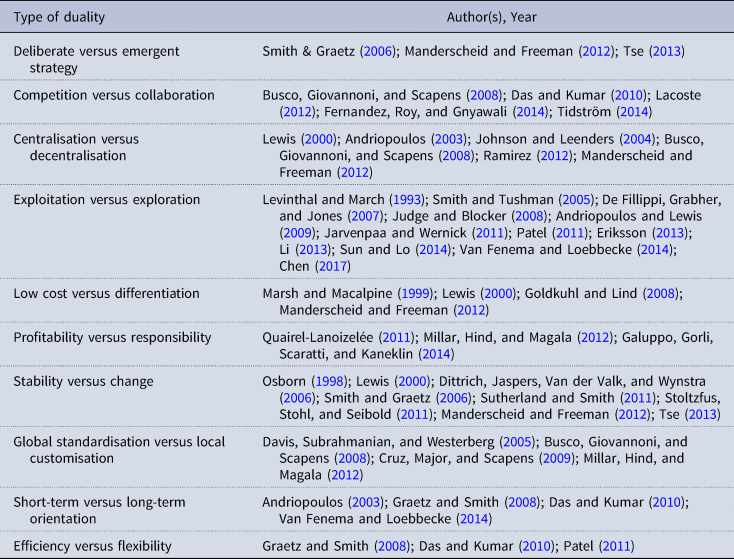
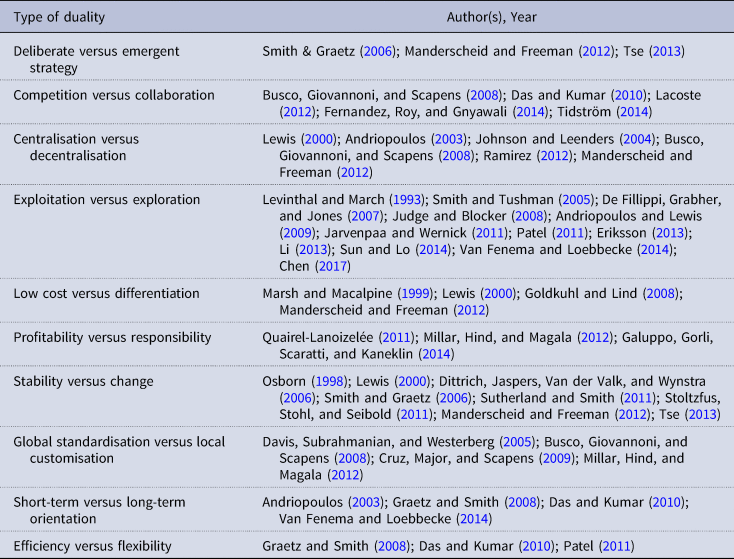
Academic research on strategic dualities has especially evolved in the last two decades (Birkinshaw, Zimmermann, & Raisch, Reference Birkinshaw, Zimmermann and Raisch2016; Schad, Lewis, Raisch, & Smith, Reference Schad, Lewis, Raisch and Smith2016; Smith, Erez, Jarvenpaa, Lewis, & Tracey, Reference Smith, Erez, Jarvenpaa, Lewis and Tracey2017) and today we have some well-known examples of organisational dualities (see Table 1) within different organisational and contextual settings (Janssens & Steyaert, Reference Janssens and Steyaert1999) often categorised into one systemic level.
An overview of the most often cited organisational dualities
According to Smith and Lewis (Reference Smith and Lewis2011), there are four different types of dualities and resulting tensions:
(1) A performing tension that can arise from the ‘plurality of stakeholders and their competing strategies and goals’ (Smith & Lewis, Reference Smith and Lewis2011: 384) and associated outcomes.
(2) Belonging tensions, which evolve around individual and collective identity issues. That is, within the firm, there are opposing but coexisting roles and values which promote the conflict of self versus other(s).
(3) Organising tensions that surface when a social/environmental mission is combined with business needs to compete and achieve short-term economic performance, which triggers competition between organisational structures, cultures, practices, and processes. Typical organising tensions include collaboration versus competition and empowerment versus direction.
(4) Learning tensions that emerge from the existence of multiple and divergent time horizons (Smith, Gonin, & Besharov, Reference Smith, Gonin and Besharov2013) in the process of ‘building upon and destroying the past to create the future’ (Smith & Lewis, Reference Smith and Lewis2011: 383).
Taking into account these definitions, we can say that duality represents a specific organisational aspect composed (systemically or socially constructed) of two contradictory and simultaneously complementary poles. These poles can be considered as the right and left extreme of the specific organisational aspect and while somewhat simplistic in nature, allow for meaning to be drawn. They ‘assume the existence of the other, refer to each other, but remain irreducible to each other’ (Möllering, Reference Möllering2005: 284). Each pole of the duality is necessary but not sufficient alone for the long-term well-being of the organisation (Ashforth & Reingen, Reference Ashforth and Reingen2014). Because of the opposition between the poles, it seems impossible to manage them simultaneously. As a consequence, managers usually address only one pole of the duality (Fairhurst, Reference Fairhurst2019) at a time. For example, they apply a centralised or decentralised structure, they exploit or explore, or they seek stability or change. However, most of the time this is not even a clear decision taken after a thorough analysis of the situation. Especially when managers are faced with competing tensions in allocating scarce resources, they can attempt to ignore, compartmentalise, aggregate, or synthesise organisational dualities (Kraatz and Block, Reference Kraatz, Block, Greenwood, Oliver, Sahlin-Andersson and Suddaby2008). Alternatively, they persist in the strategic direction followed thus far because of the existing organisation design (Henderson & Clark, Reference Henderson and Clark1990), routines (Gilbert, Reference Gilbert2005), and competencies (Leonard-Barton, Reference Leonard-Barton1992), situations that March (Reference March1991) defined as ‘inertia traps’. In addition, there is a theoretical stance that says management must follow one strategy option as to avoid a possible ‘stuck-in-the-middle’ situation (Porter, Reference Porter1996; Tushman & Romanelli, Reference Tushman, Romanelli, Staw and Cummings1985).
In broad terms, two strategies related to the management of dualities exist. The first is an alignment strategy that seeks synergies and interrelationships (Hargrave & Van de Ven, Reference Hargrave and Van de Ven2017; Salvato & Rerup, Reference Salvato and Rerup2018; Smets, Jarzabkowski, Burke, & Spee, Reference Smets, Jarzabkowski, Burke and Spee2015). This approach supposes that any improvement in one dimension of the duality should improve the other dimension or should at least not diminish its performance. The second strategy is that of avoidance, whereby tensions are largely ignored or set aside by accepting trade-offs or an ‘or’ i.e. alternative solution (van Bommel, Reference van Bommel2018). The most likely result of the second strategy is the development of a self-reinforcing cycle that suppresses rather than enables the other pole of the duality (Schmitt & Raisch, Reference Schmitt and Raisch2015), eventually undermining the effectiveness of an organisation (Andriopoulos & Lewis, Reference Andriopoulos and Lewis2009). Some authors propose Hegel's dialectic as the most appropriate approach to management of dualities (e.g. De Wit and Meyer, Reference De Wit and Meyer2005). Hegel's dialectic entails a starting point (i.e., a thesis or the first pole of duality), followed by a contradiction (i.e., an antithesis or the second pole of duality), and ending with a compromise between the two (i.e., a synthesis). Such process allows integration of the compatible aspects of duality and full separation of the conflicting one. In that way management is in a position to get a ‘both/and’ solution. However, this position was challenged by Li (Reference Li2014) who says that Hegel's dialectic does not accept the contradiction of duality but instead rejects it. According to Li (Reference Li2014) Hegel's dialectic dismisses the differences between poles and keeps only their similarity. Instead Li (Reference Li2014) proposes management of dualities based on ‘asymmetrical’ and ‘transitional’ balancing. ‘Asymmetrical’ balancing considers one of the poles as dominant and the other as subordinate with a threshold value that defines which pole is dominant and which subordinate. On the other hand, ‘transitional balancing’ assumes that opposite poles are shifting over time from the dominant role or the subordinate role toward their opposite side with no need for resolution. The concept of duality is fundamentally committed to the concept of process or change and not to the final resolution.
According to Lüscher and Lewis (Reference Lüscher and Lewis2008: 234), duality management does not mean solving the duality in terms of eliminating its inherent tensions but rather exploiting these tensions as triggers of organisational change. When an organisation is trying to definitely eliminate a duality, it risks falling into the ‘loop of simplicity’ (Clegg, Cunha and Cunha, Reference Clegg, Cunha and Cunha2002: 487), which is in contrast to the demands of today's turbulent business environment. Duality management supposes that management coexists with dualities by accepting, differentiating, and integrating them (Lewis, Reference Lewis2000; Smith & Tushman, Reference Smith and Tushman2005) as in the case of a dynamic equilibrium model (Smith & Lewis, Reference Smith and Lewis2011). However, in order to achieve such a delicate task, management will require a considerably higher developed conceptual model of organisational dualities than a simple inventory of different dualities as is actually available in the literature.
Time and content dimensions of corporate strategy (TTOP-model)
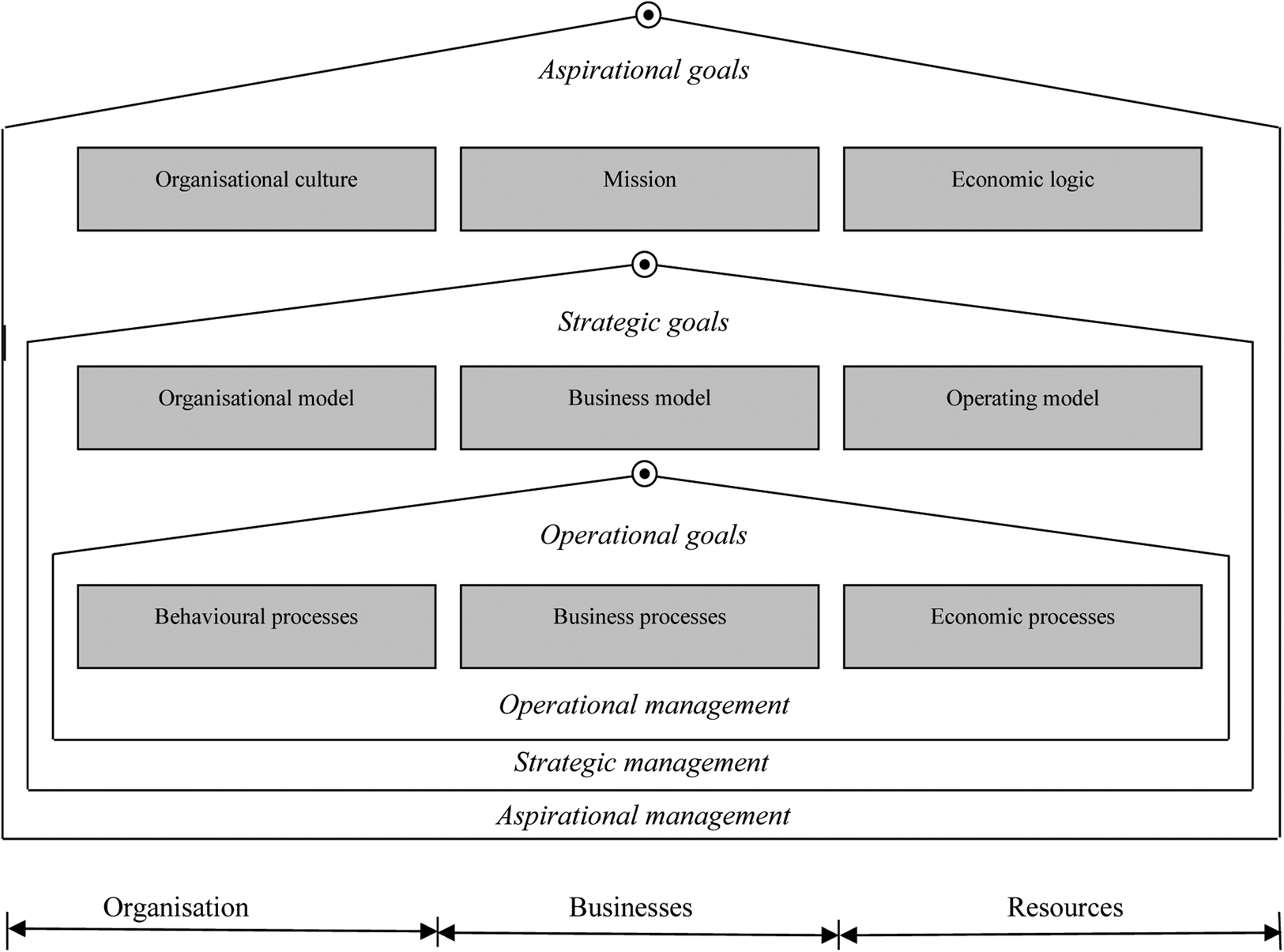
The essence of strategy is to choose what to do and what not to do. It is about implicitly or explicitly defining selection criteria and available options, and at the end making informed trade-offs to decide what strategic choice to pursue. However, prior to that, management must answer the question ‘Why’ (Sinek, Reference Sinek2009) or give purpose to the existence of an organisation. A clear answer to this question represents a pre-condition to exploring ‘What’ the organisation should do and ultimately ‘How’ they should do it. The three essence of strategy – Why, What, and How have their own time-frames that go from long to short-term with the longer one embodying the shorter one. These concepts are the foundations of the three-tier organisational policy model (TTOP) presented in Figure 1.
Three-tier organisational policy model (TTOP-model).
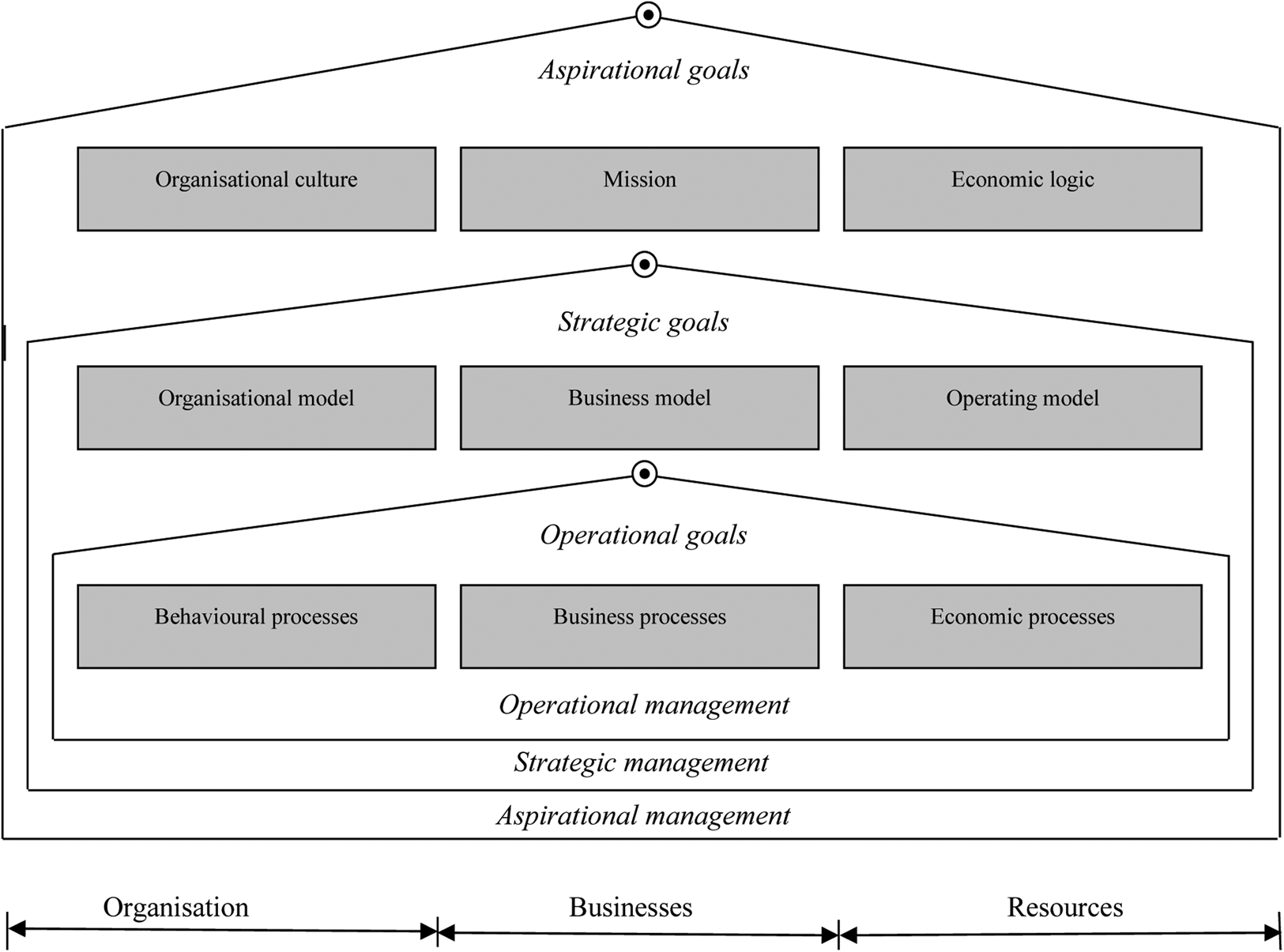
The TTOP-model represents a formative framework for research, design and assessment of corporate strategy (Biloslavo & Hicks, Reference Biloslavo and Hicks2007). It consists of a number of strategic dimensions relating to the overall purpose and direction of the business (mission, culture and logic) the components of the business (organisational model, business model and operating model (i.e. resource procurement and allocation) and the delivery of the value proposition (behavioural processes, business processes and economic processes). These dimensions therefore encapsulate the purpose of the organisation, its business composition and the functional aspects of business operations in a similar way to the Triangle of corporate strategy proposed by Collis and Montgomery (Reference Collis and Montgomery1998). These dimensions are further elaborated along three time dimensions: short-term (i.e. operational management), medium-term (i.e. strategic management), and long-term (i.e. aspirational management) (Bleicher, Reference Bleicher1996; Schwaninger, Reference Schwaninger2001; Ulrich, Reference Ulrich2001). The ‘design parameters and control variables of the higher logical levels exert a pre-control influence on those of the lower ones’ (Schwaninger, Reference Schwaninger2001: 1,213) in that the purpose of the organisation will help shape and drive the models and processes, and so on.
Each management level entails different characteristics of the basic strategic dimensions. The broadest time frame represented by aspirational management includes the firm's vision, beliefs and goals that give direction to all of the organisation's activities (Schwaninger, Reference Schwaninger2001). Aspirational management is concerned with advancing the fundamental purpose of the organisation by ensuring that all its parts are committed to a common vision. While this vision may evolve and change over time in response to fundamental changes in the internal and external environment, each incremental change is barely perceptible. Aspirational management therefore underpins the organisation's confidence in its ability to confront the future (Collins & Porras, Reference Collins and Porras1994). It is the rock on which all endeavour is based. Strategic management derives directly from an organisation's vision and defines what kind of products and/or services the organisation should develop, which markets to enter, what kind of capital, processes and relationships it should develop and in what domain.
Strategic management represents the link between long-term aspirational management and short-term operational management (Baumgartner, Reference Baumgartner2014). While aspirational management inculcates absolute or ideal standards within the organisation, based upon its vision and on what it wants to achieve in the future, operational management represents the historical standard that an organisation has achieved so far. Strategic management, therefore, represents a vector of change processes that need to be enacted across resources, business processes, and organisational values in order to move the firm from ‘what it is’ to what it ‘will be’ (Grant, Reference Grant2003). Strategic management needs to consider both the existing and future product mix, available and potentially available resources, and current and future processes for transforming the resource base, especially available intellectual capital, into the desired outputs (King, Reference King2007). In essence, management is a multilevel process, with aspirational management fulfilling the foundational function and strategic management representing the orientational function.
Methodology
In the study the Delphi method of consensus development was used, comprising four survey rounds. The Delphi method is the forebear of participatory social research, and in different domains has primarily been employed for forecasting, planning, issue identification and prioritisation, and strategy development (Okoli & Pawlowski, Reference Okoli and Pawlowski2004). According to Ononiwu (Reference Ononiwu2013) the Delphi method allows for a systematic, interactive, iterative collection of the independent experts' opinions and their evaluation by the involved researchers. However, as Holsapple and Joshi (Reference Holsapple and Joshi2002) highlight, it is mainly used for theory generation rather than testing and evaluation. The technique was first used for research purposes in the 1950s at the Rand Corporation. Since the first Delphi study (Dalkey & Helmer, Reference Dalkey and Helmer1963) the method has evolved three main characteristics:
-
− there are more rounds of consultation than in the original study;
-
− experts are anonymous; and
-
− experts must receive feedback about the previous rounds of consultation.
Throughout the entire research process, the experts remain anonymous to one another and cannot communicate directly. Generally, there are three to four rounds of opinion exchange (Loo, Reference Loo2002) where within the first round, experts are invited to generate suggestions regarding the research question (Beech, Reference Beech1999) if this has not already been done by the researcher and in the second and further rounds, the experts are asked to give answers, mostly through a Likert-type scale (Stitt-Gohdes & Crews, Reference Stitt-Gohdes and Crews2004).
The Delphi method allows researchers to gather and coordinate the different opinions of experts on the proposed research problem. In the sequence of rounds, experts can re-evaluate their previous positions by considering the feedback they receive from the researcher, who summarises their opinions between rounds, ensuring all opinions are presented in a completely equal way.
The method has two basic purposes. The first is to provide a shared answer to the proposed problem, and the second is to coordinate the expressed opinions in such a way that, after a number of rounds, consensus is reached among the experts. Keeney, Hasson, and McKenna (Reference Keeney, Hasson and McKenna2006) suggest that 75% agreement can represent the standard cut-off value for achieved consensus, while other researchers say consensus is reached when at least 60% of the experts agree (Stitt-Gohdes & Crews, Reference Stitt-Gohdes and Crews2004). While consensus is the goal of the Delphi method, ‘it is important to note that iterations can conclude in a lack of agreement and consensus, a situation that researchers need to be aware of’ (Cole, Donohoe, & Stellefson, Reference Cole, Donohoe and Stellefson2013). The other important thing to consider regarding the generalisation of the results, is that their validity is rooted in the iterative process of the development of expert opinions and consensus building, a perspective which is in contrast with statistical significance (Cole, Donohoe, & Stellefson, Reference Cole, Donohoe and Stellefson2013). As such, it can be concluded that the Delphi technique is not a substitute for other research methods, but rather an option for discussing and testing complex and intertwined subjects that cross over narrow disciplinary boundaries (Grisham, Reference Grisham2009). This requires a panel of experts who are composed of people with appropriate knowledge and expertise in the particular field under study. So, the careful selection of experts is a stage that represents the keystone to a successful Delphi study (Stitt-Gohdes & Crews, Reference Stitt-Gohdes and Crews2004). The number of experts in the expert group can vary depending on the complexity of the study. For example, Loo and Thorpe (Reference Loo and Thorpe2003) have suggested that the appropriate number is between 15 and 30 experts, Stitt-Gohdes and Crews (Reference Stitt-Gohdes and Crews2004) between 10 and 15, and Okoli and Pawlowski (Reference Okoli and Pawlowski2004) between 10 and 18. However, in the first Delphi study undertaken, there were only seven experts (Dalkey & Helmer, Reference Dalkey and Helmer1963). Irrespective of the number of experts, the method itself has a high degree of reliability and validity due to the many iterative rounds between researcher and experts (Landeta, Reference Landeta2006).
The Delphi process we applied had three main objectives:
(1) to achieve consensus among experts on identified dualities in the literature review;
(2) to achieve consensus among experts on the classification of identified dualities, within the dimensions of corporate strategy based on the TTOP-model;
(3) to achieve consensus among experts on the classification of identified dualities into medium-term or long-term management levels.
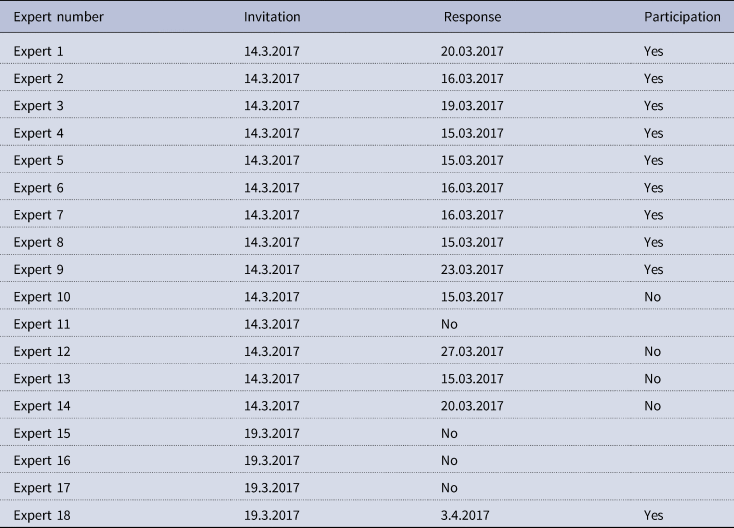
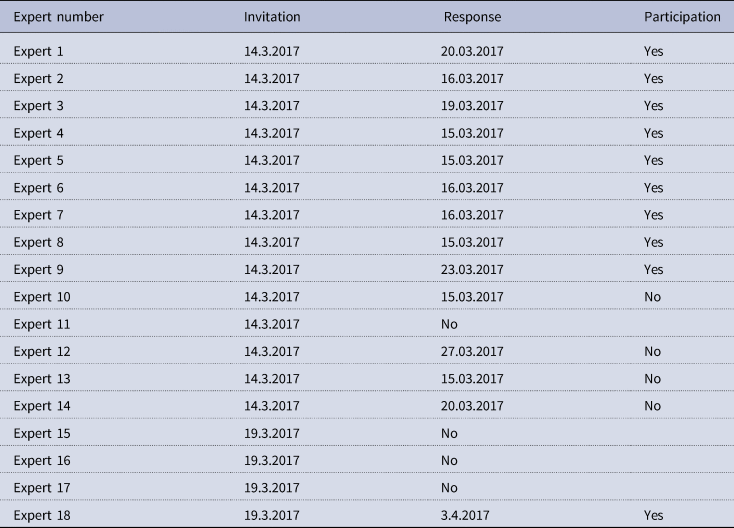
The expert panel was composed of academic professors and researchers from the field of organisational policy, strategic management, management, and innovation management. First, three local experts and 11 foreign experts were invited. A few days later, four more foreign experts were invited with the purpose of retaining as high a number of experts as possible, as the dropout rate for a Delphi study can be high after the first few rounds (Day & Bobeva, Reference Day and Bobeva2005). Fourteen out of eighteen experts replied, and of them, ten confirmed participation, representing a 56% response rate (see Table 2). Among them were some of the most cited researchers in the area of organisational dualities.
Dates of the request for participating in the expert group and the answers receivedFootnote 7
In Round 1, participants were asked to agree/disagree with 21 statements (with each duality representing its own question). Experts answered ‘Yes’ if they agreed or ‘No’ if they disagreed. Participants were also asked to suggest additional dualities, which were incorporated as new statements (n = 4) in Round 2, and comment on the categorisations provided. Surprisingly the simplistic nature of the categorisations was accepted and seemed to resonate with the Delphi sample. In Round 2 participants re-appraised their answer in view of the group consensus and considered the new proposed dualities in Round 1. In Round 3 participants were asked to rate agreement/disagreement with 23 statements regarding classification of dualities within the TTOP's building blocks and two time horizons. In Round 4, the last Round of the Delphi process, participants re-appraised their answer in view of the group consensus in Round 3. Communication with the experts was conducted through email, allowing them 14-day to respond. Once we received experts' answers to each questionnaire, we had seven days to analyse them and prepare the questionnaire for the next round. Each round lasted 21 days in total, and the entire study took place between March 2017 and June 2017.
Usually, the Delphi method is composed of two parts: (i) the experts are asked to define the research topic (the experts answer an open question), and then (ii) researchers attempt to create consensus among the experts on the answer to the question defined in the first part (experts answer closed-ended questions). However, for our research, we partly modified the methodFootnote 4 by not asking for the research topic but instead proposing a list of 21 previously identified dualities.Footnote 5
Analysis and findings
The first round of the Delphi method
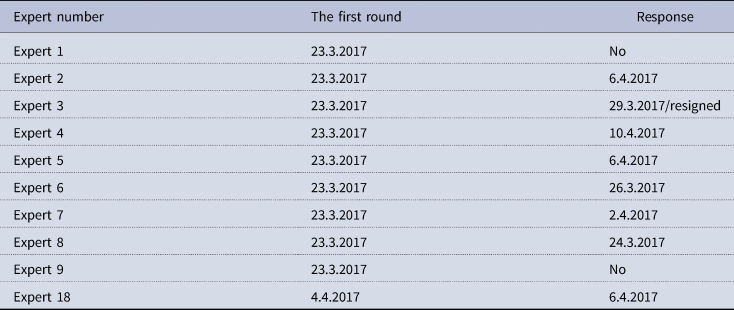
The first questionnaire was composed of two parts. In the first part, there were 21 closed questions with each duality representing its own question. Experts answered ‘Yes’ if they agreed or ‘No’ if they disagreed. In the second part, the experts were able to suggest additional dualities not identified in the first part of our research. The first questionnaire was sent to the nine experts involved in the first round on 23 March 2017, and the deadline for returning it was 6 April 2017. Expert 18 received the questionnaire later, having only confirmed his participation on 3 April 2017, when the Delphi method was already in process. However, there was still sufficient time for him to be included in the expert group. Consequently, this expert was sent the first questionnaire on 4 April 2017, and he returned the questionnaire exactly on the deadline of 6 April 2017. The dates on which first round responses were received from experts are presented in Table 3.
Dates of sending the questionnaire and receiving responses in the first round
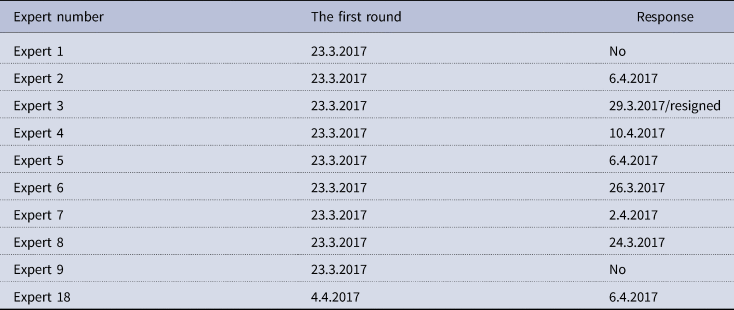
In this round, two experts did not respond, even though they had previously confirmed their participation and two reminders were sent to them. Expert 3 resigned after receiving the first questionnaire, as he did not consider himself an appropriate expert for the research context.
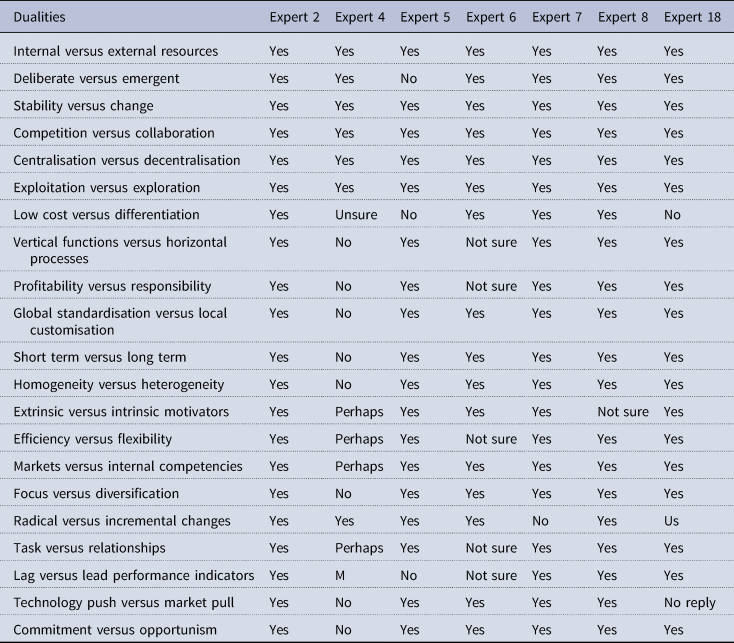
In the first round, the experts reached a 100% consensus for four dualities: internal versusFootnote 6 external resources, competition versus collaboration, centralisation versus decentralisation, and exploitation versus exploration. As a result, they did not have to reply on these four dualities in the second round. We also found that the minimum percentage of consensus was reached for low cost versus differentiation and lag versus lead performance indicators dualities, with 57% of experts agreeing with these two dualities (or, four out of seven). According to the rule of 60% as a cut off value we would need to exclude them from further rounds. However, we kept them because one of the experts said ‘I'm not sure’, which we consider as not as a final negative answer.
In the first round, the experts suggested renaming the duality ‘homogeneity versus heterogeneity’ as ‘uniform versus diverse’. The suggestion was accepted, and the duality was renamed for the second round. The experts also suggested four additional dualities which we had not identified during the literature analysis:
-
− democratic versus autocratic
-
− entrepreneurial versus control/planned
-
− simple versus complex nature of the business
-
− outsourcing versus integration
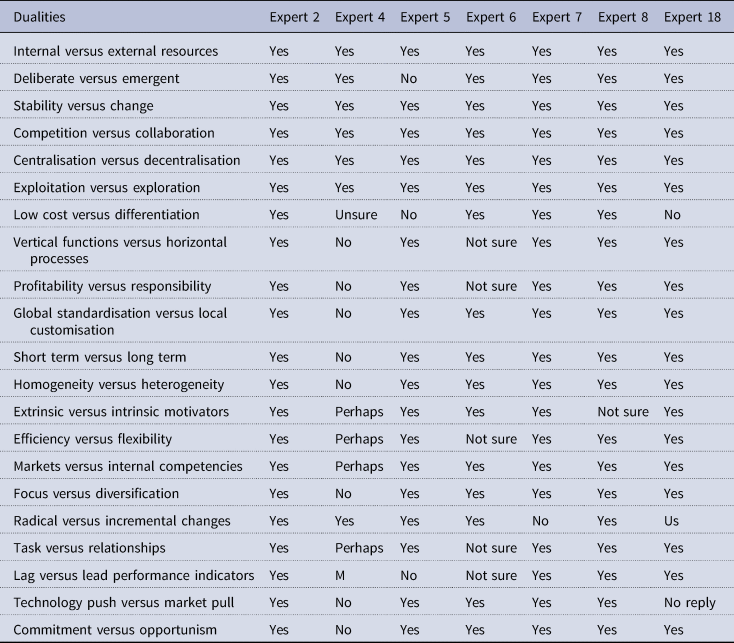
The experts' responses for each duality in the first round are presented in Table 4.
The results from the first round of the Delphi method
The second round of the Delphi method
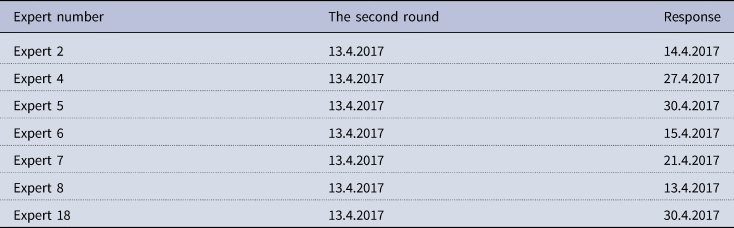
After the first round of the Delphi method, seven experts remained in the expert group, representing a 39% response rate. The second round started on time (on 13 April 2017), although Expert 4 returned the questionnaire after the deadline.
The second questionnaire was composed of three parts. In the first part, there were again 21 closed questions incorporating feedback from the first round. The second part contained four new closed questions on the additional dualities that had been mentioned by the experts in the first round. Meanwhile, the third part gave experts the opportunity to write extra comments.
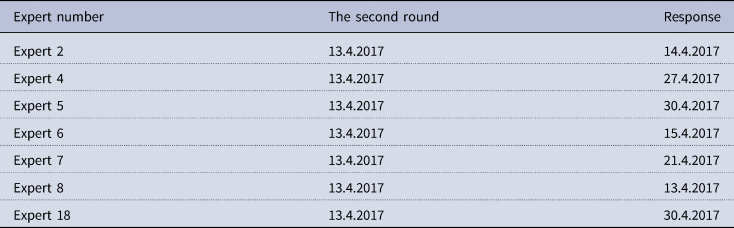
The second questionnaire was sent to experts on 13 April 2017 and the deadline was 27 April 2017. The dates on which second round responses were received from experts are presented in Table 5.
Dates of sending the questionnaire and receiving responses in the second round
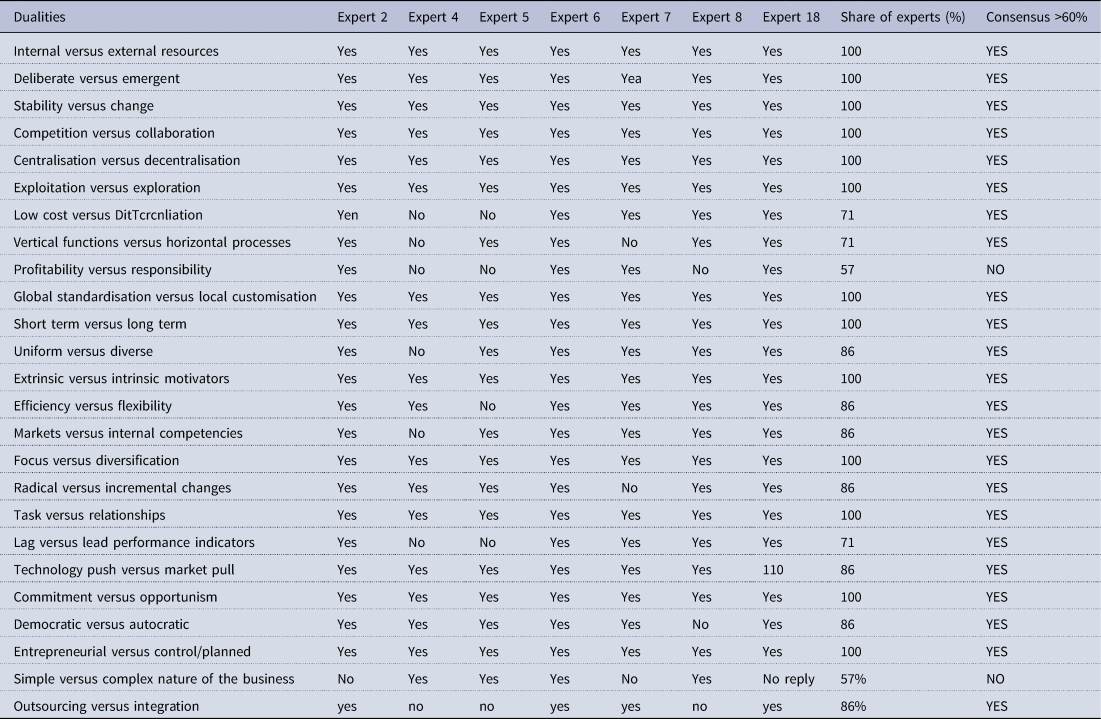
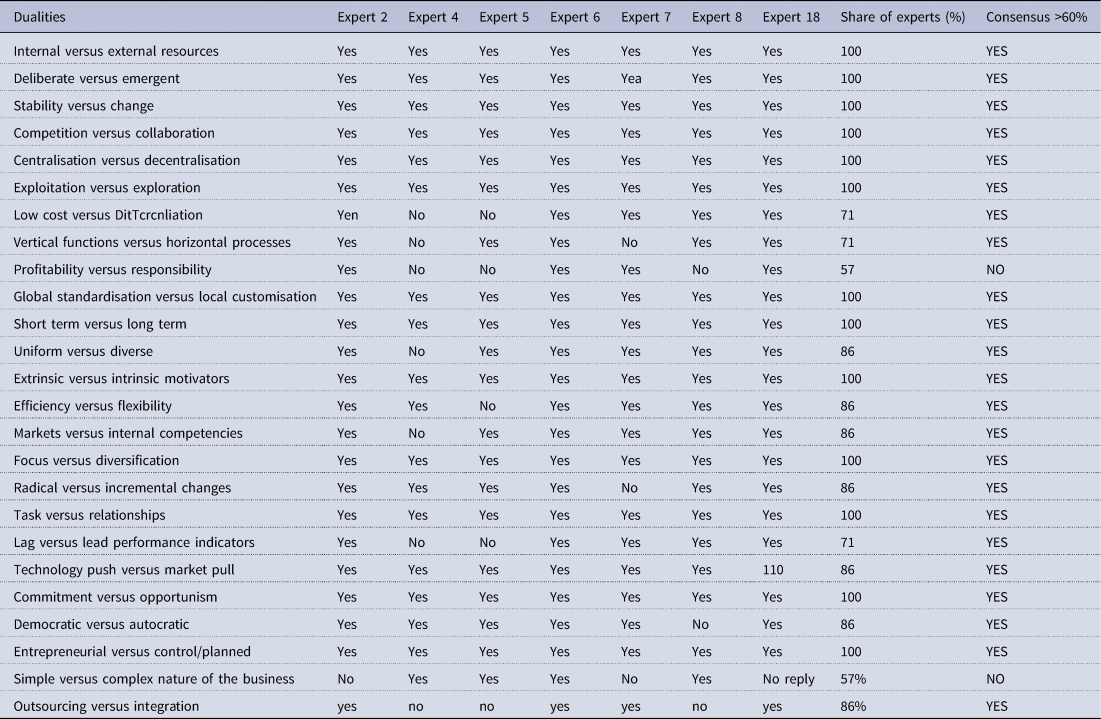
Data analysis from the second round of the Delphi method shows that the experts reached a final consensus on 23 dualities. The two dualities on which they did not achieve a consensus were profitability versus responsibility and the simple versus complex nature of the business. The percentage of experts who agreed on the integration of these two dualities in the TTOP-model was 57% for both, less than the minimum of 60% needed for reaching consensus. Because of this, we excluded these two dualities from the final set. On the simple versus complex nature of the business duality, one expert said: ‘Too broad, and so little seems ‘simple’ these days in business’.
The reached percentage of consensus is as follows: 100% consensus on 13 dualities, representing seven experts out of 7, 86% consensus on eight dualities, representing six experts out of seven, and 71% consensus on three dualities, representing five experts out of seven. Thus, for more than 50% of the identified dualities, a full expert consensus was achieved.
The experts' responses for each duality in the second round are presented in Table 6.
The results from the second round of the Delphi method
The third round of the Delphi method
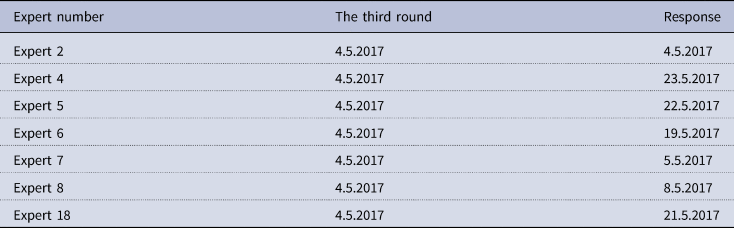
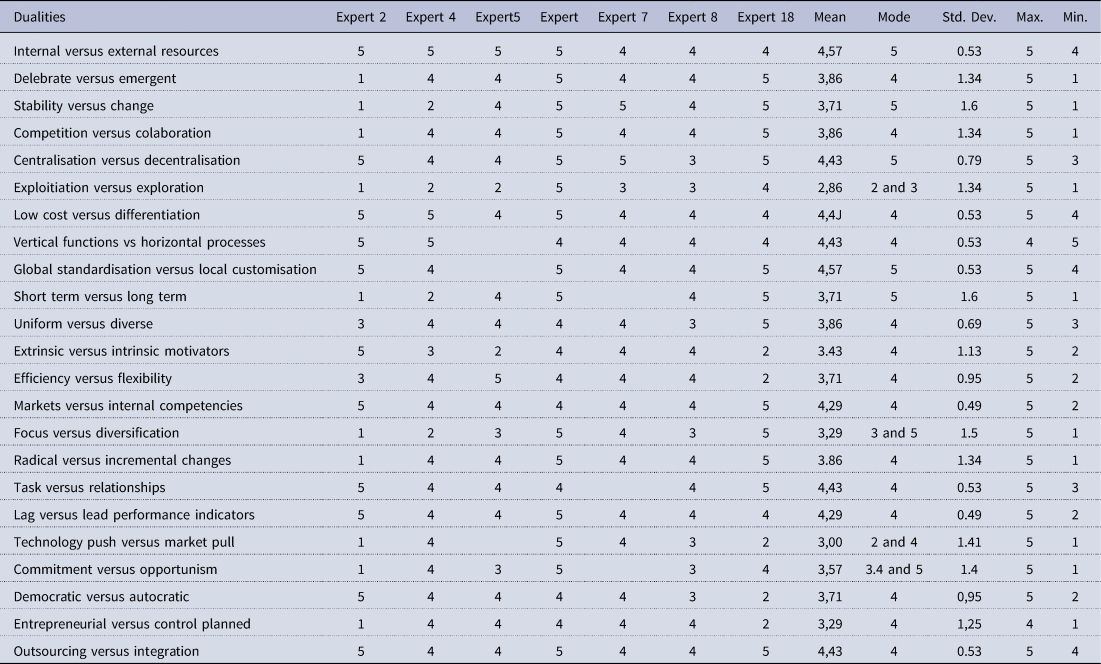
All experts responded to the second round questionnaire in time for the third round to start as planned on 4 May 2017 (despite the fact that Expert 3 and Expert 7 returned the questionnaire three days late). The third round questionnaire contained feedback from the second round of the Delphi method. It also represented the beginning of the second part of our research, in which we asked experts whether they agreed with the proposed classification of dualities within the TTOP's building blocks and two time horizons. This also gave the option for categorisations to be contended or removed or moved. The third questionnaire was composed of 23 closed questions, and experts' opinions were measured with a 5-point Likert scale, whereby the numerical value 1 meant strongly disagree, 2 disagree, 3 neither agree nor disagree, 4 agree and 5 strongly agree. The neutral point (neither agree nor disagree) was provided as an option because the experts had not yet received feedback on the second part of the research.
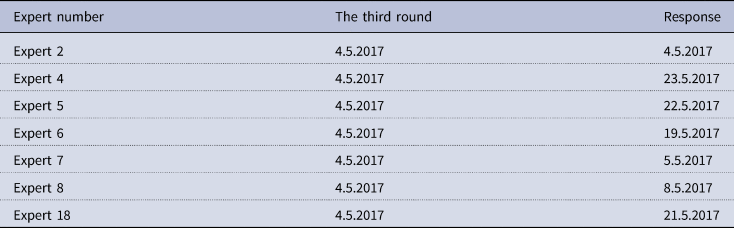
The third round questionnaire was sent to the experts on 4 May 2017 with a deadline of 18 May 2017. The dates on which responses were received from experts are presented in Table 7.
Dates of sending the questionnaire and receiving responses in the third round
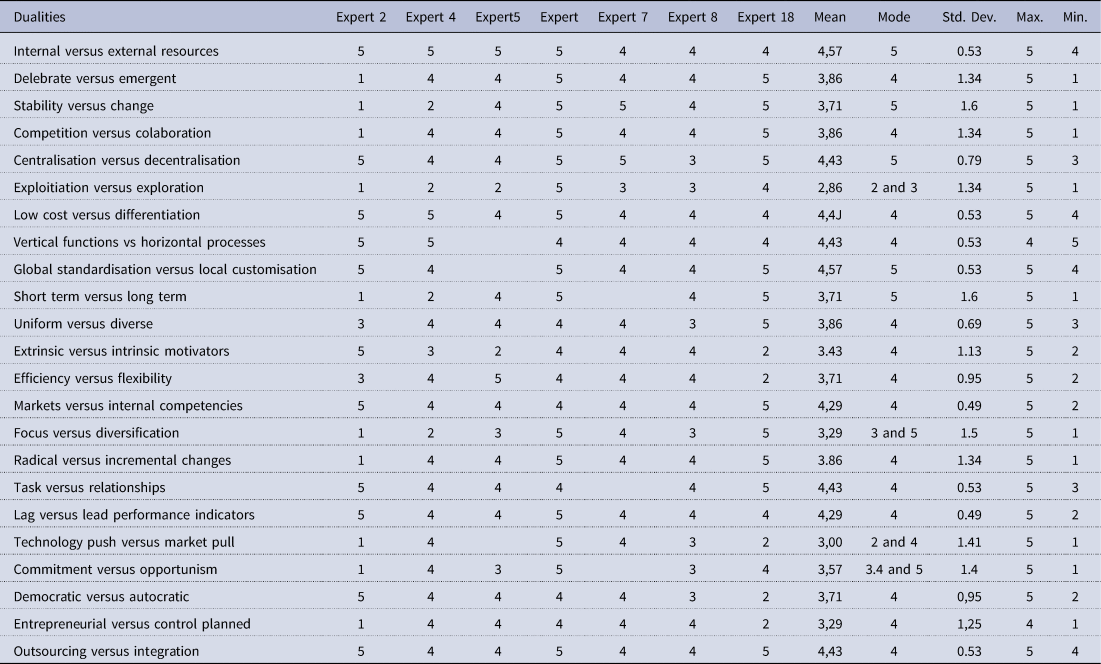
The highest average value achieved on the Likert scale was 4.57, representing two dualities:
-
− internal versus external resources
-
− global standardisation versus local customisation
The maximum numerical value was 5 and the minimum was 4, while the mode was 5.
For the following four dualities the average value was 4.43:
-
− low cost versus differentiation
-
− vertical functions versus horizontal processes
-
− task versus relationships
-
− outsourcing versus integration
For these dualities, the maximum numerical value was 5, while both the minimum value and mode were 4.
The following two dualities achieved a numerical value of 4.29:
-
− markets versus internal competencies
-
− lag versus lead performance indicators
For the abovementioned eight dualities, the consensus was so high that experts did not have to reply again on them in the fourth (and last) round of the Delphi method.
The experts' responses for each duality in the third round are presented in Table 8.
The results from the third round of the Delphi method
The fourth round of the Delphi method
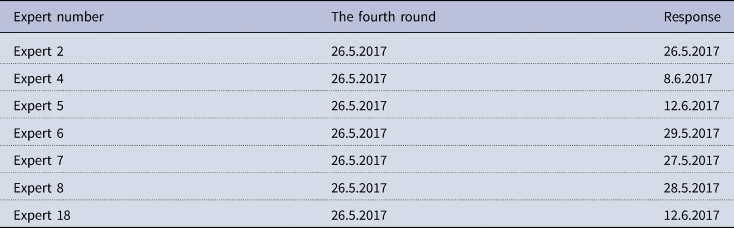
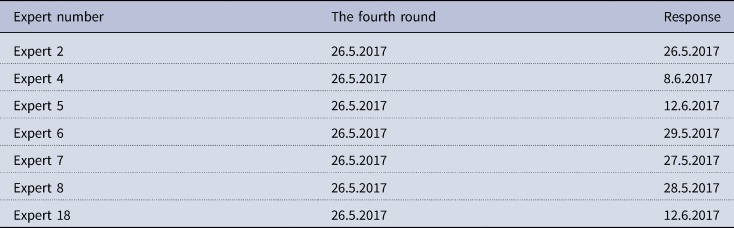
In the third round, Expert 2, Expert 3, Expert 4, and Expert 7 returned the questionnaire late. Consequently, we started the fourth round one day later than scheduled, on 26 May 2017. In this final round, experts answered on a 4-point Likert scale with the numerical value 1 representing strongly disagree, 2 disagree, 3 agree and 4 strongly agree. As the fourth round was the last, we excluded the neutral point ‘neither agree nor disagree’ in order to push experts to provide a clear opinion on individual dualities. As before, the experts received the feedback from the third round of the Delphi method. The fourth questionnaire was sent to the experts on 26 May 2017 and the deadline was 9 June 2017. All experts responded on time, except Expert 3 and Expert 7, who responded three days late.
Although we started with ten experts in the first round, it is important that between the second and fourth round all seven experts were retained. The dates on which fourth round responses were received from experts are presented in Table 9.
Dates of sending the questionnaire and receiving responses in the fourth round
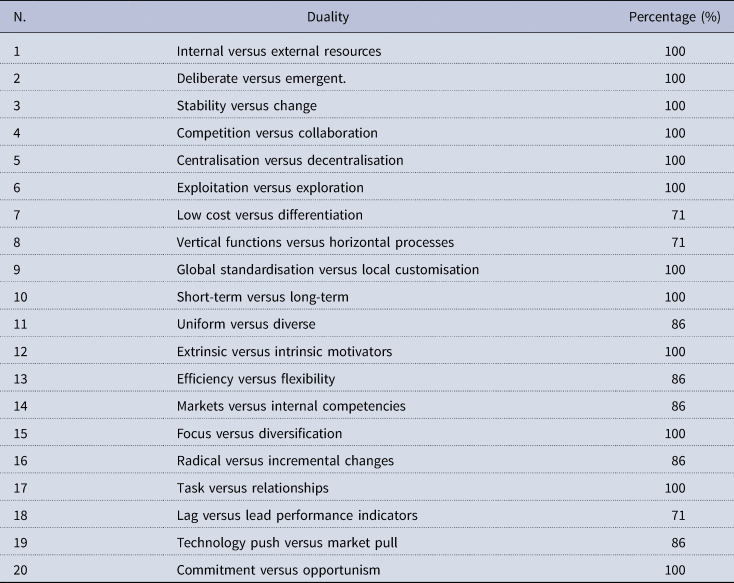
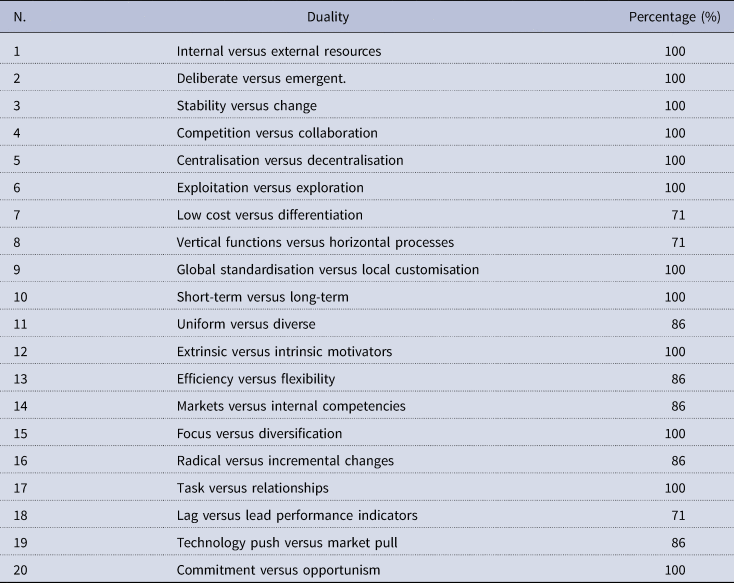
In this final round, a 100% consensus was reached on nine dualities (i.e. all answered ‘strongly agree’ or ‘agree’). For another nine dualities, six experts out of seven agreed, representing an 86% consensus, and for four other dualities, five experts out of seven agreed, representing a 71% consensus. In total, the experts reached consensus for 22 out of 23 dualities.
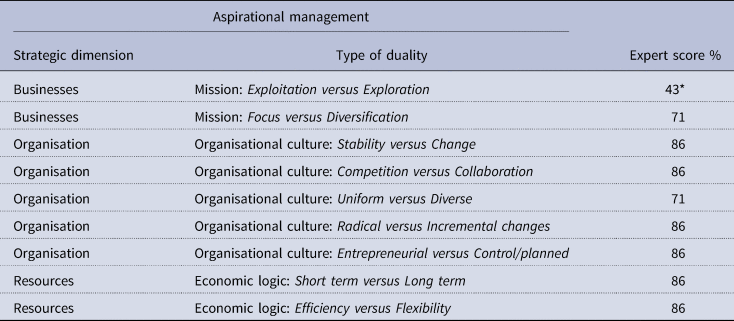
The duality they did not reach consensus on was the integration of exploitation versus exploration into the long-term aspirational management level within the TTOP-model. For this duality, the experts only reached a 43% consensus, which is lower than the minimum necessary percentage of 60%. This means that the exploitation versus exploration duality was considered appropriate for inclusion but not as an aspect of aspirational management. In regard to this, one of the experts said, ‘I think Exploration versus Exploitation decisions are more about strategic goals or even operational goals than aspirational, which seem to me more abstract’. Consequently, exploitation versus exploration duality was included in medium-term strategic management level within the business block of the TTOP-model.
Experts' responses for each duality and the percentage of consensus for the fourth round of the Delphi method are found in Table 10.
The results from the fourth round of the Delphi method

Data interpretation
With the Delphi method we gained expert opinions on:
-
− dualities recognised in the literature published up to 2015
-
− possible additional dualities
-
− the classification of dualities in the TTOP-model
Tensions that experts considered to be dualities and the percentage consensus achieved are presented below in Table 11.
Dualities considered by experts and the percentage of consensus
The experts did not reach consensus on the profitability versus responsibility duality, as the percentage of those in agreement was less than the minimum necessary. Consequently, this duality was not included in further steps of the research.
The experts suggested four additional dualities: Democratic versus Autocratic, Entrepreneurial versus Control/planned, Outsourcing versus Integration, and Simple versus Complex nature of the business. However, consensus was only reached on three of the dualities:
(1) Democratic versus Autocratic 86%
(2) Entrepreneurial versus Control/planned 100%
(3) Outsourcing versus Integration 86%
Meanwhile, there was only 57% agreement on the simple versus complex nature of the business duality, meaning that a consensus was not reached. Consequently, this duality was excluded from the research as not appropriate for integration in the TTOP-model.
The data in this part of the research shows that the minimum expert consensus was 71%, which is higher than the minimum necessary (60%). Consequently, it can be claimed that at least 71% of experts agreed with the identified dualities, so minimum expert consensus is 71% and maximum consensus is 100%. The average, meanwhile, is 92% consensus.
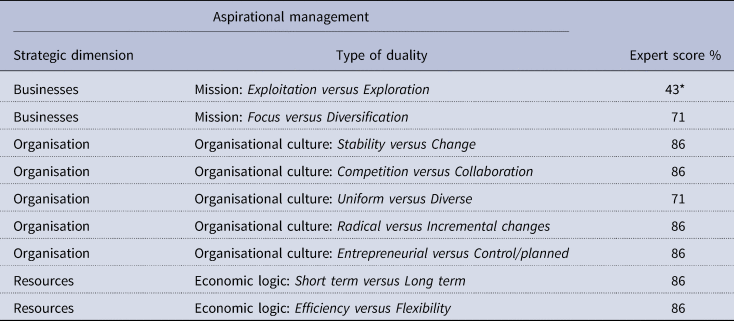
The expert consensus on the integration of each duality into the time frame of long-term (aspirational management) and medium-term (strategic management) in the TTOP-model, is shown below in Tables 12 and 13. These tables reflect the final result of the 23 dualities as classified.
Dualities within the aspirational management level of the TTOP-model
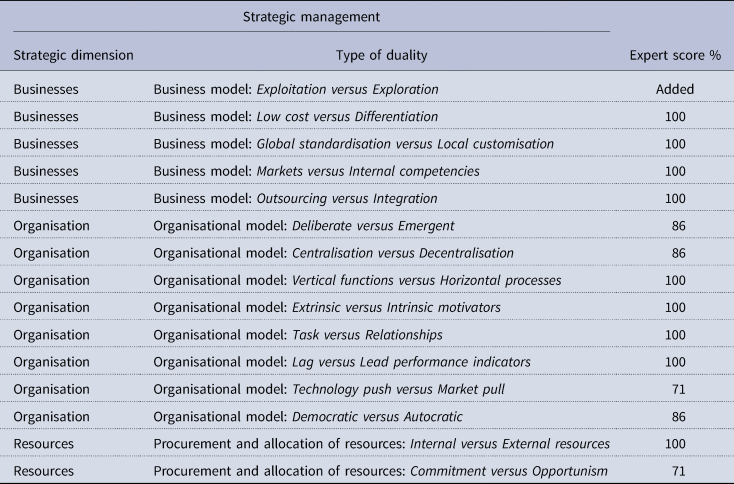
Dualities within the strategic management level of the TTOP-model
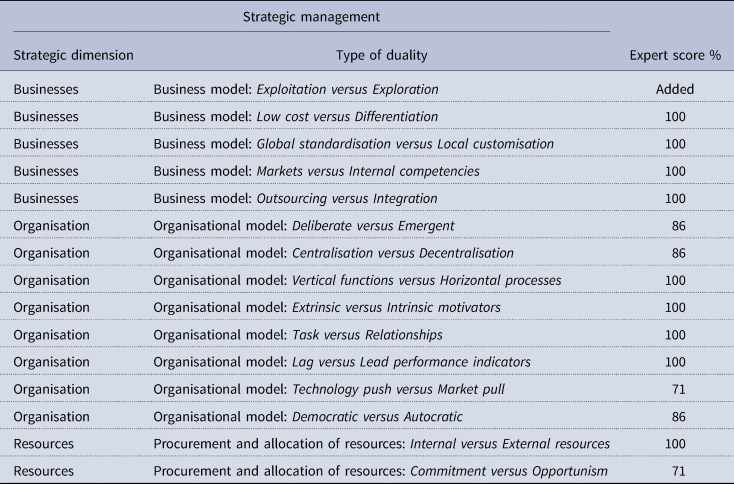
As in the first part of the research, the minimum expert consensus in the second part was 71%, and the maximum was 100%. At this point it can be claimed that at least 71% of experts agreed on the suggested placing of the duality into the TTOP-model. Meanwhile, the average consensus was 89%. Experts did not agree on positioning the exploitation versus exploration duality (see * with 43%) within the aspirational management level as they did not see it as part of a more ‘abstract’ foundational function but rather as a tangible strategic orientation that gives direction to business development and design.
Table 13 below shows the strategic management level dualities with the addition of Business model: Exploitation versus Exploration. This now reflects the final and completed TTOP framework with dualities added.
Discussion
Strategy is full of trade-off decisions that require management to weigh one option over another and to resolve difficult dilemmas that arise. Because an organisation's resources are limited, management must clearly define its goals and selection criteria in order to select the best possible option. The selection criteria define which properties should be sought in a particular strategic option and how well they score. Some options will score high according to some criteria and low for others. If it were not so, the choice would be obvious. When this obvious choice does not exist, which happens most of the time, management must compromise between the various strategic options. For example, investing in a new production line or moving to a new geographical region also means compromises that need to be made regarding the expected level of future growth and profitability on the one hand, and investment requirements and risk level on the other. However, ultimately, one option is selected and others discarded. While this process is suitable for making strategic decisions, it is not suitable for management of dualities. The classical approach to decision making is forbidding management to look toward the uncertain, the ambiguous, and the contradictory that characterise management of dualities. Indeed, Lewis and Smith (Reference Lewis and Smith2014) have emphasised that a paradoxical lens needs a ‘holistic understanding of tensions and cognitive and social influences on decision making’, in this respect, our study adds new knowledge to the research area.
To avoid too much complexity, scholars often narrow their research focus to a specific duality or generalise across a broad range of dualities (e.g. Lewis & Smith, Reference Lewis and Smith2014) without considering to which strategy dimension or management level a particular duality corresponds. Within the TTOP-model, management of dualities is conceived as a multidimensional process (Schwaninger, Reference Schwaninger2000) that involves the managerial ability of systemic sense making and sense giving at the aspirational and strategic level, in order to create common frames of reference. The experts agreed on eight dualities to be included in the aspirational management level. Of these dualities, the one that, according to literature, can be perceived as the guiding duality is stability versus change. This is the most central duality of organisation and administration (Farjoun, Reference Farjoun2010).
On the strategic level experts agreed on fourteen dualities. Some of them are very well known, e.g., exploration versus exploitation, task versus relationships, low cost versus differentiation, while others are less so. We can also see that the number of dualities is higher at the strategic level than at the aspirational level of strategy and that most dualities are related to organisational and business model. Their classification within the TTOP model provides insight into their interconnectedness and indicates which elements of the strategy management must reconsider in the event that within one or more dualities happens a shift from the dominant subordinate pole, or vice versa.
Implications, limitations and future research possibilities
Our paper sought to address the research questions:
-
− How can we classify organisational dualities based on different temporal horizons (i.e. long- and medium-term)?
-
− How can we classify organisational dualities within different dimensions of corporate strategy (i.e. resources, businesses, and organisation)?
In doing so we sought to contribute to the conversations on duality by empirically adding a better understanding of the temporal influences on dualities and classifying them in a systematic way that would allow them to be managed to gain better organisational performance. This research therefore represents an important step forward in dialectical research on organisations even if it does not add new dualities as all of them are in one way or another already mentioned in the literature. The paper is not designed to be a thorough review of the existing literature, nor does it attempt to propose a new model of paradox theory, but instead it combines multiple bodies of literature and opinions of involved experts, and provides a classification of dualities on two temporal levels and three dimensions of corporate strategy.
In addressing our two research questions we found that it was possible to classify duality based on temporal horizons and also within different dimensions of corporate strategy and that in doing so we found that the dualities differ from other strategic decision contexts in two essential elements. The first is that poles of duality are interrelated and complementary, which means that we cannot unequivocally assess the benefit of one pole without considering the impact on the other pole, e.g. stability enables change and change allows for stability (Farjoun, Reference Farjoun2010). The second element we contribute is that both poles of duality in their own way, contribute to the specific organisational goal e.g. radical and incremental changes both contribute to innovation.
Classifying the dualities highlighted that strategic dualities require management to transcend Aristotelian formal logic governed by the laws of non-contradiction and the excluded middle, as these laws state that all things must belong to categories that are mutually exclusive. For example, short-term versus long-term orientation duality demands a change in the conversation from one where short-term and long-term are seen in opposition – one bad and the other good – to an ‘and’ construction, where delivering in the short-term means strengthening and not depleting long-term performance potential.
As management cannot come to the above understanding by intuition alone, often trapped in an ‘inertia trap’ unable to recognise duality, the results of our research will help management to not only recognise different dualities but to understand which elements of the strategy are affected by them. Furthermore, it will reveal how such dualities may persist over time and how they will influence the other dualities across the hierarchy. For example, a stronger orientation versus control/planned organisational culture is aligned with a stronger propensity for efficiency and stability at the aspirational level of strategy that then influences a stronger propensity for global standardisation, exploitation and low cost at the strategic level of corporate strategy. All these strategy directions must however be ‘balanced’ with the opposite pole of dualities in order to keep the necessary tension to continue to spur organisational transformation and change. This is clearly a highly complex chain reaction and one where experience may have been used in ‘old’ business environments. Now, modern business is more complex, dynamic, and fast paced. Big data, artificial intelligence, quantum computing, machine learning and algorithms may be being developed to deal with the range of paradoxes and dualities that exist but there will always be a place and role for human intuition, judgement and ‘gut feeling’. As such our classification of dualities within the TTOP model is our offering of a tool that can be used alongside our ‘humanness’ to provide management with a common frame of reference. or ‘cognitive map’, to guide and give meaning to their strategic activities that are not fixed in time, objective or knowable, but instead are subjective (i.e., context dependent) and in a constant flux.
Despite the significant contribution our paper makes, there are three important limitations to consider. The first is that it is not possible to ensure that the expert selection procedure included all relevant individuals or that the final list did not suffer from any bias. The second is an unavoidable blind spot that happens in the process of creating the model by taking no account of unimportant matters and purposefully omitting certain factors in an essential reduction of complexity. The third is the sacrifice made in our attempt to reduce the complexity of the dualities and thus provide a meaningful starting point for practitioners and other researchers. We recognised that the dualities will influence the other dualities across the hierarchy of our model but for this paper we have not explored such correlations further yet. We see that as the basis for our further research where we will explore the duality across the levels of the hierarchy, through temporal context and by the nature of systemic vs socially constructed perspectives. As with other models in this form of research, TTOP needs to be considered only as a contingent formative intellectual map, and indeed a starting point, which over time and through constant re-examination will be enhanced and refined.
This research also opens up new opportunities for future research within the field of duality management. It would be reasonable to further empirically test the list of 23 dualities. First, it is important to discover which relationships exist between dualities within different building blocks of strategic management as well as within aspirational management. Similarly, it would be interesting to analyse the relationships that exist between dualities in the same building block within aspirational management and strategic management. Second, it is important to seek relationships between dualities at different levels in an organisation and various performance indicators. As Lewis and Smith (Reference Lewis and Smith2014, p. 128) have said, ‘sustainable high performance stems from embracing multiple, opposing forces simultaneously’. For example, with the TTOP model, it can be verified which type of correlation, if any, exists between duality management in the aspirational management level and the various performance indicators of an organisation. The same can also be verified for the strategic management level. As such, further empirical research can provide deeper understanding of duality management in the sense of how dualities can be managed for better organisational performance within levels, business context and different environmental and cultural dimensions. The phenomenon of duality management is known for being present in organisations, but there is still much to do in terms of transferring this new knowledge into management practice. Our work is a step in this direction.