1. Introduction
The rise of nation states was closely associated with the rise of unified customs territories within them. The Zollverein, the 1834 customs union between German states, was the first international trade agreement that created a unified customs area between independent sovereign nations, unifying customs areas across political borders rather than just within them. Its institutional characteristics, in particular the free trade area, the common external tariff and the explicit revenue-sharing mechanism made it the first customs union according to modern understanding, even providing the templateFootnote 1 for the definition of that institutional structure (Viner, Reference Viner1950). This paper takes up a model-based analytic narrative structure to understand the mechanisms that led to the emergence of this novel institutional structure in the centre of Europe.
The Zollverein was not only the first customs union; it was also a multilateral trade agreement resulting from a sequential negotiation process. It is, therefore, an excellent historical case study for the ongoing debate about the role of regional trade agreements in the creation of multilateral agreements, often labelled as stepping stones versus stumbling blocks (Aghion et al., Reference Aghion, Antras and Helpman2007). Traditionally, the economic history literature has focused on the reasons underlying the existence of the Zollverein rather than analysing its creation process. Consequently, the actual nature of the formation process – why this multilateral agreement was the outcome of sequential negotiations – has never been explained in any great depth.
This paper, consequently, focuses on the origin and emergence of this institution. The starting point is a stylised characterisation of the historical environment of the sovereign German states, especially their involvement in trade negotiations, in the early 19th century. This results in a particular game-theoretic bargaining structure building on coalition externalities, which are the effects an agreement, a coalition, between some states has on those not involved. Using an analytic narrative approach, the analysis then builds on the model to illuminate these externalities as the mechanism underlying the negotiation structure and the institutional outcome, and thereby more generally the nature of the formation process of trade agreements. The Zollverein, and the customs union as an institution, were born due to the particular interdependence between neighbouring German states at the time.
The Zollverein was an important step of the institutional modernisation processes started by German states during the Napoleonic wars. Some of them, most notably Prussia, began to modernise their customs and tariff structures by establishing modern, external customs systems. In 1828, the first customs union agreements were concluded, which led consequently to the establishment of the Zollverein on 1 January 1834 as a customs union of sevenFootnote 2 states. Over the next three decades, a number of further states joined this union, which saw substantial structural changes after the 1866 war between Prussia and Austria and finally became part of the internal political structure of the German Empire in 1871 (Hahn, Reference Hahn1982; Henderson, Reference Henderson1984). The Zollverein set the template for a customs union (Viner, Reference Viner1950); it had no internal customs borders, common external tariff rates, and an explicit revenue distribution system. The net revenues, after the states' costs for border customs administration were compensated, were split evenly according to population size.Footnote 3 Certain necessary administrative functions were handled by a small standing office, whereas any significant decisions, such as tariff rate changes, had to be made unanimously by a congress of all member states that met approximately every 3 years. Actual border controls and practical customs administration were still in the purview of the national services. The Zollverein treaties also constrained member states with regards to public monopolies and producer taxes. Weights and measurements were harmonised and the acceptance of multiple currencies in use throughout its territory was regulated (Hahn, Reference Hahn1982; Henderson, Reference Henderson1984).
In the second half of the 19th century, the emerging historiography about its creation focused on Prussia's hegemony. One influential interpretation was given by Treitschke (Reference Treitschke1872), who saw the Zollverein as a first step towards German unification under the enlightened guidance of the Prussian monarch. This nationalistic view interpreted the Zollverein as a move by Prussia to assert hegemony over Germany and to diminish the influence of its rival, Austria. This view began to be challenged in the 20th century, where, for example, Taylor (Reference Taylor1946) and Kitchen (Reference Kitchen1978) both argue that Prussia's motives were initially of economic nature and only became political later on. Murphy (Reference Murphy1990) provides a differing political interpretation, arguing that the Zollverein was intended as a political bulwark against France. The theory commonly accepted in the current economic history literature (Alesina and Spolaore, Reference Alesina and Spolaore2003; Williamson, Reference Williamson, Findlay, Henriksson, Lindgren and Lundahl2006) has been introduced by Dumke (Reference Dumke1976, Reference Dumke1994) and emphasises the huge fiscal savings due to economies of scale in customs administration. Financial gains, which resulted from these savings, are seen as the main incentive for the creation and participation in the union. Further works about the formation process such as Hahn (Reference Hahn1982) and Henderson (Reference Henderson1984) are more descriptive in their approaches and do not provide a structural analysis explaining the observed structures of the formation.
A major recent exception is Ploeckl (Reference Ploeckl2015) which systematically works through the formation sequence of the Zollverein demonstrating what factors, especially what externalities, shaped the accession of each country. It relies on the model presented hereFootnote 4 to use coalition externalities between German states as the organising principle to carefully illustrate the historical externalities and how their impact can explain the observed timing and sequence of states joining. This paper complements Ploeckl's (Reference Ploeckl2015)Footnote 5 detailed historical description of externalities with a justification of the underlying modelling framework as well as an emphasis on and analysis of wider institutional developments beyond historical details such as the structure of negotiation process in trade negotiations and the choice of trade agreement structures including the innovation of the customs union.
The issues of the formation and nature of trade agreements do receive attention in the modern trade literature, especially regarding the design of a global trade architecture and the role of regional trade agreements. As Evenett (Reference Evenett2004) outlines, there are three approaches to explain the formation process of such trade agreements. The first two, Technocratic Entrepreneurship and Geopolitics and Mercantilism, focus on the respective role of technocratic experts as well as geostrategic and mercantilistic motives without providing a clear structural framework. The third, Domino Regionalism, stresses the cascading political economy effects of trade creation and diversion. In this approach, which was formalised by Baldwin (Reference Baldwin and Bhagwati1999), an idiosyncratic event changes the internal political economy within one state, which then joins the trade agreement. The resulting trade creation and diversion effects lead to political economy changes in other countries, leading them to join as well.
Similarly, Aghion et al. (Reference Aghion, Antras and Helpman2007) develop a bargaining model based on an underlying cooperative game. More general than Baldwin's approach, it provides a theoretical framework for the role of regional agreements in building a global trade agreement and is flexible enough to allow general conclusions about the nature of the formation process. The central feature is the existence of coalition externalities, which represent the impact regional agreements have on those states that are not involved. These externalities turn out to be the main determinant for the structure of the formation process. The model's general nature allows its application to historical circumstances, so it can shed new light on the origins of the Zollverein and the formation of a customs union. My central argument is that a stylised reading of the historical situation of the German states in the early 19th century presents an environment which fits the setup of the model by Aghion et al.; the logic of the model, including the presence and the nature of coalition externalities, can, therefore, explain the characteristics of the observed formation process with its bargaining structure of bilateral negotiations and the novel institutional form of a customs union.
The nature of the formation process of trade agreements has implications for other effects, such as a possible endogeneity between the membership in trade agreements and the effect of such a membership on trade flows between states (Baldwin, Reference Baldwin2006; Wolf and Ritschl, Reference Wolf and Ritschl2011). Keller and Shiue (Reference Keller and Shiue2014) show such a relationship for the Zollverein using one of the factors presented in this paper, namely international market access based on geographic location, as an instrument for a state's accession into the customs union. This paper complements that analysis by providing a structural framework which explains that utilised correlation and embeds it within the larger formation process.
The following section describes the game-theoretic setup and underlying historical context, in particular the set of states involved as players, their potential actions and the nature of coalition externalities. The latter's impact is then demonstrated in the next section, which explores the influence of these externalities on the observed bargaining structure and institutional choice. The final section concludes with a discussion about the implications for the sequence of negotiations and the importance of coalition externalities.
2. A formation framework
Aghion et al. (Reference Aghion, Antras and Helpman2007) provide a game-theoretic framework for negotiations about trade agreements. It is framed as a noncooperative game, but their setup with a group of states negotiating without strong restrictions on the agreement structure resembles closely a cooperative game with transferable utility where a number of players decide on cooperative actions by forming coalitions. This approach, however, usually focuses on the resulting coalitions of states; in other words, who signs on to a trade agreement in the end, without specifying the bargaining and formation process. It is, therefore, combined with a bargaining structure which determines the specific characteristics of the formation process and resulting payoff outcome.
The outcome of the bargaining game is a partition of all players into non-overlapping coalitions. If a coalition has more than one player, it represents a trade agreement between coalition members. A value function based on the underlying cooperative game gives a payoff for each coalition and depends consequently on the objectives of the involved actors. Aghion et al. (Reference Aghion, Antras and Helpman2007) use mainly aggregate welfare as the objective in modern negotiations. The relevant aims, and consequent payoffs, of tariff and trade policies at the time of the Zollverein will be discussed later on.
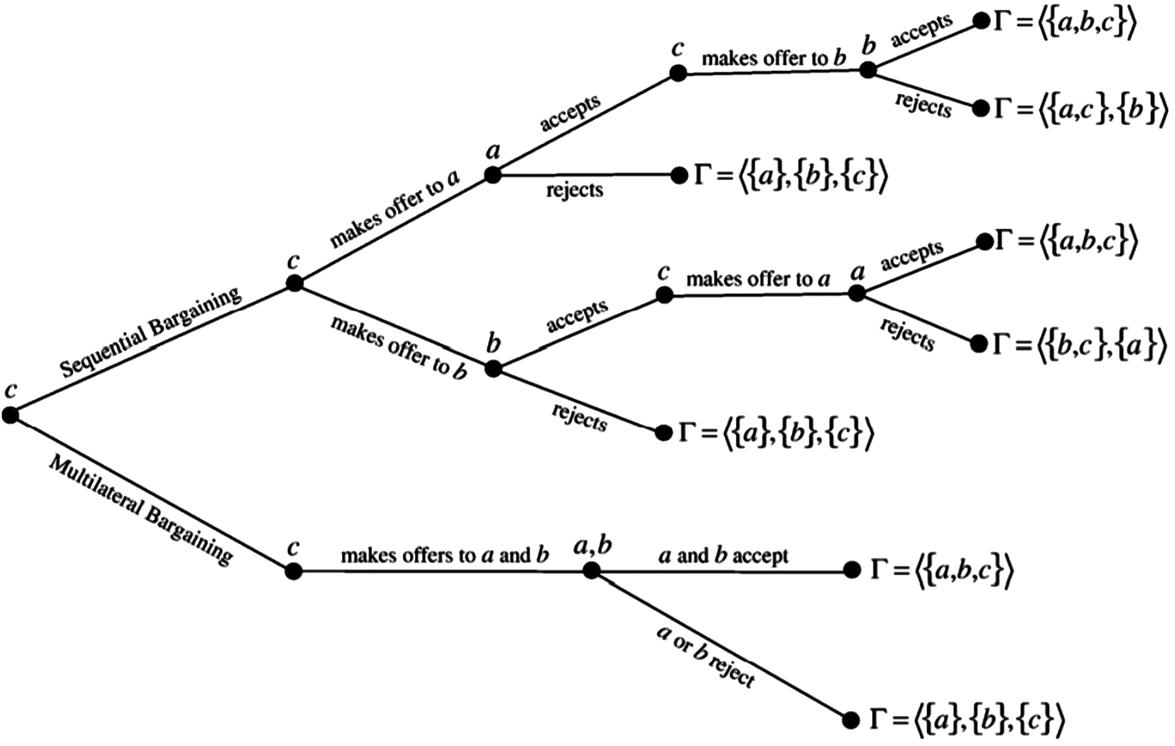
The basic setup of the bargaining game involves an agenda setter, the leading state, and a set of follower states. The agenda setter starts with choosing either a multilateral negotiation approach, making simultaneous offers to all other players, or a sequential approach, starting with an offer to other countries one by one. Under multilateral negotiations, states weigh up their received offers individually and simultaneously respond with a ‘yes’ or ‘no’ decision. If at least one state says ‘no’, the negotiations fail and no agreement is reached. The resulting outcome is, therefore, either a global agreement or no agreement at all. Under the sequential approach, the agenda setter makes offers to the individual states sequentially. If one state decides to reject the offer, the negotiations stop and the result is an agreement with all the countries which had received and accepted their offers prior to this rejection. The extensive form of this bargaining game is depicted graphically in Figure 1.
Extensive form of the bargaining model. This is Figure 1 from Aghion et al. (Reference Aghion, Antras and Helpman2007).

Each membership offer has under both negotiation structures an associated payoff, potentially including lump sum transfers, which is used by states to evaluate their membership decision. These payoffs are influenced by what Aghion et al. (Reference Aghion, Antras and Helpman2007) label coalition externalities, representing positive or negative impacts on a state's payoff through an affirmative membership decision of another state.
There are positive coalition externalities in a country if its payoff, and consequently the reservation price of joining the coalition, increases when another state joins the coalition by accepting the trade agreement offered by the agenda setter. Negative coalition externalities imply that the country's payoff decreases in such a case, and no coalition externalities exist if the payoff does not change. Thus, positive coalition externalities imply that one country profits from an agreement between other countries whereas negative coalition externalities imply that it loses.
Set of players
This model has two types of players, the agenda setter and regular players. This categorisation reflects distinctions between states that were members of the Deutsche Bund, the common political governance institution for German states created by the Congress of Vienna in 1815.
The institutional structures of the Deutsche Bund had three different categoriesFootnote 6 of member states: first, Austria and Prussia as part of the great European powers that served as guarantors for the acts of the Congress of Vienna and consequently the constitution of the Deutsche Bund; second, a number of mid-sized powers, such as Bavaria and Hannover, with full voting rights in its Diet; and third, smaller principalities and free cities as part of shared voting arrangements (Angelow, Reference Angelow2003).
Prussia and Austria were the agenda setters for the Deutsche Bund and consequently for trade negotiations, a role that will be discussed in more detail later on.
The main set of players is reflecting the second group: mid-sized states with full voting rights. This group contains Baden, Bavaria, Hannover, Hesse-Cassel, Hesse-Darmstadt, Saxony and Wuerttemberg. Most of these states had begun to institutionally modernise following the French or Prussian examples, including the creation of new customs systems with external tariff border systems and the abolishment of internal tariff lines. Some of these states had also started to negotiate in varying constellations about trade agreements. These negotiations, however, failed to result in more than short-lived and narrow agreements (Henderson, Reference Henderson1984; Müller, Reference Müller1984). Their participation demonstrates that these states were active on their own behalf in trade negotiations, yet none had a dominant position like an agenda setter. This implies that they all fit the profile of regular, follower players very well.
The third group are small, though formally independent, states without individual voting rights. The constitution of the German Federation specified groups of states with a common vote, leaving the actual voting arrangement up to the group members. Due to their size, non-contingent geographic locations and independent participation in early trade negotiations, some of these groups, however, should be split up. I split Braunschweig and Nassau, the two largest states under this arrangement, and classify them as individual players. I do the same for Oldenburg, as well as the group of free cities, notably Frankfurt, Hamburg and Bremen. Alternatively, it is possible to include a coalition of such states as a single player. This is appropriate for the Thuringian principalities,Footnote 7 which had a shared voting group and ended up with a shared membership in the Zollverein.
This leaves a number of very small, geographically dispersed principalities, which were combined in a number of voting blocs. In contrast to their Thuringian counterparts, they had no clear dynastic, geographic or other connection. Some of them, for example the Anhalt principalities, were enclaves within the territories of other states such as Prussia.Footnote 8 Encompassing states, most importantly Prussia, usually treated these small principalities similarly to the enclaves of other larger states by including them into their own tariff systems.Footnote 9 The actual sovereigns of these enclaves were financially compensated for the loss of tariff revenues, usually based on the number of enclave inhabitants. Because these small principalities surrendered their tariff policy to encompassing neighbours, they did not participate in trade negotiations and are therefore do not represent players in these circumstances.
Neighbouring states Denmark, the Netherlands and Switzerland also do not feature as players. The Swiss had received a guarantee of their absolute neutrality in the Congress of Vienna and saw any sharing of sovereignty required by an involvement as unacceptable. Denmark owned the German principality of Holstein-Lauenburg, an official member of the Deutsche Bund, but the Danish King preferred consistency of economic policy within his dominion over a possible membership in the Zollverein. Similarly, the Netherlands owned a principality, Luxembourg, which was considered to be German (i.e. a member of the Deutsche Bund). Luxembourg joined the Zollverein in 1842 as part of the Prussian tariff system due to political pressure. As one of the fortresses of the Deutsche Bund was located there the German states in the Zollverein moved decisively to secure the adhesion of Luxembourg, once France had floated plans about a possible customs union (Henderson, Reference Henderson1984). The Netherlands itself had a trade policy which tried to extract as much as possible from its favourable geographic position, controlling the Rhine's mouth into the North Sea. Necessary compensation would have made an accession too costly for Prussia and the Zollverein (Van Zanden and Van Riel, Reference Van Zanden and Van Riel2004).
A final neighbour with the potential to become substantially involved in German trade agreements was France. In contrast to the afore-discussed foreign states, it also had the size, economic strength and political importance to become a leader rather than simply a follower state, so its potential will be discussed in the following section on the role of the agenda setter.
Agenda setter
After the Napoleonic wars, there was a small group of major powers that guaranteed stability in Europe. The two leading German nations, Prussia and Austria, as well as a neighbour, France, were part of this group. This strategic importance, combined with their economic size and significance, implies that these nations had a superior position in trade negotiations with other German states. Stylised into the framework of the game, they can be seen as a distinct class of players with a special set of actions to which follower states can only react. Such a player is labelled an agenda setter.
Prussia was the only one of the three that became actively involved in trade negotiations and is, therefore, the only relevant agenda setter. It actively assumed this role in 1828 when it opened negotiations with Hesse-Darmstadt (Hahn, Reference Hahn1982), but two prior decisions already foreshadowed this action. The first was Prussia's refusal to follow-up on the mandate for closer economic cooperation given to the Deutsche Bund, which is discussed later on in the context of the negotiation structure. The second is domineering behaviour exhibited in its enclave policy. Although the inclusion of enclave territories within the customs area of the surrounding nation was nothing extraordinary,Footnote 10 Prussia's unilateral imposition of this policy in 1818 on a number of formally sovereign, independent enclaves clearly was. The inability of the affected principalities to reverse or even change the imposed terms shows Prussia's ability to dictate the structures of trade negotiations.
Similarly, both France and Austria had the potential, due to their size and geographical location, to become agenda setters. Neither grasped the opportunity, mostly due to their preferences for strong protection and against differential tariffs (VBDZ 772). Importantly, the geographical situationFootnote 11 also did not present them with as extensive opportunities for administrative savings as it did for Prussia. This implies that the possible payoff from trade agreements with German states for both France and Austria were considerably lower than for Prussia. As a consequence, Austria took a passive stance towards the first rounds of negotiations conducted by German states and adopted a policy of accommodation towards Prussia (Branchart, Reference Branchart1930). The French government was acting in a similar way to its Austrian counterpart. Despite receiving repeated letters from its Bavarian and German representatives, detailing the possibility of gaining influence over German states through trade policy, the French government did not deviate from its high tariff policy, angering possible partners in Germany. The July revolution in 1830 did not notably change this stance (Krauss, Reference Krauss1987).
After Prussia had assumed the role of the agenda setter in 1828 through starting negotiations with another German state, neither France nor Austria contested that move. Nor did they see a Prussian success at forming a customs union with other German states as beneficial for them either. This did not cause them to become active players, but they allowed other German states to use their backing and weight in negotiations with Prussia, which is explained in more detail in the discussion of coalition externalities.
Set of actions
The role of the agenda setter during the formation process is formally stylised into two main characteristics. First, the agenda setter has the right to decide when and with whom negotiations are opened. Historically, Prussia had to choose between opening multilateral negotiations, i.e. simultaneous negotiations with all follower states, or bilateral, sequential ones. Second, the agenda setter proposes the membership terms for each state it opens negotiations with. As a consequence, follower states have only to act in a single instance, namely they can accept the proposed terms and join the agreement or reject the offer and stay outside. These proposed terms of membership had two main dimensions: first, the policy areas covered in the agreement; and second, the institutional structure.
All players were members of the Deutsche Bund. This implies the existence of a political institution which already covered certain policy areas including security-related topics, such as an institutionalised military cooperation between the member states. The existence of these structures meant that based on a pre-existing commitment these issues were the topic of separate negotiations between German states and therefore excluded from trade negotiations (Angelow, Reference Angelow2003). Article 19 of the Bundesakte (VBDZ 156), the constitution underlying the Deutsche Bund, contained the intention, and thereby an authorisation, to coordinate trade and customs policyFootnote 12; the Bund under Prussian leadership, however, decided to leave these issues to individual member states (Angelow, Reference Angelow2003). This implies that the range of topics potentially covered by relevant negotiations were predominantly economic policies, including tariff and other trade barriers and a range of related internal issues such as tax structures, monopolies and privileges, currencies, legal structures and regulatory issues. Another area was the trade relationships with foreign nations.Footnote 13
In consequence, although the negotiations were focused on specific economic issues only there were no such restrictions for institutional or structural terms. The states were free to accept any institutional structure short of a political unification. This allowed for bilateral as well as multilateral arrangements, either free-standing or potentially embedded into the Deutsche Bund. The players' negotiations also had to cover the length of the agreement with possibilities ranging from one-time actions to permanent ones.
Coalition externalities
It is in the nature of international trade that an agreement between two states has an impact on others. These c externalities, and their impact on payoffs, are therefore an important factor determining the outcome of international negotiations, including the bargaining structure, the order in which states agree and the resulting institutional characteristics. This implies that the theoretical framework should incorporate such coalition externalities. Aghion et al. (Reference Aghion, Antras and Helpman2007) includes them based on their prominence and importance for trade creation and diversion effects of modern trade agreements.Footnote 14 Although this assumes that the utility function of the relevant actor, in modern settings usually a democratic government, is predominantly concerned with general economic welfare, early 19th century German sovereigns and elites had substantial political power to prioritise their preferences focused on fiscal and mercantilist notions.
As these externalities are affecting the payoff of players, they obviously drive trade and tariff policy choices. This implies that understanding the contemporary factors underlying these policies allows the identification of the main coalition externalities relevant at the time of the Zollverein. The following outlines, therefore, historically important goals for trade policies in the context of externalities for trade negotiations between German states.
Williamson (Reference Williamson, Findlay, Henriksson, Lindgren and Lundahl2006) identifies three central motives for tariff policies between 1789 and 1938: a revenue motive, a strategic tariff motive, and a Stolper–Samuelson factor compensation motive. The first is based on fiscal reasons; governments set tariffs to raise revenues, either for the state's or even the sovereign's personal coffers. The second is based on the idea of strategic tariff setting. At the time of the Zollverein this motive focused predominantly on reciprocal market access, so tariff setting involved negotiations with other states about reciprocal concessions. The third is based on internal political economy, more precisely a connection between trade and politics based on the Stolper–Samuelson theorem as extensively explored by Rogowski (Reference Rogowski1990). Given tariff rates affect relative prices between sectors, for example agriculture and manufacturing, and thus the relative income of these sectors, their members have an incentive to influence tariff setting with the resulting relative rates reflecting the relative influence and strength of individual sectors.
Starting with fiscal effects, a new coalition formed by the agenda setter can affect the revenues of third states directly and indirectly. The direct effect is the impact on tariff revenues through the change in trade volumes. A coalition can divert trade, reducing the imports of third countries and consequently lowering their tariff revenues. Diversion of trade, additionally, had an indirect effect through impacting practical trade routes. Such roads bolstered revenues not just through transit tariffs but also through demand for services along the route such as logistics, transportation, housing, food, or access to markets such as fairs. Governments were able to levy taxes and fees and derive substantial revenues from them. Traffic patterns change when tariff barriers change; free traffic within a coalition enticed merchants to use routes in customs union territory and to bypass outside countries.
The second is the political economy of trade politics. Given geographical positions, a coalition might be able to obtain control over all relevant trade routes leading into a non-member country. The coalition consequently had a certain degree of control over the tariff system of that country, as high transit tariff barriers had similar effects to high barriers by the country itself. This poses problems if a state aimed to secure market access through reciprocal preferential treatment and therefore planned to implement a low tariff system.Footnote 15 Such an implementation, or even offer, towards another state becomes meaningless and consequently cannot elicit reciprocation. The perception that a state lost control over its own customs system has not only trade but also political effects. The power to determine one's own tariff system is a question of political sovereignty; losing that power threatens the political situation of the sovereign. This was a real fear for the sovereigns of smaller German states in light of the mediatisation process of independent states, started through the Reichsdeputationshauptschluss of 1803, where stronger states annexed small, formally independent, territories. The rulers of surviving small principalities only had guarantees by the Congress of Vienna to secure their dynastic rights and therefore had the fear that a loss of control over trade policy would be the first step towards annexation by larger neighbours, in particular Prussia. This tariff sovereignty also does allow for ‘sovereignty bargains’ as states may be able to trade a certain degree of sovereignty over its custom system for financial or other benefits (Mattli, Reference Mattli2000). Coalition externalities then affect the price or benefit such a bargain might command.
The third is internal political economy. Rogowski's framework stresses the effects of trade barriers on factor compensation and therefore the relative political power of sectors. The use of tariffs and customs to foster manufacturing and the intention to start the industrialisation process is an important aspect of this point.
The public debate about economic policy in the wake of the creation of the Deutsche Bund did feature strong voices, including notable economist Friedrich List,Footnote 16 advocating free trade within and between German states and barriers against other countries, in particular Britain. These became important elements of the successful industrialisation strategies of western states in what Allen (Reference Allen2011) labels the standard model of industrialisation. The debate, however, was also characterised by regional rather than sectoral interests, mirroring Germany's political and economic decentralisation and the large heterogeneity within and between states. Prussia's tariff system of 1818 is a prime example; although its moderate tariffsFootnote 17 were a compromise between the agricultural as well as industrial and commercial interests, this primarily reflected the relative interests and power of eastern and western Prussia. The regional heterogeneity between and especially within German states in economic, social and political terms implies that the impact of tariff structures, including those intended to foster industrialisation, varied strongly between regions.Footnote 18
The effect of a neighbouring state joining a coalition like the Zollverein consequently had a strongly regional impact rather than nationwide sectors. Regional interests played an important role in shaping tariff-based industrial policy as Prussia demonstrates (Ohnishi, Reference Ohnishi1973). The geographical structure of other German states was similarly a combination of different, sometimes completely unconnected territories, each with their own strongly differing regional interest. An accession of neighbouring states into the Zollverein changed the relative strength of regions through favouring or hurting regional sectors and shifting political power between them. Such a change in the internal political economy of a state can influence its government to look more or less favourably on the Zollverein and thereby changing the necessary payoff required to convince the state to join.
Governments of follower states could obviously foresee that coalition externalities reduce their payoff, so they had an incentive to prevent or reduce them in anticipation. To counter effects caused by a coalition's control over roads, states had to find ways to secure access to unimpeded trade routes. Possibilities were building or improving roads through their territory, especially in coordination with other affected states. To counter potential international effects, states had to use reciprocal power before they were cut off. This implies concluding formal diplomatic agreements with foreign nations to lock in preferential treatment for market access. In addition, a state could commit itself by treaty not to join the coalition, which would serve as a signal to foreign states and raise the predominantly political cost to the agenda setter to compensate for the necessary breakup of an official treaty. To counteract effects on the internal political economy, governments have limited options. Because these effects cause shifts in relative power and demands, governments would need to make concessions to specific regions and sectors. These concessions, for example tax relief, are costly from a government viewpoint; thus, mitigation was more complicated in that regard.
3. Formation implications
This stylised reading of the historical context of German states in the decades after the Napoleonic wars gives rise to a formation framework in the form of a co-operative bargaining game. The agenda setter selects between multilateral and bilateral negotiations with a set of follower states and decides on the terms of the agreement offered to the followers, which includes the institutional nature of the potential outcome. The offered terms, and therefore payoffs for involved states, within the possible sequential negotiation process are shaped by the existence and nature of coalition externalities, the effects that intermittent coalition formations had on not involved states in three different broad areas.
The following focuses on that role of these coalition externalities within Germany in the early 19th century in the decision about the negotiation structure as well as the choice of institutional structure for historical trade negotiations, whereas Ploeckl (Reference Ploeckl2015) starts with the above described framework as a launching pad to document the historical coalition externalities visible within the sequential bargaining structure.
Bargaining structure
The agenda setter obviously selects the most beneficial and profitable bargaining structure. Sequential, bilateral negotiations involve the formation of intermittent trade agreements. If coalition externalities exist, these intermittent coalitions affect the reservation price of other states to join the agreement and consequently the eventual payoff for the agenda setter. This raises the question as to what externality characteristics lead to a choice of bilateral negotiations. The logic of the model implies that the existence of negative coalition externalities in at least one country is a necessary and sufficient condition for the choice of sequential negotiations in a setting with three countries. For more than three countries, it is no longer sufficient,Footnote 19 but still a necessary condition. Ultimately, the agenda setter will choose bilateral negotiations if the negative, reservation price lowering effects on the states in the optimal sequence outweigh the positive, increasing effects.
Prussia's alternative to bilateral negotiations was to bring the other German states to one table. The institutional framework of the Deutsche Bund indeed offered such an opportunity for multilateral negotiations, which Prussia rejected on at least two specific occasions. The first was the attempt by some states to follow-up on the mandate of closer commercial integration articulated in the afore-mentioned Bundesakte. The full plenum, in particular due to Prussia's influence, however, remained inactive and nothing resulted from the initial impetus. The existence of this article, including the fact that years later it again led some states to petition for multilateral negotiations, demonstrates that multilateral negotiations between German states were indeed a possibility and that Prussia explicitly rejected them (Arning, Reference Arning1930). Another moment was Prussia's reaction to the Mitteldeutscher Handelsverein, an association between a number of German states formed in reaction to Prussia's first customs union agreement with Hesse-Darmstadt.Footnote 20 Prussia insisted on negotiating only with individual states, thereby rejecting any demands for negotiations with all of the Handelsverein's members combined (VBDZ 609) (Haferkorn, Reference Haferkorn1933).
The model also includesFootnote 21 that the rejection of an offer ends negotiations under both structures, however sequential ones will result in a coalition of all actors that had accepted an offer whereas multilateral ones will result in a complete breakdown. This is visible in the negotiations between a number of smaller German states during the 1820s. Although these multilateral approaches occasionally even reached seeming agreements, these fell apart before they could be implemented. And following the model, these failures of common negotiations were usually complete rather than resulting in successful agreements between those states that favoured the proposed terms.Footnote 22
The choice between negotiation approaches also requires the agenda setter to find the sequence of bilateral negotiations. Obviously, the agenda setter will determine the one that is optimal for its payoff. The logic of the model implies that the optimal sequence will maximise negative externalities and minimise positive ones in all three areas of externalities outlined above: fiscal effects, market access and political economy.
The strong role of these negative coalition externalitiesFootnote 23 is already visible in Prussia's choice to start the negotiation sequence.Footnote 24 Its agreement with Hesse-Darmstadt in 1828 had no real obvious benefit for Prussia; in financial terms, it was even a considerable loss due to the limited savings from the short length of border coveredFootnote 25 and substantial monetary transfers. The agreement, however, had a strong impact on other German states. One such externality was strategic because it prevented Hesse-Darmstadt from joining Bavaria and Wuerttemberg, who had formed an agreement around the same time, preventing a further expansion of their undertaking. Another externality was the effect on the other Hessian states, in particular on the neighbouring Hesse-Cassel. Besides a regional economic effect from the custom border changes, the treaty explicitly called for Hesse-Darmstadt to use its political influence and dynastic relations to convince the neighbouring Hessian sovereignties to accede as well (VBDZ 379); Prussia especially wanted Hesse-Cassel to join (VBDZ 370) as its geographic position linked two major Prussian territories and brought all trade routes between the south of Germany and the North Sea ports, as gateways to many international markets, under Zollverein control. As a consequence, the southern German states experienced a number of negative externalities, in particular financial ones. Higher transit tariffs would reduce trade, and therefore tax revenues, and lead to a reduction in market access because Prussia's control over trade routes affected the ability of these states to conclude reciprocal trade agreements with foreign nations.
Ploeckl (Reference Ploeckl2015) takes this role of externalities for the optimal sequence as the organising principle for a description of the circumstances and context of the full accession sequence. This historical evidence shows not only the presence of such coalition externalities during the Zollverein formation, it also highlights how multiple, rather than a single dominant, motives for tariff and customs policies were at play.
The stark contrast between the economic negotiations of German states with those about internal security issues also appears to reflect the logical consequence of coalition externalities as predicted by the model. In contrast to the bilateral, drawn-out negotiations for the Zollverein, the negotiations about internal security were multilateral, most notably the Carlsbad Decrees in 1819. The agenda setterFootnote 26 brought the relevant states to the negotiation table, followed by unanimous ratification of the decrees through the Deutsche Bund (Nipperdey, Reference Nipperdey1996). Covering issues such as press censorship and political control of universities, professors and student union, the measures would have likely led to mostly positive coalition externalities from the perspective of rulers in bilateral negotiations. A state could potentially profit from measures taken by neighbours, as those might suppress support for relevant domestic political groups from neighbour counterparts. This would result in a ruler feeling more secure consequently raising their reservation price to incur the costs of imposing the measures as well. In this case the structure of externalities points towards multilateral negotiations as the preferred choice for the agenda setter.
Institutional choice
After establishing the set of players, the range of actions, the choice of bargaining structure and the role of externalities, the final question is why the Zollverein became a customs union.
The model does not make any direct prediction about the structure of the trade agreement, except that the agenda setter will choose that which maximises its payoff. Following the model logic, the choice of bilateral negotiations implies the existence of negative externalities, which can be captured by the agenda setter. The institutional form, the innovation of a customs union, was therefore chosen to maximise the payoff of the complete agreement and the extent of intermittent negative coalition externalities.
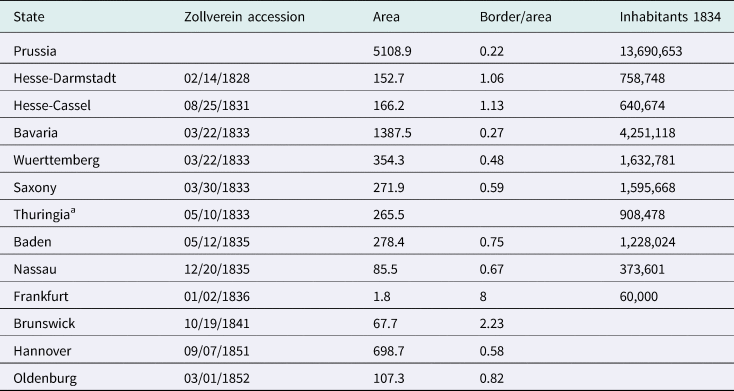
Dumke's thesis about economies of scale in customs administration as the underlying reason for the Zollverein points towards the maximisation of the payoff for the complete agreement (Dumke, Reference Dumke1994). Although both, a customs union and a regular free trade agreement, lead to a fall in direct revenues due to free trade over borders between members, only a full customs union allows states to reduce or even fully abolish customs controls. Dumke also demonstrates that these administration cost savings were quite high when compared to customs revenues, and thereby outweigh the welfare benefits from the ability to set differential tariff rates under a free trade agreement. For smaller states the costs of an external border system were even so prohibitive that they had to resort to internal tolls and tariffs on the roads through their territory instead. Following Dumke (Reference Dumke1976), Table 1 lists the ratio of border length to area, which is a good quantitative estimate for the ratio of administrative costs to revenues of an external tariff borders system.Footnote 27
Summary Statistics about Zollverein members

Data source: Dumke (Reference Dumke1994), Henderson (Reference Henderson1984)
a Individual Thuringian principalities had an area between 6.3 and 65.9 and a border/area ratio between 1.8 and 5.3.
This customs union advantage over a free trade agreement stems from a difference in the necessity of enforcing rules of origin regulations. FTA members can only uphold differential tariff rates against third country imports if rules of origin regulations are enforced at all borders. The relatively small size and complex, interwoven geographical positions of German states made it easy to enter the lower tariff member state, relabel the origin of the goods and then freely export into the higher tariff member state with tariff savings outweighing higher transport costs and the risk of detection. The preferential trade agreement between Hesse-Darmstadt and Baden in 1824 had this problem. Hesse, which had strong budgetary problems, was running high tariffs for revenue purposes, whereas Baden, as a trading-oriented nation, had relatively low tariffs. This created two possibilities for foreign producers. For example, a trader in Bavaria, who wanted to sell in Hesse-Darmstadt, either travelled directly to Hesse-Darmstadt paying high tariffs on his goods, or travelled to Baden, paying low tariffs but only slightly higher travel costs, and then entered Hesse-Darmstadt without further payments and masked the origin of his goods as Baden. Within a year, Hesse-Darmstadt cancelled the treaty due to complaints about such smuggling and Baden's inaction in this matter (Müller, Reference Müller1984).
Customs unions are characterised by a uniform tariff structure (Viner, Reference Viner1950), which allows the agenda setter to exert negative coalition externalities by constraining differential tariff rates of coalition members. If a state joins the customs union it has to adjust its tariff rates on non-member states according to the rules imposed by the agenda setter. This implies that preferential tariff rates for other states have to be removed, which imposes a negative impact on those states and their market access. Similarly, the imposed tariff changes also affect the political economy of direct neighbour states through a differential regional impact for neighbouring areas. As these effects reduce the reservation price for affected non-member states to join, these represent waysFootnote 28 for the agenda setter to maximise the payoff through negative externalities that are not available with a free trade agreement.
The administrative savings through a customs union also explain why Prussia became the agenda setter rather than Austria or even France. Calculating the length of the borders with other German states that would become internal borders of a customs union shows for Prussia a value of approximately 3,180 km, compared to 1,197 km for Austria and 434 km for France. Additionally, these values are biased against Prussia as France's border with German states, notably Baden, consisted mainly of the Rhine, therefore cheap to administer. Similarly, Austria's borders with Saxony and Bavaria were mountainous in large parts, again implying comparatively lower costs. Furthermore, the calculation for Prussia excludes the borders of enclaves, including Prussian ones and those within Prussia.Footnote 29 Another difference was the number of German neighbour states. Although Austria had three and France had four, Prussia had at least a dozen,Footnote 30 indicating that it could profit comparatively more from a widespread agreement than a small number of bilateral ones.
The Zollverein became the first international customs union because it was beneficial for Prussia, the agenda setter, to innovate in institutional structures of trade agreements. Although other European states, especially west of the Rhine, had built large, internal customs zones, that had not been the case between German states (Dincecco, Reference Dincecco2010). The Zollverein represented an institutional innovation that reaped the benefits of overcoming this fragmentation even without political unification. The cost reductions of reduced custom controls outweighed the welfare gains from tariff deviations,Footnote 31 thereby providing an economic benefit and rational to create a common customs area. The prevalence of negative coalition externalities through the impact on market access and internal, regional and sectoral political economy within states allowed Prussia to overcome the missing political power of a centralised state to create such a unified area without military or extremely costly measures.
4. Conclusion
Traditionally, the economic history literature on the creation of the Zollverein has focused on the underlying reason for its formation rather than the structure of the formation process itself. This paper demonstrates that a game-theoretic approach built upon a stylised view of historical environment can go beyond explaining the historical events and illustrate the development of general institutional structures, in particular the new institutional form of a customs union. The central idea that shapes the process is the presence of coalition externalities, the effects intermediate agreements have on those states not involved. Their particular nature led to the emergence of the first customs union and the origins of this new institutional form of trade agreements.
This conceptual approach allows for finding a balance between individual factor explanations, such as financial savings or international market access, and fully contingent descriptions, which do not provide a structural explanation. It also allows for widening the scope of relevant factors from purely financial administrative savings, traditionally the main explanation for the Zollverein, to the inclusion of important geographical, political and trade policy factors.
This paper provides a justification for the use of an underlying theoretical framework through a close fit with the historical environment, provides a categorisation of relevant coalition externalities in this particular context, and explains two important characteristics of the formation process. The model, however, also provides predictions for another aspect of this process, namely the sequence of accession into the customs union. The discussion here, therefore, provides the justification for the use of the framework by Ploeckl (Reference Ploeckl2015), who builds upon it to provide a thorough, historical, explanation of the observed accession sequence and involved coalition externalities. In particular, it is demonstrated that this sequence indeed has the characteristics of the optimal sequence implied by the model. The main conclusion of that analysis, namely that specific coalition externalities determined each step of the accession sequence, provides detailed historical evidence for and reinforces the conclusions drawn here about the importance and role of these externalities for the choice of bilateral negotiations and the resulting institutional form of a customs union.
The Zollverein was the first customs union because of the particular nature of the coalition externalities at the time. In the historical negotiations between German states, these externalities were substantially influenced by geographic considerations. The location of trade routes and the consequential impact on customs revenues as well as the physical control over these routes and the impact for international market access were much more shaped by the geographical conditions in the historical situation of the 19th century than they are today. This importance of geographical factors reinforced the relative size of coalition externalities, indicating that the latter were especially strong in this setting. This is contrasted by the relatively lower importance of tariff barriersFootnote 32 as the dominating benefit and cost consideration.
The nature of such externalities is also the determining factor for similarities and differences between the Zollverein and modern institutions, in particular the customs union underlying the European Union. The Zollverein was a very focused institution, in which participating states did not link its economic nature with other political considerations. Consequently, the relevant externalities are very much focused on trade-related impacts. The broader nature of the EU implies that the relevant externalities in its case have differed substantially. Its origin as a multilateral organisation points towards the existence of positive coalition externalities, which made it beneficial to start with a larger coalition than sequential negotiations. Over time, this changed and more negative externalities, in particular in trade questions as demonstrated by Rieder (Reference Rieder2006), came to shape the expansion of the EU in a more sequential manner.
The Zollverein was a successful trade agreement providing the template of a customs union between modern economies, and its example allows us to draw conclusions for modern trade policy. It provides a case study where an agenda setter uses a sequential approach to form a coalition and illustrates the importance of externalities and the effect a coalition has on non-participating states. It shows that regional agreements can be building blocks, but for the successful conclusion of a global free trade agreement, the agenda setter should have sufficient possibilities to exert negative coalition externalities during the formation process. Finally, it points us towards the nature of these externalities as a decisive factor in determining the institutional forms trade agreements might take.
Acknowledgements
This paper is based on my PhD Dissertation completed at Yale University. I am grateful to Tim Guinnane, Carolyn Moehling and Peter Schott for their guidance and support. The paper also profited from comments from a range of seminar and conference audiences as well as conversations with Rui Esteves, James Fenske, Sibylle Lehmann-Hasemeyer and others. All remaining errors are entirely my own.
Financial support
I would like to acknowledge and thank Alexander von Humboldt Foundation for the financial support through an Experienced Researcher Fellowship for a stay at the chair in Economic and Social History at the University of Hohenheim, during which revisions of this paper were completed.