Experimental procedure
The genus Arachis contains about 80 species divided into nine sections (Krapovickas and Gregory, Reference Krapovickas and Gregory1994; Valls and Simpson, Reference Valls and Simpson2005). Unique and useful traits exist in these wild peanut species. Therefore, these wild species can be used as a secondary pool for improvement of cultivated peanut. Successful examples relate to improvement in resistances to root-knot nematode, leaf spot and rust by interspecific introgression from wild species to cultivated peanut. Within the U.S. Arachis germplasm collection, there are 70 wild peanut species, and these wild species have not been well characterized. Because oil content and fatty acid composition are important seed quality traits for peanut breeding programs, the objective of this study was to determine the oil content and fatty acid composition variability among the wild peanut species.
Available seeds from 49 accessions (representing 39 Arachis species plus one cultivated line, PI 370331) were requested from the Plant Genetic Resources Conservation Unit, Griffin, GA, USA (Supplementary Table S1, available online only at http://journals.cambridge.org). Prior to oil content and fatty acid composition analyses, the seed-coat colour was scanned and recorded using Hewlett-Packard Scanjet 7400C. The procedures for the determination of oil content and fatty acid composition and the functional mutation screening for FAD2A by real-time PCR were based on the methods described by Wang et al. (Reference Wang, Chen, Davis, Guo, Stalker and Pittman2009) and Barkley et al. (Reference Barkley, Wang and Pittman2010), respectively. An analysis of variance was performed on the data, and means were separated using Tukey's multiple comparison procedure.
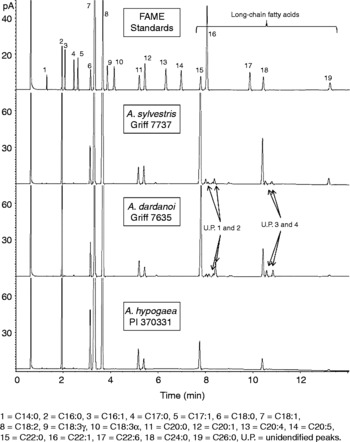
The seed size of the wild peanut species was very different from the cultivated peanut (Supplementary Fig. S1, available online only at http://journals.cambridge.org). The variability in oil content among the wild peanut species ranged from 41.7 to 61.3%, with an average of 52.8%. There were four Arachis species accessions (PI 468328, PI 210554, Griff 7635 and PI 468337) that contained over 59% oil, which is much higher than the cultivated peanut (Supplementary Table S1, available online only at http://journals.cambridge.org). On an average, the wild peanut species contained a much lower amount of oleic acid (35.76%) and much higher amount of linoleic acid (36.25%) than the cultivated peanut (58.5 and 21.5%, respectively). Furthermore, no functional mutation in the FAD2A gene (for high oleic acid) was identified in the wild peanut species (Supplementary Table S2, available online only at http://journals.cambridge.org), and no species was found with a high oleic acid to linoleic acid ratio. However, several species contained significantly higher amounts of long-chain fatty acid (LCFA, C ≥ 22) than Arachis hypogaea. For example, Arachis sylvestris (Griff 7737) and Arachis dardanoi (Griff 7635) contained 22.3 and 19.0% LCFA, respectively, much higher than the cultivated peanut (4.2%, Supplementary Table S1, available online only at http://journals.cambridge.org and Fig. 1). Fatty acid analysis revealed that some wild species contained unidentified fatty acid peaks. For example, both A. sylvestris and Arachis dardanoi contained four unidentified peaks (U.P. 1–4 on Fig. 1).
Comparison of fatty acid profiles in wild peanut species with cultivated peanut on gas chromatograms. The top of several peaks (7, 8, 15 and 16) cannot be seen because of image enlargement. The peaks within the bracket indicate the long-chain fatty acid, and the unidentified peaks are indicated by arrows. FAME, fatty acid methyl esters; A. sylvestris, Arachis sylvestris; A. dardanoi, Arachis dardanoi; A. hypogaea, Arachis hypogaea.

Discussion
Significant variability in the oil content and fatty acid composition has been detected among the wild peanut relatives. Our results were consistent with a previously published report (Stalker et al., Reference Stalker, Young and Jones1989). The diploid species Arachis magna contains 61% oil, and A. sylvestris contains 22% LCFA, which may be useful for developing high oil content or LCFA peanut cultivars. The unidentified peaks from gas chromatography analysis may be from long-time temporal seed storage. Confirmation of the origin of unidentified peaks will require the comparison between the chromatograms generated from stored seeds and freshly harvested seeds of the same species.
Acknowledgements
The authors thank Mr Brandon Tonnis for his excellent assistance on chemical analysis and Mr Jerry Davis for his statistical analysis.