Introduction
Rice (Oryza sativa L.) is the staple food of more than half of the world's population (Sreedhar and Reddy, Reference Sreedhar and Reddy2019). Higher rice productivity can be expected if average temperature during vegetative and grain filling stage is 26–28 and 22–27°C, respectively, (Deng et al., Reference Deng, Ling, Sun, Zhang, Fahad, Peng, Cui, Nie and Huang2015), clear sky during the daytime for higher photosynthetic activity, low night temperature for a reduced rate of respiration and uniform distribution of the rainfall throughout the growing season (Anonymous, 2009). Among the various environmental factors, the low light intensity has emerged as a major constraint for rice production, especially in Southeast Asia and China (Ren et al., Reference Ren, Yang, Xu, Fan, Wang and Guan2002). In several south Asian countries including India, most of the rice (around 80%) is grown during the monsoon season, when light intensity is 40–60% less as compared to the dry season (Panda et al., Reference Panda, Biswal, Behera, Baig, Dey, Nayak, Sharma, Samantaray, Ngangkham and Kumar2019). Prabhjyot-Kaur et al. (Reference Prabhjyot-Kaur, Sandhu, Singh, Kaur, Singh and Kaur2016) reported a decreasing trend in duration of the bright sunshine (BSS) hours in Punjab. They observed a decrease in the duration of BSS @ 0.04 h/year on both annual and kharif season (May to October and corresponds to rice growing season of May to September) basis, at Ludhiana (Punjab). The rice crop needs around 1500 BSS hours during transplantation to maturity (Panda et al., Reference Panda, Biswal, Behera, Baig, Dey, Nayak, Sharma, Samantaray, Ngangkham and Kumar2019), but only 800–900 BSS hours are available during the wet season thus, adversely affecting its productivity (Gbadamosi et al., Reference Gbadamosi, Emmanuel and Mary2014).
Previous studies indicated that rice grain yield has a significant positive correlation with solar radiation during the vegetative phase and entire rice growing season (Sandhu et al., Reference Sandhu, Prabhjyot-Kaur, Gill and Bala2013; Garima et al., Reference Garima, Sandhu, Prabhjyot-Kaur and Gill2020), reproductive phase (Garces-Varon and Restrepo-Diaz, Reference Garces-Varon and Restrepo-Diaz2015), grain filling period (Mo et al., Reference Mo, Li, Pan, Fitzgerals, Xiao, Tang, Wang, Duan, Tian and Tang2015; Chen et al., Reference Chen, Li, Zeng, Deng and Ren2019) or reproductive and ripening phases (Wang et al., Reference Wang, Deng and Ren2015). These correlation studies (Sandhu et al., Reference Sandhu, Prabhjyot-Kaur, Gill and Bala2013; Garima et al., Reference Garima, Sandhu, Prabhjyot-Kaur and Gill2020) helped in the understanding of the relationship but cannot help in the quantification of yield loss due to the reduction in sunshine intensity as these were based on district-level average yield data. Most of the studies (Garces-Varon and Restrepo-Diaz, Reference Garces-Varon and Restrepo-Diaz2015; Wang et al., Reference Wang, Deng and Ren2015; Chen et al., Reference Chen, Li, Zeng, Deng and Ren2019) concentrated on reproductive stages, while the present study covered vegetative and reproductive stages and tried to quantify the yield loss. The present study also tested foliar application of nitrogen (N) as a measure to mitigate the impacts of reduced sunlight intensity.
Chlorophyll a (Chl a) and chlorophyll b (Chl b) are the principal photosynthetic pigments and their concentration is increased under low light intensity (Fang et al., Reference Fang, Chen, Cheng, Jiang, Qiu and Luo2021). Under low light stress Chl b increases more than Chl a, thus leading to a reduction in Chl a/b ratio (Baig et al., Reference Baig, Anand, Mandal and Bhatt2005). Reduced photosynthetic rate under low light conditions leads to reduced tiller number during vegetative phase, increased male sterility at the time of flowering and reduced starch accumulation during grain filling stage resulting in a poor rice yield and quality (Liu et al., Reference Liu, Wu, Chen, Ma and Gao2014). Low light intensity also increases spikelet sterility (Panda et al., Reference Panda, Biswal, Behera, Baig, Dey, Nayak, Sharma, Samantaray, Ngangkham and Kumar2019).
Nitrogen is an important nutrient, which is applied in most of the rice producing areas and its application during different growth stages is well documented. Studies by Wang et al. (Reference Wang, Ge, Yan, Wei, Zhang, Dai, Huo and Xu2014) and Pan et al. (Reference Pan, Liu, Mo, Patterson, Duan, Tian, Hu and Tang2016) formed the basis for using N in the present study as a mitigation option as they reported that some of the adverse effects of short-term shading on the rice could be compensated by a proper N application.
Quality of rice is generally evaluated on the basis of milling efficiency, appearance and shape of the grain, cooking and sensory properties and its nutritional value. Lower light intensity also reduced the 1000-grain weight of milled rice which is an important physical quality parameter of the milled rice (Cheng-gang et al., Reference Cheng-gang, Jia, Yan, Dan, Chun-bang and Tian2015). On the other hand, milling and head rice recovery was increased by the N application (Ning et al., Reference Ning, Qiao, Liu, Lin, Li, Wang, Wang and Ding2010; Zhou et al., Reference Zhou, Huang, Jia, Wang, Wang, Xu, Li, Wang and Dou2018). Cooking and eating quality of rice is also an important quality parameter and it consists of various properties including minimum cooking time (MCT) of rice, elongation ratio (ER), etc. Lower sunlight intensity and application of N can influence the cooking properties of rice (Ren et al., Reference Ren, Yang, Xu, Fan and Ma2003; Leesawatwong et al., Reference Leesawatwong, Jamjod, Kuo, Dell and Rerkasem2005; Wang et al., Reference Wang, Deng, Ren and Yang2013; Mingotte et al., Reference Mingotte, Gonçalves, Yada, Fornasieri Filho and Lemos2015).
Under natural conditions, a low sunlight intensity generally leads to reduction in daytime temperature (maximum temperature, T max) (Kitaya et al., Reference Kitaya, Shibuya, Kozai and Kubota1998). Deviation in temperature from optimum can reduce productivity of rice. The decrease in sunlight intensity due to cloudiness alters the microclimate in crop canopy. Under such conditions, the plants are exposed to reduced temperature as well as diminished photosynthetically active radiation (PAR).
It is evident that deficit solar radiation affects productivity and quality of rice. The available literature is lacking on the possibility of foliar N application as a strategy to reduce the harmful effects of deficit solar radiation on rice productivity and quality. Secondly, the literature is also lacking on the integrative effect of reduced T max as a result of reduced sunlight intensity on rice productivity. Therefore, the present study was planned with the objectives of quantifying the effect of 50% reduction in sunlight intensity on the performance of rice secondly, to assess the possibility of alleviating these harmful effects with foliar N application and thirdly, to quantify the integrative effect of reduced sunlight intensity and T max on the performance of rice.
Materials and methods
Site description
The field experiments were conducted at two different locations, i.e. Ludhiana and Hoshiarpur, situated in two different agro-climatic zones of the Punjab state in India. Ludhiana is located in the central plain zone and Hoshiarpur is in sub-mountainous undulating zone.
Ludhiana is located at 30°54′N and 75°48′E with an elevation of 247 m above the mean sea level in Trans-Gangetic Agro-Climatic zone. The experimental field at Ludhiana was located at 30°90′N and 75°80′E latitude and longitude, respectively. Ludhiana is distinguished by sub-tropical semi-arid type of climate with hot summers and very cold winters. The maximum temperature above 40.0°C is a common feature during summers and frequent frosty spells are experienced during winters, especially during the months of December and January. The average annual rainfall is 759 mm and approximately 80% of which is received through southwest monsoon (during June to September). June is usually the hottest month with an average temperature of 32.0°C and January is the coldest month with an average temperature of 12.0°C.
Hoshiarpur is located at 31°53′N and 75°92′E with an elevation of 296 m above the mean sea level. The experimental field at Hoshiarpur was located at 31°36′N and 76°02′E. Hoshiarpur possesses a comparatively cool and humid climate owing to its proximity to the hills. The average annual rainfall is 1067 mm. About 78% of the annual rainfall is received during the monsoon season (June to September). June is usually the hottest month of the year with an average temperature of 30.4°C and January being the coldest month with an average temperature of 11.2°C.
Weather during the crop season
The meteorological data during the crop season for Ludhiana was recorded at agro-meteorological observatory situated in Punjab Agricultural University. The temperature and rainfall data for Hoshiarpur was downloaded from the India Meteorological Department (IMD) website (http://www.imdpune.gov.in/Clim_Pred_LRF_New/Grided_Data_Download.html) and the data for sunshine hours were downloaded from https://www.mosdac.gov.in/data/insituBrowse.do?mode=downloadInsituData.
At Ludhiana, during the crop season, the monthly maximum/minimum temperature varied from 40.4/26.8°C (June) to 30.5/15.8°C (October 2019) (Fig. 1). Relative humidity varied from 42 (June) to 81% (August) and pan evaporation from 129.4 (June) to 15 mm (October) (Fig. 2). A total of 872.8 mm of rainfall was received during the crop season with 59.8, 182.2, 354.2 and 276.6 mm during June, July, August and September, respectively, (Fig. 3).
Air temperature and average sunshine hours recorded during the crop growing season at Ludhiana.

Average morning and evening relative humidity (%) and total evaporation (mm) recorded during the crop growing season at Ludhiana.

Weekly total rainfall (mm) recorded during the crop growing season at Ludhiana and Hoshiarpur (Source of rainfall data at Hoshiarpur: http://www.imdpune.gov.in/Clim_Pred_LRF_New/Grided_Data_Download.html).

At Hoshiarpur, during the crop season, the monthly maximum/minimum temperature varied from 38.2/24.3°C (June) to 28.9/13.9°C (October 2019) (Fig. 4). A total of 1368.6 mm of rainfall was received during the crop season with 240.0, 290.0, 402.4 and 436.3 mm during June, July, August and September, respectively, (Fig. 3).
Air temperature and average sunshine hours recorded during the crop growing season at Hoshiarpur (Source of temperature data: http://www.imdpune.gov.in/Clim_Pred_LRF_New/Grided_Data_Download.html, Source of sunshine data: https://www.mosdac.gov.in/data/insituBrowse.do?mode=downloadInsituData).

Soil of the experimental sites
At Ludhiana, the soil was loamy sand in texture. The electrical conductivity of 0–15 and 15–30 cm layer of soil was 0.21 and 0.29 dS/m, respectively. The pH for 0–15 and 15–30 cm layer of soil was 6.6 and 6.9, respectively. Thus, the soil was normal in reaction. The organic carbon, available nitrogen, phosphorus and potassium content of 0–15 cm layer of soil was 0.44%, 302.9, 20.4 and 169.4 kg/ha whereas, for 15–30 cm layer the values were 0.41%, 319.6, 18.6 and 150.5 kg/ha, respectively. Thus, the soil was medium in organic carbon, available nitrogen, phosphorus and potassium.
At Hoshiarpur, the soil was also loamy sand in texture. The electrical conductivity of 0–15 and 15–30 cm layer of soil was 0.51 and 0.49 dS/m, respectively. The pH for 0–15 and 15–30 cm layer of soil was 7.8 and 7.9, respectively. Thus, the soil was normal in reaction. The organic carbon, available nitrogen, phosphorus and potassium content of the 0–15 cm layer of soil was 0.84%, 489.3, 15.5 and 155 kg/ha whereas, for 15–30 cm layer the values were 0.81%, 499.8, 15.9 and 149 kg/ha, respectively. Thus, the soil was high in organic carbon and, available nitrogen but medium in phosphorus and potassium contents.
Experimental details
The field experiment was conducted (during June to October 2019) in a randomized block design and was replicated thrice at both locations. Analysis of variance was performed to determine the effect of treatments. Means were compared using the least significant difference at 5% level of probability. The treatments comprised four levels of sunlight intensity: full sun light intensity (Control), 50% reduction in sunlight intensity during 15–45 (R15–45), 46–75 (R46–75) and 76–105 (R76–105) days after transplanting (DAT) and five levels of foliar N application [Control, spray of 3% urea solution in water before (NB), midway (NM), afterwards (NA) and midway & afterwards (NMA) the reduction in sunlight]. The 3% weight to volume urea solution was prepared by dissolving solid urea in water. The volume of urea solution was used @ 500 l/ha. The dates of the foliar nitrogen application are mentioned in Table 1. Sunlight intensity was reduced by covering the plots from top (leaving the sides open) with green shade net capable of reducing sunlight intensity by 50%. The shade net was placed with the help of galvanized iron (GI) pipe structures. The 15–45, 46–75 and 76–106 DAT corresponds to the start tillering to maximum tillering, maximum tillering to booting and panicle emergence to maturity phase of rice variety used for the experiment, respectively.
Time of application of foliar nitrogen (figure in parentheses is date of N application)

Control: Full sunlight.
DAT: Days after transplanting.
Crop management
The field was ploughed twice using tractor drawn disc harrow and the plots were flooded with water and puddled. The 30 days old seedlings of rice variety PR 122 were transplanted at a spacing of 20 × 15 cm on 24 June and 26 June 2019 at Ludhiana and Hoshiarpur, respectively. The doses of nitrogen as recommended by Punjab Agricultural University were applied @ 105 kgN/ha (225 kg/ha Urea) for medium fertility soil at Ludhiana and 78.75 kgN/ha (168.75 kg/ha Urea) for high fertility soil at Hoshiarpur in three equal split doses. One third nitrogen was applied at transplanting and remaining was applied equally at 3 and 6 weeks after transplanting. At the time of transplanting, 30 kgP2O5/ha (67.5 kg/ha Diammonium phosphate), 30 kg/ha K2O (50 kg/ha Muriate of potash) and 40 kg/ha of zinc sulphate monohydrate (33%) were applied at both the locations. Water was kept ponded in the field during first two weeks. Afterwards, irrigation was applied two days after the ponded water had infiltrated into the soil. Pre-emergence herbicide Pretilachlor 50 EC @ 1500 ml/ha was used to control the weeds by broadcasting in ponded water at 2 DAT. Later, hand weeding was done whenever required.
Observations recorded
The number of effective tillers (having 50% of filled panicles) were counted at harvest and expressed as effective tiller/m2. The number of filled grains/panicle was counted from randomly selected panicles and was expressed as average. Thousand grain weight of paddy was determined by weighing 1000 grains from bulk samples of each treatment. The grain and biological yield were expressed at 14% moisture content and were recorded from net plot area. The chlorophyll content of leaves of rice was estimated with the help of the Chlorophyll Meter Model M C 100 (Apogee Instrument, Logan, UT, USA) portable leaf greenness meter. The data were recorded from centre of top, middle and bottom leaves of five plants from each plot. Chlorophyll content was presented as μmol/m2 of leaf surface after calculating average from five plants from each plot separately for top, middle and lower leaf. The PAR was measured with Line quantum sensor (Apogee Instrument, Logan, UT, USA) at the top of crop canopy.
Locally manufactured rice grading device, capable of separating head and broken rice out of the milled rice depending upon the difference in length with the help of sieves, was used to separate broken kernels from the milled rice. The kernels with more than two-third length were considered as head rice. Head rice was weighed and expressed as percentage of paddy. Length and breadth of milled rice kernels was recorded from ten grains placed end to end using a ruler and was repeated in triplicate. The average was recorded as the length and breadth and their ratio depicted the L/B ratio. Thousand grain weight of milled rice was determined by weighing 1000 grains from milled rice samples of each treatment. The minimum cooking time (MCT) of rice was determined by cooking two grams of milled rice with 20 ml of distilled water taken in 50 ml beaker and cooked in boiling water bath. The MCT was estimated by removing a few kernels from the water at different times and pressing them in between two glass plates. The procedure was repeated till no white core was visible between the plates and at this moment, the time was noted and the time taken from the start of the cooking indicated the MCT and was recorded in seconds. The elongation ratio (ER) was determined by dividing average length of cooked whole kernels by average length of uncooked whole kernels.
To identify whether the T max or the PAR intensity has greater influence on productivity of rice, multiple correlation analysis was carried out. Regression equation was developed using data of both locations for predicting rice yields as a function of T max and PAR intensity. The range of T max and PAR used in the development of the equation were 33.1 to 35.1°C and 882 to 1416 μmol/m2/s, respectively. To evaluate the impact of reduction in PAR and concurrent reduction in T max, different levels of T max [35.1 (ambient), 34.1 and 33.1°C] and incident PAR [1416 (ambient), 1376, 1335, 1274.4, 1203.6, 1132.8, 1062.0 and 991.2 μmol/m2/s] were used as inputs in the regression equation. The 1 and 2°C reduction in T max were equivalent to 2.85 and 5.70% reduction from the ambient temperature and the reduced PAR intensity levels corresponded to 2.8, 5.7, 10, 15, 20, 25 and 30% reduction from the ambient PAR.
Results
Intensity of solar radiation and T max
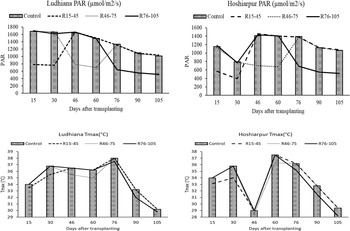
It is clear that, covering the plots with green shade net resulted in almost 50% reduction in incident PAR (Fig. 5). The incident PAR varied from 1015 to 1683 μmol/m2/s and 796 to 1411 μmol/m2/s at Ludhiana and Hoshiarpur, respectively. The variation in incident PAR might be attributed to the level of cloudiness/haziness on the day of recording the data at that particular place and to some extent on the geographical location of both the sites.
Incident photosynthetically active radiation (PAR) and maximum temperature (T max) at top of the rice canopy.

Covering the plots with green shade net resulted in reduction of T max at both locations (Fig. 5). At Ludhiana, the average maximum temperature under R15–45, R46–75 and R76–105 was 1.1, 1.0 and 0.9°C lower than that under full sunlight conditions, respectively, and the corresponding reduction at Hoshiarpur was 1.1, 1.1 and 1.2°C.
Chlorophyll content
It is evident that the chlorophyll content of rice leaves decreases as the intensity of solar radiation increases (Table 2). Among the radiation levels, the chlorophyll content at the time of harvest at Ludhiana in top leaves was 11.4, 13.7, 13.7 and 13.8 μmol/m2, in middle leaves was 9.33, 10.6, 10.6 and 10.7 μmol/m2 and in the bottom leaves was 4.97, 6.79, 6.72 and 6.82 μmol/m2 for control, reduction in solar radiation during 15–45, 46–75 and 76–105 DAT, respectively. Similarly, at Bahowal the chlorophyll content in top leaves was 14.5, 15.4, 15.4 and 15.5 μmol/m2, in middle leaves was 14.0, 15.1, 15.0 and 15.1 μmol/m2 and in the bottom leaves was 6.03, 7.96, 7.91 and 8.03 μmol/m2 under control, reduction in solar radiation during 15–45, 46–75 and 76–105 DAT, respectively. The additional nitrogen application led to an increase in chlorophyll content of the rice leaves. Among N levels, the chlorophyll content at the time of harvest at Ludhiana in top leaves was 11.3, 13.9, 13.9, 13.1 and 13.6 μmol/m2, in middle leaves was 9.02, 10.9, 10.7, 10.2 and 10.7 μmol/m2 and in the bottom leaves was 4.73, 6.92, 6.83, 6.52 and 6.64 μmol/m2 for control, spray of 3% urea before, midway, afterwards and midway + afterwards the reduction in solar radiation, respectively. Similarly, at Bahowal the chlorophyll content in top leaves was 13.9, 15.7, 15.6, 15.2 and 15.5 μmol/m2, in middle leaves was 13.7, 15.4, 15.3, 14.6 and 15.1 μmol/m2 and in the bottom leaves was 6.24, 7.98, 7.83, 7.58 and 7.78 μmol/m2 in control, spray of 3% urea before, midway, afterwards and midway + afterwards the reduction in solar radiation, respectively. The variation in chlorophyll content with the change in the solar radiation intensity was more evident at the Ludhiana as compared to that at Hoshiarpur. The maximum reduction of 0.004 μmol/m2/s with one unit decrease in the intensity of PAR was observed at Ludhiana due to the reduction in solar radiation during 75–105 DAT. Among the top, middle and bottom leaves the chlorophyll content of the bottom leaves showed a very high degree of negative correlation with the intensity of PAR. Among the locations, at Ludhiana, the top and bottom leaves, showed a higher level of correlations between chlorophyll content and PAR intensity as is evident from P and F values.
Statistics of relationship between chlorophyll content (at harvest) and PAR intensity

1 Range of PAR (μmol/m2/s) used for determining the linear relationships.
Yield attributes
At both locations, the number of effective tillers was significantly higher under full sunlight intensity as compared to treatment having reduced solar radiation during maximum tillering to booting (46–75 DAT) stage (Table 3). Amongst the N levels, maximum effective tillers/m2 were observed in foliar N application before the reduction in solar radiation. However, it was statistically at par with foliar N application midway and midway + afterwards (NMA) the reduction in solar radiation at both locations (Table 3). The relationship between the number of effective tillers/m2 and PAR during initial vegetative (15–45 DAT) and panicle emergence to maturity (76–105 DAT) stages was found to be linear and statistically non-significant at both locations. While during the maximum tillering to booting (46–75 DAT) stage, it was found to be linear and statistically significant within a PAR range of 744–1565 and 691–1407 μmol/m2/s at Ludhiana and Hoshiarpur, respectively. The reduction in 1 unit of PAR during 46–75 DAT at Ludhiana and Hoshiarpur led to a reduction in the effective tillers/m2 by 0.066 and 0.061, respectively (Table 4).
Effect of sunlight intensity and foliar nitrogen application on the yield attributes of rice

Relationship between yield attributes and PAR during different treatments of reduction in sunlight intensity and its statistics

1 Range of PAR (μmol/m2/s) used for determining the linear relationships.
The maximum number of grains/panicle was significantly higher under full sunlight intensity as compared to plots receiving reduced solar radiation during maximum tillering to booting (46–75 DAT) and panicle emergence to maturity (76–105 DAT) stages at both locations (Table 3). Amongst the N levels, maximum grains/panicle were observed in foliar N application before the reduction in solar radiation. However, it was statistically at par with foliar N application midway and midway + afterwards (NMA) the reduction in solar radiation at both locations (Table 3). The relation between the number of grains/panicle and PAR during 46–75 DAT was statistically significant within a PAR range of 744–1565 and 691–1407 μmol/m2/s at Ludhiana and Hoshiarpur, respectively. A reduction of 0.014 and 0.020 grains/panicle at Ludhiana and Hoshiarpur, respectively, was noticed due to decrease in 1 unit of PAR during 46–75 DAT (Table 4).
The maximum 1000-grain weight was observed under full sunlight and it was significantly higher by 9.61% (at Ludhiana) as compared to treatment receiving reduced solar radiation during panicle emergence to maturity (75–105 DAT) stage (Table 3). Amongst the foliar N application treatments, the maximum 1000-grain weight was observed in foliar N application before the reduction in solar radiation. Also, it was significantly higher as compared to the control by 16.1% (at Ludhiana) and was statistically at par with all other foliar N application levels (Table 3). The relationship between the 1000-grain weight of paddy and PAR was found to be statistically significant at Hoshiarpur during the panicle emergence to maturity (76–105 DAT) stage (Table 4). The weight of 1000 grains decreased @ 0.003 g per unit reduction in PAR during panicle emergence to maturity stage (at Hoshiarpur) within a PAR range of 586–1195 μmol/m2/s (Table 4).
Grain yield
Grain yield decreased significantly due to a reduction in sunlight intensity (Table 5). As a result of a reduction in sunlight intensity during the start to maximum tillering (15–45 DAT), maximum tillering to booting (46–75 DAT) and panicle emergence to maturity (76–105 DAT) stages the grain yield was decreased significantly as compared to control by 11.4, 16.3 and 10.6%, respectively, at Ludhiana and by 9.29, 14.4 and 8.17%, respectively, at Hoshiarpur. Amongst the foliar N application treatments, the maximum grain yield was observed with foliar N application before the reduction in solar radiation and it was significantly higher than the control (by 10.3 and 9.45% at Ludhiana and Hoshiarpur, respectively). However, it was statistically at par with foliar N application midway and midway + afterwards (NMA) the reduction in solar radiation at both locations.
Effect of sunlight intensity and foliar nitrogen application levels on grain and biological yield of rice

The relationship between the grain yield and PAR intensity during the start to maximum tillering (15–45 DAT) and panicle emergence to maturity (76–105 DAT) stages at Ludhiana was linear and statistically significant (P < 0.05) within a PAR range of 772–1672 and 570–1147 μmol/m2/s, respectively (Table 6). The grain yield was decreased by 0.0007 and 0.0010 t/ha in response to a decrease in 1 unit of PAR during the start to maximum tillering and panicle emergence to maturity stages, respectively (Table 6).
Relationship of grain yield and biological yield with PAR during different treatments of reduction in sunlight intensity and its statistics

1 Range of PAR (μmol/m2/s) used for determining the linear relationships.
The relationship between the grain yield and PAR intensity during the start to maximum tillering (15–45 DAT) and maximum tillering to booting (46–75 DAT) stages at Hoshiarpur was linear and statistically significant within a PAR range of 481–974 and 691–1407 μmol/m2/s, respectively (Table 6). The grain yield was decreased by 0.0011 and 0.0013 t/ha in response to a decrease in 1 unit of PAR during the start to maximum tillering and maximum tillering to booting stages, respectively.
Biological yield
The highest biological yield was observed under full sunlight intensity (Table 5). With the reduction in sunlight intensity during start to maximum tillering (15–45 DAT), maximum tillering to booting (46–75 DAT) and panicle emergence to maturity (76–105 DAT) stages the biological yield decreased significantly as compared to control by 6.14, 9.36 and 5.82%, respectively, at Ludhiana and by 5.97, 6.60 and 4.76%, respectively, at Hoshiarpur. When the foliar N was applied before the reduction in the sunlight intensity the biological yield was significantly higher than control by 12.7 and 11.9% at Ludhiana and Hoshiarpur, respectively. However, it was statistically at par with foliar N application midway the reduction in solar radiation.
The relationship between the biological yield and PAR during the start to maximum tillering (15–45 DAT) and panicle emergence to maturity (76–105 DAT) stages of rice at Hoshiarpur was linear and statistically significant (Table 6). The biological yield was decreased by 0.0016 and 0.0011 t/ha due to a decrease in 1 unit of PAR during 15–45 and 76–105 DAT, within a PAR range of 481–974 and 586–1195 μmol/m2/s, respectively.
Quality parameters
The head rice recovery and L/B ratio of milled rice (Table 7) varied statistically non-significantly with various levels of sunlight intensity and foliar N application at both locations.
Effect of sunlight intensity and foliar nitrogen application levels on head rice recovery (%), L/B ratio of milled rice, 1000-grain weight (g) of milled rice, minimum cooking time (s) and elongation ratio of rice

The 1000-grain weight of milled rice at Ludhiana was significantly higher by 9.40% under full sunlight intensity as compared to treatment receiving reduced solar radiation during the panicle emergence to maturity (76–105 DAT) stage. The 1000-grain weight of milled rice produced under foliar N application before the reduction in the sunlight intensity was significantly higher by 10.4% as compared to the control. However, at Hoshiarpur, it varied statistically non-significantly with sunlight intensity and foliar N application (Table 7). The relationship between the 1000-grain weight of milled rice and PAR at both locations was found to be statistically non-significant.
The cooking quality of milled rice varied significantly with sunlight intensity and foliar N application at both locations (Table 7). The MCT of rice grains produced under reduced solar radiation during panicle emergence to maturity (76–105 DAT) was highest and was significantly higher by 14.2 and 14.7% as compared to control at Ludhiana and Hoshiarpur, respectively. However, it was statistically at par with the MCT of rice grains produced as a result of a reduction in solar radiation during the maximum tillering to booting stage. Foliar N application before the reduction in the sunlight intensity resulted in highest MCT and it was significantly higher by 7.60 and 6.02% as compared to control at Ludhiana and Hoshiarpur, respectively. However, it was statistically at par with the MCT under foliar N application midway and midway + afterwards (NMA) the reduction in solar radiation. The relationship between the MCT and PAR during maximum tillering to booting (46–75 DAT) and panicle emergence to maturity (76–105 DAT) was linear and statistically significant and with 1 unit decrease in PAR, the MCT was increased by 0.171 and 0.270 s, respectively, at Ludhiana and by 0.204 and 0.269 s, respectively, at Hoshiarpur (Table 8).
Relationship of quality parameters of rice with PAR during different treatments of reduction in sunlight intensity and its statistics

1 Range of PAR (μmol/m2/s) used for determining the linear relationships.
The ER was significantly reduced due to a reduction in sunlight intensity (Table 7). During the start to maximum tillering (15–45 DAT), maximum tillering to booting (46–75 DAT) and panicle emergence to maturity (76–105 DAT) stages of rice with reduction in solar radiation intensity the ER was decreased by 2.41, 3.01 and 3.61%, respectively, at Ludhiana and by 2.61, 3.92 and 4.58%, respectively, at Hoshiarpur. The foliar N application significantly reduced the ER of rice. With the application of foliar N before, midway, afterwards and midway + afterwards (NMA) the reduction in solar radiation the ER decreased as compared to control by 2.41, 1.81, 2.41 and 4.22%, respectively, at Ludhiana and by 2.63, 1.97, 2.63 and 3.95%, respectively, at Hoshiarpur. The relationship between ER and PAR during maximum tillering to booting and panicle emergence to maturity stages was linear and statistically significant within a PAR range of 744–1565 and 570–1147 μmol/m2/s, respectively, at Ludhiana and 691–1407 and 586–1195 μmol/m2/s, respectively, at Hoshiarpur (Table 8).
Relationship between rice productivity, temperature and PAR
The relationship between rice grain yield, T max and PAR intensity at top of canopy was:

The P value of 0.0010 and 0.0014 for T max and PAR intensity, respectively, indicate a good fit of the equation. A decrease in T max by 1 and 2°C (2.85 and 5.70% of 35.1°C) at PAR intensity of 1416 μmol/m2/s increased the productivity of rice by 10.5 and 21.0%, respectively (Table 9). On the other hand, a corresponding decrease in PAR intensity by 2.85 and 5.70% at a T max of 35.1°C, decreased the productivity of rice by 2.05 and 4.10%, respectively. A 15 and 30% reduction in PAR leads to a change in rice productivity by −10.9 to +10.1% and −0.86 to −21.9%, respectively, under different temperature regimes, as compared to that under ambient conditions.
Effect of reduction in seasonal maximum temperature and sunlight intensity on grain yield of rice

1 Seasonal average PAR intensity of unshaded plots observed during the season.
2 Values of PAR used for calculations.
3 Figures in parenthesis represent the% reduction in PAR from 1461 μmol/m2/s.
4 Seasonal average maximum temperature of unshaded plots observed during the crop season.
Discussion
In the earlier studies reported in literature, the low radiation stress was applied either during vegetative phase (Liu et al., Reference Liu, Zhou, Yang, Li and Zhang2009) or after heading until maturity (Wang et al., Reference Wang, Ge, Yan, Wei, Zhang, Dai, Huo and Xu2014, Reference Wang, Deng and Ren2015; Barmudoi and Bharali, Reference Barmudoi and Bharali2016). Zhu et al. (Reference Zhu, Yang, Ma, Li and Chen2008) evaluated the response of rice to reduced sunlight intensity for 15 days intervals. However, in the present study the response of rice to reduced sunlight intensity was studied during 15–45, 46–75 and 76–105 DAT corresponding to start tillering to maximum tillering, maximum tillering to booting and panicle emergence to maturity stages, respectively. So, the present study evaluated the response of rice to reduced sunlight intensity during the entire growth period after transplanting.
As a mitigation strategy in majority of other studies (Vishwakarma et al., Reference Vishwakarma, Kushwaha, Kanaujia and Singh2008; Roudsari and Ashouri, Reference Roudsari and Ashouri2019) different doses of nitrogen was applied to soil, but in the present study, in addition to soil application, foliar N (3% urea) was also tested. The hypothesis of using the foliar N was that the time required by plants to utilize N to counter stress would be less than that from the soil application.
Intensity of solar radiation and T max
In the present study, the intensity of solar radiation was reduced to 50% by covering the plots with green shade net. Studies are available highlighting the ability of shade nets to reduce the intensity to the desired level as Mo et al. (Reference Mo, Li, Pan, Fitzgerals, Xiao, Tang, Wang, Duan, Tian and Tang2015) reduced the intensity of solar radiation by 67%. Apart from green shade net, other materials have also been tested. Chen et al. (Reference Chen, Li, Zeng, Deng and Ren2019) shaded the rice plants with white cotton yarn and black nylon net and observed that effective PAR was reduced to 32 and 83%, as compared to the control, respectively.
The 50% reduction in sunlight intensity resulted in a decrease in T max by 0.9–1.2°C and it might be attributed to reduction in incoming solar radiation as happens during the cloudy days. ISCCP (2021) reported that the clouds reduce the earth surface temperature by 5°C. In the present study, reduction in T max was less as compared to that reported by ISCCP (2021) because on cloudy days the level of the reduction in solar radiation was higher (Panda et al., Reference Panda, Biswal, Behera, Baig, Dey, Nayak, Sharma, Samantaray, Ngangkham and Kumar2019) than in the present study. Secondly, the sides of the plots were open which allowed the free circulation of air, warm air from the surroundings might have increased the T max of the shaded plots.
Chlorophyll content
The chlorophyll content of rice leaves showed an inverse relationship with the intensity of solar radiation (Table 2). Panda et al. (Reference Panda, Biswal, Behera, Baig, Dey, Nayak, Sharma, Samantaray, Ngangkham and Kumar2019) also demonstrated an increase in chlorophyll content of rice under reduced sunlight intensity due to the increase in size and number of chloroplasts, quantity of chlorophyll per chloroplast and better grana development. However, Baig et al. (Reference Baig, Anand, Mandal and Bhatt2005) reported a reduction in Chlorophyll a/b ratio with simultaneous increase in Chlorophyll b content under low light conditions. The application of foliar N helped in increasing the concentration of chlorophyll under both control and shaded conditions. Under shaded conditions it might be possible that N application helped in increasing the Chlorophyll a content more as compared to Chlorophyll b, thus leading to an improvement in Chlorophyll a/b ratio. In order to, make up the loss in photosynthesis plants tend to increase their chlorophyll content but they are constrained due to low light intensity and reduced concentration of chlorophyll a, although total chlorophyll content increases under low light condition in rice.
Yield attributes
The reduction in sunlight intensity during 46–75 DAT (covering maximum tillering to booting stage) significantly reduced the number of effective tillers/m2 as compared to the control (Table 4). Panda et al. (Reference Panda, Biswal, Behera, Baig, Dey, Nayak, Sharma, Samantaray, Ngangkham and Kumar2019) also observed a significant reduction in the number of effective tillers/m2 under low light treatment imposed during the maximum tillering stage. In the present study, the crop was at maximum tillering on 50 DAT. Sandhu et al. (Reference Sandhu, Mahal, Vashist, Buttar, Brar and Singh2012) also reported that due to reduced sunshine during transplanting to 90 DAT in rice the number of panicles/m2 during a low yield year (2010) was 2.69% less than that during a high yield year (2009). The impact of light intensity in promoting tillering occurs through higher photo assimilation, which in turn increases carbon availability for enhanced root growth (Assuero and Tognetti, Reference Assuero and Tognetti2010). The increase in effective tillers with foliar N application might be due to enhanced sprouting of the tiller primordium as a result of sufficient supply of N (Liu et al., Reference Liu, Ding, Wang, Meng and Wang2011).
The reduction in sunlight intensity during 46–75 (maximum tillering to booting stage) and 76–105 (booting to dough stage) DAT significantly decreased the number of grains/panicle as compared to control. Liu et al. (Reference Liu, Zhou, Yang, Li and Zhang2009) also reported a significant reduction in the number of grains/panicle under low light conditions from transplanting to the booting stage of rice as it alters the source-sink ratio to a great extent. The foliar N application before the reduction in solar radiation resulted in a significantly higher number of grains/panicle as compared to control (Table 3). This might have happened due to the beneficial effect of N on the vegetative growth of rice resulting in an increase in the accumulation of photosynthates and transfer to the sink.
Reduction in sunlight intensity during 76–105 DAT (booting to dough stage) significantly reduced the 1000-grain weight of paddy as compared to the control at Ludhiana (Table 3). Chen et al. (Reference Chen, Li, Zeng, Deng and Ren2019) also observed a significant reduction in the 1000-grain weight due to shading during the grain filling period due to reduced photosynthesis. Panda et al. (Reference Panda, Biswal, Behera, Baig, Dey, Nayak, Sharma, Samantaray, Ngangkham and Kumar2019) also found a significant reduction in the 1000 grain weight in rice under low light conditions (25% shading) at maximum tillering. In the present study, the reduction in sunlight intensity caused a reduction in growth of plants as evident from biological yield (Table 4). The less developed plants (as evident from biological yield) might have contributed lesser quantity of stored carbohydrates to the developing grains thus leading to a reduction in 1000 grain weight. Application of foliar N before the reduction in the sunlight intensity produced a significantly higher 1000-grain weight of paddy as compared to control at Ludhiana (Table 3). The foliar N application might have resulted in higher rate of photosynthesis and development of source organs (Roudsari and Ashouri, Reference Roudsari and Ashouri2019) leading to more translocation of photosynthates from the source to the sink leading to an increase in 1000-grain weight. A non-significant reduction in 1000 grain weight of rice at Hoshiarpur in response to reduced sunlight intensity might be attributed to higher fertility level (higher content of organic carbon and available N) of the soil of the experimental field. Higher fertility level might be a reason for the better development of plants and enabled plants to produce grains of similar weight as produced under full sunlight conditions.
Yield
The reduction in the sunlight intensity significantly reduced the grain yield as compared to full sunlight intensity at both the locations (Table 6). Wang et al. (Reference Wang, Deng and Ren2015) also observed a decrease (23.5–47.7%) in the grain yield of rice due to 53% reduction (with white cotton yarn) in the sunlight intensity from heading to maturity. In the present study, we observed 10.6 and 8.17% reduction in grain yield at Ludhiana and Hoshiarpur, respectively, as a result of 50% reduction in sunlight intensity during 76–105 DAT, which almost resembles with the treatment of Wang et al. (Reference Wang, Deng and Ren2015). The lower reduction in the present study might be due to differences in varieties and duration of reduction in sunlight intensity. Higher grain yield with foliar application of N might be due to higher values of growth parameters and yield attributes observed in the present study. Many studies (Vishwakarma et al., Reference Vishwakarma, Kushwaha, Kanaujia and Singh2008; Roudsari and Ashouri, Reference Roudsari and Ashouri2019) showed the positive response of rice to N application. In majority of earlier studies, N was applied to soil and in a few studies (Habibi et al., Reference Habibi, Nouri, Nasiri and Ali2014; Mahmoodi et al., Reference Mahmoodi, Morteza, Ali and Neshaie-Mogadam2020) N was applied as foliar application but with a different objective than ours. In the present study, the focus was on foliar N application as an option to decrease the harmful effects of reduced intensity of solar radiation on rice productivity. In case of a cloudy weather (reduced sunlight intensity) forecast, the farmers can apply N as foliar spray (urea as in the present study). Foliar spray is more effective than soil application as far as the time required for the uptake of N by plants. Therefore, the present study offers an alternative for reducing the loss in rice productivity due to a reduction in sunlight intensity as a result of cloudy weather.
A reduction in the sunlight intensity significantly reduced the biological yield as compared to full sunlight intensity (Table 5). Similar to the present study, Barmudoi and Bharali (Reference Barmudoi and Bharali2016) recorded significantly lower values of biological yield due to 50% reduction in the sunlight intensity during 40 DAT to maturity by using standard hessian cloth. Higher biological yield with foliar N application might be due to the increased growth parameters and higher grain yield.
Quality parameters
The head rice recovery and L/B ratio of milled rice varied statistically non-significantly with different levels of sunlight intensity and foliar N application at both the locations (Table 7). Jiang et al. (Reference Jiang, Dian-Rong, Gao, Lü, Cheng, Liang and Wen-fu2013) also observed a non-significant change in milling quality of rice in response to shade during different (tillering and jointing stages) growth stages of rice. Li et al. (Reference Li, Zhang, Wang, Liu and Yang2007) also found non-significant effect of N application on the L/B ratio of rice.
The reduction in 1000-grain weight of milled rice due to reduction in sunlight intensity during 76–105 DAT might be attributed to the decrease in the dry matter accumulation leading to the reduced supply of photosynthates during the grain filling stage (Table 7). Cheng-gang et al. (Reference Cheng-gang, Jia, Yan, Dan, Chun-bang and Tian2015) also observed a reduction in the 1000-grain weight of rice due to 50% reduced light during the heading to maturity stage (in the present study 76–105 DAT corresponded to booting – hard dough stage). The increase in 1000-grain weight of milled rice with foliar N might be due to higher rate of photosynthesis and plant growth which might have further resulted in more translocation of photosynthates from the source to sink (Table 7). The non-significant effect of sunlight intensity and N application at Hoshiarpur might be due to the high fertility level of the soil of the experimental field which might have helped in the development of healthy plants and thus the production of normal grains even under reduced sunlight. The reduction in sunlight intensity and application of foliar N significantly increased the MCT as compared to control (Table 7). Hai-yan et al. (Reference Hai-yan, Ying, Shi, Chao, Lei, Dong, Nian-bing, Zhi-peng, Ya-jie, Pei-yuan, Qi-gen and Hong-Cheng2018) observed an increase in protein content of rice grains as a result of shading as well as due to application of nitrogen. Proteins increase hardness of grains (Martin and Fitzgerald, Reference Martin and Fitzgerald2002) and thus harder grains took more time for cooking.
The reduction in sunlight intensity and foliar N application significantly reduced the ER as compared to control (Table 8). Hai-yan et al. (Reference Hai-yan, Ying, Shi, Chao, Lei, Dong, Nian-bing, Zhi-peng, Ya-jie, Pei-yuan, Qi-gen and Hong-Cheng2018) observed an increase in protein content and decrease in starch content of rice grains under low light conditions and also with the application of N. Since starch is responsible for absorption of water and thus, elongation during cooking of rice grains, so the decrease in the ER might be attributed to the decreased carbohydrate content under both low light conditions and foliar N application.
Relationship between rice productivity, maximum temperature and PAR
The analysis revealed that the positive effect of decrease in T max by 1 and 2°C from 35.1°C was nullified with a decrease in PAR by 15 and 30% of 1416 μmol/m2/s (ambient seasonal average PAR), respectively. Therefore, it is evident that on cloudy days the decrease in T max might have a far more positive influence on the productivity of rice than a negative impact due to the corresponding reduction in sunlight intensity. However, under natural cloudy conditions, the beneficial effects of reduced T max on rice productivity are not observed because the reduction in PAR on cloudy days is much more than 50% and T max also drops significantly and may reach out of the optimum range suggested by studies (Anonymous, 2009; Deng et al., Reference Deng, Ling, Sun, Zhang, Fahad, Peng, Cui, Nie and Huang2015). Panda et al. (Reference Panda, Biswal, Behera, Baig, Dey, Nayak, Sharma, Samantaray, Ngangkham and Kumar2019) reported that in several south Asian countries including India, about 80% of the rice is grown during monsoon season, when the light intensity is about 40–60% less as compared to dry season. Thus, the present study, suggests that partly cloudy weather with slight reduction in sunlight intensity and T max might be beneficial to rice as compared to full sunlight having high T max or a densely cloudy weather having very low T max.
Conclusions
Under the low radiation intensity, the physiological traits in rice get altered. This is evident from the increase in chlorophyll content of leaves under reduced radiation environment. The decrease in radiation intensity during maximum tillering to booting, decreased the effective tillers, number of grains/panicle and grain yield. Foliar application of N given to rice before the reduction in sunlight intensity helped in boosting the tillering phase as well as the formation of more number of grains/panicle and increasing the grain yield by ~9–10%. The reduction in sunlight intensity and application of foliar N, increased the MCT and decreased the ER of rice grains. The present study suggests that, a slight decrease in daytime temperature due to clouds might have a positive influence on rice productivity, while the negative effect of reduction in solar radiation may be offset by foliar application of 3% urea prior to or during the cloudy weather conditions.
Author contributions
G., S. S. S., A. K., P. K., S. K. and S. S. W. planned and supervised the study. G., S. S. S. and M. S. B. conducted the field experiments and collected the data. A. K., M. S. B. and S. S. W. provided research facilities. G. and A. K. conducted laboratory studies. G., S. S. S. and K. K. G. performed statistical analyses and interpretation of results. G. and S. S. S. wrote original draft of the manuscript. S. S. S., P. K., S. K. and K. K. G. revised the manuscript. S. S. S. and P. K. obtained funding.
Financial support
The study was funded by the Indian Council of Agricultural Research (ICAR) through All India Coordinated Research Project on Agrometeorology (AICRPAM), ICAR-CRIDA, Hyderabad.
Conflict of interest
The authors declare no conflicts of interest exist.
Ethical standards
Not applicable.