INTRODUCTION
Time of harvesting during ripening of rice (Oryza sativa L.) is an important management factor for farmers, as it may affect the amount of harvested grain and physical grain quality and hence monetary return. A delay in harvesting may increase the chance of grain shattering and grain loss at harvesting, and of crop lodging and a subsequent increase in the time required for harvesting, reducing the grain quality. It is known that head rice yield (HRY) – the portion of milled rice that are whole kernels (or at least 75% original kernel length) as a mass percentage of rough rice – often declines with a delay in harvesting; Thompson and Mutters (Reference Thompson and Mutters2006) gave an example of decreased HRY from 63.8 to 45.8% as a result of a 10-day delay in harvesting in California. An increased proportion of broken rice with delayed harvesting is caused by adsorption of moisture by the grain in high humidity or with rainfall, causing grain to fissure and subsequently break during threshing and milling (Jindal and Siebenmorgen, Reference Jindal and Siebenmorgen1994). However, HRY may increase with time after flowering with the increase in grain yield as grain is gradually filled. Further delay in harvesting beyond 4 weeks after heading may result in decreased HRY depending on soil type and time of draining (Counce et al., Reference Counce, Siebenmorgen, Vories and Pitts1990b). Factors determining rice grain quality particularly HRY were reviewed by Siebenmorgen et al. (Reference Siebenmorgen, Grigg and Lanning2013). Delay in harvesting on the other hand is potentially advantageous in terms of the cost of drying as grain moisture content decreases during the ripening and hence reduces the energy requirement to dry grain further before milling (Geng et al., Reference Geng, Williams and Hill1984). Maximum economic return to growers may be obtained when the crop is harvested after peak HRY because of reduced energy cost for drying grain. Siebenmorgen et al. (Reference Siebenmorgen, Cooper, Bautista, Counce, Wailes and Watkins2008) demonstrated that the maximum HRY was obtained when the crop was harvested at a grain moisture content of 21% but net value of the crop was maximized at a grain moisture content of 18.5%, because of the reduced energy cost of drying.
The optimum time of harvesting depends on the crop and environmental conditions during grain filling and ripening. In the Mekong region, most rice crops are grown in the rainfed lowlands in the wet season, and harvesting commonly takes place in late October–December at the beginning of the dry season when risk of rainfall is low, but air temperature is still high (e.g., mean minimum of around 20 °C in southern Laos; Sipaseuth et al., Reference Sipaseuth, Fukai, Inthapanya and Chanphengsay2009), relative to temperate growing regions (e.g., mean minimum of around 15 °C in Yanco, Australia; Farrell et al., Reference Farrell, Fukai and Williams2006). Crops mature and ripen rather quickly in the Mekong region and identifying optimum harvesting time is critical. In addition, there are major socio-economic changes that are taking place for rice-harvesting methods and subsequent rice consumption pattern in the region. Traditionally, rice fields were harvested manually by a large number of people in a short period of time, and rice was mostly consumed at home. However, rice for marketing has increased in the region, and Thailand, Vietnam and Cambodia are now major rice exporters. Milling quality was not a major concern to rice farmers in subsistence agriculture, but higher HRY is preferred when rice is marketed. With increased labour cost and migration to regional towns and overseas, securing labour is not as easy any more (Cramb and Newby, Reference Cramb, Newby and Cramb2015), and rice is increasingly harvested by machine, particularly combine harvester; the number of combines in Cambodia reached 5500 units in 2015 (Department of Agricultural Engineering, 2016). The use of combines is likely to have an impact on HRY and other quality parameters. During combine harvesting, some grains may be lost through the rear discharge (Siebenmorgen et al., Reference Siebenmorgen, Andrews, Vories and Loewer1994). The combine harvester could also damage grains more than hand harvesting because of its higher speed to harvest grain and HRY may be reduced by 2% (Andrews et al., Reference Andrews, Siebenmorgen, Vories, Loewer and Mauromoustakos1993). However, combine-harvested crops are often dried differently from hand-harvested crops and this may also contribute to the difference in HRY. The hand-cut plants are left in the field for a day or two for sun-drying before threshing, while rice grain harvested by combine may be dried artificially using a dryer or sun-dried. Sun-drying of combine-harvested rough rice on a plastic sheet with large diurnal variation in air relative humidity may cause grain fissuring and eventual decrease in HRY. Optimum harvesting time may be determined by visual observation in the field, and often rice crops are harvested 28–30 days after flowering in the Mekong region. Grain moisture content may be used as an indicator, and the optimum grain moisture content was considered to be around 21% in Arkansas, USA (Siebenmorgen et al., Reference Siebenmorgen, Grigg and Lanning2013). In Texas, maximum HRY was achieved within a range of moisture content (16–23%) and between 22 and 36 days after heading depending on genotype and growing season (Calderwood et al., Reference Calderwood, Bollich and Scott1980).
The objectives of this work were to determine how HRY was affected by harvesting time during rice ripening and whether the combine and hand harvesting differ in their response to harvesting time, for rainfed lowland rice in the Mekong region.
MATERIALS AND METHODS
Experiments were conducted in the field in two wet seasons at the Cambodian Agriculture Research and Development Institute, Phnom Penh, Cambodia. The first crop was direct seeded using a drum seeder at a seeding rate of 80 kg/ha on 25 July 2014 and the second crop was transplanted using a 6-row transplanter (Iseki 500DX) on 25 June 2015. The soil type was Prateah Lang, and the fertilizer was applied at the rates of 37.8N–23P2O5–15K2O kg/ha as basal and at the rate of 12 kg/ha of N twice during the growth period. The medium maturity, long-grain Phka Rumduol variety was used in both experiments.
In the year 1, there were two adjacent blocks: one was allocated for combine harvesting and the other for hand harvesting. Each block was considered an experiment, and three times of harvesting around maturity (25, 35 and 45 days after 50% flowering) were randomized with three replications. The year 2 experiment was carried out in a spit-plot design with harvesting method (hand harvesting and combine harvesting) as the main plots and the harvesting time (25, 35 and 45 days after 50% flowering) as sub-plots, with three replications. The plot size was 20 × 3 m2 for combine harvester, and 3 × 2 m2 for hand harvesting. The crop was harvested on 21 November, 1 and 11 December in 2014 and on 23 November, 3 and 13 December in 2015.
Hand and combine harvesting
Combine and hand harvesting treatments followed the local practices, and they differed in post-harvest in terms of drying, threshing and cleaning of grains, in addition to the harvesting itself. For both treatments, the crop was harvested from the whole plot. For the hand-harvesting treatment, a sickle was used to cut the rice stem and then the cut stem was laid on the stubble for sun-drying in the field for 1–2 days until grain moisture content was 14% as determined by GMK-303/grain moisture metre (G-Won Hitech Co. Ltd., Seoul, South Korea). The stems were bundled and threshed by hand in the field. The threshed grain was cleaned manually by winnowing, and grain weight, grain moisture content and grain yield were corrected to 14% moisture content. The grain was then milled and grain quality was determined. To measure the harvesting loss in the fields, the number of panicles inside a steel frame quadrat (0.25 m2) placed on the soil surface was counted, and this was converted to grain weight based on the mean grain weight of the panicle in the corresponding treatment.
The combine (Kubota series DC90, Kubota Corporation, Osaka, Japan) used to harvest the crop was operated at an appropriate speed to ensure there was no excessive harvesting loss. The combine harvested along the paddy field with 2 m wide cutter bar for 20 m, and grains were collected to determine the weight and moisture content. The rough rice was spread to 2 cm depth on plastic sheets and sun-dried and was moved around every 1 hour for even drying until the moisture content became 14%. To determine the grain harvesting losses, a mosquito net was used to cover the combine outlet and all straw and panicles were collected following the procedure described by Siebenmorgen et al. (Reference Siebenmorgen, Andrews, Vories and Loewer1994). Then, grain weight and moisture content were determined from the materials to estimate grain loss during combine harvesting.
Grain fissuring assessment
From each plot, 30 rice kernels were taken within 1 hour of the harvest, and the husk was removed by hand. With the aid of an inflorescence light in a box with glass lit by incandescent light from the bottom, grain fissuring was estimated using the NAPHIRE (1997) technical guideline. Small fissure ranged 1/8–2/8, medium fissure 3/8–4/8 and large fissure > 5/8 of grain length.
Milling recovery assessment
After sun-drying of the rice grain collected from each harvesting time for both hand and combine harvesting, a sample of 250 g rough rice was milled to determine the milling recovery. One pass milling machine (Thaisang Netting Ltd. Partnership, Bangkok, Thailand) was used to mill the rice samples. It contained a huller rubber roller to remove husks, and the brown rice with less than 3% of rough rice was then whitened by polishing for 35 seconds. Then, broken grain was also separated from the head rice (whole kernels or at least 75% original kernel length), and their weights were determined.
RESULTS
Weather conditions
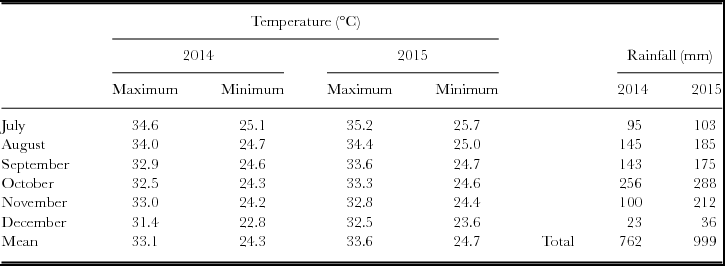
Both mean maximum and minimum air temperatures decreased gradually during the crop cycle in both years, but the mean air temperature was about 0.5 °C higher in 2015 than in 2014 (Table 1). Rainfall increased from July to October and decreased thereafter in both years. However, 2015 was wetter than 2014, with a total rainfall of 999 mm from July to December compared with 762 mm in 2014. High rainfall in November 2015 resulted in standing water in the field around the time of harvesting; however, this was drained 5 days prior to the first harvest.
Weather conditions during the experiment in 2014 and 2015.

Experiment 1 (2014)
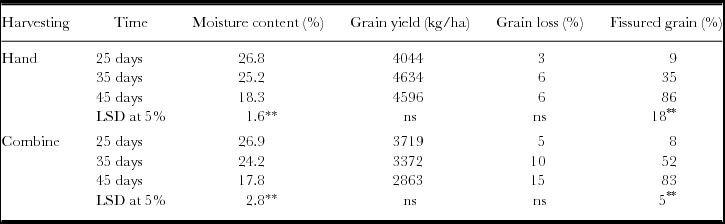
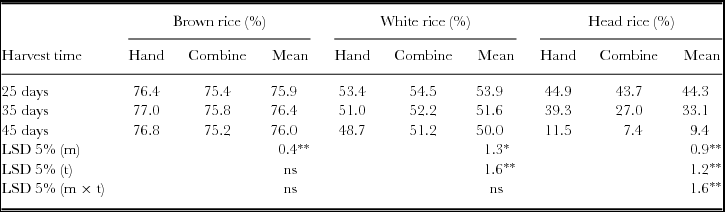
In the hand-harvesting trial, grain moisture content exceeded 25% at 25 and 35 days after flowering, but it decreased sharply at 45 days after flowering to 18.3% (Table 2). Grain yield and grain loss were not significantly affected by harvesting time, but grain fissuring increased sharply after the first harvest and 86% of grain was fissured by 45 days after flowering. A similar trend was observed from the combine harvest. Grain yield of combine-harvested crop was lower than hand-harvested crop; however, this was probably due to the field positions of these two adjacent trials as combine and hand harvesting were not randomized. On the other hand, grain loss was higher in the combine-harvested crop with a mean of 10% compared with 5% in the hand-harvested crop. As was the case in the hand-harvested crop, grain fissured more at 35–45 days after flowering compared with the crop harvested at 25 days as grain moisture content decreased with the delay in harvesting. The delay in harvesting had no effect on the proportion of brown rice, and only a slight decrease in the proportion of white rice is observed (Table 3). However, the HRY decreased sharply on average from 44 to 9% with delay in harvesting beyond 25 days after flowering, and this was exacerbated when harvested by combine.
The effect of three harvesting times (days after flowering) on rice grain moisture content, grain yield, grain loss and fissured grain in Experiment 1 (2014).

LSD = least significant difference; ns = non-significant; **= significantly different at 1%.
The effect of three harvesting times (t; days after flowering) and method (m) on milling quality of rice in experiment 1 (2014).

LSD = least significant difference; ns = non-significant; *,**= significantly different at 5% and 1%, respectively.
Experiment 2 (2015)
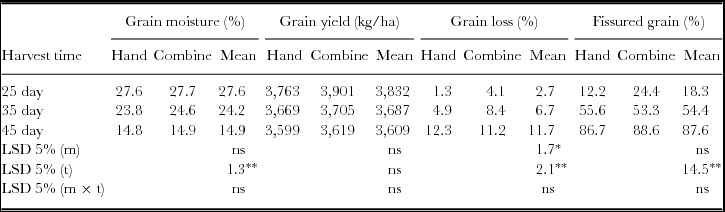
In the year 2 experiment, all crops were lodged due to strong winds. Grain moisture content was similar for both hand and combine harvested crops, and the mean moisture content was high at 27.6% and decreased slightly by 35 days after flowering, and then sharply to 14.9% at 45 days after flowering (Table 4). Grain yield was not affected by the time of harvest or harvesting method with mean yield exceeding 3700 kg/ha. Grain-harvesting loss in the field increased sharply from the mean of 1.3 to 12.3% in hand harvesting and from 4.1 to 11.2% as the harvesting was delayed from 25 to 45 days after flowering. Mean grain loss was slightly higher in the combine- than hand-harvested field.
The effect of three harvesting times (t; days after flowering) and method (m) on rice grain moisture content, grain yield, grain loss and fissured grain (%) for Experiment 2 (2015).

LSD = least significant difference; ns = non-significant; *,**= significantly different at 5% and 1%, respectively.
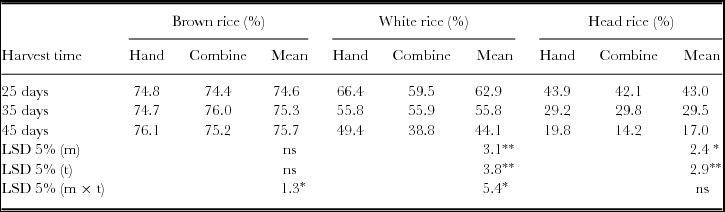
Fissured grain proportion at the time of harvest was not affected by the harvesting method, but increased sharply as harvesting was delayed from 25 to 35 and then to 45 days after flowering (Table 4).Brown rice proportion was slighlty affected by the time and method of harvesting, while white rice proportion decreased with delay in harvesting after 25 days after flowering, and also it was lower in combine- than hand-harvested crops at 25 and 45 days after flowering (Table 5). HRY decreased sharply with delay in harvesting after 25 days after flowering, but it was also slightly lower in combine- than hand-harvested crop.
The effect of three harvesting times (t; days after flowering) and method (m) on Milling quality of rice in Experiment 2 (2015).

LSD = least significant difference; ns = non-significant; *,**= significantly different at 5% and 1%, respectively.
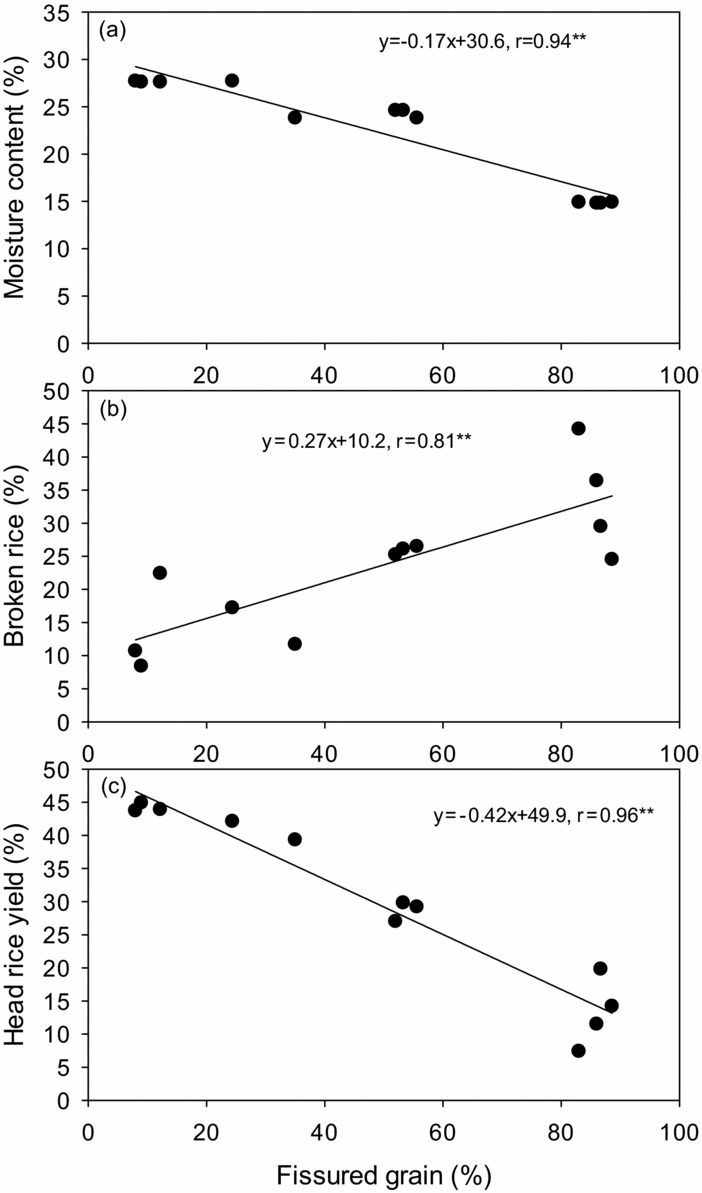
As harvesting was delayed from 25 to 35 and 45 days after flowering, grain moisture content decreased and grain fissuring increased, indicating that grain fissures increased with time as low moisture grain encountered variation in air temperature and humidity during the ripening stage. Thus, there was a strongly negative correlation between moisture content and fissured grain proportion at the time of harvest (Figure 1a). Similarly, the proportion of broken rice increased and HRY decreased with delay in harvesting, and the proportion of fissured grain was directly correlated with broken rice proportion and HRY (Figure 1b and c).
The relationships between moisture content (a), broken rice (b) and head rice yield (c) with fissured grain across Experiments 1 and 2. Each symbol represents the mean of each harvest time, for each method.

DISCUSSION
The results of the two experiments are similar in terms of the effect of delay in harvesting on changes in grain moisture content, grain fissuring at harvest and milling quality (Tables 2–5). In some cases, however, the results were only statistically significant in Experiment 2, and this may be due to the superior design of this experiment. In Experiment 1, two blocks were allocated separately for hand harvesting and combine harvesting, but they were under different growing conditions, and grain yield differed between the two blocks.
HRY may be determined by the genetic make-up of a crop; for example, high HRY tends to be obtained in genotypes with low amylose content (Zhou et al., Reference Zhou, Liang, Ponce, Marundon, Ye and Zhao2015). However, the results shown here clearly indicate that it was affected greatly by management factors such as the time of harvesting, the methods of harvesting and subsequent grain drying (Tables 3–5). When harvesting is delayed and grain moisture content decreases, moisture adsorption increases by low moisture content rough rice, and subsequently more grain is fissured and HRY decreases particularly in grain with thick kernel (Jindal and Siebenmorgen, Reference Jindal and Siebenmorgen1994).
When rice was harvested at 25 days after flowering, HRY was the highest at around 42–45% in both hand and combine harvesting (Tables 3 and 5). These values were similar to the mean (43.8%) in wet season of 39 varieties evaluated by the International Rice Research Institute (Zhou et al., Reference Zhou, Liang, Ponce, Marundon, Ye and Zhao2015). These are, however, lower than peak HRY obtained in some other regions, for example, 57–63% in long grain hybrid cultivar XL723 in Arkansas (Lanning et al., Reference Lanning, Siebenmorgen, Counce, Ambardekar and Mauromoustakos2011) and 56–64% in medium grain variety M202 in California, USA (Thompson and Mutters Reference Thompson and Mutters2006). This low HRY may be related to high minimum air temperature of around 24 °C during grain ripening (Table 1), as high night time temperature commonly reduces HRY through quick decrease in grain moisture content (Counce et al., Reference Counce, Bryant, Bergman, Bautista, Wang, Siebenmorgen, Moldenhauer and Meullenet1990a; Lanning et al., Reference Lanning, Siebenmorgen, Counce, Ambardekar and Mauromoustakos2011). Another factor affecting HRY is excessive or lack of standing water during growth in rainfed lowland rice in the Mekong region. In such areas, drought development is common, particularly terminal drought that results in severe stress just before maturity (Fukai and Ouk, Reference Fukai and Ouk2012). Reduced period of standing water during grain filling period could also lead to low HRY (Counce et al., Reference Counce, Siebenmorgen, Vories and Pitts1990b), and it is likely that the sun-drying of rough rice in the field may have contributed to lower HRY.
The results of decreased HRY from 25 days after flowering (Tables 3 and 5) indicate that 35 days after flowering is already too late for harvesting in these years in Cambodia, although grain moisture content was still high at around 24% at 35 days after flowering (Tables 2 and 4). The moisture content of 24% is higher than those found at appropriate harvest time for long grain rice in Texas (17–20%; McCauley and Way, Reference McCauley and Way2002) and in Arkansas (19–22%; Siebenmorgen et al., Reference Siebenmorgen, Bautista and Counce2007), and indicates that considerable drying is required for the rice crops in the Mekong region. It appears that grain moisture content is difficult to use as a harvesting criterion because the difference in moisture content between 25 and 35 days after flowering was small, despite higher grain fissuring and lower HRY when the crop was harvested 35 days after flowering. Similarly, Thompson and Mutters (Reference Thompson and Mutters2006) observed large day-to-day as well as bay-to-bay fluctuation in grain moisture content and also made the point of the difficulty in using grain moisture content as an estimate of HRY in California.
In the present study, grain fissuring at harvest increased sharply with delay in harvesting, and by 35 days after flowering, about 52–54% of grain fissured and over 80% by 45 days after flowering (Tables 2 and 4). Furthermore, for given postharvest handling conditions including grain drying, threshing, cleaning and milling, the HRY was related to the proportion of fissured grain at harvest (Figure 1c). This was the case when grain fissuring variation was caused by different times of harvesting after flowering. Similarly, Siebenmorgen et al. (Reference Siebenmorgen, Bautista and Counce2007) found that 77% of total variation in HRY was explained by fissuring. The result of grain fissuring in the present study suggests that if the proportion of fissured grain is less than 20% at the time of harvest, then HRY would be 45% or higher.
Results from a recently conducted survey of grain fissuring and moisture content of rice in 20 farms (unpublished data) indicate that there were 8 farms with grain fissuring exceeding 10% at harvest and 12 farms with grain moisture content below 24%. This moisture content was slightly lower than 27% and 24–25% at 25 and 35 days after flowering, respectively, but is higher than the moisture content at harvesting in the US studies mentioned earlier.
HRY was on average 2–6% higher in hand than combine harvesting, but this difference was small for crops harvested at 25 days after flowering (Tables 3 and 5). The difference noted in HRY between the harvesting methods may not be attributable to differences in harvesting methods as such, as grain fissuring was similar between the two harvest methods, but rather this may be caused by the different methods used for drying grain after harvesting. Sun-drying of hand-harvested rice plants on rice stubble may have contributed to maintaining high HRY compared with sun-drying on a plastic sheet of threshed rough rice from combine harvesting. One reason for the lower HRY of combine-harvested crop would be higher drying temperature (Truong et al., Reference Truong, Truong, Fukai and Bhandari2012), as it is likely that the rough rice on the plastic sheet was exposed to higher temperatures than the rice plants dried on rice stubble. Further work is required to improve HRY by using artificial drying with a constant temperature.
Grain harvest loss was small when the crop was harvested at 25 days after flowering, but increased with time (Tables 2 and 4). This would be caused by grain shattering at the time of harvest and more plants lodged with delayed harvesting. The heavier grain loss found with the rice harvested by combine would be caused by crop lodging and also at the later harvesting occasions grains were too mature for harvesting by combine. On average, the loss was 2–5% greater in combine-harvested crops, but hand-cutting loss included only cutting operation and not field drying, transportation, threshing and cleaning. Our earlier study (CARDI, 2011) showed that field drying, collecting and threshing loss of hand-harvested crops were about 4%, and hence when these are considered, the total grain loss by hand- and combine-harvesting methods may be similar. For crops harvested by 35 days after flowering, the total loss would be less than 10%. It should be pointed out the yield loss by combine depends on the speed at which the combine is operated in the field, and the present study employed a relatively slow speed of combine harvesting and the result may be considered at the lower end of grain loss in the field.
In conclusion, the two seasons of experiments in Cambodia indicated that the optimum harvesting time for rainfed lowland rice in the Mekong region appears to be 25–30 days after flowering when grain moisture content is still high exceeding 25%. This result needs to be confirmed with further analysis of crops grown in different environments in the region. As most farmers do not keep a record of flowering time of their crops, a description of appropriate panicle conditions for optimum harvesting time may be required.
Acknowledgments
The authors wish to thank the Australian Centre for International Agricultural Research (ACIAR, CSE-2012/77) for financial support and the assistance provided by staff from Cambodian Agriculture Research and Development Institute and local farmers.