INTRODUCTION
Most older people with advanced cancer report moderate to severe pain that diminishes quality of life (Caltagirone et al., Reference Caltagirone, Spoletini and Gianni2010). In the final stages of the disease, up to 85% of older people will also develop delirium (LeGrand, Reference LeGrand2012), an acute organic brain disorder marked by impaired consciousness and awareness as well as abnormalities of cognition and perception (American Psychiatric Association (APA), 2000). There are three subtypes of delirium: hypoactive, which presents with confusion and sedation; hyperactive, which presents with hallucinations, delusions, agitation, and disorientation; and a mixed presentation with features of both the hyperactive and hypoactive subtypes (APA, 2000; Breitbart & Strout, Reference Breitbart and Strout2000; Leonard et al., Reference Leonard, Agar and Mason2008). For each of these subtypes, the outcome may be characterized as terminal, in which delirium continues until death, or reversible, in which it resolves before death (Lawlor et al., Reference Lawlor, Gagnon and Mancini2000). Both cancer pain and delirium at the end of life are associated with profound negative psychological and physiological consequences for patients (Yennurajalingam et al., Reference Yennurajalingam, Braiteh and Bruera2005), as well as significant distress for family members (Breitbart et al., Reference Breitbart, Gibson and Tremblay2002; Partridge et al., Reference Partridge, Martin and Harari2013). Despite their high prevalence, the aging of the population (Statistics Canada, 2011), and the recognition that cancer is a disease of older people (Canadian Cancer Society's Steering Committee, 2010), much remains to be learned about cancer pain and delirium.
Furthering our knowledge depends on the availability of validated pain assessment strategies; however, assessing pain in older cancer patients with delirium presents many challenges (Bruera et al., Reference Bruera, Fainsinger and Miller1992). Primary among these is that delirium may interfere with the self-report of pain. For example, some patients with hypoactive delirium may be unable to communicate verbally. Conversely, some patients with hyperactive delirium, who may be able to verbalize, may provide self-reports that are incoherent or difficult to interpret due to the presence of hallucinations or delusions (Boettger & Breitbart, Reference Boettger and Breitbart2011). Another challenge is that the behavioral manifestations of pain and delirium may overlap, complicating observational assessment. For instance, guarding and grimacing may indicate pain or agitation or both. Differentiation of the underlying cause of behavioral cues is difficult (Husebo et al., Reference Husebo, Ballard and Aarsland2011). Finally, the ways in which the well-documented repertoire of pain cues (Hadjistavropoulos et al., Reference Hadjistavropoulos, Breau, Craig, Turk and Melzack2011) may change as a result of the widespread brain dysfunction associated with delirium (Mittal et al., Reference Mittal, Muralee and Williamson2011; Vasilevskis et al., Reference Vasilevskis, Han and Hughes2012) or other changes associated with impending death and advanced disease (Crews, Reference Crews2007; Kehl & Kowalkowski, Reference Kehl and Kowalkowski2013) are unknown. Established observational pain scales were not developed for this population and may not be sensitive to these assessment challenges (Herr et al., Reference Herr, Bjoro and Decker2006a). Furthermore, a measure developed and validated specifically for these patients is not currently available.
Despite these assessment challenges, healthcare workers (HCWs) believe that most patients with cancer-related delirium experience pain (Gagnon et al., Reference Gagnon, Lawlor and Mancini2001), and in one study they rated pain during delirium with agitation as more intense than pain during delirium without agitation (Bruera et al., Reference Bruera, Fainsinger and Miller1992). Importantly, HCWs' pain judgments impacted management, including the administration of opioid analgesics (Bruera et al., Reference Bruera, Fainsinger and Miller1992; Gagnon et al., Reference Gagnon, Lawlor and Mancini2001). It is not clear how these HCWs judged pain or differentiated it from agitation. Studies in other populations have shown that pain judgments are based on a complex weighting of multiple sources of data, including patient self-report, behavior, and medical evidence (Tait et al., Reference Tait, Chibnall and Kalauokalani2009; Bryson et al., Reference Bryson, Coe and Swami2010; Wandner et al., Reference Wandner, Heft and Lok2014). Similar complexity would be expected in the present patient population.
Understanding how HCWs determine that older cancer patients with delirium are in pain is a critical first step to improving pain assessment and management for this vulnerable group. To date, studies designed specifically to identify patient-based cues used by HCWs to make pain judgments and to examine how cues differ by delirium subtype and outcome have not been reported. Our retrospective cohort study was conducted to address this knowledge gap by examining HCWs' judgments of cancer pain and delirium in older palliative care inpatients.
METHODS
Participants and Setting
We reviewed the medical records of consecutive patients, 65 years of age and above, admitted to the Harold and Shirley Lederman Palliative Care Centre at the Princess Margaret Cancer Centre, University Health Network, during a one-year period. Patients diagnosed with delirium via clinical interview were eligible for inclusion in our study. The Lederman Centre is a 12-bed acute palliative care inpatient unit for patients with cancer. Approximately 350 patients are admitted yearly, with an average length of stay of 11 days; 50% of patients die on the unit, 30% are discharged home, and 20% are transferred to other units, predominantly community palliative care units or hospices (Bryson et al., Reference Bryson, Coe and Swami2010).
Data Collection
The data were collected using a uniform electronic data extraction template. Unanticipated scenarios not included in the training were discussed with the research team until a consensus on coding was reached. Abstractors were blind to the study's specific objectives but were aware that it was about pain and delirium. Each chart was reviewed by one abstractor, either a registered nurse or clinical research associate, who received training prior to reviewing the charts, and all categorizations were subsequently reviewed by Dr. Gagliese.
Demographic and Medical Data
The demographic and medical data extracted included age, sex, marital status, education, ethnicity, time since cancer diagnosis, cognitive status at admission, length of admission in days, and medications administered each day. Comorbidities and total number of conditions were recorded. These were further classified into conditions often associated with pain (e.g., osteoarthritis; Merskey & Bogduk, Reference Merskey and Bogduk1994) and those not usually associated with pain (e.g., hypertension). Strongest analgesic class administered was categorized according to the World Health Organization (WHO) analgesic ladder (Jadad & Browman, Reference Jadad and Browman1995): opioid ± nonopioid (e.g., nonsteroidal anti-inflammatory drugs, adjuvants) analgesics, nonopioid analgesics only, and no analgesics. All notes from admission to either discharge or death were reviewed.
Delirium
Patients were classified as having delirium if the notations indicated that the patient received this diagnosis based on clinical interview by a palliative care physician or psychiatrist. All notations regarding type of delirium (hyperactive, hypoactive, or mixed) were recorded. Delirium was further classified as reversed (resolved prior to death or discharge) or terminal (continued until death) based on chart notations subsequent to clinical interviews. Cognitive status was evaluated daily.
Pain
Patients were classified as having pain on any day that the notes indicated that the person was in pain. Multiple notations of pain on the same day were scored as one day in pain. Similar rubrics were used to code “unable to judge pain” and “no pain.” All notes made by nurses or physicians describing pain assessment, characteristics, and behavioral expressions were extracted. This study was approved by the University Health Network Research Ethics Board.
Data Analysis
Prior to analysis of the outcomes of interest, comparisons between the two abstractors on all variables were conducted using t tests for continuous variables and chi-square tests for categorical variables to assess consistency of abstraction and identify any systematic abstractor bias. There were no differences between the abstractors on any variable; therefore, all subsequent analyses were conducted pooling across abstractors.
Participant Demographic and Medical Data
Descriptive statistics (means, standard deviations, frequencies) were calculated for the demographic and medical variables. The prevalence of delirium, its subtypes, and outcomes were calculated.
Pain and Delirium
Content analyses of the clinical notations were undertaken to identify the rates of charting pain, ability to judge pain, pain assessment strategies employed, and behavioral indicators of pain. The relationship between assessment strategy employed (e.g., patient self-report vs. behavioral observation by an HCW) and pain judgment was assessed using chi-square tests. Pain-related notations were compared across patients with different delirium subtypes and outcomes.
RESULTS
Participants
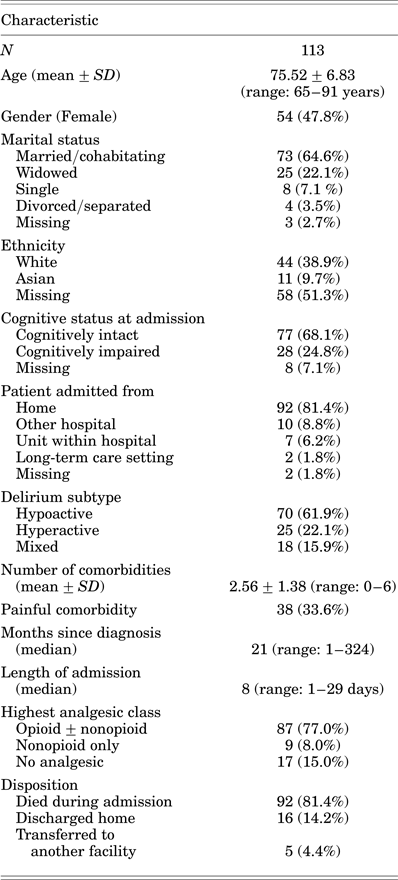
During the 1-year review period, 169 patients above the age of 65 years were admitted to the Lederman Palliative Care Centre. Twenty (11.8%) were excluded due to missing or incomplete information on cognitive status, and 36 (21.3%) were excluded because the patients did not experience delirium during their admission. Therefore, this paper reports on 113 (66.9%) patients who were diagnosed with delirium (Table 1). The average age was 75.5 ± 6.8 years (range: 65–91 years), and 47.8% were women. A quarter of the patients had delirium on the first day of admission, and the majority had onset within three days. Hypoactive delirium was most common, though hyperactive and mixed presentations were also seen. Most of the patients experienced terminal delirium and died during the admission.
Patient characteristics

Chart Notation Content Analysis
Clinical notes from 804 admission days were abstracted. On 38 days (4.7%), there were no chart notations about pain. On 58 (7.2%) days, HCWs recorded being unable to assess pain or that the patient was unresponsive. Therefore, 708 assessment days were available for content analyses. Three (0.4%) notes indicated that a family member had reported that the patient was in pain. Information regarding how family members made this judgment or HCWs verified it was not recorded. On a large majority of days (86%, 609/708), assessment was based on patient self-report (e.g., patient “denies,” “reports,” or “does not complain” of pain). On the remaining 13.6% (96/708) of assessment days, observational pain cues guided HCW decisions.
Grouping self-report and observational assessments together, it was more likely for the notes to indicate that patients were experiencing pain than that they were not in pain (61.8 vs. 38.2%, p ≤ 0.0001). This was maintained when considering self-report and behavioral observation separately (Table 2). However, assessments based on observation were more likely than those based on patient self-report to indicate the patient was in pain (78.1 vs. 59.3%, p ≤ 0.0001; Table 2).
Pain judgment by assessment strategy or informant
ap ≤ 0.0001 for column-wise comparisons; bp ≤ 0.0001 for comparison across assessment strategies.
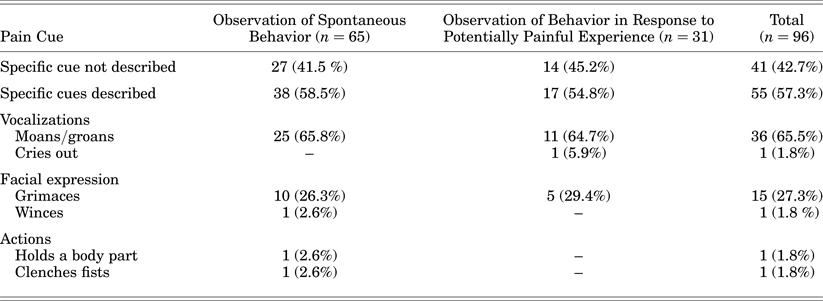
Examination of pain judgments based on behavioral observation revealed two major assessment strategies: observation of spontaneous behaviors (67.7%, 65/96) and observation of behaviors elicited by potentially painful experiences, such as repositioning or movement (32.3%, 31/96; Table 3). In 42.7% of observational assessments, HCWs did not record the specific cues used to determine the presence of pain. Instead, they wrote general behavioral impressions, such as “no obvious sign of pain” or “looks comfortable” or simply noted that the patient had “pain with repositioning” or “reacts to painful stimuli.”
Pain cues by type of behavioral observation
For the rows, “specific cues described” and “specific cues not described,” the denominator is the n for that column. For the three subcategories “vocalizations,” “facial expressions,” and “actions,” the denominator is that column's value for “specific cues described.”
Specific behavioral pain cues were described in 57.3% of observational assessments and were equally likely whether behaviors were spontaneous or elicited. For both types of assessment, the most common behavioral signs recorded were vocalizations, such as “moaning” or “groaning” (65.5%), and the facial expression “grimacing” (27.3%). See Table 3 for details on specific pain cues. Observational cues did not differ by delirium subtype or outcome.
DISCUSSION
To our knowledge, this is the first study to examine HCWs' judgments about pain in older cancer patients with delirium on each day of admission to an acute palliative care unit. We found that the judgments were based primarily on self-report when patients were able to verbally communicate, and on observation of behavioral cues, such as vocalizations and facial expressions, when patients could not verbally self-report. Both spontaneous behaviors and those exhibited during potentially painful experiences, such as repositioning or movement, were considered in assessments. These strategies did not differ by delirium subtype or outcome and were consistent with clinical guidelines (Herr et al., Reference Herr, Coyne and Key2006b) regarding pain judgments in other nonverbal populations.
Consistent with our previous studies in the palliative care setting (Cheung et al., Reference Cheung, Le and Gagliese2011), most of the patients were judged to have pain at some point during their admission. Presence of pain did not differ by delirium subtype. Interestingly, Bruera et al. (Reference Bruera, Fainsinger and Miller1992) reported differences in nurses' pain intensity ratings by delirium subtype, with more intense pain attributed to patients with than those without agitation. However, their study is not directly comparable to the present one, as different aspects of pain were examined. Bruera et al. (Reference Bruera, Fainsinger and Miller1992) examined HCWs' judgments of pain intensity, whereas we examined their judgments of presence or absence of pain. It is possible that the strategies used to judge these aspects of pain differ (Chang et al., Reference Chang, Oh and Park2011; Martel et al., Reference Martel, Thibault and Sullivan2011). Therefore, these seemingly discrepant results may reflect the assessment of different pain-related constructs. The cognitive strategies used to assess different pain characteristics is an important area for future research.
We found that, when judging the presence of pain, the most common strategy was to elicit patient self-report. However, the validity and reliability of self-reports for this patient population have not been established. A small study of intensive care unit patients suggested that, even when verbal ability was preserved, the rate of symptom reporting decreased during delirium, possibly challenging reliance on self-report (Tate et al., Reference Tate, Sereika and Divirgilio2013). Comparable data from the palliative care setting are not currently available. The ability of people with other types of cognitive impairment to verbally self-report pain has received more research attention and debate. For instance, among older people with mild dementia, there is some evidence that training and simplified protocols can lead to reliable self-report (Chibnall & Tait, Reference Chibnall and Tait2001), but there is also evidence of poor reliability and considerable difficulties with self-report (Feldt et al., Reference Feldt, Ryden and Miles1998). In our study, self-reports were more likely to indicate that patients were in pain than free from pain, consistent with the high prevalence of pain documented in cognitively intact palliative care populations (Cheung et al., Reference Cheung, Le and Gagliese2011). This may indirectly support the validity of these self-reports. However, the prevalence was lower than that detected by behavioral observation. While this may suggest that behavioral observation is more sensitive for this group, it may also reflect poor specificity, in particular the difficulties differentiating pain from symptoms of delirium. Unfortunately, the lack of chart notations describing how self-reports were obtained limits conclusions. The feasibility and psychometric properties of self-report pain scales for cancer patients with delirium remain to be evaluated.
When patients were unable to provide verbal self-reports, HCWs relied on behavioral cues, particularly vocalizations and facial expressions, to judge pain. Although the primacy of vocalizations and facial expressions is consistent with the literature on other patients with impaired ability to report pain verbally (Herr et al., Reference Herr, Coyne and Key2006b), the validity and reliability of these cues for this particular group of patients has not been established. This is critical, given the potential for behavioral overlap. For instance, patients may exhibit the same behaviors, such as grimacing and yelling, because of delirium, pain, or both (Bruera et al., Reference Bruera, Fainsinger and Miller1992). This overlap has important implications for symptom identification and management, including the potential risk of misattribution of symptoms (Breitbart & Alici, Reference Breitbart and Alici2008; Partridge et al., Reference Partridge, Martin and Harari2013). The chart notations were silent on how HCWs disentangled these overlapping behavioral presentations. Prospective research examining the cognitive processes HCWs use to make these important clinical distinctions would provide essential information for the development of a standardized assessment protocol that could be used with this population.
An important finding was that, despite the lack of such a protocol, HCWs assessed both spontaneous and evoked pain, with the same pain cues (grimacing and moaning/groaning) most commonly described for both. This reflects the well-known distinction between background and incident pain in cancer patients (Breivik et al., Reference Breivik, Cherny and Collett2009; Haugen et al., Reference Haugen, Hjermstad and Hagen2010). It also suggests that HCWs were taking a proactive, hypothesis-testing approach to pain assessment. It is tempting to conclude that behaviors elicited during a potentially painful experience are due to pain, but the validity of this conclusion can be challenged. It is also possible that the potentially painful experience increases agitation or anxiety, whose behavioral expression is misattributed to pain. Nonetheless, consideration of evoked pain is critical, and an effective and clinically useful assessment protocol for these patients must capture and differentiate these two types of pain.
The development of such a protocol will depend on research focused specifically on pain in older cancer patients with delirium. It is not appropriate to generalize from other cognitively impaired groups because clinical differences between them may impact on behavior in unique ways (Herr et al., Reference Herr, Coyne and Key2006b). For instance, acute cognitive dysfunction, advanced cancer, impending death, high symptom burden, and polypharmacy, which characterize older palliative care inpatients (van Lancker & van Hecke, Reference van Lancker, Velghe and van Hecke2014), may impact on pain behaviors in ways that are not comparable to older people with dementia in a long-term care setting. Consistent with this, observational pain scales developed for older people with dementia in a long-term care setting have been shown to perform poorly when used with older people with comorbid dementia and delirium (Hadjistavropoulos et al., Reference Hadjistavropoulos, Voyer and Sharpe2008). Similarly, pain assessment tools developed for people with delirium in the postoperative (Feldt, Reference Feldt2000) or intensive care (Gelinas et al., Reference Gelinas, Fillion and Puntillo2006) setting may be limited in applicability. These measures do not consider delirium subtypes and outcomes, the interpretation of nonspecific behavioral cues, or the differentiation of evoked from background pain. Furthermore, it is increasingly recognized that delirium may have different pathophysiology and symptom presentation across patient populations, also limiting generalizations (Leonard et al., Reference Leonard, Agar and Mason2008; Mittal et al., Reference Mittal, Muralee and Williamson2011; Vasilevskis et al., Reference Vasilevskis, Han and Hughes2012). As such, research into cancer pain assessment in older people in the palliative care setting is urgently needed.
Although it is preliminary, our study provides novel information regarding judging pain in this group of patients and is an important first step in the development of a standardized pain assessment protocol. However, the results must be interpreted in light of a number of limitations. Chief among them is that the data are based solely on review of HCWs' chart notations, which may be incomplete or inaccurate (Wu & Ashton, Reference Wu and Ashton1997). We took several steps to maximize the rigor of our chart abstraction, including training data abstractors, using a standardized abstraction protocol, and discussing ambiguous notes or situations (Wu & Ashton, Reference Wu and Ashton1997; Gearing et al., Reference Gearing, Mian and Barber2006). Importantly, chart review may have been particularly suitable for our objectives, as it provides rich naturalistic source data about HCWs' practices in a nonselected sample of patients free of response biases that may operate in the context of a research study (Wu & Ashton, Reference Wu and Ashton1997; Gearing et al., Reference Gearing, Mian and Barber2006). In particular, HCWs made their notations without knowledge of their future use in research about pain.
A related limitation is that the study took place in a single, highly specialized, acute palliative care unit with a relatively small sample size, possibly threatening the generalizability of the results. This may be especially relevant to our finding of consistency of pain cues and assessment strategies across delirium subtypes, as relatively few cases of hyperactive and mixed delirium were included in the analysis, and the diagnosis of delirium was based on clinical interview rather than a standardized measure. However, our findings regarding the prevalence of delirium, its subtypes, and its outcomes are consistent with larger studies designed to systematically evaluate these issues (LeGrand, Reference LeGrand2012). This supports the representativeness of our sample and increases confidence in our findings. Nonetheless, replication in larger and more diverse clinical settings is welcome.
The key conclusion from this study is that HCWs routinely made judgments about pain in older patients with delirium using a repertoire of strategies that included patient self-report and observation of spontaneous and evoked behavior. Using these strategies, HCWs judged pain to be highly prevalent in the palliative care inpatient setting. Given these findings, it is critical that research and clinical attention be brought to the careful development of a valid, reliable, and clinically feasible assessment protocol. Improved pain assessment will contribute to enhanced pain management as well as improved quality of life and better death and dying in this especially vulnerable group of patients.
ACKNOWLEDGEMENTS
We wish to thank the members of the Cancer Pain Research Unit Writing Seminar for valuable feedback on earlier drafts of this manuscript.
DISCLOSURES
This project was supported by an operating grant from the Canadian Institutes of Health Research (MOP-230863) to Lucia Gagliese. Rebecca Rodin was supported by a research studentship from the Government of Ontario Summer Experience Program. There are no conflicts of interest to declare. The funding sources had no role in study design; in the collection, analysis, or interpretation of data; in the writing of the report; or in the decision to submit the article for publication.