INTRODUCTION
Reference is managed by language users using a range of linguistic strategies, globally in terms of topic structure, word order, and so forth, as well as locally through the selection of referring expressions including zero, pronominal, or nominal noun phrase (NP) forms (alongside the appropriate local marking of such forms) across a given text. This allows language users and their audience to track referents as discourse unfolds in a process known as referential movement, and as “about every third word of discourse (sometimes even more than that) is dependent on the process of referential choice” (Kibrik, Reference Kibrik, Haspelmath, König, Oesterreicher and Raible2001, p. 1124), referential movement occupies a critical role in the overall coherence of discourse, dealing with the central question of “who did what to whom?”
Unlike textual accounts of reference as a cohesive device (e.g., Halliday and Hasan, Reference Halliday and Hasan1976; Hasan, Reference Hasan and Flood1984), current accounts of referential movement suggest that language users guide their audience in navigating the “common ground” (following Stalnaker, Reference Stalnaker, Munitz and Unger1974; see also Clark, Reference Clark, MacWhinney and O’Grady2015; Levinson, Reference Levinson, Enfield and Levinson2006) held in language, with referential relations emerging “not in the text, but in two collaborating minds” (Gernsbacher and Givon, 1995, p. viii) in real time.
(1) A: I just got back from Paris last week.
B: That must have been an interesting trip.
(2) A: Did you talk to Kate yesterday?
B: Yes, I told her about the arrangements (Clark, Reference Clark, MacWhinney and O’Grady2015, p. 330).
In both examples (1) and (2), language users’ specific use of a short NP form such as the demonstrative (1) or the pronoun (2) at that express moment should allow for the audience to resolve the reference with minimal processing effort (e.g., the “minimize forms” principle of Hawkins [Reference Hawkins2004]) and without ambiguity. Incorrect or infelicitous NP selection will result in the audience’s struggle or failure to correctly resolve the inference, potentially leading to miscommunication with an accompanying breakdown of coherence (Ryan, Reference Ryan2012). A range of cognitive, syntax-pragmatic scales or “hierarchies” of referring expressions have been proposed in the literature that claim to account for which form may felicitously be used under particular circumstances. These include scales of NPs organized under identifiability (Gundel, Hedberg, and Zacharski, Reference Gundel, Hedberg and Zacharski1993), topicality (Givón, Reference Givón, Givón and Gernsbacher1995), or accessibility (Ariel, Reference Ariel1991, Reference Ariel, Fretheim and Gundel1996, Reference Ariel2008, Reference Ariel2010), where particular referring expressions “encode” (Ariel, Reference Ariel2008) the level of inference needed to resolve any reference toward a specific referent at any given moment. Taking Ariel’s Accessibility Theory as an example, a language users’ choice of referring expression at the moment of expression should consider the target referent(s)’ relative distance between discourse-old and repeated mentions, competition between referents of similar types, degree of salience of the referent (see also Centering Theory, e.g., Grosz, Joshi, and Weinstein, Reference Grosz, Joshi and Weinstein1995), and the unity (breaks in continuity) of reference within a given discourse sequence. The relative configuration of these criteria lead to the (near) universal positioning of all NP forms as low to high accessibility markers, suggested by Ariel to follow the order seen in the scale in Figure 1.
The Accessibility Scale (taken from Ariel, Reference Ariel2008, p. 44).

Ariel (Reference Ariel, Fretheim and Gundel1996) also suggested a scale for discourse-new reference in English, starting from demonstrative NPs used for referent introductions (“this + N”) followed by indefinite quantifiers (“another + N”), followed by discourse-new specific indefinite article NPs (“a + N”) as NP forms respectively encoding the perceived high to low accessibility of certain discourse-new referents between a speaker and their audience, with the indefinite article NP most commonly used for referent introductions where no lexical or inferable link (or “anchor”; Gardent, Manuélian, and Kow, Reference Gardent, Manuélian and Kow2003) can be derived between the discourse-new referent and any antecedent. Thus, following Ariel's approach, the referent “a man” would be realized in text (in English, at least) roughly as follows:
(3) A man [discourse new, non-accessible] went into a store, where a woman was reading a magazine. The man [discourse old, intermediate accessibility] needed some food. He [discourse old, high accessibility] looked at some vegetables and Ø [discourse old, highest accessibility] took a potato. (Crosthwaite, Reference Crosthwaite2017, p. 542)
BRIDGING RELATIONS
As speakers use the form that they believe is most responsive to the state of shared knowledge with the addressee when introducing discourse-new referents, it is typical that language users use the NP form/position that commonly marks the highest level of accessibility along the hierarchy of NP forms available (Gundel et al., Reference Gundel, Hedberg and Zacharski1993). When introducing a specific, yet hearer-unknown referent into discourse for the first time (following Bickerton’s [1981] distinction), there is typically no such shared knowledge, and the lowest accessibility NP form is used. In English, as mentioned, the indefinite article “a/an” typically plays this role (alongside its role as a marker of generic and nonspecific reference) (example 4), while other languages use other forms. In Mandarin, for example, numeral + classifier NPs (一 “yi” [numeral] 个 “ge” [general classifier] + noun) are typically used, occasionally alongside the use of existential markers (e.g., “有,”, yǒu—“there is” in Mandarin) (example 5). In example (6), Korean uses postnominal nominative marking (e.g., “가,” “ga”) alongside the use of first position in the sentence (examples taken from Crosthwaite, Reference Crosthwaite2014b, pp. 462–464):
(4) A boy entered a restaurant (English)
(5) 有 一 个 男孩 走进 餐厅
yǒu yī gè nánhái zǒujìn cāntīng
There is one CLSFootnote 1 boy enter restaurant
“A boy entered a restaurant” (Mandarin)
(6) 한 아이가 식당으로 들어갔습니다.
Hanaika siktangulo tulekasssupnita
one boy-NOM restaurant-into enter-PAST-POL-DECFootnote 2
“A boy entered a restaurant” (Korean)
In examples (4) to (6), there does not appear to be any kind of relation we can infer between the two nominal referents (a boy, a restaurant), and the boy’s discourse newness is marked as such in (4) using the use of the indefinite article; in (5) through the use of the existential marker 有 and the numeral + classifier NP (一个男孩); and in (6) using the numeral NP in first position with post-nominative marking (한 아이가).
However, it is often the case that a lexical relation (i.e., through synonymy, hyponymy, meronymy, or thematic role) or inferable relation (i.e., through circumstantial or world-knowledge effects) may be derived from some aspect of the given or situational context and the discourse-new, hearer-unknown referent to be introduced as the discourse unfolds. What is more, where such a relation exists, a discourse-new hearer-unknown referent may be introduced using an NP form significantly higher along the informational hierarchy (i.e., a more definite NP form) than would be reserved for a discourse-new referent with no lexical or inferable relation derivable. For example, observe the definite article in example (7), or the bare nominals in examples (8) and (9).
(7) A man walks into a restaurant. The waiter gave him a menu [English]
(8) 有 一 个 男孩 走 进 餐厅 , 服务员 给 他 一 份 菜 单
yǒu yī gè nánhái zǒu jìn cāntīng, fúwùyuán gěi tā yī fèn cài dān
EXIST NUM CLS boy enter restaurant. Waiter give him one CLS menuFootnote 3
A boy entered a restaurant. The waiter gave him a menu. [Mandarin]
(9) 한 남자가 식당으로 걸어갔다. 종업원이 그남자에게 메뉴판을 줫다.
Han namcaka siktangulo kelekassta. Congepweni kunamcaeykey meynyuphanul cwesta.
One man-NOM restaurant enter-PAST-DEC. Waiter-NOM that-man-towards menu-ACC give-PAST-DEC.
A man entered a restaurant. The waiter gave him a menu. [Korean]
A definite NP is less likely to be used when either a lexical relation between given/new entities is absent/weak (or in the case of L2 learning, perhaps not known), or when the level of inference needed to resolve the bridging relation using the situational/discourse context or “world” knowledge resources becomes too great (example 10):
(10) I was looking at van Gogh’s self-portrait. The missing ear made me feel sad.
I went to see some impressionist paintings. The missing ear made me feel sad.
I went to a gallery yesterday. The missing ear made me feel sad.
(Wilson and Matsui, Reference Wilson and Matsui1998, p. 6)
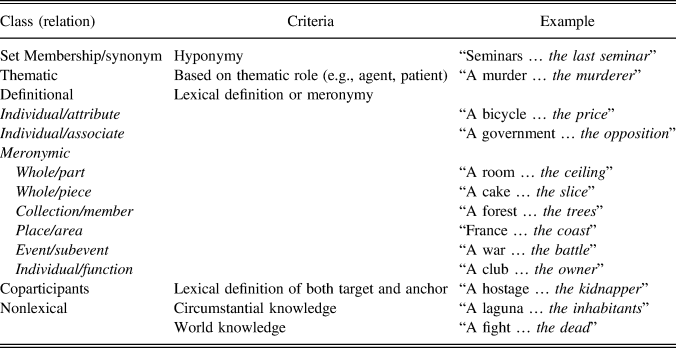
Such referential relations are known as bridging descriptions (Clark, Reference Clark, Schrank and Nash-Webber1975; Clark and Haviland, Reference Clark, Haviland and Freedle1977; Crosthwaite, Reference Crosthwaite2014a, Reference Crosthwaite2014b, Reference Crosthwaite2016a; Matsui, Reference Matsui2000; Wilson and Matsui, Reference Wilson and Matsui1998) or associative NPs (Hawkins, Reference Hawkins1978; Poesio and Vieira, Reference Poesio and Vieira1998).Footnote 4 The use of definite article bridging relations for discourse-new, hearer-unknown introductions is significantly less frequent than that of other uses of the definite article, as attested in Poesio and Vieira’s (1998) corpus-based study of 1,412 L1 English definite article NPs, of which only 11% were determined to be bridging NPs. Because of the potentially vast prerequisite lexical and pragmatic knowledge required to resolve bridging relations, these discourse-new definite NPs have attracted significant attention in natural language processing studies, due to the difficulty such relations pose to automated coreference resolution (Irmer, Reference Irmer2010; Ogrodniczuk and Zawisławska, Reference Ogrodniczuk and Zawisławska2016; Poesio and Artstein, Reference Poesio, Artstein, Calzolari, Choukri, Maegaard, Mariani, Odijk, Piperidis and Tapias2008; Poesio and Vieira, Reference Poesio and Vieira1998). In this regard, attempts have been made to provide taxonomies of bridging relations, notably Gardent, Manuélian, and Kow (Reference Gardent, Manuélian and Kow2003), modified in Crosthwaite (Reference Crosthwaite2016a) (Table 1).
A taxonomy of bridging relations (modified from Gardent et al. 2003)

ACQUIRING BRIDGING IN L2
It has been well documented that language-specific differences in referential movement generally cause difficulties for L2 learners, particularly when considering the great variety in how (in)definiteness is (un)marked across languages. Such difficulties can and do lead to breakdowns in the referential coherence of the L2 texts/discourse produced (Crosthwaite, Reference Crosthwaite2014a). This is because—despite the universal hierarchies for reference posited above—the exact configuration of NP forms and structures along these hierarchies are language specific. When an L2 learner is faced with the task of acquiring referential movement in the L2, differences in the forms used and complexity of the syntax/pragmatic distinctions involved in (in)definiteness marking across different languages often result in severe difficulties for processability of the L2 system (Pienemann, Reference Pienemann1998), numerous sources of L1 transfer/interference (Ellis, Reference Ellis2006a, Reference Ellis2006b; Hawkins and Chan, Reference Hawkins and Chan1997), and the recently discussed “interface” learnability issues encountered when acquiring syntax-pragmatic or semantic-pragmatic distinctions in L2 (Lardiere, Reference Lardiere2009; Sorace, Reference Sorace2011; Sorace and Filiaci, Reference Sorace and Filiaci2006). All these concerns result in a lengthy (and often unsuccessful) path to acquiring the L2 system, with Mandarin Chinese being no exception (Mai, Reference Mai2015).
Specific to the acquisition of bridging relations, when acquiring the linguistic means of producing bridging in the L2, language learners are liable to face a myriad of problems. One such problem is that bridging is a relatively infrequent type of reference compared to that of definite discourse-old reference or indefinite discourse-new reference. This is certainly the case in English (Poesio and Vieira, Reference Poesio and Vieira1998), and we do not expect the frequency of bridging in Mandarin (or any language) to be significantly different (despite a lack of published corpus data on this phenomenon in other languages). Where the same type of marking is used for both bridging and discourse-old reference, as it is in English with the definite article, cue competition (where “cues” related to linguistic features that trigger a cognitive response in a language learner, either explicitly or implicitly) and contingency effects between the two reference types prove difficult for L2 learners, who are generally predisposed to looking out for a one-to-one mapping of form to function (Andersen, Reference Andersen1984). Crosthwaite (Reference Crosthwaite2014b) showed that L2 learners were more likely to acquire the discourse-old usage of the English definite article someway prior in development to acquiring the use of the definite article for discourse-new bridging purposes, and as a corollary, L2 learners of English were also likely to associate the indefinite article with all discourse-new reference, infelicitously using this form where a bridging relation exists. According to Ellis (2006a, p. 1), this is because L2 learners are “intuitive statisticians” who acquire their L2 by contingency (ΔP), learning particular form-function mappings by gathering information between cues and their outcomes, as well as information on salience and competition of such mappings in the target language—a difficult task given that natural language is “a prime example of a stimulus environment rich in multiple cues” (Ellis, Reference Ellis2006b, p. 168). Despite being intuitive statisticians, L2 learners’ intuitions in this regard are often incorrect.
A second problem for L2 learners when acquiring bridging is that of the well-documented potential for negative transfer (or lack of opportunity for positive transfer) from the L1. This is keenly felt between article/article-less L1/L2 pairs (Crosthwaite, Reference Crosthwaite2016b; Dekeyser, Reference Dekeyser2005; Diez-Bedmar and Papp, Reference Diez-Bedmar, Papp, Gilquin, Diez-Bedmar and Papp2008; Ekiert, Reference Ekiert2007, Reference Ekiert, Han and Cadierno2010; Huebner, Reference Huebner1983; Ionin, Ko, and Wexler, Reference Ionin, Ko and Wexler2004; Ionin, Baek, Kim, Ko, and Wexler, Reference Ionin, Baek, Kim, Ko and Wexler2012; Young, Reference Young, Bayley and Preston1996). As the L2 learner’s initial state is that of tabula repleta rather than tabula rasa (Ellis, Reference Ellis2006a), the L1 can exert considerable influence on the development of L2 definiteness marking as both L1 and L2 “compete for access to conscious awareness” (Ellis, Reference Ellis2006b, p. 174), and with L1-learned form-function cues exceptionally difficult to restructure in adult life. In addition, as mentioned previously, according to the interface hypothesis of L2 acquisition (Lardiere, Reference Lardiere2009; Sorace, Reference Sorace2011; Sorace and Filiaci, Reference Sorace and Filiaci2006), cues that cut across syntax-pragmatic boundaries (including definiteness marking) are particularly hard to acquire. This is because one must learn both the syntactic markings of the L2 as well as the pragmatic distinctions involved in the selection of those markings, which are not always altogether clear from the input alone. This process is strongly mediated by the L1, causing certain learners to become more (or less, depending on the L1/L2 pair in question) sensitive to these distinctions. In this regard, Ellis (2006b, p. 185) notes “a sad irony for an L2 speaker [as] more input simply compounds their error; they dig themselves ever deeper into the hole created and subsequently entrenched by their L1.”
Given these difficulties when acquiring bridging in L2, a variety of studies from the East Asian L2 English context have confirmed that L2 learners from Asian language backgrounds are unable to properly maintain L2 English target norms of syntax-pragmatic reference marking in L2 narrative production (Crosthwaite, Reference Crosthwaite2013, Reference Crosthwaite2014a, Reference Crosthwaite2016b; Hendriks, Reference Hendriks and Ramat2003; Kang, Reference Kang2005, Reference Kang2009; Ryan, Reference Ryan2012, Reference Ryan2015, Reference Ryan2016). These studies look at the breadth of referring expressions produced by Asian learners of L2 English including zero, pronominal, and full NP reference, generally using narrative picture descriptions or film retellings as the elicitation device. Such studies focus on whether the reference produced is an error (i.e., is incompatible with the L2 grammar) or whether the reference violates accessibility-based principles of economy of referential form through under/overexplicitness (i.e., a sequence of full NPs where pronouns may reasonably be used, e.g., the repeated name principle; Gordon, Grosz, and Gilliom, Reference Gordon, Grosz and Gilliom1993). In each case, differences between the L1/L2 referential systems are listed as the cause of frequent errors and/or overexplicitness in the L2 (at intermediate levels of proficiency, at least).
However, L2 acquisition of bridging relations has only been tested in two published studies thus far. The first of these (Crosthwaite, Reference Crosthwaite2014b) used a narrative picture sequence production task on 10 L1 speakers of Mandarin, Korean, and English and 60 Korean and Mandarin L2 English learners per language group (n = 10 over six L2 proficiency levels), and showed that L1 Mandarin and Korean speakers learning L2 English acquired the use of the English definite article for bridging relations at around B1 - B2 level of the Common European Framework of L2 proficiency (CEFR; Council of Europe, 2001). This is much later (pseudolongitudinally, at least) than that of specific, discourse-old use of definite article NPs in these respective language groupings. This finding is suggestive of the effects of cue contingency and frequency of bridging relations in the input, as mentioned previously.
Significant differences were also found in the way that L1 Mandarin and Korean (both technically article-less languages in the literature) encode bridging relations, with L1 Mandarin speakers clearly differentiating nonbridging reference (using numeral + classifier NPs) from bridging reference (using bare NPs). While bare nominals may be used for specific and nonspecific indefinite reference or specific definite reference in Mandarin (Li and Thompson, Reference Li and Thompson1981) following Bickerton’s (1981) taxonomy of reference types, Hickmann, Hendriks, Roland, and Liang (Reference Hickmann, Hendriks, Roland and Liang1996) as well as Crosthwaite (Reference Crosthwaite2014b) found that numeral + classifier NPs are significantly more likely to be used for discourse-new specific indefinite reference than bare nominals are for this function, with bare nominals preferred for definite reference and bridging reference. L1 Korean speakers, however, were found to use bare NPs for both bridging and nonbridging discourse-new reference as well as discourse-old reference, leaving discourse status and bridging relations in Korean all to be inferred rather than marked explicitly. In light of these findings, the L2 English results suggested that Mandarin L2 English learners were able to utilize positive transfer from their L1 in terms of a shared syntax-pragmatic distinction between differential marking of bridging and nonbridging discourse-new reference between Mandarin and English (even though the forms used are different), while this distinction was unavailable for Korean L2 English learners. The Mandarin L2 English learners eventually acquired appropriate marking of bridging in English at earlier CEFR proficiencies (e.g., A2-B1 CEFR) than was seen in the Korean L2 English group (until at least C1 level). Thus, difficulties at the syntax-pragmatic level interface the Korean L2 English at a significant disadvantage compared to their Mandarin L2 English counterparts.
The other published study on L2 bridging (Crosthwaite, Reference Crosthwaite2016a) adopted a corpus approach to the study of bridging in L2. The L2 English data from L1 Mandarin/Korean speakers across four L2 proficiency levels totaled just under 400,000 words with over 1,500 bridging NPs identified. The results of this study found subtle but significant differences between L1-L2 and L2-L2 groupings in terms of the frequency of particular bridging relation types identified in the data, although there was little evidence of pseudo-longitudinal development toward the L2 target frequencies, suggestive again of L1 transfer of bridging norms.
RATIONALE FOR PRESENT STUDY
While research has so far concentrated on East Asian learners of L2 English (because in Asia this perhaps accounts for the majority of second language learners of any language), there are very few studies of bridging production in article-less languages, with potentially no study having been carried out regarding the L2 acquisition of bridging in an article-less language.
The body of English-language studies on L2 Mandarin is summarized in Zhao (Reference Zhao2011), including topics such as verb-raising, aspect markers, wh-words, causative/resultative compounds, topic and bei/ba structures, and relative de/er clauses, with very little explicitly covering reference. Except for child language studies (Hickmann et al., Reference Hickmann, Hendriks, Roland and Liang1996), the majority of studies on the syntax-pragmatic referential system of Mandarin are written in Chinese-language journals (Shi, Reference Shi2002; Xu, Reference Xu2000, Reference Xu2002). The findings of these studies generally follow the claims of a much smaller number of English-language studies (e.g., Hedberg, Reference Hedberg, Fretheim and Gundel1996; Liu, Reference Liu, van Linden, Verstraete and Davidse2010) in that numeral + classifier NPs appear to function similarly to that of English indefinite article NPs and that demonstrative NPs (e.g., 这个+N or 那个+N) are increasingly used as mid- to low-accessibility markers in a similar manner as the English definite article.
Another review of L2 Mandarin research (Mai, Reference Mai2015) also points out that most studies only look at acquisition of L2 Mandarin by speakers of English or other (typically article-L1) European languages, and do not compare production of these learners with L2 production from L1 speakers of languages typologically more similar to Mandarin (i.e., article-less L1 languages), such as Korean or Japanese. As with Mandarin, these L1s include classifiers, grammatical aspect markers, and prenominal relative clauses, and so do not have to “establish processing routines of those structures from scratch” (Mai 2015, p. 131), yet there is little comparative research available. A notable exception is Liang (Reference Liang2006), who studied L2 acquisition of numeral + classifier NPs by Japanese and English native speakers, noting errors with incompatible numeral + classifier NPs with plural referents by the English learners at even advanced stages of proficiency, suggesting a gap between syntactic and semantic acquisition of the form. Crosthwaite (Reference Crosthwaite2014a, Reference Crosthwaite2014b) stands as another exception to the dearth of studies on Asian referential systems by including L1 Mandarin and Korean data on bridging, determining that in Mandarin, for bridging referents, numeral + classifiers are omitted before the noun, with Korean making no distinction on the NP for bridging or nonbridging reference.
Yet, except for these studies, only one published Chinese-language doctoral dissertation specific to bridging in Mandarin appears to exist (Mo, Reference Mo2005) and one or two Chinese-language journal articles have dealt with the topic (Mo, Reference Mo2004; Xu, Reference Xu2007). There are no current papers covering L2 Mandarin production of bridging reference by speakers of either article- or article-less L1s. As bridging is a key part of the syntax-pragmatic paradigm of reference marking, and as bridging has already been explored from the article-less L1 source to article-L2 target perspective, such a study would provide useful data regarding the learnability of a relatively low-contingency form-function mapping, and the extent to which crosslinguistic influence affects the acquisition of this key referential function among an underexplored set of L1/L2 target pairs. This article intends to fill this research gap.
METHOD
AIMS AND RESEARCH QUESTIONS
This study set out to explore how L2 learners of article- or article-less L1s manage the introduction of definite discourse-new bridging reference in L2 Mandarin narrative discourse. The research questions are as follows:
RQ1: How do learners of L2 Mandarin manage the introduction of bridging (and new, nonbridging) reference?
RQ2: Is there an effect of the article status of the L1 (article vs. article-less) on the NP forms used to introduce bridging and new, nonbridging reference in L2 Mandarin?
PARTICIPANTS
L1 Participants
To hypothesize the potential for L1 interference during L2 Mandarin production of bridging reference across speakers of article-L1/article-less L1 languages, data was collected from 20 monolingual L1 Mandarin speakers, 20 article-L1 (English) speakers, and 20 article-less L1 speakers (in this case 20 L1 Korean speakers). English and Korean were chosen as representative of article- versus article-less L1 approaches respectively, as these represented the vast majority of the distribution of participants of these two groups for the L2 study. Their data was not taken in Hong Kong (where the L2 data was taken), rather, it was taken in each native setting. Although some of the article-less L2 cohort are from L1 Japanese backgrounds (see next section), the definiteness system and bridging reference system of Japanese is largely similar to that of Korean in that pronouns are seldom used, both languages lack articles, and bridging is realized through bare nominals, as with example 11 where result (Kekka) has a bridging relation to questionnaire:
(11) 2006 FIFA world cup-no yushokoku yosou enquˆete-wo okonatta.
2006 FIFA world cup winner expectation questionnaire conducted
(The expectation questionnaire about 2006 FIFA world cup winner was conducted.)
Kekka-wa Brazil-ga top-datta. Kuwasii enquˆete kekka-wa HP-de.
result Brazil top detail questionnaire result web page
(The top of the questionnaire result was Brazil. The detail of the result appeared in web page; Sasano, Kawahara, and Kurohashi, 2007, p. 130.)
The L2 English proficiency of the Asian language speakers was not tested, but the L2 Mandarin proficiency of the non-Mandarin speakers involved in the L1 data collection was nil, and none of the participants tested expressed any knowledge of Cantonese at the outset. As the listener of the narratives was a native speaker of the L1 background of the participant, it was unlikely that any second language effects would find their way into the L1 production.
L2 Participants
The L2 Mandarin participants in the study were all undergraduates studying non-credit-bearing Mandarin courses as part of their studies at a university in Hong Kong. These were all drawn from numerous cohorts of the university’s Level 4 L2 Mandarin course structure. All students at this level had taken an in-house placement test to get on to this level, and we specifically selected students who had received scores on our test deemed equivalent to Level 3 of the standardized Chinese-language proficiency test Hanyu Shuiping Kaoshi (HSK), placing each student at approximately equivalent to B1 of the equivalent CEFR scale for English. Students at HSK Level 3 “can communicate in Chinese at a basic level in their daily, academic and professional lives. They can manage most communication in Chinese when travelling in China” (http://www.chinaeducenter.com/en/exams.php). Students at Level 4 of our course but whose placement test scores were equivalent to lower HSK levels (e.g., Level 2) were not selected, leaving each L2 student (either from article-L1 or article-less L1 groups) of the same relative proficiency, although our in-house test is only a rough measure of HSK scores, and with very few students entering our programs having sat the official HSK test. No L2 students expressed knowledge of Cantonese at the outset of the study. Students of lower L2 proficiencies were unlikely to be able to complete a full narrative picture sequence task and were not invited to join the study.
In total, from the article-less L1 group, 45 L1 Korean speakers and 12 L1 Japanese speakers joined the study. From the article-L1 group, 12 L1 British English speakers, 5 L1 Australian English speakers, and 6 L1 American English speakers joined the study. The overall number of participants is small but reflective of the general L2 Mandarin learning population of the non-credit language courses at the level and context in question across two semesters of data collection. Given that the study is conducted in Hong Kong, participants from article-less L1 backgrounds outnumber those of article-L1 backgrounds almost 2 to 1, which reflects the general demographics of the international student population at the university. The majority of the L2 data was taken from undergraduates (81.2%) who had been in Hong Kong for an average of one year, and were largely female (82%). The average duration of study among all participants was 3 years (part-time, at least), with most beginning their Mandarin studies as an additional language during high school. Classes on these non-credit-bearing courses are taught entirely in native Mandarin.
MATERIALS
The picture sequence used in both the L1 and L2 studies was a revised version of the sequence used in Crosthwaite (Reference Crosthwaite2014a, Reference Crosthwaite2014b), and a numbered version of the sequence can be seen in Appendix A. As with those studies, the story was normalized for narrative and episodic structure using Stein and Glenn’s (1979) “story grammar” model, where a main character overcomes a difficulty with a given situation (in this case, a game of basketball). A school setting is introduced in pictures 1, 2, and 6, ensuring that the situational setting is “retained in peripheral consciousness as background orientation for the particular, localized events which may then be focused on” (Chafe, Reference Chafe1980, p. 42), allowing for certain bridging relations to be derived from this situational context. The materials in the present study greatly expand the potential for bridging relations as a whole (and for certain relation categories in particular) from those seen in previous research.
PROCEDURE
All participants (L1 and L2) were invited into a quiet room individually by one of the researchers (the selection of whom was dependent on the L1 background of the participant, in each case the researcher was a native speaker of the participant’s L1 although the Japanese participants were met by a Chinese researcher). One (identical) copy each of the picture materials was placed in three separate envelopes marked A, B, and C on a desk in front of the researcher and participant. The researcher read out the instructions of the task to participants in their native language, which stated that participants were to select one of the envelopes marked A, B, or C (while the researcher looked away), and to remove the picture sequence, holding it away from the researcher’s view, and to place the remaining envelopes in a box under the desk. The participant was informed that envelopes A, B, and C contained different sequences and that the researcher had no idea which sequence the participant had selected, and would, following the narration, have to guess which envelope the participant had picked later when comparing the “three” sequences with the recorded narratives. This procedure ensures no assumed mutual knowledge of the sequence between researcher and participant, avoiding conditions for unnecessary deictic reference production (either nonverbally by pointing at referents or verbally such as “that window you can see in picture 4”). Participants were asked to tell the story in third person rather than first person. Participants could take as long as needed before beginning their narrative, allowing them to conceptualize the entire narrative as a series of sequential episodes (or macrostructures, following Van Dijk, Reference Van Dijk1976) necessary for global coherence. Participants were encouraged to treat the narrative as a real “story” with a true introduction and conclusion and not to simply relate what they saw in the numbered order of the sequence as separate events (i.e., “in picture 1 we see … in picture 2 we see …”) but rather as a connected whole, and (where possible) to make the story as interesting as possible. Participants in the native groups took 2 to 3 minutes to observe the sequence before beginning, while participants in the L2 groups took an average of 4 to 5 minutes.
Participants were notified that there was no time limit on their performance of the narrative to avoid any perceived pressure of time and were also informed that they may continue to view the sequence while telling the story to avoid pressure to memorize the events in the sequence. When the participant signaled their readiness, an MP3 recorder was started and the participant told their story to the researcher, who was instructed to “actively listen” by offering linguistic (e.g., “hmm,” “OK”) and paralinguistic cues (e.g., nods, smiles), as absence of these cues has been shown to cause L1 and L2 participants’ narratives to more frequently break down (Crosthwaite, Reference Crosthwaite2011). For the L2 participants, during performance of the narrative, to avoid the potential for limits in learners’ lexical repertoire for encoding the depicted events to be the cause of NP selection rather than knowledge of which NPs to use for bridging/nonbridging contexts, questions about vocabulary could be glossed with single words if the participant was able to provide a gesture (e.g., “shooting” a ball) or oral description (e.g., “that thing the ball goes into in a basketball game”) except for target referents (researchers asked participants to “move on” or “what happened next” for questions about target referents). In the event of sustained pauses (more than 20 seconds), the researcher also prompted the participant to move on to the next picture in the sequence. Once the narrative was complete, the participants returned the sequences to the envelope (ensuring the researcher could not see either sequence or envelope), and returned the envelope to the box for the next participant.
DATA ANALYSIS
All audio files were transcribed verbatim into Mandarin (L1 and L2), English (L1), or Korean (L1) scripts, respectively, by a native-speaking researcher with the same L1 background as the participant, and the first mention of all target referents were scored by the researcher who had transcribed the text, noting the NP form used. The target new nonbridging referents are:
BOY (Picture 1)
BASKETBALL (Picture 2)Footnote 5
GIRL (Picture 7)
WINDOW (Picture 9)
CAR/TRUCK (Picture 12)
DOG (Picture 16)
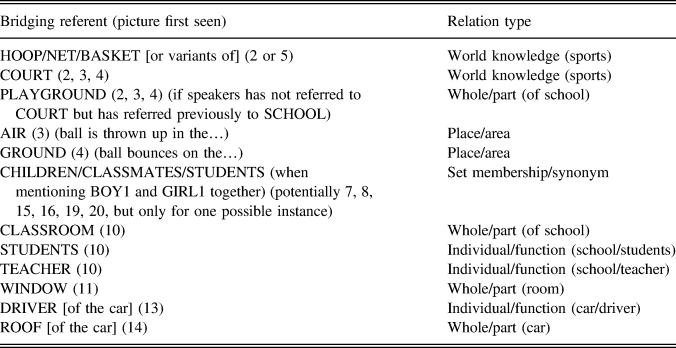
The target bridging referents are shown in Table 2, with the picture number of the sequence where the referent is first seen shown in parentheses.
Target bridging referents and relation type

Certain target bridging referents (CLASSROOM, PLAYGROUND) were only coded as such if the school was introduced explicitly beforehand, allowing the bridging relation to be drawn. The school was not explicitly mentioned in 3 out of the 23 article-less L1 narratives only, and in each of these three, the CLASSROOM was explicitly named as such, still allowing for bridging relations to TEACHER/STUDENTS to be made.
The three Mandarin-speaking researchers periodically checked each other’s scoring (L1 and L2) for accuracy, making amendments where required. Immediate self-corrections to references (e.g., “a teacher …, the teacher…”) were counted as valid (with the original reference disregarded), while new referent repetitions (“the teacher … the teacher”) were not counted. Occasionally participants selected a name or a description of a referent that did not link to the character’s role in the narrative (e.g., the use of “an old woman” to describe the teacher). In such cases no bridging reference occurs, and so such instances are not included in the analysis, yet these made up only a very small amount (< 5) of the total references to bridging referents in either the L1 or L2 data. For cases in which participants topicalized certain referents and therefore digressed from the presented picture order (e.g., a car [12] - > the driver [13] vs. a driver [13] - > the car [13, 12]), we treated either order as representative of bridging if a suitable bridging relation could still reasonably be derived.
RESULTS
L1 DATA
This section represents the findings of the L1-only narratives from L1 Mandarin, article-L1 and article-less L1 participants, to formulate potential hypotheses for the L2 study.
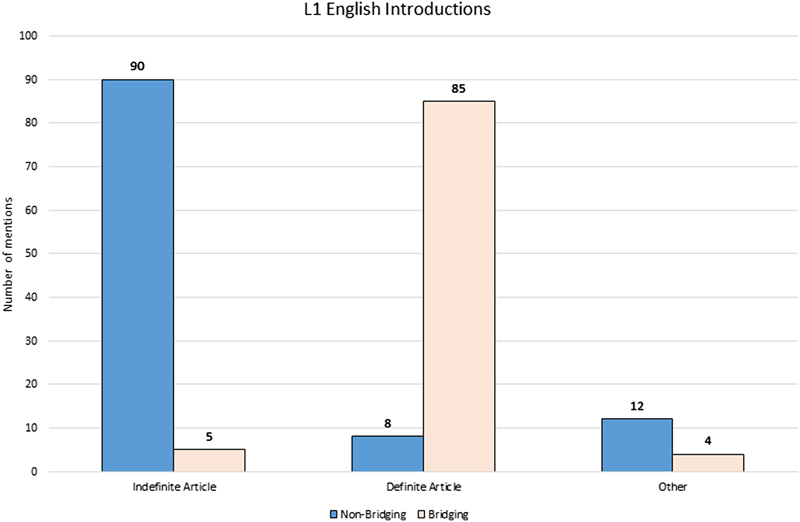
Figure 2 represents the introductions by the article-L1 (English) group by referent type. As with Crosthwaite (Reference Crosthwaite2014a, Reference Crosthwaite2014b), there is a marked preference for indefinite article NPs with new nonbridging referents, while bridging referents are typically introduced with definite article NPs (Examples 12 and 13).
(12, new, nonbridging) There’s a young guy standing in front of a school, holding a basketball.
(13, bridging) It smashes the top of a truck, and the guy, the driver, goes through the door and comes out on the roof.
Article-L1 introductions.

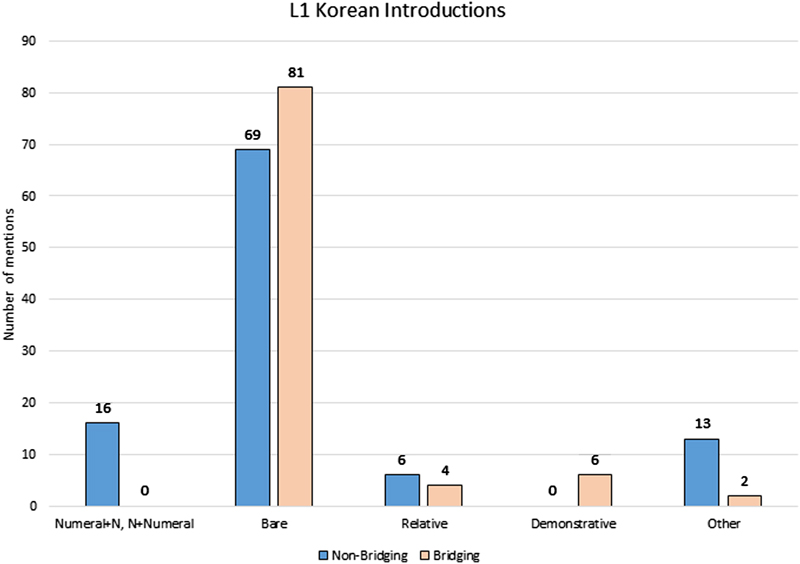
Figure 3 represents the introductions by the article-less L1 group (in this case, Korean, although very similar to the referential system of Japanese) by referent type. As with Crosthwaite (Reference Crosthwaite2014a, Reference Crosthwaite2014b), there is little distinction for inferability as reflected in NP selection, with bare nominals equally as likely to be used for specific indefinite and bridging referent types (Examples 14 and 15).
(14, new, nonbridging) 학교운동장에 학생이 농구공을 가지고 있습니다.
hakkyowuntongcangey haksayngi nongkwukongul kaciko isssupnita.
School playground-LOC student-NOM basketball-ACC has-POL-DEC
A boy has a basketball at school.
(15, bridging) 창문으로 공이 학교 교실로 들어가 버렸네.
changmwunulo kongi hakkyo kyosillo tuleka pelyessney
Window-through ball-NOM school classroom-into gone throw-PAST
The ball entered through a/the classroom window
선생님이 공을 밖으로 던졌습니다.
sensayngnimi kongul pakkulo tencyesssupnita.
Teacher-NOM ball-ACC outside-to throw-PAST-POL-DEC
The teacher threw the ball outside.
Article-less L1 introductions.

For the two animate main characters (BOY and GIRL), numeral + N, N + numeral NPs, or the use of quantifiers such as “another –다른” or “some –어떤” were occasionally used for introductions but not for other nonbridging types such as CAR or DOG or SOCCER BALL. An interesting finding of this data is that of the Koreans’ repeated mentions of the driver’s FOOT in kicking the ball, constituting a part/whole bridging relation. This was not part of the target list but was commented on by 8 of the 10 participants in the L1 Korean data only.
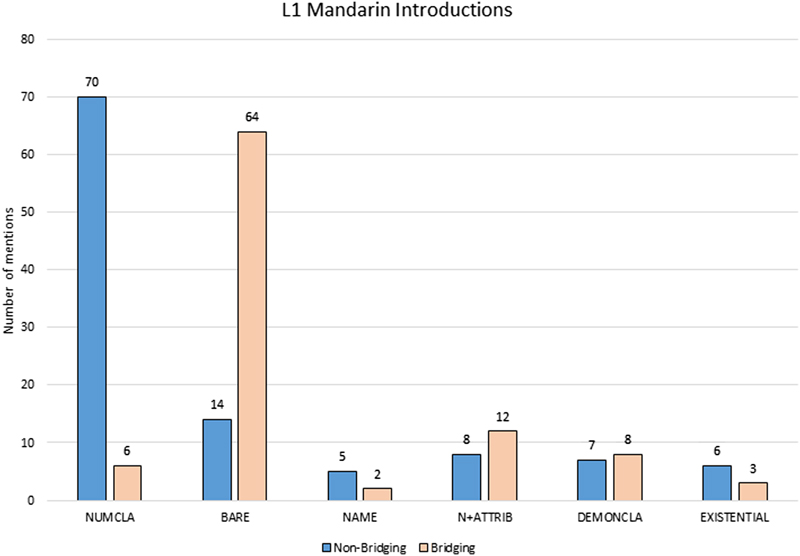
Figure 4 represents the introductions by the L1 Mandarin group by referent type.
L1 Mandarin introductions.

The findings largely follow those of previous research in that specific indefinite referents tend to receive numeral + classifier NPs while bridging referents tend to receive bare nominals (Examples 16 and 17).
(16, new, nonbridging) 有 一个 男生 很 喜欢 去 打 篮球
yǒu yī gè nánshēng hěn xǐhuān qù dǎ lánqiú
EXIST NUMCLASS schoolboy very like go play basketball
There was a schoolboy who liked to go and play basketball.
(17, bridging) 他们 俩 后来 就 回到 教室 里 一起 听 老师
tāmen liǎhòulái jiù huídào jiàoshì lǐ yīqǐ tīng lǎoshī
They both later then return classroom inside together hear teacher
They both later returned to the classroom to hear the teacher together.
Many of the numeral + classifier NPs used for new nonbridging reference are preceded by the existential marker “有—yǒu.”Footnote 6 We also note an equal use of demonstrative + classifier NPs for both bridging and new nonbridging referents, and a slightly higher use of noun + attributive marker NPs for bridging referents over new nonbridging referents (notably TEACHER and DRIVER), although the L1 Mandarin speakers also on occasion produced complex existential + numeral + classifier + noun + attributive marker NPs, for example:
(18) 小 狗 看 到了 远方 有 一个 崭新 的 足球
xiǎo gǒu kàn dàoliǎo yuǎnfāng yǒu yī gè zhǎnxīn de zúqiú
small dog see finally far away EXIST NUMCLASS brand-new ATT soccer ball.
Finally, the little dog saw in the distance there was a brand-new soccer ball.
Such mentions were coded as numeral + classifier NPs for scoring purposes, but represent a level of syntactic complexity that was not seen in the L2 data by either the article- or article-less learner groups.
In summary, each L1 appears to mark bridging and new nonbridging reference differently, with NP form in line with that of Crosthwaite (Reference Crosthwaite2014a, Reference Crosthwaite2014b), as summarized in Table 3.
L1 NP forms for bridging and nonbridging reference

These results lead to the following potential hypotheses for the L2 data. On the one hand, speakers of article-L1s such as English appear to make a distinction for inferability on the NP form, as do L1 Mandarin speakers. However, bridging introductions in L1 Mandarin are realized through bare nominals, while for speakers of article-L1s, the definite article is overwhelmingly used. As definite articles do not exist in Mandarin, and given that discourse-old low-accessibility reference is often marked by demonstrative + classifier NPs (Hedberg, Reference Hedberg, Fretheim and Gundel1996; Liu, Reference Liu, van Linden, Verstraete and Davidse2010), speakers of article-L1s may likely infelicitously overuse the Mandarin demonstrative + classifer NP form to mark bridging reference, treating it as a de facto English-like definite article as they would in their L1. On the other hand, speakers of L1 Korean (representing the majority of the article-less L1 speakers in the L2 data, although the Japanese system is largely identical) do not make a distinction for inferability on the NP form, and for bridging, use the same form as that of the L1 Mandarin speakers, namely the bare nominal. Given the high frequency of numeral + classifier introductions in L1 Mandarin, cues from the input should be sufficiently strong to encourage speakers of article-less L1s to adopt this NP form for nonbridging referents, yet given the low frequency of demonstrative + classifier NPs for bridging reference in L1 Mandarin, speakers of article-less L1s are, presumably, significantly less likely to use demonstrative + classifier NPs for bridging reference than speakers of article L1s.
L2 DATA
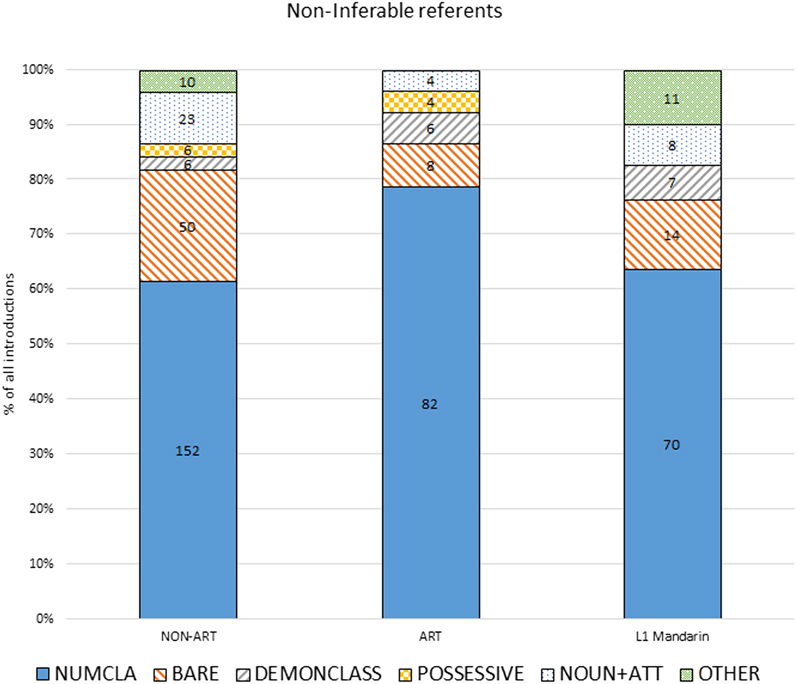
Figure 5 represents the introductions of nonbridging referent types by L2 Mandarin learners from both article and article-less L1 groups, with the data from the L1 Mandarin speakers shown for reference, and with raw values shown in the columns.
Introduction of nonbridging target referents by L2 Mandarin learners.

While speakers of both article- and article-less L1s are largely following the L2 target system by marking nonbridging referents with numeral + classifier NPs, the data does suggest a distinction between article-L1 and article-less L1 groups in the frequency of use of these NPs over the use of other forms. Namely, one might assume that those from article-L1 backgrounds are substituting the numeral + classifier construction into a de facto English indefinite article-like usage, while those from article-less L1 backgrounds are more likely to use a wider variety of NP forms. As the distribution of discourse-new reference for each NP form/target is binomial, binary logistic regression analysis was used to determine whether the status of the speakers’ L1 (article- or article-less language) is a significant predictor of the use of numeral + classifier introductions for nonbridging referents. The analysis suggests that the status of the speakers’ L1 (article- or article-less language) is a significant predictor of such introductions (χ2 = 10.36, df = 1, p < .001)—in fact, speakers from article L1 backgrounds were 2.3 times as likely to use this construction than speakers of article-less L1 backgrounds (β = .846, Wald = 9.56, p = .002, Exp(β) = 2.33).Footnote 7 For reference, when L1 Mandarin data is added to the model (χ2 = 10.71, df = 2, p = .005), there is no significant difference between the article-less group’s predicted use of numeral + classifier NPs and that of L1 Mandarin (β = -.090, Wald = .142, p = .706, Exp(β) = .914), while there is a significant difference between L1 Mandarin speakers’ and article-L1 L2 Mandarin learners’ use of this NP form for this function (β = -.756, Wald = 5.897, p = .015, Exp(β) = 2.13).
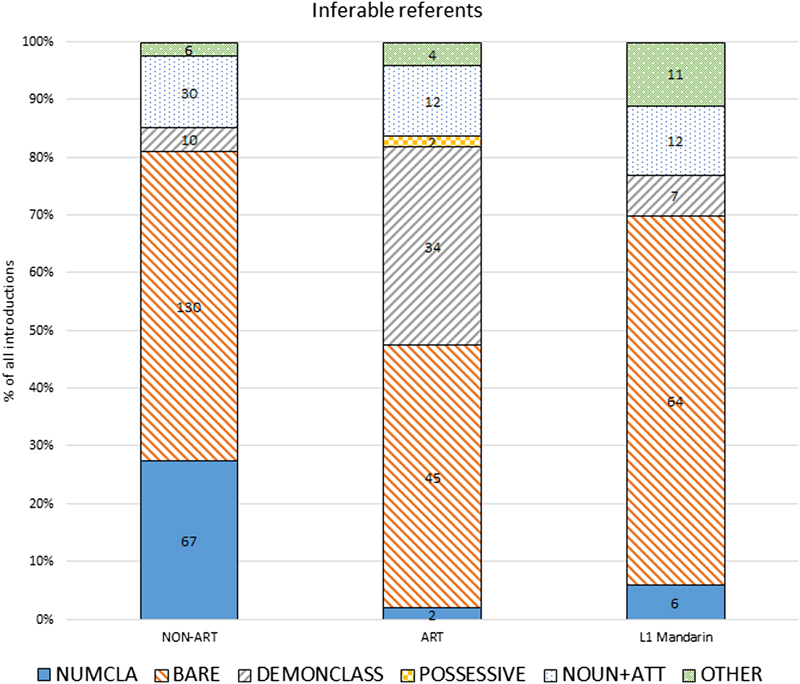
Figure 6 represents the distribution of introductions by the L2 learners for bridging referent types, with L1 Mandarin data shown for reference, and with raw values shown in the columns.
Introduction of bridging target referents by L2 Mandarin learners.

The data suggests a distinction between article-L1 and article-less L1 groups for the use of demonstrative + classifier NPs to introduce bridging referents, leading to the assumption that many of those from the article-L1 group may be substituting the demonstrative + classifier construction into a de facto English definite article-like usage as was hypothesized from the differences between the English and Mandarin L1 data. A logistic regression analysis was used to determine whether the status of the speakers’ L1 (article- or article-less language) is a significant predictor of the use of demonstrative + classifier introductions for bridging referents. The analysis suggests that whether the speaker came from an article/article-less L1 was a significant predictor of the use of this NP form to introduce bridging referents (χ2 = 51.71, df = 1, p < .001). In fact, speakers from the article-L1 group were as much as 12.1 times as likely to use this construction than speakers of article-less L1s (β = 2.50, Wald = 41.93, p < .001, Exp(β) = 12.188). For reference, when L1 Mandarin data is added to the model (χ2 = 54.65, df = 2, p < .001), there is no significant difference between the article-less group’s predicted use of demonstrative + classifier NPs and that of L1 Mandarin (β = -.562, Wald = 1.22, p = .269, Exp(β) = .570), while there is a significant difference between L1 Mandarin speakers’ and article-L1 L2 Mandarin learners’ use of this NP form for this function (β = 1.93, Wald = 18.94, p < .001, Exp(β) = 6.94).
However, we also note a significantly higher number of infelicitous numeral + classifier NPs for bridging reference from the article-less L1 group than the article-L1 group, suggesting that those from the article-less L1 group are tending to mark all new reference (bridging or nonbridging) using numeral + classifier NPs. This finding was confirmed by another logistic regression analysis (χ2 = 38.17, df = 1, p < .001) suggesting that those from article-less L1s were 18 times as likely to use this NP form when referring to bridging referents than those from article-L1s (β = 2.91, Wald = 16.01, p < .001, Exp(β) = 18.46). For reference, when L1 Mandarin data is added to the model (χ2 = 51.41, df = 2, p < .001), there is no significant difference between the article-L1 group’s predicted use of numeral + classifier NPs and that of L1 Mandarin (β = -1.13, Wald = 1.85, p = .173, Exp(β) = .323), while there is a significant difference between L1 Mandarin speakers’ and article-less L2 Mandarin learners’ use of this NP form for this function (β = 1.78, Wald = 16.11, p < .001, Exp(β) = 5.96).
DISCUSSION
The results as presented are, at the time of writing, the largest controlled evidence of the use of bridging relations in L2 Mandarin discourse by speakers of article- and article-less first languages, demonstrating the marking and selection of both lexical and inferential bridging relations that native and foreign language users of Mandarin produce during narrative production. For RQ1 (how L2 Mandarin learners manage bridging), it appears speakers of both article and article-less L1s are sensitive to the syntax-pragmatic distinction in Mandarin between bridging and nonbridging reference, clearly marking both referent types differently in the target language. While this finding was hypothesized for speakers of article-L1s under Crosthwaite (2014b) as both English and Mandarin mark for inferability on the NP, the similar findings for the article-less L1 group suggest that it is also a relatively straightforward matter for speakers of article-less L1s to adopt the bridging marking norms of the L2 target. If we follow Ellis’s (2006a, 2006b) approach to the discussion of L2 acquisition, while bridging is a relatively infrequent phenomena compared to that of indefinite discourse-new or definite discourse-old reference, it may be the case that the syntax-pragmatic distinction between bridging and nonbridging reference in Mandarin is particularly salient (definite, specific usages of the bare nominal nonwithstanding), although it is “hard to agree on an operationalization of salience in syntax” (Dekeyser, Reference Dekeyser2005, p. 15). Certainly, there is a clear distinction in L1 Mandarin data between numeral + classifier NPs used for discourse new, noninferable reference, and with bare forms used for discourse new, inferable reference, leaving a sufficiently “transparent” (ibid., p. 3) form/function relationship for the L2 learner to acquire. However, we feel that given the difficulties encountered by L1 Korean speakers when acquiring bridging in L2 English (where, again, a clear distinction exists between indefinite and definite articles for nonbridging/bridging discourse-new reference), we are uncertain whether this distinction is the key to the relative ease of acquisition found in this study, especially considering that bare NPs are commonly used in discourse-old reference in Mandarin, as definite article NPs are in English.
It could also be the case that it is comparatively easier to acquire bridging in L2 Mandarin than L2 English, for example, given that Mandarin uses an unmarked form for bridging and the marked form (numeral + classifier NP) for nonbridging indefinite reference. This may be the case for both L1 speakers of English and Korean/Japanese in that these languages mark bridging through either a complex article system (English) or have complex agglutinative inflectional referential systems generally (Korean/Japanese), making the L2 Mandarin form/function mapping appear relatively simplistic given that “the more that needs to be expressed overtly, the more choices need to be made” (ibid., p. 6). Here, we can perhaps discount the potential claim that the L2 production of the bare nominal found in this study is in fact a developmental feature of the L2 varieties tested here, given that a more complex NP form is used for nonbridging indefinite reference (numeral + classifier NP) in L2 Mandarin, and which appears frequently and appropriately in the L2 data. If the bare nominal was taken to be a developmental feature of the L2 production, one might then reasonably assume that bare nominals would also be used in place of numeral + classifier NPs, but this does not appear to be the case from the L2 data in the present study. Rather, the L1 distinction between bridging = bare nominal and nonbridging introductions = numeral + classifier NP appears to be evidenced in the L2 production, at even this relatively early L2 proficiency level.
However, it appears crosslinguistic interference may be responsible for the differences noted in the results for RQ2 (effect of article vs. article-less L1). Here, the findings of the study suggest significant effects of L1 background on the L2 Mandarin introduction of nonbridging and bridging relation reference. Specifically, L2 Mandarin learners from article-L1s appear to use the Mandarin numeral + classifier + noun construction as a de facto English-like indefinite article for nonbridging reference, and demonstrative + classifier + noun constructions as a de facto English-like definite article for bridging reference—reflecting their L1-like preference to explicitly mark bridging and nonbridging relations on the NP. In addition, L2 learners from article-less L1 backgrounds might well use a wider variety of forms in line with the L2 target, but also on occasion (just under 25% of the time) infelicitously use numeral + classifier NPs for bridging relation referents, suggesting neither an L1-like nor L2-target approach, but one in which numeral + classifier NPs are used to mark all types of discourse newness, whether bridging or nonbridging. Again, such evidence suggests that the L1 syntax-pragmatic configuration of marking bridging reference (alongside the well-established concerns regarding the crosslinguistic marking of [in]definiteness in general) causes considerable interference for our experimental groups during L2 acquisition. These findings are in line with the claims of Ellis (Reference Ellis2006a, Reference Ellis2006b) in that those from article-L1s are (relatively) unable to prevent their L1 affecting how they perceive the cues of the syntax-pragmatic system of the L2, or that those from article-less L1s lack the ability to perceive the cues of the L2 target system, eventually resulting in the optionality seen in their L2 data.
A limitation of the study lies in the small sample size when comparing the number of participants from article-L1s to those from article-less L1s. Unfortunately, this limitation is tied to our learning context, in that there are very few L2 speakers of Mandarin from article-L1s attending noncredit Mandarin courses in Hong Kong, and even fewer that would be of a higher proficiency than the learner group sampled in the present study. The Mandarin portion of the research team felt that the gap between the Level 4 learners sampled in this study and those in lower levels was also considerable and that students at lower levels would not be able to complete the narrative, knowing only a few basic “survival” phrases and having very limited vocabulary. Such learners would be unlikely to create the conditions for a full range of bridging relations to be explored. While our statistical models passed goodness-of-fit tests even with our small sample, future research needs to consider (a) whether and (b) when L2 Mandarin learners from article-L1s are able to overcome the effects of L1 transfer and produce the appropriate L2 target markings associated with bridging reference, if a good-sized sample of learners at higher L2 proficiencies can be sourced. Mai (2015, p. 137) also suggests that current studies “rarely go beyond late L2 Chinese learners who come to the classroom without prior exposure to Chinese and acquire the language through formal L2 instruction,” and we are equally guilty in this regard. We are also aware that only one elicitation device was used, and that eye-tracking data or a self-paced reading task would help to triangulate the claims made from the narrative production data. We do not have access to eye-tracking hardware in our context, and as the proficiency of the students and focus of the L2 Mandarin course is on spoken language, our students are unable to read much (if any) Chinese script. Conversion to Romanized Pinyin is unlikely to be representative of how L1 Mandarin speakers perceive the referential system of their native language. Another potential limitation is that our participants could have some underlying knowledge of Cantonese from living in Hong Kong, although they did express otherwise. However, we feel that this is unlikely to have affected the results as (a) the spoken form of Mandarin and Cantonese are not mutually intelligible, (b) it is unlikely that these learners would have much knowledge of the written form by this proficiency level, and (c) the lingua franca for the L2 participants in Hong Kong is that of English rather than Cantonese. Analysis of the discourse-old reference used across L1/L2 groupings would also contribute to our claims regarding crosslinguistic influence and cue contingency, although as the focus of this article is on discourse-new reference and due to space considerations, we accept that such an analysis should be performed in a follow-up article. It would also be of interest to look at differences between L1/L2 pairs in terms of the marking of bridging relations by type, but the small sample size for particular relation types from our picture sequence rendered this analysis unsuitable. A corpus study of L2 Mandarin production would help to offset this concern, allowing for a greater frequency of all bridging relation types to be found in the data.
CONCLUSION
The present study has explored how speakers of article- and article-less L1s manage the production of discourse-new reference in bridging and nonbridging contexts. These findings have a number of implications for the SLA field. Firstly, it is apparent that more attention needs to be paid to studies of both Asian and non-Asian learners learning Asian languages if we are to document in more detail the specific phenomena that cause difficulties for L2 learners and how to overcome them as the importance of Asian languages spreads globally. Secondly, we have provided further evidence of L2 learnability issues related to crosslinguistic influence and acquiring language at the syntax-pragmatic interface. The L2 learners in our study were generally successful at producing target-like reference between bridging and nonbridging reference, and fared relatively better in the production of target-like bridging reference than L2 English learners from article-less backgrounds as reported in previous studies. However, we have clearly identified both predictable crosslinguistic effects as well as L2-specific difficulties encountered by L2 learners of Mandarin, and that are unique to the study of Mandarin as a second language. The findings again suggest (as with previous research) that Mandarin may be a special case among so-called article-less languages in terms of the encoding of definiteness generally and bridging relations in particular, and that learners of L2 Mandarin need to be made more fully aware of the syntax-pragmatic differences between their L1 and L2 target.
APPENDIX A
PICTURE SEQUENCE MATERIALS