‘Any person that shall inspect the minutes of our assembly and peruse only the titles of those acts which they annually frame, alter or amend will be convinced that our claim of legislation…is grounded in reason, just policy and the necessity of the case’, concluded the Jamaican planter Edward Long in his history of the island in 1774. He added that ‘the greater part of them are merely local or provincial, some calculated for only temporary ends, others to take effect as probationary, and to be rescinded again or gradually enlarged and amended, according as experience may determine their good or evil operation’.Footnote 1 Thirty years later, his successor Bryan Edward similarly noted that, ‘the English laws being silent, the colonial legislature has made and continues to make such provision therein as the exigencies of the colony are supposed to require’, not least the system of slavery and plantation agriculture, ‘[and] where the principle of the English law has been adopted, it has been found necessary to alter and modify its provisions so as to adapt them to circumstances and situation’.Footnote 2 Both Long and Edwards therefore assumed the operation of an active colonial legislature which would deal not just in matters of high constitutional principle but also the more mundane political and legislative business needed to make society – and the system of slavery – function effectively.
These assumptions reflected the development of legislative bodies in the British Isles and North America in the eighteenth century. Beyond their celebrated constitutional triumphs in seizing power at different points from a reluctant executive, there was a parallel legislative revolution that transformed these legislatures into instruments of public policy. Quantitative studies of British and Irish law-making up to 1800 have demonstrated that there was a vast upsurge in legislative output during this period, much of it intended to reshape the societies and economies that lay within – and, in the case of the Westminster parliament, beyond – their borders. Such studies say less about the wider effectiveness of legislation itself at solving these issues, a question that can only be resolved by detailed study, but they have been particularly useful in revealing how political institutions and communities changed in this period and the political culture and ambitions of the groups who used them. Less systematic studies have shown that the colonial houses of assembly of North America similarly expanded in scope and scale in the decades before the American Revolution, a process that might have laid the inevitable foundations for the break with Britain. How far was this true though in the West Indies, which possessed an equally vibrant political and legislative culture by the mid-eighteenth century, but followed a different path of development after the great imperial disjuncture of the American Revolution in 1783?
To answer these questions, this article offers a quantitative survey of legislation in Jamaica, the largest and richest island in the British West Indies, between the first assembly in 1664 and the end of unfree labour in 1838. It concludes that the volume of legislation increased massively in this period and in line with similar developments in Britain, Ireland, and colonial North America before 1776, reflecting a common process of development. It was, moreover, a collaborative process. While studies of Jamaica, the West Indies, and North America generally place the most stress on the violent confrontations between colonial and imperial power, this was the exception rather than the rule. Most legislation was passed with relatively little opposition, and in Jamaica the gradual withdrawal of governors from active political involvement between the 1780s and 1820s contributed to an upsurge in legislative output as elites throughout the island seized the opportunity to use legislation to try to refashion their own politics, society, and economy. The British and Irish legislative revolutions of the long eighteenth century were therefore in fact transatlantic phenomena that were echoed directly in Jamaica.
I
‘It has been a commonly-received opinion’, Long admitted, ‘that the people of this island are fond of opposition to their governors, [and] that they are ever discontented and factious.’ He laboured to prove otherwise but this view was broadly accepted by contemporaries, and by historians Agnes Whitson and George Metcalf in their studies of island politics up to 1783, as well as broader surveys of the West Indies by Lowell Ragatz and others.Footnote 3 Studies from the imperial perspective by Helen Taft Manning and others tended to endorse this picture, perhaps reflecting an imperial focus that tended to see colonial groups as obstacles to its unity and cohesion.Footnote 4 ‘Perhaps nothing is more extraordinary in English institutional history than the part played by these little bodies’, noted Manning, for example, ‘[as] the British constitutional tradition sustained them in a sense of their own importance and allowed them to make good their pretensions in the eyes of the highest legal authorities in Great Britain.’Footnote 5 More recent work by Jack Greene and others has offered a valuable corrective by stressing the ideological sophistication of elites in Jamaica and the West Indies, including the political languages of liberty and property that they shared with their counterparts in North America.Footnote 6 Politics in the West Indies had reached much the same state of maturity as in North America, and their divergent development after 1783 therefore did not reflect any real prior or underlying political and constitutional differences.
By focusing though on moments of confrontation, this literature has reinforced the traditional picture of a truculent and fractious island elite more concerned with its own privileges than with good government. It still seems unclear how such a patently dysfunctional political elite could have built and maintained a system of plantation slavery that survived until it was dismantled by imperial pressure in the 1830s. This has been answered by looking at these societies from the bottom up. Beginning in the 1960s, Elsa Goveia and others have highlighted how assemblies created legal codes to structure slavery and slave-holding across the West Indies and meet its economic and social challenges.Footnote 7 Edward Kamau Brathwaite's argument that Jamaica developed a stable, syncretic ‘creole’ society between 1770 and 1820 has focused the attention of Christer Petley, Trevor Burnard, and others on the mundane social transactions that held this society together.Footnote 8 Most recently, Diana Paton has demonstrated how parish vestries, the assembly, and governors worked together from the 1770s to create a complex system of gaols that enforced this code. ‘State decisions were not simply worked out in conflict between local and imperial elites’, she concludes, ‘[but] in ways that were significantly influenced by local contestation and negotiations.’Footnote 9 Law and law-making therefore helped to underpin the system of slavery, and required a competent and relatively efficient legislature able to keep pace with the growing demands upon it. A quantitative study of the house of assembly in Jamaica demonstrates that it largely met these expectations.
The assembly therefore expanded its power and role at a moment when representative institutions throughout the British Atlantic were likewise growing in size and stature, above all in Britain itself. Nearly 19,000 bills were introduced into the parliament at Westminster between 1660 and 1800, at least half of them after 1760, and more than two-thirds of these bills became law.Footnote 10 ‘This dramatic rise in legislative output was a most remarkable development’, notes Julian Hoppit, ‘and one of significance for historians of all shades’, since it both reflected and stimulated many of the major political, economic, and social changes of this period.Footnote 11 Joanna Innes and many others have fleshed out these conclusions by showing how various groups in Britain began to use the new power of parliamentary statute for their own ends, such as to effect the reform of the poor law or the criminal code.Footnote 12 The geographical ambitions of this legislation also increased, as the parliament legislated for Scotland and Ireland and also asserted the right to pass laws for its imperial territories, with decidedly mixed results. At least 191 imperial acts relating to imperial trade alone were passed between 1660 and 1800, for instance, most of them after 1760, and this pattern did not change much until reforms in the 1860s began to devolve the initiative to the colonial assemblies.Footnote 13 These bills may have comprised only 2 per cent of all legislation in parliament between 1801 and 1840, but it nevertheless amounted to an unprecedented expansion of the geographical scope of legislative power.Footnote 14
David Hayton and James Kelly have demonstrated that the Irish parliament, part of both a colonial state and ancien régime, experienced a similarly revolutionary change between 1692 and its abolition in 1801. At least 3,450 bills were introduced during this period and about 2,300 became law, at least half of them between 1771 and 1801.Footnote 15 This was all the more remarkable because the parliament was constrained until 1782 by the legal restrictions of Poynings’ Law, which allowed the Irish and British privy councils to amend or block legislation and could only be evaded by a legal loophole where the houses of the Irish parliament debated the ‘heads of bills’.Footnote 16 Westminster occasionally legislated for Ireland or introduced bills through the Irish privy council, but most of the bills introduced before 1801 were domestic in origin and were likewise used to effect a legislative revolution. Beyond the creation of a large fiscal-military state and a corpus of discriminatory legislation known as the ‘penal laws’, Ireland saw a very similar process of legislation expansion as interest groups used the power of the parliament at Dublin to effect political, social, and economic change.Footnote 17 ‘The impression conveyed, as early as the 1730s’, Hayton notes, ‘[is] one of an institution whose members believed it had already come of age.’Footnote 18
Quantification and categorization of legislation in Britain and Ireland has therefore captured an important process of political development, and although the quantity of legislation is no guide to its quality, the sheer fact that so much was produced has been used to draw important conclusions about the nature of these societies. It can also be extended to the British colonies of North America and the West Indies, which almost always had active – many imperial officials thought over-active – houses of assembly. They have usually been examined though, even by Jack Greene and others, as political and constitutional institutions rather than legislative ones. ‘Understandable and useful as this approach is’, noted Alison Olson in 1991 in her survey of this topic, ‘it has obscured other questions’, and she argued that by taking over a wide range of banal legislative duties that could not be addressed at either an imperial or local level the assemblies made it possible for colonists to contemplate independence.Footnote 19 One part of the ‘transatlantic constitution’ recently described by Sarah Mary Bilder and Daniel Hulsebosch was therefore the system of imperial courts that reviewed colonial legislation and judicial rulings, but among the other crucial parts were the legislative structures that passed these laws in the first place.Footnote 20 These assemblies have been studied both systematically and comparatively, but their legislative outputs have not, and very few have included the British West Indies, despite a comparable legislative inheritance that also continued to develop within this transatlantic framework long after 1783.Footnote 21 The next three sections show that the assembly of Jamaica developed along very similar lines to its counterparts in Britain, Ireland, and North America and that it saw an increased volume of legislation in this period; that this was driven partly by improved administration and by the changing political situation; and that it also reflected growing demand for legislation within Jamaican society. The island was therefore no political outlier but an integral part of the transatlantic constitution and the wider legislative revolution that swept up the legislatures of the British Atlantic world across the long eighteenth century.
II
Jamaica was Britain's largest and richest possession in the West Indies, its population rising from several thousand at the time of its first assembly in 1664 to about 400,000 in 1800. Like the other islands of the West Indies, its wealth was built on sugar, and 90 per cent of the population were therefore black slaves imported from West Africa to labour under brutal conditions on behalf of the small white elite, which did not exceed about 30,000 in 1800. The need to control this large, hostile, and alien population shaped the ‘creole’ society of the island, but this white elite also laboured to reproduce the political and legal structures of ancien régime they had left behind in England. Among the first institutions created after the conquest in 1655 was therefore an assembly, which grew to about forty members in the eighteenth century who were elected by richer planters, merchants, and professionals in the fifteen to twenty parishes of the island.Footnote 22 Strict racial and economic requirements made for very small electorates. About 1,572 votes were cast in elections in 1816, for example, representing perhaps about 6 per cent of the white population and less than half a per cent of the total population, which was narrower than all but the most rotten boroughs in Britain.Footnote 23 Surrounding the assembly was a growing public sphere that could allow the disenfranchised to exercise influence on politics through petitions and other outdoor politics, such as in 1748, when a false petition was used to undermine a bill on slavery before the house.Footnote 24 It therefore provided suitable raw material for the expansion of its legislative output, particularly from the 1750s onwards.
Not just the political machinery of Jamaica but also its operation was deliberately modelled on English practice. When the house of assembly was first convened in January 1664, it immediately insisted that it had the same powers and privileges as its counterpart in Westminster, with the island's council acting as the upper chamber and revising bills and the governor then accepting or rejecting them on behalf of the crown.Footnote 25 Bills could therefore be introduced by any member or on the order of the house and its committees, and frequently on the basis of petitions placed before the house by groups in the island.Footnote 26 The bill then passed through its first, second, and third readings, often with a committee stage after the second reading to allow it to be debated and revised. Opponents consequently had multiple chances to wreck the bill, such as by calling divisions, adding wrecking amendments or counter-petitions, or even simply deferring discussion until the assembly was prorogued or dissolved. The council in turn might reject the bill, or amend it and send it back to the assembly, who then faced the dilemma of accepting the amendments or rejecting them and possibly losing the bill entirely. It was then passed to the governor of the island, who might sometimes withhold his consent, either on his own initiative or upon instructions from home.
As in Ireland though, this was only the first stage in the process, since the crown and parliament in Britain insisted they had the right to approve or disallow acts passed by colonial assemblies. Efforts to impose a version of Poynings' Law on Jamaica were abandoned in 1681, and the assembly usually refused to incorporate suspending clauses into bills that would defer the operation of the act until they were approved in London, but some degree of oversight remained.Footnote 27 At the end of a session, the acts were sent to the secretary of state for the southern department – or, after 1795, for the colonies – and were then passed to the Board of Trade to be reviewed.Footnote 28 The privy council was then duly advised by them whether to confirm or disallow the acts, or simply let them ‘lie by’ without any further action. The process therefore lacked the very close level of imperial control exercised in Ireland under Poynings' Law before 1783, where the Irish and British privy councils could both amend and disallow bills, but it still had several points where parties in the assembly or council in the island, or the governor, or the Board of Trade, Colonial Office, privy council and parliament, or other parties, could block colonial legislation. For example, the ‘West India lobby’ of merchants, absentee planters, and slave traders in London sometimes helped to shepherd statutes through the privy council and Board of Trade, but also blocked several efforts by the assembly to tax slave imports or absentees.Footnote 29 Counting the number of acts and bills that came before the assembly shows that the island nevertheless saw a very high level of legislative activity for its size and population.
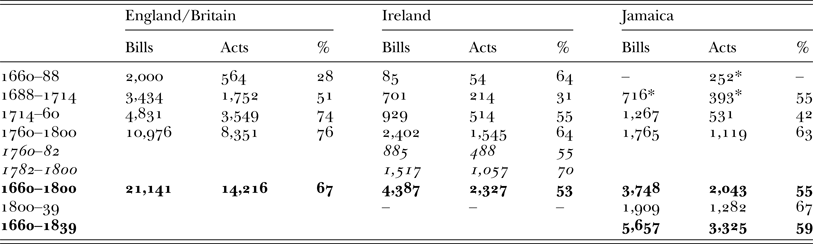
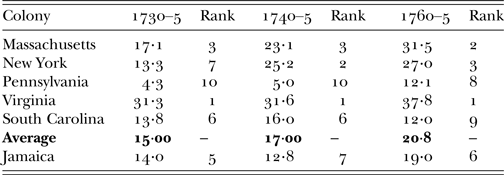
There were at least 5,700 legislative initiatives in the assembly between its first session in January 1664 and the session in December 1838 (Figure 1 and Table 1), held only a few months after enslaved labour was finally abolished. The real total was probably higher but gaps in the assembly journals between 1664 and 1709 make it impossible to calculate an exact figure. These initiatives ranged from successful acts to failed bills that were ‘ordered’ or formally proposed but never even made it to their first reading. There were also numerous petitions not included here that were intended to elicit some sort of action, such as legislation or the grant of money. Out of these bills, more than 3,300 or about 60 per cent became law. As in Britain and Ireland, the total number of legislative initiatives also rose sharply, and not in line with the growth in population. Long calculated that Jamaica had some 20,000 people in the 1660s, which had reached about 80,000 by 1714, about 160,00 by 1760, and peaked in the 1800s at roughly 400,000 whites, slaves, and free persons of colour.Footnote 30 Yet the number of acts tripled from five or so per year in 1714 to fifteen or twenty between the 1730s and 1760s, a level that was broadly in line with the figures that Olson calculated for colonies in North America such as Massachusetts, New York, Pennsylvania, Virginia, and South Carolina (Table 2).Footnote 31 By 1800, the assembly was passing between thirty or forty acts per year and it remained at this level in the 1830s even though the population began to decline. The growth of legislation in the island was therefore not simply a product of demographic expansion but, as the next two sections will show, instead reflected an increasing demand for legislation and the developing capacity of the assembly at both an administrative and political level to meet or accommodate this demand.
Total bills and total acts in Jamaica, 1664–1839 (10 year moving average) Sources: see Table 1.

Numbers of bills and acts in Britain, Ireland and Jamaica, 1660–1839

* Incomplete data.
Sources: Jamaica: Journals of the House of Assembly of Jamaica for 1664 to 1826 (14 vols., Kingston, Jamaica, 1808–26); and the Votes of the House of Assembly of Jamaica for 1827 to 1838 (11 vols., Kingston, Jamaica, 1827–38), in The National Archives, CO140/115-29; England/Britain: based on Julian Hoppit and Joanna Innes, Failed legislation, 1660–1800 (London, 1997); and Julian Hoppit, ‘Patterns of parliamentary legislation, 1660–1800’, Historical Journal, 39 (1996). Ireland: based on David Hayton, ‘Introduction: the long apprenticeship’, Parliamentary History, 20 (2001), p. 9; James Kelly, Poynings' Law and the making of law in Ireland, 1660–1800 (Dublin, 2007), pp. 160–4, 242–4, 310–12, 355–7; and Coleman Denny, ‘An administrative and legal history of the Irish parliament, 1613–1689’ (Ph.D. thesis, University College Dublin, 2011), pp. 87–8, 162.
Numbers of acts in selected colonial legislatures, 1730–65

Source: based on Olson, ‘Colonial legislatures’, p. 563.
III
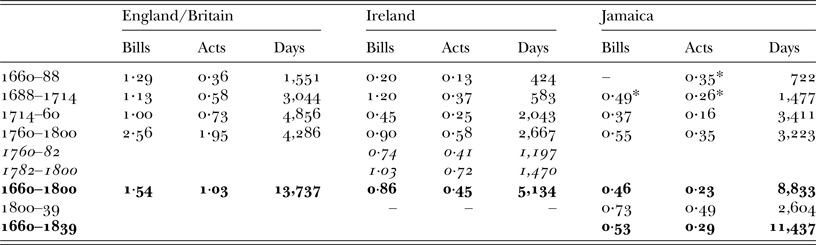
Both Hoppit and Hayton argue that parliaments became more prominent instruments of public policy in Britain and Ireland after 1688 in part because they became more effective at supplying legislative solutions to political, social, and economic issues. The effectiveness of legislation at solving these problems may be a separate question but quantitative studies of both legislatures demonstrate that the number of bills and acts debated and passed increased across the eighteenth century, both in absolute terms and relative to the number of days they were in session. At Westminster, the number of bills doubled from 1·2 to 2·6 per day of session between 1660 and 1800, and the number of acts quadrupled from 0·5 to 2·0 per day, demonstrating a large rise in business and an even greater rise in the efficiency with which it was conducted (Table 3).Footnote 32 In Dublin, the number of bills doubled from 0·5 to 1·0 per day between 1714 and 1800, and the number of acts nearly tripled from 0·3 to 0·7 per day, indicating a slower but still significant rise in its overall efficiency at making law. Hayton argues that it was by 1801 ‘a relatively efficient and productive legislative machine’.Footnote 33 The chance of a bill failing to pass into law also fell threefold in Britain and Ireland, and by 1800 around three-quarters of all legislative initiatives in both parliaments were successful, though Ireland only reached this point some twenty years after Britain.Footnote 34
Numbers of bills and acts per day of sessions in Britain, Ireland, and Jamaica, 1660–1839

* Incomplete data.
Sources: see Table 1.
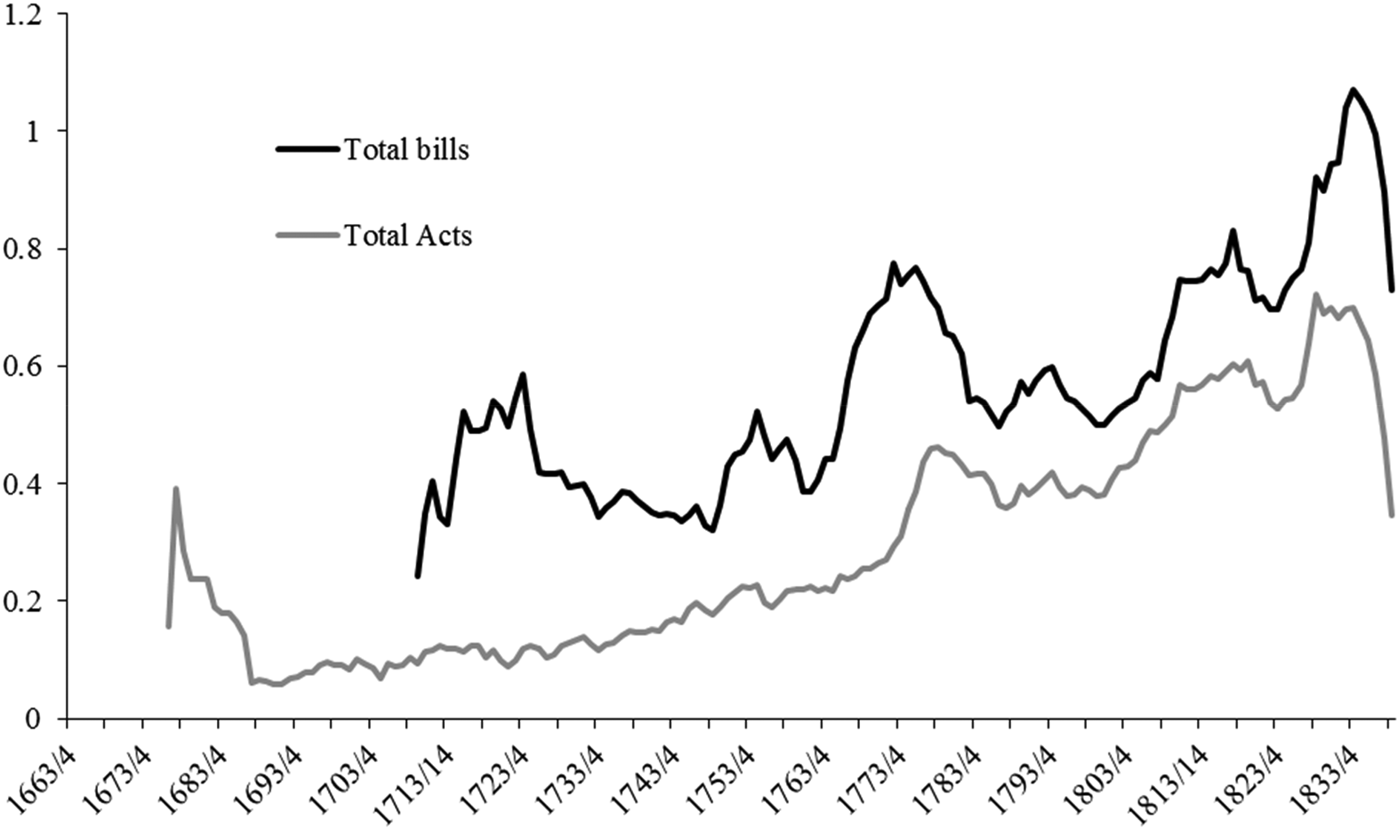
The legislative efficiency of the far smaller house of assembly in Jamaica remained below that of Westminster and Dublin, which no doubt helped to fuel some of the condescension of imperial commentators. Its forty or so members sat for twice as many days as the Irish parliament before 1800, nearly 9,000 in total, but only passed half as many bills, though the overall rates of efficiency did increase throughout the century as the sessions grew shorter and more regular and as output expanded. By the early eighteenth century, the assembly had largely ceased to be an event and had instead become an institution, holding at least one session every year after 1718. Between 1714 and 1760, it still only debated about 0·4 bills per day and passed less than half of these, and these rates only slowly increased before 1800. By the early nineteenth century though, the house was debating 0·7 bills per day and passing 0·5 acts per day, levels that were broadly comparable with the parliament in Dublin in the twenty or so years before 1800, and this total could rise even higher in exceptional years such as 1828, when the house managed to introduce about sixty bills in just under forty days. Rates of success also rose to match levels in Britain and Ireland, hitting around 70 per cent after 1800 and even 80 per cent during the 1820s but then falling to 50 per cent during the 1830s due to the political clashes noted in more detail below (Figure 2).Footnote 35
Total acts and total bills per day of session in Jamaica, 1664–1839 (10 year moving average) Sources: see Table 1.

As in Britain and Ireland, one element underlying this change was probably the accumulation of legislative experience and administrative refinements that helped to smooth the passage of bills through the assembly. ‘Parliament only gradually came to terms with its newfound potential to conduct a heightened volume of legislation’, notes Hoppit, ‘[and] perhaps it took time to learn how to timetable bills, to order select committees or to ensure that only high-quality proposals were considered.’Footnote 36 Standing orders evolved to help regulate proposals, a corps of professional draftsmen and lawyers helped to steer bills through parliament, and Hoppit and Innes argue that legislative initiatives also shifted away from contentious general measures towards specific local legislation that was less likely to generate opposition.Footnote 37 In Jamaica, there were fewer standing orders, probably because the assembly was small enough that most business could be carried on informally, but several procedures gradually became formalized such as an order in 1769 ‘that no bill of a private nature shall take rise in the house but by petition from the party desiring such a bill, and after a report from a committee appointed to enquire into the allegations of such a petition’.Footnote 38 As in North America, it also became common to print the statutes, at first singly and then in bulk, and from 1749 the daily minutes or ‘votes’ were also printed and put into circulation, which would all have helped to familiarize groups in the island with the forms and procedures of legislation.Footnote 39 Even in 1827 though, most new bills were still generally being drafted by the parties introducing them and only occasionally by ‘a professional friend…[or] the Clerk of the House,…[or] the professional assistance of counsel’, suggesting that the formalization of legislation lagged behind Britain.Footnote 40
However, the slow accumulation of experience and procedure cannot account for the ups and downs of legislative output in Britain, Ireland, or Jamaica across this period, which instead owed a great deal to changing patterns of politics. In Britain, the conflict between king and parliament before 1688 and between Whigs and Tories before 1714 made parliamentary sessions irregular and unpredictable, and contributed to a low rate of success that discouraged the introduction of legislation.Footnote 41 Only once the political situation had reached a degree of superficial stability after 1714 under the Whig Ascendancy were conditions more suitable for the expansion of parliamentary business. In Ireland, the final victory of the Whigs in 1714 likewise brought an unprecedented level of stability to Irish politics, which were now managed on behalf of the British ministry by local ‘undertakers’ such as William Connolly and Alan Brodrick.Footnote 42 Rates of success for legislation rose from 50 per cent to 70 per cent by the mid-eighteenth century but then went into reverse as politics were disrupted by the collapse of the undertaker system in the 1750s, direct rule by the lords lieutenant, and the growth of a Patriot opposition.Footnote 43 Hayton concludes that where the efficiency and output of the Irish parliament fell, it generally reflected ‘the relatively disturbed state of Irish politics… [in] periods marked by managerial instability and popular “patriotic” campaigns, as compared with those sessions when a calmer atmosphere prevailed, under settled management’.Footnote 44 When the British ministry allowed the Irish parliament almost complete legislative autonomy between 1783 and 1801, refraining from all but the most necessary interventions, the number of bills introduced into the parliament at Dublin and their rate of success increased almost exponentially. The restraints on the crown and its ministers secured in England in 1688 and Ireland in 1783, gained largely by political means, therefore helped to increase the capacity for legislation by reducing disruption and offering more reliable and predictable sessions.
The volatile output of the house of assembly in Jamaica was likewise a product of colonial politics. Legislative initiatives and their chances of success increased gradually but suffered several major setbacks when the assembly clashed with the governor and council and disrupted the legislative process. Extended conflict with successive governors between 1714 and 1728 over privileges and policy meant that nearly two-thirds of bills failed, for example, but the successful resolution of this issue, the need to present a united front during the First Maroon War in the 1730s, and the extended tenure of the emollient Edward Trelawney between 1738 and 1752, reduced this by a third.Footnote 45 Trelawney was even able to broker a compact between the two main factions in the assembly and form the Jamaica Association, ‘a coherent political grouping that would facilitate cooperation not only between the islanders themselves but between himself and the assembly’, and in this highly congenial environment the efficiency of law-making doubled.Footnote 46 When this goodwill was squandered by his successor Charles Knowles in the 1750s, who instead allied the merchants of Kingston to break up the Jamaica Association and impose imperial policy on the planters of Spanish Town, their repeated clashes in the assembly produced a sudden spike in failed bills.Footnote 47 The efficiency of the legislative process was only restored in 1760 under the more conciliatory policies of Henry Moore, a native of the island who brokered a rapprochement with the planters.Footnote 48 Failure rates spiked once again in the 1760s when the assembly clashed with William Lyttelton over its privileges and only fell after 1776, when the existential crisis faced by the island during the American Revolution War and the successful French campaigns in the West Indies forced the assembly and governors reluctantly to co-operate.Footnote 49
The experience of the American Revolution required the imperial government to reappraise its approach to colonial assemblies after 1783, to cease to attempt to make general policy through them, and in general – as in Ireland – to leave them with a relatively free hand in legislation. A. J. Murray concluded that between 1783 and 1815 ‘Jamaica's legislative freedom…reached its zenith.’Footnote 50 A series of relatively conciliatory governors between 1791 and 1827 restricted their interventions mainly to key imperial priorities such as the enforcement of the navigation laws, the defence of the island, and, somewhat reluctantly, the protection of slaves and the abolition of the slave trade.Footnote 51 Rates of success and legislative output rose largely in step as interest groups eagerly took advantage of more reliable sessions to bring forward their bills, interrupted only by brief moments of conflict. For example, although the end of the slave trade had little impact on the legislation of the island in December 1808, the duke of Manchester dissolved the assembly after it insisted that he send away from the island the detested garrison of black troops, who were regarded as a standing affront by paranoid local elites and had briefly risen in mutiny the year before.Footnote 52 Two-thirds of the bills were lost and had to be laid before the assembly again at its next session, which Manchester then dissolved prematurely in December 1809 after a further clash over a bill banning nonconformist missionaries from preaching to slaves.Footnote 53 Failure rates rose to levels not seen since before 1783, foreshadowing the events of the late 1820s as imperial pressure for humanitarian measures increased and the Colonial Office abandoned its hands-off policy. Renewed conflict resulted in obstruction and tactical politicking by both sides, and half the bills presented each year between 1828 and 1837 failed to pass, culminating in a constitutional crisis of December 1838 when the governor dissolved the assembly three times in succession within a week and the imperial government threatened to suspend the legislature entirely and govern the island directly under the royal prerogative.Footnote 54
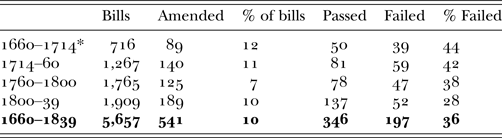
The growing legislative output of the assembly therefore reflected to some degree the favourable political conditions that Jamaican elites secured for themselves in the later eighteenth and early nineteenth centuries. This applied not only to their relations with the governor but also with the island council and the privy council in Britain. Each had the power to frustrate legislation noted above and continued to exercise this even in the 1830s in exceptional circumstances, while the assembly likewise sought to remove council control entirely. One of the issues at stake when Manchester dissolved the assembly in December 1809, for instance, was their claim that neither the governor nor the council could reject bills passed by the house; it aimed, Manchester complained, ‘[at] assuming to itself an independent and paramount jurisdiction, rendering ineffectual every other authority’.Footnote 55 However, the overall tenor of their relations gradually shifted around 1783 from confrontation to collaboration, and although the council was forced to drop its claims to initiate or even amend supply bills, it continued to debate and amend other legislation and even settled more productively into its role as the bulwark of imperial interests and a check on the assembly.Footnote 56 Around 10 per cent of bills each year were amended by the council between 1664 and 1838 but the overall likelihood of these amended bills passing increase by half as the period advanced, pointing to the development of a more collaborative relationship that may even have facilitated the expansion of legislation in the long run by polishing the rough edges of the bills passed by the assembly and weeding out errors or elements unacceptable to the imperial government (Table 4).
Number of bills amended by the council in Jamaica, as percentage of total bills, and final outcomes, 1660–1839

* Incomplete data.
Sources: see Table 1.
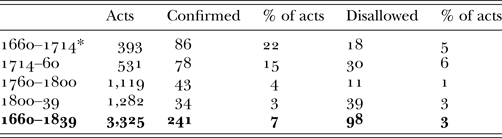
By the same token, studies focusing on slavery or constitutional conflicts between Jamaica and the imperial metropole can give the misleading impression that the Board of Trade and the privy council in Britain cracked the whip with increasing frequency in this period and used their power to confirm and disallow legislation to shape colonial policy. In fact, these institutions exercised their authority of Jamaica very sparingly indeed, and certainly no more or less than they did for the colonies in North America before 1776, where about 5 or 6 per cent of acts were disallowed (Table 5).Footnote 57 More than forty Jamaican acts were disallowed between 1664 and 1760, mostly during the political clashes of the 1750s noted above, but this was only 4 per cent of the total. Between 1760 and 1839, this fell to 2 per cent, and well over half of the fifty acts disallowed were statutes passed during the confrontations over slavery in the 1830s. Acts relating to slavery were twice as likely to be disallowed as all others, reflecting the concern by the imperial metropole to rein in some of the most severe aspects of the colonial slave code.Footnote 58 As in Ireland, where the number of acts disallowed fell to less than half a per cent after 1783, the wider rethinking of imperial government in the wake of the American Revolution therefore tended to deter direct intervention in colonial politics and gave local elites more freedom and confidence in making legislation.Footnote 59 The practice of formally confirming colonial statutes rather than simply leaving them in operation likewise fell in this period, from 15 per cent of all Jamaican acts before 1760 to 3 per cent thereafter. In strictly quantitative terms, the privy council therefore intervened about as much in Jamaican politics as in those of North America before 1783, and even less thereafter, creating an increasingly favourable and supportive environment for the growth of legislation.
Privy council, confirmations and disallowances of Jamaican legislation by the British privy council, 1660–1839

* Incomplete data.
Sources: see Table 1.
Of the 2,600 or so failed legislative initiatives introduced into the house of assembly in Jamaica between 1664 and 1839, at least three-quarters were therefore lost in the assembly itself, a ratio that largely remained static throughout this period (Table 6). This was lower than in Britain, where nearly 90 per cent of bills failed in the lower house, but similar to Ireland between 1782 and 1800.Footnote 60 It is perhaps too early to say whether this is a measure of the success of imperial government, which only had to block or disallow a quarter of the legislative initiatives that came before it, or in fact a measure of their failure because, after all, a quarter of legislative initiatives had to be blocked or disallowed. The evidence presented here merely shows that it was no more or less successful in Jamaica in this regard than it was in North America or Ireland, two regions which saw very similar levels of intervention but nevertheless moved into outright confrontation during the American Revolution. The fact that Jamaica failed to follow these other regions into opposition, even if some merchants in Kingston did briefly toy with independence in 1774, suggests that direct legislative interference by the Board of Trade and the privy council was not sufficient in itself to provoke revolt.Footnote 61 This tends to confirm what Jack Greene, Trevor Burnard, Andrew O'Shaughnessy, Peter Marshall, and many others have argued, that the final fractures came from exogenous and largely contingent sets of factors specific to the mainland colonies that could no longer be accommodated or addressed by the framework of the transatlantic constitution.Footnote 62
Final stage of failed and disallowed bills, by number and percentage, 1714–1839

* This total has been adjusted to include the 98 acts in this period that passed successfully in Jamaica but then disallowed by the privy council.
** Incomplete data.
Sources: see Table 1.
IV
Although the growing administrative capacity of the house of assembly in Jamaica and more propitious political circumstances may help to explain some of its rising legislative efficiency and output, these mechanisms of supply worked in tandem with a growing demand for legislation. Hoppit notes that in Britain, for instance, three-quarters of the business that came before the parliament at Westminster was not proposed by the ministry but by private interests and had little to do with the core business of taxation or warfare.Footnote 63 ‘Much legislation was local, and much of it demand led’, he concludes, and recent work has demonstrated how interest groups and lobbyists such as the West India interest in London could bring forward bills for their own ends.Footnote 64 The upsurge of legislation in Ireland was likewise driven in part by private individuals, who used many of the same political techniques.Footnote 65 Closer to Jamaica, Olson and others have argued that the ‘rise’ of the assemblies in North America was driven in part by the new opportunities such institutions now offered over local town meetings for the urgent problems facing individual colonies. ‘They included defense, the need for a medium of exchange, Indian relations, transportation facilities on a new scale, inter-colonial relations’, she notes, ‘and the regulation of competing economic, ethnic and religious groups in an increasingly pluralistic society.’Footnote 66 Colonies as diverse as Virginia, Pennsylvania, and New Jersey all saw a rise in petitioning in this period as groups or individuals looked to assemblies for financial, judicial, and, increasingly, legislative solutions to these issues. This section will demonstrate that in Jamaica the revolution in legislation was likewise partly a product of rising popular demand.
During this period, the members of the assembly largely set its own legislative agenda. The island council had lost the power to initiate bills by the 1770s and all but four of the forty it introduced were rejected by the lower chamber.Footnote 67 Governors could try to put legislation before the house, but this required allies and the construction of an imperial party who demanded their own favours in return.Footnote 68 ‘So long as the Mother Country abstains from asking support from her colony,…the Governor is under no necessity of having recourse to party or to any leading interest’, one governor told the Colonial Office in 1799, for instance, ‘but the moment pecuniary assistance is asked…[the governor] must be a party man to carry the objects asked for.’Footnote 69 Neither the Board of Trade nor the Colonial Office, nor even the privy council, could introduce legislation directly, though they could sometimes suggest or bring forward through the governor the bills that they would like to see introduced.Footnote 70 The Westminster parliament legislated for the empire with increasing frequency, as noted above, and this threat was also sometimes more than enough to prompt bills in the assembly such as the Slave Registration Act in 1817 and the Act of Emancipation in 1833, both passed specifically to forestall imperial intervention.Footnote 71 Yet this could also backfire, as in the constitutional crisis of 1838, when plans to reform West Indian prisons by imperial legislation led to a backlash in parliament as well as in Jamaica that nearly brought down the Whig ministry.Footnote 72 Bills therefore arose mainly from within the assembly itself as the population began to exploit its growing power as a legislature to support their own particular interests, and this was sufficient to ensure that even as the rates of legislative failure rose in the 1830s the overall numbers of legislative initiatives continued to rise virtually unabated.Footnote 73
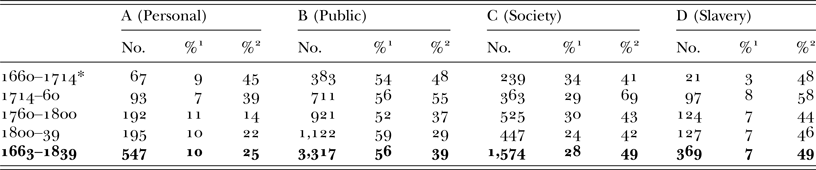
The importance of popular demand in stimulating legislation can be gauged by breaking down its output into broad categories, thereby exposing the wide range of interest groups that legislation was intended to address. Hoppit and Innes identified ten main categories of legislation in Britain, many of them having no real official origin, and these categories were adopted by Hayton and Kelly in their study of the Irish parliament. All have noted the difficulties in categorizing bills, especially when only the title remains.Footnote 74 For Jamaica, it is also necessary to accommodate the ubiquity of slavery, which was addressed not only by specific measures such as the slave codes but also in a piecemeal way as subsidiary clauses in other bills. The decision has therefore been taken to reallocate bills on public and private finance (2) to the categories for government (1) and the economy (7) respectively, and to assign public bills relating to slaves, free people of colour, and the maroons to (2) while allocating all private bills on this topic to the existing category for them (1). For ease of analysis, these categories have then been grouped into four related but ultimately arbitrary themes. ‘Personal’ legislation (A) includes all private bills, and ‘Slavery’ (D) all slavery bills, while ‘Public’ (B) has all government (1), law and order (3), and military (5) bills, and ‘Society’ (C) the bills relating to religion (4), society (6), the economy (7), and transportation (8). Although no substitute for detailed studies of individual legislation and legislative programmes, the overall pattern (Table 7) closely matches the patterns seen in Britain and Ireland and strongly suggests that the interests of local elites helped to drive this continued upsurge in colonial legislation.
Legislative initiatives by theme, as percentage of total legislation (%1) and percentage of failures (%2), 1660–1839

Sources: see Table 1.
Despite the central importance of slavery to the society and economy of Jamaica, only 369 bills (and 190 acts) specifically dealt with slaves, free persons of colour, and maroons, constituting just under 7 per cent of all legislative initiatives. They were nonetheless among the earliest and most important acts since they created the legal framework for chattel slavery, and Goveia argued that elites in the Leeward Islands and elsewhere fought so hard for their assemblies for this reason. ‘By the end of the eighteenth century, the two great institutional systems of the British Leeward Islands – the system of representative government and the system of slavery – were firmly established in law and custom’, she notes, adding that ‘the slave laws of the islands were essentially a product of their interrelationship’.Footnote 75 Though relatively unplanned responses to specific problems, albeit shaped by a consistent culture of economic logic and racial prejudice, the codes created in the late seventeenth century produced a stable and adaptable legal framework that gave planters wide discretionary authority over their slaves and backed them up with systems of courts, gaols, and workhouses.Footnote 76
Most of the slavery legislation passed before the 1790s therefore did not tamper with the basic framework put together in the 1660s but merely tweaked certain aspects in response to new challenges, in particular the recognition of autonomous communities of maroons after the peace treaty in 1739 and the growing population of free people of colour by mid-century. Many of the later acts in the Leeward Islands were likewise mainly concerned with tightening up the earlier police laws to remove loopholes and introducing new economic restrictions on slaves.Footnote 77 The numbers of acts passed in Jamaica also grew from the 1790s onwards as Jamaica and the West Indies came under pressure to abolish the slave trade, ameliorate conditions for slaves, grant civil rights to free people of colour, and eventually to abolish slavery itself.Footnote 78 Like the penal laws of Ireland, which developed in a very similar fashion, the number of bills was no indication of their effectiveness or impact, but the example of Jamaica shows that the island and its assembly were certainly capable of turning out workable legislative solutions when necessity demanded.Footnote 79
The day-to-day legislative agenda was therefore instead dominated mainly by bills relating to the business of government, administration, taxation, policing, and defence. Over 3,000 bills were introduced, nearly 60 per cent of all bills, and just under 2,000 passed into law, with a rate of success rising from 40 per cent to 70 per cent by the early nineteenth century as the process became more routine. They included the annual bills regulating the militia and voting taxation, which were drawn up and shepherded through the house by a standing committee known as the commissioners of public accounts, who met regularly throughout the year and were by the 1750s ‘in all essence…the Treasury Board of the island’.Footnote 80 Other issues with extensive runs of legislation included the powers of the assembly and patent officials, the needs of the parish vestries and local government, and the reform of courts and the law. This expansion in fiscal-military law-making closely overlapped with the creation of a domestic fiscal-military state in Jamaica during the eighteenth century intended to curb the threat of slave revolts.Footnote 81 Spending rose from about J£40,000 per year in 1774 to J£300,000 after 1815, and even reached J£630,000 in 1795 during the crisis of the Second Maroon War, and the taxes and borrowing that sustained this spending were ultimately underwritten by the legislative power of the assembly and its frequent votes of supply. Other bills helped to regulate the militia and the parties sent after runaway slaves; granted land for fortifications, barracks, and naval dockyards; and regulated the imperial military garrison and its auxiliaries. Most were relatively routine and as in Britain and Ireland the expansion of the Jamaican fiscal-military state therefore ‘was not, in legislative terms, either experimental or risky’, but it played a crucial role in the creation of an effective system of security.Footnote 82
Elites therefore tenaciously defended the power and privileges of their assembly because these enabled them to pass these measures for their own defence, and also because the passage of important measures such as taxation could serve as tactical weapons in contests with the imperial government. Like their counterparts in Ireland and their predecessors in seventeenth-century England, the colonial elites carefully ensured that the standing revenue was too small for the governor's needs and then deliberately voted supply bills for only one or two years at a time so that the governor would have no choice but to recall the house each year in order to renew them.Footnote 83 Thus, although the duke of Manchester dissolved the house in December 1809 on a matter of imperial principle, he had to climb down and recall it in November 1810 because it had failed to renew the grants necessary to subsidize the imperial garrison.Footnote 84 Like the similar practice of passing short bills of several months that would expire before they could be seen and disallowed in Britain by the privy council, various tactics intended to evade the full scope of imperial control became an important practical tool in the conflicts between colony and metropole and even artificially inflated the levels of legislation far beyond what was really required.Footnote 85
The high volume of routine public legislation and the regular and reliable sessions that resulted in Britain and Ireland created opportunities for other interest groups to bring forward their own bills, and the same was true in Jamaica, where legislation on government, taxation, warfare, and slavery never accounted for more than two-thirds of the total legislative business of the house even in the early nineteenth century. Across this period, around 1,600 bills dealt with matters that did not relate to the core business of taxing and defending the island or enslaving its inhabitants, and although some were introduced under imperial pressure to tackle particular issues the vast majority seem to have arisen from within the Jamaican elite to address various social and economic challenges that looked like they required a legislative solution. At least half passed, with both the volume and chances of success increasing after the mid-eighteenth century as the assembly became a more efficient legislative machine. Economic bills predominated, though without the huge number of enclosure acts that distorted totals in Britain, while bills on religion were even rarer than in Britain.Footnote 86 All had roughly similar chances of success, not least because many dealt only with local issues that tended as in Britain and Ireland to arouse less opposition than the more general measures.Footnote 87 For example, Diana Paton has shown that the new prisons and workhouses created after 1770 were generally authorized under piecemeal legislative initiatives or by broader permissive legislation that permitted action without prescribing it and helped to defuse the opposition that might otherwise have arisen.Footnote 88
Finally, at least 547 or 10 per cent of bills across this period related to private matters, compared to 14 per cent in the Irish parliament and nearly 30 per cent in the British parliament.Footnote 89 These covered a wide range of issues. As in Britain, elites in Jamaica complained that courts in the island were slow and inefficient and found legislation a useful alternative to complex estate settlements.Footnote 90 More than 200 estate bills came before the assembly, some of them several times, and at least two-thirds were successful compared to three-quarters in Britain.Footnote 91 There were also twenty-four bills on miscellaneous issues, such as the dissolution of the marriage between the Kingston merchant Edward Manning and his wife Elizabeth in 1739 after a public scandal.Footnote 92 This bill tested the limits of the assembly's claim to possess exactly the same powers as its counterpart in Westminster, and was subsequently disallowed by the privy council in Britain. The remaining 300 or so private bills were for the manumission of individual slaves or the grant of limited privileges to free persons of colour.Footnote 93 Offering certain constrained legal privileges such as the right to testify in court, they were clearly valued by the petitioners and enjoyed an unusually high success rate. Well over 80 per cent were successful on their first attempt and it was almost unheard-of for any to fail due to outright opposition, probably because only acceptable individuals were permitted to submit petitions in the first place.
V
Just under 6,000 legislative initiatives were therefore debated in the house of assembly in Jamaica between the initial session in January 1664 and the constitutional crisis of December 1838. Well over 3,000 passed. Many were later repealed or disallowed or were only of temporary duration, but the result was nevertheless a huge corpus of legislation that was intended to shape the economic, society, and politics of the island in ways that now need to be fully explored. The creation of a slave code was only one aspect of a wider legislative output that was mainly, as Edward Long later claimed, ‘incidental [i.e. relating] to the colony and calculated for the relief and benefit of its inhabitants, who…[are] the best judges of the evils they feel and their proper remedies’.Footnote 94 The island therefore witnessed its own particular version of a wider revolution in legislative practice and power that was experienced by Britain and Ireland earlier in the eighteenth century, and which also flowered in the United States after 1783. This was characterized not only by an expansion in the sheer volume of legislation but also by the greater speed and efficiency of the process itself and wider ambitions of legislators. In Britain, this helped to kick-start the development of a fiscal-military state and industrial change, while in Ireland it supported the social, political, and economic marginalization of the Catholic Irish population. In Jamaica, it helped underpin the political, administrative, social, and legal apparatus of slavery. In each case, the process was facilitated by the growing administrative efficiency of these legislative institutions and by the political battles that members waged with imperial authorities, but it was driven by the strong and growing conviction of elites that legislation was important, useful, and capable of reshaping the world around them. Further work on Jamaica and the other islands in the West Indies will do much to round out this picture.
As far as it is possible to tell, the assembly of Jamaica also differed very little in terms of legislation from its counterparts in North America before 1776, combining violent constitutional clashes with an increasing volume of routine business. In fact, legislation was a weapon in these clashes, and success helped to carve out a secure or protected space for further legislation that then reinforced the authority and legitimacy of these assemblies in their next confrontations with the imperial regime. As Olson concluded on the basis of her brief overview of colonial legislation, assemblies gained power ‘not only through their successful encounters with the colonial governors but also through their developing ability to handle the legislative needs of their constituents’.Footnote 95 Yet in the West Indies, this did not lead to independence since the relationship could also be productive as well as competitive. For many years, the political and legal structures of the wider transatlantic constitution were sufficient to accommodate this tension and to enable houses of assembly throughout British America to co-operate with the imperial government in the processes of rule. The divergent trajectories of North America and the West Indies after 1783 therefore did not reflect any major underlying legislative differences, only an exogenous and largely contingent set of factors that have been analysed in much greater detail elsewhere and eventually made resistance in North America seem not only practical but positively necessary. In Jamaica and the West Indies, by contrast, the framework of the transatlantic constitution buckled but did not break and continued to provide an effective scaffolding for their shared and ongoing process of legislative revolution.