Lack of proper hand hygiene is one of the strongest correlates of healthcare-acquired infections. Despite the clear benefits, optimal hygiene practices are far from universal, likely due to multiple contributory factors such as perceived risk, lack of accountability, and reliance on other prevention efforts.Reference Lam, Lee and Lau 1 , Reference Wendt, Knautz and von Baum 2 The pathway for horizontal transmission of a nonairborne organism among patients not in direct contact with each other implicates both the patient as a reservoir and practitioner as a vector.Reference Pittet, Allegranzi and Sax 3 In a study of microorganisms cultured from patients and staff in a medical intensive care unit (MICU) before gloving was common, nearly 20% of patients had potentially pathogenic bacteria recovered. Pseudomonas aeruginosa was the most common at 32% of isolates, and staff hand washing samples showed 21% colonization with Staphylococcus aureus.Reference Bauer, Ofner, Just, Just and Daschner 4 A more recent study recovered gram-negative bacilli from 38% of nurses’ hands in a neonatal intensive care unit (NICU).Reference Waters, Larson and Wu 5 It has been estimated that 20%–40% of a patient’s flora in the intensive care unit (ICU) are the result of cross contamination via the healthcare worker (HCW).Reference Weinstein 6
Simulation studies have been used to mathematically model methicillin-resistant Staphylococcus aureus (MRSA) colonization in adult ICUs.Reference Sébille, Chevret and Valleron 7 – Reference Hall, Barrass, Leach, Pittet and Hugonnet 10 Overall, these studies indicate that hand hygiene is an effective strategy to reduce patient colonization, but a major limitation in their methods has been accurately modeling the patient–provider interactions: equal risk is assumed among all patients rather than the individual characteristics of a given patient. Thus, a severely ill, intubated patient is at a risk similar to a stable, nonintubated patient nearing discharge. Furthermore, these patient–provider interactions as well as prevalence of MRSA colonization may drastically vary between neonatal and adult ICUs. We chose to focus on the NICU as MRSA has historically been common in this environment and the consequences of colonization are dire: ~30% may develop invasive infection.Reference Popoola, Budd and Wittig 11
In this study, we sought to accurately model patient–provider interactions based on empiric data from our NICU using a novel network modeling approach. In the NICU, the focus has shifted to clustering of medical care, which consequently results in fewer patient–provider interactions. Our goals were (1) to describe the reduction in cross transmission of colonized MRSA as a consequence of varying levels of hand hygiene by HCWs and (2) to highlight newer and approachable methods in modeling infectious disease transmission.
METHODS
Setting
The Christiana Hospital NICU, part of the Christiana Care Health System (Newark, DE) is a regional perinatal referral center with 1,100 admissions per year, and 60 beds (with the ability to accommodate 70 beds). The NICU is designed around 3 main hallways, with an additional observation area and isolation rooms. MRSA screening occurs every 1–3 weeks, with specimens obtained from the nares and tested via polymerase chain reaction technology. Using data from the electronic medical record (EMR), we ascertained all medical care that infants received while in the unit, for the period of January 1 through May 31, 2015. This period was the most recent period in which complete data were available for research in the EMR, and was deemed long enough to account for any random variation. We considered only care sufficient to contaminate the HCW and subsequently to pass a pathogen to an infant based on a Fulkerson scale ranking of ≥5,Reference Wendt, Knautz and von Baum 2 which includes provider contact with the infant or nearby environment (Supplementary Table 1). The hospital’s institutional review board approved this study.
Transmission Dynamics and Assumptions
Our primary inferential goal was infant–infant horizontal transmission of MRSA colonization occurring via the HCW as a vector on an hourly basis. This goal required a description of the care network in the NICU per infant per hour, akin to a social network analysis. To create this network, we aggregated all care that an infant received per hour and then linked the performing healthcare provider(s) to other infants seen by that provider for that hour.
All infants in the NICU may become colonized with MRSA (if they are not initially colonized). Initial colonization was defined based on routine surveillance cultures used in the NICU, and it was varied, acknowledging that not all MRSA carriers would be detected through the surveillance efforts. We posited that some infants may have been colonized through vertical transmission from the birth process, from contact with a previously colonized provider, or from handling from colonized family members. Infants were at risk of colonization up until the time they were discharged, transferred, or expired in the NICU.
Data and Parameters
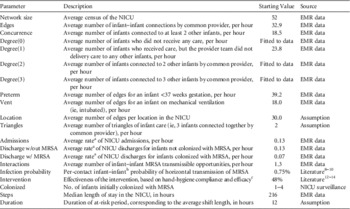
Making our models operational required data on the care network in the NICU, on MRSA risk information, and on hygiene effectiveness (Table 1). As mentioned, provider interactions were based on EMR data from our NICU and corresponded to infant–infant connections based on the care team. We allowed provider interactions to vary based on several characteristics of the infants and the environment. Preterm infants (<37 weeks gestation) had 23% more connections to other infants in the unit, and ventilated infants had 46% more connections to other infants in the unit, implying that more provider care was needed for more acute infants. We also acknowledged that most of the care providers (ie, bedside nurses) are generally clustered by patient assignments, while fewer providers cover all areas in the NICU (ie, physicians, nurse practitioners, respiratory therapists). Thus, we posited that 90% of interactions are within 1 of 3 halls in the Christiana Hospital NICU.
Model Input and Simulation Parameters

NOTE. MRSA, methicillin-resistant Staphylococcus aureus; NICU, neonatal intensive care unit; EMR, electronic medical record.
a Rates were calculated based on the average number of infants admitted or discharged to the NICU per day for the study period, then divided by 24 to arrive at an hourly rate. For example, during this period the NICU averaged 3.12 admissions per day, or 0.13 (ie, 3.12/24) admissions per hour.
b Calculated as the product of the per contact probabilities of patient–provider MRSA transmission and provider–patient MRSA transmission.
c Calculated as the product of the overall compliance with hand hygiene and efficacy at eliminating MRSA from hands.
We obtained information on the worst-case per-contact probability of patient-to-HCW transmission of MRSA (15%) and HCW-to-patient transmission of MRSA (5%) based on these sources.Reference McBryde, Pettitt and McElwain 8 – Reference Hall, Barrass, Leach, Pittet and Hugonnet 10 To obtain a single per-contact probability that defines horizontal infant–infant transmission with the provider as the vector, we took the product of these 2 probabilities (ie, 0.75%). This probability was then used to determine incident MRSA colonization as a function of both the number of provider interactions a given MRSA-colonized infant has per hour, and the number of interactions that provider has with other, noncolonized infants in the same hour.
We evaluated hand hygiene as our primary intervention, which was aggregated from 2 factors: (1) overall compliance with hand hygiene by staff in the NICU and (2) efficacy of proper hand hygiene at eliminating MRSA from the hands. The average compliance with proper hand hygiene noted in prior reviews of NICUs has hovered around 55%,Reference Ofek Shlomai, Rao and Patole 12 , Reference Newnam 13 while its efficacy against MRSA was shown in a randomized controlled trial at 88%.Reference Ho, Poh, Choudhury, Krishnan, Ang and Chow 14 The product of these 2 probabilities yields an overall effectiveness of 48%. Historical data from the Christiana Hospital Infection Prevention Department indicate near-complete hand-hygiene compliance within the NICU for the study period, although these data do not include ancillary staff or determine proper hygiene technique.
Statistical Methods
The NICU care network was specified using a temporal exponential-family random graph model, implemented in the EpiModel package in R,Reference Jenness, Goodreau and Morris 15 and it was calibrated to the empiric NICU data. A temporal model allowed us to specify how the patient care network evolved over time during a typical provider shift of 12 hours. The “at-risk” period based on the infant–provider interactions lasted for an entire shift, where each time step consisted of 1-hour care bundles. See Table 1 for starting parameter values.
The susceptible-colonized compartmental model was simulated for 100 runs. Each simulation ran for 216 time steps, corresponding to the median length of stay in hours for 9 days in the NICU. This method allowed for patient entry and exit in the NICU based on the mean number of admissions (entry), and discharges, transfers, or deaths (exit) for the study period. Upon entry, infants are considered susceptible, and upon exit, they are removed from the network. The starting population was balanced to ensure an equal number of preterm and intubated infants in each of the 3 locations because the assigned bed location is dictated by bed and staff availability, not by acuteness. Estimates correspond to the mean count and prevalence (count divided by census) of MRSA colonization after all simulations, with corresponding 95% confidence intervals. All analyses were performed in R version 3.2.1 (R Foundation for Statistical Computing, Vienna, Austria) with EpiModel version 1.2.1.
Sensitivity Analyses
The main analysis required a range of MRSA baseline prevalences informed by surveillance data and hand-hygiene effectiveness, informed from literature as well as hospital data. The number of initially colonized infants was incremented from 1 (1.9% starting prevalence) to 4 (7.7% starting prevalence), and hand-hygiene effectiveness was applied at approximate quantiles: 0% (no compliance), 24%, 48% (average from literature), 68%, 88% (maximum expected benefit with total compliance), and 100% (theoretical maximum). We undertook 2 additional and independent sensitivity analyses to test modeling assumptions. First, we lowered the per-contact probability of patient-to-HCW transmission of MRSA to 7.5% (from 15%), halving the overall per-contact probability to 0.375%. Second, we increased the duration of the simulation from the median stay of 9 days to the maximum observed stay of 174 days (4,176 time steps) using parameters from our infection control program: median baseline MRSA prevalence of n=2 (3.4%) and a hand-hygiene effectiveness of 88%.
RESULTS
From January 1 to May 31, 2015, there were 477 admissions to the NICU. The mean census was 52 occupied beds (standard deviation, 6) and the median length of stay was 9 days (interquartile range, 5–23). Healthcare workers (n=599) documented 154,064 care events in the EMR rated by the investigators on the Fulkerson scale as ≥5, corresponding to an average of 1.1 contacts per infant per hour. Based on care provided by the provider team within a 1-hour period in the NICU, the mean number of infant–infant MRSA transmissible opportunities per hour was 1.3. The care network model described the empiric data well (Supplementary Figure 1).
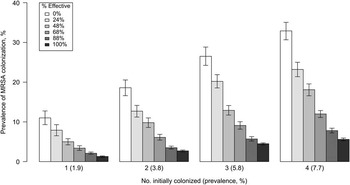
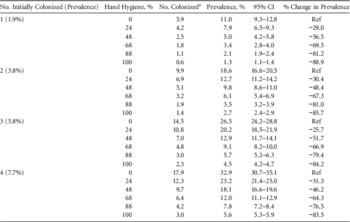
Figure 1 plots the mean prevalence of MRSA colonization in the NICU after 100 simulations for each state of initial colonization and hand-hygiene effectiveness. As shown in Figure 1 and Table 2, increasing hand-hygiene effectiveness (by increasing compliance) markedly reduced infant–infant transmission of MRSA via the HCW. Compared to no hand hygiene and averaged across all 4 initial colonization states, prevalence was reduced by approximately 29%, 51%, 67%, 80%, and 86% for the respective levels of hygiene: 24%, 48%, 68%, 88%, and 100%. MRSA colonization in the simulated NICU may be contained at optimal levels of hygiene compliance and reduced at the theoretical maximum of 100% effectiveness for a per-contact probability of 0.75%. For example, with 4 initially colonized infants (a starting prevalence of 7.7%), the post-simulation prevalence remained at 7.8% (95% confidence interval [CI], 7.2%–8.4%) with 88% hygiene effectiveness, and dropped to 5.6% (95% CI, 5.3%–5.9%) at 100% effectiveness. At lower levels of hand-hygiene effectiveness, the postsimulation prevalence always increased, regardless of the number of initially colonized infants. Lowering the per-contact infant–infant probability of horizontal transmission of MRSA lowered the postsimulation prevalence (Supplementary Figure 2) and demonstrated lower levels of hygiene effectiveness necessary to contain or reduce MRSA (≥48%). We did not find prevalence of MRSA colonization to be sensitive to the simulation duration (Supplementary Figure 3).
Simulated prevalence of methicillin-resistant Staphylococcus aureus (MRSA) colonization based on the mean of 100 simulations of a neonatal intensive care unit with 52 infants for a typical 9-day length of stay (216 hours) with a per-contact infant–infant probability of 0.75%, given varying combinations of initially colonized infants (n=1, 2, 3, 4) and hand-hygiene effectiveness calculated as a function of compliance and efficacy at removing MRSA from hands: 0%, 24%, 48%, 68%, 88%, and 100%.

Postsimulation Prevalence of MRSA Colonization in the NICU Simulated From the Provider Care Network

NOTE. MRSA, methicillin-resistant Staphylococcus aureus; NICU, neonatal intensive care unit; CI, confidence interval
a Based on the mean of 100 simulations of a NICU with 52 infants for a typical 9-day length of stay (ie, 216 hours) with a per-contact infant–infant probability of 0.75%, allowing for 4 states of initial colonization (n=1, 2, 3, 4) and 6 states of hand-hygiene effectiveness calculated as a function of compliance and efficacy at removing MRSA from hands: 0%, 24%, 48%, 68%, 88%, and 100%.
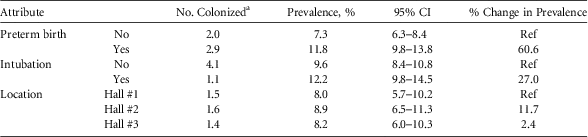
Table 3 presents the results of the network simulations for the 3 attributes of care in the NICU (preterm birth, intubation, and location in the unit) assuming midpoints from our initial analysis for number of initially colonized infants (n=2; a 3.8% starting prevalence) and 48% hand-hygiene effectiveness. Infants with higher acuteness had increased prevalence of MRSA colonization due to the increase in healthcare provider contacts. Specifically, preterm infants had a 61% increase in MRSA colonization compared to term births, and mechanically ventilated infants had a 27% increase in MRSA colonization compared to nonintubated infants. The simulated prevalence of MRSA colonization by location was approximately equivalent (8%–9%), although the random admission process of susceptible infants into the model induced some variation.
Postsimulation Prevalence of MRSA Colonization in the NICU Simulated From the Provider Care Network

NOTE. MRSA, methicillin-resistant Staphylococcus aureus; NICU, neonatal intensive care unit; CI, confidence interval.
a Based on the mean of 100 simulations of a NICU with 52 infants for a typical 9-day length of stay (216 hours) with a per-contact infant–infant probability of 0.75% by 3 care-related attributes (preterm birth, intubation, and location in the unit) given 2 initially colonized infants (3.8% starting prevalence) and a hand-hygiene effectiveness calculated as a function of compliance and efficacy at removing MRSA from hands of 48%.
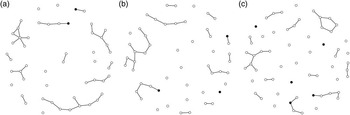
Figure 2a–c depicts the NICU care network with 2 initially colonized infants and a hand-hygiene effectiveness of 48% at the simulation start, midpoint, and conclusion of the simulation (corresponding to time steps 1, 108, and 216). Supplementary Video 1 shows the dynamic process of infant–infant MRSA transmission for an entire simulated run with these parameters.
Graphical representation of a given neonatal intensive care unit (NICU) care network with 2 initially colonized infants (3.8% starting prevalence) and a hand-hygiene effectiveness of 48% at simulation start (a), midpoint (b), and conclusion (c), corresponding to hourly time steps 1, 108, and 216. Susceptible infants are shown as white nodes, and methicillin-resistant Staphylococcus aureus (MRSA)-colonized infants are shown as black nodes. Edges between nodes depict infant–infant linkage by the healthcare provider team. Per-contact infant–infant probability of horizontal MRSA transmission 0.75%.

DISCUSSION
In this simulation, we identified characteristics of care in the NICU that allowed horizontal infant–infant transmission of MRSA, and we modeled prevalence of colonization during a typical length of stay. Our primary finding was the absence of a plateauing effect as hand-hygiene effectiveness increased. To answer our initial question, there is no “good enough” level of hygiene to suggest that MRSA transmission can effectively be blocked under our initial model assumptions. Even with perfect hand-hygiene compliance in the NICU, the number of secondary colonizations, inferred as the effective reproductive number (R), declined only when hand-hygiene effectiveness exceeded our hypothesized maximum benefit of 88% (or the per-contact probability decreased).
In other studies that have modeled MRSA spread in the adult ICU, lower levels of hand-hygiene compliance brought R to the epidemic threshold value of 1.0. McBryde et alReference McBryde, Pettitt and McElwain 8 observed an R of 1.0 with a compliance of 48%, implying that exceeding this level can reduce an outbreak of MRSA colonization in the unit, while Grundman et alReference Grundmann, Hori, Winter, Tami and Austin 9 detected this effect at 66% compliance. Sebille et alReference Sébille, Chevret and Valleron 7 noted that at 90% hand-hygiene compliance could yield a ~33% decrease in colonized patients, with little additional benefit when compliance exceeded ~66%. These studies have an important limitation: compliance with hand hygiene was assumed to confer 100% clearance of MRSA from the hands. In practice, hand-hygiene effectiveness is likely <90%.Reference Ho, Poh, Choudhury, Krishnan, Ang and Chow 14 Moreover, these study results are specific to the adult ICU and did not take the acuteness of the patient into account. Using the network modeling approach, as opposed to deterministic compartmental models or stochastic individual contact models (individual- or agent-based) we could more accurately capture the nuanced care that occurs in the NICU with respect to several markers of care delivery (patient acuteness and location).
These markers of care delivery have important implications for clinical practice. As noted, infants who were born preterm and/or required mechanical ventilation had a higher prevalence of MRSA post simulation, likely due to the increased care required of these acute patients. These infants are therefore at greater risk of MRSA colonization with possible subsequent invasive infection leading to sepsis. Additionally, we observed that patient location mattered in this risk profile in that largely clustered care practices may inhibit infant–infant transmission of MRSA into other locations.Reference Geva, Wright, Baldini, Smallcomb, Safran and Gray 16 While the design of our NICU led us to model location as a function of 1 of 3 possible hallways, the actual cocooning effect of the interactions may be driven by assignments or nurses, who deliver most of the hour-to-hour infant care and therefore have the most patient contacts. Assuming an average of 2 infants per nurse,Reference Rogowski, Staiger, Patrick, Horbar, Kenny and Lake 17 and even with ideal hand-hygiene compliance, infant–infant transmission of MRSA could still occur, particularly if both infants required continual care.
To our knowledge this is the first study to employ a network model for studying MRSA transmission in the NICU specifically addressing the question of adequate hand hygiene, although others have used network models in a similar setting. Geva et alReference Geva, Wright, Baldini, Smallcomb, Safran and Gray 16 employed a network modeling approach to MRSA spread in a NICU, and while they found, similar to our analysis, that the care network is the primary driver of transmission, their model did not incorporate acuteness markers of the infant or consider nonnursing care.
Although our modeling interest was specific to hand hygiene, other interventions, including contact precautions (ie, mask, gown, gloves),Reference Giuffrè, Cipolla and Bonura 18 , Reference Gregory, Eichenwald and Puopolo 19 patient cohorting, and isolation,Reference Giuffrè, Cipolla and Bonura 18 – Reference Huang, Lien, Su, Chou and Lin 20 and surveillance and decolonization,Reference Gregory, Eichenwald and Puopolo 19 , Reference Huang, Lien, Su, Chou and Lin 20 have proven effective to control MRSA in the NICU. Often employed in combination, each of these interventions operates on a different aspect of pathogen transmission. Contact precautions alter the per-contact probability of either the HCW becoming the vector, or, if contaminated or previously colonized, lowers the chances of the HCW transmitting a pathogen to a patient. Cohorting of patients according to the presence of MRSA colonization, with dedicated staff and/or isolation rooms, will modify the NICU care network by altering the number of infant–infant MRSA transmissible opportunities. Lastly, surveillance and decolonization lowers the prevalence of MRSA in the NICU,Reference Popoola, Colantuoni and Suwantarat 21 reducing colonization pressure and subsequently mitigating the possibility of the HCW becoming a vector.
The initial prevalence of MRSA in our study ranged from 1.9% to 7.7%, and these levels may slightly overestimate the true prevalence of MRSA in NICUs. In a 2014 meta-analysis of MRSA colonization in various NICUs over a 12-year period, the mean prevalence was 1.5% (95% CI, 0.9%–2.2%).Reference Zervou, Zacharioudakis, Ziakas and Mylonakis 22 However, we chose this range in our sensitivity analysis for several reasons. First, we based these extremes on empiric surveillance cultures, and our NICU has experienced high rates in the past; even this surveillance program may not fully capture all true colonizations. Second, the infected-colonized compartmental model required us to start with a nonzero number of initially colonized infants in the unit. Third, we wished to represent a worst-case scenario in the time of an outbreak of MRSA colonization. This approach also allowed us to examine colonization pressure (the proportion of infants colonized with MRSA); as the proportion increases, the risk of infant–infant horizontal transmission also increases. As such, our modeling approach presents worst-case postsimulation prevalence estimates.
Several other limitations should be considered. Our models did not incorporate visitor–infant contact, which as a general trend in the NICU has substantially increased; thus, we may have underreported the total patient contacts if they were not documented in the EMR. The average number of infant contacts per hour in our study was similar to another NICU that reported an average of 1.8 contacts per hour, and only 6% of touches were by visitors (94% were nurses, doctors, and allied health staff).Reference Lam, Lee and Lau 1 While visitors generally would not have had contact with other infants, this could lead to an infant becoming colonized independent of the HCW. We also did not consider fomite–person interactions, such as cell phones, which can harbor organisms.Reference Achermann, Seidl and Kuster 23 This would alter the per-contact probability by including another source for HCW contamination between infant–infant contacts. Finally, the probabilities modeled for per-contact infant–infant transmission and hand-hygiene effectiveness are products of 2 independent probabilities. While their independent effects cannot be established in our work, the sensitivity analyses undertaken reflected the expected impact on results.
This work has notable strengths. We used empiric data on HCW and patient interactions to construct our NICU care network. Now that the environment has been accurately modeled, the model can readily adapt to other outcomes, such as investigating respiratory tract colonization in the NICU, or the model can be generalized to other non-NICU healthcare environments by modifying the assumptions. This work may contribute to the development of prospective surveillance programs based on horizontal transmission networks. For example, if a provider has had contact with a known MRSA colonized patient, all subsequent patient contacts by that provider for their shift can be monitored, tested, and potentially decolonized or isolated using this model.
In summary, we observed the care network in the NICU is a major contributor to the horizontal spread of MRSA. The care requirements in intensive care settings offer many opportunities for the healthcare provider to become the intermediary for transmission. Even under optimal hand-hygiene conditions, horizontal transmission of MRSA is possible, suggesting an important role for other complimentary interventions including contact precautions and decolonization. Additional prevention paradigms should focus on the most acute patients because they are at the greatest risk.
ACKNOWLEDGMENTS
The authors would like to thank Laura Carsley from the Christiana Hospital NICU for assistance with provider documentation and nursing care in the unit, and Dr Michael LeVasseur from the University of Pennsylvania and Dr Samuel Jenness from Emory University for their expertise in simulation modeling.
Financial support: No financial support was provided relevant to this article.
Potential conflicts of interest: All authors report no conflicts of interest relevant to this article.
SUPPLEMENTARY MATERIAL
To view supplementary material for this article, please visit https://doi.org/10.1017/ice.2017.116.