Schools are one of the primary providers of mental health services for children and adolescents (Burns et al., Reference Burns, Costello, Angold, Erkanli, Stangl and Tweed1995), and today's school counsellors deal routinely with complicated situations in which students have acute counselling needs, including aggression and depression (Page, Pietrzak, & Sutton, Reference Page, Pietrzak and Sutton2001). The growing interest in youth aggression and depression has been accompanied by an increased focus on prevention in schools (Hoagwood, Reference Hoagwood2000; Shirk, Kaplinski, & Gudmundsen, Reference Shirk, Kaplinski and Gudmundsen2009). For this reason, it seems to be important to determine the factors that impact on the aggressive behaviours of young people.
Several cognitive and emotional factors are associated with aggression. Studies have focused on problem-solving skills (D'Zurilla, Chang, & Sanna, Reference D'Zurilla, Chang and Sanna2003) and mental health factors, such as depression (Ferguson, Miguel, & Hartley, Reference Ferguson, San Miguel and Hartley2009), as correlates of aggression. Such studies provide support for the relationship between social problem-solving and depression (Fremouw, Callahan, & Kashden, Reference Fremouw, Callahan and Kashden1993; Specken & Hawton, Reference Specken and Hawton2005), and the relationship between depression and aggression (Ferguson et al., Reference Ferguson, San Miguel and Hartley2009; Mammen, Kolko, & Pilkonis, Reference Mammen, Kolko and Pilkonis2002). Although the relationship between problem-solving and aggression and the relationship between depression and aggression have been investigated in previous studies, no study known to date has addressed the indirect relationships between problem-solving and aggression, that is, whether problem-solving affects aggression through depression. In addition, most studies investigating the associations among problem-solving, depression and aggression have involved samples with clinical depression (Cauffman, Feldman, Waterman, & Steiner, Reference Cauffman, Feldman, Waterman and Steiner1998; Goddard, Dritschel, & Burton, Reference Goddard, Dritschel and Burton1996; Wolfersdorf and Kiefer, Reference Wolfersdorf and Kiefer1998). So the purpose of the present study is to explore the direct and indirect relationships between problem solving, depression and aggression among adolescents from a nonclinical sample.
Social Problem-Solving and Aggression Link
Cognitive processes are salient factors for aggressive behaviours (Teisl & Cicchetti, Reference Teisl and Cicchetti2007). Social problem-solving as a cognitive process is defined as the effective cognitive and behavioural coping strategies used by individuals when faced with problems. Social problem-solving theory emphasises the role of social problem-solving for the prevention of aggression (D'Zurilla & Nezu, Reference D'Zurilla and Nezu1999). When facing problems, adolescents with higher social problem-solving efficacy are more likely to handle such situations effectively and use effective problem-solving strategies rather than aggressive behaviours. Similarly, some studies have demonstrated that problem-solving deficiency in children and adolescents is associated with aggressive behaviours (Lochman & Dodge, Reference Lochman and Dodge1994; Lochman, Wayland, & White, Reference Lochman, Wayland and White1993). In a qualitative study, Evans and Short (Reference Evans and Short1991) found that aggressive adolescents are less likely to prefer positive problem-solving skills in the face of problems (i.e., hypothetical stories), and that their solutions were ineffective and included more aggression than solutions preferred by non-aggressive adolescents. Studies have also found that non-aggressive children and adolescents use more effective problem-solving skills compared with their peers who have aggressive behaviors (e.g., Lochman & Dodge, Reference Lochman and Dodge1994). Results of intervention programs for aggression also indicate that these programs lead adolescents to solve problems more effectively and in turn behave less aggressively (Guerra & Slaby, Reference Guerra and Slaby1990; Seçer & Ogelman, Reference Seçer and Ogelman2011).
Further, aggression is generally thought to result from problems related to information processing systems (Crick & Dodge, Reference Crick and Dodge1994; Dodge & Crick, Reference Dodge and Crick1990). According to the social information processing model (Crick & Dodge, Reference Crick and Dodge1994), to be able to respond appropriately to social situations, it is necessary to process information so that information is encoded exactly, an interaction goal is specified, and alternative responses are produced to achieve this goal; these alternatives need to be evaluated and the behaviour has to be acted upon. Several studies indicated that children with aggressive behaviours have problems with these information processing steps (Dodge, Reference Dodge1980, Reference Dodge1993; Dodge, Lochman, Harnish, Bates, & Pettit, Reference Dodge, Lochman, Harnish, Bates and Pettit1997; Lochman & Dodge, Reference Lochman and Dodge1998). Studies also suggest that aggressive individuals are more likely to perceive their environment as hostile, and to perceive others’ behaviours as aggressive, while paying less attention to the positive cues in the environment (Dodge, Bates, & Petit, Reference Dodge, Bates and Pettit1990). This negative perception or attribution may lead to the use of ineffective problem-solving behaviours and, in turn, increase the possibility of aggressive behaviour (Lochman & Dodge, Reference Lochman and Dodge1994; Quiggle, Garber, Panak, & Dodge, Reference Quiggle, Garber, Panak and Dodge1992).
Mediatory process
Deficiencies in social problem-solving are also associated with depression (Becker-Weidman, Jacobs, Reinecke, Silva, & March, Reference Becker-Weidman, Jacobs, Reinecke, Silva and March2010; Nezu, Reference Nezu1987; Siu & Shek, Reference Siu and Shek2010). Effective problem-solving enhances positive coping, which may decrease the likelihood of experiencing emotional or mental health problems (D'Zurilla & Nezu, Reference D'Zurilla and Nezu1999). While positive problem-solving is negatively associated with depression (Specken & Hawton, Reference Specken and Hawton2005), negative problem orientation is positively related to depression (D'Zurilla, Chang, Nottingham, & Faccini, Reference D'Zurilla, Chang, Nottingham and Faccini1998). Even under situations of high stress, people who solve their problems effectively and constructively experience less depression than those who do not have effective social problem-solving skills (Nezu & Ronan, Reference Nezu and Ronan1988).
Depression has also been found to be related to aggression (Cauffman et al., Reference Cauffman, Feldman, Waterman and Steiner1998; Ferguson et al., Reference Ferguson, San Miguel and Hartley2009; Steiner, Garcia, & Matthews, Reference Steiner, Garcia and Matthews1997). In their study Ferguson et al. (Reference Ferguson, San Miguel and Hartley2009) found that depression and peer effect were the most important predictors of aggression. Similarly, Flannery, Singer, and Wester (Reference Flannery, Singer and Wester2003) found that adolescents with higher levels of aggression experience more mental health problems such as anxiety and depression.
Depressed adolescents show elevated levels of hopelessness (Kashani, Dandoy, & Reid, Reference Kashani, Dandoy and Reid1992), negative self-concept (Hops, Lewinsohn, Andrews, & Roberts, Reference Hops, Lewinsohn, Andrews and Roberts1990) and negative attribution style (Curry & Craighead, Reference Curry and Cralghead1990). As with aggressive adolescents, depressed adolescents manifest low problem-solving skills. The deficiencies in social problem-solving appear to play an important role in both aggression and depression (Tolan & Loeber, Reference Tolan, Loeber, Tolan and Cohler1993). Both aggressive adolescent and depressive adolescents are more likely to seek little additional information in problematic situations and find less effective alternative solutions (Reinecke, Reference Reinecke1995).
In conclusion, the existing literature provides some evidence for the relationships between social problem-solving and aggression (e.g., Crick & Dodge, Reference Crick and Dodge1994; Dodge & Crick, Reference Dodge and Crick1990; D'Zurilla & Nezu, Reference D'Zurilla and Nezu1999), depression and aggression (Ferguson et al., Reference Ferguson, San Miguel and Hartley2009), and social problem-solving and depression (D'Zurilla et al., Reference D'Zurilla, Chang, Nottingham and Faccini1998; Specken & Hawton, Reference Specken and Hawton2005). Based on these findings, we hypothesised that depression would be a possible mediator between social problem solving and aggression. In the present study, direct relationships between social problem-solving and aggression were investigated, as well as an indirect relationship, that is, whether social problem-solving affects aggression through depression.
Method
Participants and Procedures
This study involved 413 high school students in a small-sized city in western Turkey. The sample included 247 (61%) females and 160 (39%) males. The mean age of this sample was 15.74 years (SD = .97, year range 14–17 years). The adolescents were randomly selected from five different high schools.
We received permission from the local education authorities and school principals and obtained informed consent from both parents and students. The study utilised cross-sectional design comprising several self-reports. Participants were asked to complete questionnaires, including measures of social problem-solving, depression and aggression. The questionnaires were administered in group sessions lasting approximately 40 minutes during the school time. All participants were volunteers, and were allowed to withdraw at any point.
Measures
Social Problem-Solving
The Social Problem-Solving Inventory—Revised Short-Form (D'Zurilla, Nezu, & Maydeu-Olivares, Reference D'Zurilla, Nezu and Maydeu-Olivares2002) was used to measure social problem-solving. It is a 25-item self- administered questionnaire designed to measure an individual's cognitive, affective or behavioural responses to real-life problem-solving situations. The scale is comprised of five subscales, including Positive Problem Orientation, Negative Problem Orientation, Rational Problem-Solving Style, Impulsive/Carelessness Style and Avoidance Style. Internal consistencies in the original study were reported in D'Zurilla, Nezu and Maydeu-Olivares (Reference D'Zurilla, Nezu and Maydeu-Olivares1996) from .76 to .92. Test–retest reliabilities (3 weeks) were found to range from .72 (Positive Problem Orientation) to .88 (Negative Problem Orientation). The scale was adapted into Turkish by Eskin and Aycan (Reference Eskin and Aycan2009). The internal consistency coefficients ranged from a low of .62 to a high of .92. The test–retest reliability coefficients ranged from .60 to.84. The internal consistency coefficient for the present study ranged from .68 to 90.
Aggression
The Buss-Perry Aggression Questionnaire—Short Form (BPAQ-SF) was used to measure aggression. It is a 12-item scale derived from the 29-item BPAQ (Buss & Perry, Reference Buss and Perry1992) by Bryant and Smith (Reference Bryant and Smith2001). The BPAQ-SF has four subscales: Physical Aggression, Verbal Aggression, Anger and Hostility. Each subscale had three items. In addition to obtaining subscale scores, a total aggression score can also be calculated. The refined model yielded acceptable goodness of-fit (GFI = .94). Two samples were used to assess the replicability of the refined four-factor model using a new ‘short form’ of the BPAQ. For both samples, reliability coefficients were generally acceptable for the refined factors of Physical Aggression (.79 and .80), Verbal Aggression (.83 and .80), Anger (.76 and .76), and Hostility (.75 and .70) (Bryant and Smith, Reference Bryant and Smith2001). The internal consistency coefficient for the present study was .85.
Depression
The depression subscale of the Brief Symptom Inventory (BSI) was used in order to measure individuals’ depression symptoms. The BSI was developed by Derogatis (Reference Derogatis1992) and a shortened version of the SCL-90-R and was adapted to Turkish by Şahin and Durak (Reference Şahin and Durak1994). The brief version consists of 53 items rated on a 5-point Likert-type scale. The scale was developed in order to measure nine different mental health indicators, such as depression, interpersonal sensitivity, somatisation, obsessive-compulsive disorder, anxiety, and paranoid thoughts. The adapted version of BSI revealed five subscales as a result of exploratory factor analysis: Anxiety, Depression, Negative Self, Somatisation, and Hostility. The Cronbach alpha reliability coefficients have been found to be acceptable, .95 to .96, for the Turkish form. In this study, the alpha coefficient for the depression subscale was found to be .85.
Results
First, we tested the effects of age and sex on the studied relationships by adding them as predictors of aggression. We found that standardised coefficients from the links between social problem-solving and depression were −.389 without age and sex, −.389 with age and sex. Standardised regression coefficients in the relationships between social problem-solving and aggression were −.128 without age and sex, −.125 with age and sex. Based on this small effect, we decided to present the model without age and sex included as controls.
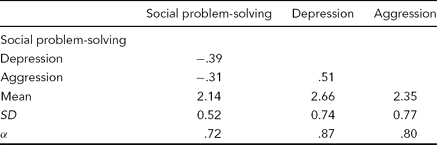
Results of zero order correlations indicated that social problem-solving was significantly and negatively correlated with depression and aggression. As expected, depression was found to be related positively with aggression. As can be seen in Table 1, all measures had acceptable internal reliability coefficients.
Descriptive Statistics and Intercorrelations of Variables
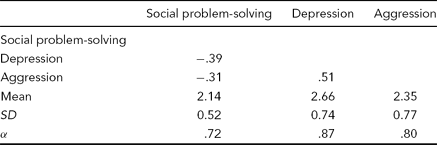
Note: *p < .01
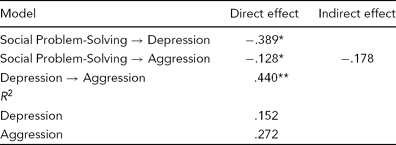
In order to analyse direct and indirect relationships between social problem-solving, depression and aggression, a path analysis was conducted using AMOS 19. Standardised path coefficients of direct and indirect relationships between social problem-solving, depression and aggression are presented in Table 2.
Direct and Indirect Relationships Between Social Problem-Solving, Depression and Aggression
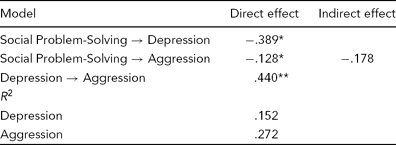
Note: *p < .01
Results indicated that direct effects of social problem-solving and depression on aggression were significant, as well as indirect effects of social problem-solving on aggression through depression. The indirect effect of social problem-solving on aggression was greater in magnitude than the direct effects. In addition, Table 2 presents the total variance explained in depression and aggression. Social problem-solving explained almost 15% of the variance in depression, and social problem-solving and depression together explained almost 27% of the total variance in aggression. We also analysed the mediational role of depression in the relationship between social problem-solving and aggression using the bootstrapping method (Hayes, Reference Hayes2009; Preacher & Hayes, Reference Preacher and Hayes2004; Reference Preacher and Hayes2008; see Table 3).
Mediation of the Indirect Effect of Social Problem-Solving on Aggression Through Depression

Note: SE: Satandart error; SPS: Social problem-solving. Level of confidence for confidence intervals: .95; Number of bootstrap resamples: 5000; Significant (confidence intervals do not containing zero).
Results suggest that depression partially mediated the relationship between social problem-solving and aggression. If the confidence interval does not contain zero, mediation effects are considered to be significant (Hayes, Reference Hayes2009). As can be seen in Table 3, both confidence interval values are negative and do not contain zero.
Discussion
The purpose of the present study was to examine the direct and indirect relationships among social problem- solving and aggression, as well as whether depression mediates the relationship between social problem-solving and aggression. Results provide support for both direct relationships and indirect relationship, that is, depression appears to act as a mediator in the relationship between social problem-solving and aggression. More clearly, social problem-solving is associated with aggression through depression.
Regarding the negative relationship between social problem-solving and aggression, consistent with previous findings (D'Zurilla & Nezu, Reference D'Zurilla and Nezu1999; Lochman & Dodge, Reference Lochman and Dodge1994; Lochman et al., Reference Lochman, Wayland and White1993), individuals who have effective problem-solving abilities are less likely to exhibit aggressive behaviours. Social problem-solving was also negatively associated with depression, indicating that people with effective problem-solving skills experience fewer depressive symptoms. This finding is also consistent with the findings of previous studies (Fremouw et al., Reference Fremouw, Callahan and Kashden1993; Goddard et al., Reference Goddard, Dritschel and Burton1996; Nezu & Ronan, Reference Nezu and Ronan1988; Specken & Hawton, Reference Specken and Hawton2005). Individuals who do not have adequate social problem-solving skills are more likely to be affected by stress or negative experiences (Nezu & Ronan, Reference Nezu and Ronan1985), and in turn this increases the possibility of experiencing depression (Heppner, Baumgardner, & Jackson, Reference Heppner, Baumgardner and Jackson1985; Nezu, Reference Nezu1985).
The relationship between depression and aggression is consistent with previous work which found that higher depression was associated with higher levels of aggression (Cauffman et al., Reference Cauffman, Feldman, Waterman and Steiner1998; Ferguson et al., Reference Ferguson, San Miguel and Hartley2009; Steiner et al., Reference Steiner, Garcia and Matthews1997). It appears that through negative emotions, depression may foster aggressive behaviour. While some depressive people become introverted, in others, depression triggers anger and this anger might result in aggression (Berkowitz, Reference Berkowitz1993).
This study has some potential implications for developing intervention programs for reducing aggression. The present findings highlight the role of both social problem-solving and depression on aggression. Consistent with previous claims that focused on the importance of social problem-solving skills for preventing aggression (Crick & Dodge, Reference Crick and Dodge1994; Dodge & Crick, Reference Dodge and Crick1990), findings in the present study highlight the need for school prevention programs to teaching social problem-solving skills by school counsellors. In addition, using positive problem-solving strategies would be associated with experiencing less depression (Becker-Weidman et al., Reference Becker-Weidman, Jacobs, Reinecke, Silva and March2010). In line with the findings that indicate the effects of depression on individuals ways of thinking (e.g., Watkins & Baracaia, Reference Watkins and Baracaia2002), the results show the importance of having concern for individuals’ mental health when designing intervention and/or prevention studies for aggression. More specifically, although social problem-solving skills are important for effectively coping with problems and may help individuals to find alternative coping skills rather than behaving aggressively (Seçer & Ogelman, Reference Seçer and Ogelman2011), the current study provides evidence to consider the depression levels of people while developing intervention programs for aggression. In summary, it is suggested that counselling interventions should include problem-solving skills and depression, both of which are predictors of aggression.
The present study has some limitations. First, because of the cross-sectional nature of this study, one cannot assume casual relationships among social problem-solving, depression, and aggression. Longitudinal studies might help us to better understand the casual relationships. Second, participants of this study were students. In future studies, out of school youths should be included. Third, we used the total scores of social problem-solving and aggression. Future studies should investigate the relationships between different problem solving styles and subscales of aggression such as physical and verbal aggression, anger and hostility.