





1. Introduction
In the ever-continuing study of fluids, the exploration of flows induced by non-dissipative, parity-breaking viscosities has emerged as a new frontier. Such transport coefficients, which fall under the heading of odd viscosity, result from the spinning of the microscopic or mesoscopic particles that constitute the fluid (Banerjee et al. Reference Banerjee, Souslov, Abanov and Vitelli2017; Markovich & Lubensky Reference Markovich and Lubensky2021; Fruchart, Scheibner & Vitelli Reference Fruchart, Scheibner and Vitelli2023). Odd viscosity gives rise to a wide range of novel physical phenomena, such as azimuthal flow of sedimenting particles (Khain et al. Reference Khain, Scheibner, Fruchart and Vitelli2022), torque induced by the rate of area change (Lapa & Hughes Reference Lapa and Hughes2014), non-reciprocal self-induced flow fields for swimmers (Hosaka, Golestanian & Daddi-Moussa-Ider Reference Hosaka, Golestanian and Daddi-Moussa-Ider2023a), formation of inertial-like waves (Kirkinis & Olvera de la Cruz Reference Kirkinis and Olvera de la Cruz2023), Hall-like transport in fluids (Lou et al. Reference Lou, Yang, Ding, Liu, Chen, Zhou, Ye, Podgornik and Yang2022), oscillating vortical boundary layers (Abanov et al. Reference Abanov, Can, Ganeshan and Monteiro2020), and many more (Lucas & Surówka Reference Lucas and Surówka2014). Furthermore, odd viscosity has implications across various scales and disciplines, including electron fluids (Delacrétaz & Gromov Reference Delacrétaz and Gromov2017; Berdyugin et al. Reference Berdyugin2019), diatomic gases (Korving et al. Reference Korving, Hulsman, Knaap and Beenakker1966; Hulsman et al. Reference Hulsman, Van Waasdijk, Burgmans, Knaap and Beenakker1970), equatorial waves (Souslov et al. Reference Souslov, Dasbiswas, Fruchart, Vaikuntanathan and Vitelli2019; Tauber, Delplace & Venaille Reference Tauber, Delplace and Venaille2019), colloidal rotors (Soni et al. Reference Soni, Bililign, Magkiriadou, Sacanna, Bartolo, Shelley and Irvine2019; Hargus et al. Reference Hargus, Klymko, Epstein and Mandadapu2020; Han et al. Reference Han, Fruchart, Scheibner, Vaikuntanathan, de Pablo and Vitelli2021; Hargus, Epstein & Mandadapu Reference Hargus, Epstein and Mandadapu2021; Poggioli & Limmer Reference Poggioli and Limmer2023; Matus, Lier & Surówka Reference Matus, Lier and Surówka2024) and biological systems (Tan et al. Reference Tan, Mietke, Li, Chen, Higinbotham, Foster, Gokhale, Dunkel and Fakhri2022). Odd viscosity is also studied at different Reynolds numbers, ranging from zero Reynolds number Stokes flow (Khain et al. Reference Khain, Scheibner, Fruchart and Vitelli2022; Hosaka, Golestanian & Vilfan Reference Hosaka, Golestanian and Vilfan2023b; Yuan & Olvera de la Cruz Reference Yuan and Olvera de la Cruz2023) or Oseen flow (Lier et al. Reference Lier, Duclut, Bo, Armas, Jülicher and Surówka2023) to fully developed turbulence (de Wit et al. Reference de Wit, Fruchart, Khain, Toschi and Vitelli2024).
A key tool for understanding fluid behaviour at low Reynolds numbers is the Lorentz reciprocal theorem (Lorentz Reference Lorentz1896), which in its original form holds only for even viscous fluids, but was recently generalized to fluids with odd viscosity (Hosaka et al. Reference Hosaka, Golestanian and Vilfan2023b). One of the many things that this generalized Lorentz reciprocal theorem allows one to compute is the odd viscosity induced lift force on a translating object. In two dimensions, such a lift force is zero for incompressible fluids with no-slip boundary conditions, but it can take on a non-vanishing value at quadratic order in slip length (Lier Reference Lier2024) for compressible fluids (Hosaka, Komura & Andelman Reference Hosaka, Komura and Andelman2021b; Lier et al. Reference Lier, Duclut, Bo, Armas, Jülicher and Surówka2022; Duclut et al. Reference Duclut, Bo, Lier, Armas, Surówka and Jülicher2024) or liquid domains in a membrane (Hosaka, Komura & Andelman Reference Hosaka, Komura and Andelman2021a).
The force and torque for odd Stokes flow past a sphere were computed by Hosaka et al. (Reference Hosaka, Golestanian and Vilfan2023b) up to linear order in odd viscosity, and by Everts & Cichocki (Reference Everts and Cichocki2024) nonlinearly in odd viscosity. Stokes flow, also known as creeping flow, means that the role of inertia, which enters through the convective term in the Navier–Stokes equation, is ignored entirely. The reason why it is worthwhile to not ignore this convective terms is twofold. First, to ignore the convective term requires the Reynolds number to be negligible, which is not the case in many fluid systems. Second, for translating obstacles, convective effects always dominate over viscous ones when one considers the flow sufficiently far from the obstacle (Proudman & Pearson Reference Proudman and Pearson1957; Van Dyke Reference Van Dyke1975; Veysey & Goldenfeld Reference Veysey and Goldenfeld2007). In two dimensions, this is what causes the Stokes paradox, which bars one from finding a solution to the Stokes equation (Lamb Reference Lamb1932). In three dimensions, one can still obtain a Stokes solution but one is faced with the Whitehead paradox (Whitehead Reference Whitehead1889), which makes the low Reynolds number expansion a singular perturbation theory. Although resolving the Whitehead paradox leads one to find that the Stokes solution accurately describes the flow at leading order in Reynolds number, this impediment further motivates the need to understand the role of convection in the case of odd viscous flow. Considering the role of convection for three-dimensional odd viscous flow is what is done in this work.
2. Odd viscous Navier–Stokes equation
Let us consider an incompressible fluid system with free-stream velocity  $U_i$, shear viscosity
 $\eta _s$, and constant density
 $\rho _0$, and a rigid no-slip sphere with radius
 $a$. We use these to non-dimensionalize the coordinate
 $x_i$, fluid velocity
 $u_i$ and stress tensor
 $\sigma _{ij}$. In addition, there is a single three-dimensional odd viscosity
 $\eta _o$ which is assumed to be small compared to
 $\eta _s$. We start from the steady, incompressible Navier–Stokes equation
 \begin{equation} \boldsymbol{\nabla}_i u_i =0,\quad Re \, u_j\, \boldsymbol{\nabla}_j u_i - \boldsymbol{\nabla}_j \sigma_{ij} = 0, \end{equation}
where  $Re$ is the Reynolds number, given by
 $Re = \rho _0\,|U|\,a / \eta _s$. To keep the computations tractable at non-zero Reynolds numbers, we consider only the simplest possible three-dimensional odd viscosity
 $\eta _o$ (Yuan & Olvera de la Cruz Reference Yuan and Olvera de la Cruz2023; Everts & Cichocki Reference Everts and Cichocki2024), namely the odd viscosity that arises upon coarse-graining a system of particles with an intrinsic rotation whose rotation axis is pointed in direction
 $\ell _{i}$ (Markovich & Lubensky Reference Markovich and Lubensky2021, Reference Markovich and Lubensky2022). We will call this vector the axis of chirality. Without loss of generality, we take the axis of chirality to be pointed in the
 $z$-direction, i.e.
 $\ell _i = \delta ^z_i$. For such an odd viscosity and the isotropic shear viscosity, the stress
 $\sigma _{ij}$ constitutes
 \begin{equation} \sigma_{ij} ={-} p \delta_{ij} + \boldsymbol{\nabla}_{i} u_{j} + \boldsymbol{\nabla}_{j} u_{i} +\gamma_{{o}} (\delta_{i k} \varepsilon_{j l } + \delta_{j k } \varepsilon_{i l}) (\boldsymbol{\nabla}_{k} u_{l} + \boldsymbol{\nabla}_{l} u_{k}), \end{equation}
where  $p$ is the dimensionless pressure,
 $\gamma _{{o}} = \eta _o / \eta _s$, and
 $\varepsilon _{i j}$ is the two-dimensional anisotropic Levi–Civita tensor, i.e.
 $\varepsilon _{i j } = \epsilon _{i j k} \ell _k$, with
 $\epsilon _{i jk }$ being the three-dimensional Levi–Civita tensor. Plugging (2.2) into (2.1a,b) yields (Khain et al. Reference Khain, Fruchart, Scheibner, Witten and Vitelli2023; Yuan & Olvera de la Cruz Reference Yuan and Olvera de la Cruz2023)
 \begin{equation} \boldsymbol{\nabla}_i u_i =0,\quad Re\, u_j\,\boldsymbol{\nabla}_j u_i - (\delta_{ij} + \gamma_{{o}} \varepsilon_{ij})\,\varDelta u_j + \boldsymbol{\nabla}_i p_{{m}} = 0, \end{equation}
where we introduced the modified pressure (Ganeshan & Abanov Reference Ganeshan and Abanov2017) given by  $p_{{m}} = p - \gamma _{{o}} \varepsilon _{ij}\,\boldsymbol {\nabla }_i u_j$, and
 $\varDelta$ is the Laplacian operator.
3. Odd Oseenlet
We now consider the effect of a non-vanishing Reynolds number on the flow past a stationary sphere. When considering low Reynolds number flow past a sphere, one runs into the Whitehead paradox (Whitehead Reference Whitehead1889), which is the finding that it is impossible to obtain a low Reynolds number correction to Stokes flow when one assumes the convective term proportional to  $Re$ in (2.3a,b) to be globally small. To resolve this, we use the method of matched asymptotic expansions (Kaplun Reference Kaplun1957; Proudman & Pearson Reference Proudman and Pearson1957), which means that one iteratively finds inner and outer solutions to distinct expansions of (2.3a,b), which are matched to each other at the boundary of their respective domains of validity. This begins with the zeroth outer solution, which is given by the dimensionless free-stream velocity
 $e_i = U_i / |U|$. The zeroth outer solution is then matched to the zeroth inner solution, which is the stokeslet. This zeroth inner solution is then matched to the first outer solution, which is given by the Oseenlet.
3.1. Zeroth inner solution
For the inner solution, we expand our fluid velocity as
 \begin{align} u_i = u_i^{(0)} + Re\, u_i^{(1)} + O(\log(Re)\,Re^2),\quad p_{{m}} = p_{{m}}^{(0)} + Re\, p_{{m}}^{(1)} + O( \log(Re)\,Re^2 ), \end{align}
where we note that we added possible corrections of  $O(\log (Re)\,Re^2)$ as it was found that in the absence of odd viscosity, the second inner solution is of this form (Proudman & Pearson Reference Proudman and Pearson1957). Equations (3.1a,b) mean that at leading order, (2.1a,b) reduce to
 \begin{equation} \boldsymbol{\nabla}_i u^{(0)}_i =0,\quad (\delta_{ij} + \gamma_{{o}} \varepsilon_{ij})\, \varDelta u^{(0)}_j - \boldsymbol{\nabla}_i p^{(0)}_{{m}} = 0. \end{equation}
Working in the co-moving frame with the sphere's centre as the origin, the boundary conditions that we impose are given by
 \begin{equation} \lim_{r \rightarrow \infty} u_{i} = e_i,\quad u_{i}|_{r = 1 } = 0, \end{equation}
where  $r = \sqrt {x^2 + y^2 + z^2 }$, and
 $e_i = U_i / |U|$. Solving up to
 $O (\gamma _o^2)$ leads to (Hosaka et al. Reference Hosaka, Golestanian and Vilfan2023b)
 \begin{equation} u^{(0)}_i = e_i - \left(1 + \tfrac{1}{6} \varDelta\right) ({\mathsf{G}}^{(0,{s})}_{ij} + \gamma_o {\mathsf{G}}^{(0,{o})}_{ij}) \mathcal{F}^{(0)}_j + O (\gamma_o^2), \end{equation}
where we introduced the even and odd Oseen tensor (Yuan & Olvera de la Cruz Reference Yuan and Olvera de la Cruz2023)
 \begin{equation} {\mathsf{G}}^{(0,{s})}_{ij} =\frac{1}{8 {\rm \pi}}\,(\delta_{ij} \varDelta - \boldsymbol{\nabla}_i\boldsymbol{\nabla}_j) r,\quad {\mathsf{G}}^{(0, {o})}_{ij} ={-} \frac{1}{8 {\rm \pi}}\,(\varepsilon_{ij} \delta_{kl} + \delta_{l i} \varepsilon_{jk} - \delta_{lj} \varepsilon_{ik})\,\boldsymbol{\nabla}_k\boldsymbol{\nabla}_lr. \end{equation}
The boundary conditions require the dimensionless Stokes force  $\mathcal {F}^{(0)}_j$ to be
 \begin{equation} \mathcal{F}^{(0)}_i = (C^{(0)}_D \delta_{ij}+C^{(0)}_L \varepsilon_{ij}) e_j, \end{equation}
with drag and lift coefficients given by (Hosaka et al. Reference Hosaka, Golestanian and Vilfan2023b)
 \begin{equation} C_D^{(0)} = 6 {\rm \pi}+ O (\gamma_o^2),\quad C_L^{(0)} = 3 {\rm \pi}\gamma_{{o}} + O ( \gamma_o^3 ). \end{equation}
Restoring the dimensionality and defining the total force  $F_i$, (3.7a,b) means that we have a drag force
 \begin{equation} F^{(0)}_D = F^{(0)}_i e_i = 6 {\rm \pi}a \eta_s\,|U| + O ( \gamma_o^2 ), \end{equation}
and lift force
 \begin{equation} F^{(0)}_L = \varepsilon_{ij} F^{(0)}_i e_j = 3 {\rm \pi}a \eta_o\,|U| + O ( \gamma_o^3 ). \end{equation}
3.2. First outer solution
Having found the zeroth inner solution, we connect this solution to the outer region to obtain the first outer solution. The boundary of the outer region is characterized by  $Re \, r = O (1)$, so that in order to consistently match small Reynolds number corrections, we work with the Oseen coordinate
 $\tilde r = Re\, r$. For the outer solution, we expand the fields as
 \begin{equation} \tilde u_i = e_i + Re \, \tilde u^{(1)}_i + O(Re^2),\quad \tilde p_{{m}} = Re^2 \, \tilde p^{(1)}_{{m}} + O(Re^3). \end{equation}
The equation that the first outer solution must obey is the Oseen equation (Lamb Reference Lamb1932; Oseen Reference Oseen1910), which is given by
 \begin{equation} \tilde{\boldsymbol{\nabla}}_i \tilde u^{(1)}_i =0,\quad (\delta_{ij} + \gamma_{{o}} \varepsilon_{ij})\,\tilde \varDelta \tilde u^{(1)}_j - \tilde{\boldsymbol{\nabla}}_i p^{(1)}_{{m}} = e_j\,\tilde{\boldsymbol{\nabla}}_j \tilde u^{(1)}_i. \end{equation}
The method of matched asymptotic expansions dictates that  $\tilde u^{(1)}_i$ must be connected to the zeroth inner solution. We find the corresponding inner boundary condition to be given by
 \begin{equation} \tilde u^{(1)}_i \rightarrow - t(\tilde{{\mathsf{G}}}^{(0,{s})}_{ij} + \gamma_o \tilde{{\mathsf{G}}}^{(0,{o})}_{ij}) \mathcal{F}^{(0)}_j + O( \gamma_{{o}}^2)\quad \text{as } r \rightarrow 0, \end{equation}
where
 \begin{equation} \tilde{{\mathsf{G}}}^{(0,{s})}_{ij} = \frac{1 }{8 {\rm \pi}}\,(\delta_{ij}\,\tilde \varDelta - \tilde{\boldsymbol{\nabla}}_i \tilde{\boldsymbol{\nabla}}_j) \tilde r,\quad \tilde{{\mathsf{G}}}^{(0,{o})}_{ij} ={-}\frac{1 }{8 {\rm \pi}}\,(\varepsilon_{ij} \delta_{kl} + \delta_{l i } \varepsilon_{j k} - \delta_{lj } \varepsilon_{i k})\, \tilde{\boldsymbol{\nabla}}_k \tilde{\boldsymbol{\nabla}}_l \tilde r. \end{equation}
Condition (3.12), together with the outer boundary condition and (3.10a,b), forces  $\tilde u^{(1)}_i$ to be given by
 \begin{equation} \tilde u^{(1)}_i ={-} (\tilde{{\mathsf{G}}}^{(1,{s})}_{ij} + \gamma_{{o}} \tilde{{\mathsf{G}}}^{(1,{o})}_{ij}) \mathcal{F}^{(0)}_j + O( \gamma_{{o}}^2), \end{equation}
where  $\tilde{{\mathsf{G}}}^{(1,{s})}_{ij}$ represents the tensor corresponding to the even Oseenlet, which is of the form (Pozrikidis Reference Pozrikidis1996)
 \begin{equation} \tilde{{\mathsf{G}}}^{(1,{s})}_{ij} = \frac{1}{4 {\rm \pi}}\,(\delta_{ij} \tilde\,\varDelta - \tilde{\boldsymbol{\nabla}}_j \tilde{\boldsymbol{\nabla}}_i) \int_0^{\tilde \zeta} \frac{1 - \exp(- \xi)}{\xi}\,{\rm d} \xi, \end{equation}
with  $\tilde \zeta = \frac {1}{2}( \tilde r - \tilde x_i e_i )$. Here,
 $\tilde{{\mathsf{G}}}^{(1,{o})}_{ij}$ is given by (see Appendix A for a derivation)
 \begin{equation} \tilde{{\mathsf{G}}}^{(1,{o})}_{ij} = \frac{1}{4 {\rm \pi}}\,(\varepsilon_{ij} \delta_{kl} + \delta_{l i } \varepsilon_{j k} - \delta_{l j} \varepsilon_{i k})\, \tilde{\boldsymbol{\nabla}}_k \tilde{\boldsymbol{\nabla}}_l \exp(-\tilde \zeta). \end{equation}
The tensor  $\tilde{{\mathsf{G}}}^{(1,{o})}_{ij}$ can be understood as corresponding to the odd part of the solution to the Oseen equation in the presence of a singular force. We therefore name this solution the odd Oseenlet.
4. First inner solution
Having found the first outer solution, we use the method of matched asymptotic expansions to obtain the outer boundary condition for  $u^{(1)}_i$. Matching of the inner solution to the outer solution at
 $O (Re)$ leads to the outer boundary condition
 \begin{align} su^{(1)}_i &\rightarrow \frac{1}{8 {\rm \pi}}\,\mathcal{F}^{(0)}_j \left[\frac{1}{2}\,(\delta_{ij}\,\varDelta - \boldsymbol{\nabla}_j \boldsymbol{\nabla}_i) - \gamma_o (\varepsilon_{ij} \delta_{kl} + \delta_{l i } \varepsilon_{j k} - \delta_{l j } \varepsilon_{ik})\, \boldsymbol{\nabla}_k \boldsymbol{\nabla}_l\right] \zeta^2 \nonumber\\ &\quad\ {}+O (\gamma_{{o}}^2 )\quad \text{as } r\rightarrow \infty, \end{align}
where  $\zeta = \frac {1}{2}( r -x_i e_i )$. Expanding (2.1a,b) up to
 $O(Re)$, one finds that the first inner solution must satisfy
 \begin{equation} \boldsymbol{\nabla}_i u^{(1)}_i =0,\quad (\delta_{ij} + \gamma_{{o}} \varepsilon_{ij})\, \varDelta u^{(1)}_j - \boldsymbol{\nabla}_i p^{(1)}_{{m}} = u^{(0)}_j\,\boldsymbol{\nabla}_j u^{(0)}_i. \end{equation}
Until now, we have made no assumption about the direction of the free-stream velocity with respect to  $\ell _i$. In order to compute the first inner solution, it is important that we do so. Let us first consider the longitudinal case where
 $e_i = \ell _i$. The longitudinal case is simpler than the transverse case as we retain axial symmetry. For the case with transverse free-stream velocity, we refrain from computing the first inner solution. Using the Lorentz reciprocal theorem, we instead directly compute the lift force, which exists only for the transverse case.
4.1. Longitudinal free-stream velocity
For the case  $e_i = \ell _i$, let us first solve (4.2a,b) at zeroth order in
 $\gamma _o$. For this, we use the axial symmetry of the longitudinal free-stream velocity to take the stream function ansatz (Happel & Brenner Reference Happel and Brenner1983)
 \begin{equation} u^{(1,{s})}_{\varpi } ={-} \frac{ \partial_{z }\psi^{(1,{s})}}{\varpi },\quad u^{(1,{s})}_{\phi} =0,\quad u^{(1,{s})}_{z} = \frac{ \partial_\varpi \psi^{(1,{s})}}{\varpi}, \end{equation}
where  $\varpi$,
 $\phi$ and
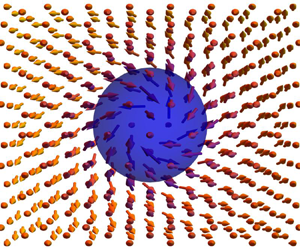
 $z$ are cylindrical coordinates as visualized in figure 1. The solution that obeys (4.2a,b) in the absence of odd viscosity and satisfies the inner and outer boundary is given by (Proudman & Pearson Reference Proudman and Pearson1957)
 \begin{equation} \psi^{(1,{s})} = \frac{3}{32}\,\varpi ^2 \left(\frac{1}{r^3}-\frac{3}{r}+2\right) -\frac{3}{32}\,\varpi ^2 z\left(\frac{1}{r^5}-\frac{1}{r^4}+\frac{1}{r^3}-\frac{3}{r^2}+\frac{2}{r}\right), \end{equation}
with  $r =\sqrt {\varpi ^2 + z^2 }$. Now we move to
 $u^{(1,{o})}_{i}$. As a first step, let us define
 $u^{(1,{o})}_{i} = u^{\prime (1,{o})}_{i} + u^{\prime \prime (1,{o})}_{i}$, with
 \begin{equation} u^{\prime (1,{o})}_{ \varpi} = 0,\quad u^{ \prime (1,{o})}_{\phi } ={-} \frac{ \partial_{z }\psi^{(1,{s})}}{\varpi},\quad u^{\prime (1,{o})}_{z } = 0, \end{equation}
so that at  $O(\gamma _o)$, (4.2a,b) reduce to
 \begin{equation} \varDelta u^{\prime \prime (1,{o})}_i - \boldsymbol{\nabla}_i p^{(1,{o})}_{{m}} = u^{(0,{s})}_j\, \boldsymbol{\nabla}_j u^{(0,{o})}_i + u^{(0,{o})}_j\,\boldsymbol{\nabla}_j u^{(0,{s})}_i. \end{equation}
The right-hand side of (4.6) only has a non-vanishing  $\phi$-component, thus
 $u^{(1,{o})}_i$ also only has a non-vanishing
 $\phi$-component. The only possible contribution from pressure therefore also comes from the
 $\phi$ gradient, which vanishes due to axial symmetry. Equation (4.6) thus simplifies to
 \begin{equation} \varDelta u^{\prime \prime (1,{o})}_{\phi} = u^{(0,{s})}_j\, \boldsymbol{\nabla}_j u^{(0,{o})}_{\phi}. \end{equation}
The solution to (4.7) is given by
 \begin{align} u^{\prime \prime (1,{o})}_{\phi} &= \frac{1}{32}\,\varpi \left(-\frac{1}{r^6} + \frac{ A_1}{r^5} -\frac{12}{r^4} + \frac{ A_2}{r^3 } \right) \nonumber\\ &\quad +\frac{1}{32}\,\varpi ^3 \left(\frac{3}{4 r^8} - \frac{5 A_1}{4 r^7} +\frac{18}{r^6}-\frac{12}{r^5}-\frac{9}{2 r^4}+\frac{6}{r^3} \right), \end{align}
where the coefficients  $A_1$ and
 $A_2$ must be found by imposing the boundary conditions. For the outer boundary condition, we must consider (4.1), which together with (4.5a–c) yields the outer boundary condition
 \begin{equation} u^{\prime \prime (1,{o})}_{\phi} = \frac{3 \varpi ^3}{16 r^3}\quad \text{as}\ r \rightarrow \infty. \end{equation}
This boundary condition is satisfied regardless of  $A_1$ and
 $A_2$. However, requiring that the inner boundary condition is satisfied leads one to find
 $A_1 = \frac {33}{5}$ and
 $A_2 = \frac {32}{5}$. Thus the complete solution is given by
 \begin{align} u^{\prime \prime (1,{o})}_{\phi} &= \frac{1}{32}\,\varpi \left(-\frac{1}{r^6} + \frac{33}{5 r^5 } -\frac{12}{r^4} + \frac{32}{5 r^3}\right) \nonumber\\ &\quad +\frac{1}{32}\,\varpi ^3 \left(\frac{3}{4 r^8} - \frac{33}{4 r^7} + \frac{18}{r^6}-\frac{12}{r^5}-\frac{9}{2 r^4}+\frac{6}{r^3}\right). \end{align}
Having obtained a complete solution up to first order in odd viscosity and Reynolds number, we compute the force on the sphere corresponding to this solution. As follows from axial symmetry, there is no lift force. There is only the convective correction to drag force, which leads to a total drag force
 \begin{equation} F_D = F_i e_i = 6 {\rm \pi}a\,|U|\,\eta_s \left(1+ \tfrac{3}{8}\,Re\right) + O(\gamma_o^2, \log (Re)\,Re^2). \end{equation}
However, we do find odd viscous effects through the dimensionless torque  $\mathcal {T}^{(1)}_{k} = \int _{B} \epsilon _{ij k } x_i \sigma ^{(1)}_{jl} \,{\rm d} S_l$. Restoring dimensions, we acquire the total stream-induced torque
 $T_S$ whose value is given by
 \begin{equation} T_S = \ell_i T_i = \frac{2 {\rm \pi}a^2 }{5}\,| U|\,\eta_o\,Re + O (\gamma_o^3, \gamma_o \log (Re)\,Re^2). \end{equation}
This torque is displayed graphically in figure 1. We thus learn that convection can allow for a sphere to feel torque when moving through an odd viscous fluid in an axially symmetry way. Reflection symmetry prevents such a torque from arising for Stokes flow past a sphere (Khain et al. Reference Khain, Fruchart, Scheibner, Witten and Vitelli2023).
Graphical representation of cylindrical coordinates  $\varpi,\phi,z$ for a sphere immersed in a fluid, with streaming velocity
 $U_i$ pointed in the
 $z$-direction, and an odd viscosity whose axis of chirality
 $\ell _i$ is also pointed in the
 $z$-direction. The picture also shows the drag force
 $F_D$ and the stream-induced torque
 $T_S$ whose value is given in (4.12).

4.2. Transverse free-stream velocity
For the case where the free-stream velocity is transverse to  $\ell _i$, to explicitly solve (4.2a,b) in a way that satisfies the inner and outer boundary conditions is challenging. Fortunately, it turns out that that thanks to the Lorentz reciprocal theorem, we need not know more about the first inner solution than (4.1) and (4.2a,b) in order to obtain the first convective correction to drag and lift force on a translating sphere. The Lorentz reciprocal theorem connects two fluid systems, with the first fluid system being the one that we wish to better understand, and an auxiliary fluid system that is used to accomplish this by means of the Lorentz reciprocal theorem. The first fluid system is one corresponding to the first inner solution represented by fluid velocity
 $u^{(1)}_i$. The auxiliary fluid system labelled by
 $*$ is identical to the first fluid system except for the following three things.
(i) We consider for the auxiliary fluid system a dimensionless free-stream velocity
 $e^{*}_i$ that satisfies $(e^{*}_i)^2=1$ and $e^{*}_i \ell _i=0$, but is not necessarily parallel to $e_i$, as a parallel $e^{*}_i$ does not allow one to extract lift force (Lier Reference Lier2024).
(ii) For the auxiliary fluid system, we consider Stokes flow, i.e. flow that corresponds to the zeroth inner solution represented by fluid velocity
$u^{* (0)}_i$.(iii) In order for the Lorentz reciprocal theorem to hold for odd fluids, we require that odd viscosity of the second fluid system is given by
$\gamma ^{*}_{{o}} = - \gamma _{{o}}$ (Hosaka et al. Reference Hosaka, Golestanian and Vilfan2023b).


These differences are displayed graphically in figure 2. Starting from (4.2a,b), the Lorentz reciprocal theorem gives the relation (Brenner & Cox Reference Brenner and Cox1963; Masoud & Stone Reference Masoud and Stone2019)
 \begin{equation} \int_{S_{\infty}} (u_j^{* (0)} \sigma^{(1)}_{ij} - u_j^{ (1)} \sigma^{* (0)}_{ij}) \,{\rm d} S_i = \int_{V_{\infty}} u^{ (0)}_i\, \boldsymbol{\nabla}_i u^{ (0)}_j u^{* (0)}_{j} \,{\rm d} V, \end{equation}
where the normal of the surface integral points outwardly. Here,  $S_{\infty }$ is the surface of a sphere centred at
 $x_i$ that encloses the volume
 $V_{\infty }$ of the fluid system, whose radius will eventually be taken to infinity. Furthermore,
 $V_{\infty }$ surrounds
 $B$, the boundary of the sphere (see figure 2). To work out (4.13), we introduce the definitions
 \begin{align} I_1 = \int_{S_{\infty}} u_j^{* (0)} \sigma^{ (1)}_{ij} \,{\rm d} S_i,\quad I_2 ={-} \int_{S_{\infty}} u_j^{ (1)} \sigma^{* (0)}_{ij} {\rm d} S_i,\quad I_3= \int_{V_{\infty}} u^{ (0)}_i\,\boldsymbol{\nabla}_i u^{ (0)}_j u^{* (0)}_{j} \,{\rm d} V. \end{align}
For the first two terms, it holds that because the sphere with surface  $S_{\infty }$ will be considered infinitely large, any contribution to the integrand that is
 $O(r^{-3})$ can be discarded. To take advantage of this fact, let us introduce for a general field
 $f$ the notation
 \begin{equation} f = \sum_{n=0} (\,f )_{{-}n}\,r^{{-}n}, \end{equation}
where  $(f)_{-n}$ has no
 $r$-dependence. We first consider
 $I_1$, which in the limit of infinite sphere radius can be written as
 \begin{align} I_1 = \int_{S_{\infty}} (\sigma^{ (1)}_{ij})_{{-}1} [( u^{* (0)}_j)_0\,r^{{-}1} + ( u^{* (0)}_j)_{{-}1}\,r^{{-}2}] \,{\rm d} S_i + \int_{S_{\infty}} (\sigma^{ (1)}_{ij})_{{-}2}\,( u^{* (0)}_j)_{0}\,r^{{-}2} \,{\rm d} S_i. \end{align}
Here,  $u^{* (0)}_j$ is fully even under
 $x_i \rightarrow -x_i$, and since (4.16) is a surface integral,
 $(\sigma ^{ (1)}_{ij})_{-1}$ or
 $(\sigma ^{ (1)}_{ij})_{-2}$ must be odd under
 $x_i \rightarrow -x_i$ in order for this contribution to
 $I_1$ to be non-vanishing. This cannot come from the pressure term as it is fully even. For
 $(\sigma ^{ (1)}_{ij})_{-1}$ to give a non-vanishing contribution thus requires
 $( u^{ (1) }_j )_{0}$ to be even under
 $x_i \rightarrow -x_i$. From (4.1), it follows that
 \begin{equation} ( u^{ (1) }_j )_{0} = J_{jk} \mathcal{F}^{(0)}_k + \text{terms odd under}\ x_i \rightarrow - x_i, \end{equation}
with  $J_{jk}$ given by
 \begin{equation} J_{ij} = \frac{1}{32 {\rm \pi}}\,(3 \delta_{ij} - e_i e_j - 2 \gamma_o \varepsilon_{ij}). \end{equation}
Because this term is constant, it vanishes when computing the corresponding viscous stress. Therefore, (4.16) reduces to
 \begin{equation} I_1 = e^{*}_j \int_{S_{\infty}} \sigma^{ (1)}_{ij} \,{\rm d} S_i. \end{equation}
Now  $I_1$ can be related to the desired
 $\mathcal {F}^{(1)}_i$ whose expression is given by
 $\mathcal {F}^{(1)}_i = \int _{B } \sigma ^{(1)}_{ij} \,{\rm d} S_j$. Specifically, from (4.2a,b), it follows that
 \begin{equation} \int_{B + S_{\infty}} (\sigma^{ (1)}_{ij} - u^{(0)}_j u^{(0)}_j) \,{\rm d} S_j =0. \end{equation}
Equation (4.20) simplifies by noting that  $u^{(0)}_j =0$ on
 $B$. Furthermore, since
 $u^{(0)}_j$ is fully even under
 $x_i \rightarrow - x_i$, we have
 $\int _{B + S_{\infty }} u^{(0)}_j u^{(0)}_j \,{\rm d} S_j = 0$, from which it follows that
 $I_1 = - e^{*}_j \mathcal {F}^{(1)}_j$. We then consider
 $I_2$, which in the limit of infinite sphere radius can be written as
 \begin{equation} I_2 ={-} \int_{S_{\infty}} r^{{-}2} ( u_j^{ (1)} )_0\, (\sigma^{* (0)}_{ij} )_{{-}2} \,{\rm d} S_i. \end{equation}
Here,  $(\sigma ^{* (0)}_{ij} )_{-2}$ is odd under
 $x_i \rightarrow - x_i$, so that only the even part of
 $(u^{(1)}_j)_0$ can contribute. This term is given by (4.17), and we thus find
 \begin{equation} I_2 ={-} J_{jk} \mathcal{F}^{(0)}_k \int_{S_{\infty}}\sigma^{* (0)}_{ij} \,{\rm d} S_i. \end{equation}
Using the zeroth-order version of (4.20), it holds for the zeroth-order Stokes force that  $\mathcal {F}^{* (0)}_{i} = - \int _{S_{\infty }} \sigma ^{* (0)}_{ij} \,{\rm d} S_j$, so that (4.22) turns into
 $I_2 = - J_{jk} \mathcal {F}^{* (0)}_{j} \mathcal {F}^{(0)}_k$. Finally,
 $u^{(0)}_i$ is fully even under
 $x_i \rightarrow -x_i$, making the integrand of
 $I_3$ fully odd under
 $x_i \rightarrow -x_i$, thus
 $I_3 =0$. Combining the results for
 $I_1$ and
 $I_2$, (4.13) narrows down to
 \begin{equation} \mathcal{F}^{(1)}_j e^{*}_j = J_{jk}\mathcal{F}^{* (0)}_{j} \mathcal{F}^{(0)}_k. \end{equation}
We now consider two choices for  $e^{*}_i$ that enable us to extract drag and lift force, respectively. First, we take
 $e^{*}_i = e_i$. Using (4.18), (4.23) then reduces to the formula for the convective correction to drag force (Brenner & Cox Reference Brenner and Cox1963; Masoud & Stone Reference Masoud and Stone2019)
 \begin{equation} \mathcal{F}^{(1)}_j e_j = C_D^{(1)} = \frac{9 {\rm \pi}}{4 } + O(\gamma_o^2). \end{equation}
Let us now consider the case  $e^{*}_i = \varepsilon _{ij} e_j$. We find the convective lift force correction
 \begin{equation} \varepsilon_{ij} \mathcal{F}^{(1)}_i e_j = C_L^{(1)} = \frac{9 {\rm \pi}}{16}\,\gamma_o + O(\gamma_o^3). \end{equation}
Using (3.6) and restoring the dimensionality, we finally obtain the total drag force (Proudman & Pearson Reference Proudman and Pearson1957)
 \begin{equation} F_D = F_i e_i = 6 {\rm \pi}a\,|U|\,\eta_s \left(1+ \tfrac{3}{8}\,Re \right) + O (\gamma_o^2, \log(Re)\,Re^2), \end{equation}
and total lift force
 \begin{equation} F_L = \varepsilon_{ij} F_i e_j = 3 {\rm \pi}a\,|U|\,\eta_o \left(1+ \tfrac{3}{16}\,Re\right) + O(\gamma_o^3, \gamma_o \log (Re)\,Re^2). \end{equation}
In Appendix B, we show an alternative and more direct way of computing (4.25).
Graphical representation of the two fluid systems that are considered when using the Lorentz reciprocal theorem. These are (a) the first fluid system, which we wish to understand better, and (b) the auxiliary fluid system, which is used to gain understanding of the first one by means of the Lorentz reciprocal theorem.

5. Discussion
In this work, we studied the effect of convection for odd viscous flow past a sphere, and computed low Reynolds number corrections to the corresponding forces and torques. Since the low Reynolds number expansion is singular, we obtained inner and outer solutions that are matched using the method of matched asymptotic expansions. We considered two cases, namely the cases where the axis of chirality is parallel and orthogonal to the free-stream velocity. For the longitudinal case, we could use axial symmetry to fully apply the method of matched asymptotic expansions up to first order. Due to axial symmetry, lift force vanishes; however, we do find that the interplay between convection and odd viscosity can turn on torque for a translating sphere. Torque does not arise for Stokes flow, because in this case a coupling between torque and translation is precluded by the symmetry of Stokes flow under reflection along the direction of motion (Khain et al. Reference Khain, Fruchart, Scheibner, Witten and Vitelli2023). This symmetry is also called fore–aft symmetry. Interestingly, the breaking of fore–aft symmetry exhibited by the flow is also found to generate torque on a sphere translating through an even viscous fluid subject to a background rotation. In this case, the torque arises when the rotation axis is aligned with the motion, similar to how in the odd viscous case the axis of chirality is aligned with the motion. In both cases, the stream-induced torque arises at first order in Reynolds number. Aurégan, Bonometti & Magnaudet (Reference Aurégan, Bonometti and Magnaudet2023) have studied the force and torque for this rotating fluid system numerically, avoiding the need to assume certain characteristic numbers such as the Reynolds number to be small. It would be interesting to similarly numerically explore odd viscous flow past a sphere without assuming the Reynolds number or  $\gamma _o$ to be small. For Stokes flow, odd viscous flow was studied analytically and nonlinearly in
 $\gamma _o$ in Everts & Cichocki (Reference Everts and Cichocki2024).
Because the stream-induced torque arises exclusively due to convection, measuring torque is an excellent avenue for experimentally studying the interplay between convection and odd viscosity. Specifically, one could measure the rotation of a spherical object that is dropped into an odd viscous fluid that has its axis of chirality aligned with the gravitational force. A good option for the experimental realization of a three-dimensional odd viscous fluid is a suspension of externally rotated spinners, as considered by Soni et al. (Reference Soni, Bililign, Magkiriadou, Sacanna, Bartolo, Shelley and Irvine2019). However, in this work the spinners were confined to an interface, which prevents the odd viscosity from being three-dimensional. Another challenge in studying the interplay between convection and three-dimensional odd viscosity with a suspension of spinners is that such a fluid will also exhibit rotational viscosity, which can affect the torque on an obstacle.
For the transverse case, axial symmetry is broken, and the computation of convective effects on flow is more involved. We therefore computed only the first Reynolds number corrections to the forces with the help of the odd generalization of the Lorentz reciprocal theorem (Hosaka et al. Reference Hosaka, Komura and Andelman2021b). A relevant question is whether for the transverse case, stream-induced torque can also arise. Because axial symmetry breaking dramatically complicates this problem, an analytical computation of the first inner solution seems out of reach, and one instead must rely on an indirect method similar to the Lorentz reciprocal theorem that was employed to compute lift force. Because torque requires knowledge of a force dipole as opposed to a force monopole, finding such an approach is more involved.
Acknowledgements
We thank J. Everts, Y. Hosaka, T. Khain, P. Matus, C. Scheibner and P. Surówka for useful discussions. We also thank the referee for mentioning the analogy between odd viscous stream-induced torque on a sphere and torque on a sphere for fluids subject to a background rotation.
Declaration of interests
The author reports no conflict of interest.
Appendix A
To derive the first outer solution, we start from (3.11a,b) and add a point force that approximates the sphere at distances far away from it. The corresponding point force solution will turn out to satisfy the inner boundary condition (3.12). Introducing the point force yields the equations
 \begin{gather} \tilde{\boldsymbol{\nabla}}_i \tilde u^{\prime (1)}_i =0, \end{gather}
 \begin{gather}(\delta_{ij} + \gamma_{{o}} \varepsilon_{ij} )\,\tilde \varDelta \tilde u^{\prime (1)}_j - \tilde{\boldsymbol{\nabla}}_i \tilde p^{\prime (1)}_{{m}} = e_j\,\tilde{\boldsymbol{\nabla}}_j \tilde u^{\prime (1)}_i + \mathcal{F}^{(0)}_i\,\tilde \delta, \end{gather}
where  $\tilde \delta$ is the three-dimensional Dirac delta function located at the origin. Following Pozrikidis (Reference Pozrikidis1996), we take the divergence of (A1b) to obtain
 \begin{equation} \tilde \varDelta \tilde p_{{m}}^{\prime (1)} ={-} \mathcal{F}^{(0)}_i\, \boldsymbol{\nabla}_i \tilde \delta + \gamma_o \varepsilon_{ij}\,\tilde \varDelta \tilde{\boldsymbol{\nabla}}_i u^{\prime (1)}_j. \end{equation}
Using the relation  $\tilde \delta = - \tilde \varDelta ({1}/{4 {\rm \pi}\tilde r})$, (A2) can be solved as
 \begin{equation} \tilde p^{\prime (1)}_{{m}} = \mathcal{F}^{(0)}_i\, \tilde{\boldsymbol{\nabla}}_i \frac{1}{4 {\rm \pi}\tilde r} + \gamma_o \varepsilon_{ij}\, \tilde{\boldsymbol{\nabla}}_i \tilde u^{\prime (1)}_j. \end{equation}
Plugging this back into (A1b), we obtain
 \begin{equation} e_j\,\tilde{\boldsymbol{\nabla}}_j \tilde u^{\prime (1)}_i = [\delta_{ij}\,\tilde \varDelta + \gamma_{{o}} (\varepsilon_{ij}\, \tilde \varDelta - \varepsilon_{k j }\,\tilde{\boldsymbol{\nabla}}_i \tilde{\boldsymbol{\nabla}}_k)]\tilde u^{\prime (1 )}_j + \frac{ \mathcal{F}^{(0)}_j}{4 {\rm \pi}}\, (\delta_{ij}\,\tilde \varDelta - \tilde{\boldsymbol{\nabla}}_i \tilde{\boldsymbol{\nabla}}_j)\,\frac{1}{\tilde r}. \end{equation}
At zeroth order in  $\gamma _{{o}}$, (A4) can be solved with
 \begin{equation} \tilde u^{\prime (1,\text{s})}_i ={-} \mathcal{F}^{(0,{s})}_j (\delta_{ij}\,\tilde \varDelta - \tilde{\boldsymbol{\nabla}}_i \tilde{\boldsymbol{\nabla}}_j)\,\mathbb{M}, \end{equation}
where  $\mathbb {M}$ is given by
 \begin{equation} (\tilde \varDelta - e_j\,\tilde{\boldsymbol{\nabla}}_j)\, \mathbb{M} = \frac{1}{4 {\rm \pi}\tilde r}. \end{equation}
Note that the ansatz of (A5) is such that (A1a) is automatically satisfied. We can take the Laplacian of (A6) to find
 \begin{equation} (\tilde \varDelta - e_j\,\tilde{\boldsymbol{\nabla}}_j)\, \varDelta \mathbb{M} ={-}\tilde \delta. \end{equation}
We define
 \begin{equation} \tilde \varDelta \mathbb{M} = \varPhi \exp(\tilde x_i e_i / 2), \end{equation}
so that (A7) turns into the Helmholtz equation
 \begin{equation} \tilde \varDelta \varPhi - \tfrac{1}{4} \varPhi ={-} \tilde \delta, \end{equation}
whose solution is given by
 \begin{equation} \varPhi = \frac{1}{4 {\rm \pi}\tilde r} \exp(- \tilde r /2). \end{equation}
Equation (A8) then turns into
 \begin{equation} \tilde \varDelta \mathbb{M} = \frac{\exp(- \tilde\zeta )}{4 {\rm \pi}\tilde r}, \end{equation}
with  $\tilde \zeta = \frac {1}{2} (\tilde r - \tilde x_i e_i)$. Equation (A11) can be solved to find (Pozrikidis Reference Pozrikidis1996)
 \begin{equation} \mathbb{M} = \frac{1}{4 {\rm \pi}} \int_0^{\tilde \zeta} \frac{1 - \exp(- \xi)}{\xi}\,{\rm d} \xi. \end{equation}
Having found  $\tilde u^{\prime (1,{s})}_i$, we move on to
 $\tilde u^{\prime (1,{o})}_i$. For this, we take the ansatz
 \begin{equation} \tilde u^{\prime (1,{o})}_i ={-} \mathcal{F}^{(0,{s})}_j {\mathsf{A}}_{i j k l}\, \tilde{\boldsymbol{\nabla}}_k \tilde{\boldsymbol{\nabla}}_l \mathbb{N} - \mathcal{F}^{(0,{o})}_j (\delta_{ij}\,\tilde \varDelta - \tilde{\boldsymbol{\nabla}}_i \tilde{\boldsymbol{\nabla}}_j)\,\mathbb{M}, \end{equation}
where  ${\mathsf{A}}_{i j k l}$ is some four-tensor. The second term on the right-hand side of (A13) cancels out the odd part of the point-force term in (A4). Plugging (A13) into (A4) and considering the contributions
 $O(\gamma _{{o}})$, we find
 \begin{equation} \mathcal{F}^{(0,{s})}_j {\mathsf{A}}_{i j k l }\,\tilde{\boldsymbol{\nabla}}_k \tilde{\boldsymbol{\nabla}}_l(\tilde \varDelta \mathbb{N} - e_m\, \tilde{\boldsymbol{\nabla}}_m \mathbb{N})={-} \mathcal{F}^{(0,{s})}_j (\varepsilon_{il}\,\tilde \varDelta - \varepsilon_{k l }\,\tilde{\boldsymbol{\nabla}}_i \tilde{\boldsymbol{\nabla}}_k) (\delta_{lj} \tilde\,\varDelta - \tilde{\boldsymbol{\nabla}}_l \tilde{\boldsymbol{\nabla}}_j)\,\mathbb{M}. \end{equation}
Simplifying leads to
 \begin{equation} {\mathsf{A}}_{i j k l }\,\tilde{\boldsymbol{\nabla}}_k \tilde{\boldsymbol{\nabla}}_l (\tilde \varDelta \mathbb{N} - e_m\,\tilde{\boldsymbol{\nabla}}_m \mathbb{N}) ={-} (\varepsilon_{ij}\delta_{kl}+ \varepsilon_{j k} \delta_{il} - \varepsilon_{ik} \delta_{l j})\,\tilde{\boldsymbol{\nabla}}_k \tilde{\boldsymbol{\nabla}}_l \varDelta \mathbb{M}. \end{equation}
To solve (A15), we take
 \begin{equation} {\mathsf{A}}_{ij k l } = \varepsilon_{ij} \delta_{kl} + \varepsilon_{j k} \delta_{il} - \varepsilon_{ i k } \delta_{l j}, \end{equation}
and also impose
 \begin{equation} \tilde \varDelta \mathbb{N} - e_i\,\tilde{\boldsymbol{\nabla}}_i \mathbb{N} ={-} \tilde \varDelta \mathbb{M}. \end{equation}
Note that we have
 \begin{align} \tilde{\boldsymbol{\nabla}}_i \tilde u^{\prime (1,{o})}_i &={-} \tilde{\boldsymbol{\nabla}}_i [\mathcal{F}^{(0)}_j ( \varepsilon_{ij} \delta_{kl} + \varepsilon_{j k} \delta_{il} - \varepsilon_{ i k } \delta_{l j} )\, \tilde{\boldsymbol{\nabla}}_k \tilde{\boldsymbol{\nabla}}_l \mathbb{N}] \nonumber\\ &={-} \frac{\mathcal{F}^{(0)}_j }{\eta_s }\,(\varepsilon_{kj}\,\tilde{\boldsymbol{\nabla}}_k + \varepsilon_{j k }\,\tilde{\boldsymbol{\nabla}}_k)\,\tilde \varDelta \mathbb{N} =0, \end{align}
thus incompressibility is guaranteed for  $\tilde u^{(1,{o})}_i$. Proceeding, we find that with the help of (A11), (A17) can be rewritten as
 \begin{equation} \tilde \varDelta \mathbb{N} - e_i\,\tilde{\boldsymbol{\nabla}}_i \mathbb{N} ={-} \frac{\exp(- \tilde \zeta)}{4 {\rm \pi}\tilde r}, \end{equation}
which is solved when one takes
 \begin{equation} \mathbb{N} = \frac{\exp(- \tilde \zeta )}{ 4 {\rm \pi}}. \end{equation}
The combination of (A3), (A5) and (A13) fully specifies  $\tilde u^{\prime (1,{o})}_i$. It turns out that this point force solution satisfies (3.12), and therefore
 $\tilde u^{(1,{o})}_i = \tilde u^{\prime (1,{o})}_i$. We have thus obtained (3.14).
Appendix B
In this appendix, we show a more direct way to compute the convective corrections to the Stokes forces from the first outer solutions. First, let us define
 \begin{equation} v_i ={-} Re \,\tilde u^{(1)}_i, \end{equation}
where  $\tilde u^{(1)}_i$ is the first outer solution given in (3.14). We revert back to the coordinate
 $r$ and to the frame where the fluid is stationary at
 $r \rightarrow \infty$ and the sphere is moving with a sphere velocity
 $V_{i} = - U_{i}$. We then find the fluid velocity
 \begin{equation} v_i = (H^{({s})}_{ij} + \gamma_{{o}} H^{({o})}_{ij}) \mathcal{F}^{(0)}_j + O( \gamma_{{o}}^2), \end{equation}
where we introduced the Green's functions  $H^{({s})}_{ij}$ and
 $H^{({o})}_{ij}$ given by
 \begin{gather} H^{({s})}_{ij} = \frac{1}{4 {\rm \pi}\,{Re}}\,(\delta_{ij}\,\varDelta - \boldsymbol{\nabla}_j \boldsymbol{\nabla}_i) \int_0^{Re \,\zeta} \frac{1 - \exp(- \xi)}{\xi}\,{\rm d} \xi, \end{gather}
 \begin{gather}H^{({o})}_{ij} = \frac{1}{4 {\rm \pi}\,{Re}}\,(\varepsilon_{ij} \delta_{kl} + \delta_{l i} \varepsilon_{j k} - \delta_{l j } \varepsilon_{i k})\,\boldsymbol{\nabla}_k \boldsymbol{\nabla}_l \exp(- Re\,\zeta), \end{gather}
with  $\zeta = \frac {1}{2}( r - x_i e_i )$. Since we are interested in the transverse case, we take
 $\mathcal {F}^{(0)}_i \ell _i =0$. To compute the inertial corrections, we will follow the method described in Pozrikidis (Reference Pozrikidis1996). This method involves extracting the inertial correction to the Stokes force by looking at how, from the point of view of the first outer solution, the sphere is accelerated by convection. To see this, let us expand
 $v_i$ for small
 $r$ using the notation introduced in (4.15). It follows from the matching condition (3.12) that
 $( v_i)_{-1}$ is given by the zeroth inner solution, which represents Stokes flow. Therefore,
 $( v_i)_{-1}$ does not depend on Reynolds number. For the sub-leading contribution, we find from (B2) that
 \begin{align} ( v_i)_0 &={-} \frac{{Re}}{16 {\rm \pi}} \left[(\delta_{ij} - e_{i} e_{j}) \left(\frac{3}{2} - \frac{ x_{{\parallel}} ( 4 r^2 - x_{{\parallel}}^2 - z^2 )}{2 r^3}\right)+ e_{i} e_{j} \left(1 - \frac{ x_{{\parallel}} ( x_{{\parallel}}^2 + r^2 )}{2 r^3 } \right) \vphantom{\left(1 - \frac{x_{{\parallel}} ( r^2 - z^2 )}{2 r^3 }\right)}\right. \nonumber\\ &\quad \left.{}-\varepsilon_{ij} \gamma_o \left(1 - \frac{x_{{\parallel}} ( r^2 - z^2 )}{2 r^3 }\right)\right] \mathcal{F}^{(0)}_j + O(\gamma_{{o}}^2, Re^2), \end{align}
where  $x_{\parallel } = e_l x_l$. The right-hand side of (B4) tells us the effective correction to the sphere velocity due to convective corrections. Only the part that is even under
 $x_i \rightarrow - x_i$ can be viewed as such an effective sphere velocity correction, whereas the part that is odd has its effective contribution to the sphere velocity cancelled out. Focusing on the part of (B4) that is even under
 $x_i \rightarrow - x_i$, we find
 \begin{equation} ( v_i)_0 ={-}Re\, J_{ij} \mathcal{F}^{(0)}_j + \text{terms odd under}\ x_i \rightarrow - x_i + O( \gamma_{{o}}^2, Re^2), \end{equation}
where  $J_{ij}$ was defined in (4.18). We then extract from (B5) the leading-order contribution to the effective sphere velocity
 $V_i^{\prime }$, which is given by
 \begin{equation} V_i^{\prime} = V_i - Re\,J_{ij} \mathcal{F}^{(0)}_j. \end{equation}
We then use the formula for the Stokes force of (3.6) to find the effective Stokes force induced by  $V_i^{\prime }$. We find
 \begin{align} \mathcal{F}^{\prime (0)}_i &={-} (C^{(0)}_D \delta_{ij} + C^{(0)}_L \varepsilon_{ij}) V^{\prime}_j \nonumber\\ &= [(C^{ (0)}_D + Re \, C^{ (1)}_D) \delta_{ij} + (C^{(0)}_L + Re \, C^{ (1)}_L) \varepsilon_{ij}] U_j, \end{align}
where
 \begin{equation} C^{(1)}_D = \frac{9 {\rm \pi}}{4} + O( \gamma_{{o}}^2),\quad C^{(1)}_L = \frac{9 {\rm \pi}}{16}\,\gamma_o + O( \gamma_{{o}}^3). \end{equation}


 Open access

