Hunting and gathering represents the oldest and perhaps the most successful human lifeway. As such, it may hold the key to answering some of the central questions about being human—about social life, politics, gender, nutrition, and living in nature without destroying it (Jordan Reference Jordan, Bentley, Maschner and Chippendale2008:447). Hunter-gatherer societies held sway in midwestern North America for at least 11,000 years, or until the first century before the Common Era; consequently, the region represents a rich context for investigation. The majority of this vast time frame has been divided by regional archaeologists into a Paleoindian (>11,500–10,000 BP) and a subsequent Archaic period (10,000–2700 BP), based on changing subsistence practices, assemblages, site structures, and inferred organizational characteristics. At a grand scale, we certainly see an increase in social complexity across this span, and with many more people at the end of this episode than at the beginning. Explanations of long-term change in midwestern Paleoindian and Archaic societies, however, have been relatively few, somewhat unsatisfying, and perhaps too generalized (Emerson and McElrath Reference Emerson, McElrath, Emerson, McElrath and Fortier2009:24, 27). This contrasts with the comparative theoretical richness regarding change within the much “hotter” societies—to paraphrase Lévi-Strauss (Reference Lévi-Strauss1966:233–234)—of the succeeding Woodland and Mississippian periods. In this article, we examine long–term change in the early Midwest from the perspective of raw material supply as a measure of mobility and focus particularly on the Upper Mercer and Flint Ridge outcrops of east-central Ohio.Footnote 1 We relate our specific study findings back to more general considerations of how cultures change and how we see the evidence for that change archaeologically. Not all change is in the same direction, nor does it all propel complexity.
To again paraphrase Lévi-Strauss (Reference Lévi-Strauss1963:89), mobility is good to think with. Differences in residential mobility among human groups are vast and contribute to the construction of vastly different realities. Americans move their residences on average 11.7 times (United States Census Bureau 2018), and this seems like a big number as we contemplate U-Hauls and broken heirlooms. The limited scale of contemporary American residential mobility, however, comes to the fore when we consider that a 65-year-old Montagnais of the Canadian forest would have moved her or his residence over 3,200 times (Kelly Reference Kelly1995:125). This kind of observable difference between cultures is a testimony to human problem-solving capabilities and carries important implications in its own right, but our special concern as archaeologists often comes in considering mobility patterns at space/time scales far broader than what has been observed in the ethnographic record (Kelly Reference Kelly1995:333–344; Lucas Reference Lucas2005:54–55). Collectively and regularly, we have directed our broad brushes toward those relationships that tie long-term mobility patterns to discussion of changing environment, population, and social complexity, more often than not, within an explicitly neoevolutionary framework.
Mobility has been a key component of neoevolutionary models of long-term change going well back to the 1960s and 1970s. Binford (Reference Binford, Binford and Binford1968, Reference Binford1980) was one of the first to posit a causal link from environmental change to mobility change, and from mobility change to changes in population size/density and social complexity, all in an explicitly neoevolutionary framework. Brown (Reference Brown, Price and Brown1985) and others followed this same general line in explaining increasing complexity among foragers in eastern North America, and one-way neoevolutionary models continue to underlie most broad-scale interpretations of the ancient past in our region (Emerson and McElrath Reference Emerson, McElrath, Emerson, McElrath and Fortier2009:24; Thompson Reference Thompson2011:413). This comes despite the fact that the actual predictive power of the key variables using ethnographic samples has been shown to be quite uneven (Binford Reference Binford2001:312; Collard et al. Reference Collard, Buchanan, O'Brien and Scolnick2013:5; Hamilton et al. Reference Hamilton, Lobo, Rupley, Youn and West2016:129–131; Kelly Reference Kelly1995:310; Vaesen et al. Reference Vaesen, Collard, Cosgrove and Roebroeks2016). Consequently, we believe there is value in considering more socially contingent and historiographic perspectives on long-term change among forager societies in the distant past (see Preucel and Mrozowski Reference Preucel, Mrozowksi, Preucel and Mrozowski2010; Sassaman and Randall Reference Sassaman, Randall and Pauketat2012:22–25; Trigger Reference Trigger1989:337–347). Here, mobility is seen more directly in the context of social histories on the land as they pertain to information, alliance, exchange, and ritual responsibilities. In framing the present investigation along these lines, we focus particularly on the long-term relations between lithic supply and environment, and secondarily on the spatial relation of everyday practice (local lithic supply) and long-distance networking (inflow of exotica). Indirectly, we see our study as bearing on how early cultures may have changed over time in the Midwest, and by extension, on how mobility relates to forager complexity.
Mobility and Lithic Supply
The concepts of mobility and lithic supply are related but not equivalent. Mobility is a settlement strategy used to reduce risk, and it plays a dominant role in the organization of forager lifeways (Amick Reference Amick2017:133; Kelly Reference Kelly1988:717). Groups that are highly mobile move frequently and across large distances. Such moves require the expenditure of considerable energy, deep planning, and effective tactics. We further recognize that mobility is a reversible condition; that it may vary seasonally, annually, or according to some other parameter; and that it is categorical in the sense that different priorities require different degrees of mobility that can be examined, for example, by gender, age, skill set, or task group (e.g., Irimoto Reference Irimoto1981:129–131). The size of a foraging group's home range has been shown to be a useful ethnographic measure of relative mobility (Hamilton et al. Reference Hamilton, Lobo, Rupley, Youn and West2016:127, 130; Kelly Reference Kelly1995:130–131).
Archaeologically, lithic raw material distributions often have been used to measure mobility. The bridging assumption here is that toolstone choices should become more limited as home range size decreases. In the Midwest, the notion that toolstone choices became more localized as the Paleoindian and Archaic periods unfolded has long been suggested (e.g., Cook Reference Cook and Munson1980; Deller Reference Deller, Ellis and Lothrop1989; Koldehoff and Loebel Reference Koldehoff, Loebel, Adams and Blades2009; Munson and Munson Reference Munson, Munson, Butler and May1984). As Ellis (Reference Ellis2011:390) noted, however, the long-term accumulation of diagnostic tools across any landscape almost always represented hundreds of years of shifting hunter-gatherer priorities, which in turn produced distributions of varying size, shape, and density. The resultant palimpsests in the present, therefore, may be considerably different from any specific group's home range in the past (contra Carr Reference Carr2017; Daniel Reference Daniel2001; Gramly Reference Gramly, Laub, Miller and Steadman1988; Koldehoff and Loebel Reference Koldehoff, Loebel, Adams and Blades2009). Diachronic archaeological data conform to their own long-term parameters quite differently (and a good deal more messily) in spatiotemporal scale from the “snapshots” experienced by ethnographic participant observers (Bailey Reference Bailey2007). Consequently, we see lithic supply patterns as only indirect and generalized measures of comparative hunter-gatherer mobility and not directly interpretable as ancient home ranges per se.
Lithic supply studies addressing mobility generally take one of two tacks. They are predominantly either site centered or source centered. The first focuses on a specific site or small set of sites and examines the distances that various raw materials had to move from a source to a given depositional context. This is essentially what Flannery (Reference Flannery and Flannery1976) referred to years ago as an “empirical catchment” approach to material supply, and it continues to be utilized in a variety of archaeological contexts (e.g., Bamforth Reference Bamforth2009:153; Biró Reference Biró, Adams and Blades2009:51; Soto Reference Soto2016). An advantage is that it allows a comparative assessment of curation and raw material choice for different tool types in a given assemblage (e.g., Jones et al. Reference Jones, Back, Jones and Hughes2003:22).
The second, or source-centered, approach examines summary distance/direction relationships from a given source to numerous archaeological find spots of temporally diagnostic materials. Thus, for example, Cantin (Reference Cantin2000:63,70) uses a sample of 83 early Archaic Thebes biface find locations in Indiana, constructs a summary fall-off curve for distance from the Wyandotte flint source, documents a steep drop-off at 150 km from source, and infers a foraging range of that size. The source-centered approach carries a regional orientation and is the focus of our study.
Furthermore, to facilitate longitudinal comparisons, we introduce here the concept of “lithic supply zone” as a comparative measure of mobility. As defined, a lithic supply zone (LSZ) is that area immediately around a single raw material source where it was directly accessed and beyond which is seen a major drop-off in the frequency of that source (McCoy et al. Reference McCoy, Ladefoged, Blanshard and Jorgensen2010:174).Footnote 2
An LSZ should decrease in size with a decrease in mobility, all other things being equal. This, however, poses the problem of actually measuring the extent of the LSZ, particularly as the “edge” of direct supply is approached. This may be less of a problem in situations where there is a rapid change in the percentage of a given raw material over distance; for example, Tankersley (Reference Tankersley, Tankersley and Isaac1990:283) notes sharp decreases in the percent of Clovis/Gainey points made of Hopkinsville flint 75 km from source, Wyandotte flint 250 km from source, and Upper Mercer flint 250 km from source. It also must be noted in these cases that the highlighted changes in slope occurs when the primary materials are only about 10% to 5% of the total at these distances. Such percentages seem too low when considering direct procurement as a primary supply process, although Tankersley may have constructed percentages somewhat differently than in our approach. Burke (Reference Burke, Bressy, Burke, Chalard and Martin2006:4) suggests 50% as a reasonable criterion for identifying the boundaries of a single-source LSZ. In practice, LSZ boundaries are clinal in nature and therefore subject to multiple interpretations. Fortunately, the present study is less concerned with boundaries or edges per se and more concerned with comparative pattern evaluations across time. That said, our interest is more with those areas where a given material constitutes 70% or 50% of the total, rather than 20% or 10%, and where we assume a larger variety of supply processes may be at work.
It is to be expected that diagnostics made of less frequently used, minority raw materials also will occur within the bounds of a constructed LSZ. For purposes of this study, we selectively will examine some of them. We are interested particularly in determining if they are locally derived and generally lesser-quality materials, or if they are higher-quality exotics derived from afar. Lesser-quality, local materials are often the result of ad hoc, opportunistic replacement of tools preferentially made from higher-quality, more desirable sources (Jones et al. Reference Jones, Fontes, Horowitz, Beck and Bailey2012:354; Tankersley Reference Tankersley, Tankersley and Isaac1990:274). Alternatively, the consistent presence of exotic, high-quality resources within a supply zone is more likely to represent the convenient discard of more widely ranging treks, personal in-migration, or long-distance exchange (Amick Reference Amick2017:131, 133). In sum, the organizational implications of these alternatives—exotic versus local supplementation—are different, with the former more likely associated with more spatially expansive social networks (Buchanan et al. Reference Buchanan, Hamilton, David Kilby and Gingerich2016).
Our interpretive interests in examining lithic supply lie primarily in two areas. First, we are interested in LSZ size and shape over time. We assume that a trend toward less mobility (increased sedentism) should be tracked by ever smaller LSZs. A gradualist or “settling in” model toward sedentism and complexity was first developed in eastern North America in the 1950s by Caldwell and later put into explicitly neoevolutionary terms by Winters and Brown, now driven by environmental change (Carlson Reference Carlson, Jeske and Charles2003:72; Sassaman Reference Sassaman2010:9–10, 144–145). This sort of thinking is still foundational in the explanation of cultural change in the eastern North American past (e.g., Benn and Thompson Reference Benn, Thompson, Emerson, McElrath and Fortier2009:525–528; Stafford et al. Reference Stafford, Richards and Anslinger2000:332; Stothers et al. Reference Stothers, Abel, Schneider, Prufer, Pedde and Meindl2001:246–247, 258–262). Others have critically examined this perspective and at the same time promoted models of change in the area relating to the importance of particular histories and practice in explaining structural change (Emerson and McElrath Reference Emerson, McElrath, Emerson, McElrath and Fortier2009:27–35; McElrath and Emerson Reference McElrath, Emerson, Emerson, McElrath and Fortier2009:844–848; McElrath et al. Reference McElrath, Fortier, Koldehoff, Emerson, Emerson, McElrath and Fortier2009:365–366; Sassaman Reference Sassaman2010:xvii, 10, 25, 145–148, 180–181). Second, we want to document and interpret the relationships that exist between LSZ size/shape and the pattern of exotics as they pertain to sources of varying direction and distance. These ties to more distant places can be expected to vary under varying social circumstances, and they pertain not only to the extension of alliance networks important for regional stability and identity (Sassaman Reference Sassaman2010:12, 50, 147) but also as demonstrations of the personal powers and special abilities that serve to legitimize social inequalities (Helms Reference Helms1988).
Materials Studied
Hafted Bifaces
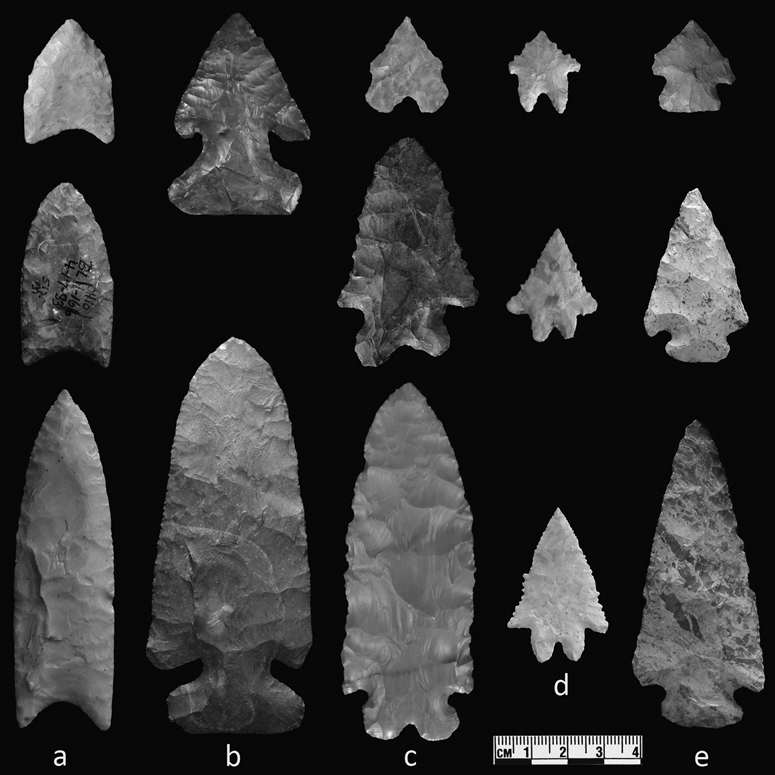
In order to examine long-term trends in mobility, five biface forms were selected based on their broad known distributions across the study area and their relative ease of identification, even when extensively resharpened (Figure 1). We assume that raw materials used to make diagnostic hafted bifaces provide a useful comparative measure of lithic supply, but we realize that they do not necessarily capture all dimensions or scales of archaeological interest (Bamforth Reference Bamforth2009). The four earliest of these forms are of a common lineage beginning with Clovis (Sassaman Reference Sassaman2010:21–39). The fifth and most recent is probably also similarly affiliated, although the tracing of this last line is less direct and requires additional evaluation. We expect, consequently, that certain core sensibilities toward people, plants, animals, the land, and the supernatural would be maintained by the people who made these tools. Below are the five biface types in the present study.
Five study biface types showing the effects of resharpening: (a) Clovis/Gainey, (b) Thebes, (c) MacCorkle, (d) LeCroy, (e) Brewerton Corner-Notched.

Clovis/Gainey
These basally fluted, parallel-sided bifaces mark a stylistic continuum, and they are the earliest but most common Paleoindian projectile point form in the region (Seeman et al. Reference Seeman, Summers, Nilsson, Barans and Gingerich2018). Clovis/Gainey points date to the period 11,500–10,800 BP, and they are coincident with Late Glacial conditions of the Bølling-Allerød and Younger Dryas (Ellis et al. Reference Ellis, Carr and Loebel2011:535–536). At this time, glacial ice was over 200 km to the north, and coniferous and mixed coniferous/deciduous forest with open glades predominated in the study area. Pine replaced spruce around 10,800 BP (Ellis et al. Reference Ellis, Carr and Loebel2011:537–538), or perhaps as late as 10,000 BP (Yu Reference Yu2000:1736), signaling dryer conditions. The Lake Erie shoreline was much lower than today, with the entirety of the Western Basin exposed as dry land—a condition that prevailed until 4500 BP (Holcombe et al. Reference Holcombe, Taylor, Reid, Warren, Vincent and Herdendorf2003:696–698). We presume that the Ohio River and its northerly tributaries had transitioned from braided streams to incised, single-thread systems by this time, although the picture is far from clear (Purtill Reference Purtill2012; Rogers Reference Rogers1990:73, 82). Terrestrial environments were patchy, with high spatial variability (Ellis et al. Reference Ellis, Carr and Loebel2011:537–538). This represents the period of lowest mast potential within the study parameters, with minimal hickory, beech, or chestnut. Caribou were present in the region (Seeman et al. Reference Seeman, Nilsson, Summers, Morris, Barans, Dowd and Newman2008). Early Paleoindian societies in the Midwest relying on Clovis/Gainey fluted bifaces are assumed to be among the most mobile in human history (Ellis Reference Ellis2011:392).
Thebes
This is a type cluster with a number of specific regional styles characterized by long, wide bifaces with deep haft notching, heavily ground bases, blade serration, and unifacial, beveled resharpening (Justice Reference Justice1987:54–60). In this article, we specifically exclude the St. Charles form based on stylistic and distributional characters (McElrath et al. Reference McElrath, Fortier, Koldehoff, Emerson, Emerson, McElrath and Fortier2009:360), although Justice (Reference Justice1987) includes it in the type cluster. Thebes points occur stratigraphically above Early Side-Notched points and below Kirk Corner-Notched points at the Caesars Archaeological Project in southern Indiana and are dated to the period 9500–9000 BP (Nolan and Fishel Reference Nolan, Fishel, Emerson, McElrath and Fortier2009:422–423; Stafford and Cantin Reference Stafford, Cantin, Emerson, McElrath and Fortier2009:292). Thebes bifaces are therefore coincident with the earliest Holocene and the establishment of modern climatic gradients in the region (Shane et al. Reference Shane, Snyder, Anderson, Prufer, Pedde and Meindl2001:35). Comparatively, forests were less open than previously, and seasonality was more pronounced. Pine was still present, but forests carried a stronger deciduous character, with high percentages of oak (Ellis et al. Reference Ellis, Carr and Loebel2011:538; Shane et al. Reference Shane, Snyder, Anderson, Prufer, Pedde and Meindl2001:29; Yu Reference Yu2000:1737). All subsequent Archaic populations experienced less environmental and vegetational change than during this time interval (Delcourt and Delcourt Reference Delcourt and Delcourt2004:135).
MacCorkle Stemmed
This is a large, serrated-bladed, diagonally notched biface with a bifurcated base and rounded basal ears that project slightly laterally (Justice Reference Justice1987:86–89). MacCorkle points occur stratigraphically above Kirk Corner-Notched forms and below LeCroy bifurcate points at the St. Albans site (Broyles Reference Broyles1971:49). We accept a time range of 8900–8500 BP following Nolan and Fishel (Reference Nolan, Fishel, Emerson, McElrath and Fortier2009:435). At this time and shortly before, it can be assumed that the Ohio River floodplain was actively aggrading with extensive overbank sedimentation based on the presence of deeply buried floodplain sites along the Ohio and at least its northerly flowing tributary, the Kanawha (Broyles Reference Broyles1971; Robinson et al. Reference Robinson, Johnson, Cummings, Bastianini and Siemon2010; Stafford and Cantin Reference Stafford, Cantin, Emerson, McElrath and Fortier2009).
LeCroy
This is a small, thin, serrated biface often made on a flake blank with sharply eared shoulders and a bifurcated base (Justice Reference Justice1987). LeCroy bifaces occur in stratified, dated contexts at the St. Albans, Rose Island, West Blennerhassett Island, and Rodgers Shelter sites, among others, and provide a basis for a temporal placement of 8400–8100 BP (Ellis et al. Reference Ellis, Timmins, Martelle, Emerson, McElrath and Fortier2009:802; Nolan and Fishel Reference Nolan, Fishel, Emerson, McElrath and Fortier2009:437; Robinson et al. Reference Robinson, Johnson, Cummings, Bastianini and Siemon2010:Appendix H). At St. Albans, these bifaces are stratigraphically above MacCorkle and St. Albans forms and below Kanawha Stemmed. At West Blennerhassett Island, LeCroy points occur below Kirk Serrated bifaces.Footnote 3 At this time, the upper Great Lakes had established a confluent lake system and Lake Erie now received regular flow from the Detroit River (Larsen Reference Larsen and Halsey1999:28), thereby creating a stronger barrier between what is now Ohio and Ontario to the north. Lake Erie lake levels were still well below modern averages (Holcombe et al. Reference Holcombe, Taylor, Reid, Warren, Vincent and Herdendorf2003:698). Farther to the west, this period is associated with the start of warmer conditions sometimes referred to as the Hypisithermal, but this is not as evident in Ohio or farther to the east where there is oscillating climatic variability (Li et al. Reference Li, Yu and Kodama2007; Purtill Reference Purtill, Emerson, McElrath and Fortier2009:568).
Brewerton Corner-Notched
This diagnostic form is broad-bladed, relatively thick, corner-notched biface associated with the Laurentian tradition (Justice Reference Justice1987). In Ohio, this form is frequently resharpened to a pentagonal shape and/or recycled into end scrapers. Brewerton Corner-Notched bifaces occur in well-dated contexts in Ontario and New York, with a suggested temporal placement of 5000–4500 BP (Ellis et al. Reference Ellis, Timmins, Martelle, Emerson, McElrath and Fortier2009:808). This approximates a time when multiseason sedentism and increased territoriality become more prominent in general discussions of the archaeological record across much of the Midwest (Emerson et al. Reference Emerson, McElrath, Williams and Neusius1986:266–267), as well as the prospect of more formalized interaction networks (Jefferies Reference Jefferies, Gibson and Carr2004). Brewerton Corner-Notched points are associated with assemblages that include a wide range of hunting, fishing, lumbering, and nut-processing tools (Ritchie Reference Ritchie1965:87–103), as well as bannerstones of slate, granite, and Carolina chlorite. At this time, Lake Erie was still well below modern levels, but regional climate and forest communities were broadly consistent with modern values. Seasonality was less pronounced and precipitation more evenly distributed than at any previous period in the Holocene, with temperatures slightly cooler than today's averages (Shane et al. Reference Shane, Snyder, Anderson, Prufer, Pedde and Meindl2001:32–33). The Ohio River had achieved its modern configuration, and the main terrestrial resources had stabilized in approximately the patterns observed in the early nineteenth century.
The Upper Mercer and Flint Ridge Outcrops
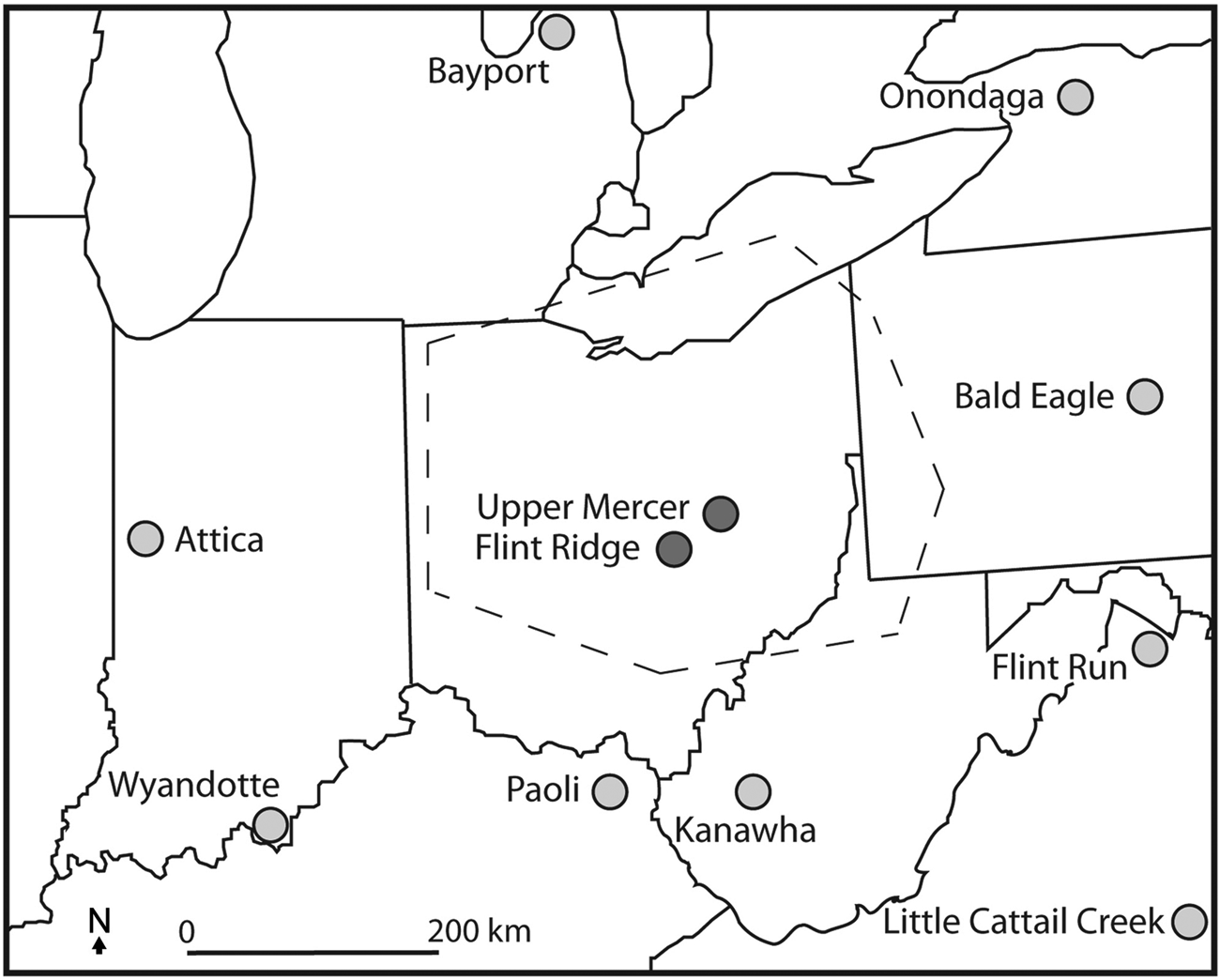
Flint is the official state gemstone of Ohio for good reason. In Ohio and immediately adjacent to its political borders, a minimum of 21 different flints associated with the Silurian, Devonian, Mississippian, Pennsylvanian, and Permian geologic time-rock units can be found. Of these, outcrops of Pennsylvanian flint along the Flint Ridge in Licking County, Ohio, and Upper Mercer flint in western Coshocton County, Ohio, are by far the most important (Carlson Reference Carlson1991). They serve as the focus of the present investigation. None of the other regional flints is of the same quality or shows the same intensity of use. Flint Ridge is typically light in color with bright hues; it is dense, translucent to semi-opaque, lustrous, and commonly milky white or bluish-white with light-gray patches or streaks, and it may range to red, yellow, brown, blue and green, and dark gray in color and with characteristic fusulinids. Upper Mercer is also typically of very good quality. It is dense and opaque with a waxy luster, and with small vugs and fractures of chalcedony and drusy quartz. It is typically black or dark gray with light-gray or tan patches and streaks, and it contains sponge spicule bioclasts, bryozoans, and echinoderms (Carlson Reference Carlson1991:14–16). In cases of apparent overlap, the greater edge translucency of Flint Ridge is the single best identifier, which relates to Luedtke's (Reference Luedtke1992:122) comment that Flint Ridge “has a luminous quality that is difficult to quantify but is quite distinctive among Midwestern cherts.” Lithic materials of comparable quality to Flint Ridge and Upper Mercer, such as the Wyandotte flint of south-central Indiana or the Onondaga flint of western New York, lie 200 km or more in all directions, and it is useful to consider their proxemics as alternative sources of high-quality raw materials (Figure 2).Footnote 4, Footnote 5
Location of the main outcrops of Flint Ridge and Upper Mercer flint and nearest high-quality sources within 400 km. Thiessen polygon drawn with borders midway between calculated weighted center of UM/FRF outcrops and nearest high-quality sources.

Early archaeologists documented the magnitude of quarrying efforts directed toward Flint Ridge and Upper Mercer flints, and they are impressive (Fowke Reference Fowke1902:619–625). The flint from both sources is of high quality, and it is available in large, homogeneous blocks, and in beds up to 4 m thick. These properties facilitate high mobility by allowing the production of large, reducible bifaces with long use-lives (Tankersley Reference Tankersley, Tankersley and Isaac1990:275). The geographic overlap of Flint Ridge and Upper Mercer is modest, and the best sources of each lie about 35 km apart, or well within the potential home range of a single foraging group (Carskadden Reference Carskadden2004:4–8). Given the large spatial scale under consideration, and for purposes of this study, we have chosen to consider them sometimes as a single high-quality supply zone following Gramly (Reference Gramly, Laub, Miller and Steadman1988:272; see also Seeman Reference Seeman1994:276) and in other instances as separate materials.
Our Approach
The sample used for the present study was assembled opportunistically over a six-year period. We began by developing a secondary, county-level dataset for Clovis/Gainey based on the work of Fogelman and Lantz (Reference Fogelman and Lantz2006), Prufer (Reference Prufer1960, Reference Prufer1961, Reference Prufer1962, Reference Prufer1963, Reference Prufer1964), and Tankersley (Reference Tankersley1989). For later bifaces, primary data on raw material choices was assembled from museum collections, and then by in-filling geographic gaps with the collections of local historical societies, universities, and private collectors—a method found to be useful in previous distributional studies (e.g., Daniel Reference Daniel2001:243; White Reference White2014:57). The goal was to amass a sample with county-level raw material data for a minimum of five bifaces per type in order to construct comparative percentages (Daniel Reference Daniel2001:243).
Raw material identifications were made macroscopically with the aid of a type collection and microscopically using fossils and other inclusions, a method used in other large-scale projects (e.g., Burke Reference Burke, Bressy, Burke, Chalard and Martin2006:4; Cantin Reference Cantin2000:18; White Reference White2014:57). Upper Mercer and Flint Ridge are among the easier midwestern materials to identify based on texture, luster, compositional homogeneity, and diagnostic inclusions. In addition, the large size of hafted bifaces made raw material identifications easier than working with smaller materials. The authors have had considerable experience in the identification of Ohio-area raw materials.
To examine comparatively Upper Mercer/Flint Ridge (UM/FRF) lithic supply over time, we employed three perspectives, as discussed below, and with the expectation that several lines of inquiry may shed slightly different lights on lithic supply.
Perspective One (Fall-Off from Source)
Here, we examine the relative importance of UM/FRF as a function of distance from source. Distance-decay following the inverse square law is a reasonable expectation in situations where strong impediments to communication are not at work (Hodder and Orton Reference Hodder and Orton1976:196–197). A distance-decay model is about as simple (or elegant) as it gets, and it does not consider the effects of other factors, such as the “fit” of material quality to tool kit needs, social boundary effects, group size, and the number of steps, direction, and distances to discard (White Reference White2012; Wilson Reference Wilson2007). Approximations of the inverse square law have been shown to characterize a variety of spatial phenomena, from perceived sound levels to the stylization of east African sitting stool dimensions and to the distance from source zones for chert and silcrete stone tools in Australia (Clarkson and Bellas Reference Clarkson and Bellas2014:328, 331; Hodder Reference Hodder1982:52–54). Our approach here was to calculate the weighted center between the main FRF and UM outcrops, to compute the percentage of UM/FRF bifaces in each find county where the sample size was five or more, and then to group cases into 50 km intervals from source, the latter following from Ellis (Reference Ellis2011:390), Tankersley (Reference Tankersley, Tankersley and Isaac1990:283), and White (Reference White2014:65).
Perspective Two (Direction/Distance Interpolation)
A given LSZ can be seen as not only distance dependent but also direction dependent. For example, Kelly (Reference Kelly1995:138) notes that home ranges are restricted by the difficulty of crossing rough terrain, and Morrow (Reference Morrow2014) shows that major river barriers can limit travel for pedestrian foragers. The difficulty of acquiring directional data in 360-degree fashion around a given source sometimes has affected the usefulness of previous directional studies. Although far from perfect, our approach makes strides to address this limitation by tracking find spots in all directions from outcrop source.
To measure distance/direction from source, a trend-surface analysis was conducted in order to smooth individual perturbations. Using Esri ArcMap 10.5.1 mapping and analytic software, the Inverse Distance Weighted (IDW) interpolation function was constructed for each biface type. The IDW algorithm uses a series of known points, and the proximity of those points to other known points, to estimate a value surface. This function provides more reliable results than the Kriging geostatistical interpolation in estimating a surface layer for this dataset (Colucci Reference Colucci2017:64–73). Since the concern is with comparative lithic supply over time, attention was focused on those mapped regions where Upper Mercer/Flint Ridge comprised at least 50% of the raw materials, following from Burke (Reference Burke, Bressy, Burke, Chalard and Martin2006:4).
Perspective Three (Least-Distance LSZ)
The third perspective on the UM/FRF LSZ is based on least-distance principles and makes use of a seven-sided Thiessen polygon with boundaries midway between the most proximal high-quality materials in the surrounding region. This is referred to as the Expected Lithic Supply Zone (ELSZ; Figure 2). Specific exotic materials used to construct the ELSZ include Attica (western Indiana), Bayport (southeastern Michigan), Onondaga (western New York), Bald Eagle (Pennsylvania), Flint Run (Virginia), Kanawha (West Virginia), and Paoli (northern Kentucky).Footnote 5 The ELSZ is a constant for all biface classes, and it covers 104,864 km2.
From Perspective Three, we examine vectors into the ELSZ for the seven bordering exotic sources, plus Wyandotte flint (south-central Indiana). In order to minimize sample size differences and the fact that certain areas have sites with large numbers of fluted points, these vectors document which counties in our sample have produced one or more bifaces of a given material. This helps to dampen the effects on the overall pattern of a few large sites located hundreds of kilometers away from the raw material source (e.g., Ellis et al. Reference Ellis, Carr and Loebel2011:542–543; Holen Reference Holen2001:97). The examination of individual vectors from source has been used previously to examine lithic supply (e.g., Amick Reference Amick2017:134; White Reference White2014:63–64), but not precisely in the manner proposed here.
Our interest in this third model is twofold. First, it facilitates standardized comparisons of social networking linking adjacent LSZs to the UM/FRF LSZ. Second, it provides a model with which we can compare inferred UM/FRF LSZs based on other criteria, and we are especially interested here in the GIS models generated under Perspective Two.
Findings
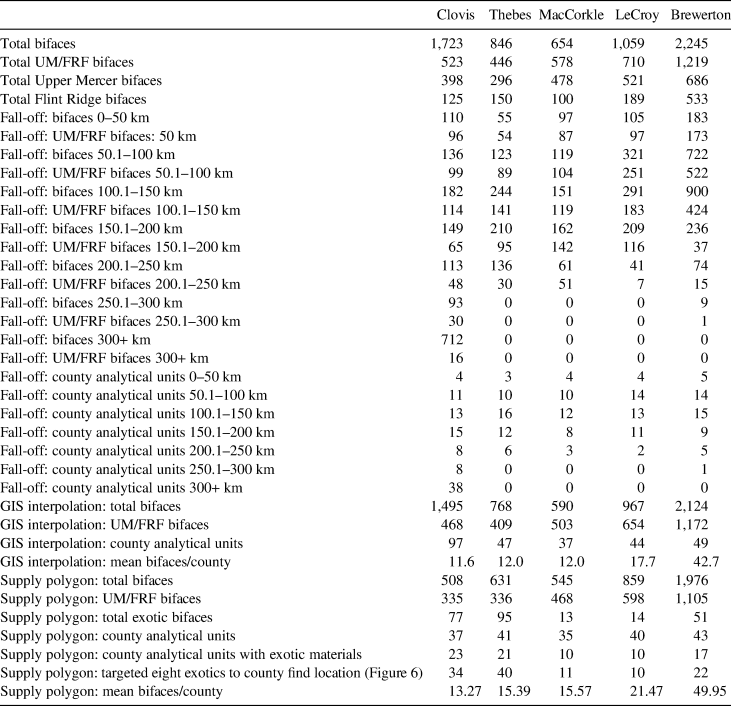
Altogether, we collected raw material data on 6,527 diagnostic projectile points with county-level provenience or better (Table 1). Roughly half of these are made of UM/FRF, specifically 3,476 bifaces. The results of targeted comparisons are as follows.
Summary Data for Study Bifaces and County Analytical Units.

Perspective One (Fall-Off from Source)
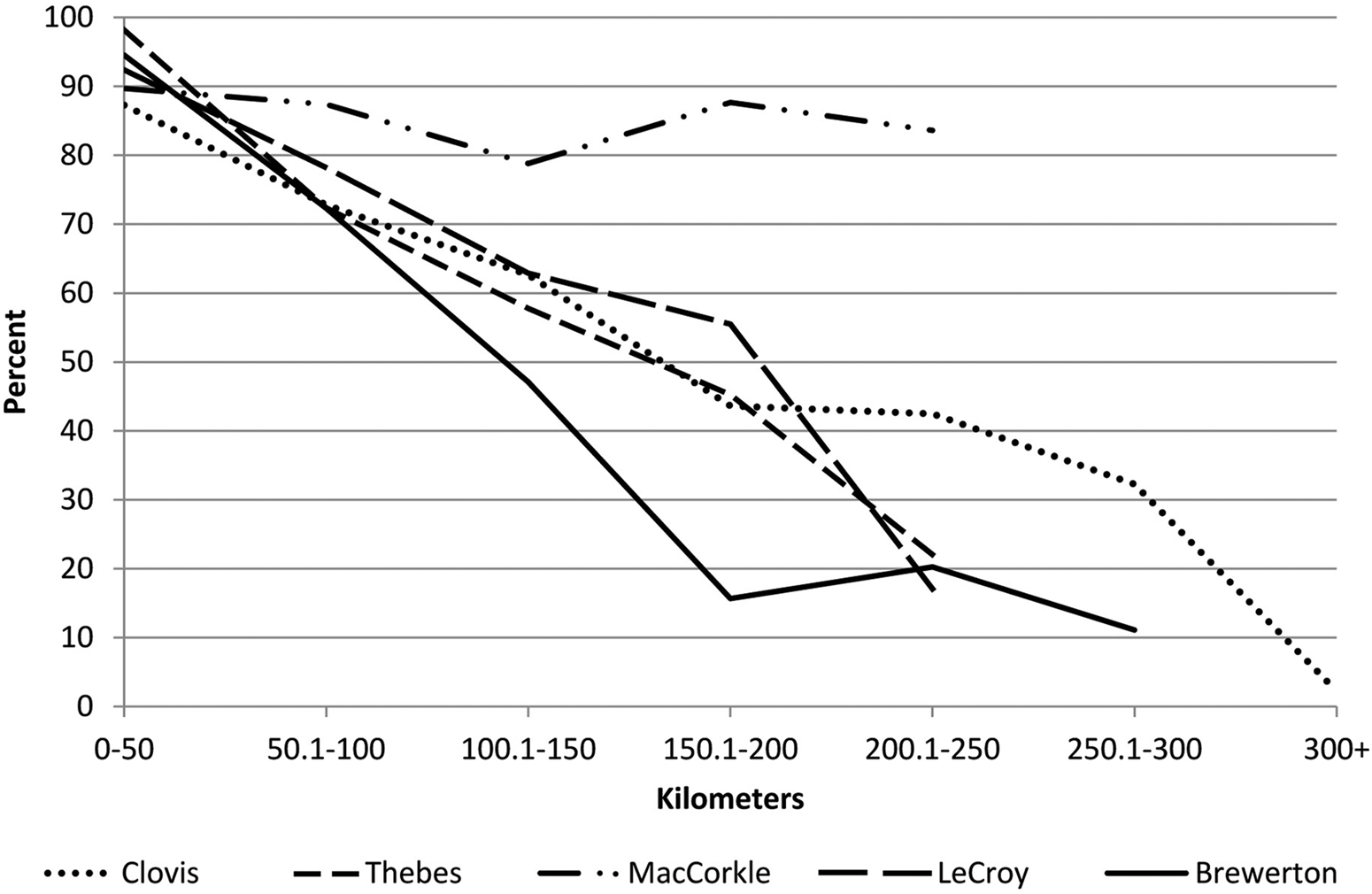
Nondirectional fall-off data indicate that there are differences in the sizes of LSZs over time for the five time-sensitive biface types studied (Figure 3; Table 1). Several patterns are clear. First, within 50 km of source, all five biface types are made of UM/FRF for over 87% of the samples, and despite anticipated differences in the organization of technology over a 7,000-year span.
Percentage fall-off of UM/FRF with distance for five temporally diagnostic midwestern biface types.

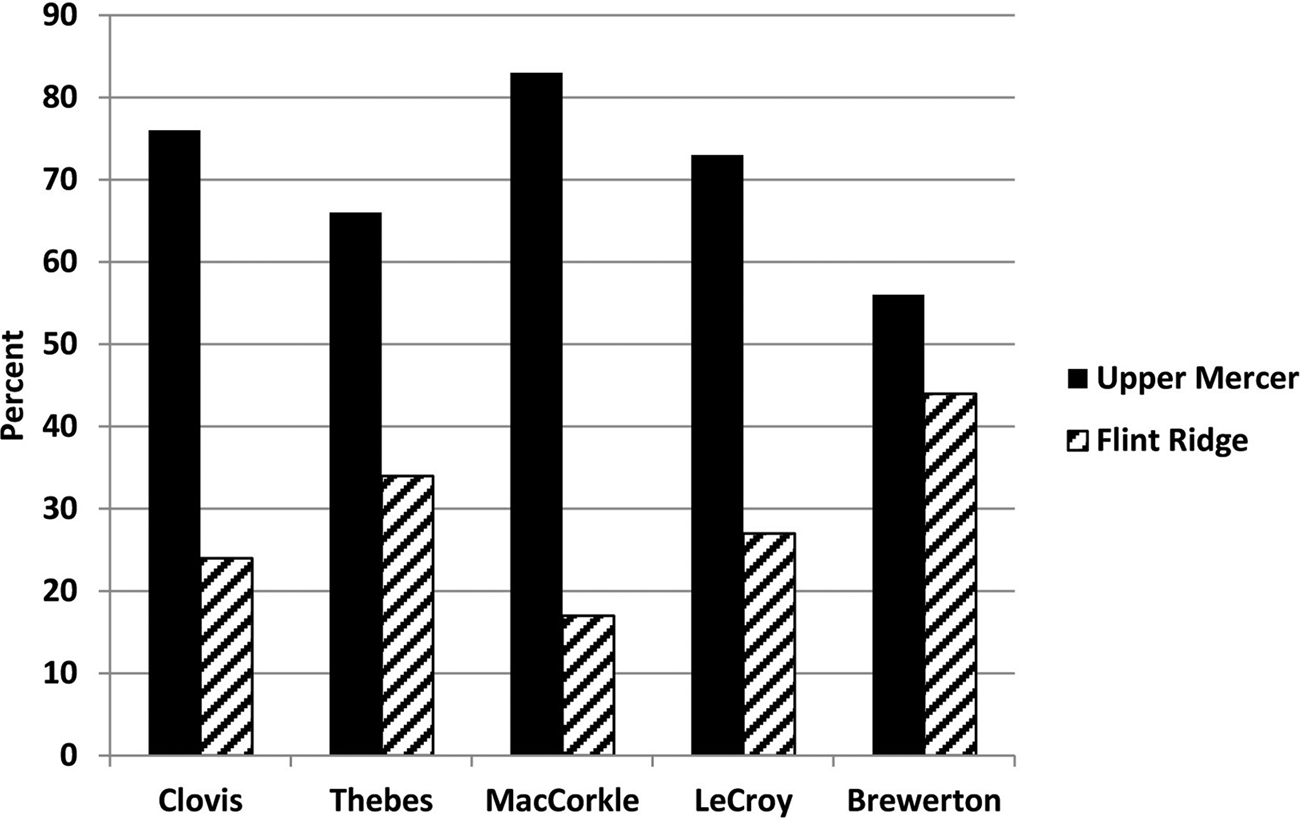
Second, and with regard to the overall pattern of fall-off with distance, there is little correspondence with chronological order as would be expected according to a gradualist neoevolutionary model. Clovis/Gainey, Thebes, and LeCroy follow relatively similar extinction patterns until 150.1–200 km from source, after which Clovis/Gainey plateaus at over 30% for the next 100 km. MacCorkle shows much less fall-off with distance when compared to Clovis/Gainey, Thebes, or LeCroy, and over 80% of this type is still made of UM/FRF at the 200.1–250 km interval. Only Brewerton exhibits the abrupt change in slope that others have used to delineate an LSZ “edge,” but importantly, this comes only when the percentage of UM/FRF falls well below 20% and approximately 150 km from source. For reasons discussed above, this percentage seems too low for an LSZ as defined here. The Brewerton distribution provides the best approximation of expectations under the inverse square law. Brewerton also shows the most equitable use of Flint Ridge versus Upper Mercer (Figure 4; Table 1).
Comparative percentages in the use of Upper Mercer and Flint Ridge flint for five diagnostic biface types over time.

Third, if 50% is a reasonable estimate for direct supply from source, then this value is reached most quickly for late Archaic Brewerton Corner-Notched bifaces at about 115 km, followed by Thebes and Clovis at 160 km, LeCroy at 185 and MacCorkle at something much higher than 200 km (and outside of the spatial scope of this study). The Thebes, Clovis, and LeCroy values are generally similar to those obtained for the use by early Archaic foragers in the Carolinas for Uwharrie rhyolite (Daniel Reference Daniel2001:243). In sum, a comparison of our nondirectional fall-off patterns provides results that are inconsistent with a gradual post-Pleistocene reduction in mobility.
Perspective Two (Direction/Distance Interpolation)
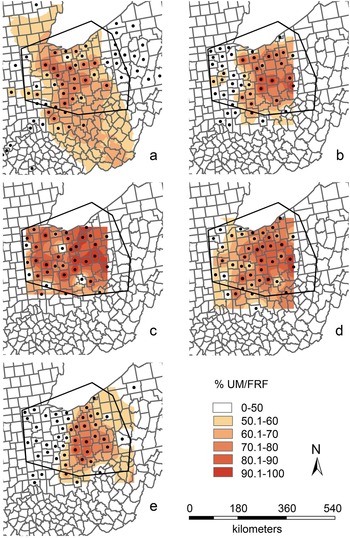
The addition of directional data provides further insight into the patterns documented as a function of distance alone (Figure 5; Table 1). The GIS interpolation models based on available data points are clearly more interpretable for the Clovis/Gainey and Brewerton data based on the larger spatial reach of the former and the smaller absolute size of the latter. Shape data make clear that the Clovis/Gainey distribution is elongated north/south and spans multiple major drainages. It closely approximates previous LSZ estimates based on more impressionistic information (e.g., Seeman Reference Seeman1994). Ellis (Reference Ellis2011:386) has argued that the dominant pattern of band movement in the entire Great Lakes/Northeast for this period is north/south, and he has noted a possible relationship to seasonal caribou migration patterns. Comparatively, the subsequent Thebes LSZ is smaller, less elongated, and denser. The eastern margin of the Thebes LSZ corresponds with the known eastern extent of the point type (Justice Reference Justice1987:57). Compared with Thebes, the MacCorkle LSZ extends beyond the sampled area in all directions and with a very high utilization of Upper Mercer (Figure 4; Table 1). White (Reference White2012:252) noted a similar post-Thebes expanded Upper Mercer distribution for Kirk Corner-Notched early Archaic bifaces. The larger MacCorkle LSZ is consistent with the fact that Upper Mercer still constitutes 69% of the MacCorkle points found beyond and to the west of the present study boundaries in the upper Wabash drainage of northeastern Indiana 285 km from source (Holsten and Cochran Reference Holsten and Cochran1986:31). The size/shape of the subsequent LeCroy distribution is more clinal and probably smaller than MacCorkle, with less intensive use of Upper Mercer and more of Flint Ridge. Finally, the Brewerton Corner-Notched size/shape distribution is the smallest of the five with a more extensive distribution to the south than in the north and with a steeper fall-off to the west.
Direction/distance GIS interpolation models of UM/FRF lithic supply zones for five diagnostic midwestern biface types: (a) Clovis/Gainey, (b) Thebes, (c) MacCorkle, (d) LeCroy, (e) Brewerton Corner-Notched.

The areal extent of the Clovis/Gainey LSZ approximates 140,573 km2. For the subsequent Thebes distribution, there is a reduction to approximately 90,000 km2 with less north/south elongation. The 50% supply zones for both MacCorkle and LeCroy are larger than that of Thebes, but we do not yet have sufficient data to provide reasonable size/shape estimates. The comparable Brewerton estimate is 69,575 km2. Regarding an “expected versus observed” type of comparison, we note that the Clovis/Gainey LSZ is much larger than the ELSZ, and that the Thebes and Brewerton distributions are much smaller. The Thebes-to-MacCorkle increase in size is particularly interesting in light of Nolan and Fishel's comment (Reference Nolan, Fishel, Emerson, McElrath and Fortier2009:436) that they would expect exactly the opposite results in Illinois. In sum, the GIS interpolations indicate clear differences in LSZ shape and size over time and show no singular trend.
Perspective Three (ELSZ and Exotic Vectors)
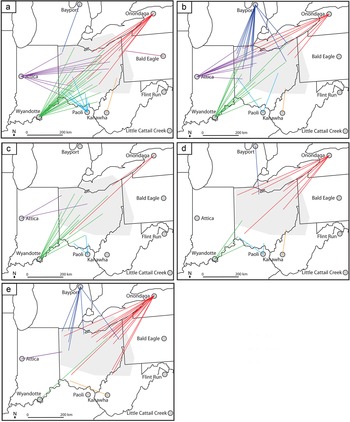
Comparative plots of vectors of high-quality, extra-local raw materials are mapped on the least-distance ELSZ and shown in Figure 6. They show that Paoli and Kanawha as southern high-quality sources and Bald Eagle and Flint Run jaspers as eastern sources were unimportant during the entire 7,000-year span studied. We infer that physical barriers to social interaction, such as the ruggedness of the Appalachian Mountains and a flood-prone Ohio River, were important for all forager land-use patterns in the region. The average distance between exotic outcrop and county find location is similar across periods: Clovis/Gainey = 381.241 km (N = 34); Thebes = 334.244 km (N = 40); MacCorkle = 348.688 km (N = 11): LeCroy = 339.004 km (N = 10); Brewerton = 366.130 km (N = 22).
Vector plots of high-quality materials into the UM/FRF lithic supply zone for five diagnostic biface types, 11,200–5000 BP: (a) Clovis/Gainey, (b) Thebes, (c) MacCorkle, (d) LeCroy, (e) Brewerton Corner-Notched.

For the Clovis/Gainey period, three exotic materials—Wyandotte, Onondaga, and Attica—are dominant, and all three show considerable geographic reach from the southwest, west, and northeast into the ELSZ. These distributions overlap in northeastern Ohio, an area of targeted early Paleoindian interest and the location of two large, non-outcrop related sites (Eren et al. Reference Eren, Redmond, Miller, Buchanan, Boulanger, Morgan, O'Brien and Gingerich2018; Seeman et al. Reference Seeman, Summers, Nilsson, Barans and Gingerich2018). Subsequent Thebes bifaces show an increased reliance on materials from the Bayport source to the north. The number of counties yielding Thebes points of exotic materials was about the same as that of Clovis/Gainey (Table 1). External connections decrease considerably by 8900 BP, as indicated by the low incidence of MacCorkle bifaces made of exotics, as well as for subsequent LeCroy materials, but they then increase again slightly for late Archaic Brewerton (Table 1). For these latest two periods, the incidence of Onondaga increases, suggesting a stronger east-west interregional network along the Lake Ontario/Lake Erie lake plains. This pattern continues into the subsequent Early and Middle Woodland periods.
Keeping in mind that the constructed polygons are of uniform size for all periods, it is of note that when the proportion of exotic materials to UM/FRF is considered, Clovis/Gainey (77/335 = 23%) and Thebes (95/336 = 28%) are relatively similar, and they are distinct from MacCorkle (13/468 = 3%), LeCroy (14/598 = 2%), and Brewerton (43/1,105 = 5%). In summary, the use of eight proximal exotic materials as a measure of external social connectivity shows temporal variation in directionality, no incremental decrease in average distance or number of county-level occurrences over time, and a dichotomous difference between the two earliest biface types and those that follow regarding the proportions of exotic raw materials present.
Evaluation of Findings
Long-term lithic supply of a particular raw material over deep time shows considerable variability among successive forager populations in the eastern Midwest, and little correlation with changes in climate. Furthermore, even the apparent reduction in mobility at the Pleistocene/Holocene boundary, as signaled by our Clovis/Gainey to Thebes comparison, deserves closer scrutiny in light of Ellis's (Reference Ellis2011:393; see also Surovell et al. Reference Surovell, Boyd, Vance Hanes and Hodgins2016:6; Tankersley Reference Tankersley and Dancey1994:116) findings that the earliest fluted point sites in eastern North America (Clovis/Gainey) are farther from lithic sources than later Paleoindian sites (Barnes, Crowfield)—the latter still well with the Pleistocene. We are sufficiently familiar with the data in our own region to predict even more temporal variability in LSZs if additional middle and late Archaic diagnostics are examined in a refined temporal scale.
A lack of correlation between lithic supply size/shape and known climatic changes in the eastern Midwest makes it difficult to explain the inferred changes in mobility due entirely to externally driven environmental forces. Instead, a social perspective that situates much of the changes we document in the constitution and reconstitution of alliance networks, individual agency, and other historical considerations may be more appropriate (Sassaman and Randall Reference Sassaman, Randall and Pauketat2012:22–26). Our findings add to a growing body of data that show that hunter-gatherers in eastern North America over the long haul were involved in events and processes that speak of a more contingent, nuanced sequence than gradualist, neoevolutionary theory allows.
As a second point for consideration, we would note that our study suggests that the relationship between the size/shape of UM/FRF lithic supply zones and the occurrence of exotic materials acquired from afar was highly variable over time. Clovis/Gainey had a large lithic supply zone and extensive links to other (exotic) lithic supply networks. Thebes had a small lithic supply zone and extensive links to others. MacCorkle had a large lithic supply zone and a few links to other supply zones. Brewerton had a small lithic supply zone and few links to others. This sort of patterning, in turn, supports the interpretation that lithic supply zones, as they relate to mobility, and the occurrence of exotic flints, as a materialization of wider-reaching social relations, are complexly intertwined and affected by different considerations. They also do not always change synchronically. If we add to this the limited information available on the spatial distribution of artifact style zones, as well as the presence in all periods of rare objects coming and going across distances of subcontinental scale, our view of hunter-gatherer experience and versatility becomes richer and even more multiscalar. The need to extend social relations between local groups as well as to successfully access resources within groups are always at work among humans. Consequently, we must consider the prospect that cultural diversity and change are rooted just as much (or perhaps more) in the very expansiveness of historically constituted, far-flung relations of alliance, exchange, and journeying as it is in the more intimate relations to place, family, and food choice (Sassaman Reference Sassaman2010; Shields Reference Shields1999). The resolution of these scales of “near” and “far” brings a necessary tension to the choices made by foraging peoples in both time and space, and we must keep an analytical eye on both to see the true range of creativity and versatility represented.
Our diachronic findings are consistent with the view that hunter-gatherer societies can make remarkable behavioral changes through time as manifested in lithic supply—and by implication, mobility—and not necessarily in any consistent (unilineal) direction (e.g., Smith Reference Smith2010:880). When the caribou are gone, they are gone, but flexibility and the exercising of options are part and parcel of a forager's life. Although they are not necessarily directly observable in the midwestern archaeological record, we know that such options as organizing camping units around same-sex versus different-sex consanguines and specific patterns of preferred cousin marriage can have profound effects on the intensity and extensiveness of social networks as well as the organization of labor (Binford Reference Binford2001:420; Ives Reference Ives, Godelier, Trautmann and Tjon Sie Fat1998).
In summary, and as Jordan notes (Reference Jordan, Bentley, Maschner and Chippendale2008:454), “long-term change among prehistoric foragers was unpredictable, reversible, and rapid, far from a smooth and irreversible progression from simple to complex.” An ability to appreciate such patterning in future interpretations of midwestern lithic supply will enhance the richness and meaning of the various pasts we can make. Such interpretations will depend not only on the predilections and findings of particular investigators but on the support and cooperation of a community of practitioners far larger and more diverse than those in our immediate professional past.
Acknowledgments
This project was made possible with the support of institutions and private collectors that allowed us to study and photograph their county-level collections. These include the Cincinnati Museum of Natural History, the Cleveland Museum of Natural History, the Ohio History Connection, the Booneshoft Museum of Discovery, Hopewell Culture National Historic Park, the Mahoning Valley Historical Society, Mercyhurst College, Carnegie Museum of Natural History, the Blennerhassett Museum, F. A. Seiberling Nature Realm, David Alvarado, Jerry Anderson, Dan Bartlett, Pat Cadle, Quentin Carpenter, Tom Carroll, Jeff Carskadden, Doug Chandler, Doris Cosstentino, David Cox, Don Eberle, Craig Ferrell, Steve Fuller, Charlie Hambel, Greg Hawkins, Brent Heath, Dan Henry, Pat Layshock, Marvin Leatherman, Frank Meyer, Sandy Hambel Miller, Larry Morris, Nils Nilsson, Chris Parker, Joe Parrish, Scott Place, Kris Ruggles, Bob Scantlen, Doug Shoop, Chuck Stevens, Garry Summers, Jo Tillert, John Vargo, and Bob Wilson. We also wish to thank the journal editor and reviewers for improving the quality of our manuscript.
Data Availability Statement
Electronic data, images, and notes for this project are stored at Kent State University.