INTRODUCTION
The ‘KUW 2009 Expedition' was carried out in Mayotte, Comoro Islands in the south-western Indian Ocean, during 1–21 November 2009. This expedition was organized by Jean-Marie Bouchard of the Kraken Underwater Works Cie (KUW), Mayotte, with scientific partnership between the Institut de Recherche de l'École Navale (IRENav), Brest, and the Muséum National d'Histoire Naturelle (MNHN), Paris (Bouchard et al., Reference Bouchard, Poupin, Cleva, Dumas and Dinhut2009). The objective of the expedition was to establish the first inventory of decapod and stomatopod crustaceans of the Mayotte region. For the anomuran family Porcellanidae, 23 species in six genera were reported based on the material collected during the expedition and published records from the Mayotte region (Poupin et al., in press). Poupin et al. (in press) referred two specimens to Polyonyx aff. boucheti Osawa, Reference Osawa2007 and mentioned that the material of P. utinomii Miyake, Reference Miyake1943 recorded by Osawa (Reference Osawa2001) from the Maldives might belong to their P. aff. boucheti because of geographically similar localities. Except for the material from the Maldives, P. utinomii has been known only from Japan (Osawa, Reference Osawa2001). This led us to re-examine the specimens from Mayotte and the Maldives for clarifying their identities. Close examination and comparison showed that the Mayotte specimens belong to P. boucheti and the Maldives material is undoubtedly referred to P. utinomii. The occurrence of P. boucheti from the Indian Ocean greatly extends its distribution range since the species was known only from the Loyalty Islands, south-western Pacific. In this short paper, we give a brief description providing evidence for the identification.
MATERIALS AND METHODS
The material from Mayotte was collected during SCUBA dives. Details on the sampling techniques used during the ‘KUW 2009 Expedition' are described by Bouchard et al. (Reference Bouchard, Poupin, Cleva, Dumas and Dinhut2009; in press) along with a list of the stations. The specimens examined of P. boucheti are deposited in the collection of the MNHN, Paris. Carapace length (cl) was measured from the anterior median tip of the rostrum to the posteromedian margin of the carapace, and the carapace width (cw) was measured between the broadest points. Measurements of chelipeds and ambulatory legs are shown in Osawa (Reference Osawa2007). Terminology generally follows that of Osawa & Chan (Reference Osawa, Chan and Chan2010). Abbreviations used in this paper are: coll., collected by; ovig., ovigerous; and stn, station. The material of P. utinomii from the Maldives is deposited in the Natural History Museum and Institute, Chiba (CBM) and shown below.
Polyonyx utinomii Miyake, Reference Miyake1943: Vadoo, Maldives, outer side of eastern reef, 20 m, in tube of Chaetopterus sp., 22 April 1996, coll. K. Nomura, 1 male (cl 1.7 mm, cw 2.0 mm), 1 ovig. female (cl 2.1 mm, cw 2.7 mm), CBM-ZC 5157.
RESULTS
SYSTEMATICS
Family PORCELLANIDAE Haworth, Reference Haworth1825
Genus Polyonyx Stimpson, Reference Stimpson1858
Polyonyx boucheti Osawa, Reference Osawa2007
(Figures 1 & 2)
Polyonyx boucheti Osawa, Reference Osawa2007: 39, figures 13–15 [type locality: Mepinyo, Santal Bay, Lifou Island, Loyalty Islands. Atelier LIFOU: stn 1446, 20°50.8′S 167°09.7′E, 36–40 m]; Osawa & McLaughlin, Reference Osawa, McLaughlin, Low and Tan2010: 114 (list).
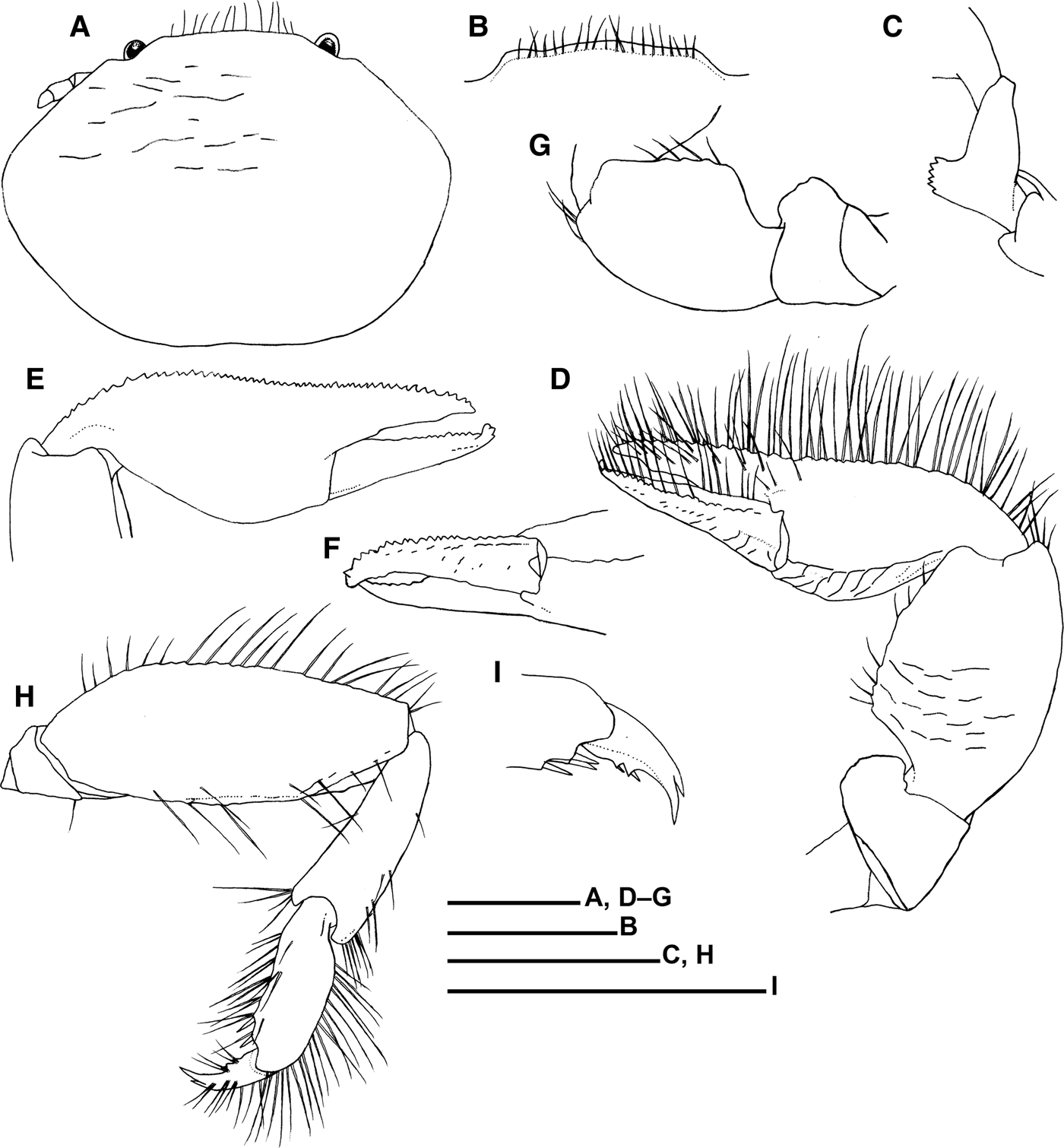
Polyonyx boucheti Osawa, Reference Osawa2007, ovigerous female (carapace length 2.2 mm; carapace width 3.2 mm), MNHN-Ga 7465: (A) carapace, eyes, and left antennal peduncle, dorsal view (transverse striae on carapace partially illustrated); (B) rostrum, frontal view; (C) merus of left third maxilliped, lateral view; (D) larger right cheliped, dorsal view (transverse striae on carpus partially illustrated); (E) same, chela, ventral view (setae omitted); (F) same, dactylus and distal part of palm, posterior view; (G) merus and carpus of left cheliped, dorsal view; (H) right second pereopod, lateral view; (I) same, dactylus and distal part of propodus, lateral view (setae omitted). Scale bars: 1.0 mm.

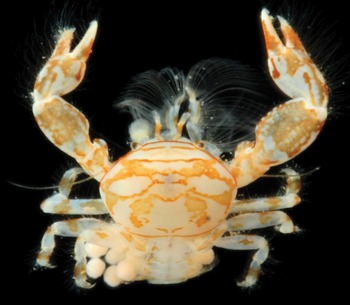
Polyonyx boucheti Osawa, Reference Osawa2007, ovigerous female (carapace length 2.2 mm; carapace width 3.2 mm), MNHN-Ga 7465: entire animal, dorsal view (photograph: J. Poupin/R. Cleva).

Polyonyx aff. boucheti: Poupin et al., in press: 22, figure 11D.
MATERIAL EXAMINED
Mayotte, KUW 2009: stn 12, La Prévoyante reef, 12°41′34.70″S 45°9′59.99″E, 6–11 m, 6 November 2009, coll. J.-M. Bouchard, V. Dinhut & J. Dumas, 1 ovig. female (cl 2.2 mm, cw 3.2 mm), MNHN-Ga 7465; stn 25, islet M'tzamboro, southern tip, 12°39′30.18″S 45°1′38.65″E, 15–20 m, 14 November 2009, coll. J.-M. Bouchard, V. Dinhut & J. Dumas, 1 ovig. female (cl 1.9 mm, cw 2.9 mm, partially broken), MNHN-Ga 7466.
DESCRIPTION
Carapace transversely ovate, 1.4 times wider than long; branchial margins strongly convex on anterior part; dorsal surface weakly to moderately convex, covered with delicate, short and moderately long, transverse striae. Rostrum broad, nearly transverse in dorsal view, with row of sparse moderately long setae along anterior margin, weakly trilobate in frontal view; median lobe low, broadly rounded, without median longitudinal groove. Protogastric ridges and cervical grooves faintly demarcated.
Third thoracic sternite somewhat depressed medially; anterior margin weakly trilobite, lateral lobes narrow, distinctly exceeding obsolete median lobe.
Ocular peduncles short and small. Antennal peduncle slender.
Third maxilliped relatively slender; carpus with subtriangular lobe on ventral margin, lobe marginally dentate; propodus slender, slightly tapering distally.
Chelipeds somewhat unequal in size but similar in morphology, sub-cylindrical; dorsal surface covered with short delicate, oblique and transverse striae. Merus with roundly sub-rectangular lobe distally on dorsoanterior margin. Carpus broad, 1.6 times longer than broad; dorsoposterior margin rounded, with tuft of setae distally; dorsoanterior margin with elevated lobe weakly convex or nearly transverse and bearing sparse setae. Chela relatively narrow, 2.7–3.1 times as long as broad, inflated dorsoventrally on palm, with distinct hiatus between fingers; anterior margin slight undulate at base of fixed finger, entirely with row of small denticles and long simple setae; dorsal surface adjacent to anterior margin also with scattered setae. Palm without distinct dorsomedian longitudinal ridge. Fixed finger with small, curved distal claw; cutting edge slightly concave, with row of small subacute teeth. Dactylus approximately half length of chela, opening at oblique angle (in smaller cheliped, at nearly vertical angle).
Ambulatory legs (second to fourth pereopods) short, sub-cylindrical, with short and moderately long, simple setae on dorsal and ventral margins; setae sparse on meri, carpi, and dactyli but numerous on propodi; lateral surfaces nearly smooth. Meri somewhat compressed laterally, elongate ovate, unarmed on margins; dorsal margin slightly crenulated. Carpi slender, unarmed. Propodi relatively short, 3.1–3.2 times as long as high; dorsal margin nearly smooth; ventral margin with 1 sub-distal corneous spine; ventrodistal margin with 2 corneous spines subequal in size. Dactyli each terminating in curved bifurcate claws, ventral claw sharply pointed, much larger than dorsal claw; ventral margin with 2 small teeth each bearing tiny corneous spine.
COLORATION IN LIFE
Carapace white, with light brown markings: frontal, anterior branchial, and posterior margins each with narrow line; pair of transverse, long lines just behind of level of orbits; markings on gastric, cardiac, and branchial regions net's mesh-like. Chelipeds with irregular brown markings on each merus, carpus, and chela. Ambulatory legs white, with brown markings; meri of second and third pereopods with 2 bands on proximal and submedian parts, but merus of third pereopod with only submedian band; carpi each with small proximal blotch; propodi each with broad band on median part; dactyli without markings. See Figure 2.
DISTRIBUTION
Previously known only from the Loyalty Islands: 5–40 m (Osawa, Reference Osawa2007); now from Mayotte, Comoro Islands in the south-western Indian Ocean: 6–20 m.
HABITAT
The present specimens were collected from similar coral grounds at stn 12 and stn 25 (depths of 6–20 m). In the two stations, there were colonies of soft corals; stony corals such as Acropora, Pocillopora, and Seriatopora; sponges; coral boulders or rubbles; and dead corals on coral–sand bottoms (cf. Bouchard et al., Reference Bouchard, Poupin, Cleva, Dumas and Dinhut2009; Poupin et al., in press). Sampling techniques at these stations include SCUBA-operated brushing baskets on the rubbles and dead corals and SCUBA-operated vacuum cleaners on the coral–sand. Polyonyx boucheti was found in the fine fraction of the sediment (mesh < 5 mm). As attention was paid only to crustaceans during these samplings, no commensal animals were known.
REMARKS
The present specimens from Mayotte agree well with the original description of Polyonyx boucheti in the diagnostic aspects, particularly in having these characters: frontal margin of carapace bearing relatively long, simple setae (Figure 1B); merus of third maxilliped with ventral lobe marginally dentate (Figure 1C); merus of cheliped with roundly subrectangular lobe on dorso-anterior margin (Figure 1D, G); and ambulatory legs bearing relatively long and numerous setae (Figure 1H).
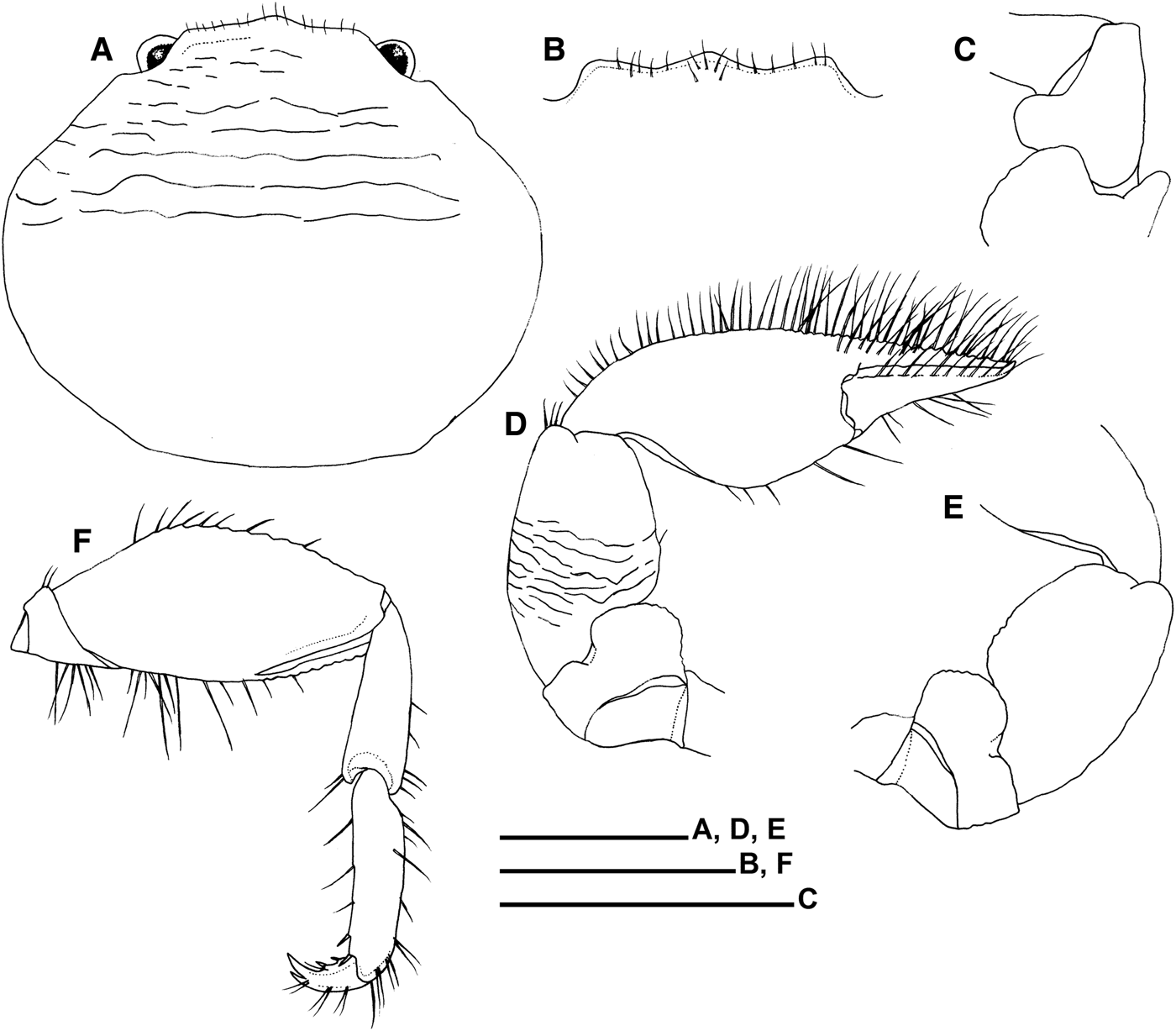
As mentioned before, Poupin et al. (in press) suggest that the material from the Maldives referred to P. utinomii by Osawa (Reference Osawa2001) might belong to P. boucheti presently re-identified. However, re-examination has shown that the material is undoubtedly referred to P. utinomii in having the frontal margin of the carapace with short setae (Figure 3B), the merus of the third maxilliped having the ventral lobe marginally smooth (Figure 3C), the merus of the cheliped with a very broad and rounded lobe on the dorsoanterior margin (Figure 3D, E), and the propodi of the ambulatory legs bearing sparse short setae (Figure 3F). In addition to these features, the transverse striae on the carapace and chelipeds are more pronounced and numerous and the median lobe of the rostrum is more developed in P. utinomii than in P. boucheti (see Osawa, Reference Osawa2001: figures 4A & 5A; 2007: figures 13A & 14A; Figures 1A, B, D & 3A, B, D, this paper). Coloration in life is also different between the two species. The carapace has numerous orange-brown or dark brown transverse lines in P. utinomii, instead of light brown net's mesh-like markings in P. boucheti (Osawa, Reference Osawa2001: figure 7A; Watanabe, Reference Watanabe2012: unnumbered figure; Figure 2, this paper).
Polyonyx utinomii Miyake, Reference Miyake1943, ovigerous female (carapace length 2.1 mm; carapace width 2.7 mm), CBM-ZC 5157: (A) carapace and eyes, dorsal view (transverse striae on carapace partially illustrated); (B) rostrum, frontal view; (C) merus of left third maxilliped, lateral view; (D) larger left cheliped, dorsal view (transverse striae on carpus partially illustrated); (E) merus and carpus of right cheliped, dorsal view; (F) right second pereopod, lateral view. Scale bars: 1.0 mm.

Polyonyx boucheti and P. utinomii are widely distributed in the Indo-West Pacific, although the records of the two species are very limited. Polyonyx boucheti is known only from the Loyalty Islands and Mayotte, whereas there are some records of P. utinomii from the western Pacific, but all of them are restricted in Japanese localities (Osawa, Reference Osawa2001).
Polyonyx boucheti and P. utinomii belong to the P. sinensis group, an informal species group of Johnson (Reference Johnson1958), which is practically characterized by the ambulatory dactyli each with the dorsal claw being much smaller than the ventral claw. Most species of the P. sinensis group, including P. utinomii, are known to live in association with tube-dwelling polychaetes such as Chaetopterus Cuvier, Reference Cuvier1830 and Mesochaetopterus Potts, Reference Potts1914, and Loimia Malmgren, Reference Malmgren1865 (Osawa, Reference Osawa2001; Werding, Reference Werding2001; unpublished data). Additionally, the other congeneric species also have commensal habitats and have been frequently collected from sponges (Haig, Reference Haig and Serène1979, Reference Haig and Morton1992; unpublished data). Although P. boucheti has not been recorded as a commensal of any animal, this species is also probably associated with a tube-dwelling polychaete as in P. utinomii.
ACKNOWLEDGEMENTS
Financial support for the field research has been obtained from the Direction de l'Agriculture et de la Forêt of Mayotte (DAF) and Total Foundation. Jean-Marie Bouchard, Jacques Dumas and Vincent Dinhut have collected the present specimens during SCUBA dives in Mayotte lagoons. Régis Cleva helped to sort the specimens and to integrate them in the Muséum National d'Histoire Naturelle, Paris (MNHN) collections. Supplementary assistance for this research has been also given by the Institut de Recherche de l'École Navale, Brest (IRENav) and the MNHN. The manuscript benefitted from helpful comments by an anonymous referee.