1. Introduction
It is widely believed that some form of international policy coordination is necessary to tackle global environmental problems such as global warming. Economists have long argued that, when each country non-cooperatively sets domestic environmental policies, outcomes may be inefficient because of externalities through transboundary pollution and/or imperfectly competitive international markets (Barrett, Reference Barrett1994; Kennedy, Reference Kennedy1994). Thus, economists emphasize the need for cooperative policies such as international environmental agreements (IEAs) to internalize the externalities and achieve efficient allocations.
Economists also recognize that promoting the development of cleaner technologies is important to overcome environmental problemsFootnote 1: they have focused on firm incentives in developing cleaner technologies and analyzed the effectiveness of different policy instruments in inducing environmental innovation (Downing and White, Reference Downing and White1986; Milliman and Prince, Reference Milliman and Prince1989; Fischer et al., Reference Fischer, Parry and Pizer2003). To date, most studies have shown that incentive-based environmental policies are superior to command-and-control policies in fostering innovation for developing cleaner technologies.
However, to the best of the author's knowledge, there are no studies that investigate the relationship between different environmental policies with and without the cooperation of governments and firm incentives in developing cleaner technologies in open-economy settings. This relationship is important because international firms that invest strategically in environmental R&D make decisions based on whether national governments determine policies cooperatively or non-cooperatively and what policy instruments each government chooses. As Tarui and Polasky (Reference Tarui and Polasky2005) indicate, large firms (e.g., large automobile companies, electric power generators or oil companies) that produce a significant share of emissions may have an incentive to alter investment strategically in order to induce favorable shifts in future environmental policy. For example, the successful R&D efforts to find substitutes for chlorofluorocarbons (CFCs) made by DuPont, the world's third largest chemical company, are considered to have changed the stringency of the Montreal Protocol.Footnote 2 Another example of firms making strategic investment choices (or voluntary approaches) is the Keidanren Voluntary Action Plan on the Environment (Keidanren, Reference Keidanren1997), which promotes efforts to curb CO2 emissions, which is a unilateral initiative by Japan's most influential business association. The voluntary plan was established even before the adoption of the Kyoto Protocol in 1997. Furthermore, the target the Japanese government accepted under the Kyoto Protocol was partly based on consultations with Keidanren. Other examples include actions by German industry groups when a coalition of Social Democrats and the Green Party proposed an energy tax in 1999 (Conrad, Reference Conrad2001). These examples indicate the importance of international oligopoly and the lack of regulatory commitment by showing that dominant firms (or industry groups) may have strategic incentives to act in ways that might influence future environmental regulation.Footnote 3
To investigate the relationship between environmental innovation and policy cooperation, we construct a simple two-country model with international oligopoly and transboundary pollution. In particular, we compare firms' strategic incentives for developing cleaner technology under four international policy regimes: (i) each country non-cooperatively (unilaterally) sets the level of tax (price) regulations on its domestic polluting firm; (ii) each country non-cooperatively sets the level of quantity regulations; (iii) countries cooperatively set the level of harmonized tax regulations; and (iv) countries cooperatively set the level of harmonized quantity regulations. In our model, governments are assumed to be unable to credibly commit to the level of environmental regulations. This lack of regulatory commitment provides firms with an incentive to influence the level of regulations through their environmental R&D activities.Footnote 4
Within the above framework, we compare firm incentives under different policy regimes. We show that in either case, with or without policy cooperation, firm incentives under quantity regulations are greater (smaller) than those under price regulations if the marginal environmental damages (MEDs) are greater (smaller). This result is important because most of the previous studies that use a closed-economy model (such as Downing and White, Reference Downing and White1986; Milliman and Prince, Reference Milliman and Prince1989; Denicolò, Reference Denicolò1999; Fischer et al., Reference Fischer, Parry and Pizer2003) conclude that price regulations are superior to quantity regulations in inducing firms to invest in clean technology.Footnote 5 The relative ranking of firm incentives between tax and quantity regulations crucially depends on the direct cost-reducing and strategic policy-inducing effects of innovation. The direct effect of innovation is smaller under a tax regulation regime than under a quantity regulation regime because each government cannot help but lower tax rates out of fear that setting higher tax rates will induce foreign firms to produce more. On the other hand, the strategic effect of innovation is greater under a tax regulation regime. This is because innovation necessarily relaxes domestic regulation and tightens foreign regulation under a tax regulation regime, while this is not necessarily the case under a quantity regulation regime. If the MEDs are large, the level of regulation in both countries is stringent and therefore the direct effect outweighs the strategic effect. In that case, quantity regulations encourage more innovation than price regulations.
Then we show that under non-cooperative policy settings, the net benefit of each country before innovation is greater under a quantity regulation regime than under a tax regulation regime. Therefore, if MEDs are not so large, quantity regulations yield a greater static benefit for countries; however, dynamically, price regulations encourage more innovation than quantity regulations.
We then compare firm incentives with and without cooperation between governments. Although stringent regulation under policy cooperation (harmonization) increases the value of and need for innovation, firms do not necessarily have greater incentives under cooperative regimes than they do under non-cooperative regimes. This is because, under non-cooperative policy regimes, firms also have strategic incentives to relax domestic regulations and tighten foreign regulations when investing in environmental R&D. In contrast, if policies are set cooperatively and harmonized between nations, such strategic aspects of innovations will disappear. Whether the policy instrument is price or quantity regulations, our results demonstrate that firm incentives are greater under non-cooperative regimes than under cooperative regimes if MEDs are large. In other words, policy harmonization statically yields a larger net benefit for countries than non-cooperative policy setting through internalization of policy externalities, but it does not encourage innovation more than non-cooperative policy setting does.
This study relates to the literature on strategic environmental policy in an open-economy model (Conrad, Reference Conrad1993; Barrett, Reference Barrett1994; Kennedy, Reference Kennedy1994; Ulph, Reference Ulph1996). Addressing issues of strategic trade in the output market and transboundary pollution, these studies demonstrate considerable strategic relationships between governments in environmental policy making, and government incentives to impose inefficiently less (or more) stringent environmental regulations.Footnote 6 Because they focus on strategic interactions between governments, they do not investigate firms' incentives for environmental R&D. Our study relates even more closely to that of Conrad (Reference Conrad2001), who considers policy regimes with different timings of environmental policy making (setting taxes and standards) in the model of strategic environmental policy. He shows that, if the industry anticipates that taxes and fees will be introduced in the upcoming years, it would be rational for firms to act in advance in order to mitigate the necessity for taxes. While his study focuses on investigating firms' strategic incentives to adjust output and abatement before regulations are introduced, our study investigates and compares firms' strategic R&D incentives under several policy regimes.Footnote 7
The structure of this paper is as follows. In section 2, we present the elements of the model. In section 3, we analyze and compare firm incentives for environmental R&D under non-cooperative tax and quantity regulations. In section 4, we examine firm incentives under cooperative policy regimes. In section 5, we analyze the effect of policy cooperation on firms' innovation incentives. Finally, section 6 offers concluding remarks.
2. The model
Consider two exporting firms 1 and 2 located in two different countries 1 and 2, respectively. Each firm i ∈ {1, 2} produces homogenous goods and engages in Cournot (quantity) competition in a world (third) market. In the production process, firms generate emissions that are proportional to output. Firm i's emissions harm not only country i's environment but also country j's environment partly, i.e., its emissions are transboundary. To reduce emissions, regulation policies are implemented. We examine four regimes with respect to policy making in the two countries: (i) regime NT refers to the non-cooperative tax regulation regime where each government non-cooperatively sets domestic emission tax rates; (ii) regime NQ refers to the non-cooperative quantity regulation regime where each government non-cooperatively sets the level of domestic emissions; (iii) regime CT refers to the cooperative tax regulation regime where governments set cooperative (harmonized) tax rates; and (iv) regime CQ refers to the cooperative quantity regulation regime where governments set a cooperative (harmonized) level of emissions.
The timing of the game is as follows. In period 1, each government sets a policy: under NT (NQ), it sets a domestic tax (the level of domestic emissions) non-cooperatively; under CT (CQ), it sets a harmonized tax (the harmonized level of emissions) cooperatively. In period 2, given the regulation policies, each firm non-cooperatively determines its own output. We investigate the firm incentives for environmental R&D that are evaluated in period 0; i.e., R&D incentives that we examine have strategic natures because they take into account the effect of their environmental R&D on domestic and foreign policies or on the cooperative policy.Footnote 8 The assumption that R&D decisions are made before regulators set policies is particularly valid as R&D is typically a long-term activity and a government or regulator is unable to commit to the level of environmental policy credibly.Footnote 9
2.1. The firms
In period 2, firms 1 and 2 engage in Cournot competition in a world market. The emissions by firm i are a i = (e − εi)y i, where e is the emission coefficient before innovation, εi (<e) is the amount of innovation, and y i is the output of firm i. The profits of firm i (i = {1, 2}, i ≠ j) are defined by
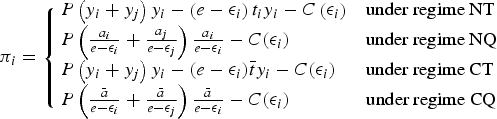 $$\pi_{i}= \left\{\matrix{P\left(y_{i}+y_{j}\right)y_{i}-\left(e-\epsilon_{i}\right)t_{i}y_{i}-C\left(\epsilon_{i}\right)\hfill & \hbox {under regime NT} \hfill \cr P\left({a_i \over e-\epsilon_i} + {a_j \over e-\epsilon_j} \right){a_i\over e-\epsilon_i}-C\lpar \epsilon_i\rpar \hfill & \hbox {under regime NQ} \hfill \cr P\left(y_i+y_j \right)y_i-\lpar e-\epsilon_i\rpar \bar t y_i-C\lpar \epsilon_i\rpar \hfill & \hbox {under regime CT} \hfill \cr P\left({\bar a \over e-\epsilon_i} + {\bar a \over e-\epsilon_j} \right){\bar a \over e-\epsilon_i}-C\lpar \epsilon_i\rpar \hfill & \hbox {under regime CQ}}\right.$$
where P (.) is the inverse demand for goods in the world market, C(εi) is firm i's cost of innovation that is increasing and strictly convex with C(0) = 0 and C'(0) = 0, t i and a i are respectively the emission tax rate and the level of emissions in country i that are non-cooperatively set by government i, and t and a are harmonized policies cooperatively set by both governments. For the sake of simplicity, we assume that the marginal production costs of both firms are zero. The results obtained in this study are also qualitatively valid under conditions of a constant marginal cost of production. The inverse demand function is assumed to be linear: P(y1 + y2) = 1 − y1 − y2. Throughout the paper, we only consider the interior solutions where both firms' outputs are non-negative.Footnote 10
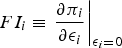
We define firm i's incentives for environmental R&D (denoted by FI i) as
 $$FI_{i}\equiv \left.{\partial\pi_i \over \partial\epsilon_i}\right\vert _{\epsilon _i =0}$$
in period 0, i.e., the marginal profit of an increase in the amount of innovation, starting from (εi) = 0.Footnote 11
2.2. The governments
The net benefit of country i, denoted by W i (i = {1, 2}, i ≠ j), is defined as the sum of the domestic firm's profits, the tax revenues (if any), and the environmental damages from emissions:
 $$W_{i}= \left\{\matrix{\pi_{i}+\left(e-\epsilon_{i}\right)t_{i}y_{i}-d_{i}\left[\left(e-\epsilon_{i}\right)y_{i}+\gamma \left(e-\epsilon_{j}\right)y_{j} \right]\hfill & \hbox {under regime NT}, \hfill \cr \pi_{i}-d_{i}\left(a_{i}+\gamma a_{j}\right)\hfill & \hbox {under regime NQ}, \hfill \cr \pi_{i}+\left(e-\epsilon_{i}\right)\bar{t}y_{i}-d_{i}\left[\left(e-\epsilon_{i}\right)y_{i}+\gamma \left(e-\epsilon_{j}\right)y_{j} \right]\hfill & \hbox {under regime CT}, \hfill \cr \pi_{i}-d_{i}\left(\bar{a}+\gamma \bar{a}\right)\hfill & \hbox {under regime CQ},}\right.$$
where d i is the constant MEDs from emissions and γ ∈ [0, 1] is the degree of emission spillovers. Following the standard literature of strategic environmental policy such as Barrett (Reference Barrett1994) and Roelfsema (Reference Roelfsema2007), we assume that domestic consumption in each country is sufficiently small in comparison to world consumption such that each government ignores the effect of its policies on domestic consumers.Footnote 12 Any tax payment is purely distributional. Here we assume linear environmental damages, but our main results also hold for a convex environmental damage function.Footnote 13
3. Non-cooperative policy regimes
3.1. Emission taxes (regime NT)
The model is solved backwards. In period 2, firm i maximizes (1), taking y j, t i and t j as given. The first-order conditions of the problem are y i = [1 − (e − εi) t i − y j]/2 for i ≠ j, which is the best-response function of firm i. Then the equilibrium output in period 2 is y i (.) ≡ y i(t i,t j,εi,εj = [1 − 2(e − εi)t i + (e − εj)t j]/3. We define the profit function in period 1 by substituting y i(.) into (1) as πi(.) ≡ πi(t i, t j, εi, εj).
In period 1, each country non-cooperatively chooses the emission tax rate so as to maximize the net benefits (2). The first-order conditions of the problem are t i = [6(e − εi)d i − 3γ(e − εj)d i − (e − εj)t j − 1]/4(e − εi) for i = 1, 2 i ≠ j, which are the reaction functions of the two governments. Since the slope of the best-response is ∂ t i/∂ t j = −(e − εj)/[4(e − εi)] < 0, we find that t i and t j are strategic substitutes. Solving the two reaction functions, we obtain the equilibrium tax in period 1 as follows:
 $$\eqalign{t_{i}^{NT} & \equiv t_{i}^{NT}\left(\epsilon_{i}\comma \; \epsilon_{j}\right)\cr & = {{\left(e-\epsilon_{i}\right)\left(8d_{i}+\gamma d_{j}\right)-2\left(e-\epsilon_{j}\right)\left(d_{j}+2\gamma d_{i}\right)-1}\over{5\left(e-\epsilon_{i}\right)}}\comma \; {\quad \forall i=1\comma \; 2\comma \; }}$$
where superscript NT represents the variable in the equilibrium of regime NT.Footnote 14
Substituting (3) into y i(·), we obtain the equilibrium output and emissions as y iNT ≡ y iNT(εi, εj) and a iNT ≡ (e − εi)y iNT. Evaluating it at a symmetric equilibrium (i.e., d 1 = d 2 = d and ε1 = ε2 = ε), we obtain the equilibrium output of each firm as y NT = [2 − d(e − ε) (2 − γ)]/5, where variables without subscripts indicate those in the symmetric equilibrium. Thus, we assume d < 2/[(e − ε)(2 − γ)] in order to obtain the interior solution y NT > 0.
In a symmetric equilibrium (d 1 = d 2 = d and ε1 = ε2 = ε), the non-cooperative tax rate reduces to
 $$\left. {t^{NT} } \right\vert _{d_1 = d_2 = d\comma \; \varepsilon _1 = \varepsilon _2 = \varepsilon } \equiv \tilde t^{NT} = \displaystyle{{3d\lpar e - \varepsilon \rpar \lpar 2 - \gamma \rpar - 1} \over {5\lpar e - \varepsilon \rpar }}.$$
Then, taking d < 2/(e − ε)(2 − γ) into account, we find that
 $$\tilde{t}^{NT}-d=-{1+d\lpar e-\epsilon\rpar \left(-1+3\gamma \right)\over 5\left(e-\epsilon \right)}\lt 0\comma \;$$
which implies that the non-cooperative tax rate (in a symmetric equilibrium) is less than the MEDs from emission, d.
Lemma 1
In a symmetric equilibrium, a non-cooperative tax rate is less than the MEDs from emission.
Then we investigate the effects of the marginal improvements (marginal decreases) in emissions technology on one's own and the other's equilibrium tax rates.
 $${\partial t_i^{NT}\over\partial \epsilon_i}=-{1+2\left(e-\epsilon _j\right)\left(d_j+2\gamma d_i\right)\over 5\left(e-\epsilon_i\right)^2} \lt 0\comma \; \quad {\partial t_j^{NT}\over \partial \epsilon_i}={2\left(d_i+2\gamma d_j\right)\over 5\left(e-\epsilon_j\right)}\gt 0.$$
Lemma 2
A marginal innovation by the domestic firm lowers the domestic tax and raises the foreign tax rate.
For a given rate of domestic tax, a marginal innovation (a small increase in εi) leads to greater output by firm i. This gives the domestic policy maker incentives to raise the tax rate. However, a marginal innovation leads to a reduction in firm i's emissions, which gives the domestic policy maker incentives to lower the tax rate. Because the non-cooperative tax rate is less than the MEDs (Lemma 1), the latter's incentives dominate the former. Thus, ∂t iNT/∂εi < 0.∂t jNT/∂εi comes from the fact that the non-cooperative taxes are strategic substitutes.
Next, differentiating πiNT(εi, εj in εi, we have
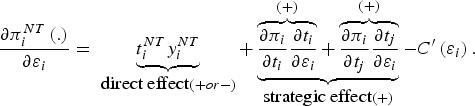 $$\displaystyle{{\partial \pi _i^{NT} \left(. \right)} \over {\partial \varepsilon _i }} = \; \underbrace {t_i^{NT} y_i^{NT} }_{\hbox {direct}\; \hbox {effect}\lpar + or - \rpar } + \underbrace {\overbrace {\displaystyle{{\partial \pi _i } \over {\partial t_i }}\displaystyle{{\partial t_i } \over {\partial \varepsilon _i }}}^{\left(+ \right)} + \overbrace {\displaystyle{{\partial \pi _i } \over {\partial t_j }}\displaystyle{{\partial t_j } \over {\partial \varepsilon _i }}}^{\left(+ \right)}}_{\hbox {strategic}\; \hbox {effect}\lpar + \rpar } - C^{\prime }\left({\varepsilon _i } \right).$$
The first term captures the direct cost-reducing effect of innovation: a marginal innovation reduces its own tax payments. The sign of this term is positive as long as the equilibrium tax rate is positive.Footnote 15 The second and third terms capture the strategic policy-inducing effects of innovation: a marginal innovation lowers domestic tax and raises foreign tax, both of which in turn benefit the firm itself. The last term represents the cost of innovation.
We then explicitly derive the firm incentives for environmental R&D in a symmetric equilibrium of regime NT, that is, FI NT. Evaluating (5) at εi = 0 and at a symmetric equilibrium, we have
 $$FI^{NT}\equiv \left. {\pi_{i}^{NT}\lpar{\cdot}\rpar \over{\partial \epsilon_{i}}} \right\vert _{d_{1}=d_{2}=d\comma \epsilon_{1}=\epsilon_{2}=0}={4d\lpar 3+\gamma\rpar \left[2-ed\lpar 2-\gamma\rpar \right]\over 25}\comma \;$$
which indicates that each firm's innovation incentive is increasing in γ. From the assumption of interior solution ensuring y NT > 0, we find that FI NT is always positive. Notice that the innovation incentives are defined as the marginal profits of a small improvement in its own emission technologies (evaluated at the point εi = 0), so the innovation cost is not included in FI NT because C′(0) = 0.
3.2. Quantity regulations (regime NQ)
Next, we consider non-cooperative regulation based on quantity, which is defined as setting the total allowable volume of emissions (or equivalently, emission caps) a i by each government. Because ε1, ε2, a 1 and a 2 are determined in period 0 and 1, we need not consider the firms' output choices in period 2 as long as the quantity regulation is binding.
The maximization problem of government i (i = 1, 2) in period 1 is
 $$\max_{a_i}\ P\left({a_i \over e-\epsilon_i}+ {a_j \over e-\epsilon_j} \right){a_i \over e - \epsilon_i}-d_i\left(a_i+\gamma a_j\right)-C\left(\epsilon_{i}\right).$$
Solving the first-order conditions for both governments, we obtain the equilibrium level of emissions (quantity regulations) in country i as
 $$a_i^{NQ}\equiv a_{i}^{NQ}\left(\epsilon_{i}\comma \; \epsilon_{j}\right)={\left(e-\epsilon_i\right)\left[1-2\left(e-\epsilon_i\right)d_i +\left(e-\epsilon_j\right)d_j\right]\over3}\comma \;$$
where superscript NQ represents the variable under the NQ regime. Therefore, y iNQ = [1 − 2(e − εi)d i + (e − εj)d j]/3 for i = 1, 2. We then have
 $$\displaystyle{{\partial a_i^{NQ}}\over{\partial \epsilon_i}} = -\displaystyle{{1-4\left(e-\epsilon _i\right)d_i + \left(e-\epsilon_j\right)d_j}\over{3}} \gtreqless 0\comma \; \quad \displaystyle{{\partial a_j^{NQ}}\over{\partial \epsilon_i}} = -\displaystyle{{\left(e-\epsilon_j\right)d_i}\over{3}} \lt 0.$$
Lemma 3
A marginal innovation by the domestic firm relaxes or tightens domestic quantity regulation and tightens foreign quantity regulation.
In contrast to the tax case, a marginal innovation tightens domestic quantity regulation when d i is small. The intuition is as follows. The regulator i sets a i to equate the marginal revenue of a i with the marginal damage of a i given a j. The marginal damage is independent of εi, whereas the marginal revenue is increasing or decreasing in εi. When d i is small (large), a i is large (small) and thus, the marginal innovation decreases (increases) the marginal revenues. Therefore, to increase (decrease) the marginal revenues, the regulator sets a smaller (larger) a i.Footnote 16
From the equilibrium emission cap a iNQ, we obtain the output of each firm in a symmetric equilibrium as y NQ = [1 − (e − ε)d]/3. Thus, we assume d < 1/(e − ε) to ensure an interior solution y NQ > 0. Substituting a iNQ and a jNQ into (1), we have πiNQ(εi, εj). Differentiating πiNQ in εi, we have
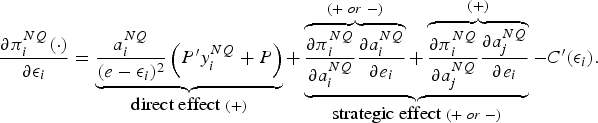 $$\eqalign{\displaystyle{{\partial \pi_{i}^{NQ}\lpar{\cdot}\rpar }\over{\partial \epsilon_{i}}} = \underbrace {\displaystyle{ a_{i}^{NQ}\over \lpar e-\epsilon_{i}\rpar ^{2}} \left(P^{\prime }y_{i}^{NQ}+P\right)} _{{\hbox {direct\ effect}}\ \lpar +\rpar } +\underbrace {\overbrace {\displaystyle{\partial \pi_{i}^{NQ}\over \partial a_{i}^{NQ}}\displaystyle{\partial a_{i}^{NQ}\over \partial e_{i}} }^{\lpar +\ or\ -\rpar }+\overbrace {\displaystyle{\partial \pi_{i}^{NQ}\over \partial a_{j}^{NQ}} \displaystyle{\partial a_{j}^{NQ}\over \partial e_{i}}}^{\lpar +\rpar }}_{{\hbox {strategic\ effect}}\ \lpar +\ or\ -\rpar }-C^{\prime }\lpar \epsilon_{i}\rpar .}$$
The direct effect of marginal innovation is always positive because P′y iNQ + P > 0, which can be confirmed by y NQ < arg maxy iP(y i + y j)y i. In other words, given a i and a j, marginal innovation enables the firm to increase its output and profits. However, the strategic (policy-inducing) effect of innovation is ambiguous because a marginal innovation may tighten regulations that the firm faces (as shown in Lemma 3). If d i is small enough, the second term in (8) would be negative and may dominate the third term.
We then explicitly derive the firm incentives for environmental R&D under the NQ regime. Evaluating (8) at εi = 0 and at a symmetric equilibrium, we have
 $$FI^{NQ}\equiv \left. \displaystyle{\partial \pi_{i}^{NQ}\lpar{\cdot}\rpar \over\partial \epsilon_{i}} \right \vert _{d_{1} = d_{2}=d\comma \ \epsilon_{1}=\epsilon_{2}=0} = \displaystyle{d\left(1+5ed\right)\over 9} \gt 0.$$
FI NQ is always positive although an innovation may tighten the domestic regulation.Footnote 17
3.3. Comparison between regimes NT and NQ
Next, we compare NT and NQ equilibrium in two points: countries' net benefits and firms' innovation incentives. Here, the net benefits in each country are evaluated in exante terms, i.e., the net benefits without environmental innovations. The exante net benefits in each equilibrium can be obtained, respectively, by
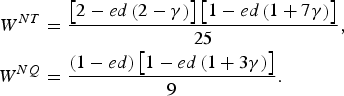 $$\eqalign{W^{NT}& = \displaystyle{\left[2-ed\left(2-\gamma \right)\right]\left[1-ed\left(1+7\gamma \right)\right]\over 25}\comma \; \cr W^{NQ}&=\displaystyle{\left(1-ed\right)\left[1-ed\left(1+3\gamma \right)\right]\over 9}.}$$
We then state the following propositions:
Proposition 1
The exante net benefit in each country is higher under regime NQ than under regime NT. In addition, the gap between them becomes larger as emission spillovers become greater. Formally, WNQ > WNT and ∂ (WNQ − WNT)/∂ γ > 0.
Proof 1
The first assertion is derived from W NQ − W NT = 7[1 − ed(1 − 3γ)]2/225 > 0, while the second one is derived from d(W NQ − W NT)/dγ = 14ed[1 − ed(1 − 3γ)]/75 > 0.
The advantages regarding the net benefits under regime NQ over regime NT can be confirmed by the fact that equilibrium output under NQ is smaller than that under NT.Footnote 18 In our model, the output is consumed in the third market, and hence the consumer surplus is not included in the net benefits of both countries. Therefore, the output of each firm under oligopolistic competition is excessive from the viewpoint of the joint maximization of their profits. Furthermore, production is also excessive because of negative pollution externalities. Therefore, y NT > y NQ leads to W NT < W NQ. The reason why y NT is larger than y NQ is as follows. Under NT, each government cannot help but lower tax rates out of fear that setting higher tax rates will induce the foreign firm to produce more, whereas, under NQ, the foreign firm cannot change its output levels after the domestic government sets the policy. Thus, the non-cooperative tax becomes inefficiently lower and the differences in net benefits become larger as damages from foreign emissions become larger (i.e., γ is larger).Footnote 19
We then compare firm incentives under NT with those under NQ.
Proposition 2
Firm incentives for environmental R&D are larger under regime NT than under regime NQ for small MEDs and/or for large emission spillovers, and vice versa. Formally,
 $$FI^{NT}\gtreqless FI^{NQ} \Leftrightarrow d\lesseqgtr \displaystyle{191 + 72\gamma \over e\lsqb 341-36\gamma \lpar 1 + \gamma \rpar \rsqb }.$$
Proof 2
From (6) and (9), we obtain the critical value of d displayed in the proposition. In addition, it is obvious that the critical value is increasing in γ.
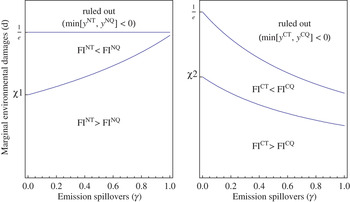
Contrary to the widespread notion that price (tax) regulations induce firm innovation more than quantity (emission-cap) regulations, our result indicates that the relative ranking of firm incentives crucially depends on the MEDs and the degree of transboundary pollution, if we assume the existence of international oligopoly and a lack of regulator's commitment power. The underlying intuition is as follows: when d is small, innovations tighten domestic quantity regulation as well as foreign quantity regulation, as shown in Lemma 3. On the other hand, innovations relax domestic tax regulation while tightening foreign regulation. Thus, FI NT > FI NQ holds for smaller d. When d is large, innovations relax domestic regulation while tightening foreign regulation under either regime. However, regulation is stricter under NQ than under NT (equivalently, y NT > y NQ), and the benefits from increases in output are greater under NQ than under NT. Therefore, FI NT < FI NQ holds for larger d. In addition, from (4) and (7), the larger the γ, the greater the decrease (increase) that innovation causes in domestic (foreign) tax rates, while the effect of an innovation on domestic and foreign quantity regulations is independent of γ. Thus, FI NT > FI NQ holds for larger values of γ. The left panel of figure 1 simply illustrates the results.Footnote 20
Tax vs. quantity regulations: non-cooperative regimes (left) and cooperative regimes (right)

Combining the results of Propositions 1 and 2 implies that, under a non-cooperative policy setting, a quantity regulation regime leads to higher exante net benefits in each country and greater firm incentives for environmental R&D than a tax regulation regime if the MEDs are large enough and/or the emission spillovers are small. On the other hand, if the MEDs are not so large and/or the emission spillovers are large, the exante net benefits are larger under quantity regulation regimes but innovation incentives are greater under tax regulation regimes.
4. Cooperative policy harmonization
In this section, we examine the issue of international harmonization in emission controls. Suppose an official multilateral agreement (e.g., an international climate agreement) requires a harmonized environmental policy that will be followed by both countries. The principle is that both governments will harmonize regulations to maximize the sum of both countries' net benefits. We investigate firm incentives for environmental R&D in the case where firms expect such policy harmonization to be implemented. The situation corresponds to the cases of DuPont and Keidanren, as mentioned in the introduction.
4.1. Socially optimal outcome
Before deriving firm incentives for environmental R&D under regimes CT and CQ, we derive the socially optimal outcomes. The optimal outputs for maximizing the sum of the net benefits of both countries can be characterized by solving the following problem: maxy 1, y 2W 1 + W 2. We have the optimal outputs for maximizing the sum of the net benefits of both countries in a symmetric equilibrium: y* = [1 − d(e − ε) (1 + γ)]/4. Thus, in this section, we assume d < 1/[(e − ε)(1 + γ)] for ensuring y* > 0.Footnote 21
4.2. Emission taxes (regime CT)
In period 2, each firm chooses an output level to maximize its profits (1), given the rival firm's output level and harmonized tax rate t. Solving the first-order conditions of both firms characterizes the equilibrium output:  $\hat{y}_{i}=\lsqb 1-\left(e-2\epsilon_{i}+\epsilon_{j}\right)\bar{t}\rsqb /3$.
In period 1, the collective choice on harmonized tax rate is decided so as to maximize the net benefits of both countries. The maximization problem is represented by maxtW 1 + W 2. Arranging the first-order condition of the problem, we obtain the equilibrium tax rate t CT as
 $$t^{CT}\left(\epsilon_{i}\comma \; \epsilon_{j}\right)= \displaystyle {\matrix {\sum _{i}^{2}\lpar e-\epsilon_{i}\rpar +\sum_{i\neq j}^{2}\left[6\lpar e-\epsilon _{i}\rpar ^{2}\lpar d_{i}+\gamma d_{j}\rpar \right]\cr - 3\lpar e-\epsilon_{1}\rpar \lpar e-\epsilon _{2}\rpar \lpar d_{1}+d_{2}\rpar \lpar 1+\gamma\rpar } \over 2\left(2e-\epsilon_{1}-\epsilon_{2}\right)^{2}}\comma \;$$
where superscript CT represents the variable under regime CT.Footnote 22 In a symmetric equilibrium (d 1 = d 2 = d and ε1 = ε2 = ε), the harmonized tax rate reduces to
 $$\left. t^{CT}\right\vert _{d_{1}=d_{2}=d\comma \ \epsilon_{1}=\epsilon_{2}=\epsilon }\equiv \tilde {t}^{CT}=\displaystyle{1+3d\left(e-\epsilon \right)\left(-1+3\gamma \right)\over 4\left(e-\epsilon \right)}.$$
Then, taking d < 1/[(e − ε)(1 + γ)] into account, we find that
 $$\tilde {t}^{CT}-d = \displaystyle{1+d\left(e-\epsilon \right)\left(-1+3\gamma \right)\over 4\left(e-\epsilon \right)} \gt 0\comma \;$$
which implies that the harmonized tax rate (in a symmetric equilibrium) is greater than the MEDs from emission, d.
Lemma 4
In a symmetric equilibrium, a harmonized tax rate is greater than the MEDs from emission.
The result is intuitive. Cournot competition between firms 1 and 2 yields more total output than the collusive production that maximizes the joint profits of both firms. Because the sum of both countries' net benefits does not take consumer surplus into account, a harmonized tax should be employed to reduce the overproduction due to oligopolistic competition, as well as to decrease the negative (environmental) externality of production. Thus, the harmonized tax rate is greater than the MEDs.
Next, differentiating t CT in εi and evaluating it at a symmetric equilibrium (d 1 = d 2 = d and ε1 = ε2 = ε), we obtain
 $$\left. \displaystyle{\partial t^{CT}\over\partial \epsilon_i}\right\vert _{d_{1}=d_{2}=d\comma \ \epsilon_{1}=\epsilon_{2}=\epsilon }=\displaystyle{1\over8\left(e-\epsilon \right)^2 }\gt 0.$$
Lemma 5
A marginal innovation by one firm necessarily raises the harmonized tax rate.
For a given rate of harmonized tax, a marginal innovation (a small increase in εi) leads to greater total output.Footnote 23 Initially, the total output is inefficiently greater than the collusive output that maximizes both firms' joint profits. Therefore, the increase in the total production due to a marginal innovation aggravates the overproduction, which gives the policymaker incentives to raise the harmonized tax rate. On the other hand, a marginal innovation leads to smaller total emissions, which gives the policy maker incentives to lower the tax rate.Footnote 24 The greater the initial tax rate compared to the MEDs from emissions, the more likely that the former incentives will prevail over the latter incentives. Because the harmonized tax rate is greater than the MEDs (Lemma 4), a marginal innovation raises the harmonized tax rate (i.e., the harmonized tax rate is increasing in εi).Footnote 25
We define y iCT ≡ y iCT (εi,εj) by substituting t CT into the equilibrium output in period 2. The symmetric equilibrium output is given by y CT = [1 − d(e − ε)(1 + γ)]/4 > 0, which equals y*: the cooperative tax will induce socially optimal outcomes.
The effect of changes in εi on the equilibrium profits, πiCT (εi, εj), is decomposed into the following three components:
 $$\displaystyle{\partial \pi_{i}^{CT}\lpar{\cdot}\rpar \over\partial \epsilon_{i}} = \underbrace {t^{CT}\, y_{i}^{CT}}_{{\hbox {direct\ effect}}\ \lpar +\rpar } + \underbrace{\displaystyle{\partial \pi_{i}^{CT}\over \partial t^{CT}}\displaystyle{\partial t^{CT}\over\partial \epsilon_{i}}}_{{\hbox {strategic\ effect}}\ \lpar -\rpar }-\ C^{\prime }\lpar \epsilon_{i}\rpar.$$
The first and second terms represent the direct effect of decreases in tax payments and the strategic policy-inducing effect of innovation, respectively. Because the tax rate is harmonized at t CT, one firm's innovation has the same impact of tax changes on both firms. The direct effect of innovation is always positive when it is evaluated in a symmetric equilibrium because t CT and y CT are always non-negative.
We explicitly obtain the firm incentives for environmental R&D in period 0 by evaluating (11) at εi = 0 and at a symmetric equilibrium:
 $$FI^{CT}\equiv \left. \displaystyle{\partial \pi_{i}^{CT}\lpar{\cdot}\rpar \over\partial \epsilon_{i}} \right \vert _{d_{1}=d_{2}=d\comma \ \epsilon_{1}=\epsilon_{2}=0}=\displaystyle{\left[1-ed\lpar 1+\gamma \rpar \right]\left[1+4ed\lpar 1+\gamma \rpar \right]\over 16e} \gt 0.$$
4.3. Quantity regulations (regime CQ)
Next we derive the firm incentives for environmental R&D in the case where harmonized quantity regulations (emission allowance) are determined cooperatively. As before, each firm cannot produce output beyond the predetermined level y i = a/(e − εi). Thus, we need not investigate the behavior of each firm in period 2 unless the quantity regulation is not binding.
The cooperative emission standard a is chosen in period 1 to maximize joint net benefits W 1 + W 2. The maximization problem is
 $$\max_{\bar {a}}\ \displaystyle \sum_{i\neq j}^{2}\left[p\left(\displaystyle{\bar {a}\over e-\epsilon_i} + \displaystyle{\bar {a}\over e-\epsilon_j}\right)\, \displaystyle{\bar{a}\over e-\epsilon_i}-d_i\bar {a}\left(1 + \gamma \right)-C\lpar \epsilon _{i}\rpar \right].$$
The first-order condition, after some manipulation, isFootnote 26
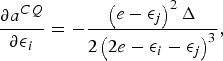
 $$\eqalign{ & a^{CQ}=\lpar e-\epsilon_{1}\rpar \lpar e-\epsilon_{2}\rpar \cr & \quad \times \left. \left\{\sum_{i\neq j}^{2}\left[\left(e-\epsilon_{i}\right)-d_{i}\lpar e-\epsilon_{i}\rpar \lpar e-\epsilon_{j}\rpar \left(1+\gamma \right)\right]\right\}\right/ \left[2\left(2e-\epsilon _{1}-\epsilon_{2}\right)^{2}\right].}$$
The output in a symmetric equilibrium is given by y CQ = [1 − d(e − ε)(1 + γ)]/4 = y CT = y* > 0, which implies that the cooperative quantity regulation will induce socially optimal outcomes. Differentiating this with respect to εi and evaluating it at a symmetric equilibrium, we have
 $$\left. \displaystyle{\partial a^{CQ}\over\partial \epsilon_{i}} \right \vert _{d_{1}=d_{2}=d\comma \ \epsilon_{1}=\epsilon_{2}=\epsilon } = -\displaystyle{1-2d\lpar e-\epsilon \rpar \lpar 1+\gamma \rpar \over 8 }\gtreqless 0.$$
Lemma 6
A marginal innovation by one firm tightens or relaxes the harmonized quantity regulation.
Equation (13) shows that when d is smaller (larger) than 1/[2(e − ε)(1 + γ)], then marginal innovation decreases (increases) a CQ. The intuition is as follows. When d is small, the level of a CQ and output are both large, and marginal innovation largely increases output. Because the revenue function of firms is convex but environmental damages are linear, the impact of innovation on environmental losses outweighs the impact on profit gains. Thus, marginal innovation tightens the harmonized level of emission caps when d is small.Footnote 27
The effect of changes in εi on the equilibrium profits, πiCQ (εi, εj), is decomposed into the following three components:
 $$\displaystyle{\partial \pi_{i}^{CQ}\lpar{\cdot}\rpar \over\partial \epsilon_{i}} = \underbrace {\displaystyle{a^{CQ}\over\lpar e-\epsilon_{i}\rpar ^{2}} \left(P^{\prime }y_{i}^{CQ}+P\right)}_{{\hbox {direct\ effect}}\ \lpar +\rpar }+\underbrace {\displaystyle{\partial \pi_{i}^{CQ}\over \partial a^{CQ}}\displaystyle{\partial a^{CQ}\over\partial \epsilon_{i}}}_{{\hbox {strategic\ effect}}\ \lpar +\rpar \ {\hbox {or}}\ \lpar -\rpar }\ -\ C^{\prime }\lpar \epsilon_{i}\rpar.$$
The first and second terms represent the direct effect of increasing output and the strategic policy-inducing effect of innovation. Because emission cap level is harmonized at a CT, one firm's innovation has the same impact of changes in emission caps that both firms face. The direct effect of innovation is always positive because (P′ y iCQ + P) > 0 and a CQ > 0.Footnote 28
We obtain the explicit form of the firm incentives for environmental R&D in period 0 by evaluating (14) at εi = 0 and at a symmetric equilibrium.
 $$FI^{CQ}\equiv \left. \displaystyle{\pi_{i}^{CQ}\left(\cdot \right)\over\partial \epsilon _{i}}\right \vert _{d_{1}=d_{2}=d\comma \ \epsilon_{1}=\epsilon_{2}=0}=\displaystyle{1 + e^2d^2\left(1+\gamma \right)^2\over16e}\gt 0.$$
4.4. Comparison between regimes CT and CQ
Let us now compare firm incentives in CT with those in CQ equilibrium. Obviously, the net benefits under CT and those under CQ are the same because y CT = y CQ = y*. In other words, the two regimes (CT and CQ) are indifferent and statically attain the socially optimal allocation. However, the firm incentives for environmental R&D are different under the two regimes. Comparing (12) and (15) yields the following result.
Proposition 3
Firm incentives for environmental R&D are larger under regime CT than under regime CQ for small MEDs and/or for small emission spillovers, and vice versa. Formally,
 $$FI^{CT}\gtreqless FI^{CQ}\ \Leftrightarrow \ d\lesseqgtr \displaystyle{3 \over 5e\left(1+\gamma \right)}.$$
As under the non-cooperative policy regimes, the ranking with regard to firm incentives for environmental R&D crucially depends on d and γ. From (10) and (13), we find that, for a larger value of d, innovations relax the harmonized level of quantity regulations while necessarily strengthening that of price (tax) regulations. Thus, FI CT < FI CQ holds for larger value of d. On the other hand, when d is small, innovations tighten both cooperative policies. However, under CT, innovations reduce the net marginal cost of production (e it CT) and thus increase the output of the innovating firm. Thus, FI CT > FI CQ holds for smaller values of d. The right panel of figure 1 illustrates this result.Footnote 29
5. Does policy harmonization encourage innovation?
In this section, we compare firm incentives under non-cooperative policy regimes with those under cooperative policy regimes. Certainly, regulations are stricter and the exante net benefits of both countries are greater under cooperative policy regimes than under non-cooperative policy regimes (either tax or quantity regulations). However, the ranking of firm incentives for environmental R&D is not easy to determine because stricter regulations under cooperative regimes increase the value of and the need for innovation in firms while also eliminating the strategic advantages of innovation that relax domestic regulations and tighten foreign regulations.
5.1. Non-cooperative vs. cooperative tax regulations
The following proposition compares FI NT with FI CT.
Proposition 4
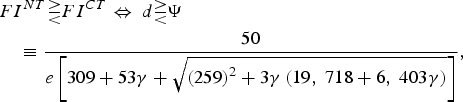
Firm incentives for environmental R&D are larger under regime NT than under regime CT for large MEDs and/or for large emission spillovers, and vice versa. Formally,
 $$\eqalign{& FI^{NT}\gtreqless FI^{CT} \Leftrightarrow \ d\gtreqless \Psi \cr & \quad \equiv\displaystyle{50 \over e\left[309 + 53\gamma +\displaystyle \sqrt{\left(259\right)^2+3\gamma \left(19\comma \; 718+6\comma \; 403\gamma \right)}\right]}\comma \; }$$
where 0 < Ψ < 1/[e(1 + γ)] holds for all γ ∈ [0, 1].
Proof 4
See Appendix.
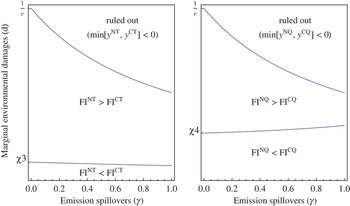
As shown by the left panel of figure 2, firm incentives are larger under NT than under CT except when d is extremely small.Footnote 30 Comparing (11) with (5) gives us the intuition of the comparison result. Innovations under NT have the effect of lowering domestic taxes and raising foreign taxes whereas those under CT have the effect of raising both countries' tax rates. Due to this strategic effect of innovation, which widens the gap between domestic and foreign tax rates under NT, FI NT > FI CT holds in most regions. However, as we see from (6) and (12), FI NT converges to zero, but FI CT converges to 1/(16e) as d approaches to zero. This is because the equilibrium tax rate under NT becomes negative for extremely small d, which makes the direct effect in equation (5) negative. Thus, FI NT < FI CT holds for extremely small d.
Non-cooperative vs. cooperative regulations: tax (left) and quantity regulation (right)

5.2. Non-cooperative vs. cooperative quantity regulations
Finally, we compare firm incentives under NQ with CQ.
Proposition 5
Firm incentives for environmental R&D are larger under regime NQ than under regime CQ for large MEDs and/or for small emission spillovers, and vice versa. Formally,
 $$FI^{NQ}\gtreqless FI^{CQ}\ \Leftrightarrow \ d\gtreqless \Omega \equiv \displaystyle{\sqrt{\left(19-9\gamma \right)\left(37+9\gamma \right)}-8 \over e\left[71-9\gamma \left(2+\gamma \right)\right]}\comma \;$$
where 0 < Ω < 1/[e(1 + γ)] holds for all γ ∈ [0, 1].
Proof 5
See Appendix.
The right panel of figure 2 illustrates the results.Footnote 31 When d is large, innovations relax the domestic regulations and tighten the foreign regulations under NQ, whereas they relax both countries' regulations under CQ. This can be confirmed by comparing the strategic effect in (8) with that in (14). Thus, FI NQ > FI CQ holds for relatively large values of d. On the other hand, when d is small, under both regimes, innovations tighten both countries' regulations. In this case, the level of regulations is stricter under CQ than under NQ, which implies that the marginal profits of innovations are larger under CQ than under NQ. This finding can be confirmed by comparing direct effects in (8) with those in (14). Thus, FI NQ < FI CQ holds for relatively small values of d.
From Propositions 4 and 5, we can state that under either regime, price or quantity regulations, policy cooperation (harmonization) necessarily enhances exante net benefits in each country; however, it does not necessarily increase firms' innovation incentives. In particular, when the MEDs are large, policy cooperation provides smaller incentives to each firm to engage in environmental R&D than a non-cooperative policy setting does.
6. Concluding remarks
Employing a simple two-country model of strategic environmental policy, we investigate and compare firm incentives for developing cleaner technology under several policy regimes: Non-cooperative policy settings of tax and quantity regulations (NT and NQ) and cooperative policy settings of tax and quantity regulations (CT and CQ).
The results obtained in this study are summarized as follows: contrary to the general view, firm incentives are not necessarily greater under price regulations than under quantity regulations. Under both non-cooperative and cooperative regimes, firm incentives under quantity regulations are greater (smaller) than those under price regulations if the environmental damages are large (small) and/or emission spillovers are small (large). Under non-cooperative policy settings, each country's net benefits before innovation are greater under quantity rather than tax regulation regime. Therefore, if the MEDs are not so large and/or emission spillovers are large, quantity regulations statically yield larger net benefit for countries than price regulations do but, dynamically, they do not encourage environmental innovation more than price regulations do. In addition, under either regime, tax or quantity regulations, policy cooperation (harmonization) statically enhances net benefits for each country but does not necessarily increase firms' innovation incentives. This situation occurs when environmental damages are large.
It is worth noting that our analysis has left certain issues unanswered. For example, we have assumed the inverse demand functions to be linear for the sake of mathematical simplicity. Considering a more general demand structure may affect the comparison of firms' innovation incentives under different policy regimes. In addition, we have focused solely on a symmetric equilibrium to gain analytical insight. Thus, it is desirable to extend our analysis by considering asymmetric policy preferences between policy makers and by incorporating vertically and horizontally differentiated products. Finally, we have investigated only innovation incentives for developing clean technologies. It may be significant to consider firms' pollution abatement activities and their incentives for developing superior abatement technologies. These additional avenues of investigation await future research.
Supplementary materials and methods
The supplementary material referred to in this paper can be found online at journals.cambridge.org/EDE/.