Introduction
Older adults, particularly those residing in aged-care facilities, face heightened risks of mortality and long-term health complications during natural hazard–related disasters.Reference Hua, Patel and Thomas 1 –Reference Hua, Patel and Thomas 3 Although facility size, provider sector, and resident health status vary, a common challenge exists: protecting vulnerable older adults during emergencies. The concept of “aging in place,” which enables older adults to continue living in familiar environments, is highly valued in welfare policy concerning older adults.Reference Wiles, Guberman and Reeve 4 However, disasters frequently place this principle under strain.
In Japan, disaster response has traditionally emphasized evacuation to designated shelters. However, subsequent revisions to disaster legislation have increasingly recognized situations in which remaining indoors may be safer than evacuation, particularly for individuals who require continuous care. Many aged-care facilities are considered to fall within this category. Although remaining onsite is legally recognized under certain circumstances, little is known about how aged-care facilities translate this principle into operational preparedness. Some facilities have developed explicit shelter-in-place (SIP) plans, whereas others anticipate continuing onsite care without formal SIP planning. In this study, onsite care refers broadly to the anticipated continuation of care within a facility during a disaster, whereas SIP refers specifically to facilities with an explicit plan to remain onsite and continue care under disaster conditions. Despite the practical importance of onsite care, evidence regarding how aged-care facilities prepare to sustain onsite care during disasters remains limited. In contrast, in the United States, shelter-in-place (SIP) is explicitly recognized as a disaster-response option within emergency preparedness frameworks and is incorporated into planning guidance for health care and aged-care facilities. 5 Research in the United States has examined emergency preparedness policies and the application of SIP in long-term care settings.Reference Castro, Persson and Bergstrom 6 , Reference Kennedy, Hua and Nelson 7 However, SIP is not uniformly appropriate across disaster contexts and is not inherently a preferred evacuation strategy. For example, remaining onsite may be unsafe when facilities are located in flood-prone areas, when buildings are structurally vulnerable, or when essential services such as electricity, water, sanitation, and staffing cannot be maintained. Conversely, evacuation itself may pose substantial risks for frail older adults. Therefore, the appropriateness of SIP depends on the interaction between hazard characteristics, facility conditions, and the capacity to sustain care.
The 2011 Great East Japan Earthquake highlighted challenges in disaster response for older adults requiring long-term care. Under the disaster-response framework in effect at the time, evacuation to designated shelters was generally emphasized as the principal protective action. 8 However, some facilities initially continued caring for residents onsite because immediate relocation was not feasible. Residents were subsequently transferred to public shelters, where deteriorating living conditions adversely affected their health and necessitated further transfers.Reference Mori, Sugawara and Obuchi 9 These experiences demonstrated that evacuation alone does not ensure continuity of appropriate care for older adults requiring long-term care. Since 2013, revisions to Japan’s disaster legislation have increasingly recognized that, under certain circumstances, remaining indoors or securing safety onsite may be an appropriate protective action when evacuation itself poses risks. Disaster prevention policies in Japan have also recognized the role of aged-care facilities in strengthening community disaster resilience. Some facilities have been designated as welfare shelters to accommodate individuals identified by municipalities as requiring special support. 10 However, most aged-care facilities are not designated as welfare shelters. Consequently, little empirical evidence is available regarding how facilities anticipate disaster response and prepare for situations in which care may need to be sustained onsite. Understanding these anticipations is important because facility-level preparedness may affect not only resident safety but also potential demands on welfare shelters, public shelters, health care services, and other community support resources during disasters.Reference Pierce, Morley and West 11
In 2021, the Ministry of Health, Labour and Welfare introduced business continuity planning (BCP) guidelines requiring aged-care facilities to prepare for natural hazard–related disasters, 12 with compliance becoming mandatory in 2024. However, the level of operational detail provided in the guidelines varies considerably across preparedness domains. While stockpiled supplies and sanitation measures are described in detail, staff mobilization and communication arrangements receive less detailed guidance. Internationally, the U.S. Centers for Medicare & Medicaid Services (CMS) mandated emergency preparedness planning through the Emergency Preparedness Final Rule in 2017, 5 prompting multiple evaluation studies.Reference Lane and McGrady 13 , Reference Lane and McGrady 14 In contrast, empirical evaluations of the implementation of these preparedness measures remain scarce.
This study examines the preparedness of Japanese aged-care facilities with respect to stockpiled essential supplies and sanitation measures, two preparedness domains that are described in considerable operational detail within Japan’s BCP guidelines and are fundamental to maintaining care during disasters. Specifically, it analyzes variations in preparedness according to evacuation strategy, provider sector, and resident mobility. The study aims to identify potential implementation gaps in preparedness measures that are explicitly addressed in the national BCP guidelines.
Methods
Questionnaire Development
A questionnaire comprising 46 substantive items plus one consent item was developed to assess disaster preparedness in aged-care facilities. The questionnaire was informed by 3 sources: the Japanese BCP guidelines, 12 a previous national survey on disaster preparedness in aged-care facilities, 15 and an emergency preparedness checklist developed by the Centers for Medicare & Medicaid Services. 5 In addition, items were incorporated to capture community-specific factors, including differences in disaster risk and levels of collaboration with local governments. To ensure content validity, the draft questionnaire was reviewed by an expert panel comprising disaster researchers, public health scholars, aged-care facility staff, and government officials with experience in crisis management.
The questionnaire comprised items covering facility characteristics, anticipated evacuation strategies, stockpiling, sanitation, staffing, communication, coordination with local authorities, and continuity-of-care arrangements. The present analysis focused on 11 outcome indicators related to stockpiling (6 items) and sanitation measures (5 items). These domains were selected a priori because they are described in considerable operational detail in Japan’s BCP guidelines and are fundamental to maintaining continuity of care during disasters. Evacuation strategy was used as the primary stratification variable. Results for other questionnaire domains are not reported in the present study.
Stockpiling items included three-day supplies of food and water for residents, supplies for staff, generators, emergency cooking equipment and fuel, and cold-weather measures. Sanitation items included emergency toilet supplies, such as disposable toilet bags and cardboard toilet devices, incontinence products, toilet waste solidifying agents, designated temporary waste storage areas, and no sanitation preparation. Although cold-weather measures are mentioned only briefly in the BCP guidelines, and supplies for staff are not explicitly addressed, these items were included because they were considered relevant to sustaining onsite care. The overall structure of the questionnaire is summarized in Supplementary Table 1.
Data Collection
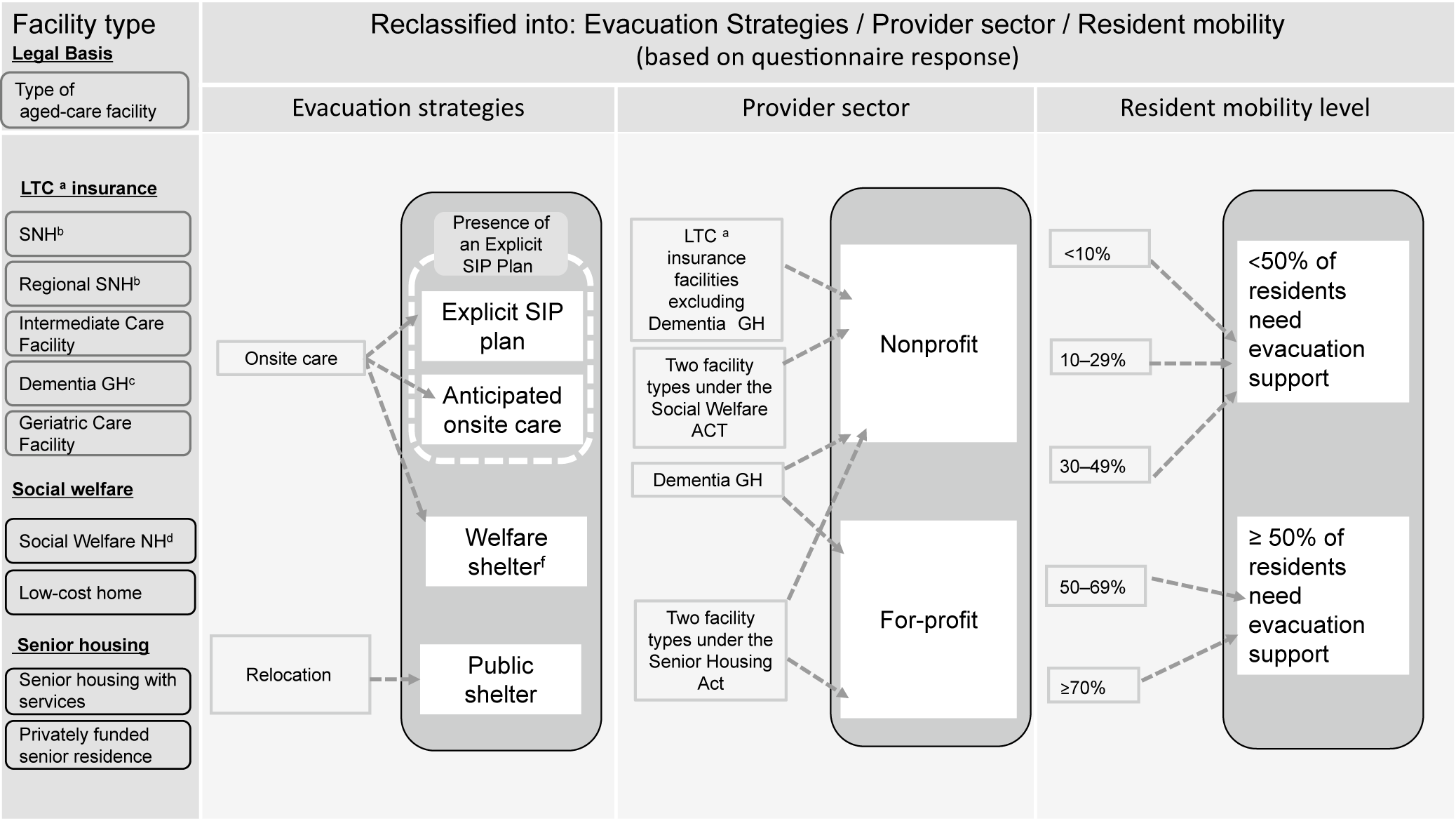
The survey targeted all 1366 residential aged-care facilities operating in Shizuoka Prefecture as of January 2023. Provider sector was classified as nonprofit or for-profit based on the legal status of the operating organization, as determined from survey responses on facility type and operating body (Figure 1).
Classification of residential aged-care facilities by evacuation strategy, provider sector, and resident mobility.
Facilities were classified based on their anticipated evacuation strategy during disasters and the legal framework under which they operate. “Onsite care” refers to the continuation of care within the facility during a disaster, regardless of whether such arrangements were formally planned. SIP denotes an explicit facility-initiated plan to remain onsite during a disaster. a. Long-term care. b. Special nursing home. c. Dementia Care Communal Living Facility Group home. d. Nursing home. e. In this study, “SIP” was defined operationally as an evacuation strategy in which an aged-care facility plans for its residents to remain onsite during a disaster based on its own internal planning. f. Facilities designated as welfare shelters.

Figure 1 Long description
The figure shows how residential aged-care facilities were reclassified for analysis according to three dimensions: evacuation strategy, provider sector, and resident mobility. Facility types were grouped according to their legal basis under long-term care insurance, social welfare legislation, or senior housing legislation. Evacuation strategies were classified as onsite care or relocation. Onsite care included facilities with an explicit shelter-in-place (SIP) plan, facilities anticipating onsite care without an explicit SIP plan, and facilities designated as welfare shelters; relocation was classified as evacuation to a public shelter. Provider sector was classified as nonprofit or for-profit based on the legal status of the operating organization. Long-term care insurance facilities other than dementia group homes and facilities operating under the Social Welfare Act were classified as nonprofit; senior housing with services and privately funded senior residences were classified as for-profit. Dementia group homes were classified as nonprofit or for-profit according to the reported operating body. Resident mobility was classified according to the proportion of residents requiring evacuation support: less than 50% or 50% or more. The original questionnaire categories of less than 10%, 10–29%, and 30–49% were grouped as less than 50%, whereas 50–69% and 70% or more were grouped as 50% or more.
In February 2023, a self-administered questionnaire was mailed to either the facility manager or the person in charge of risk management at each facility. A postcard reminder was sent in March, followed by a second mailing of the same questionnaire to nonrespondents in June. In July, non-responding facilities were contacted again via telephone. Responses were received both online and by postal mail. Each questionnaire was assigned a unique 5-digit alphanumeric code for identification and follow-up purposes. Web-based duplicate responses were excluded, whereas all paper responses were retained. After the data collection period concluded in August 2023, all of the identifying codes were permanently deleted.
Analysis
Facilities were analyzed on the basis of valid responses regarding evacuation strategies, resident mobility, and provider sector (Figure 1). These classification variables were derived from questionnaire responses and were specified a priori as the main analytical framework for this study. Stockpiling and sanitation measures were summarized descriptively and compared by evacuation strategy, provider sector, and resident mobility. The recoding scheme is presented in Supplementary Table 2.
Evacuation strategy was classified using self-reported responses to the questionnaire item asking whether the facility had a plan to remain onsite during certain disasters. Onsite care was used as a broader operational category referring to anticipated continuation of care within the facility, whereas SIP referred specifically to a formalized planning subtype within onsite care. Facilities were stratified according to the following three variables:
-
1. Evacuation strategy—Facilities were grouped into 4 types on the basis of their responses:
-
a. Onsite with an explicit SIP plan (explicit SIP)
-
b. Onsite without an explicit SIP plan (anticipated onsite care)
-
c. Onsite due to designation as a welfare shelter (welfare shelter)
-
d. Evacuation to public shelters (public shelter)
-
-
2. Provider sector—Facilities were classified as nonprofit or for-profit based on the legal status of the operating organization.
-
3. Resident mobility—Facilities were divided into 2 groups according to a 50% threshold for the proportion of residents who required evacuation assistance because of physical or cognitive impairments.
For Table 1, percentages were calculated using all 632 facilities as the denominator, with missing responses presented as a separate category. For stratified and inferential analyses, missing data were excluded, and percentages were calculated using valid responses. In this study, SIP was defined operationally as an onsite evacuation strategy on the basis of the facility’s self-reported internal planning. Facilities were categorized into 4 evacuation strategy groups: explicit SIP plan, anticipated onsite care, welfare shelter, and public shelter (Figure 1). Chi-square tests were used to compare preparedness indicators by SIP planning status, provider sector, and resident mobility. For SIP planning status comparisons, facilities designated as welfare shelters and facilities planning evacuation to public shelters were excluded. A 2-sided significance level of 0.05 was used for all of the statistical tests. Statistical analyses were performed using SPSS version 28.0.1.1. Although facilities designated as welfare shelters also remain onsite during disasters, their status is determined externally by municipalities and does not reflect facility-initiated planning. Therefore, these facilities were excluded from SIP-related comparisons. When designated as welfare shelters, facilities are not required to plan for onsite standby as part of their evacuation strategy, and residents do not relocate to public shelters. In such cases, facilities are expected to receive governmental support, including supplies and personnel.
Characteristics of aged-care facilities in this study

Table 1. Long description
Table 1 summarizes characteristics of the 632 aged-care facilities analyzed. Median resident capacity was 38, with a range of 4–519. Evacuation strategies were explicit SIP in 238 facilities (37.7%), anticipated onsite care in 232 (36.7%), welfare evacuation shelter in 136 (21.5%), and public shelter in 26 (4.1%). Provider sector was nonprofit in 291 facilities (46.0%) and for-profit in 328 (51.9%), with 13 (2.1%) reporting no answer. In 251 facilities (39.7%), fewer than 50% of residents required evacuation assistance; in 362 (57.3%), 50% or more required assistance; 19 (3.0%) provided no answer. Hazard-zone locations were flood-prone for 189 facilities (29.9%), landslide-prone for 105 (16.6%), tsunami-prone for 53 (8.4%), outside these zones for 294 (46.5%), and unknown for 19 (3.0%). Percentages were calculated using all 632 facilities as the denominator unless otherwise specified. Hazard-zone categories were not mutually exclusive.
a Unless otherwise specified, percentages were calculated using all 632 facilities as the denominator; missing responses are presented as a separate category.
b Facilities were divided into 2 groups using a threshold of 50% for the proportion of residents requiring evacuation assistance.
c Hazard zone categories are not mutually exclusive; facilities could select more than 1 option.
Ethics Approval and Consent to Participate
The data in this study were collected from managers or staff of aged-care facilities, with all facility names anonymized. In accordance with the Japanese Ethical Guidelines for Medical and Health Research Involving Human Subjects, this type of research—collecting nonpersonal, institutional-level data—is considered exempt from ethical review. This exemption was confirmed by the Research Ethics Committee of the Shizuoka Graduate University of Public Health. However, the study was conducted in accordance with the principles of the Declaration of Helsinki. Informed consent for this study was obtained in the form of a response to the first questionnaire item: “If you agree with the purpose of this survey, please check the box next to Q1 before answering the questions. Q1 I agree with the contents and will cooperate with the survey.”
Results
Characteristics of the Aged-Care Facilities
From February to August 2023, 639 responses were collected. Of these, 632 valid responses regarding evacuation strategies were analyzed in this study (response rate: 46%, 632/1366). Owing to legal regulations, the capacity of some facilities is set at 10 people or fewer. The median facility capacity across all facilities was 38 (range: 4-519) (Table 1). With respect to evacuation strategies, 38% (238/632) of the facilities were classified as having explicit SIP plans, whereas 37% (232/632) anticipated remaining onsite without explicit SIP plans. Facilities designated as welfare shelters accounted for 22% (136/632) of facilities and were expected to remain onsite without resident relocation. Only 4% (26/632) planned to evacuate to public shelters. With respect to provider sector, 46% (291/632) of facilities were nonprofit, and 52% (328/632) were for-profit; provider sector data were missing for 2% (13/632). Resident mobility data were available for 613 facilities; data were missing for 19 facilities.
In more than half of the facilities, at least 50% of residents required evacuation assistance. Regarding geographic hazard exposure, 47% of facilities were located outside the listed hazard zones; 30% were in flood-prone areas, 17% in landslide-prone areas, and 8% in tsunami-prone areas.
SIP Planning by Provider Sector and Resident Mobility
In the SIP-related 2-category comparison, excluding welfare shelters and public shelters, SIP planning status did not differ by provider sector (P = 0.86) (Table 2). The proportion of facilities with explicit SIP plans was similar between facilities with a lower proportion of residents requiring evacuation assistance (<50%) and those with a higher proportion (≥50%), 36% and 38%, respectively. In contrast, anticipated onsite care without explicit SIP plans was more common in the <50% group than in the ≥50% group: 46% versus 30%. Among facilities in the 2 onsite-care groups, the proportion with an explicit SIP plan differed significantly by resident mobility (P = 0.01).
Distribution of evacuation strategies by provider sector of facility and resident mobility

Table 2. Long description
Table 2 shows the distribution of four evacuation strategies by provider sector and resident mobility. Among all 632 facilities, 238 (37.7%) had an explicit SIP plan, 232 (36.7%) anticipated onsite care without an explicit SIP plan, 136 (21.5%) were welfare shelters, and 26 (4.1%) planned evacuation to public shelters. Among 291 nonprofit facilities, the corresponding proportions were 32.0%, 30.2%, 33.7%, and 4.1%; among 328 for-profit facilities, they were 42.6%, 41.9%, 11.6%, and 4.0%. The comparison between explicit SIP and anticipated onsite care did not differ by provider sector (P = 0.86). Among 251 facilities with fewer than 50% of residents requiring evacuation assistance, 36.3% had explicit SIP and 46.2% anticipated onsite care; among 362 facilities with 50% or more requiring assistance, 38.4% had explicit SIP and 30.1% anticipated onsite care. This two-category comparison differed significantly by resident mobility (P = 0.01). P values compare only explicit SIP with anticipated onsite care; welfare shelters and public shelters were excluded from these comparisons.
Percentages are calculated within each row unless otherwise specified.
a Onsite with an explicit shelter-in-place plan (explicit SIP).
b Onsite without an explicit shelter-in-place plan (anticipated onsite care).
c Onsite due to designation as a welfare shelter (welfare shelter).
d Evacuation to public shelters (public shelter).
e P values compare only facilities with explicit SIP plans and facilities anticipating onsite care without explicit SIP plans.
f Excluding 19 facilities with missing data.
g The cutoff value was set at 50% of residents requiring evacuation assistance at each facility.
Disaster Preparedness
With respect to stockpiling and related operational resources, three-day water and food supplies for residents, generators, and fuel were each reported by approximately three-quarters of all facilities (Figure 2a). These items are explicitly addressed in the BCP guidelines. In contrast, supplies for staff and cold-weather measures, which are not explicitly addressed or are mentioned only briefly in the guidelines, were available in only approximately half of facilities. Percentages were calculated using valid responses for each item; denominators varied because of missing data. Facilities with explicit SIP plans tended to report higher preparedness for selected items than facilities anticipating onsite care without explicit SIP plans. No statistically significant differences were observed for 3-day supplies of food and water for residents or generators. Welfare shelters showed preparedness levels similar to those of the 2 onsite-care groups. By provider sector, nonprofit facilities had significantly higher availability of 3-day supplies of food and water for residents than for-profit facilities (P = 0.001). Nonprofit facilities were also more likely to have fuel (P < 0.001), cold-weather measures (P = 0.018), and emergency toilet supplies (P < 0.001). In contrast, supplies for staff did not differ significantly by provider sector. No significant differences were observed by resident mobility for any of the stockpiling or sanitation indicators examined.
Preparedness profiles of aged-care facilities by anticipated evacuation strategy. (a) Stockpiling; (b) Sanitation measures.
Notes: P values indicate comparisons between facilities with explicit SIP plans and facilities anticipating onsite care without explicit SIP plans. Facilities designated as welfare shelters and facilities planning evacuation to public shelters were excluded from statistical comparisons.

Figure 2. Long description
Two radar charts labeled a and b. A shared legend at the top indicates four facility types: Explicit S I P (solid line), Anticipated onsite care without S I P (dashed line), Welfare shelter (dotted line), and Public shelter (dash-dot line).
Panel a, Stockpiling: A hexagonal radar chart with axes for Water 3 days, Food 3 days, Staff supplies (P = 0.03), Generator, Fuel (P < 0.001), and Cold-weather (P < 0.001). The Welfare shelter group shows the highest preparedness across most axes, reaching near 80 percent for water and food. The Public shelter group shows the lowest preparedness, often below 40 percent. Explicit S I P and onsite care without S I P groups fall in the middle, with Explicit S I P generally scoring higher in fuel and cold-weather supplies.
Panel b, Sanitation Measures: A pentagonal radar chart with axes for Emergency toilet supplies (P = 0.005), Incontinence products, Waste solidifying agents, Temporary waste storage, and No preparation. Most facilities show high preparedness for incontinence products (60 to 80 percent) but low preparedness for emergency toilet supplies and waste solidifying agents (mostly below 40 percent). The ‘No preparation’ axis shows very low values for all groups, indicating most have some form of sanitation plan. The Explicit S I P group shows significantly higher preparedness for emergency toilet supplies compared to the onsite care without S I P group.
With respect to sanitation measures, the proportion of facilities reporting no sanitation preparation varied across evacuation-strategy groups, ranging from approximately 3% to 13%. Incontinence products were stocked by 63% (401/632) of facilities. Emergency toilet supplies, toilet waste solidifying agents, and designated temporary waste storage areas were reported by 43% (273/632), 17% (109/632), and 29% (181/632), respectively (Figure 2b). These sanitation measures were available in fewer than half of facilities, except for incontinence products. A statistically significant difference was observed in the availability of emergency toilet supplies according to SIP planning status (P = 0.005). However, this statistically significant difference does not necessarily indicate adequate preparation.
Discussion
This study summarizes key differences in disaster preparedness among Japanese aged-care facilities. Most facilities anticipated continuing care onsite during disasters, although a substantial proportion had no explicit SIP plan. Stockpiling of essential supplies, including food, water, and power-related resources, was relatively well developed. In contrast, preparedness for sanitation measures, staff support, and cold-weather conditions, all of which are important for sustaining care over extended periods, was less consistent, regardless of whether facilities had an explicit SIP plan. These findings suggest that the unresolved issue is not whether onsite care is anticipated, but whether preparedness systems adequately support it.
Implementation Gaps Between the BCP Guidelines and Facility Preparedness
Several implementation gaps were evident between the preparedness measures described in the BCP guidelines and actual facility preparedness. 12 Even among facilities with explicit SIP plans, preparedness for sanitation and other operational resources remained limited. Basic resident supplies and power-related resources were relatively widely available. In contrast, sanitation measures, which are also described in operational detail in the guidelines, were unevenly implemented. Although almost 70% of facilities reported at least one sanitation measure, the most frequently prepared item was incontinence products. Reliance on such supplies alone is insufficient, because not all residents require incontinence products, and inadequate arrangements for toileting and waste management may compromise toileting independence, dignity, infection control, and waste management. Only about half of facilities had emergency toilet supplies, and fewer than one-fifth had stocked toilet waste solidifying agents. These findings suggest that sanitation preparedness should be prioritized not merely as an adjunct to stockpiling but as a core element of continuity-of-care planning.
Preparedness was also limited for items that were not explicitly addressed, or were mentioned only briefly, in the BCP guidelines, such as supplies for staff and cold-weather measures. A recent national survey conducted after mandatory BCP implementation reported that more than 90% of aged-care facilities had formulated BCPs. 16 In contrast, the present study did not ask whether BCP documentation had been completed, but examined the readiness of specific operational items. The findings therefore suggest that formal BCP completion may not necessarily imply operational preparedness. They also indicate that even when national guidelines describe preparedness measures in detail, implementation may vary substantially across specific disaster-preparedness components.
Disaster Preparedness Beyond Short-Term Life Preservation
Disaster preparedness in aged-care facilities should not be understood solely as short-term life preservation. Because most facilities in this study anticipated continuing care onsite during disasters, preparedness for sanitation, waste management, staff support, and cold-weather conditions is directly relevant to whether basic care can be sustained beyond the acute phase. The present study did not assess resident health outcomes or the quality of care during actual disasters. Nevertheless, the findings indicate that several operational items needed to sustain onsite care were less consistently available than basic food and water supplies for residents. International humanitarian guidance has long recognized sanitation as a core requirement for protecting health and dignity in emergencies. 17This perspective is also relevant to aged-care facilities, where residents often require continuous assistance with daily activities. Strengthening preparedness for sanitation and staff support should therefore be regarded as part of continuity-of-care planning, rather than as optional supplementary stockpiling.
Facility Preparedness and Community Resilience
Although this study did not directly assess community-level outcomes, facility-level preparedness may have implications beyond individual facilities. When aged-care facilities are unable to sustain basic care onsite because of inadequate sanitation, insufficient staff support, or limited operational supplies, residents may require relocation or additional external assistance. Such situations could increase avoidable demand on welfare shelters, health care services, and other community support resources during disasters.Reference Pierce, Morley and West 11 , 16 Strengthening preparedness in aged-care facilities may therefore contribute not only to continuity of care for residents but also to community disaster resilience by reducing preventable pressure on wider support systems.
These implications may also be relevant beyond Japan. Previous studies have shown that the treatment of SIP and onsite continuity of care varies across countries and care systems. 5 , 18 , 19 The Japanese case may therefore serve as an illustrative example of how preparedness gaps can emerge for care-dependent populations when evacuation is difficult, delayed, or incomplete.
Limitations
This study has several limitations. First, the survey response rate was 46%, which may limit its representativeness. Facilities with greater interest in disaster preparedness may have been more likely to respond, potentially leading to an overestimation of preparedness. Second, because responses were collected using both online and postal methods, potential mode effects may have introduced bias. For example, facilities responding online may have differed from postal respondents in administrative capacity, digital readiness, or engagement with disaster preparedness. Third, the identification of welfare shelters was based on self-reported information rather than verification through administrative records, which may have introduced classification error. Finally, the study was limited to facilities in a single prefecture. Shizuoka Prefecture has a high level of disaster awareness and preparedness, and its hazard profile, administrative context, and facility composition may differ from those of other regions in Japan. Therefore, the findings may not be fully generalizable, and the preparedness levels observed in this study may be higher than those in regions with lower levels of disaster-preparedness awareness. Future research should employ nationwide and longitudinal designs to assess changes in preparedness over time and to evaluate preparedness across regional and disaster contexts.
Conclusion
This study identified implementation gaps between Japan’s BCP guidelines and preparedness practices in aged-care facilities. Although onsite care was widely anticipated, preparedness for sanitation, staff support, and cold-weather conditions remained inconsistent. These findings suggest that formal BCP completion should not be equated with operational preparedness. Post-mandate monitoring and support should focus not only on whether facilities have formulated BCP documents, but also on whether they have implemented the concrete measures needed to sustain onsite care during disasters.
Supplementary material
The supplementary material for this article can be found at http://doi.org/10.1017/dmp.2026.10445.
Data availability statement
The data that support the findings of this study are not publicly available because additional analyses using the same dataset are currently underway. Data may be made available from the corresponding author upon reasonable request, subject to ethical approval and data use agreements.
Author contributions
HM conceived the study, acquired funding, designed the study protocol, led the project administration, collected and analyzed the data, interpreted the results, and drafted the manuscript. HS supported the project administration, contributed to data collection, provided critical comments on the manuscript, and approved the final version. TK contributed to the interpretation of the analytical results, commented on the manuscript draft, supervised the study, and approved the final version.
Funding statement
This study was supported by Shizuoka Prefecture Commissioned Funds for Social Health and Medical Research (UE21103). The funding source did not affect the study design; the collection, analysis, and interpretation of the data; the writing of the report; or the decision to submit the article for publication.
Competing interests
None.
Consent for publication
Not applicable.
AI-assisted writing statement
During the preparation of this work, the authors used ChatGPT (OpenAI) to assist with language editing and clarity of expression. After using this tool, the authors reviewed and edited the content as needed and took full responsibility for the content of the published article.