Introduction
Chinese authorities enthusiastically adopted neoliberal approaches to overcome shortages of quality social services in the early 2000s. These approaches introduced market mechanisms in the economy, including government purchased services to replace state monopolies. The government expanded supply by purchasing services from local and international not-for-profits, commercial organisations and households. How did the Chinese government manage the risks of increasing provision via government purchasing and how did it differ from other countries? The article focuses on an example of a social services sector, early childhood education and care (ECEC) for children aged three-five years, to explore this policy question. It examines the government responses in China and Australia, which faced similar risks from expanding supply through the market, albeit in different settings. The methods were policy analysis of public documents, laws, policies and media.
First, the article provides background literature about government purchasing of social services including via subsidies to parents and providers; the policy context of ECEC in China and Australia; and a framework for assessing the potential positive and negative impacts on cost and quality from government mechanisms for prompting private provision (Petersen et al., Reference Petersen, Hjelmar and Vrangbæk2018). It then describes the method and findings, before discussing the implications for understanding policy responses to risks from reliance on market forces in other social service sectors.
Background
Welfare states differ according to the ways governments provide, fund and regulate the supply of social services (Nam, Reference Nam2020). Choices by the state differ over time, place and across types of service, and are continually contested and revised through interactions among policy makers and advocates from across multiple levels of government, industry and service users’ communities.
Government purchased social services
In both high income and transition countries including China, the latter part of the twentieth century saw governments shift from directly providing to funding and regulating social services provided by community or private organisations (Wang and Salamon, Reference Wang and Salamon2012). In the process, China emulated contracting approaches used internationally, albeit against its unique historic and cultural backdrop, and specific set of social needs and welfare state relations (Shang and Wang, Reference Shang and Wang2018). This shift towards purchasing services was to address problems of how to secure sufficient supply of quality and affordable social services, enacted through a growing number of local experiments which had wide variation in approach (Liao et al., Reference Liao, Zeng and Zhang2015). As the quality of social services requires skilled, qualified staff with limited scope for scale economies, government funders or people using and paying for the services incur high costs. In this situation, governments committed to supplying quality affordable social services have two options. They can invest through directly providing the services, such as free public education. Alternatively, they use a range of mechanisms, such as direct contracts, subsidies or consumer budgets, to purchase services to mobilize market resources and promote supply. These mechanisms have been evident in China (Martinez et al., Reference Martinez, Qu and Howell2021) and in Australia during the last three decades. The second method, using contracting, means that governments must regulate quality standards to ensure providers cannot reduce costs by compromising quality.
Direct purchasing has included contracting a defined service from a community-based or for-profit provider organisation or professional. Indirect purchasing has included subsidies to providers in return for defined outcomes or services; or individual packages, budgets or vouchers to the person using the services, which they spend with the providers (Martinez et al., Reference Martinez, Qu and Howell2021). Examples of each of these methods are evident in past or current policy in China and Australia.
Risks to government of purchasing services relate to supply, quality and cost, which are problems arising from both government and privately provided services. Regulations to prevent, enforce and penalise market behaviour about these risks are structural features of contracting relationships that can be anticipated (Benish and Levi-Faur, Reference Benish and Levi-Faur2020). The policy options to prevent or manage the problems differ for government purchased services because of the government direct or indirect financial relationship with the provider or person using the service and the potential for enforceable regulatory control over the supply, quality and cost of the service. Both China and Australia also have the financial and regulatory complications from the relationships between central and subsidiary governments’ policy, financing and regulatory enforcement mechanisms.
The main theorisation of the government purchasing trend is New Public Management (NPM), which argues that efficient and effective delivery of sufficient services dictates the need to separate funding, regulation and delivery between government and the market (Benish and Levi-Faur, Reference Benish and Levi-Faur2020). This theorisation also predicts that the separation may be an answer to problems of supply of quality services. Each of these arguments are contested in practice. In their systematic review Petersen et al. (Reference Petersen, Hjelmar and Vrangbæk2018) analysed the impact of government purchasing on the cost to government and quality of services, considering change over time, as well as place and institutional context. The impact of relying on government purchased services to increase supply of services is potentially positive, reducing costs and enhancing quality, or may be negative, accentuating the risks to cost and quality. Their analysis found that any lowering of costs for government of purchased services reduced over time, and were negligible for social services (Petersen et al. Reference Petersen, Hjelmar and Vrangbæk2018). The findings about the impact on quality were inconclusive, raising questions about whether purchasing could address quality goals or at worst, posed further risks to quality. As expected, the impact varied by the country and institutional context in which the services were provided. The analysis of Petersen et al. (Reference Petersen, Hjelmar and Vrangbæk2018) incorporates the interaction between cost to government and quality, as well as recognising the impact of time, place and institutional context.
Here we follow the focus of Petersen et al. (Reference Petersen, Hjelmar and Vrangbæk2018) on cost and quality impacts, in analysing changes in government policy expanding government purchasing in China and Australia. While NPM helps to broadly explain the background to policy trends underpinning government purchasing in China and Australia, it does not explain the ways particular governments respond to risks, and simplifies the historical and political context. Closer analysis of context could explain the differences in the countries’ policy trajectories as policies adapt to risks to supply, quality and cost. For this reason, adopting the focus on cost and quality of Petersen et al. (Reference Petersen, Hjelmar and Vrangbæk2018), we empirically analyse the policy contexts and national experiences to contribute to richer understandings of policy and regulatory change.
Comparative early childhood education policy
Government purchasing of ECEC provides a case study that demonstrates Australia’s and China’s responses to some of the inherent risks of purchasing. ECEC is a social services sector which, in different ways in different countries, has been seen as part of the answer to complex social problems due to its ability to educate and socialise children for school, promote social mobility, secure women’s economic contribution, address falling birth rates, and enact rights to education (Penn, Reference Penn2011).
Internationally, there is a range of rationales for ECEC, which, along with distinctive histories, cultures and institutions, underpin much national and local diversity in models of provision (Penn, Reference Penn2011). However, the growing dominance of economic rationales for ECEC has coincided with international policy convergence around liberal, market driven approaches. Despite their institutional and implementation differences, similar policy mechanisms have been adopted and similar problems of quality, accessibility and cost have arisen in different policy regimes (Brennan et al., Reference Brennan, Cass, Himmelweit and Szebehely2012; Mahon et al., Reference Mahon, Anttonen, Bergqvist, Brennan and Hobson2012). Notable work is by Mahon et al. (Reference Mahon, Anttonen, Bergqvist, Brennan and Hobson2012) who compared policies in Australia and Canada with those of Finland and Sweden. They found commonalities in ideas used to legitimate policy, but differences in the ways common ideas were translated into policy. While all four countries adopted market models of early childhood provision, they modified these to fit with their existing policy paths. In Finland and Sweden the approach was to establish universal and quality ECEC and maintain a large publicly funded ECEC sector, while emphasising liberal ideas of parental choice in markets that included for-profit provision – amounting to ‘a degree of liberalisation’ (Mahon et al., Reference Mahon, Anttonen, Bergqvist, Brennan and Hobson2012: 427). At the same time, liberal welfare regimes also developed systems built around choice, whilst adopting elements of social investment approaches of social democratic regimes (Mahon et al., Reference Mahon, Anttonen, Bergqvist, Brennan and Hobson2012). Rather than comparing liberal countries like Australia with authoritarian cases like China, comparative research on early childhood systems has tended to focus on policy configurations in liberal and social democratic countries.
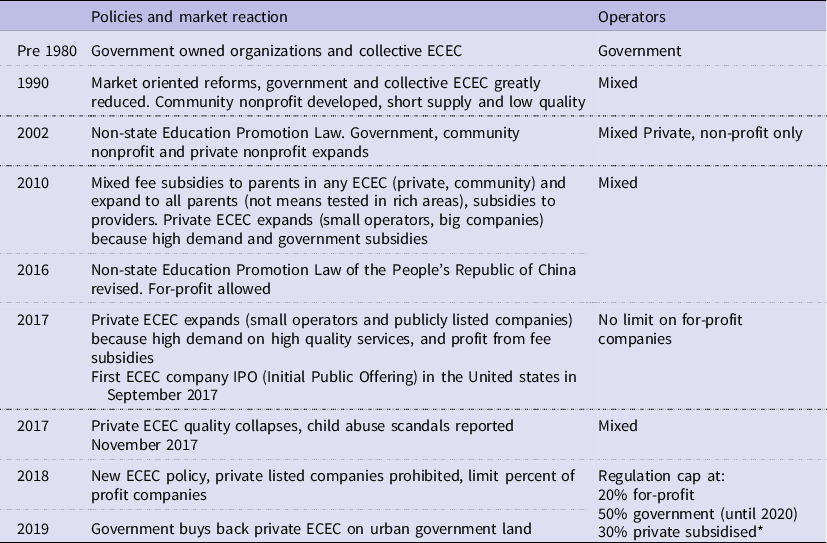
In China, as in other countries, ECEC is a service area that government sometimes views as less controversial than others, perhaps because of the growing consensus around the importance of human capital investment, whereby supporting child learning and development is emphasised as important for future economic growth (Yue et al., Reference Yue, Tang, Shi, Tang, Shang, Medina and Rozelle2018; Wang et al., Reference Wang, Li, Abbey and Rozelle2018; Li et al., Reference Li, Loyalka, Rozelle and Wu2017). As part of China’s larger economic reforms starting in the 1990s, the government gradually moved away from state run support to various market mechanisms, including private and eventually contracted services. China began government purchasing of ECEC in the 2000s, to varying degrees at the local level. As Wallace (Reference Wallace2020) explains, limited public financing of pre-school education at a time of growing participation meant private kindergarten providers filled the gap in public provision, albeit with high variability in quality. Government purchased ECEC began in some locations in about 2010 in response to an overwhelming shortage of services. The policy then became a national approach, noted in the findings section (Table 1). When policy risks of market provision became evident in national scandals about abuse and financial mismanagement in 2017, the government rapidly backed away from increasing the privatisation of ECEC (Whale Media, 2019) and placing strict regulations on contracting.
Policy trajectory in China

Source: authors’ summary of policy analysis.
Notes: *puhui universal access, government subsidised, non-profit.
In Australia, market mechanisms have been justified as ways to encourage efficiency and innovation and to contain government spending on provision, while expanding supply. Market based approaches, involving government subsidies for a mixed market and fees for families, were implemented to address growing demand and rising costs of ECEC, to respond to dominant ideas inside government about the benefits of competition and small government, and to activate service users as consumers (Meagher and Cortis, Reference Meagher, Cortis, King and Meagher2009; Cortis et al., Reference Cortis, Blaxland, Adamson, Meagher, Stebbing and Perche2022; Stebbing, Reference Stebbing, Meagher, Stebbing and Perche2022). While subsidies were initially available only to support non-profit provision, the policy trajectory involved an experiment with rapid privatisation of long day care from the 1990s, after fee subsidies were extended to families using for-profit services, which led to very high market concentration of a single corporate provider and near national market collapse in 2008 (Brennan et al., Reference Brennan, Cass, Himmelweit and Szebehely2012; Sumsion, Reference Sumsion, Lloyd and Penn2012; Stebbing, Reference Stebbing, Meagher, Stebbing and Perche2022). Prior to collapse, critics had raised concerns about quality and affordability and whether public subsidies should underwrite profits of corporate providers (Brennan, Reference Brennan2007).
This background indicates that further research is needed to understand the variation in how governments respond when faced with market risks to the provision of quality contracted government services. It may be that authoritarian and neoliberal governments have different perspectives on the role of government, market and public in these responses. The content and timing of their responses may affect the availability of quality services in a mixed welfare system. The remainder of this article addresses one of these questions: how did the Chinese government manage the risks of increasing the provision of social services via government purchasing and how did it differ from other countries?
Research methods
We conducted qualitative policy analysis of China and Australia’s approaches to address the above question. This analytical approach enables inductive work to generate a hypothesis about policy process and to reveal the policy mechanisms and processes and the meanings of the policy experience (Edin and Pirog, Reference Edin and Pirog2014). Documents were drawn from publicly available policy, law, government reviews, literature and media, and analysed to profile a case in each country of rapid market expansion that required a major policy response. The cases were chosen as most relevant to the trajectory of policies about new government purchasing structures and responses to risks encountered. Ethics approval was from UNSW Sydney.
The documents were identified through internet searches of documents relevant to ECEC policy in Chinese and English languages over the period of introducing and responding to the impact of government purchasing. The documents were organised chronologically, presented in the findings tables. Applying the approach of Petersen et al. (Reference Petersen, Hjelmar and Vrangbæk2018) we analyse documents by identifying content relating to cost to government and quality from purchased services, with a focus on how risks were managed or exacerbated.
A limitation is that the document analysis method does not include direct engagement with stakeholders. Further research could explore the experience of the stakeholders, including families using ECEC, providers and government.
The findings about how each country managed the risks from government purchased early childhood education services are presented by analysing the policy trajectory, the risk to cost and quality and the government response to the risks.
The case of Chinese early childhood education purchasing policy
The development of Chinese policy regarding the funding and purchasing of early education and care developed over time. Key moments and approaches in the trajectory are detailed in Table 1.
Historically, ECEC was state run, without a private market (She, Reference She2018b) and enrolment was low because of a low level of economic development at that time. Before the 1978 reforms and opening-up, early childhood education was an urban system of employer and institution-based welfare with free or low-cost care. In rural areas, seasonal kindergartens based on the collective economy were encouraged. These policies changed in the 1980s, when joint public and private kindergartens were promoted in cities (Central Committee of the Communist Party of China and the State Council, 1979). Rural areas established one-year preschool classes affiliated with schools (Ministry of Education, 1983).
Further reform through private provision of early childhood education in the 1990s was part of the process of establishing a market economy. ECEC was marketized, enabling services to become self-financing (Lyu, Reference Lyu2008). Private early childhood education could not distribute profit or assets outside the educational institutions, which limited the development of for-profit services. Many children’s services in rural collectives and city employers gradually closed. At the same time, the government reduced its support for ECEC, so that it could concentrate on 9-year compulsory education for children aged seven-fifteen years. These changes led to the decline of public and collective ECEC by 2000, resulting in fewer places, high cost and poor quality (She, Reference She2018b). Child care became a private family responsibility during this collapse of public services. The cost was mainly borne by families for the family provision of care and the costs of formal care that gradually shifted to the market.
As the economy developed, demand for ECEC increased, because more women were in the paid workforce in rural and urban areas, yet the number of public ECEC services was declining. The proportion of private kindergartens grew from forty per cent to sixty eight per cent in China between 2001 to 2010 (Wu, Reference Wu2011). Inequality in access to ECEC between rural and urban children worsened (Wu, Reference Wu2011). Rural children were disadvantaged by the weak financial capacity of the county-level governments, which limited the supply from private providers. The inability of parents to pay also inhibited the demand and supply of private services (Wu, Reference Wu2011).
Through this period, the importance of human capital became increasingly prominent in policy decisions (Jintao, Reference Jintao2007). The government set the goal that all children have equal access to quality and inclusive ECEC and to raise the enrolment rate from fifty one per cent in 2011 to eighty five per cent in 2020 (Wu, Reference Wu2011; State Council 2010a, 2010b, 2019). It allocated funds to purchase ECEC, accelerate government direct investment, and support commercial ECEC.
1.1. Government purchased services
In 2010, Chinese policy goals regarding ECEC services were that all children were to have equal access to quality affordable preschool education. The aim was to solve four problems: the under supply of services, the lack of affordable services, the low quality of services and inequality between rural children, migrant children and urban children (State Council, 2010a, 2010b). Purchasing services from private providers was a key policy tool to accelerate supply of ECEC. In addition to operating public kindergartens, governments also purchased ECEC from the market, with specific practices varying by location (Shang and Wang, Reference Shang and Wang2018; Zhang, Reference Zhang2019).
The first method was allocating an education allowance or voucher to families, either universal or residual. Universal allowances (the Nanjing Model) emphasised consumer sovereignty, efficiency and equal opportunity. All eligible children in local kindergartens could apply for the education allowance, which were used to access ECEC in the market. Residual allowances (Ningxia Model) were provided to a small number of pilot private kindergartens to offset some of the fees for children from low-income families (Zhang, Reference Zhang2019).
The second method of government purchasing was paying kindergartens to increase their places for children. One way was government contracts to private kindergartens to provide universal access (puhui) (Zhou et al., Reference Zhou, Jiang, Zheng and Li2020) with some subsidised or free places for local children. This model mainly targeted children from low-income families and migrant worker families. The other way was government contracts to kindergartens to expand their capacity to enrol more children. For example, the Nanjing “Kindergarten Increment Project” contributed to each class in new, reconstructed or expanded public or private and city or rural kindergartens that meet defined standards (Shang and Wang, Reference Shang and Wang2018; She, Reference She2018a; Zhang, Reference Zhang2019).
A third method was operational subsidies for the general operation of the service, rather than specifically to increase the number of places. Examples were paying insurance or staff costs and providing training to staff. The purpose was to stabilise staff turnover and quality by raising salaries. A more direct fourth method was to directly contract the operation of new state-built kindergartens to private operators. The operators included nongovernment organisations (NGOs), social institutions or qualified individuals contracted through low-cost leasing or cooperation.
Throughout China, combinations of the four government purchased services methods were used to increase preschool education services. Initially the methods were mostly non-competitive, later introducing competition between providers in the middle and late stages (Zhang, Reference Zhang2019).
The policy goals of government purchased preschool education were successful. Preschool education enrolment rose from about forty six per cent in 2010 to eighty three per cent in 2019, and forty sevent point one million children in preschool in 2019 (MOE 2020). In addition to substantial financial input, the rapid growth of preschool education capacity was mobilized through the market, which added new resources (Yue et al., Reference Yue, Tang, Shi, Tang, Shang, Medina and Rozelle2018).
Risks to cost and quality in China
The risks of relying on private investment soon became evident. The market regarded ECEC as an investment opportunity with long-term, high profits due to the government’s large investment in preschool education purchased services, the demand from the expected rise of the fertility rate and the shortage of high-quality preschool education (Whale Media, 2019). Some ECEC chain institutions enjoyed a net profit margin of 73 per cent. They predicted that each kindergarten would have a stable annual profit of 20-40 per cent to investors after the first four years (Whale Media, 2019).
The success in early stages from the government purchased ECEC encouraged the government to relax profit-making restrictions. The amendment to the Private Education Promotion Law 2016 allowed private capital in for-profit educational institutions (Standing Committee of the National People’s Congress, 2018). The first highly concentrated ECEC chain institution in China, RYB Education, acquired kindergartens across China and grew significantly through financing and public listing in the United States of America in 2017. The profit-driven focus meant that funds that could improve the service quality were instead distributed to shareholders. Teachers were not all qualified, many of them were poorly paid and the services were not well managed. Serious child abuse incidents occurred in private kindergartens in Beijing and nationally (Whale Media, 2019).
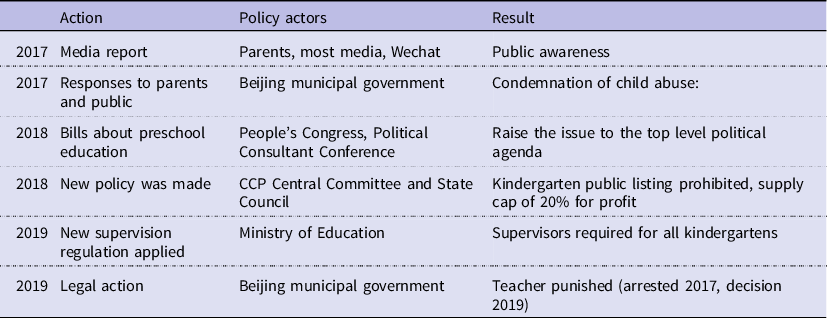
These problems caused public outrage, which triggered further policy changes. The most common complaints were the quality and child outcomes through under-servicing, and later complaints related to the scandals. Other complaints were about staff conditions and staff turnover, and bureaucratisation and administrative costs for parents and providers who need to reimburse their vouchers to cash (She and Shan, Reference She and Shan2019). Famous ECEC institutions were criticized for charging higher fees.
From 2017 problems about the quality of ECEC became known through social and public media. Their complaints were circulated nationwide, mobilizing complaints from families in the large cities of Shanghai and Beijing. The media coverage stimulated governments at local, city and provincial level to respond to parents’ complaints. Nationally, People’s Representatives raised the issue at the National Congress at the top of the political agenda.
Government response to market risks in China
In the face of the public dissatisfaction, the policy response was swift to address the poor quality of services (Table 2). Policy reform included a national cap on ECEC places for profit providers (20 per cent), and the local cap in Nanjing was lower (10 per cent) (Bureau of Education, Jiangsu Province, 2015; State Council, 2018). Policy also prohibited the listing of ECEC companies on the public share market (State Council, 2018)
Government and public actions after the early childhood education scandal in 2017

Source: authors’ summary of policy analysis.
The government justification for the policy was that:
The fundamental nature of preschool education shall be public welfare, which means kindergarten shall not be run as an enterprise. If there is a conflict between the profit-making nature of capital and the public welfare nature of preschool education, we should first adhere to the principle of maximizing the interests of children. (She, Reference She2018a)
With the new restriction on the private market supply of ECEC, local government services expanded, as did government subsidized supply from the community sector (State Council, 2019). The government bought back services from the private market (Shang and Wang, Reference Shang and Wang2018). Government purchasing now included subsidies and parent fee limits on non-state-providers. New regulations were introduced for the operation of services to ensure quality standards, including qualified managers, salary levels and teacher qualifications. Criminal charges for abusers were introduced.
Expanding ECEC in China is a national policy. Although the regional heterogeneity is large in China, the central government tried to reduce regional differences by providing more financial resources to poor regions to address availability and quality of services. The cases mentioned in the analysis impacted not only on local policies, but were also taken up at a national level to create consistent policy expectations.
In summary several notable features stand out in the China case study. These features were the short timeframe for the introduction of government purchased services; the primary policy focus on commitment to early childhood education; public mobilisation of dissatisfaction with the quality of care; and swift government reaction to these complaints through changes to regulations.
The case of Australian government early childhood education purchasing policy
Comparison with the Australian case is a useful way to understand the possible explanations for the features of the Chinese case. Although the policy and institutional context of each country is different, they both went through processes of increasing private provision, then changing policy to respond to market failure. In Australia, policy changes facilitated very rapid growth of market-based approaches, which proved unsustainable.
Policy trajectory of government purchased services in Australia
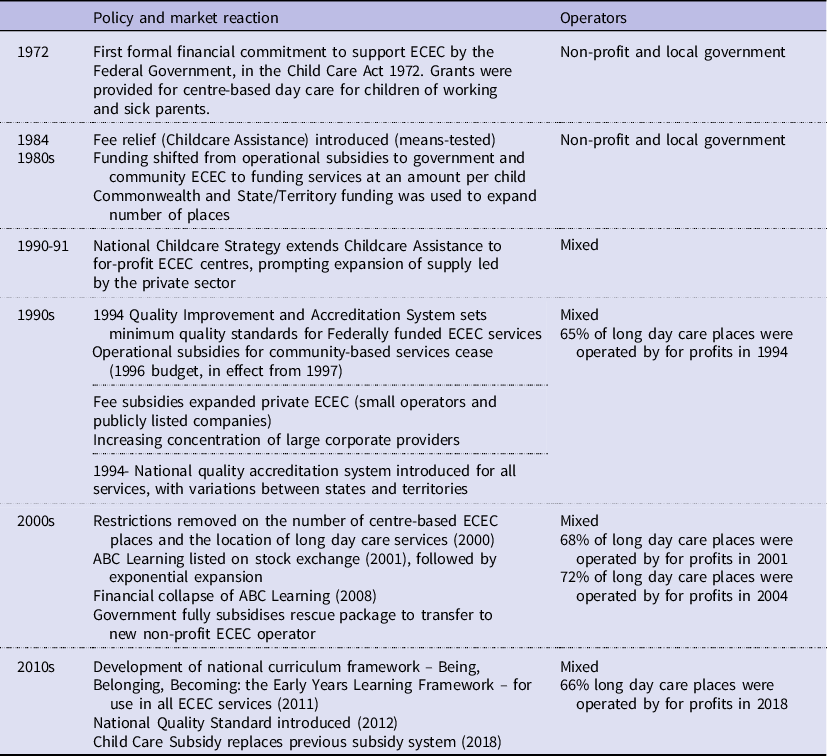
The Australian Government first funded community-based child care centres following the Child Care Act 1972. Rather than directly purchasing services via contract, Australia’s early approach to expanding supply, to meet increased demand associated with women’s workforce participation, was to provide subsidies to assist community-based (not-for-profit) childcare services to operate. Initially, eligibility for operational subsidies excluded private for-profit providers, constraining market development by directing federal government support only to community sector and local government providers. Later, to reduce the cost of ECEC for families, fee subsidies were provided directly to parents. At first these subsidies were restricted to families using community-based services, detailed in Table 3 (Brennan, Reference Brennan2007).
Policy trajectory in Australia

Source: Brennan, D. (Reference Brennan2007) and authors’ summary of policy analysis.
The 1990-91 Federal Budget extended fee assistance to families using private, for-profit ECEC (Brennan, Reference Brennan2007). This was justified firstly on the basis of bringing in additional capital to expand and upgrade supply, and secondly on the basis of competitive neutrality, or that withholding subsidies from those using for-profit care was discriminatory, giving unfair advantage to those eligible for government subsidies (Brennan, Reference Brennan2007). Thirdly, fees at the time were lower in privately run centres, which would make childcare more affordable for working parents (Brennan, Reference Brennan1998). In 1996-97, operational subsidies for community-based long day care services were removed, intended to ‘level the playing field’ between different kinds of providers. Direct federal support to childcare centres was replaced with subsidies to parents, to promote a demand-driven system (Brennan, Reference Brennan1998). There were no restrictions on private providers on where they established services or the number of funded places (Baxter, et al., Reference Baxter, Bray, Carroll, Hand, Gray, Katz, Budinski, Rogers, Smart, Skattebol and Blaxland2019), as it was felt the creation of ECEC places would be driven by market demand rather than government assessment of need. This set of changes enabled private providers to gain market share. Following the extension of subsidies for use of private for-profit services and removal of any advantage operational subsidies gave to community-based providers, private provision grew rapidly, and in a haphazard way, with little planning or regulation of the pace or location of expansion (Press and Hayes, Reference Press and Hayes2000; Brennan, Reference Brennan2007).
Impact of risks to cost and quality in Australia
While for-profit providers range from small stand-alone businesses to large corporate chains (not all of whom will be aggressive profit-maximisers), international research points to particular risks to quality and system stability when large proportions of services are run by for profit providers (Cleveland and Krashinsky, Reference Cleveland and Krashinsky2005, Prentice, Reference Prentice2005; Organisation of Economic Co-operation and Development (OECD), 2012). Australia’s experience with the expansion and subsequent collapse of the corporate provider ABC Learning exemplifies the risks. ABC Learning was founded in 1988 and grew to operate thirty one centres before being listed on the stock exchange in 2001 (Sumsion, Reference Sumsion, Lloyd and Penn2012). Stockmarket listing enabled it to gain access to large amounts of capital, to expand rapidly and aggressively take over centres which were previously community-based or run by owner-operators. ABC absorbed most corporate rivals and rapidly grew (Brennan, Reference Brennan2007; Sumsion, Reference Sumsion, Lloyd and Penn2012). For-profit operators controlled three quarters of long day care places from 2004, with ABC comprising a large and growing market share. Government funding fuelled this growth, with 44% of ABC Learning’s income coming from government subsidies in 2005 (Brown, Reference Brown2009). Prior to its collapse in late 2008, ABC had comprised 25% of the long day care market in Australia (OECD, 2012), and as high as 50% in some Australian states (Sumsion, Reference Sumsion, Lloyd and Penn2012). It also acquired market share in the United Kingdom (UK), Hong Kong, Indonesia, and the Philippines; and, after acquiring services in the United States (US) during 2006, was the largest provider globally (Brown, Reference Brown2009).
Although provision of subsidies to the private sector provided an assurance of income, ABC Learning’s strategy of rapid and relentless acquisitions, financed through increased debt, proved unsustainable. It had made large profits for directors and shareholders, using a model of cost-cutting by providing minimal quality, and by advocating against regulation, whilst benefiting from subsidy arrangements. Critics argued that the company used minimum staff-child ratios, low wages, under-qualified staff, minimal cleaning and poor quality equipment (Sumsion, Reference Sumsion, Lloyd and Penn2012). After numerous court cases and concerns about its inflated valuation ABC Learning entered voluntary administration in late 2008. As a result, very large numbers of children and families faced the prospect that their ECEC service would close, underlining the risks for families, particularly for workforce participation, of instability in markets.
Government response to market risks in Australia
The government intervened to keep services operating in the short term, then provided a loan to be fully repaid to Goodstart, a specially-formed consortium of non-profits which took over most ABC centres and subsequently became Australia’s largest ECEC provider, shifting the market mix in favour of not-for-profit provision. Regulations subsequently introduced sought to ensure suitability of private operators entering the market and increased financial reporting (OECD, 2012).
To manage the risks of for-profit provision including the risk of collapse, the OECD (2012) suggests requiring for-profit providers to meet the same regulatory and quality standards as other providers; regulating market entry and quality with appropriate penalties and requiring all services to participate in an information system to assist families in making informed choices about ECEC.
The collapse of ABC Learning dramatically underlined the imperative for more effective regulation, renewed recognition of the importance of the not-for-profit sector, and shaped reform processes centred on professionalization and quality monitoring, including National Quality Standards that were subsequently introduced under a Federal Labor Government, and in partnership with the states and territories (Brennan and Cortis, Reference Brennan, Cortis, McClelland, Smyth and Marston2021). ABC Learning’s demise coincided with growing evidence about the enduring impact of children’s early experiences, and growing interest in strengthening Australia’s human capital. This spurred a major program of reform to ECEC co-ordinated nationally in the years following the corporate collapse (Brennan and Cortis, Reference Brennan, Cortis, McClelland, Smyth and Marston2021). Such changes after the market collapse were focused on improving quality, safety and children’s outcomes, including creating national cohesion in requirements regarding staff to child ratios and requirements for staff to hold or obtain qualifications and a national curriculum framework to be used by all services.
A major development has been the introduction of National Quality Standards, which sets quality benchmarks which services are rated against. This has helped emphasise the importance of quality in national policy debates. Information on the performance of services is compiled and reported publicly by the Australian Children’s Education and Care Quality Authority (ACECQA) in an effort to make quality more visible to families to help them exercise choice, and to drive performance improvement. Publication of quality data also draws governments’ and policy makers’ attention to significant variations in quality across the sector. The proportion of services meeting or exceeding quality standards has increased from when data were first collected in 2014 (ACECQA, 2022), in keeping with expectations of continuous improvement built into the Standards. However, weaknesses of the market approach persist. For-profit providers, which recent data indicate operate two-thirds of approved long day care services, remain significantly less likely to meet the standard than government or community-based services (ACECQA, 2019). However, sanctions are not imposed for repeated failure to meet quality standards, enabling poor quality provision to persist (Brennan and Cortis, Reference Brennan, Cortis, McClelland, Smyth and Marston2021; Cortis et al., Reference Cortis, Blaxland, Adamson, Meagher, Stebbing and Perche2022).
Despite turning to the not-for-profit sector to operate services to avert a ECEC crisis after the collapse of ABC Learning, the Australian Government continues in its commitment to a mixed ECEC market. When redesigning ECEC funding in the 2018 Child Care Package, subsidies continue to be paid to families for use in any accredited service. There is no differentiation in rules or regulation between government, not-for-profit or for-profit providers and there are no limits on the future growth of corporate providers of long day care. In 2018, despite the predominance of Goodstart, 66 per cent of long day care places were operated for profits (Baxter et al., Reference Baxter, Bray, Carroll, Hand, Gray, Katz, Budinski, Rogers, Smart, Skattebol and Blaxland2019). Corporate providers continue to view ECEC as a profitable, viable market (Bray et al., Reference Bray, Baxter, Hand, Gray, Carroll, Webster, Phillips, Budinski, Warren, Katz and Jones2021). In addition, despite a new emphasis on quality and early learning in the 2010s, the Child Care Subsidy incorporates an expanded conditionality. Access depends on parents’ participation in ‘recognised’ work and study activities, with substantially fewer subsidised hours provided to families not engaged in employment or education (Stebbing, Reference Stebbing, Meagher, Stebbing and Perche2022).
Overall, Australia’s experience of allowing private providers to have unrestricted access to government subsidies led to rapid, haphazard growth in for-profit supply, generating problems of poor quality and instability, which culminated in the collapse of the dominant provider. After ABC Learning collapsed, the government provided funding to keep centres open temporarily so as to contain the crisis for families, then supported a consortium of non-profits to take over provision. The crisis gave weight to a subsequent reform agenda, including the introduction of nationally cohesive quality benchmarks, and regular rating services against comprehensive quality standards. However, the financial arrangements underpinning the crisis remain in place, allowing private providers to access government subsidies: in 2021, over two thirds of long day care services (68 per cent) continued to be provided by for-profits (ACECQA, 2022) – although Goodstart, the non-profit which took over ABC Learning, remains the largest single operator, with over 650 centres compared to the largest corporate provider (G8) which runs over 450 (ACECQA, 2021: 12). Further, while quality arrangements intervene to stop service delivery by those with serious regulatory breaches, many delivering poor quality services are able to continue operating.
Discussion
The analysis addressed the question of how the Chinese government managed the risks from increasing the provision of social services via government purchasing and how their policy responses differed from other international experience. The research examined this question using the cases of government purchased early childhood services in China and Australia. The two countries experienced major policy changes, risks and responses in a similar period, but are not often subject to comparative social policy research. Reflecting the focus of Petersen et al. (Reference Petersen, Hjelmar and Vrangbæk2018) on the outcomes of contracting, particularly the cost and quality implications, we have examined challenges resulting from the use of government purchasing to stimulate market-driven expansion of ECEC supply, in different welfare contexts. The analysis of policy and research in the two cases examined the ways two countries with different local institutional histories drew on government purchasing models as market-based mechanisms to expand ECEC systems. Lessons are pertinent elsewhere, including in Europe and England where market mechanisms were similarly adopted to rapidly expand system capacity (Brennan et al., Reference Brennan, Cass, Himmelweit and Szebehely2012). Of particular interest is the way, in the Chinese and Australian cases, both countries needed to manage similar risks and negative impacts. In both cases, governments relied on private providers but also required significant policy changes to maintain quality and stability, and interventions to address failures in the market model. The challenge of comparing countries with different policy regimes and country sizes was managed by focusing on the issue of child care expansion through markets, in a similar period within the national policy context. In both countries, the national government was primarily responsible for the policy response. The advantage of this approach was to be able to identify similar policy responses, despite the obvious contextual differences.
The two cases underline the ways care markets involve risks and negative impacts, irrespective of the political system and policy trajectory. While market models were implemented in ways that reflected their policy and institutional histories, both needed to quickly revise their market agenda to address the failures of these approaches to secure an adequate supply of quality care. Their response reflects the ways market mechanisms give rise to similar challenges of quality, accessibility and cost, even when implemented in different ways and in different policy regimes (Brennan et al., Reference Brennan, Cass, Himmelweit and Szebehely2012; Mahon et al., Reference Mahon, Anttonen, Bergqvist, Brennan and Hobson2012). Both China and Australia faced high risks from allowing low quality services into the market, which required further investment to remedy with new and ongoing regulations. In China the political motivation was about quality and the public focus on child safety. Unlike in Australia, caps were placed on for-profit providers. In Australia, the crisis occurred in the financial collapse of the market. China initially opened the market to any providers, but then responded to quality and cost problems by restricting the proportion of private providers. In Australia the fee subsidies and minimal planning controls allowed for untrammelled growth and market dominance of a single provider. This for-profit provider was able to gain market share and saturate the market. The market dominance continued to the point of market collapse, at which point the government responded with a bailout which reshaped the market mix, along with new quality controls. Unlike China, Australia has not applied caps to address the high ongoing reliance on for-profit, including corporate provision: therefore, such risks remain. Indeed, shifting this reliance now appears politically difficult, as market arrangements enable private providers to use their market position to further secure policy settings that reinforce their interests and continuing viability (Stebbing, Reference Stebbing, Meagher, Stebbing and Perche2022).
The policy analysis showed that the two governments’ policy responses to the problems from government purchasing came at different speeds. The Chinese government responded quickly to national abuse scandals, when the risks entered national public discourse, rather than waiting. In contrast the Australian government observed problems accumulating after subsidies were extended to for-profits in 1990, not initiating major changes until the dominant private player faced imminent financial collapse.
When faced with compromises to quality due to cost cutting by providers, both governments responded with tighter regulatory controls to link government funding allocation closer to quality, the two aspects of Petersen’s analysis. They changed policies in a similar way to limit risks from market forces by using a broader range of policies. In China, the new policies were direct contracting and grants to non-profit organisations, and subsidies to parents. The result of the new policies was less reliance on private for-profit providers. In Australia’s case, additional support to non-profits was only temporary, in the course of alleviating the crisis of corporate collapse and supporting a non-profit consortium to take over ABC Learning’s centres. While this reduced dominance of a single corporate provider, reliance on poorer quality and private for-profit provision continues.
China differed in the speed and strength of the regulation, relying on strict limits to the proportion of market provision. The Chinese government’s main approach to deal with the quality problem was to increase the government supply, subsidise inclusive, non-profit providers, buy back private services to the government and exclude for-profit services from the government purchasing. The policy instituted a fixed cap on private providers in the market mix (20 per cent). Australia did not explicitly restrict the private sector, but changed the market mix away from concentration of corporate child care by supporting a non-profit model to operate centres previously run by ABC Learning. China increased the regulation of quality standards to compel compliance. Australia also gradually increased quality and curriculum standards, and instituted greater accountability through public information from a new Australian Children’s Education and Care Quality Authority. The Australian policy approach was to promote quality across the system through continuing the shift to a demand driven system, rather than stimulate particular types of providers.
1.2. Implications for government purchased services
The policy process of popularizing inclusive and public-benefit ECEC in China was a salient case of public administration. The case reveals the Chinese government’s political capacity to mobilize financial resources to address a major social issue that affects families’ livelihoods. In addition to mobilizing government funds, the challenge was how to rapidly expand the scale of ECEC to bridge the gap in service provision. Purchasing services from the market was a key approach to achieve the policy objective of expanding supply. However, the case also demonstrates that it was necessary to strictly regulate the process to control cost and quality, define the eligibility of providers and monitor the quality of the service provision in response to public feedback. The Chinese government responded in this case by limiting the for-profit participation in the service provision.
The comparative analysis showed that both the Chinese and Australian governments turned to not-for-profit providers at times of crisis. In China, this involved purchasing from non-profit and small operators to increase the supply of services, and through explicit caps on corporations in China. In Australia, a small shift in the predominance of corporate provision resulted from the large non-profit provider established to rescue the market, and the Australian Government remains strongly committed to supporting a mixed market in ECEC.
The findings also have policy implications for government purchasing in general. When early education became a tool for capital to make excessive profits through publicly listed companies the risk experienced was financial and quality collapse of the market. These risks were anticipated by Australian researchers observing developments in other markets, including the US and UK (e.g. Sumsion, Reference Sumsion2006) but did not garner a government response in time to prevent collapse. The Chinese and Australian cases demonstrate that when governments fail to anticipate and manage the risk, they are forced to respond in retrospect, through regulation about quality, costs and providers.
In Australia, for-profit provision in centre-based care remains relatively high, and for-profits continue to perform worse against quality standards. While none have reached the level of market concentration held by ABC Learning, several large, listed profit-oriented corporate providers together dominate the market, although Goodstart remains the largest provider. There has been a renewed emphasis on child care as a mechanism to promote workforce participation, continuing to displace the notion of children’s rights to quality education as its primary purpose, in contrast to China. This prioritisation is demonstrated in Australia’s Child Care Subsidy, which is activity tested – families’ access to subsidy depends on parents’ activities, leaving no right for children to access early childhood education and care. Problems persist of affordability – subsidy arrangements leave ECEC unaffordable for many families, including low paid essential workers (Cortis et al., Reference Cortis, Blaxland and Charlesworth2021; Noble and Hurley, Reference Noble and Hurley2021).
Both countries continue to share similar policy problems that government purchasing was not able to fix and, in some cases, aggravated, as predicted by Petersen’s analysis. Managing quality through regulation, accreditation or licensing requires enforceable standards, perhaps linked to the licence or funding. But enforceability of standards has been elusive. China has taken the short cut of capping the market participation, rather than engendering quality standards. In Australia the many providers that do not meet standards remain able to operate, and receive government subsidies except in very serious cases. The second problem is the only sources of funding for ECEC services are usually government or parents. Government purchasing relies on market responsiveness through information and funding to parents; and a commitment to nonprofit providers through government subsidised staffing costs, but policy does not always reflect these imperatives. Both countries struggle with or do not prioritise the conditions needed for these approaches to control the cost to government and the supply and quality responsiveness of the market.
Conclusion
The findings have implications for understanding the risks and ways to address government reliance on market forces in other social service sectors, and beyond the two countries examined. The main conclusion is that while government purchasing can harness markets to increase supply, tight regulation is necessary to effectively anticipate and manage risks regardless of the policy context. The Chinese government was able to be more responsive quickly to make these policy changes once threats to child safety became a politically destabilising public concern, and did so more decisively than in Australia, by capping for-profit provision. The comparison of policy experiences of government purchased services in China and Australia shows that both however retained a mix of service providers – non-profit, small private, corporations, government. The services from all providers needed to be regulated, monitored and the standards enforced. The governments attempted to allocate funding in ways that linked quality and cost through enforceable standards and parent demand across the market, although effective mechanisms remain elusive. The governments have also returned to attempting to stimulate planning for distribution of the quantity and quality of services by location and to disadvantaged families.
These lessons from the children’s services market have relevance to other social service markets. China and Australia, and similar governments seeking to address supply shortages through the market, could do well to examine their policy experiences in child care to resolve the parallel problems in aged care and other adult care.
Acknowledgements
London School of Economics and Political Science, Jude Howell, Regina Enjuto-Martinez, Yuanyuan Qu, Beijing Normal University, Yu Jie.
Financial support
Economic and Social Research Council “The politics of services subcontracting to NGOs in China”, Australia Research Council “Building China’s welfare state: government purchased services for children, ARCLP160100188, Beijing Children’s Legal Aid and Research Center, Right To Play China.