Introduction
Amyotrophic lateral sclerosis (ALS), which is a rapidly progressing neurodegenerative disease, has a mean survival time — after symptoms onset — of 2–4 years (Andersen et al., Reference Andersen, Abrahams and Borasio2012). During this time, ALS patients show muscle weakness, speech impairment, swallowing difficulties, and respiratory insufficiency due to motor neuron degeneration. About 50% are reported to also show decreased cognitive functions and behavioral and psychological symptoms (van Es et al., Reference van Es, Hardiman and Chio2017). Patients with ALS gradually lose the ability to perform daily-life activities and come to completely depend on others for physical and emotional support within a few years (Aoun et al., Reference Aoun, Bentley and Funk2013). Thus, family caregivers face daily ongoing changes in the patient's health condition as well as long-term adaptations (Hughes et al., Reference Hughes, Sinha and Higginson2005; King et al., Reference King, Duke and O'Connor2009).
Because of high medical care costs and the universal availability of home medical devices, most patients with ALS prefer to stay at home. Mostly, ALS patients receive care from their family members (Chappell et al., Reference Chappell, Dlitt and Hollander2004). The task of taking care of an ALS patient includes various responsibilities such as providing support for daily-life activities, learning new technology to communicate with the patient, and participating in decision-making regarding treatment or care, such as gastrostomy, noninvasive ventilation, and tracheostomy (Aoun et al., Reference Aoun, Bentley and Funk2013).
The multiple caregiving roles assumed by ALS family caregivers can have a negative impact on the lives of not only the patients but also the caregivers themselves. Therefore, providing support and care so that ALS patients’ family caregivers can maintain their quality of life and continue their roles as caregivers can be considered an important area in nursing care (Chu et al., Reference Chu, Tak and Kim2018).
Meanwhile, previous studies regarding family members who care for patients with neurodegenerative diseases have emphasized the negative effects, such as burden, depression, and anxiety, caused by their role (Pagnini et al., Reference Pagnini, Rossi and Lunetta2010; Aoun et al., Reference Aoun, Bentley and Funk2013). Recent studies of the family caregivers of ALS patients have reported that they experience negative psychosocial health outcomes from caregiving as well as positive outcomes, such as resilience and psychological rewards (Sandstedt et al., Reference Sandstedt, Littorin and Cröde Widsell2018). Furthermore, these positive aspects of caregiving (PAC) can reduce burden and depression, thereby functioning as psychological resources that allow family caregivers to continue performing their roles effectively (Mock and Boerner, Reference Mock and Boerner2010; Abdollahpour et al., Reference Abdollahpour, Nedjat and Salimi2018; Xue et al., Reference Xue, Zhai and He2018). However, there are insufficient validated scales for measuring such outcomes (Weisser et al., Reference Weisser, Bristowe and Jackson2015).
The PAC scale is a tool developed to measure the positive outcomes of the caregiver role for family members who care for patients with dementia. However, it is also used as a tool to measure the positive outcomes of caregiving for family caregivers who take care of patients with brain injury or stroke (Tarlow et al., Reference Tarlow, Wisniewski and Belle2004; Las Hayas et al., Reference Las Hayas, López de Arroyabe and Calvete2014; Malhotra et al., Reference Malhotra, Chei and Menon2018). PAC's reliability and validity have already been evaluated in Spain, Hong Kong, and Singapore, and it is now widely used (Las Hayas et al., Reference Las Hayas, López de Arroyabe and Calvete2014; Lou et al., Reference Lou, Lau and Cheung2015; Siow et al., Reference Siow, Chan and Østbye2017). However, further studies on family caregivers in various cultures, including Korea, are required. Therefore, this study aimed to evaluate the validity and reliability of the PAC in Korea.
Methods
Study design
This methodological study examined the validity and reliability of the Korean version of the PAC scale (henceforth, the Korean PAC). The original PAC was developed by Tarlow et al. (Reference Tarlow, Wisniewski and Belle2004) to examine the positive outcomes of caregiving for family caregivers.
Participants
The participants were adult family members who identified themselves as the primary caregivers of patients diagnosed with clinically definite, probable, or possible ALS by a neurologist based on the El Escorial criteria (Brooks et al., Reference Brooks, Miller and Swash2000). A total of 137 participants were convenience sampled in an ALS clinic at H University Hospital in Seoul, South Korea, between January and November 2016. Of these 137 participants, 10 were excluded from analysis due to missing PAC scale data. This study used secondary data. The primary research, which forms the basis of this study's analysis, was a study of the factors that affect the psychosocial well-being of the family caregivers of ALS patients, and the data for the same participants were used (Chu et al., Reference Chu, Tak and Kim2018). The required sample size for testing structural validity through exploratory factor analysis (EFA) is about 10 times the number of items, and at least 100 is desirable. Since the PAC contains 11 items, our sample size was judged to satisfy the minimum sample-size requirements (Nunnally and Berstein, Reference Nunnally and Bernstein1994; Hair, Reference Hair2010; Terwee et al., Reference Terwee, Mokkink and Knol2012).
Measures
Positive aspects of caregiving
The PAC scale was developed by the Resources for Enhancing Alzheimer's Caregiver Health (REACH) project (Tarlow et al., Reference Tarlow, Wisniewski and Belle2004) to measure the PAC for family caregivers. The original tool had 11 items in the development stage, but 2 items were deleted in the factor analysis, resulting in 9 items. However, we included the two deleted items since they were considered appropriate for Korean culture. The evaluation of each item was measured based on a 5-point Likert scale (1 = "Strongly disagree" to 5 = "Strongly agree"). A higher total score indicates that the PAC for family caregivers are higher.
Korean version of the Zarit Burden Interview
To measure the burden experienced by family caregivers, we evaluated the Korean version of the Zarit Burden Interview (ZBI-K) (Lee et al., Reference Lee, Kim and Ko2004). The ZBI tool is frequently used to measure the burden of family caregivers of ALS patients. The Korean ZBI consists of 22 items and is evaluated on a 5-point Likert scale (0 = "Never" to 4 = "Nearly always"). The range of the total score is 0–88 points, and a higher score indicates a larger burden. The reliability of the scale was Cronbach's α = 0.92 in our study.
Korean version of the Centre for Epidemiologic Studies Depression Scale
To measure depression levels, we evaluated the Korean version of the Centre for Epidemiologic Studies Depression Scale (K-CES-D) (Cho and Kim, Reference Cho and Kim1993). The CES-D contains 20 items on a 4-point scale. It is graded on a range of 0–3 points: 0 = Rarely or none of the time (less than one day a week), 1 = some or a little of the time (one to two days a week), 2 = occasionally or a moderate amount of time (three to four days a week), and 3 = most or all of the time (five to seven days a week). The level of depression can be identified through the total scores for all items (0–60 points). The reliability of the tool used in our study was Cronbach's α = 0.91.
Self-rated health status
A single item was used to measure self-rated health (SRH) status. We asked if the participant perceived his or her health condition as good or bad, and we quantified the answer (Rabin and de Charro, Reference Rabin and de Charro2001). This scale was numbered 0–100. The best health condition imaginable was indicated by 100, the worst 0.
Translation procedure
The scale was translated and applied in the following order: forward translation, expert panel, back translation, preliminary test, and final completion, based on the guidelines of the World Health Organization (2015). For the development of the Korean PAC scale, an e-mail was sent to the original scale developers, and we received approval for use. Two researchers translated the tool into Korean to complete the preliminary translation. To test the translation, the scale translated into Korean was back-translated into English by professional translators who were unfamiliar with the original tool. To evaluate the content validity index (CVI) of the back-translated scale, we selected an expert panel consisting of a professor of nursing, an expert with a doctorate in nursing, a neurologist, a clinical nurse specialist in neurology, and a clinical psychologist. Each item was evaluated on a 4-point Likert scale ranging from "Not appropriate at all" (1 point) to "Very appropriate" (4 points), and the CVI was calculated. The CVI is computed as the number of experts giving a rating of "Appropriate" or "Very appropriate" for each item divided by the total number of experts; the values range from 0 to 1.
Pretesting and cognitive interviewing
Pretesting and cognitive interviewing were conducted with seven family caregivers of ALS patients; they were selected based on criteria identical to the main study through one-on-one meetings with the researcher. First, each participant self-reported in the questionnaire. After the participant's response was recorded, the researcher personally asked the participant about any perceived awkward phrasing in the items, incomprehensible terminology, unclear content, or items that were difficult to understand. No participant in the pretest had any difficulty understanding and responding to the items.
Data analysis
Data were analyzed using SPSS Windows 21.0 and the FACTOR 10.10 (Baglin, Reference Baglin2014). The characteristics of family caregivers and ALS patients were analyzed using frequencies, percentages, means, and standard deviations. For item analysis, we calculated means and standard deviations for each item in the Korean PAC and the corrected item-total correlation coefficient. Pearson's correlation coefficient was used to analyze convergent validity.
Reliability was analyzed using Cronbach's α to evaluate the internal consistency of the measurement tools. The content validity of the scale was calculated with CVI. EFA was performed to test construct validity. Before performing EFA, we performed Bartlett's test of sphericity and the Kaiser–Meyer–Olkin (KMO) test to identify whether the collected data were suitable for factor analysis. As the items were treated as ordinal data, a polychoric correlation metrix was analyzed (Holgado-Tello et al., Reference Holgado-Tello, Chacón-Moscoso and Barbero-García2010). We performed common factor analysis using the unweighted least square (ULS) method and oblique (promax) rotation. Oblique factor rotation was used based on the assumption that there were correlations across factors. For factor extraction, parallel analysis, an eigenvalue greater than 1, and a scree plot were employed using JAMOVI (Revelle, Reference Revelle2019; The jamovi Project, 2019).
Ethical considerations
This study analyzed secondary data from a cross-sectional study. The data were collected from the ALS clinic at H University Hospital in Seoul, South Korea, between January 2016 and November 2016. The primary study was conducted after receiving approval from the Institutional Review Board of the hospital (No. HYUH 2015-12-018-002). At the time of the primary data collection, the researcher explained to participants the purpose of the research, the voluntary nature of participation, and the guarantee of privacy. The researchers obtained signatures from those who agreed to participate in a consent form. The consent form did not mention any future use of participant data. Therefore, we sought approval from H University's Institutional Review Board regarding this study's protocol and exemption from informed consent (No. HYI-18-115-1).
Results
Descriptive statistics
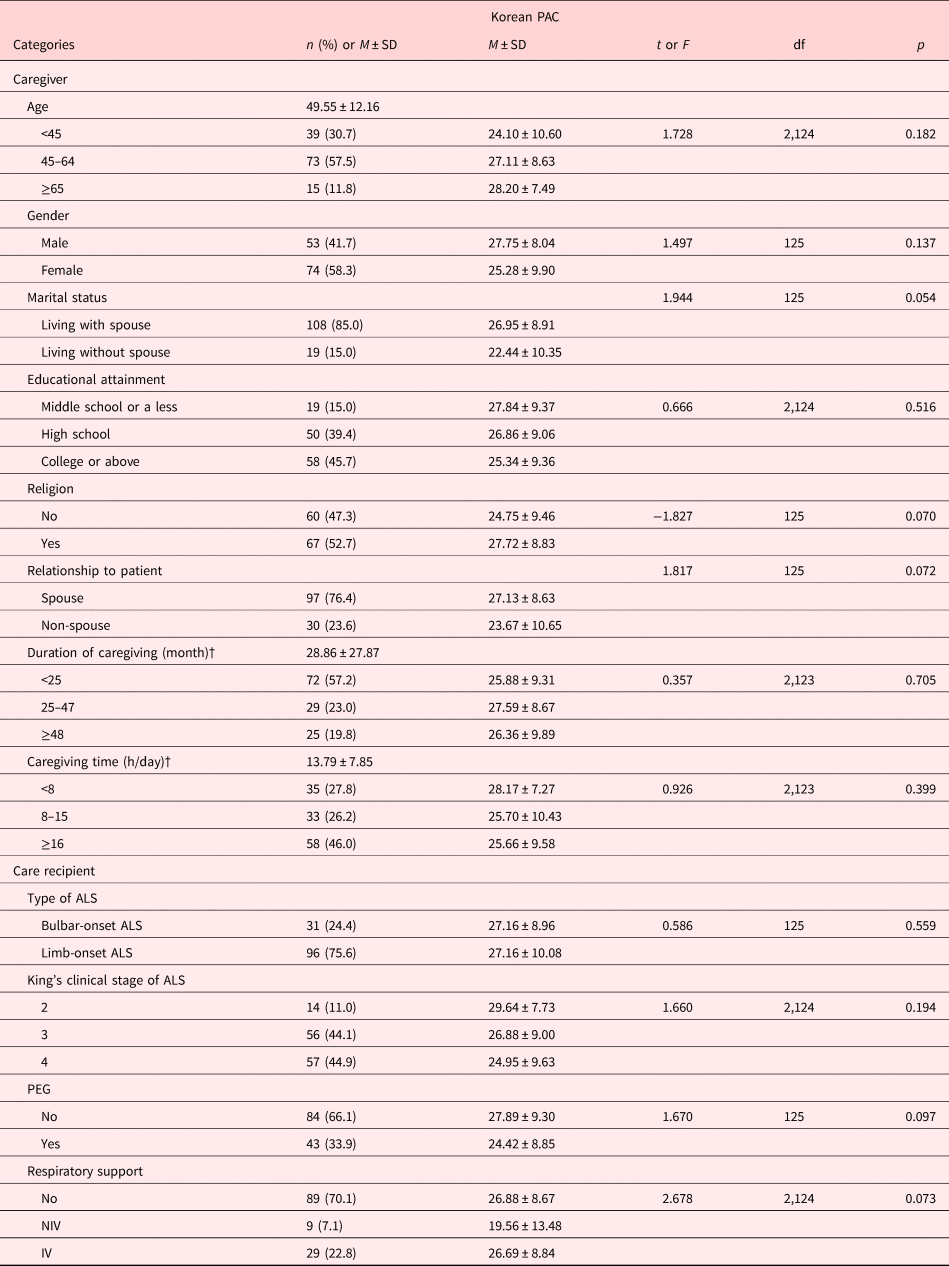
The mean age of the family caregivers was 49.55 ± 12.16 years, and 58.3% were women. Regarding marital status, 85.0% lived with their spouses. Regarding educational attainment, the largest proportion (45.7%) had a college degree or higher. Regarding having religious beliefs, 52.7% responded "Yes.". Regarding relationships with the patient, "spouse" was the most frequent response at 76.4%. The mean duration of caregiving was 28.86 ± 27.87 months, with 24 months or less being the most frequent (57.2%). The mean caregiving time per day was 13.79 ± 7.85 h, with more than 16 h being the most frequent at 46.0%.
Regarding the types of ALS, limb-onset ALS was the most common at 75.6%, and it was more common than bulbar-onset ALS (24.4%). Regarding King's clinical stages of ALS, stage 4 comprised 44.9%, stage 3 44.1%, and stage 2 11.0%. Furthermore, 33.9% of the ALS patients had received enteral feeding with gastrostomy, and 29.9% were receiving respiratory support through home ventilators (Table 1).
Differences in Korean PAC scores according to the demographic and clinical characteristics of participants (N = 127)

The Korean PAC: Korean version of the positive aspects of caregiving scale; ALS: amyotrophic lateral sclerosis; NIV: non-invasive ventilator; IV: invasive ventilator; PEG: percutaneous endoscopic gastrostomy; M ± SD: mean and standard deviation; df: degree of freedom; †: missing value was excluded.
Content validity
In the content validity testing by the expert panel, all items of the Korean PAC were evaluated as "very appropriate" or "appropriate." The average CVI was high at 1.00.
Item analysis
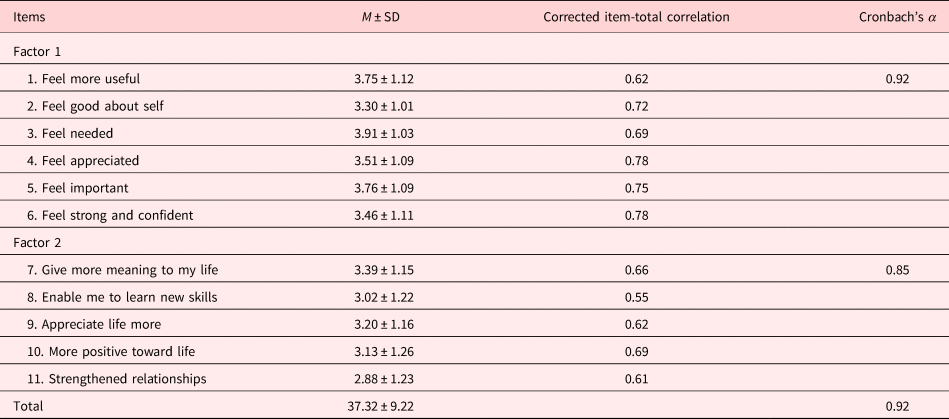
We conducted item analysis to evaluate the items of the Korean PAC (Table 2). The mean score range for the items was 2.88–3.91 points, and the range of standard deviation was 1.01–1.26 points. Item 11 (Strengthened relationships) showed the lowest mean score, while item 3 (Feel needed) showed the highest mean score. The correlations between each item score and total Korean PAC scale score were a minimum of 0.55 and a maximum of 0.78.
Item performance and reliability of the Korean PAC (N = 127)

The Korean PAC: Korean version of the positive aspects of caregiving scale.
Construct validity
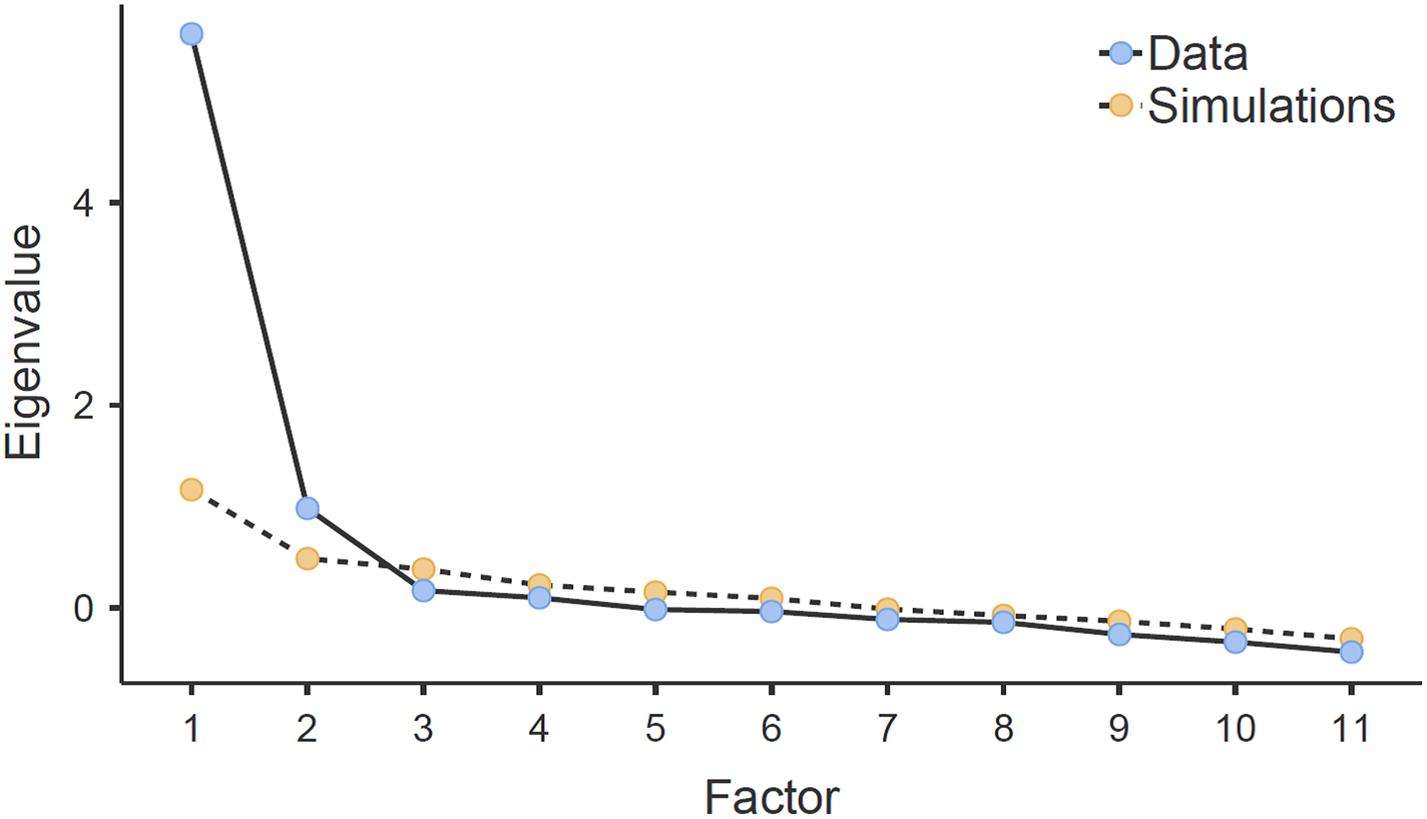
To compare the constructs of the original scale and its Korean version, we identified the factor structure through an EFA (Table 3). To identify whether the correlation matrix was an identity matrix and thus determine the suitability of the sample, we performed KMO and Bartlett's test of sphericity. Because there was sufficient evidence that it was not an identity matrix, we applied factor analysis (KMO = 0.89, χ2 = 1205.20, p < 0.001). In the factor extraction, parallel analysis, an eigenvalue greater than 1, and a scree plot suggested the two factors (Figure 1).
Parallel analysis results for the Korean PAC.

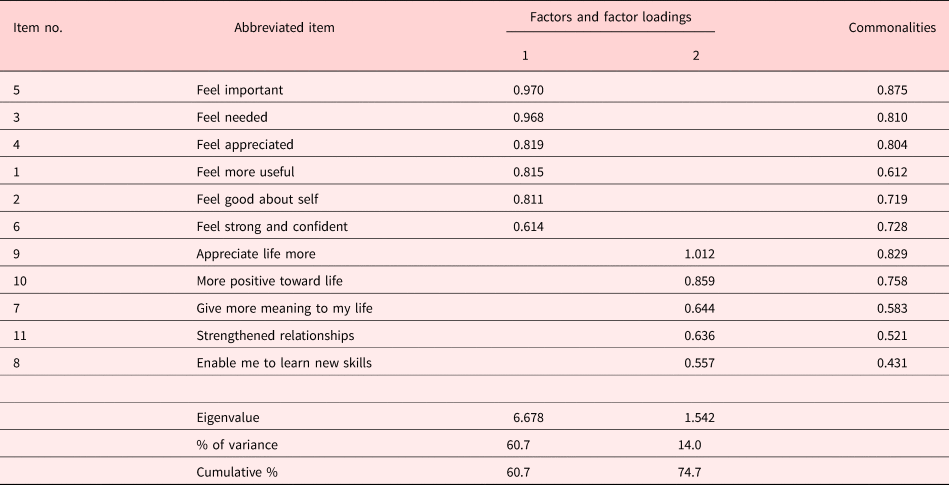
Results of the exploratory factor analysis (ULS estimation with promax rotation of the factors) of the Korean PAC (N = 127)

The Korean PAC: Korean version of the positive aspects of caregiving scale; Factor loadings below 0.3 are omitted.
The communalities of the 11 items were between 0.88 and 0.43, with all being above 0.40 (Osborne et al., Reference Osborne, Costello, Kellow and Osborne2008). The first factor (six items) explained 60.71% of the total variance, while the second factor (five items) explained 14.02% of the total variance. Together, the two factors explained 74.73% of the total variance. Factor 1 includes six items regarding the positive appraisal of self that family caregivers develop by providing care to patients. This factor was named "positive appraisal of self." Factor 2 includes five items about the positive appraisal of life through caregiving. This factor was named "positive appraisal of life."
Convergent validity
To establish convergent validity, we evaluated the relationships with variables that showed significant correlations with the Chinese version of the PAC in previous studies (Lou et al., Reference Lou, Lau and Cheung2015; Yu et al., Reference Yu, Wu and Chen2016).
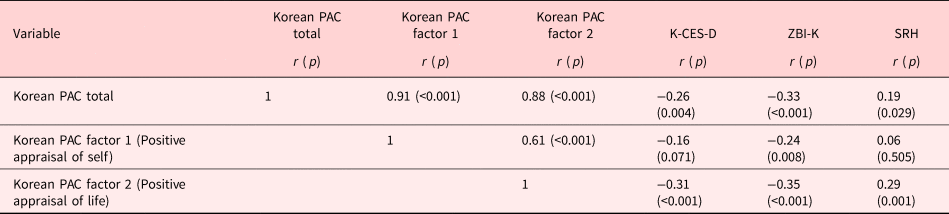
The results of testing the correlation between the Korean PAC (total items) and the K-CES-D, ZBI-K, and SRH status revealed negative correlations between the Korean PAC and the K-CES-D (r = −0.26, p = 0.004) and ZBI-K (r = −0.33, p < 0.001) and a positive correlation with SRH (r = 0.19, p = 0.029). Factor 1 (extracted through EFA) showed a statistically significant negative correlation with ZBI-K (r = −0.24, p = 0.008) and did not have a statistically significant correlation with K-CES-D (r = −0.16, p = 0.071) or SRH (r = 0.06, p = 0.505). Factor 2 showed a statistically significant negative correlation with the K-CES-D (r = −0.31, p < 0.001) and ZBI-K (r = −0.35, p < 0.001) and a statistically significant positive correlation with SRH (r = 0.29, p = 0.001) (Table 4).
Correlations among the Korean PAC and caregiving-related variables for convergent validity (N = 127)

The Korean PAC: Korean version of the positive aspects of caregiving scale; ZBI-K: Korean version of the Zarit Burden Interview; K-CES-D: Korean version of the Centre for Epidemiologic Studies Depression Scale; SRH: self-rated health.
Reliability
The test for the internal consistency reliability of the total Korean PAC showed a Cronbach's α of 0.92. The Cronbach's α values of factor 1 and factor 2 were 0.92 and 0.85, respectively (Table 2).
Sub-group analysis
The Korean PAC was not associated with the caregiver's age (F 2,124 = 1.728, p = 0.182), gender (t = 1.497, p = 0.137), marital status (t = 1.944, p = 0.054), educational attainment (F 2,124 = 0.666, p = 0.516), religion (t = −1.827 p = 0.070), relationship to patient (t = 1.817, p = 0.072), duration of caregiving (F 2,123 = 0.357, p = 0.705), and caregiving time (F 2,123 = 0.926, p = 0.399). The scale was also not associated with the care recipient's type of ALS (t = 0.586, p = 0.559), King's ALS clinical staging (F 2,124 = 1.660, p = 0.194), PEG (t = 1.670, p = 0.097), or respiratory support (F 2,124 = 2.678, p = 0.073) (Table 1).
Discussion
Recently, there have been efforts to holistically understand the caregiving experiences of family caregivers. It is essential to make attempts to understand not only the negative but also the positive aspects of providing care. For this purpose, it is important to translate the PAC developed by Tarlow et al. (Reference Tarlow, Wisniewski and Belle2004) — a tool that measures the PAC for family caregivers of ALS patients — to suit the Korean context and evaluate its reliability and validity. This study identified the Korean PAC as a reliable and valid tool that can evaluate the PAC among family caregivers of ALS patients in Korea.
Item analysis
Item 3 (Feel needed) showed the highest mean score among all items, while item 11 (Strengthened relationships) showed the lowest. This is similar to the findings of a previous study of caregivers of elderly with dementia (Lou et al., Reference Lou, Lau and Cheung2015). It differs, however, from a study of family caregivers of brain injury patients (Las Hayas et al., Reference Las Hayas, López de Arroyabe and Calvete2014), which found that item 2 (Feel good about self) had the highest mean score, while item 5 (Feel important) had the lowest. This difference may be attributable to differences in the progression of different diseases. Unlike brain injury, which involves consistently impaired functioning, ALS is a neurodegenerative disease where the symptoms worsen over time (van Es et al., Reference van Es, Hardiman and Chio2017). Furthermore, the cognition of ALS patients is fairly maintained until the advanced stages, though their daily-life activity performance regresses. Thus, family caregivers perform caregiving activities in accordance with the requests of the patients and stay near them, performing daily-life activities for them. The fact that item 11 (Strengthened relationships) showed the lowest score could be because ALS family caregivers become isolated and find it difficult to maintain social relationships, given that their role becomes more demanding as the patient's condition worsens. Nevertheless, some previous studies have reported that the PAC among the family caregivers of ALS patients are interpreted variously based on sociocultural contexts as well as the characteristics of the disease (Roth et al., Reference Roth, Dilworth-Anderson and Huang2015; Catalan et al., Reference Catalan, Ma and Huddleson2017).
Validity
The content validity of the Korean PAC was evaluated using CVI. Experts were asked to evaluate the relatedness of each item, and the level of agreement among experts was examined. Content validity was evaluated to be high if the CVI value was greater than 0.80. In this study, the mean CVI was found to be very high at 1.0. Thus, we determined that the Korean PAC has valid content for measuring the PAC for family caregivers of ALS patients.
EFA was conducted to test construct validity. The construct validity analysis showed that the sample was suitable for factor analysis with KMO and Bartlett's test of sphericity. To determine the appropriate number of factors suitable for factor extraction, we used parallel analysis, a scree plot, and an eigenvalue greater than 1.0; the data met the relevant standards. Furthermore, the total explanatory power was found to be 74.73%, thus satisfying the standards generally required by extracted factors to explain at least 60% of the total variance (Cartagena-Ramos et al., Reference Cartagena-Ramos, Fuentealba-Torres and Rebustini2018). Our results are similar to a previous study of family caregivers of elderly with dementia, which showed a total explanatory power of 60.4% (Lou et al., Reference Lou, Lau and Cheung2015).
The results of our EFA indicated that the factor structure of the Korean PAC consisted of two factors, which were identical to the factor structure of the original tool. However, the items comprising factor 2 showed some changes. Item 7 (Give more meaning to my life) and item 8 (Enable me to learn new skills), which were deleted from the original scale because of low factor loadings, were placed in factor 2. The names of the extracted factors were "self-affirmation" and "outlook on life" in the original scale (Tarlow et al., Reference Tarlow, Wisniewski and Belle2004). These were called "self-affirmation" and "enriching life" in Hong Kong, whose culture is similar to that of Korea (Lou et al., Reference Lou, Lau and Cheung2015). In East Asian countries, including Korea, China, and Taiwan, there is a strong social expectation that the caregiver role will be performed by a spouse or child (Han et al., Reference Han, Choi and Kim2008), who will thus be viewed favorably when faithfully fulfilling that role (Lou et al., Reference Lou, Lau and Cheung2015). Accordingly, this commitment to a socially expected role is thought to promote a more positive perception of individuals and their lives.
In the present study, these factors were termed "positive appraisal of self" and "positive appraisal of life." This was to create a similar context and allow for an easy and direct understanding of what the scale aims to measure in Korean culture.
The Korean PAC total and subscale scores can be used independently in research and practice (Siow et al., Reference Siow, Chan and Østbye2017). However, research on the positive experiences of caregivers has only been partially understood; thus, it is advisable to use total scores when using Korean PAC.
The test for convergent validity showed that the overall Korean PAC had a statistically significant correlation with the K-CES-D, ZBI-K, and SRH. This is in line with a previous study showing that PAC had negative correlations with depression and burden and a positive correlation with SRH (Abdollahpour et al., Reference Abdollahpour, Nedjat and Salimi2018; Xue et al., Reference Xue, Zhai and He2018). However, factor 1 (positive appraisal of self) only showed a significant correlation with ZBI-K, which measures the burdens of caregiving. Previous studies have also reported that this relationship between the level of PAC and variables such as depression and burden differs based on ethnicity (Catalan et al., Reference Catalan, Ma and Huddleson2017; Lee, Reference Lee2017). The present study found that the mental-health related variables of the family caregivers of ALS patients were more highly related to a positive appraisal of life (through changes in values related to life) than to a positive appraisal of self through caregiving. It is believed that a family caregiver's appraisal of life, brought about through caregiving, is more easily changed than the appraisal of self.
Reliability
The Cronbach's α (internal consistency reliability measure) of the total Korean PAC was 0.92. The Cronbach's α values for the two subscales were 0.92 and 0.85. It was, thus, evaluated as having satisfactory reliability. The internal consistency reliability of the Korean PAC was similar to the 0.91–0.93 level in Siow et al. (Reference Siow, Chan and Østbye2017), which concerned family caregivers of elderly with dementia in Singapore. Meanwhile, it was higher than the 0.82 level in Las Hayas et al. (Reference Las Hayas, López de Arroyabe and Calvete2014), who studied the family caregivers of patients with brain injuries.
Limitations and future research
The present study has some limitations. We extracted the Korean PAC's structural dimensionality through EFA based on the responses of Korean participants but were unable to evaluate the suitability of the suggested structural dimensionality through confirmatory factor analysis. Furthermore, this study used secondary data and, therefore, was not able to assess various reliabilities, such as retest reliability, for the evaluation of scale stability. It is necessary to include additional methodological evaluations regarding the scale. The caregivers included in this study may have systematically low or high levels of experience with PAC than those who refused to take part in the study. Future studies that involve large samples, multiple centres, and confirmatory factor analysis are needed to provide the psychometric properties of the Korean PAC scale in the ALS population.
Conclusion
Despite the above-mentioned limitations, this study demonstrated that the Korean PAC is a reliable and valid instrument for use with Korean family caregivers of ALS patients. The scale can be a useful tool for both health care providers and researchers in assessing a family caregiver's positive appraisal of caregiving. It can also be useful for evaluating the practice outcomes of psychological interventions for family caregivers of ALS patients intended to promote a more positive experience of caregiving.
Acknowledgments
The authors are grateful to the people with ALS and their family caregivers who participated in this study.
Conflict of interest
The authors have no conflicts of interest to declare.