INTRODUCTION
The introduction of non-indigenous species into marine ecosystems has been a growing concern in recent decades (e.g. Suchanek, Reference Suchanek1994; Verlaque, Reference Verlaque1994; Coles et al., Reference Coles, De Felice, Eldredge and Carlton1999; Schaffelke et al., Reference Schaffelke, Smith and Hewitt2006; Occhipinti-Ambrogi & Sheppard, Reference Occhipinti-Ambrogi and Sheppard2007). Some species can be transported by means of anthropogenic vectors but fail to establish in the recipient communities. Establishing species may have no or little effect on the native communities, but a small proportion has the potential to become invasive (Williamson & Fitter, Reference Williamson and Fitter1996; Boudouresque & Verlaque, Reference Boudouresque and Verlaque2002). The ecological effects on native communities of these invasive species, including macroalgae, have been the subject of numerous studies (e.g. Verlaque & Fritayre, Reference Verlaque and Fritayre1994; Britton-Simmons, Reference Britton-Simmons2004; Piazzi et al., Reference Piazzi, Balata, Ceccherelli and Cinelli2005).
Successful establishment of a non-indigenous species will obviously depend partly on the environmental characteristics (abiotic factors such as temperature and salinity) of the recipient areas and their suitability for that given species. Another factor influencing establishment is the composition of the recipient community and particularly its species richness. More complex and richer communities are believed to be less subject to introductions and invasions than simple ones (Elton, Reference Elton1958; Law & Morton, Reference Law and Morton1996). However, some studies have shown that non-indigenous richness can increase with native richness (Robinson et al., Reference Robinson, Quinn and Stanton1995; Lonsdale, Reference Lonsdale1999). A recent study in terrestrial environments suggests that this positive relationship changes with spatial scale, being less marked at smaller scales, and even negative under environmental conditions such as those leading to high productivity (Davies et al., Reference Davies, Harrison, Safford and Viers2007). The mechanisms underlying these relationships are thought to reflect competitive exclusion being more common at small scales and high productivity (implying a greater resistance to introduced species), while at larger scales non-indigenous species and natives both respond to the same gradients in overall habitat suitability.
The present study aimed to test which of those two opposing hypotheses (i.e. negative versus positive relationship) developed by terrestrial ecology is relevant for macroalgal communities at different spatial scales in the marine environment. The richness of non-indigenous macroalgae was analysed in relation to that of recipient macroalgal communities in Northern Ireland and in southern England, comparing these two areas at three different spatial scales.
A further influence on the contribution of non-indigenous species to native communities is the overall ‘propagule pressure’ from different vectors. Some of the locations were considered to be likely to experience relative high propagule pressure as they were located near possible sources of introduction (marina, harbour and aquaculture facilities). This allowed comparisons of the role of proximity to a potential source of introductions in influencing the native and non-indigenous species richness of macroalgal communities.
MATERIALS AND METHODS
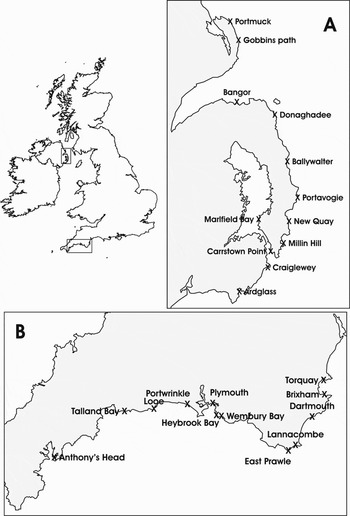
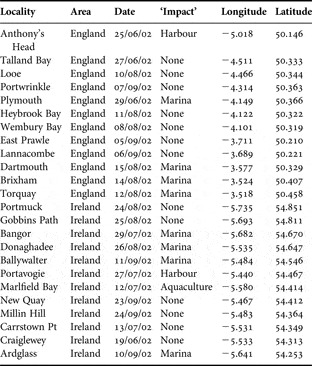
Two areas were chosen for this survey: the Belfast region for Northern Ireland and the Plymouth region for England. Within these regions, the choice of the localities was dictated by the presence of rocky shores, a suitable habitat for macroalgae. Twenty-four localities were surveyed during the summer of 2002 (Figure 1). Around half of the localities (5 in England and 6 in Northern Ireland) were near a potential source of species introductions and disturbance, which we define as ‘impact’ (Table 1).
Map showing the different sampling localities in (A) Northern Ireland and (B) the South of England.

Localities sampled during the survey. Only natural rocky shores were surveyed.

All the shores were visited during low water spring tides. Sampling was hierarchical. At each locality (shore) three 15 m stretches of shore (sites) parallel to the coastline were haphazardly selected. These stretches were separated by at least 15 m or more when possible. Three quadrats of 50 × 50 cm were studied in the lower littoral zone at each site, i.e. a total of nine quadrats per locality. The positioning of the quadrats was random but had to satisfy two conditions: quadrats were not surveyed unless they lay outside rock pools and had a macroalgal cover of at least 50%. The percentage of macroalgal cover was estimated by eye.
Inside the quadrats, all visible macroalgae (i.e. excluding microscopic thalli) were identified to species level. Identification was carried out in the field, or back in the laboratory using microscopes. In addition to studies within the quadrats, the presence of any conspicuous non-indigenous species observed outside the quadrats was recorded.
Data were recorded and analysed at the three different spatial scales: quadrat, site and locality. At the quadrat level, the macroalgal assemblages were recorded as species present or absent (qualitative only). At larger scales (sites and localities), semi-quantitative data (i.e. number of quadrats in which presence was recorded) were available for each species. An index of the diversity was provided by the number of individual species, measured at each different spatial scale (as the number of species at one scale could not be deduced from the lower scale).
The influences of sampling area and presence of impact were investigated using multivariate comparisons in PRIMER (http://www.pml.ac.uk/primer/index.htm; Clarke & Warwick, Reference Clarke and Warwick1994) and tested in one- and two-way ANOSIM designs, with differences among samples estimated using the Sorensen (for quadrat scale, with only presence data) and Bray–Curtis similarity coefficients (for site and locality scales, with semi-quantitative data).
Univariate statistics were calculated with CCS-Statistica software (Version 5.1, ®StatSoft). Response variables were the total number of taxa (i.e. species richness) and the number of non-indigenous species, at different scales. These variables were analysed with linear regressions and tested in two-way ANOVAs at the three spatial scales.
RESULTS
A total of 129 taxonomic entities were found, including 97 Rhodophyta, 23 Phaeophyceae and 9 Chlorophyta. Gametophyte and sporophyte phases of Asparagopsis armata Harvey/‘Falkenbergia' phase and Bonnemaisonia hamifera Hariot/‘Trailliella' phase were considered as different taxa because they occupy different ecological niches. Ten species were found in more than 40% of the quadrats. These were (in order of decreasing importance; mean values ± SE per locality; maximum theoretical value = 9): Fucus serratus Linnaeus (7.42 ± 2.22 quadrats per locality, N = 24), Mastocarpus stellatus (Stackhouse) Guiry (7.04 ± 2.31), Phymatolithon lenormandii (Areschoug) Adey (6.33 ± 1.76), Ulva spp. (including tubular forms) (6.00 ± 2.43), Lomentaria articulata (Hudson) Lyngbye (5.87 ± 2.23), Palmaria palmata (Linnaeus) Kuntze (5.58 ± 2.76), Phymatolithon purpureum (Crouan & Crouan) Woelkerling & Irvine (5.08 ± 2.62), Chondrus crispus Stackhouse (4.88 ± 1.87), Corallina officinalis Linnaeus (4.79 ± 2.87) and Osmundea pinnatifida (Hudson) Stackhouse (4.17 ± 2.76).
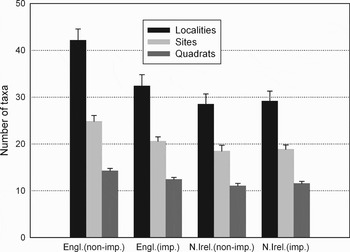
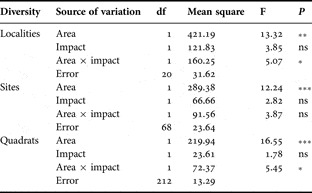
Two-way ANOVAs showed significant differences in species richness between the two sampled areas at the three spatial scales (Table 2), with more species in the south of England (Figure 2). The presence or absence of a potential source of disturbance had no influence on the species richness for the whole dataset. The two parameters had a significant interaction at the largest and smallest scales (localities and quadrats) (Table 2). Differences in the number of taxa were significant between impacted and non-impacted macroalgal communities in the south of England only at those scales (Tukey HSD post-hoc tests; Figure 2).
Variation in species diversity (number of taxa) in each category of the survey (south of England and Northern Ireland, impacted or non-impacted) at the three spatial scales investigated (mean ± SE).

Two-way ANOVAs of macroalgal diversity (number of taxa) at three different scales in the two different areas of the surveys, in both impacted and non-impacted localities (ns, not significant; *P < 0.05; **P < 0.01; ***P < 0.001). Variances were homogeneous for each ANOVA (Bartlett's test).

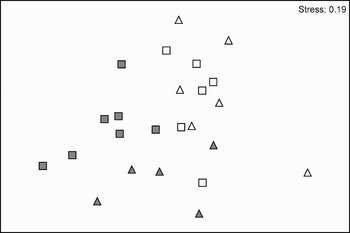
Similarly, multivariate analyses show that there was a significant difference between the composition of the macroalgal communities in the south of England and in Northern Ireland (two-way ANOSIM test statistic = 0.522, P = 0.001) (Figure 3). Differences between impacted and non-impacted sites showed less resolution but were still significant (two-way ANOSIM test statistic = 0.182, P = 0.025). Impact has no effect on the composition of the macroalgal flora at the Northern Ireland localities (one-way ANOSIM test statistic = 0.071, P = 0.102).
Ordination by non-parametric multidimensional scaling (MDS) for the composition of the surveyed macroalgal flora in the different localities (closed symbols indicate localities in the south of England; open symbols indicate localities in Northern Ireland; triangles, impacted localities (presence of marina, harbour or aquaculture facility; square, non-impacted localities)).

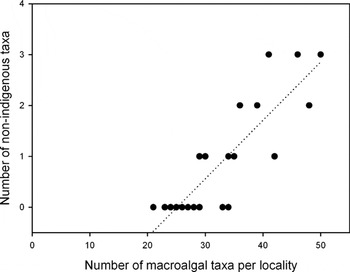
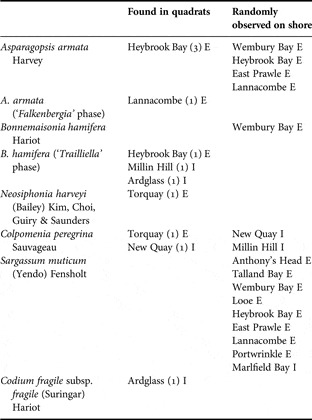
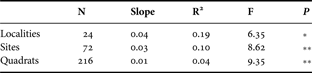
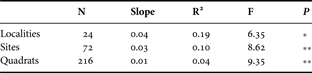
A total of 8 non-indigenous taxa and phases was found during the whole survey, inside the quadrats or randomly observed on the shore (Table 3). At the three scales tested, there was a significant positive relationship between the number of non-indigenous species (or phases) and the total number of taxa (Table 4). The slope coefficient tended to increase with the scale (from quadrats to localities). However, the coefficient of determination R2 was very low in all cases. A stronger positive regression was found between the total number of non-indigenous species, including species found outside the quadrats (increasing the maximum to 3 species), and the number of macroalgal species in each locality (y = –2.88 + 0.11 ×, R2 = 0.68, P < 0.0001) (Figure 4). Each region analysed separately showed a similar regression (England: y = –3.54 + 0.13 ×, R2 = 0.69, P < 0.0005, N = 12; Ireland: y = –2.64 + 0.11 ×, R2 = 0.41, P < 0.05, N = 12).
Number of non-indigenous macroalgae (including sightings outside sample quadrats) related to the total number of taxa per locality (y =−2.88 + 0.11 ×, R2 = 0.68, P < 0.0001, N = 24).

Non-indigenous macroalgal species observed during the survey, indicating localities with (in parentheses) the number of quadrats where the species was observed (E, England; I, Ireland).

Linear regressions showing the relationships between the number of non-indigenous species and the total number of taxa per locality, site or quadrat (*P < 0.05; **P < 0.01).
Two-way ANOVAs showed no difference between the number of non-indigenous taxa (and phases) in the two areas and between impacted and non-impacted shores at the three different scales. When observations outside the quadrats were included, there was a significant difference between the two sampled areas (two-way ANOVA, F1,20 = 4.67, P < 0.05) but not between impacted and non-impacted localities (F1, 20 = 3.47, P = 0.073); there was no significant interaction between the two parameters (F1,20 = 3.47, P = 0.073).
DISCUSSION
This survey shows clearly that macroalgal species richness is higher in the Plymouth region than in the Belfast region. This is in agreement with available data on the macroalgal flora of the British Isles (Hardy & Guiry, Reference Hardy and Guiry2003) and is not surprising in view of the general decline in species richness northwards in the north-east Atlantic (Hoek & Donze, Reference Hoek, Van den and Donze1967).
In Northern Ireland, impact (i.e. mostly marinas or small harbours) had no effect on the composition and species richness of macroalgal communities. However, for the whole study, only natural rocky habitats were investigated and at impacted localities, surveyed habitats were always close to but never in direct contact with the impact (e.g. inside the marina). The difference found between impacted and non-impacted localities in the south of England, both in the number of species (ANOVA tests) and the composition of the flora (ANOSIM tests), could be related to the presumed source of impact. Indeed, areas surrounding marinas may be relatively more disturbed by direct activity on the shore (trampling) or through general environmental degradation (e.g. pollutants). Such factors could reduce the richness of both non-indigenous and native species. The absence of this effect in Northern Ireland may reflect the relatively small facilities in this area in comparison to the south of England.
Thirteen non-indigenous seaweed species, including a total of 16 subspecies and phases, have been reported in the British Isles (Eno et al., Reference Eno, Clark and Sanderson1997). All the non-indigenous species found during the present study were already known to be in the surveyed areas. Many non-indigenous species previously recorded are found in the subtidal zone. The present study in the rocky intertidal was therefore unlikely to find some of the non-indigenous algae. This seems to be the case for species such as Antithamnionella spp., Grateloupia spp. or Undaria pinnatifida which were not recorded. Moreover, Sargassum muticum was observed at 9 of the 24 localities, but was never present inside the quadrats. Where present, S. muticum was restricted to the shallow subtidal and rockpools.
Like some other recent studies (Robinson et al., Reference Robinson, Quinn and Stanton1995; Lonsdale, Reference Lonsdale1999), we found positive relationships between the total macroalgal richness and the number of non-indigenous species (although see Klein et al., Reference Klein, Ruitton, Verlaque and Boudouresque2005). Like Davies et al. (Reference Davies, Harrison, Safford and Viers2007), we found that the slope of the regression increases with the spatial scale. However, the determination coefficients were very low but increased with the spatial scale. The best-fitting and most positive relationship was found at the locality level, when observations of non-indigenous species found outside the quadrats were included. The observed patterns suggest that non-indigenous and native species are responding to the same environmental factors both at the quadrat scale and at larger scales. Different gradients are likely to operate at the separate scales. For example, small scale topographic complexity may be important at small scales, with broader climatic suitability at large scales. Furthermore, this suggests that communities are rarely saturated with native species such that competitive exclusion occurs. Competition may still play a part if the communities are richer where there is more physical disturbance. This would be the case if sampled quadrats fell on the right hand side of a unimodal species richness–disturbance relationship, as proposed by the intermediate disturbance hypothesis (Connell, Reference Connell1978; Fox & Connell, Reference Fox and Connell1979).
The positive relationship between total and non-indigenous species richness was found within the two different regions. This pattern seems to be independent of the regional characteristics. In other words, high numbers of non-indigenous species will occur preferentially in environments favourable for seaweeds in general. The lower number of native and non-indigenous taxa in Northern Ireland could be due to a combination of different factors. One possibility is climatic constraints linked to lower temperatures, which is also the underlying cause of the macroalgal richness gradient in the north-east Atlantic. Another possibility is the relative isolation of that region in comparison to southern England. This would tend to lower the native richness. Indeed, the north of Ireland was highly affected by the last glaciations and its marine habitats, like the terrestrial landmass, may not yet have been recolonized completely (Montoya et al., Reference Montoya, Rodriguez, Zavala and Hawkins2007). On the other hand, most non-indigenous species present on the Atlantic shores of Europe were first observed in the English Channel area (Westbrook, Reference Westbrook1930; Farnham, Reference Farnham and Price1980; Critchley et al., Reference Critchley, Farnham and Morrell1983; Cabioc'h & Magne, Reference Cabioc'h and Magne1987), making this region a hotspot for seaweed introductions. Due to its remoteness, the north of Ireland is also likely to be less exposed to secondary dispersal (both natural and human-mediated) of these non-indigenous species. Consequently, it seems that successful establishment of non-indigenous species could be driven by conditions similar to the ones that allowed the settlement of native species, explaining the positive relationship between non-indigenous and native diversities.
The subtidal zone and man-made substrata, such as concrete walls, which were excluded, are known to support many macroalgae including non-indigenous species (Westbrook, Reference Westbrook1934; Curiel et al., Reference Curiel, Bellemo, Marzocchi, Scattolin and Parisi1998; Knott et al., Reference Knott, Underwood, Chapman and Glasby2004). The exclusion of marinas meant that their floating structures (mainly pontoons, but also buoys and immersed ropes), which are a completely different habitat from natural rocky shores (Connell Reference Connell2000; Holloway & Connell Reference Holloway and Connell2002), were not surveyed. These structures, with their proximity to potential vectors of introductions, seem to be a suitable habitat and act as reservoirs for non-indigenous species (Arenas et al., Reference Arenas, Bishop, Carlton, Dyrynda, Farnham, Gonzalez, Jacobs, Lambert, Lambert, Nielsen, Pederson, Porter, Ward and Wood2006). Also, invasive species seem to out-compete native ones in this kind of habitat (Farrell & Fletcher, Reference Farrell and Fletcher2006). Consequently, the pattern found in such habitats could be different from that on natural shores.
ACKNOWLEDGEMENTS
This study was funded by the European project ALIENS (Algal Introductions into European Shores). The authors are grateful to Francisco Arenas, Maeve Edwards and Gustavo Hinojosa for their help in the field.