Introduction
Psychosis is characterized by problems in social functioning (Couture et al., Reference Couture, Penn and Roberts2006; Fett et al., Reference Fett, Gromann, Shergill and Krabbendam2012). Lower social functioning is already present in childhood in individuals who continue to develop psychosis and has also been reported in individuals at high risk for psychosis (Yung et al., Reference Yung, Phillips, Nelson, Francey, Yuen, Simmons, Ross, Kelly, Baker and Paul Amminger2003; Ballon et al., Reference Ballon, Kaur, Marks and Cadenhead2007; Cornblatt et al., Reference Cornblatt, Auther, Niendam, Smith, Zinberg, Bearden and Cannon2007; Corcoran et al., Reference Corcoran, Kimhy, Parrilla-Escobar, Cressman, Stanford, Thompson, David, Crumbley, Schobel and Moore2011; Velthorst et al., Reference Velthorst, Nieman, Becker, van de Fliert, Dingemans, Klaassen, de Haan, van Amelsvoort and Linszen2016a, Reference Velthorst, Reichenberg, Kapara, Goldberg, Fromer, Fruchter, Ginat, de Haan, Davidson and Weiser2016b). Clinical high risk patients (CHR) are already in care for other psychopathology, reporting psychotic-like symptoms, but have not yet experienced – and maybe never will – full-blown psychosis. In CHR, the developmental course of social functioning is predictive of the conversion to psychosis (Niendam et al., Reference Niendam, Bearden, Zinberg, Johnson, O'Brien and Cannon2007; Cannon et al., Reference Cannon, Cadenhead, Cornblatt, Woods, Addington, Walker, Seidman, Perkins, Tsuang and McGlashan2008; Jang et al., Reference Jang, Shin, Shim, Park, Kim, Jang, Kwon, Hur, An and Kwon2011). Understanding the mechanisms underlying deficits in social functioning in at-risk states and first-episode psychosis (FEP) is crucial for understanding transition and outcome prognosis. Intervening at these early stages targeting social functioning can improve outcome and possibly delay (or prevent) transition.
Social functioning relates to establishing relationships, both vocational and private (Velthorst et al., Reference Velthorst, Nieman, Becker, van de Fliert, Dingemans, Klaassen, de Haan, van Amelsvoort and Linszen2016a, Reference Velthorst, Reichenberg, Kapara, Goldberg, Fromer, Fruchter, Ginat, de Haan, Davidson and Weiser2016b). Patients show a steep decline in these domains starting about 5 years before illness onset. The basis of social functioning is the ability to interact in an appropriate way with other people. Previous research studying online social interactions in psychosis has suggested two possible explanatory mechanisms for impairments in social interactions; these are a reduced sensitivity to rewarding effects of social contact (Fett et al., Reference Fett, Gromann, Shergill and Krabbendam2012; Gromann et al., Reference Gromann, Heslenfeld, Fett, Joyce, Shergill and Krabbendam2013; Campellone et al., Reference Campellone, Fisher and Kring2016), and an impaired social cognitive ability (Csukly et al., Reference Csukly, Polgár, Tombor, Réthelyi and Kéri2011; Horat et al., Reference Horat, Favre, Prévot, Ventura, Herrmann, Gothuey, Merlo and Missonnier2017), including impaired mentalizing (Green et al., Reference Green and Leitman2015). Social cognitive skills (Couture et al., Reference Couture, Penn and Roberts2006; Green and Leitman, Reference Green, Horan and Lee2008) are necessary for the formation and maintenance of relationships and for building trust in other people. Like patients with psychosis, CHR show deficits in a variety of these skills (Bora and Pantelis, Reference Bora and Pantelis2013; Lavoie et al., Reference Lavoie, Lacroix, Godmaire-Duhaime, Jackson and Achim2013; McCleery et al., Reference McCleery, Horan and Green2014), albeit to a lesser degree. Research has mainly focused on offline cognitive skills, without investigating them in real interactions. In the last decade, interactive designs have been widely used that have the strength to capture social cognitive skills, as well as the rewarding effects of social behavior in an online setting. We therefore investigated cooperative and unfair social interactions and the neural correlates of trust, directly comparing FEP and CHR to controls, using an interactive trust game to test whether these groups display similar underlying mechanisms of reduced social interactions.
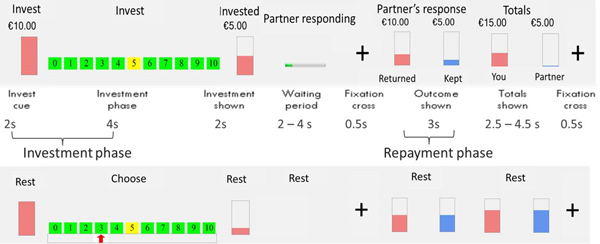
The trust game investigates real-time social interactions (Berg et al., Reference Berg, Dickhaut and McCabe1995). In the game, the first player (investor) receives a certain endowment, e.g. €10. He or she can give any amount between €0 and €10 to the second player, the trustee. The given amount is tripled and the trustee then can return any part of this amount to the investor. The best pay-off for the trustee is reached by keeping the money. Thus, investing requires trust that a fair repayment will be made. The iterative game allows for the investigation of baseline trust (i.e. first investment), and the development of trust based on cooperative and unfair social feedback. Key processes involved in the trust game are thought to be mentalizing (Gallagher and Frith, Reference Gallagher and Frith2003; Frith and Frith, Reference Frith and Frith2006; Declerck et al., Reference Declerck, Boone and Emonds2013) and reward processing (King-Casas et al., Reference King-Casas, Tomlin, Anen, Camerer, Quartz and Montague2005; Fehr and Camerer, Reference Fehr and Camerer2007; Rilling and Sanfey, Reference Rilling and Sanfey2011). Mentalizing appears to be important during both the investment and repayment phases, where estimations of the other's behavior are made. Reward learning signals have been shown to shift from the repayment phase to the investment phase in an iterative trust game (King-Casas et al., Reference King-Casas, Tomlin, Anen, Camerer, Quartz and Montague2005). Hence, we investigated both the investment and repayment phases (Fig. 1).
Graphical overview of the trust game. Note: Top row represents the visual stimuli in the game trials; middle row are the separate phases of the trust game, including durations; bottom row represents the visual stimuli in the control trials. Printed with permission of Lemmers-Jansen et al. (Reference Lemmers-Jansen, Krabbendam, Veltman and Fett2017).

Research in healthy subjects has shown that participants initially invest more than half of their endowment (Berg et al., Reference Berg, Dickhaut and McCabe1995; Johnson and Mislin, Reference Johnson and Mislin2011). Studies from our laboratory have shown that baseline trust tends to be lower in patients than controls (Gromann et al., Reference Gromann, Heslenfeld, Fett, Joyce, Shergill and Krabbendam2013; Fett et al., Reference Fett, Shergill, Joyce, Riedl, Strobel, Gromann and Krabbendam2016). Both positive (Fett et al., Reference Fett, Gromann, Shergill and Krabbendam2012) and negative (Fett et al., Reference Fett, Shergill, Joyce, Riedl, Strobel, Gromann and Krabbendam2016) symptoms have been associated with lower baseline trust, suggesting that reduced trust may reflect either paranoia or a lack of social motivation. The ability to learn from social feedback seems to depend on context (cooperative or unfair partner's responses) and illness duration: Early psychosis patients were able to adjust their trust to similar levels as controls, whereas chronic patients showed an insensitivity to positive feedback. In unfair interactions, early and chronic psychosis patients responded adequately to negative feedback (Fett et al., Reference Fett, Gromann, Shergill and Krabbendam2012, Reference Fett, Shergill, Korver-Nieberg, Yakub, Gromann and Krabbendam2015, Reference Fett, Shergill, Joyce, Riedl, Strobel, Gromann and Krabbendam2016; Gromann et al., Reference Gromann, Heslenfeld, Fett, Joyce, Shergill and Krabbendam2013; Campellone et al., Reference Campellone, Fisher and Kring2016). Understanding the mechanisms of trust in early psychosis stages may provide insights in focal points to target in social functioning interventions.
At the neural level, reduced caudate activation in chronic patients has been reported in cooperative interactions. Relatives of patients with psychosis, despite behavioral outcomes similar to controls, also showed reduced recruitment of the caudate and insula. These results possibly reflect reduced sensitivity to social reward processing mechanisms in both patients and relatives (Gromann et al., Reference Gromann, Heslenfeld, Fett, Joyce, Shergill and Krabbendam2013, Reference Gromann, Shergill, de Haan, Meewis, Fett, Korver-Nieberg and Krabbendam2014), which could account for social impairments. Associations of neural activity with positive symptoms have been reported (Gromann et al., Reference Gromann, Heslenfeld, Fett, Joyce, Shergill and Krabbendam2013).
This study set out to investigate whether CHR and FEP patients, similar to chronic patients, show reduced baseline trust and to explore the neural mechanisms underlying trust behavior in these patient groups. Based on the existing trust game literature, we hypothesized that similar to relatives (Fett et al., Reference Fett, Gromann, Shergill and Krabbendam2012) and (chronic) patients (Fett et al., Reference Fett, Shergill, Korver-Nieberg, Yakub, Gromann and Krabbendam2015) (1) FEP and CHR will show lower levels of baseline trust, and (2) CHR and FEP are able to learn from positive and negative feedback given by the counterpart and adjust their levels of trust accordingly (Gromann et al., Reference Gromann, Heslenfeld, Fett, Joyce, Shergill and Krabbendam2013; Fett et al., Reference Fett, Shergill, Korver-Nieberg, Yakub, Gromann and Krabbendam2015). In both cases, we expected CHR to perform in between FEP and controls. In addition, the associations of symptoms with baseline trust and changes in trust in FEP and CHR were examined. On the neural level, we hypothesized to find (3) attenuated activation in brain areas associated with mentalizing and reward (learning) in FEP compared with controls. Based on the trust literature in relatives and imaging research in CHR (Smieskova et al., Reference Smieskova, Marmy, Schmidt, Bendfeldt, Riecher-Rossler, Walter, E Lang and Borgwardt2013), we expected intermediate activation in CHR. Based on the findings by Gromann et al. (Reference Gromann, Heslenfeld, Fett, Joyce, Shergill and Krabbendam2013), we hypothesized to find (4) positive symptoms related positively to brain activation in mentalizing and negatively to reward areas in both patient groups. In addition, associations of brain activations with negative symptoms were investigated.
Methods
Subjects
Twenty-six FEP patients with non-affective psychosis, aged 16–22, and 17 CHR, aged 16–31, were recruited in the Amsterdam and The Hague area. Forty-nine healthy control participants (aged 16–31) were recruited to match both patient populations on age and gender. Patients were contacted through their caregivers at the academic medical center, Amsterdam (AMC), the Amsterdam early intervention team psychosis and PsyQ, The Hague. FEP were diagnosed at the AMC, according to the Diagnostic and Statistical Manual of Mental Disorders, Fourth Edition (DSM-IV) criteria (American Psychiatric Association, 2000). FEP were included within 18 months of the diagnosis (mean 5.6 months). CHR were help-seeking individuals that were referred to PsyQ by their general practitioners or other mental health institutions. After an initial diagnosis based on their complaints, all new admissions (between age 14 and 35) were screened for an ‘at-risk mental state’ (ARMS) with the Comprehensive Assessment of At-Risk Mental States (CAARMS) (Yung et al., Reference Yung, Phillips, Yuen, Francey, McFarlane, Hallgren and McGorry2005), a semi-structured interview that assesses psychotic experiences in the last year before assessment. Only the positive symptoms sub-scale was used, and both intensity and frequency of the symptoms were assessed. Patients met ARMS criteria for attenuated psychotic symptoms (a) with subthreshold intensity, when scoring 3–5 on severity and 3–6 on frequency of symptoms (all CHR participants), (b) or based on subthreshold frequency, when scoring 5–6 on severity and 3 or above on frequency (N = 2, in combination with intensity), or based on vulnerability, i.e. schizotypal personality disorder, familial history of psychosis or a drop in social functioning (N = 3, in combination with intensity) [for details, see (Yung et al., Reference Yung, Phillips, Yuen, Francey, McFarlane, Hallgren and McGorry2005), p. 966]. Patients were diagnosed as having a full-blown psychosis when scoring higher than 6. Additionally, patients had to display marked problems in socially useful activities (work and study), relationships, and self-care, indicated by a score below 55 on the Social and Occupational Functioning Assessment Scale (SOFAS; mean score 46.9) (Goldman et al., Reference Goldman, Skodol and Lave1992; Morosini et al., Reference Morosini, Magliano, Brambilla, Ugolini and Pioli2000), see also (Rietdijk et al., Reference Rietdijk, Klaassen, Ising, Dragt, Nieman, Van de Kamp, Cuijpers, Linszen and Van der Gaag2012). CHR were included within 1 year after CAARMS assessment (mean 4.8 months). Fourteen CHR patients also took part in a larger study (EU-GEI), with post-measurements at 6, 12, and 24 months using the CAARMS. Of two CHR participants, follow-up data are missing. Symptoms of depression and anxiety are often the primary presenting complaints of CHR patients, rather than the attenuated psychotic symptoms (Modinos et al., Reference Modinos, Allen, Frascarelli, Tognin, Valmaggia, Xenaki, Keedwell, Broome, Valli and Woolley2014). Similar to other CHR samples (Woods et al., Reference Woods, Addington, Cadenhead, Cannon, Cornblatt, Heinssen, Perkins, Seidman, Tsuang and Walker2009; Kelleher et al., Reference Kelleher, Keeley, Corcoran, Lynch, Fitzpatrick, Devlin, Molloy, Roddy, Clarke and Harley2012; Morrison et al., Reference Morrison, French, Stewart, Birchwood, Fowler, Gumley, Jones, Bentall, Lewis and Murray2012; Wigman et al., Reference Wigman, van Nierop, Vollebergh, Lieb, Beesdo-Baum, Wittchen and van Os2012; Fusar-Poli et al., Reference Fusar-Poli, Nelson, Valmaggia, Yung and McGuire2014), the current CHR sample had comorbid diagnoses of anxiety (5), personality (3), eating (2) and mood (2) disorders, trauma (2), and attention-deficit/hyperactivity disorder (3). Exclusion criteria for all participants were an IQ < 80 and contraindications for scanning. For FEP, additional exclusion criteria were a primary diagnosis of a mood disorder, and comorbidity with autism spectrum disorder. Healthy control participants were excluded if they had a (family) history of psychopathology, which was assessed with self-report, and by a systematic interview with questions regarding past and present mental help seeking, depressed and psychotic symptoms, and intake of medication.
We excluded four FEP and six controls due to invalid behavioral data (one FEP and two controls), unusable or missing imaging data (three FEP and four controls). The analysis sample consisted of 22 FEP, 17 CHR, and 43 controls.
Measures
Trust game
Participants played the role of investor in two multi-round trust games. They were told that they were connected to their anonymous counterpart via the Internet. In reality, they played against a computer, programmed to respond either in a cooperative or in an unfair way. In the cooperative condition, the return was 100, 150, or 200% of the invested amount, with increasing likelihood of a 200% repayment after each increase of investment. In the unfair condition, the return was 75% or 50%, with increasing likelihood of a 50% repayment after increase of investment. The two games were presented in counterbalanced order. Each game consisted of 20 experimental and 20 control trials (Fig. 1). For a detailed description of the paradigm, see Lemmers-Jansen et al. (Reference Lemmers-Jansen, Krabbendam, Veltman and Fett2017). After the trust game, a questionnaire to investigate participants’ opinions on the behavior of their counterpart was administered, to check if participants believed that they were playing a real person.
Positive and Negative Syndrome Scale
The 30-item Positive and Negative Syndrome Scale (PANSS; Kay et al., Reference Kay, Fiszbein and Opler1987) semi-structured interview was used for rating symptoms in the 2 weeks prior to testing. The PANSS distinguishes between positive, negative, and general symptoms (Kay et al., Reference Kay, Fiszbein and Opler1987). Items are scaled on a seven-point Likert scale, ratings 3 and higher indicating clinical values. All FEP and 13 CHR completed the interview. Interviews were taken by four researchers, and audio tapes (and if consented video tapes) were made. Responses were rated on the basis of the recordings and notes taken during the interview, by two researchers. Based on the first participants, an inter-rater reliability was calculated (r = 0.85). All PANSS data were rated by the same two researchers.
Wechsler Adult Intelligence Scale
To control for confounding effects of intelligence, the vocabulary subscale of the Wechsler Adult Intelligence Scale (WAIS; Wechsler, Reference Wechsler1997) was included, a measure of verbal comprehension, consisting of 33 words that had to be defined by the participants. Answers were coded as fully correct (2 points), partially correct (1), or wrong (0), resulting in a maximum score of 66.
Trust Manipulation Check Questionnaire
The trust game was followed by a questionnaire to investigate participants’ opinions on the behavior of their counterpart, and to check if they believed that they were playing a real person (‘What do you think this task was about?’, ‘What were the main causes that influenced your behavior during the task?’, ‘Did you use a strategy during the tasks? If so, which strategy?’, and ‘Did you think that the counterparts made fair choices?’). The last questions required answers specified per counterpart. If a participant referred to the two counterparts as persons in his/her responses, we regarded the manipulation as successful. If participants reported on any of the questions that they had doubts, or did not believe that the counterpart was real, the manipulation was coded as failed. Four controls, three FEP, and one CHR did not believe the manipulation.
Procedure
This research was approved by the Medical Ethical Committee of the VU Medical Center Amsterdam. All participants signed an informed consent and completed several questionnaires that are not included in the current paper. We then administered the PANSS to FEP and CHR patients. Prior to scanning, participants received oral and written instructions for the trust game, illustrated with screenshots of the game to illustrate the task. Participants played several practice rounds on a computer, accompanied by additional feedback, to ensure understanding of the task. Subsequently participants were scanned for about an hour. First, participants performed the trust game, followed by the structural scan. After this period of relative rest, they performed a second task [the Social Mindfulness Paradigm, to be reported in a separate paper (in preparation)], followed by a resting state scan. Immediately after scanning, a manipulation check for the trust game was administered (see ‘Trust Manipulation Check Questionnaire’ section). Participants received an image of their brain, €25 for participation and reimbursement of their travel costs.
fMRI data acquisition
Imaging data were obtained at the Spinoza Center Amsterdam, using a 3.0 T Philips Achieva whole body scanner (Philips Healthcare, Best, The Netherlands) equipped with a 32-channel head coil. A T2* EPI sequence (TR = 2.31, TE = 27.63, FA = 76.1°, FOV 240 mm, voxel size 2.5 × 2.5 × 2.5, 40 slices, 0.3 mm gap) was used, which resulted in 325 images per condition. A T1-weighted scan was obtained for anatomical reference (TR = 8.2, TE = 3.8, FA = 8°, FOV 240 × 188 mm, voxel size 1 × 1 × 1, 220 slices).
Data analysis
Behavioral data
Demographic and behavioral data were analyzed using Stata 13 (StataCorp, 2013) with regression analyses and χ2 tests. We analyzed group differences in first investment (baseline trust), and the development of investments (changes in trust) across repeated interactions (indicated by trial number) in each game (cooperative and unfair). We used multilevel random regression analyses to account for multiple observations [investments (level 1); within participants (level 2)]. All analyses were controlled for age and WAIS score.
Imaging data
Imaging data were analyzed using Statistical Parametric Mapping 8 (SPM, 2009). Functional images for each participant were preprocessed as follows: realign and unwarp, coregistration with individual structural images, segmented for normalization to a Montreal Neurological Institute (MNI) template and smoothing with a 6 mm Gaussian kernel (full width half maximum). At first level, a general linear model was used to construct individual time courses for the investment and repayment phase per condition, using an event-related design. For each trial, we defined the investment as the period of stimulus onset to the moment of investment, and the repayment phase as the period during which the partner's return was displayed (Fig. 1). Trials from both the cooperative and unfair conditions were contrasted with control trials. Additionally, cooperative trials were contrasted with unfair trials, to directly compare the differences in response to cooperative and unfair feedback.
A priori region of interest (ROI) analyses were performed. ROIs were derived from Gromann et al. (Reference Gromann, Shergill, de Haan, Meewis, Fett, Korver-Nieberg and Krabbendam2014). Talairach coordinates were converted to MNI space (tal2mni under MatLab), resulting in the following ROIs: right caudate (MNI coordinates 16, 17, 7), superior temporal sulcus (62, −58, 5) and TPJ (51, −57, 26), left insula (−33, 14, 0), and medial prefrontal cortex (mPFC; −3, 65, 25). We tested group differences using MarsBaR (version0.43; http://marsbar.sourceforge.net). An adjusted p value was calculated, taking the correlation between the β-values into account by using the Simple Interactive Statistical Analysis Bonferroni tool (http://www.quantitativeskills.com/sisa/calculations/bonfer.htm), resulting in adjusted p values (see Table 2) (Woudstra et al., Reference Woudstra, van Tol, Bochdanovits, van der Wee, Zitman, van Buchem, Opmeer, Aleman, Penninx and Veltman2013; Li et al., Reference Li, Tol, Li, Miao, Jiao, Heinze, Bogerts, He and Walter2014). Additional whole-brain analyses were performed, to investigate activation outside the predefined ROIs.
Associations with symptoms
Group differences in the association of first investment and development of investments with symptoms (paranoia item, positive and negative PANSS subscales) were investigated. The persecution item (P6) and the depression item (G6) were used as an additional index for paranoid ideation, as previously reported (Gromann et al., Reference Gromann, Heslenfeld, Fett, Joyce, Shergill and Krabbendam2013), and depression, based on CHR comorbidity. Second, β weights of the ROIs (average overall voxels) were associated with symptoms. To further explore the association of symptoms with behavior and brain activation, additional post-hoc analyses within patient groups were performed.
Results
Participant characteristics
Participant characteristics and baseline trust are displayed in Table 1. CHR were significantly older than controls (β = 0.40, p < 0.001) and FEP (β = 0.57, p < 0.001), and FEP scored significantly lower on the WAIS vocabulary scale than controls (β = −0.39, p = 0.003) and CHR (β = −0.31, p = 0.01). The time between diagnosis and inclusion in the study did not differ significantly between FEP and CHR (β = −0.35, p = 0.21).
Participant characteristics and baseline trust in the trust game

*Significant difference between FEP and CHR at p < 0.05.
**Significantly different from both other groups at p < 0.05.
*^FEP > CHR at p < 0.07.
CHR, clinical high risk; FEP, first-episode psychosis; S.D., standard deviation; WAIS, Wechsler Adult Intelligence Scale; PANSS, Positive and Negative Syndrome Scale; SSRI, selective serotonin reuptake inhibitors. The paranoia item forms part of the positive subscale (P6), the depression item forms part of the general subscale (G6). For analyses, these item were investigated separately.
Behavioral results
Based on the group differences, all analyses were controlled for age and WAIS vocabulary score. Four controls, three FEP, and one CHR did not believe they played against a human counterpart. Analyses without these subjects yielded similar results. Below the results of the complete sample are reported.
Group differences in baseline trust – the first investment of the first game – were found (β = −0.27, p = 0.02; Table 1), with FEP and CHR showing lower baseline trust than controls (FEP: β = −0.24, p = 0.04; CHR: β = −0.25, p < 0.05). CHR and FEP did not differ significantly from each other (p = 0.8).
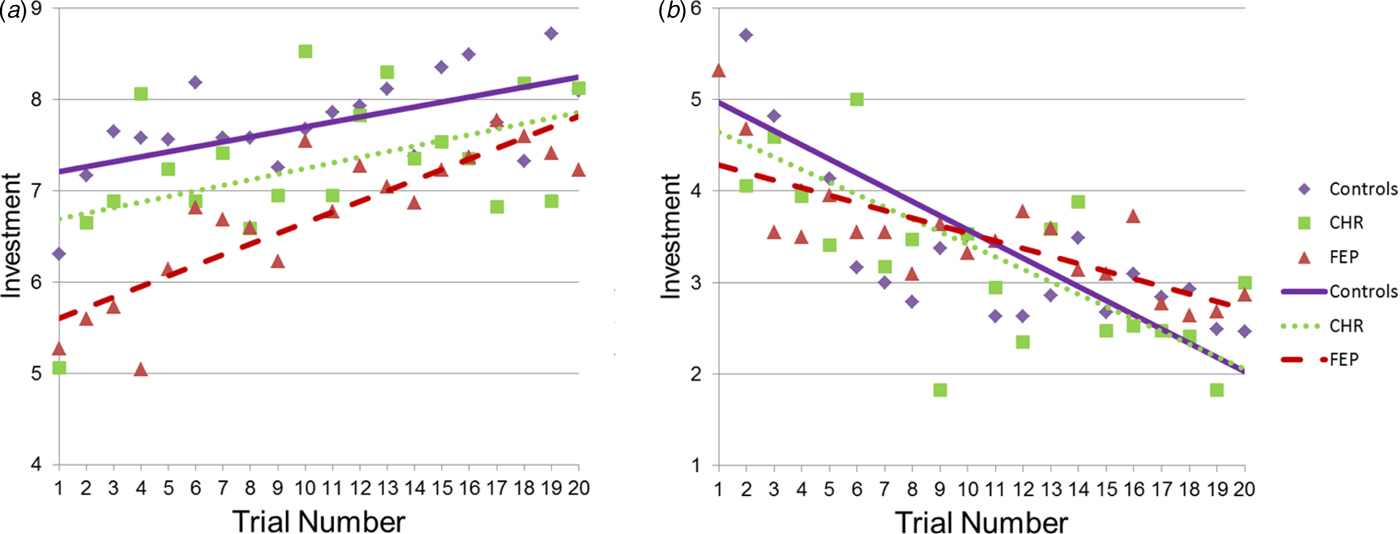
To investigate the development of trust over trials, we performed a three-way interaction ‘trial number-by-group-by-condition’ on investment. This interaction was not significant and therefore removed from the model. Significant trial number-by-group, condition-by-group, and trial number-by-condition interactions on investment were found [b = 0.03, 95% CI (0.031–0.05), p = 0.001; b = 0.49, 95% CI (0.28–0.71), p < 0.001; b = −0.20, 95% CI (−0.24 to −0.17), p < 0.001, respectively], indicating that the development of trust differed between groups (Fig. 2).
Changes in investment over trials in the (a) cooperative and (b) unfair condition.

In the cooperative condition, there was a significant group-by-trial number interaction on investment [b = 0.03, 95% CI (0.006–0.05), p = 0.01], with FEP showing significantly stronger increase than controls [b = 0.08, 95% CI (−0.07 to 0.08), p = 0.03]. Controls and CHR did not differ significantly from each other (p = 0.9). Analysis by group showed that all groups increased investments significantly (all p < 0.01; see Fig. 2a). In the unfair condition, analysis revealed a significant group-by-trial number interaction on investment [b = 0.03, 95% CI (0.01–0.06), p = 0.005], with FEP showing significantly less decrease than the other groups [b = −0.97, 95% CI (−1.89 to −0.06), p = 0.04]. All groups decreased investments significantly (all p < 0.001; see Fig. 2b).
All analyses were also conducted with medication type (no medication, atypical antipsychotics, combination of typical and atypical, other psychotropic medication) as a grouping variable. No differences in baseline trust, nor in adjustment of trust, were found between the medication groups, and no interactions with symptoms on trust were found.
Imaging results
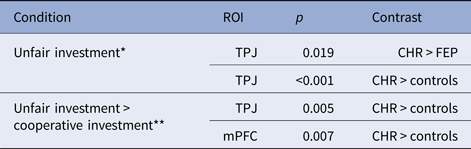
ROI analyses revealed significant group differences in the right TPJ only, showing more activation in CHR compared with controls and FEP during the investment phase in the unfair condition (Table 2 and Fig. 3). Furthermore, CHR activated the TPJ and mPFC more than controls, when investing in an unfair partner compared with a cooperative partner. Other ROIs showed no group differences. During cooperative investment, cooperative, and unfair repayment, no significant group differences in ROI activation were found. All ROI analyses were also conducted between medication groups. No significant differences in activation were found.
Location of significant regions of interest (ROIs), showing increased activation in patients at clinical high risk (CHR) in (a) the temporo-parietal junction (TPJ) during unfair investments, and (b) the medial prefrontal cortex (mPFC) during unfair investments more than during cooperative investments. Analyses were performed with sphere of 10 mm around the coordinates. Regions are shown bigger in the figure, for visualization purposes.

Region of interest (ROI) analyses outcome

*Adjusted significance level for multiple comparisons of p = 0.027.
**Adjusted significance level of p = 0.012.
Montreal Neurological Institute (MNI) coordinates: TPJ, temporo-parietal junction, 51, −57, 26; mPFC, medial prefrontal cortex, −3, 65, 25. CHR, clinical high risk; FEP, first episode psychosis.
Additional exploratory whole-brain analyses, based on a significance level of p < 0.05 family-wise error cluster corrected, did not reveal significant group differences. Results with a more lenient threshold are presented in Supplementary Table S1.
Symptoms
CHR and FEP did not differ significantly from each other in terms of overall and positive symptoms, and on the depression item. Only on the paranoia item, CHR scored significantly higher than FEP (β = 0.37, p = 0.03). There was a trend toward significance indicating that FEP had higher negative symptoms than CHR (p < 0.07).
Associations between behavioral outcomes and symptoms
No group-by-symptoms interactions on first investment were found (all p > 0.24). After removing the interaction from the model, no main effects of symptoms on baseline trust were found (all p > 0.16).
In the cooperative condition, the group-by-trial number-by-symptoms models showed a significant interaction for negative symptoms only [b = −0.02, 95% CI (−0.03 to −0.001), p = 0.03), indicating that negative symptoms impacted upon the development of trust differentially in the three groups. Post-hoc analyses showed a significant association between symptoms and changes in investments over trials in FEP [b = −0.01, 95% CI (−0.02 to −0.003), p = 0.004], but not in CHR. To visualize this association, we divided the negative symptoms in three levels (Fig. 4). Analysis indicated that the only highest level of negative symptoms interfered with increasing investments. No significant interactions with positive symptoms, paranoia, or depression were found.
Interaction between trial number and negative symptoms on investment in the cooperative condition in first-episode psychosis patients (FEP).

In the unfair condition, the group-by-trial number-by-symptoms models did not show significant interactions. After removing the three-way interaction from the model, the interaction of positive symptoms with trial number became significant [b = 0.01, 95% CI (0.0002–0.012), p = 0.04]. Higher positive symptoms were associated with less decrease in investments in FEP and CHR. Associations of decreasing investment with negative symptoms, paranoia, and depression showed no significant group differences. Analyses within each patient group revealed a significant association between depression and investment over trials in FEP [b = 0.03, 95% CI (0.007–0.056), p = 0.01], showing that FEP with a more severe depression score adjusted their investment less to the negative feedback than FEP with milder depression scores.
Associations of ROI β weights and symptoms
The β weights of the ROIs showing group differences (Table 2) were correlated with the positive and negative subscales, and PANSS paranoia and depression score. No group differences were found in the association between symptoms and ROI activation. After removing the group-by-symptoms interaction from the model, there was a positive association at trend level for TPJ activation and paranoia in the unfair investment phase (β = 0.32, p = 0.07), indicating that in both patient groups, the TPJ was increasingly activated in patients with higher paranoia.
The β weights of the TPJ were unevenly distributed. Therefore, Spearman rank correlation was used for the exploratory analyses per group. This analysis revealed significant associations between symptoms and β weights of the TPJ for CHR, but not for FEP. Specifically, CHR showed a significant positive association between the paranoia item, positive, and negative symptoms, and TPJ activation during unfair investments (ρ = 0.57, p = 0.04; ρ = 0.70, p = 0.008; ρ = 0.64, p = 0.02, respectively). No associations between symptoms and mPFC activation were found.
Discussion
This study investigated the behavioral and neural mechanisms associated with trust and the association with symptoms in a high risk (CHR) and FEP sample using an interactive trust game. Participants played two trust games, with a cooperative and an unfair pre-programmed partner. Behaviorally, FEP and CHR only differed from controls, and not from each other, showing reduced basic trust, that is, initial trust before partner feedback is revealed. No impairments in the development of trust in response to feedback over trials were found in either patient group, compared with controls. Only in FEP, associations between trust development and symptoms were found. On the neural level, CHR recruited the TPJ more than the other groups during investment in the unfair condition, suggesting differential processing as compared with healthy controls and FEP.
Behavioral mechanisms of trust
Importantly, and in line with previous research, both FEP and CHR showed reduced baseline trust toward unknown others (Fett et al., Reference Fett, Gromann, Shergill and Krabbendam2012, Reference Fett, Shergill, Korver-Nieberg, Yakub, Gromann and Krabbendam2015, Reference Fett, Shergill, Joyce, Riedl, Strobel, Gromann and Krabbendam2016; Gromann et al., Reference Gromann, Heslenfeld, Fett, Joyce, Shergill and Krabbendam2013). Reduced baseline trust has been found in individuals at genetic risk for psychosis (Fett et al., Reference Fett, Gromann, Shergill and Krabbendam2012), but contradicted by another (Gromann et al., Reference Gromann, Shergill, de Haan, Meewis, Fett, Korver-Nieberg and Krabbendam2014). Contrary to previous research (Fett et al., Reference Fett, Gromann, Shergill and Krabbendam2012, Reference Fett, Shergill, Joyce, Riedl, Strobel, Gromann and Krabbendam2016), baseline trust in FEP and CHR was not associated with symptom severity. The association with positive symptoms found by Fett et al. (Reference Fett, Gromann, Shergill and Krabbendam2012) was at trend level (0.09), providing only tentative support. The fact that reduced baseline trust has also been found in individuals at genetic risk for psychosis and now in CHR in combination with the lack of an association with symptoms, tentatively suggests that reduced baseline trust is linked to the risk for psychosis trait, rather than a consequence of the illness (a state marker) that would be associated with (temporal fluctuations of) symptoms.
Feedback learning in cooperative and unfair interactions is still intact in CHR and FEP, as opposed to chronic psychosis (Fett et al., Reference Fett, Shergill, Korver-Nieberg, Yakub, Gromann and Krabbendam2015; Campellone et al., Reference Campellone, Fisher and Kring2016). The development of trust in response to positive feedback by the game partner showed, as predicted, that FEP and CHR increased their levels of trust significantly. The same pattern was found in response to negative feedback: over game rounds FEP and CHR decreased their trust to the same level as controls. FEP showed steeper increase in positive interactions than controls, possibly because they were more sensitive to the effects of the positive feedback given they initially had lower expectations, as reflected in lower baseline trust. Furthermore, a ceiling effect might result in a less steep increase for controls, with 23% of the control participants investing the maximum of 10 in 75% or more of the trials. The slightly reduced response to negative feedback in FEP, resembling results of Fett et al. (Reference Fett, Shergill, Joyce, Riedl, Strobel, Gromann and Krabbendam2016), might be explained by the differences in first investment (FEP starting significantly lower).
Symptoms
Symptom severity on average was similar in the two patient groups. FEP showed substantial variability in symptom severity, which reflects the fact that we included both hospitalized patients and ambulant patients who were in a rehabilitation trajectory. CHR experienced more paranoia than FEP, and FEP tended to have more negative symptoms than CHR. These differences might be explained by medication effects: 64% of the FEP were on atypical antipsychotic medication, probably dampening positive symptoms, whereas 47% of the CHR was on other psychotropic medication (see Table 1). First-episode patients with highest negative symptoms, as opposed to milder symptoms, showed almost no adjustment of trust in response to positive feedback. Intact feedback learning mechanisms in FEP were associated with milder negative symptom severity. The association between negative symptoms and problems in social functioning and responding to feedback has been well established in psychosis (Addington and Addington, Reference Addington and Addington2005; Milev et al., Reference Milev, Ho, Arndt and Andreasen2005; Voges and Addington, Reference Voges and Addington2005; Waltz et al., Reference Waltz, Frank, Wiecki and Gold2011; Strauss et al., Reference Strauss, Waltz and Gold2013; Campellone et al., Reference Campellone, Fisher and Kring2016), possibly reflecting a lack of (social) motivation or depression. In the unfair condition, positive symptoms were associated with less decrease in trust in both FEP and CHR. This suggests that positive symptoms interfere with learning from negative social feedback, contradicting earlier findings that found no associations of positive symptoms with learning to trust (Fett et al., Reference Fett, Shergill, Joyce, Riedl, Strobel, Gromann and Krabbendam2016).
Neural mechanisms of trust
On the neural level, CHR activated the TPJ significantly more than the other two groups. The TPJ forms part of the mentalizing system (Fletcher et al., Reference Fletcher, Happe, Frith, Baker, Dolan, Frackowiak and Frith1995; Frith and Frith, Reference Frith and Frith2006; Van Overwalle, Reference Van Overwalle2009), and was previously found to be activated in the trust game (Saxe and Kanwisher, Reference Saxe and Kanwisher2003; King-Casas et al., Reference King-Casas, Tomlin, Anen, Camerer, Quartz and Montague2005; Krueger et al., Reference Krueger, McCabe, Moll, Kriegeskorte, Zahn, Strenziok, Heinecke and Grafman2007; van den Bos et al., Reference van den Bos, van Dijk, Westenberg, Rombouts and Crone2011). In chronic patients, reduced TPJ activation was associated with more positive symptoms (Gromann et al., Reference Gromann, Heslenfeld, Fett, Joyce, Shergill and Krabbendam2013). In our sample, TPJ activation did not differ between FEP and controls, suggesting a decline in TPJ response with longer illness duration. CHR, however, showed increased activation in this area compared with FEP and controls during unfair investment. CHR also showed more TPJ and mPFC activation than controls during investments toward the unfair counterpart, as compared with cooperative counterpart. Since both areas form part of the mentalizing system, this could suggest that unfair interactions elicit increased mentalizing in CHR. Gromann et al. (Reference Gromann, Heslenfeld, Fett, Joyce, Shergill and Krabbendam2013), in contrast, found the mPFC to be activated more in cooperative interactions in both patients and controls. Increased neural activation in patients at-risk for psychosis during mentalizing and emotion processing areas despite similar behavioral performance was previously found (Marjoram et al., Reference Marjoram, Job, Whalley, Gountouna, McIntosh, Simonotto, Cunningham-Owens, Johnstone and Lawrie2006; Brüne et al., Reference Brüne, Özgürdal, Ansorge, von Reventlow, Peters, Nicolas, Tegenthoff, Juckel and Lissek2011; Derntl et al., Reference Derntl, Michel, Prempeh, Backes, Finkelmeyer, Schneider and Habel2015). The elevated TPJ activation in CHR was associated with higher symptoms in all domains, thus associating higher illness severity with greater neural activity. This association was not found in FEP, possibly suggesting different underlying mechanisms between groups. In combination with the behavioral data, showing that CHR adapted adequately to negative social feedback, the increased TPJ activity could indicate a cognitive mechanism by which increased mentalizing helps to respond adequately to negative feedback, indicating more effort, or an inefficient use of the TPJ. The data do not point to compensating mechanisms, since they would suggest deficiencies or reduced processing in other parts of the brain. These were not found in the ROI analyses, nor in the additional whole-brain analyses (see Supplementary Table S1). The results show no evidence for reduced sensitivity to social reward in FEP and CHR, and suggest that altered mentalizing might be associated with reduced baseline trust. However, due to the small sample size, this result must be interpreted with caution.
Clinical high risk
Following the procedure of previous CHR investigations (Shim et al., Reference Shim, Kang, Sun Chung, Young Yoo, Young Shin and Soo Kwon2008; Phillips et al., Reference Phillips, Nelson, Yuen, Francey, Simmons, Stanford, Ross, Kelly, Baker and Conus2009; Fusar-Poli et al., Reference Fusar-Poli, Broome, Matthiasson, Woolley, Johns, Tabraham, Bramon, Valmaggia, Williams and McGuire2010a; Wood et al., Reference Wood, Yung, McGorry and Pantelis2011; Rietdijk et al., Reference Rietdijk, Klaassen, Ising, Dragt, Nieman, Van de Kamp, Cuijpers, Linszen and Van der Gaag2012; Thompson et al., Reference Thompson, Papas, Bartholomeusz, Allott, Amminger, Nelson, Wood and Yung2012; van der Gaag et al., Reference van der Gaag, Nieman, Rietdijk, Dragt, Ising, Klaassen, Koeter, Cuijpers, Wunderink and Linszen2012; McGorry and van Os, Reference McGorry and van Os2013; Valmaggia et al., Reference Valmaggia, Stahl, Yung, Nelson, Fusar-Poli, McGorry and McGuire2013), we included participants assessed with the CAARMS, and with a score below 55 on the SOFAS. Our sample was comparable to other samples in terms of comorbidities (Woods et al., Reference Woods, Addington, Cadenhead, Cannon, Cornblatt, Heinssen, Perkins, Seidman, Tsuang and Walker2009; Corcoran et al., Reference Corcoran, Kimhy, Parrilla-Escobar, Cressman, Stanford, Thompson, David, Crumbley, Schobel and Moore2011; Morrison et al., Reference Morrison, French, Stewart, Birchwood, Fowler, Gumley, Jones, Bentall, Lewis and Murray2012; Fusar-Poli et al., Reference Fusar-Poli, Nelson, Valmaggia, Yung and McGuire2014; Modinos et al., Reference Modinos, Allen, Frascarelli, Tognin, Valmaggia, Xenaki, Keedwell, Broome, Valli and Woolley2014; Ising et al., Reference Ising, Kraan, Rietdijk, Dragt, Klaassen, Boonstra, Nieman, Willebrands-Mendrik, van den Berg and Linszen2016). One year after testing, e.g. around 2 years after initial assessment, CHR participants were re-assessed with the CAARMS, to investigate their current status. One of the CHR had made the transition to psychosis. Of two CHR transition data were missing. In this aspect, our high risk group differed from other high risk groups. Variant transition rates have been reported in comparable samples with regard to assessment and age range (Broome et al., Reference Broome, Day, Valli, Valmaggia, Johns, Howes, Garety and McGuire2005, Reference Broome, Woolley, Johns, Valmaggia, Tabraham, Gafoor, Bramon and McGuire2012; Demjaha et al., Reference Demjaha, Valmaggia, Stahl, Byrne and McGuire2010; Fusar-Poli et al., Reference Fusar-Poli, Broome, Woolley, Johns, Tabraham, Bramon, Valmaggia, Williams and McGuire2010b; Nelson et al., Reference Nelson, Yuen and Yung2011). Transition rates in similar referred samples are under 10% (Yung et al., Reference Yung, Yung, Pan Yuen, Mcgorry, Phillips, Kelly, Dell'olio, Francey, Cosgrave and Killackey2011; Rietdijk et al., Reference Rietdijk, Klaassen, Ising, Dragt, Nieman, Van de Kamp, Cuijpers, Linszen and Van der Gaag2012). Patients already received treatment for their primary problems, including cognitive behavioral therapy for their CHR status (psychotic symptoms). This has shown to be an adequate strategy to reduce symptoms, increasing their social functioning skills, to reduce the transition rates (by 46%), and to increase chances for remission (Niendam et al., Reference Niendam, Bearden, Zinberg, Johnson, O'Brien and Cannon2007; Cannon et al., Reference Cannon, Cadenhead, Cornblatt, Woods, Addington, Walker, Seidman, Perkins, Tsuang and McGlashan2008; Jang et al., Reference Jang, Shin, Shim, Park, Kim, Jang, Kwon, Hur, An and Kwon2011; van Os and Murray, Reference van Os and Murray2013; Ising et al., Reference Ising, Kraan, Rietdijk, Dragt, Klaassen, Boonstra, Nieman, Willebrands-Mendrik, van den Berg and Linszen2016).
In a recent discussion on CHR, it has been argued that the presence of psychotic symptoms is possibly more important than transition in the assessment of CHR (van Os and Reininghaus, Reference van Os and Reininghaus2016). Many patients in care for anxiety and depression report psychotic symptoms (Velthorst et al., Reference Velthorst, Fett, Reichenberg, Perlman, van Os, Bromet and Kotov2009; Woods et al., Reference Woods, Addington, Cadenhead, Cannon, Cornblatt, Heinssen, Perkins, Seidman, Tsuang and Walker2009; van Os and Linscott, Reference van Os and Linscott2012; Wigman et al., Reference Wigman, van Nierop, Vollebergh, Lieb, Beesdo-Baum, Wittchen and van Os2012; van Os and Reininghaus, Reference van Os and Reininghaus2016), but do not transition to psychosis. The current sample fits previous descriptions, making it a representative sample of patients with psychotic symptoms and generally poor mental health. The addition of psychotic symptoms renders these patients at risk for developing psychopathology, without the direct consequence of developing a psychotic disorder (Yung et al., Reference Yung, Woods, Ruhrmann, Addington, Schultze-Lutter, Cornblatt, Amminger, Bechdolf, Birchwood and Borgwardt2012; Fusar-Poli et al., Reference Fusar-Poli, Byrne, Valmaggia, Day, Tabraham, Johns, McGuire and Team2013). In many cases, subclinical psychotic experiences are transitory (van Os and Reininghaus, Reference van Os and Reininghaus2016). However, the presence of psychotic symptoms is associated with a poorer prognosis, showing that these patients are certainly in need of special care (Ruhrmann et al., Reference Ruhrmann, Schultze-Lutter and Klosterkötter2010; van Os and Linscott, Reference van Os and Linscott2012; McGorry and van Os, Reference McGorry and van Os2013; Valmaggia et al., Reference Valmaggia, Stahl, Yung, Nelson, Fusar-Poli, McGorry and McGuire2013; van Os and Reininghaus, Reference van Os and Reininghaus2016).
Limitations and future directions
Several limitations should be considered. First, current results should be interpreted with caution, due to the small sample size, especially of the CHR sample. Our CHR results should therefore be considered as a first step in research on real-time social interaction in high risk individuals, which warrants replication and extension in future research [see also (Broome et al., Reference Broome, Fusar-Poli, Matthiasson, Woolley, Valmaggia, Johns, Tabraham, Bramon, Williams and Brammer2010; Fusar-Poli et al., Reference Fusar-Poli, Borgwardt, Bechdolf, Addington, Riecher-Rössler, Schultze-Lutter, Keshavan, Wood, Ruhrmann and Seidman2011; Juckel et al., Reference Juckel, Friedel, Koslowski, Witthaus, Özgürdal, Gudlowski, Knutson, Wrase, Brüne and Heinz2012)]. With a larger CHR sample, the number of converters will increase, allowing for an investigation of converters v. non-converters. Additionally, a larger sample would provide the possibility to subdivide the CHR sample on the basis of different symptomatology (Valmaggia et al., Reference Valmaggia, Stahl, Yung, Nelson, Fusar-Poli, McGorry and McGuire2013; Fusar-Poli et al., Reference Fusar-Poli, Nelson, Valmaggia, Yung and McGuire2014), yielding more insight in the factors causing social problems and explaining transition trajectories. Transition in these studies was not explained by comorbid anxiety and depression, but by the severity of CAARMS score, social dysfunction, and increased negative symptoms. Direct comparison between at-risk subjects with and without progression into a diagnosis of schizophrenia could also elucidate whether greater activation of the mentalizing network in CHR is serving as a compensatory mechanism, or could also be linked to transition to psychosis. Larger samples could have revealed group differences that were not apparent in this sample. Further, FEP symptom severity was rather mild, possibly due to responsiveness to antipsychotic treatment. Similar symptom severity has been found in stable and medicated patients (Möller et al., Reference Möller, Llorca, Sacchetti, Martin, Medori, Parellada and Group2005). Including a broader range of symptom severity would increase the validity of the sample. Methodologically, a limitation is that participants were not paid on performance. There is some evidence that real payment has a different effect on decisions and related brain activity than hypothetical payment (Hertwig and Ortmann, Reference Hertwig and Ortmann2001; Johnson and Mislin, Reference Johnson and Mislin2011; Vlaev, Reference Vlaev2012), but other studies have found no differences (Madden et al., Reference Madden, Begotka, Raiff and Kastern2003; Locey et al., Reference Locey, Jones and Rachlin2011). Plausibly, hypothetical payment may influence the strength, but not the direction of the effect (Derks, Reference Derks2015). Furthermore, eight participants did not believe they were playing against a human counterpart. This might have influenced their behavior. However, analyses without these participants did not change the results. Adequate increase and decrease of investments in response to cooperative and unfair feedback showed that overall the experimental manipulation of the counterpart was effective. Additionally, including an online mentalizing task in the scanner could establish direct links with the current outcomes, pointing in the direction of differential mentalizing processes.
Conclusion
Summarizing, baseline trust is impaired in FEP and CHR, indicating that reduced baseline trust is associated with the risk for psychotic illness trait, or with poor mental health in general, rather than a consequence of psychotic disorder. CHR performed in between controls and FEP (Pukrop et al., Reference Pukrop, Schultze-Lutter, Ruhrmann, Brockhaus-Dumke, Tendolkar, Bechdolf, Matuschek and Klosterkötter2006; Thompson et al., Reference Thompson, Papas, Bartholomeusz, Allott, Amminger, Nelson, Wood and Yung2012), resembling most the patient group. In contrast to chronic patients (Fett et al., Reference Fett, Shergill, Korver-Nieberg, Yakub, Gromann and Krabbendam2015), reward learning was not impaired in FEP and CHR [see also (Juckel et al., Reference Juckel, Friedel, Koslowski, Witthaus, Özgürdal, Gudlowski, Knutson, Wrase, Brüne and Heinz2012)]. This suggests that with positive social feedback, the lack of initial trust in FEP and CHR can be restored, at least in the context of the trust game. The neural results pointed to globally intact neural mechanisms associated with trust, except for changes in brain areas associated with mentalizing in CHR. However, these findings should be considered as preliminary, and more research in the field is needed to replicate and extend our findings.
Supplementary material
The supplementary material for this article can be found at https://doi.org/10.1017/S003329171800140X
Acknowledgements
The authors would like to thank Professor Lieuwe de Haan and his team at the Amsterdam Medical Center (AMC), Professor Mark van der Gaag and Dr Helga Ising at PsyQ, The Hague, Onno Ackema and the department of early psychosis of the AMC, and the VIP team for helping with recruitment of both patient groups, and Tinka Beemsterboer and colleagues at the Spinoza Centre for Neuroimaging, Roeterseiland Amsterdam for their help during scanning, and all participants for completing the testing session and providing the authors with valuable material.
Funding
This work was supported by funding of the Hersenstichting Nederland [KS2011(1)-75], a VIDI and VICI grant from the Netherlands Organization for Scientific Research (NWO) [452-07- 007453-11-005]; and an ERC Consolidator grant (648082 SCANS) to Professor Lydia Krabbendam. Anne-Kathrin Fett was supported by the Netherlands Organization for Scientific Research (NWO) VENI grant (451-13-035) and a NARSAD Young Investigator Grant from the Brain & Behaviour Research Foundation (24138).