1. Introduction
Starting with a study by Verplanken et al. (Reference Verplanken, Aarts, van Knippenberg and van Knippenberg1994), growing empirical evidence in social psychology supports the idea that habits play a major role in transportation behavior (see, for instance, Aarts et al., Reference Aarts, Verplanken and van Knippenberg1998; Gardner, Reference Gardner2009; Gärling et al., Reference Gärling, Fujii and Boe2001; Klöckner and Matthies, Reference Klöckner and Matthies2004). The rationale is that transportation behavior (especially commuting trips) is characterized by a stable context and repeated behaviors.
Several studies acknowledging the power of habit to lead human behavior have suggested policies and schemes to break patterns in transportation and other activities characterized by inertia (Bamberg, Reference Bamberg, Lahlou and Emmert2007; Eriksson et al., Reference Eriksson, Garvill and Nordlund2008; Fujii and Gärling, Reference Fujii and Gärling2003; Fujii and Kitamura, Reference Fujii and Kitamura2003; Middleton, Reference Middleton2011; Matthies et al., Reference Matthies, Klöckner and Preibner2006; Schäfer and Bamberg, Reference Schäfer, Bamberg, Ken, Tukker, Vezzoli and Ceschin2008; Thøgersen and Møller, Reference Thøgersen and Møller2008; Verplanken and Wood, Reference Verplanken and Wood2006; Verplanken et al., Reference Verplanken, Walker, Davis and Jurasek2008). However, in a review of measures aimed at reducing car use, Graham-Rowe (Reference Graham-Rowe2011: 415) finds that ‘the reductions generated by effective, rigorously-evaluated interventions seem to have been relatively modest, and approximately half the interventions evaluated using strong designs were found to be ineffective’. The picture becomes even less rosy when long-term effects are assessed.
This paper aims to provide an enriched perspective on habits using a Veblenian evolutionary economics (VEE) framework to shed new light on individual inertia in transportation behavior. The rationale for this study is that, to be more effective, policies to change transportation behavior require a detailed understanding of the habituation processes. The approach to habits proposed by Thorstein Veblen (1857–1929) based on the Pragmatist philosophy and psychology, provides a useful framework to analyze both the diachronic and synchronic dimensions of habits, and their roles in behavioral inertia. The diachronic perspective focuses on the factors that govern the processes of formation, reinforcement, and change of a given habit; the synchronic dimension deals with the relations such a habit can develop with other habits.
In line with the well-known work by Ouellette and Wood (Reference Ouellette and Wood1998), several scholars confirm that a stable context and repeated behavior provide a breeding ground for the development of habits.Footnote 1 However, this is only one aspect of the diachronic dimension of habits, and refers only to the conditions surrounding the emergence of habit. This leaves crucial questions regarding the nature of habit and the key characteristics of its dynamics. For example, what is the precise link between habit and behavior? What determines the specific content of a given habit? What are the different modalities of reinforcement of this habit? These and other questions are referred to in presenting our theoretical framework. The empirical part of the paper mainly provides a thorough account of the synchronic dimension of habit, which, to our knowledge, has been mostly overlooked in the literature on transportation.Footnote 2
It is obvious that recurrent performance of an action that has become habit-based can trigger the concomitant performance of related habits (Middleton, Reference Middleton2011). For instance, the habit of commuting by car is linked trivially to the habit of driving, but may be associated less trivially to other habits, such as listening to music or eating breakfast. Our study assesses the influence of such associated habits on the habit of driving and particularly their role in reinforcing the car-use habit. We questioned a random sample of 124 car users in the metropolitan area of Lyon about several dimensions of their transportation behavior – especially the activities they perform when driving a car – in order to highlight their habit-based features. We distinguished two groups of car-users based on the frequency of their use of public transport: the first group includes people whose transportation behaviors are based primarily on using a car; the second group includes people with more diverse transportation behavior. The results show that the VEE framework offers original and fruitful insights on transportation behavior and highlight the significance of the synchronic dimension on habits for understanding inertia in transportation behavior.
The paper is organized as follows. Section 2 describes the theoretical, VEE-based framework used to analyze habit-based behavior. Section 3 presents the data and data collection methods. Sections 4 and 5 respectively present and discuss our results and Section 6 concludes by pointing to some major issues that need to be addressed to extend the research agenda initiated in this paper.
2. Analyzing behavioral inertia: the relevance of the Veblenian approach to habits
Spurred by the need to provide a better explanation of behavioral inertia in relation to transportation modes, we propose an interpretative framework that departs from previous theoretical work based on ‘methodological collectivism’ or ‘decision theory’. For several decades these two approaches have dominated the social science literature on human behavior in general and behavioral inertia in particular. Both approaches have generated major insights, but considering behavioral inertia as the sole expression of the higher forces (‘cultural’, ‘social’, or ‘technological’) that are supposed to determine individual actions and thoughts (i.e. ‘methodological collectivism’), is no more satisfactory than considering that it is a simple problem of choice (i.e. ‘decision theory’).Footnote 3
Some authors try to go beyond this dualism. However, in our view, these attempts do not develop a framework that is sufficiently comprehensive to contemplate a third way of analyzing behavioral inertia. For instance, Kaufmann (Reference Kaufmann2002) and Petit (Reference Petit2003) adopt a Weberian perspective and consider habits as the expression of a certain logic of action (among others), that underpins the meaning the actor assigns them. In this view, an actor's transportation habits are justified and reinforced by other dimensions of his/her way of life and social integration. Our VEE theoretical framework clarifies this synchronic dimension of habits, highlighting its foundations, and integrating it with a general approach to human behavior.
The VEE framework is rooted in a set of theories that explain behavioral inertia from a perspective on the individual that gives analytical and ontological primacy to habit over choice and reason. This perspective was foundational for the evolutionary and institutional economics of Thorstein Veblen, which owes much to the Pragmatist philosophy and psychology of Charles Sanders Peirce (1839–1914), William James (1842–1910), and John Dewey (1859–1952). It is noteworthy that these theses, developed more than a century ago, have experienced a certain revival in social psychology (Aarts et al., Reference Aarts, Verplanken and van Knippenberg1998; Ouellette and Wood, Reference Ouellette and Wood1998; Verplanken and Aarts, Reference Verplanken and Aarts1999; Verplanken et al., Reference Verplanken, Aarts, van Knippenberg and Moonen1998; Wood and Neal, Reference Wood and Neal2007), and economics (Brette, Reference Brette2004, Reference Brette2006; Hodgson, Reference Hodgson1997, Reference Hodgson2004a, Reference Hodgson2004b, Reference Hodgson2007, Reference Hodgson2010; Maréchal, Reference Maréchal2009, Reference Maréchal2010). As discussed in depth in Maréchal (Reference Maréchal2009), there is obvious common ground underlying the notion of habit developed in these different literatures.
In line with this legacy, an important aspect of our VEE framework is that it considers habit not as behavior, but as ‘a propensity to behave [i.e. to implement specific patterns of action and/or thought] in a particular way in a particular class of situations’ (Hodgson, Reference Hodgson2010: 4 – original emphasis). Along similar lines, Wood and Neal (Reference Wood and Neal2007: 843) assert that ‘habits are learned dispositions to repeat past responses’. Verplanken (Reference Verplanken2006) emphasizes that such a perspective on habits differs from the behaviorist tradition of equating habit with frequent behavior.Footnote 4 This confusion between the propensity to behave and the behavior per se, can be compared to the conflation in biology of genotype and phenotype. Avoidance of this confusion is crucial. First, it distinguishes the process of habituation, which generally depends on behavior repetition, from its outcomes, namely the habit, which may be more or less frequently actualized. Second, defining habits as behaviors makes it difficult to explain how they may be transmitted among individuals, except through strict face-to-face mimicking. Defining habit as a propensity to behave allows consideration of a wide range of mechanisms for its transmission, which may establish institutions, namely ‘systems of established and embedded social rules that structure social interactions’ (Hodgson, Reference Hodgson2007: 96). In other words, such an approach provides a rationale for how social structures emerge from the interactions of individuals and how these social structures in turn may constrain, enable, or shape individual behaviors. This perspective, which is based on the idea of mutual constitution in a recursive fashion, has proved insightful for explaining the puzzling efficiency gap in energy consumption (Maréchal, Reference Maréchal2010). We claim that it could prove fruitful in the context of transportation issues which are infused with social and structural dimensions. Third, considering habit as propensity keeps open the possibility that the same habit may result in a diversity of actualizations. Rather than determining a specific reaction to a given stimulus, habit may grant the individual a more or less significant degree of freedom to define the content of a response. Although a certain degree of automaticity is regarded as one of the main features of habit (Maréchal, Reference Maréchal2010; Verplanken, Reference Verplanken2006), ‘[h]abit is not mere automatic behavior [. . .]. Even the most ingrained habits are the objects of recurring mental activity and evaluation’ (Hodgson, Reference Hodgson1993: 229).
This last position points to the crucial issue of the relations between habit, deliberation, choice, and action. Considering habit as the basic unit when analyzing behavior does not deny the individual capacity to make decisions, including strategic choices. On the contrary, as James (Reference James1892: 139) already points out, habit is a sine qua non of the exercise of intelligence: since ‘habit diminishes the conscious attention with which our acts are performed’, it releases cognitive resources that can be used to cope with original situations and new problems. This argument has been widely acknowledged within Behavioral Economics.Footnote 5 Simon (Reference Simon1947) explicitly endorses it, leading him to consider that man's ability to make decision derives from his propensity to develop and follow habits in similar situations. Hayek (Reference Hayek1952) adds to the argument, by identifying neural underpinnings to memory. Hayek argues that ‘[t]he mind classifies all in-coming data from the external environment into an appropriate category based on the similarity of the in-coming data with all previously received data’ (Frantz, Reference Frantz, Frantz and Leeson2013: 11). These inner processes lead an individual's past experiences to shape his/her later experiences, perceptions, and actions, depending on the activation of different parts of his/her nervous system. Subsequent works in neuroscience and neuroeconomics have corroborated Hayek's (Reference Hayek1952) insights (Festré and Garrouste, Reference Festré and Garrouste2009: 261–264). In particular it has been shown that ‘everyday consumer behavior’, such as ‘routine shopping and consuming’, displays features that can be properly observed and analyzed at the neural level. For instance, brand loyalty has been interpreted in terms of matching and discounting, two psychological phenomena, which are associated with neurophysiological processes, such as the release of the neurotransmitter dopamine within the reward system, and with the generation of emotional responses (Foxall, Reference Foxall2008: 378). This perspective allows highlighting an important part of habit-based behavior. Actually this way of entering the cognitive black box of habits to understand their neural underpinnings echoes James’ (Reference James1892) concern who already points out the neurophysiological foundations of habit formation.Footnote 6
However, although consistent to some extent, neuroeconomics and VEE views on habit are rooted in different approaches. In the main, neuroeconomics has tended so far to interpret habit through the lens of decision theory, as a ‘control system’ competing with other individual's ‘decision systems’ – i.e. ‘the Pavlovian system’ and ‘the goal-directed system’ – when facing specific situations of choice, such as ‘which road to travel during a commute, or addiction’ (Fehr and Rangel, Reference Fehr and Rangel2011: 22).Footnote 7 On the contrary, the VEE perspective rests on the principle of continuity, which allows habits to be ‘fused’ with rationality (Kilpinen, Reference Kilpinen2005: 1). It leads to behavior being considered as a succession of actions where ‘motives do not precede action because they enter the scene in the middle of ongoing action processes’ (Gronow, Reference Gronow2008: 361). Habitual and intelligent aspects interact during the performance of action (Kilpinen, Reference Kilpinen2000, Reference Kilpinen, Warde and Southerton2012). Moreover, habit is seen as the very foundation of rationality since ‘rational choices themselves are always and necessarily reliant on prior habits’ (Hodgson, Reference Hodgson2004b: 653). The traditional view of rationality is thus reversed: ‘[i]ts role is to hinder rather than further our action process’ (Kilpinen, Reference Kilpinen2005: 2), and ‘[i]t is no more action that needs to be explained, it rather is a change in action that demands an explanation’ (ibid.: 4). Individuals do not necessarily need incentives/motives to start acting; however, opposing habitual ways of acting require incentives/motives. More generally, the VEE framework puts the process of formation, reinforcement, and change of habits at the heart of the research agenda, and allows the principle of continuity in human behavior to be considered from two complementary viewpoints: the diachronic and synchronic dimensions.
From a diachronic viewpoint, one should consider that the characteristics of an individual's habits, at a given time, are ‘path-dependent’, or dependent on their processes of formation, reinforcement, and change. Identifying and analyzing these processes is crucial to understand the forming of the individual's cognitive perceptions, appreciations, and normative judgments. Indeed, the process of evolution of habits leads to the development of coherent cognitive frames that shape the way individuals interpret the world and make decisions (Dolfsma, Reference Dolfsma2002). Hodgson and Knudsen (Reference Hodgson and Knudsen2004: 36) argue that ‘[a] sequence of similar and repeated behaviors creates in each agent a habitual predilection, which can stimulate a “belief” or “conviction” that a particular behavior is appropriate’ and, finally, that these ‘stubborn “beliefs” in the appropriateness of an action [. . .] weigh heavily in the decision-making process of each agent’. There are many types of factors that may combine to shape the habituation processes including factors related to the individual's personal features, and to his/her natural, material, and social environment. A significant change in context may create a disturbance to the individual's behavior, which could promote changes to certain habits and alter his/her ‘beliefs’ and ‘convictions’ – see the example given by Hodgson (Reference Hodgson2003: 166) in relation to transportation behavior. In these circumstances, the individual's ‘rationality’ is opened to new information and to some reassessment of his/her habits. Promoting openness and exploiting such ‘windows of opportunity’ are a major challenge for public policy, which aims at increasing people's receptiveness to economic incentives (Maréchal, Reference Maréchal2010). Finally, the individual's social interactions must be considered.Footnote 8 This aspect is related to the crucial issue of institutional evolution, or the process of formation, reinforcement, and change of institutions. The current paper does not specifically address institutional issues. Our present concern is to outline our VEE framework and to begin to elaborate on its implications for transportation studies. The rest of the paper is devoted to the personal features of an individual's transportation habits. Exploring these ‘simple’ features is a first (necessary) step to the study of more intricate issues, such as the dynamic interactions between individual habits and institutions. As Hodgson (Reference Hodgson2010: 14) argues, ‘[o]nce habit is seen as the foundation of preferences or beliefs, we can develop an enriched understanding of the interaction between individuals and institutions, including of the causal mechanisms involved’.
To be more precise, our focus is on the synchronic dimension of personal habits. At a given time, an individual's ingrained habits are more or less interdependent although they may be related to different fields of activity or thought. Veblen (Reference Veblen1990: 39) argues that ‘[t]he individual subjected to habituation is each a single individual agent, and whatever affects him in any one line of activity, therefore, necessarily affects him in some degree in all his various activities’.Footnote 9 We consider this point to be crucial for analyzing the strength of a habit. We thus test the synchronic hypothesis that the strength of a habit, especially car-use habit, depends on its relations and degree of consistency with other habits.
3. Material and methods
Characterizing the nature, manifestation, and effects of habits related to commuting behavior is difficult. Verplanken and Orbell (Reference Verplanken and Orbell2003) use the Self-Report Habit Index (SRHI), to open the ‘blackbox’ of habits and study their automaticity. Following the work of Bargh (Reference Bargh, Wyer and Srull1994), automaticity displays four distinct features or the ‘four horsemen of automaticity’: lack of control; lack of awareness; efficiency (i.e. economizing on cognitive resources that can be used for other purposes); and lack of intention. Verplanken and Orbell (Reference Verplanken and Orbell2003) provide evidence of the existence – to an extent – of the first three features, which can serve to distinguish the ‘strength’ of different habits. Regarding unintentionality, this requires some qualification: if habits can become ‘counterintentional’ (Verplanken and Faes, Reference Verplanken and Faes1999), the fact that they must be functional (i.e. in line with other on-going actions and beliefs) makes them intentional to some degree (Polites, Reference Polites2005), which means that habits cannot be reduced to pure automatism or reflex-type behavior.
Although insightful and helpful for empirical investigation of the strength of habits, Verplanken and Orbell's SRHI is a rather ‘static’ and ‘discrete’ approach that needs to be complemented by some characterization of ‘dynamic’ (namely diachronic) and ‘systemic’ (namely synchronic) features. Also, the degree of automaticity of a habit is not equivalent to its ‘strength’. Starting from the definition of habits in Hodgson (Reference Hodgson2010), we assess the strength of habits through the relation between particular classes of situations and the implementation of specific patterns of behavior. Strength of habits, e.g. the strength of the car-use habit, encompasses both intensity and scope. Intensity refers to the frequency with which a specific pattern of behavior is activated in a given set of situations. For instance, the frequency of using the individual's own car to travel between home and work is a measure of the strength (intensity) of his/her car-use habit. Scope refers to the variety of types of situations (e.g. work commuting, grocery shopping, family visits, etc.) when a specific pattern of behavior (e.g. using the car) is commonly activated.
It is also important to stress that empirical analysis of the notion of habits entails risk of methodological bias, especially because many surveys put the respondent in the position of decision-maker (Petit, Reference Petit2003; Røe, Reference Røe2000). Respondents trapped within the researcher's decision theory framework have to justify their so-called choices and apply transportation mode choices to hypothetical situations. This can make habits appear incidental determinants of daily mobility patterns, or reduce them to the outcome of some choice, which is inconsistent with our view of habits discussed in Section 2.
Accordingly, we developed an original method that combines qualitative and quantitative elements in order to identify some habit-based features of transportation behavior. In the first step of our empirical study, 15 regular car-users were asked to describe, explain, and comment on their daily car journeys. Information was collected at the end of each journey over seven consecutive days, using voice recorders, followed by in-depth interviews with respondents. This first step, which echoes to some extent Middleton's (Reference Middleton2011) and Earl's (Reference Earl2012) experiential approaches, informed a questionnaire to identify recurring or unexpected elements.Footnote 10
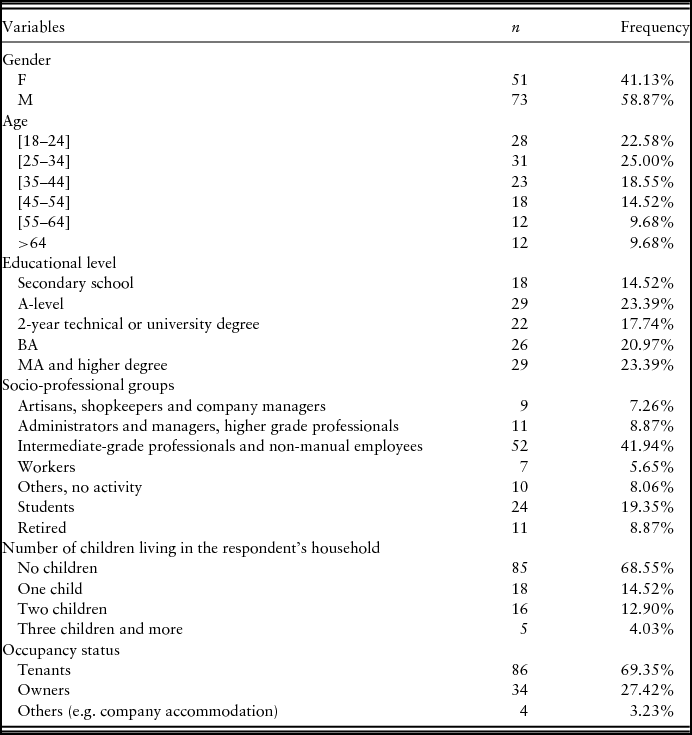
In the second stage we conducted a questionnaire survey on a random sample in December 2010 involving 124 respondents who declared using their cars ‘at least several times a week’ and having a close-to-home access to public transportation. The survey was conducted during four periods of two hours in four main squares in Villeurbanne. Residents of Villeurbanne were chosen to be survey respondents. Villeurbanne is the second (in terms of population) city in the metropolitan area of Lyon (142,552 inhabitants in 2008) and forms a continuous urban area with the city of Lyon within a ring road. The average distance from home to the public transportation system for the survey sample was 110 m, providing respondents with a convenient alternative to private car use. This allowed examination of the importance of inertia in daily transport behaviors in an urban context. In addition to general information on the respondents (see Table 1), this survey was designed to identify their places of residence and work, their most frequent journeys, their behaviors associated with driving, their frequency of weekly use of other transportation modes than private car, their feelings of constraint or choice associated with the transportation modes used, and to collect their qualitative judgments about alternative solutions. Most frequent journey by car included 31% direct commuting trips, 30% shopping trips, and 31% leisure and free-time activities.
Descriptive statistics

4. Results
Several quantitative surveys show that modal share and traffic in the metropolitan area of Lyon remained stable between 1995 and 2007 despite major improvements to public transport, especially since 2000 (Hubert, Reference Hubert2009; UrbaLyon, 2011). Although the number of car journeys declined between 1995 and 2007, their average length increased. In contrast to the projections of policy makers, car use continues to be significant and has become more complex as car drivers globally tend to integrate more activities per journey (Buhler, Reference Buhler2010). The survey results presented here constitute the core of our research to develop a better understanding of relative behavioral inertia in daily transportation modes, especially car-use, in the metropolitan area of Lyon. We assess the relations between degree of behavioral inertia, strength of the car-use habit, and the characteristics of other habits associated with driving.
We formulated a series of questions to test several hypotheses with respect to potential theoretical explanations for observed inertia in modal behaviors. These explanations mirror two of the three classes of theories referred to in Section 2, that behavioral inertia can be considered the result of rational choice or habits as defined in the VEE perspective. Many analytic and forecasting models used for transportation planning and in academic research build on cost-benefit analyses to predict behaviors, using the variables time and cost in a generalized cost analysis. This refers to a conception of universal rationality. The first set of survey results assesses the relevance of this cost and time approach to analyze transportation behaviors. Participants were asked to estimate the time and monetary costs involved in their most frequent car journeys and the equivalent costs of alternative public transport. This allows us to compare reported estimations with objectified values and identify the proportion of the population giving an accurate estimation for either alternative.Footnote 11
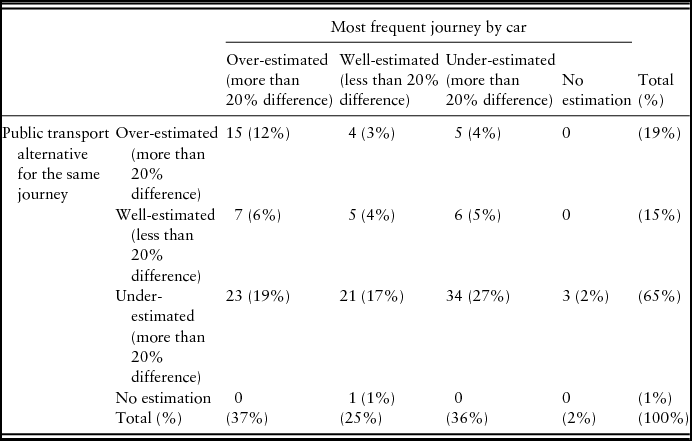
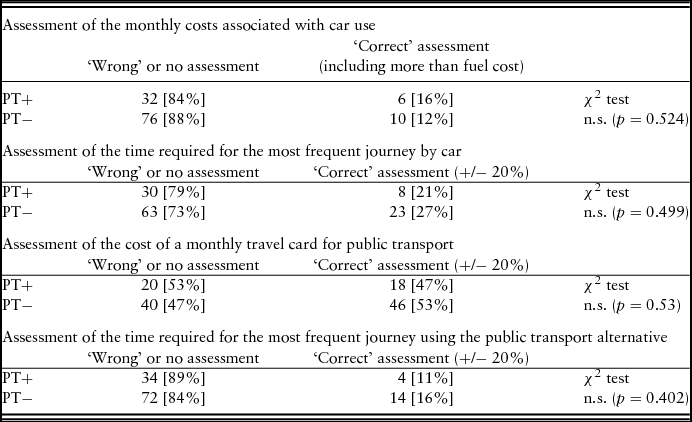
For the variable time, a huge majority (96%) were unable to provide both an accurate (i.e. within a 20% margin of error) estimation of the time required for their most frequent journeys by car and of the time required for the same journey using public transport, whether they already experienced it or not (see Table 2).
Assessment of travel times for an individual's most frequent journey by car and for public transport alternative
These results tend to discard the idea that individuals take account of objective time issues and choose on this basis to use their cars for their most frequent trips. Our results are coherent with the findings of other studies which highlight the discrepancies between perceived time and real time, due to a diversity of biases in time perception (Kaufmann, Reference Kaufmann2002; Li, Reference Li2003; Parthasarathi et al., Reference Parthasarathi, Levinson and Hochmair2013). Since perception of time is highly subjective, it is essential to look at the other component in rational choice, namely the associated financial costs. Respondents were asked to assess the monthly costs of their most frequent car journeys, and then were asked about what these included. A small minority (16%) were unable to answer the question. More than two-thirds of respondents (71%) referred only to fuel costs.Footnote 12 In line with the results of Beirão and Cabral (Reference Beirão and Cabral2007), it thus appears that the cost of travel is unlikely to be the main reason for observed inertia in transportation behavior. Our results support the idea that people do not necessarily resort to a choice scheme based on comparing alternative times and costs, as assumed by decision theory.
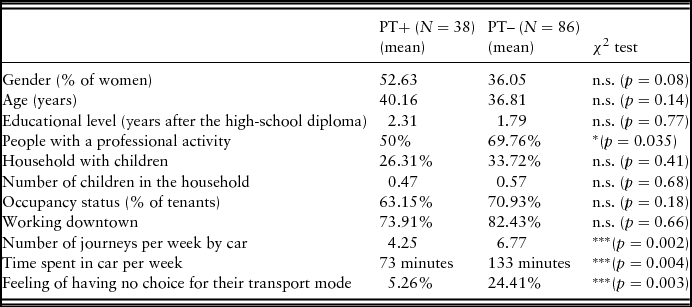
To test the role of habits in transportation mode behaviors, we partitioned the survey population into two sub-samples, considering the respondents’ frequency of use of public transportation services. The first sub-sample, ‘PT+’, includes 38 people who use public transportation services more than once a week, in addition to using their car. Sub-sample ‘PT–’ includes 86 people who rarely use public transport (i.e. once a week maximum). Our segmentation criterion allows us to classify car-drivers according to the strength of their car-use habit, assuming that both samples experience similar classes of situations.Footnote 13 This means that the PT+ group habits could be interpreted in two ways. It may be that PT+ drivers use their personal cars and public transport alternately for a particular type of trips (e.g. commuting) while PT– drivers (almost) always use their personal cars in the same class of situations and/or that PT+ drivers always use public transport for a certain type of trips which PT– drivers usually accomplish by car. Differences in the strength of the car-use habit between PT+ and PT– drivers may rest on the intensity of the habit (first case) and/or on the scope of the habit (second case). Whatever the case, PT– drivers are considered to have a stronger car-use habit than PT+ drivers.
Correlation tests show no specific link of this habit strength with age, gender, educational level, number of children, occupancy status, or employment location (see Table 3). These usual socio-economic variables are weakly correlated with the strength of car-use habit (i.e. being part of PT– group). What seems to have an influence on the strength of car-use habit, however, is the fact of having a professional activity. This would tend to support the idea developed in Shove et al. (Reference Shove, Hand, Ingram and Watson2007) that time-constrained schedules (e.g. having to conform to widespread institutional arrangements regarding working hours) provide a favorable context for the formation of habits. This line of argument is reinforced by an even more (statistically) significant result from Table 3 which shows that the ‘feeling of having no choice’ for transport mode is strongly correlated with the fact of belonging to the PT– group. Obviously, one must be very cautious in treating such a result linked to a statement that is inherently subjective (i.e. it is but a feeling). Nevertheless, taken together with the influence of having a professional activity,Footnote 14 it does suggest that ‘constrained’ car-drivers tend to display stronger car-use habits. This important result is further discussed in Section 5 in connection with other insights from the empirical survey.
Characterization of two groups of people according to the strength of car-use habit
The reported coefficients are estimated with a multinomial logit with random effects. The significance thresholds are respectively 0.5% (***), 1% (**), and 5%(*).
As expected, differences in the strength of the car-use habit also correspond to significant differences in the patterns of transportation behavior. Table 3 shows that, on average, PT– drivers use their personal cars more frequently and for longer journeys than PT+ drivers. This result leads us to examine the links between car-use habit strength and differences in the respective behaviors of the two sub-groups associated directly with driving.
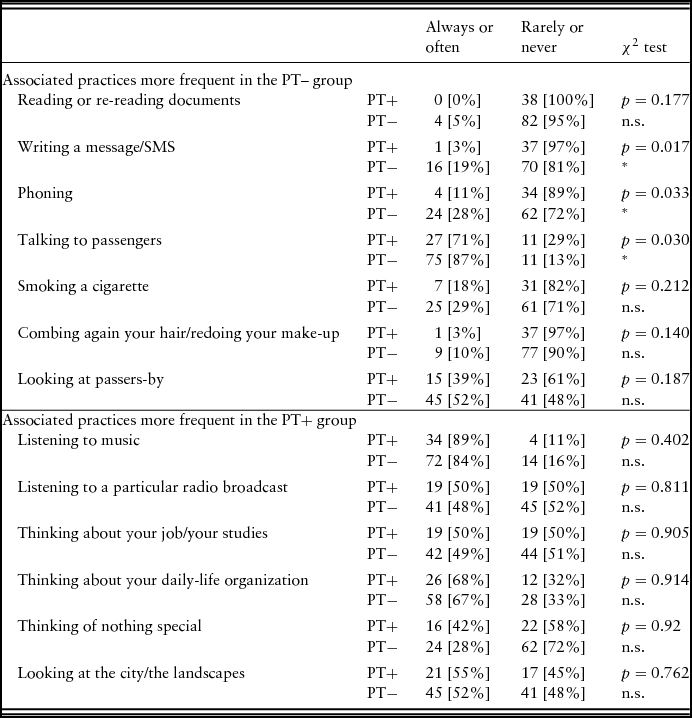
We hypothesized that the development of habits during car journeys might play a role in strengthening the car-use habit. Some of the literature on transportation (Mokhtarian and Salomon, Reference Mokhtarian and Salomon2001) indicates that daily journeys are increasingly used for a series of activities (phoning, texting, chatting, etc.). This trend is based on growing use of communication technology and less clear boundaries between family life and work and leisure activities (Laurier, Reference Laurier2004; Urry, Reference Urry2000). Investigating these ‘associated behaviors’ provides a better picture of the lived experience of a car journey. The first qualitative step in our protocol (based on in-action voice recordings) identified 13 different recurring associated behaviors mentioned in Table 4. We asked participants to the quantitative survey to estimate the frequency of each according to: ‘always’, ‘often’, ‘rarely’, ‘never’. Respondents had space to indicate additional associated behaviors. Two respondents reported the respective actions of ‘singing’ and ‘eating while driving’. This suggests that, in the main, our list included relevant behaviors.
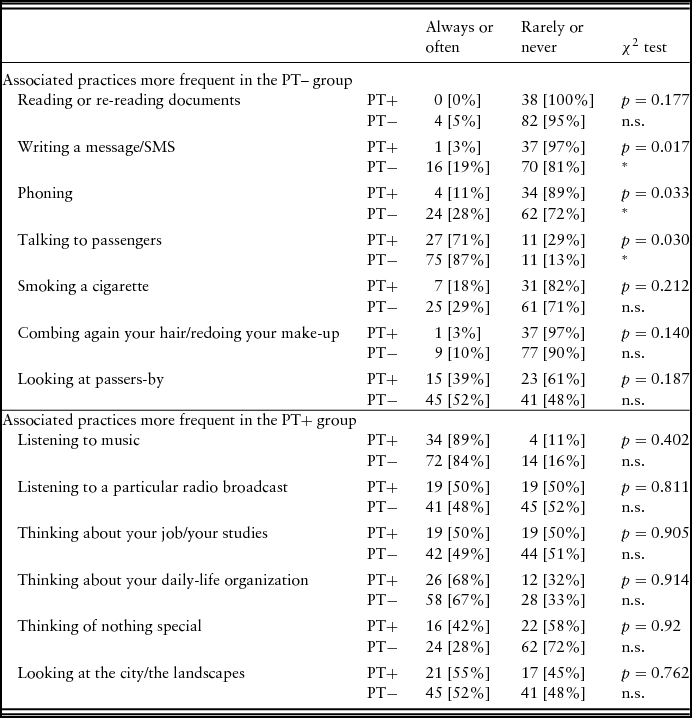
Practices associated with driving according to the strength of car-use habit
The reported coefficients are estimated with a multinomial logit with random effects. The significance thresholds are respectively 0.5% (***), 1% (**), and 5% (*).
The first effect identified is the weak influence of gender, social category, and age on the nature and frequency of the 13 associated behaviors. In contrast, we found a statistically significant correlation between belonging to one of the two sub-groups (i.e. PT+ versus PT–) and the nature of these associated behaviors. Although respondents from the PT– group reported, on average, performing a higher number of associated behaviors (5.70 to 4.92 for the PT+ group), this result remains non-significative. Beyond these quantitative aspects we explore the hypothesis of specific learning effects for the PT– group in their daily driving. To test this hypothesis further, we examine the qualitative features of the associated behaviors. Table 4 shows that some associated behaviors are more frequent in the PT– group than the PT+ group. Most of the associated behaviors in this category (i.e. ‘texting’, ‘phoning’, and ‘talking to passengers’) require at least one hand to be free, focused cognitive resources, and/or speech.
The associated behaviors that are more frequent among the PT+ group or are equivalent for both groups – i.e. listening to music, listening to a particular radio broadcast, thinking about one's job/daily life, thinking of nothing in particular, looking at the city and the landscape – are passive behaviors, requiring less focused cognitive resources, and show no statistically significant difference.
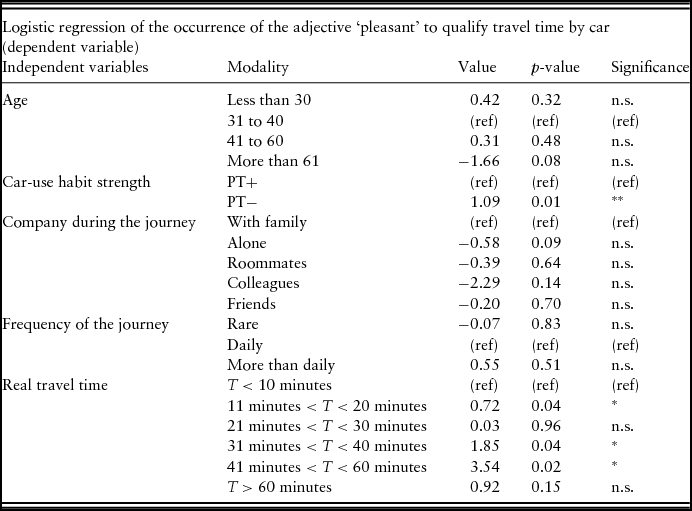
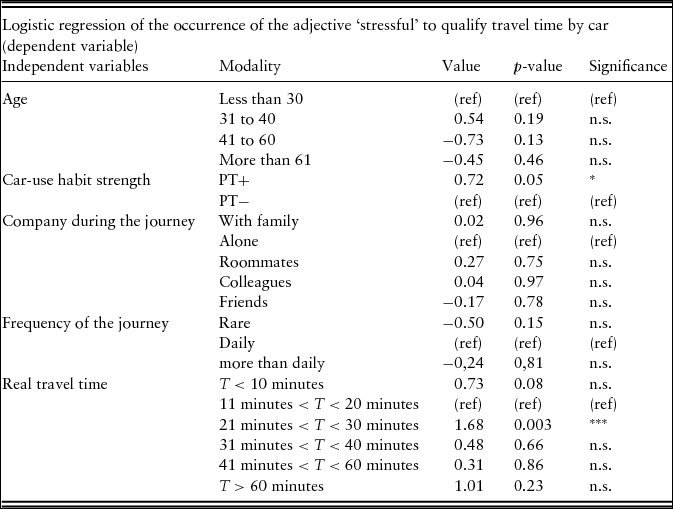
These results confirm the hypothesis of specific learning effects and possibility of behaviors that require additional cognitive resources for the PT– group.Footnote 15 The dexterity (manual dexterity, focused cognitive resources, speech) acquired through these learning processes and frequent journeys enabled this group to integrate a series of associated practices that they correlated with experiencing a ‘pleasant’ journey. As shown by Gardner and Abraham (Reference Gardner and Abraham2007), the performance of related activities is mentioned by cars users in relation with the idea of a ‘personal space’. This private sphere is valued by car users notably as it ensures a ‘freedom from observation’, thereby allowing them to do things such as ‘singing loudly’ (Gardner and Abraham, Reference Gardner and Abraham2007: 192). The car is also experienced as providing opportunities for ‘relaxation and quiet contemplation’ which may explain some of the puzzling findings of our study that are explained below. Indeed a logistic regression of the occurrence of the adjective ‘pleasant’Footnote 16 (dependent variable, Table 5) shows that the strength of car-use habit (i.e. PT– or PT+) has a statistically significant impact on perceptions of journey times as ‘pleasant’, even more than real travel time. Mirroring this important result, Table 6 (see Appendix 1) displays the results of the logistic regression for the occurrence of the adjective ‘stressful’. Besides real travel time, the only other variable that plays a significant role on perceiving car journeys as being stressful is the fact of belonging to the PT+ group.
Perception of quality of time while driving
The significance thresholds are respectively 0.5% (***), 1% (**), and 5% (*). ref = reference value.
The impact of transportation mode behaviors on qualitative perceptions of travel time suggests that associated practices may influence drivers’ evaluations. The formation and reinforcement of habits through mono-modal experience of car use (PT–) results in a deeper exploitation of travel time and more positive evaluation of car travel experience which contributes to stronger behavioral inertia.
The results of our study confirm the empirical findings in psycho-sociology and behavioral economics and, as the discussion below shows, are particularly consistent with the VEE framework.
5. Discussion
Habits and perceptions of journeys
Traditional rational choice theory has been challenged by recent empirical findings in behavioral economics (see Gowdy, Reference Gowdy2008 or DellaVigna, Reference DellaVigna2009, for a useful survey). In a world of bounded rationality (Simon, Reference Simon1947), people are unable to absorb all the information available. They must select among it (Arena et al., Reference Arena, Festré, Lazaric, Arena, Festré and Lazaric2012; Maréchal and Lazaric, Reference Maréchal and Lazaric2010) using filters or cognitive frames (for a discussion see Gronow, Reference Gronow2008). Moreover, individual learning grounded on a personal ‘mountain of experience’ may lead people facing a complex and evolving environment to ‘cling to beliefs they have, sometimes in the face of evidence to the contrary’ (Dolfsma, Reference Dolfsma2002: 681). How people assess the time and costs of their most frequent journeys (see Table 2) suggests that their transportation behavior does not derive from a well-informed rational economic trade-off between car use and use of public transport services (see also Beirão and Cabral, Reference Beirão and Cabral2007; Kaufmann, Reference Kaufmann2002; Li, Reference Li2003; Parthasarathi et al., Reference Parthasarathi, Levinson and Hochmair2013).Footnote 17 The information required to assess this trade-off may be available, but it tends to be ignored and people adopt behaviors based on habit.
Various explanations can be proposed to explain this fact. They include the efficiency derived from habit (i.e. developing certain habits allows better management of scarce cognitive resources). Indeed, the possibility that some mental processes become fairly automatic once learned, saves on psychological energy, which can be diverted to novel tasks (Bargh and Chartrand, Reference Bargh and Chartrand1999; Egidi, Reference Egidi, Simon, Egidi, Marris and Viale1992; Kahneman, Reference Kahneman2003). Furthermore, in line with the suggestion from de Board (Reference Board1978) and Bovey and Hede (Reference Bovey and Hede2001), it appears that behavioral inertia may act as a defense mechanism to reduce anxiety and reinforce self-control. ‘Stick-with-what-we-know’-type actions are likely to enhance comfort and security (Lindbladh and Lyttkens, Reference Lindbladh and Lyttkens2002), especially in contexts that require individuals to act under time pressures (Betsch et al., Reference Betsch, Haberstroh, Molter and Glöckner2004). This line of argumentation is corroborated by some of the main insights from our empirical survey as not only do car-drivers with time-constrained schedules display stronger car-use habits (see Table 3) but the fact of having stronger (weaker) car-use habits increases the likelihood of car journeys being perceived as ‘pleasant’ (‘stressful’) (see Tables 5 and 6). Stronger habits thus seem to indeed provide both a way of handling time pressure and a mechanism to reduce the stress linked to driving. This constitutes a reasonable explanation for an otherwise puzzling result of the survey: the same individuals that more often feel to be highly ‘constrained’ in ‘choosing’ their mode of transportation are also those that find car journeys more ‘pleasant’. Building on the recursive perspective on causation between agency and structure which characterizes the VEE framework,Footnote 18 this may be interpreted as institutionally constrained individuals exerting a certain degree of agency through taking advantage of a situation they feel they do not have much grip on. This illustrates how habits may combine with individual ‘reflexivity’ (Archer, Reference Archer2003, Reference Archer2007; Davis, Reference Davis2003).Footnote 19 Middleton (Reference Middleton2011: 2859) provides examples of such an overlapping process, in emphasizing the importance of ‘specific narratives of everyday urban mobilities [especially pedestrian mobilities]; the significance of how such practices are actually “talked about”; and how these accounts matter in engaging with the experiential dimensions of urban movement’. Habituation thus constitutes the mechanism through which ‘active’ agents – i.e. agents who may ‘undertake instrumental internal conversations’ (Fuller, Reference Fuller2013: 121) – adjust their cognitive perceptions, matters of appreciation and normative judgements in coherent structures (Lindbladh and Lyttkens, Reference Lindbladh and Lyttkens2002). As our survey suggests, one way this works is through habits enabling cognitive resources to be devoted to the performance of synchronic habits, rendering journeys more pleasant. This binding nature of those strong habits intimately connected with everyday life may be what causes individuals to feel they have no choice or, more likely, that it would be very effortful for them to do otherwise.
Within the VEE perspective, habits thus are not simply an efficient way to save on cognitive resources expended on searching and processing information. Habits intimately shape the way individuals acquire, filter, and manage information in accordance with their stubborn ‘beliefs’ and ‘convictions’ (Hodgson and Knudsen, Reference Hodgson and Knudsen2004: 4).
Performance of habits: one habit triggers another
Our results tend to confirm the synchronic hypothesis that the strength of the habit, in this case car-use, depends on its relations with other habits and the degree of mutual consistency among the various habits. For instance, the habit of driving oneself to work may be associated with other habits, such as supermarket shopping after work (Shove et al., Reference Shove, Hand, Ingram and Watson2007). These habits are mutually strengthening to the extent that the existence of one justifies the existence of the other. This may explain the reluctance to switch to another option such as public transportation even in presence of a convenient service.
Our study focuses on the relations between the habit of car-use and other habits actualized by the driver during a car journey, such as listening to music, phoning, or looking at the landscape. These ‘small habits’, developed to an extent by every individual, may appear trivial especially when considered independently. However, we argue that they become significant when considered jointly, and contribute to shaping the travel experience. This travel experience, in turn, plays a major role in the stability of transportation behavior thereby strengthening the transportation habit.
Our results show that the more the frequency of their actualization increases, the more the car-use habit and its related synchronic habits (reading documents, writing a message, phoning, and so on) tend to be mutually reinforcing in the sense that one habit triggers the others. Table 4 shows that the people in the PT– group are more likely to perform a set of activities that require particular dexterity. In this respect, our empirical findings are in line with results in psychology on the link between behavior repetition and strengthening of habits (see Danner et al., Reference Danner, Aarts and de Vries2008 among others). Also, the more actualized the car-use habit is, the more smoothly will its related synchronic habits be performed, leaving space for the memorization of new cognitive skills (Lazaric, Reference Lazaric2011). In short, drivers in the PT– group are more prone to being governed by cognitive automatisms enabling combination with additional activities since already established activities (i.e. driving) become more automatic. Finally, our results shed new light on the relations between habits and the pleasure of commuting (Mokhtarian and Salomon, Reference Mokhtarian and Salomon2001). They show that an increase in the frequency of actualizations of car-use and associated habits positively affects the pleasure derived from traveling (Table 5). Thus, there seems to be a positive feedback between the development of associated habits, more positive perceptions of the travel experience, and a stronger car-use habit.
These results open new avenues for mobility policy. Transportation habits intermingle with and are performed as part of a large set of habits, and cannot be reduced to discrete phenomena that could be targeted and changed independently by public policy. Promoting change in transportation behavior thus implies acting on various linked factors that underlie the development and strengthening of bundles of everyday life habits. This not only implies taking account of the main habits associated with the trip-chaining phenomenon, such as grocery shopping (Ye et al., Reference Ye, Pendyala and Gottardi2007), but also ‘smaller habits’, which may play jointly a significant role in shaping people's convictions and behaviors.Footnote 20 This leads us to wonder whether public policies should primarily target car drivers’ will to change and their awareness of convenient public transport alternative. According to Bargh and Chartrand (Reference Bargh and Chartrand1999), disrupting habit-based behaviors requires setting specific goals, and motivation. Similarly, Pelletier et al. (Reference Pelletier, Lavergne and Sharp2008) argue that people need to be aware of the drawbacks of current transportation schemes in order, in a second stage, to identify solutions. Having chosen an alternative behavior, its recurrence could result in the development of new habits. The VEE framework is illuminating and almost reverses this argument by considering that awareness of the drawbacks of current transportation behavior is a secondary factor in the process of change. The primary factor is the appearance of a disturbance to the current sequence of actions that is sufficiently important to trigger a reassessment of current behavior. One way to motivate change in transportation, to maintain the intensity of this motivation over time, and to make it effective, is to disturb the process of positive feedback between actualization of the car-use habit, actualization of associated habits, and more positive perceptions of the travel experience.
6. Conclusion
This paper is intended to show the usefulness of the VEE perspective on habits, and to complement current analyses of transportation behavior. The results of our empirical study underline the shortcomings of standard economic approaches that consider urban transportation behaviors as the sole result of a decision process guided by a well-informed assessment of the costs and benefits of various alternatives. This confirms the need to investigate the issue of urban transportation through an alternative conceptual lens. In line with the principle of continuity, applying the VEE framework allowed us to explore the importance of the synchronic dimension of habit for strengthening the car-use habit. Our empirical findings show that synchronic habits can significantly affect behavioral inertia in this regard and should be taken into account by policy-makers targeting urban transportation. For instance, this approach to transportation behavior suggests a new rationale for the importance of ‘windows of opportunity’ or key events when modal changes are more likely – e.g. following a house move or the birth of a child (Bamberg, Reference Bamberg2006, Reference Bamberg, Lahlou and Emmert2007; Fujii and Gärling, Reference Fujii and Gärling2003; Maréchal, Reference Maréchal2010; Meissonnier, Reference Meissonnier2011; Rocci, Reference Rocci2007; Schäfer and Bamberg, Reference Schäfer, Bamberg, Ken, Tukker, Vezzoli and Ceschin2008; Stranbridge et al., Reference Stranbridge, Lyons and Farthing2004; Verplanken et al., Reference Verplanken, Walker, Davis and Jurasek2008). Indeed, synchronic habits are found to be partly inactivated during these specific life stages. The underlying thesis is that the most important driver of changes to habits may be disturbances in the current driving experience, including the actualization of habits associated with car-use.
It follows from the conceptual perspective adopted in this paper that there is indeed much more behind a habit than the sole behavior to which it gives birth. It also comprises the underlying processes which bestow habits a central role in maintaining general coherence of individuals’ perceptions, appreciations, and normative judgments, and allow us to fully grasp their intertwining with institutions. In line with the argument put forth in Schwanen et al. (Reference Schwanen, Banister and Anable2012: 527), this intertwining makes that displacing carbon-intensive transportation habits ‘requires changes to “objective conditions”, which are not – or rather not only – infrastructures or pricing structures as most travel behavior analysts would have it but the customs and institutions that have shaped the habits of body–mind–world assemblages’. Coupling the main results of our survey with the account provided in Pooley et al. (Reference Pooley, Tight, Jones, Horton, Scheldeman, Jopson, Mullen, Chisholm, Strano and Constantine2011: 19), it follows that some of the needed wider societal changes that are relevant for tackling strong car-use habits would be (among others) to increase the flexibility of working hours so that alternative modes ‘could be more easily fitted into a household routine’ and to devise on family welfare policies allowing parents to be ‘less constrained by time commitments’.
Despite some useful findings, the approach adopted in this paper has some limitations which could be addressed in future research. First, our approach to the strength of the car-use habit is quite crude. It would be useful to develop a tool to measure habit strength more precisely, distinguishing between scope and intensity and taking account of the diversity of types of situations individuals face. Our method could be improved by considering some intermediate stages between strong and weak habits, and the possibility of a continuous rather than a discrete measure of habit strength might be considered. Also, the present study considers only personal car and public transportation services as substitutes for urban transport. The survey did include questions about cycling and walking, but the responses were not significant enough to be used in our analysis. A measurement tool for research on transportation should include a more comprehensive approach to modal behavior, including non-motorized modes.
This paper focuses mainly on the synchronic aspects of habits. A barrier to the development of a comprehensive tool to assess transportation habits is the lack of longitudinal approaches to transportation already underlined by Goodwin et al. (Reference Goodwin, Dix and Layzell1987). More comprehensive analysis would require a combination of longitudinal and cross-sectional approaches. It should take account of path-dependence effects and habit reinforcement, but avoid confinement in an idiosyncratic conception of the processes at play. Although the specificities of each person's experience of life are likely to play a major role in developing some specific habits (Earl, Reference Earl2012: 1070), a typology of generic life paths in relation to transportation could be constructed as a necessary next step in research on habits in transportation behavior. For instance, one cannot consider in the same way people with a strong car-use habit formed after trying all alternatives, with people who commute exclusively by car and have always done so.Footnote 21 The diachronic dimensions of habits should thus be the subject of further work to understand and formulate actions to reduce behavioral inertia in transportation. Such an approach should notably have in view a better understanding of the mechanisms of ‘reconstitutive downward causation’ from institutions to individuals (Hodgson, Reference Hodgson2004b, Reference Hodgson2007). Indeed, the impact of low-carbon mobility policies also depends on their ability to displace ‘the cultural meanings and affective atmospheres associated with cars’ and to challenge ‘popular connotations of cars with freedom, power, control’ (Schwanen et al., Reference Schwanen, Banister and Anable2012: 528). In this case, as in many other fields, it seems essential to put the processes of formation and evolution of habits and institutions at the heart of the social sciences research agenda, as Thorstein Veblen already urged economists to do one century ago.
Acknowledgements
The authors wish to thank three anonymous reviewers and the Editor-in-Chief of this journal for their useful comments and suggestions. The usual disclaimer applies.
Appendix 1
Perception of stress while driving
Appendix 2
Assessment of time and costs according to car-use habit strength