1 Introduction
The precise description of the rich events following the impact of a drop against a dry solid has been the subject of a number of recent contributions, see e.g. Roisman (Reference Roisman2009), Eggers et al. (Reference Eggers, Fontelos, Josserand and Zaleski2010), Laan et al. (Reference Laan, de Bruin, Bartolo, Josserand and Bonn2014, Reference Laan, de Bruin, Slenter, Wilhelm, Jermy and Bonn2015), Visser et al. (Reference Visser, Frommhold, Wildeman, Mettin, Lohse and Sun2015), Lee et al. (Reference Lee, Laan, de Bruin, Skantzaris, Shahidzadeh, Derome, Carmeliet and Bonn2016), Wildeman et al. (Reference Wildeman, Visser, Sun and Lohse2016), Wang & Bourouiba (Reference Wang and Bourouiba2017), Wang et al. (Reference Wang, Dandekar, Bustos, Poulain and Bourouiba2018) for its profound implications in countless applications like printing, the modelling of spray coating or the prediction of the spreading of contaminants by rain drops between neighbouring leaves (Josserand & Thoroddsen Reference Josserand and Thoroddsen2016; Lejeune, Gilet & Bourouiba Reference Lejeune, Gilet and Bourouiba2018). With only a few exceptions (Roisman, Rioboo & Tropea Reference Roisman, Rioboo and Tropea2002; Eggers et al. Reference Eggers, Fontelos, Josserand and Zaleski2010; Villermaux & Bossa Reference Villermaux and Bossa2011), most of the published results are limited to reporting the maximum spreading radii of the impacting drops. In these works, the results of the maximum radial extension reached by the falling droplets are expressed in terms of the different dimensionless parameters governing this common physical situation and also as a function of the type of substrate, which can be a hydrophilic solid (Roisman Reference Roisman2009; Antonini, Amirfazli & Marengo Reference Antonini, Amirfazli and Marengo2012; Visser et al. Reference Visser, Frommhold, Wildeman, Mettin, Lohse and Sun2015), a superhydrophobic solid (Clanet et al. Reference Clanet, Béguin, Richard and Quéré2004; Antonini et al. Reference Antonini, Amirfazli and Marengo2012; Lv et al. Reference Lv, Hao, Zhang and He2016; Quintero, Riboux & Gordillo Reference Quintero, Riboux and Gordillo2019) or a vapour layer, which is the practical way of imposing a stress free boundary condition at the bottom of the expanding drop (Tsai et al. Reference Tsai, Hendrix, Dijkstra, Shui and Lohse2011; Tran et al. Reference Tran, Staat, Prosperetti, Sun and Lohse2012).
The present contribution goes beyond the number of studies that focus on the prediction of the maximum spreading radii of impacting droplets: indeed, our theoretical results can also be used to calculate the time evolution of the position of the rim limiting the expanding liquid sheet as well as its thickness. This information is essential to predicting the diameters and velocities of the droplets ejected for drop impact velocities beyond the splashing threshold (Riboux & Gordillo Reference Riboux and Gordillo2015).
The main idea in the present contribution is that we report an analytical solution for the unsteady flow in the thin liquid film region coupling the flow in the impacting drop with that in the toroidal rim bordering the expanding liquid sheet. In this way, we are able to precisely quantify the unsteady fluxes of mass and momentum that are being injected into the rim and, following the ideas in Eggers et al. (Reference Eggers, Fontelos, Josserand and Zaleski2010), Villermaux & Bossa (Reference Villermaux and Bossa2011), Riboux & Gordillo (Reference Riboux and Gordillo2015), we apply mass and momentum balances at the rim to deduce the ordinary differential equations governing the time evolution of the rim radial position and thickness. We validate our theory by comparing our predictions with the experimental data available in the literature and also with our own experimental observations.
In § 2 we describe the experimental set-up and also present the simplified equations describing the flow. Section § 3 is devoted to providing an analytical solution to the equations governing the slender flow region located upstream of the rim, in § 4 the theoretical predictions are compared with experimental measurements and conclusions are presented in § 5.
2 Description of experiments and of the equations governing the flow
Two high speed cameras have been placed perpendicularly to each other to record simultaneously the impact of water drops of radii
 $R$
falling from rest over a dry solid at a velocity
 $V$
. With the purpose of analysing the influence of the wetting properties of the solid on the drop spreading dynamics, the substrate can be either a smooth solid surface or a substrate covered by a commercial superhydrophobic coating (Lv et al.
Reference Lv, Hao, Zhang and He2016; Quintero et al.
Reference Quintero, Riboux and Gordillo2019). Drops are formed quasi-statically at normal atmospheric conditions and the origin of time,
 $T=0$
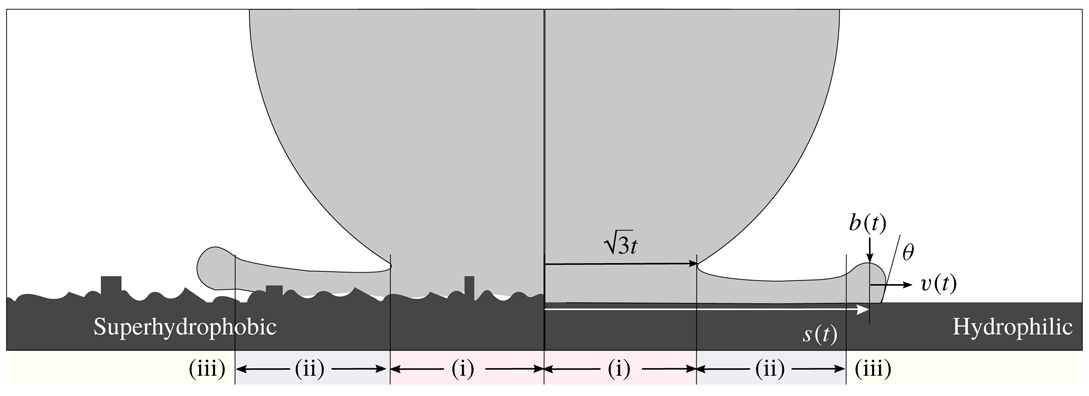
, is set at the instant the drop first touches the solid, see figure 1. The Ohnesorge, Reynolds, Weber and capillary numbers are defined here as
 $Oh=\unicode[STIX]{x1D707}/\sqrt{\unicode[STIX]{x1D70C}R\unicode[STIX]{x1D70E}}$
,
 $Re=\unicode[STIX]{x1D70C}VR/\unicode[STIX]{x1D707}$
,
 $We=Oh^{2}\,Re^{2}$
,
 $Ca=\unicode[STIX]{x1D707}V/\unicode[STIX]{x1D70E}$
with
 $\unicode[STIX]{x1D70C}$
,
 $\unicode[STIX]{x1D707}$
and
 $\unicode[STIX]{x1D70E}$
indicating the liquid density, viscosity and interfacial tension coefficient respectively. Figure 1 illustrates that, while the bottom of the falling droplet always touches the substrate, the edge of the expanding lamella may be or not in contact with the solid. Indeed, for the case of superhydrophobic coatings, the rim never touches the substrate whereas for the case of smooth hydrophilic or hydrophobic substrates the rim will take-off from the solid only when the aerodynamic lift is strong enough (Riboux & Gordillo Reference Riboux and Gordillo2014).
Sketch showing a drop spreading along a substrate which can be covered or not with a superhydrophobic material, represented here with a rough texture. The experiments to be presented next will be conducted by impacting drops against either smooth hydrophilic substrates or against superhydrophobic substrates. The region (i) indicates the drop region,
 $0\leqslant r\leqslant \sqrt{3t}$
, (ii) indicates the lamella region,
 $\sqrt{3t}\leqslant r\leqslant s(t)$
and (iii) the rim region. The variables
 $s(t)$
,
 $b(t)$
and
 $v(t)$
indicate, respectively, the rim radial position, the rim thickness and the rim velocity;
 $\unicode[STIX]{x1D703}$
is the dynamical contact angle.

Before presenting the equations governing the rim dynamics and the flow in the so-called lamella region, which is located upstream the rim, see figure 1, let us point out first that we will follow the notation in Riboux & Gordillo (Reference Riboux and Gordillo2014) and, in the text, dimensionless variables will be written using lower case letters to differentiate them from their dimensional counterparts (in capital letters). In addition, distances, times and pressures will be made non-dimensional using, as characteristic values,
 $R$
,
 $R/V$
and
 $\unicode[STIX]{x1D70C}V^{2}$
.
The radial position and the thickness of the rim, indicated here using the time-dependent variables
 $s(t)$
and
 $b(t)$
(see figures 1 and 2), can be calculated from the following balances of mass and momentum (see appendix A)
 $$\begin{eqnarray}\left.\begin{array}{@{}c@{}}\displaystyle \unicode[STIX]{x1D6FC}\frac{\unicode[STIX]{x03C0}}{4}\frac{\text{d}b^{2}}{\text{d}t}=[u(s,t)-v]h(s,t),\quad \frac{\text{d}s}{\text{d}t}=v,\\ \displaystyle \unicode[STIX]{x1D6FC}\frac{\unicode[STIX]{x03C0}b^{2}}{4}\frac{\text{d}v}{\text{d}t}=[u(s,t)-v]^{2}h(s,t)-(1+\unicode[STIX]{x1D6FD})We^{-1},\end{array}\right\}\end{eqnarray}$$
with
 $u(r,t)$
and
 $h(r,t)$
in (2.1) the averaged radial velocity and the thickness of the thin film – the lamella – which extends along the spatio-temporal region located in between the impacting drop and the rim, namely,
 $\sqrt{3t}\leqslant r\leqslant s(t)$
(see figures 1 and 2). In (2.1), we distinguish two cases depending on the wetting properties of the solid. Indeed, the sketch in figure 1 shows that the main difference existing between droplets spreading over hydrophilic or superhydrophobic substrates is that, in the latter case, the edge of the rim is never in contact with the solid. Therefore, for the case of superhydrophobic coatings,
 $\unicode[STIX]{x1D6FC}=1$
because the rim cross-sectional area can be approximated by that of a circle and
 $\unicode[STIX]{x1D6FD}=1$
because the liquid in the rim is not in contact with the substrate – see figure 1 – whereas in the case of hydrophilic ones,
 $\unicode[STIX]{x1D6FC}=1/2$
because the rim cross-sectional area can be approximated by that of a semicircle – see figure 1 – and, since the rim contacts the solid in this case,
 $\unicode[STIX]{x1D6FD}=-\cos \unicode[STIX]{x1D703}$
, with
 $\unicode[STIX]{x1D703}$
the advancing contact angle (Eggers et al.
Reference Eggers, Fontelos, Josserand and Zaleski2010).
The system of ordinary differential equations (2.1) is integrated once the averaged velocity
 $u(r,t)$
and the height of the liquid film
 $h(r,t)$
in the lamella are determined and are particularized at the radial position where the rim is located,
 $r=s(t)$
. The differential equations for
 $u(r,t)$
and
 $h(r,t)$
are deduced in appendix A applying balances of mass and momentum to a differential portion of the lamella and taking into account that the lamella is a slender thin liquid film namely,
 $\unicode[STIX]{x2202}h/\unicode[STIX]{x2202}r\ll 1$
, a condition which also yields that the pressure gradients in the liquid can be neglected within the spatio-temporal region
 $\sqrt{3t}\leqslant r\leqslant s(t)$
(see figure 2). Using these ideas, we show in appendix A that the system of partial differential equations describing the fields
 $u(r,t)$
and
 $h(r,t)$
is
 $$\begin{eqnarray}\frac{\unicode[STIX]{x2202}(rh)}{\unicode[STIX]{x2202}t}+u\frac{\unicode[STIX]{x2202}(rh)}{\unicode[STIX]{x2202}r}=-rh\frac{\unicode[STIX]{x2202}u}{\unicode[STIX]{x2202}r}\quad \text{and}\quad \frac{\unicode[STIX]{x2202}u}{\unicode[STIX]{x2202}t}+u\frac{\unicode[STIX]{x2202}u}{\unicode[STIX]{x2202}r}=-\unicode[STIX]{x1D706}\frac{u}{h\sqrt{t\,Re}},\end{eqnarray}$$
with
 $\unicode[STIX]{x1D706}$
a free constant whose value,
 $\unicode[STIX]{x1D706}=1$
, is adjusted in what follows to reproduce the experimental observations. The system (2.2) is solved specifying the values of
 $u$
and
 $h$
at the spatio-temporal boundary separating the drop and the lamella regions, namely,
 $r=\sqrt{3t}$
, (see figures 1 and 2).
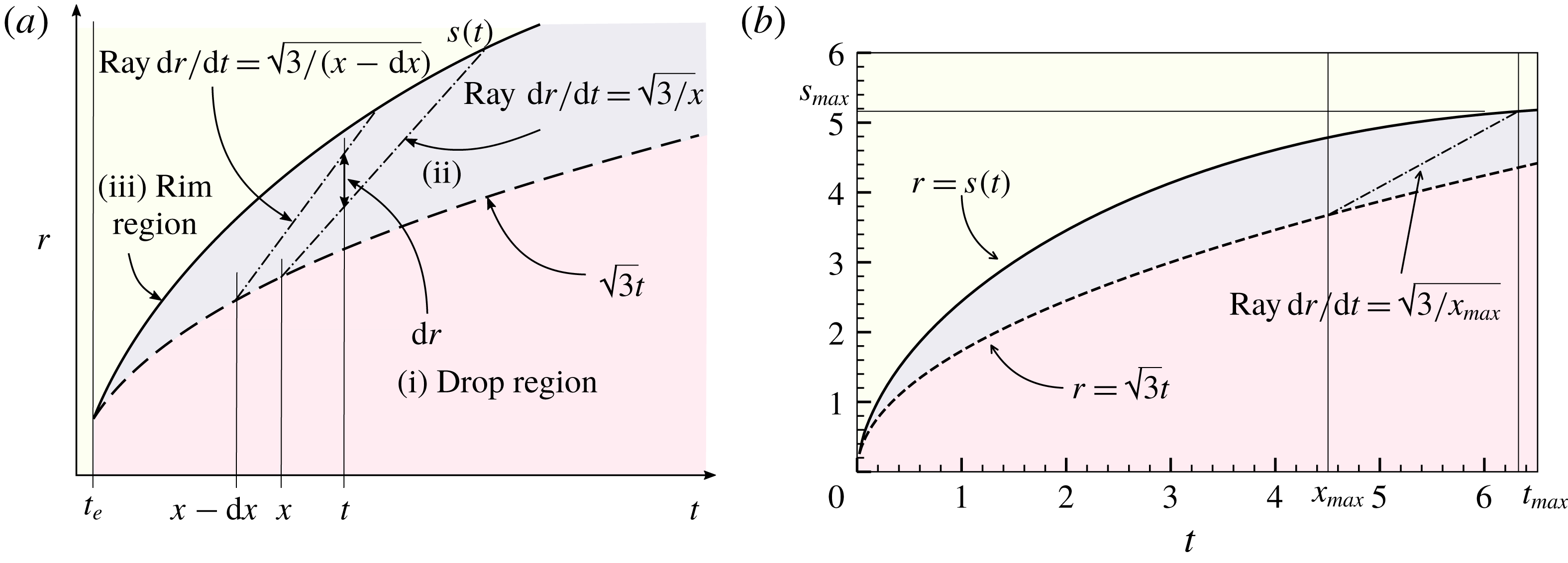
(a) Sketch showing, in a spatio-temporal diagram, the different regions defined to analyse the flow. The lamella region (ii) lies in between the end of the drop region,
 $r=\sqrt{3t}$
and the rim, located at
 $r=s(t)$
. The integration of the differential equations describing the flow in the lamella is carried our along rays
 $\text{d}r/\text{d}t=u(r=\sqrt{3x},x)=\sqrt{3/x}$
departing from the boundary
 $r=\sqrt{3x}$
, with
 $x$
a parameter denoting time. (b) The rays reaching the maximum radius
 $s_{max}$
at the instant
 $t_{max}$
depart from the boundary
 $r=\sqrt{3x}$
at an instant
 $x_{max}<t_{max}$
. The curves in (b) have been calculated for the following values of the parameters:
 $Oh=2.9\times 10^{-3}$
and
 $We=300$
, which are representative values for the spreading of millimetric water droplets over a hydrophilic substrate.

Notice first that, in the frictionless case
 $\unicode[STIX]{x1D706}=0$
, both the height of the lamella and the liquid velocity at
 $r=\sqrt{3t}$
were already given using potential flow numerical simulations in Riboux & Gordillo (Reference Riboux and Gordillo2016, figure 4):
 $u(r=\sqrt{3t},t)=u_{a}(t)=\sqrt{3/t}$
and
 $h(r=\sqrt{3t},t)=h_{a}(t)$
the function approximated by (A 20) in appendix A. For the case
 $\unicode[STIX]{x1D706}\neq 0$
the presence of the boundary layer does not change, to leading order, the velocity field at surface of the drop. Therefore, the application of a mass balance in the drop region
 $0\leqslant r\leqslant \sqrt{3t}$
expresses that the flow rate entering into the lamella is the same as in the potential flow case, a fact implying that, for a boundary-layer velocity profile of the type given in (A 6) in appendix A,
 $$\begin{eqnarray}\displaystyle \sqrt{3/t}h_{a}(t) & = & \displaystyle \sqrt{3/t}(h(r=\sqrt{3t},t)-\unicode[STIX]{x1D6FF}(t))+\sqrt{3/t}\unicode[STIX]{x1D6FF}(t)/2\nonumber\\ \displaystyle & = & \displaystyle u(r=\sqrt{3t},t)h(r=\sqrt{3t},t),\end{eqnarray}$$
with
 $\unicode[STIX]{x1D6FF}(t)$
the thickness of the boundary layer and, hence, for
 $\unicode[STIX]{x1D706}\neq 0$
,
 $$\begin{eqnarray}\left.\begin{array}{@{}c@{}}\displaystyle h(r=\sqrt{3t},t)=h_{a}(t)\left(1+\frac{\unicode[STIX]{x1D6FF}(t)}{2h_{a}(t)}\right)\\ \displaystyle u(r=\sqrt{3t},t)=u_{a}(t)\left(1+\frac{\unicode[STIX]{x1D6FF}(t)}{2h_{a}(t)}\right)^{-1}\\ \qquad \text{with }u_{a}(t)=\sqrt{3/t}\text{ and }\unicode[STIX]{x1D6FF}(t)=\sqrt{t/Re}.\end{array}\right\}\end{eqnarray}$$
3 Solution of the equations describing flow in the lamella
The solution to the system of equations (2.1), (2.2) and (2.4) could be accomplished numerically, as is reported in Quintero et al. (Reference Quintero, Riboux and Gordillo2019), but the purpose here is to provide an approximate analytical solution in the limit
 $Re\gg 1$
, which will be shown to be in excellent agreement with experiments, thus notably simplifying the calculations. With that idea in mind, notice first that the
 $Re^{-1/2}$
dependence depicted in (2.2) suggests that the fields
 $u(r,t)$
and
 $h(r,t)$
can be expressed as
 $$\begin{eqnarray}\left.\begin{array}{@{}c@{}}\displaystyle u(r,t)=u_{0}(r,t)+Re^{-1/2}u_{1}(r,t)+O(Re^{-1}),\\ \displaystyle h(r,t)=h_{0}(r,t)+Re^{-1/2}h_{1}(r,t)+O(Re^{-1}).\end{array}\right\}\end{eqnarray}$$
Indeed, the substitution of the ansatz (3.1) into (2.2) yields the following two equations for
 $u_{0}(r,t)$
and
 $h_{0}(r,t)$
:
 $$\begin{eqnarray}\left.\begin{array}{@{}c@{}}\displaystyle \frac{\unicode[STIX]{x2202}u_{0}}{\unicode[STIX]{x2202}t}+u_{0}\frac{\unicode[STIX]{x2202}u_{0}}{\unicode[STIX]{x2202}r}=0\;\Longrightarrow \;\frac{\text{D}u_{0}}{\text{D}t}=0\\ \displaystyle \frac{\unicode[STIX]{x2202}(rh_{0})}{\unicode[STIX]{x2202}t}+u_{0}\frac{\unicode[STIX]{x2202}(rh_{0})}{\unicode[STIX]{x2202}r}=-rh_{0}\frac{\unicode[STIX]{x2202}u_{0}}{\unicode[STIX]{x2202}r}\;\Longrightarrow \;\frac{\text{D}(rh_{0})}{\text{D}t}=-rh_{0}\frac{\unicode[STIX]{x2202}u_{0}}{\unicode[STIX]{x2202}r},\end{array}\right\}\end{eqnarray}$$
with
 $\text{D}/\text{D}t\equiv \unicode[STIX]{x2202}/\unicode[STIX]{x2202}t+u_{0}\unicode[STIX]{x2202}/\unicode[STIX]{x2202}r$
, and the following two additional equations for
 $u_{1}(r,t)$
and
 $h_{1}(r,t)$
:
 $$\begin{eqnarray}\left.\begin{array}{@{}c@{}}\displaystyle \frac{\unicode[STIX]{x2202}u_{1}}{\unicode[STIX]{x2202}t}+u_{0}\frac{\unicode[STIX]{x2202}u_{1}}{\unicode[STIX]{x2202}r}+u_{1}\frac{\unicode[STIX]{x2202}u_{0}}{\unicode[STIX]{x2202}r}=-\frac{\unicode[STIX]{x1D706}u_{0}}{h_{0}\sqrt{t}}\;\Longrightarrow \;\frac{\text{D}u_{1}}{\text{D}t}+u_{1}\frac{\unicode[STIX]{x2202}u_{0}}{\unicode[STIX]{x2202}r}=-\frac{\unicode[STIX]{x1D706}u_{0}}{h_{0}\sqrt{t}}\quad \text{and}\\ \displaystyle \frac{\unicode[STIX]{x2202}(rh_{1})}{\unicode[STIX]{x2202}t}+u_{0}\frac{\unicode[STIX]{x2202}(rh_{1})}{\unicode[STIX]{x2202}r}+u_{1}\frac{\unicode[STIX]{x2202}(rh_{0})}{\unicode[STIX]{x2202}r}=-rh_{0}\frac{\unicode[STIX]{x2202}u_{1}}{\unicode[STIX]{x2202}r}-rh_{1}\frac{\unicode[STIX]{x2202}u_{0}}{\unicode[STIX]{x2202}r}\\ \displaystyle \;\Longrightarrow \;\frac{\text{D}(rh_{1})}{\text{D}t}+rh_{1}\frac{\unicode[STIX]{x2202}u_{0}}{\unicode[STIX]{x2202}r}=-\frac{\unicode[STIX]{x2202}}{\unicode[STIX]{x2202}r}(rh_{0}u_{1}).\end{array}\right\}\end{eqnarray}$$
Equations (3.2) and (3.3) need to satisfy the boundary conditions deduced from (2.4) at the boundary
 $(r,t)=(\sqrt{3x},x)$
separating the drop and the lamella regions. For those cases in which
 $\unicode[STIX]{x1D6FF}(x)=\sqrt{x/Re}\ll h_{a}(x)$
the Taylor expansion of
 $u$
in (2.4) yields
 $u(r=\sqrt{3x},x)\simeq u_{a}(x)(1-\unicode[STIX]{x1D6FF}(x)/(2h_{a}(x)))$
. It happens, however, that in spite of
 $Re\gg 1$
, the ratio
 $\unicode[STIX]{x1D6FF}(x)/h_{a}(x)$
could be close to unity for sufficiently large values of the Ohnesorge number or for sufficiently large times after impact (Eggers et al.
Reference Eggers, Fontelos, Josserand and Zaleski2010; Visser et al.
Reference Visser, Frommhold, Wildeman, Mettin, Lohse and Sun2015). Motivated by this fact, the boundary conditions in (2.4) will be approximated here as
 $$\begin{eqnarray}h(\sqrt{3x},x)=h_{a}(x)+\frac{\sqrt{x}}{2}Re^{-1/2};\quad u(\sqrt{3x},x)\simeq \sqrt{\frac{3}{x}}-\frac{\sqrt{3}\unicode[STIX]{x1D712}}{2h_{a}(x)}Re^{-1/2},\end{eqnarray}$$
with
 $\unicode[STIX]{x1D712}$
a constant such that the expression in (3.4) is a good approximation to the exact value of
 $u$
in (2.4) for all values of
 $t$
. Indeed, consider for instance that
 $\unicode[STIX]{x1D6FF}/h\simeq 1$
: in this case, equation (3.4) would be, for
 $\unicode[STIX]{x1D712}=2/3$
, an excellent approximation to the initial condition for
 $u$
in (2.4). For the range of Ohnesorge numbers considered here,
 $10^{-3}\lesssim Oh\lesssim 10^{-2}$
, the ratio
 $\unicode[STIX]{x1D6FF}(t)/h_{a}(t)$
is close to unity or even slightly larger than one and, hence, equation (3.4) is a very good approximation to the exact value of
 $u$
given in (2.4) for
 $\unicode[STIX]{x1D712}=0.6$
; this is the reason why all the results presented here have been calculated for
 $\unicode[STIX]{x1D712}=0.6$
. Notice, however, that for the impact of drops with values of the Ohnesorge number larger than those considered here,
 $\unicode[STIX]{x1D6FF}/h_{a}>1$
and
 $\unicode[STIX]{x1D712}$
in (3.4) should be even smaller i.e.
 $\unicode[STIX]{x1D712}<0.6$
.
From (3.1) and (3.4) it is thus deduced that
 $$\begin{eqnarray}\left.\begin{array}{@{}c@{}}\displaystyle u_{0}=\sqrt{\frac{3}{x}},\quad u_{1}=-\frac{\sqrt{3}\unicode[STIX]{x1D712}}{2h_{a}(x)},\quad h_{0}=h_{a}(x)\quad \text{and}\quad h_{1}=\frac{\sqrt{x}}{2}\\ \displaystyle \text{at }(r,t)=(\sqrt{3x},x).\qquad \quad \end{array}\right\}\end{eqnarray}$$
The integration along rays
 $\text{d}r/\text{d}t=\sqrt{3/x}$
of the momentum equation in (3.2), subjected to the corresponding boundary condition in (3.5), yields (see figure 2
a)
 $$\begin{eqnarray}\left.\begin{array}{@{}c@{}}\displaystyle u_{0}(r,t)=\sqrt{\frac{3}{x}}\quad \text{along }\frac{\text{d}r}{\text{d}t}=\sqrt{\frac{3}{x}}\;\Longrightarrow \;r=\sqrt{3x}+\sqrt{\frac{3}{x}}(t-x)\\ \displaystyle \;\Longrightarrow \;r=\sqrt{\frac{3}{x}}t\;\Longrightarrow \;x=3\left(\frac{t}{r}\right)^{2}\;\Longrightarrow \;u_{0}(r,t)=\sqrt{\frac{3}{3(t/r)^{2}}}=\frac{r}{t}.\end{array}\right\}\end{eqnarray}$$
Moreover, the integration of the equation for
 $h_{0}(r,t)$
in (3.2) along the ray
 $\text{d}r/\text{d}t=\sqrt{3/x}$
yields
 $$\begin{eqnarray}\displaystyle \left.\begin{array}{@{}c@{}}\displaystyle \frac{\unicode[STIX]{x2202}(rh_{0})}{\unicode[STIX]{x2202}t}+u_{0}\frac{\unicode[STIX]{x2202}(rh_{0})}{\unicode[STIX]{x2202}r}+\frac{rh_{0}}{t}=0\;\Longrightarrow \;\frac{\text{D}(rh_{0}t)}{\text{D}t}=0\\ \displaystyle \;\Longrightarrow \;h_{0}(r,t)=9\frac{t^{2}}{r^{4}}h_{a}[3(t/r)^{2}],\end{array}\right\} & & \displaystyle\end{eqnarray}$$
where we have made use of the fact that
 $\unicode[STIX]{x2202}u_{0}/\unicode[STIX]{x2202}r=1/t$
, of the relationship between
 $x$
with
 $r$
and
 $t$
in (3.6) and of the corresponding boundary condition in (3.5).
Now, multiplying by
 $t$
both sides of equations in (3.3), one obtains that:
 $$\begin{eqnarray}\frac{\text{D}(u_{1}t)}{\text{D}t}=-\frac{\unicode[STIX]{x1D706}u_{0}}{h_{0}\sqrt{t}}t,\quad \frac{\text{D}(rh_{1}t)}{\text{D}t}=-\frac{1}{t}\frac{\unicode[STIX]{x2202}}{\unicode[STIX]{x2202}r}(rh_{0}tu_{1}t).\end{eqnarray}$$
The equation for
 $u_{1}$
in (3.8) can be integrated along rays
 $r=\sqrt{3/x}t$
(see figure 2
a) taking into account that, by virtue of (3.7),
 $\text{D}(rh_{0}t)/\text{D}t=0$
:
 $$\begin{eqnarray}\hspace{-20.00003pt}\left.\begin{array}{@{}c@{}}\displaystyle \frac{\text{D}(u_{1}t)}{\text{D}t}=-\frac{\unicode[STIX]{x1D706}u_{0}}{h_{0}\sqrt{t}}t\;\Longrightarrow \;\frac{\text{D}(u_{1}t)}{\text{D}t}=-\frac{\unicode[STIX]{x1D706}u_{0}rt^{2}}{rh_{0}t\sqrt{t}}=-\frac{\unicode[STIX]{x1D706}u_{0}}{rh_{0}t\sqrt{t}}\sqrt{\frac{3}{x}}t^{3}\\ \displaystyle \;\Longrightarrow \;\frac{\text{D}(u_{1}trh_{0}t)}{\text{D}t}=\frac{-3\unicode[STIX]{x1D706}}{x}t^{5/2}\\ \displaystyle \;\Longrightarrow \;u_{1}(r,t)=-\frac{1}{th_{a}(x)}\left[\frac{\sqrt{3}\unicode[STIX]{x1D712}x}{2}+\frac{2\sqrt{3}\unicode[STIX]{x1D706}}{7x^{5/2}}(t^{7/2}-x^{7/2})\right],\end{array}\right\}\end{eqnarray}$$
where we made use of the boundary condition for
 $u_{1}$
in (3.5) and also of the fact that, along rays
 $\text{d}r/\text{d}t=u_{0}=\sqrt{3/x}$
departing from the spatio-temporal boundary
 $(r,t)=(\sqrt{3x},x)$
,
 $r=\sqrt{3/x}t$
,
 $u_{0}=\sqrt{3/x}$
and
 $rh_{0}t=\sqrt{3x}h_{a}(x)x$
(see figure 2
a).
To integrate the equation for
 $h_{1}$
in (3.8) it is first convenient to notice that
 $\unicode[STIX]{x2202}(u_{1}trh_{0}t)/\unicode[STIX]{x2202}r$
can be calculated as the increment
 $d(u_{1}trh_{0}t)$
between two neighbouring rays departing from the spatio-temporal boundary
 $(r,t)=(\sqrt{3x},x)$
at the consecutive instants
 $x-\text{d}x$
and
 $x$
which, at a given instant
 $t$
are thus separated a distance
 $\text{d}r=\sqrt{3}/2x^{-3/2}t\text{d}x$
(see figure 2
a). Consequently, making use of the solution for
 $u_{1}trh_{0}t$
in (3.9) and of
 $\text{d}r=\sqrt{3}/2x^{-3/2}t\text{d}x$
,
 $$\begin{eqnarray}-\frac{1}{t}\frac{\unicode[STIX]{x2202}}{\unicode[STIX]{x2202}r}(u_{1}trh_{0}t)=-\frac{2}{14\sqrt{3}t^{2}}[(52.5\unicode[STIX]{x1D712}-30\unicode[STIX]{x1D706})x^{3}-12\unicode[STIX]{x1D706}x^{-1/2}t^{7/2}],\end{eqnarray}$$
where use of the boundary condition for
 $u_{1}$
in (3.5) has been made.
Hence, the integration of the equation for
 $h_{1}$
in (3.8) along the ray
 $\text{d}r/\text{d}t=\sqrt{3/x}$
yields
 $$\begin{eqnarray}\left.\begin{array}{@{}c@{}}\displaystyle rh_{1}t-\sqrt{3x}xh_{1}(x)=\frac{2}{14\sqrt{3}}\left[\vphantom{\frac{24\unicode[STIX]{x1D706}}{5}}(52.5\unicode[STIX]{x1D712}-30\unicode[STIX]{x1D706})x^{3}(t^{-1}-x^{-1})\right.\\ \displaystyle \hspace{35.00005pt}\left.+\,\frac{24\unicode[STIX]{x1D706}}{5}x^{-1/2}(t^{5/2}-x^{5/2})\right]\\ \displaystyle \;\Longrightarrow \;h_{1}(r,t)=\frac{1}{rt}\left[\frac{\sqrt{3}}{2}x^{2}+\frac{\sqrt{3}(105\unicode[STIX]{x1D712}-60\unicode[STIX]{x1D706})}{42}x^{3}(t^{-1}-x^{-1})\right.\\ \displaystyle \left.+\,\frac{24\sqrt{3}\unicode[STIX]{x1D706}}{105}x^{-1/2}(t^{5/2}-x^{5/2})\right],\end{array}\right\}\end{eqnarray}$$
where use of the result in (3.10) and of the boundary condition for
 $h_{1}$
in (3.5) has been made. Equations (3.1), (3.6), (3.7), (3.9), (3.11) provide the following expressions for
 $u(r,t)$
and
 $h(r,t)$
:
 $$\begin{eqnarray}\hspace{-20.00003pt}\left.\begin{array}{@{}c@{}}\displaystyle u(r,t)=\frac{r}{t}-\frac{Re^{-1/2}}{t}\left[\frac{\sqrt{3}\unicode[STIX]{x1D712}x}{2h_{a}(x)}+\frac{2\sqrt{3}\unicode[STIX]{x1D706}}{7h_{a}(x)x^{5/2}}(t^{7/2}-x^{7/2})\right]+O(Re^{-1})\\ \displaystyle h(r,t)=9\frac{t^{2}}{r^{4}}h_{a}[3(t/r)^{2}]+\frac{Re^{-1/2}}{rt}\left[\frac{\sqrt{3}}{2}x^{2}+\frac{\sqrt{3}(105\unicode[STIX]{x1D712}-60\unicode[STIX]{x1D706})}{42}x^{3}(t^{-1}-x^{-1})\right.\\ \displaystyle \hspace{-70.0001pt}\left.+\,\frac{24\sqrt{3}\unicode[STIX]{x1D706}}{105}x^{-1/2}(t^{5/2}-x^{5/2})\right]+O(Re^{-1}).\end{array}\right\}\end{eqnarray}$$
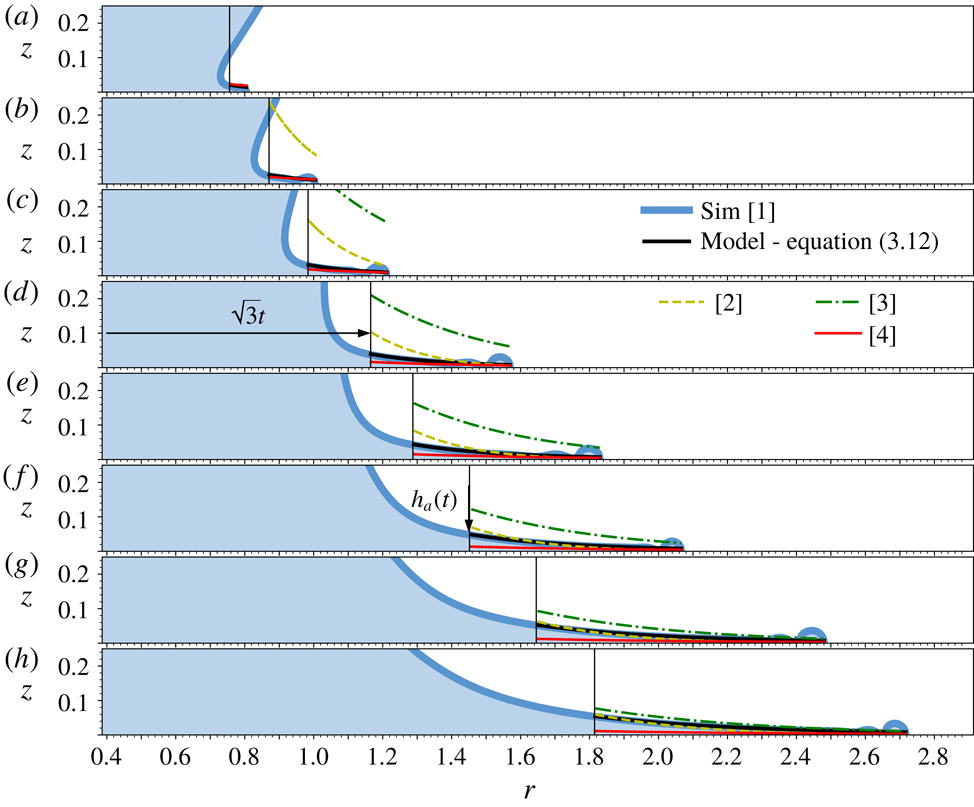
Figure 3 shows that our theoretical prediction for the height of the lamella given in (3.12) in the limit
 $Re\rightarrow \infty$
, with
 $h_{a}(x)$
approximated by (A 20) in appendix A, is in excellent agreement with the results obtained from the boundary integral numerical simulations reported in Riboux & Gordillo (Reference Riboux and Gordillo2016); the predicted values of
 $h(r,t)$
calculated using other theoretical approaches are also included in this figure.
(a) The analytical expression for
 $h_{0}(r,t)=9t^{2}/r^{4}h_{a}[3(t/r)^{2}]$
in (3.12), represented with a black line accurately predicts, in the lamella region
 $\sqrt{3t}\leqslant r<s(t)$
, the thickness of the thin liquid film calculated numerically in Riboux & Gordillo (Reference Riboux and Gordillo2016) [1], for the free slip case (
 $\unicode[STIX]{x1D706}=0$
,
 $Re\rightarrow \infty$
) and
 $We=100$
: notice that the simulations in Riboux & Gordillo (Reference Riboux and Gordillo2016) reveal that
 $h(r,t)$
does not depend on
 $We$
for
 $We\gg 1$
. (a)
 $t=0.19$
, (b)
 $0.25$
, (c)
 $0.32$
, (d)
 $0.45$
, (e)
 $0.55$
, (f)
 $0.70$
, (g)
 $0.90$
and (h)
 $t=1.10$
. The functions
 $h(r,t)$
predicted using the theoretical approaches in Roisman (Reference Roisman2009) [2], Eggers et al. (Reference Eggers, Fontelos, Josserand and Zaleski2010) [3], Wang & Bourouiba (Reference Wang and Bourouiba2017) [4] are also included in this figure.

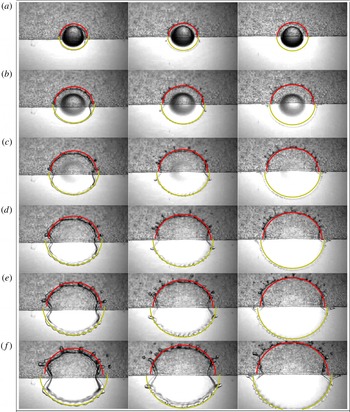
Comparison between the predicted and the observed position of the rim bordering the expanding lamella for the case of a water droplet of radius
 $R=1.46~\text{mm}$
impacting against a superhydrophobic substrate (top part of each image) or against a hydrophilic substrate (bottom part of each image). From left to right,
 $V=1.59~\text{m}~\text{s}^{-1}\;(We=50)$
,
 $V=1.94~\text{m}\;\text{s}^{-1}\;(We=76)$
and
 $V=2.37~\text{m}~\text{s}^{-1}\;(We=114)$
. The values of the dimensionless instants of time corresponding to each of the rows in the figure are: (a)
 $t=T(V/R)\approx 0.5$
, (b)
 $t\approx 1.0$
, (c) 1.5, (d) 2.0 and (e) 2.5 and (f) 3.5.

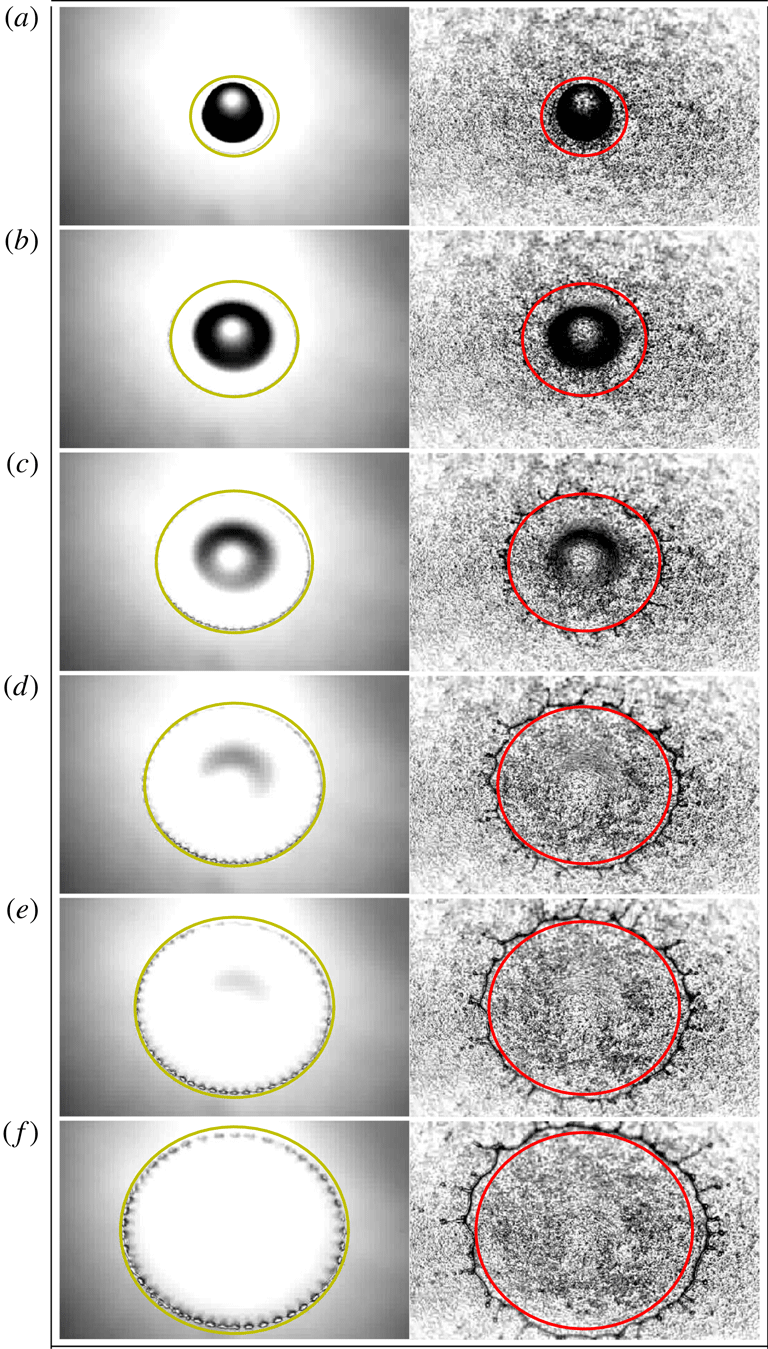
Comparison between the predicted and the observed position of the rim bordering the expanding lamella for the case of a water droplet of radius
 $R=1.43~\text{mm}$
impacting against a glass substrate (left,
 $V=3.57~\text{m}~\text{s}^{-1},We=261$
) or a superhydrophobic substrate (right,
 $V=3.58~\text{m}~\text{s}^{-1},We=264$
). The values of the dimensionless instants of time corresponding to each of the rows in the figure are: (a)
 $t=T(V/R)\approx 0.5$
, (b)
 $t\approx 1.0$
, (c) 1.5, (d) 2.0 and (e) 2.5 and (f) 3.5.

4 Comparison with experiments
The analytical expressions of
 $u(r,t)$
and
 $h(r,t)$
are given by (3.12), so we can now proceed to integrate the system (2.1) once the initial values for
 $s$
,
 $v$
and
 $b$
are specified at the instant the lamella is initially ejected. Indeed, the thin liquid film is not formed right at the instant
 $t=0$
when the drop first touches the substrate, but at the ejection time
 $t_{e}>0$
determined in Riboux & Gordillo (Reference Riboux and Gordillo2014, Reference Riboux and Gordillo2017). In Riboux & Gordillo (Reference Riboux and Gordillo2014, Reference Riboux and Gordillo2017) we predicted and also verified experimentally that, if
 $Re^{1/6}Oh^{2/3}<0.25$
, a condition which is fulfilled by all experimental conditions reported here, the ejection time can be expressed as
 $t_{e}=1.05We^{-2/3}$
. Then, the system (2.1) is integrated in time once the functions
 $u(r,t)$
and
 $h(r,t)$
in (3.12) are particularized at
 $r=s(t)$
and once the following initial conditions are imposed at
 $t=t_{e}$
(Riboux & Gordillo Reference Riboux and Gordillo2015):
 $s(t_{e})=\sqrt{3t_{e}}$
,
 $v(t_{e})=(1/2)\sqrt{3/t_{e}}$
and
 $b(t_{e})=\sqrt{12}t_{e}^{3/2}/\unicode[STIX]{x03C0}$
. The results obtained integrating the system (2.1) once the value of the free constant
 $\unicode[STIX]{x1D706}$
is fixed here to
 $\unicode[STIX]{x1D706}=1$
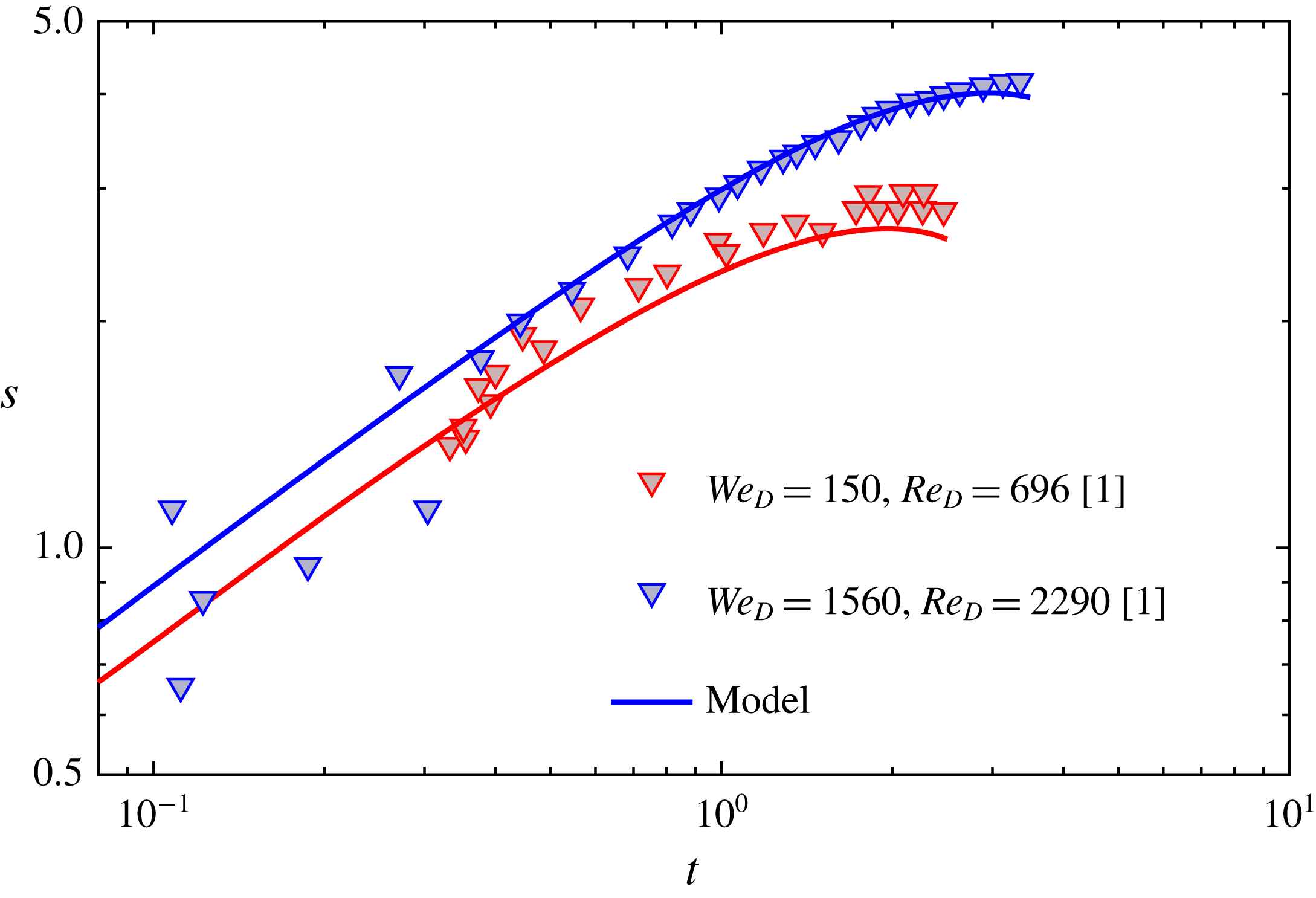
, are in remarkable agreement with experimental observations for the two types of substrates considered here, as figures 4 and 5 show.
Figure 6 shows a comparison between theory and the measured values of
 $s(t)$
in Visser et al. (Reference Visser, Frommhold, Wildeman, Mettin, Lohse and Sun2015), who analysed the spreading of micrometre-sized droplets impacting a solid substrate at velocities exceeding
 $10~\text{m}~\text{s}^{-1}$
. The cases studied in Visser et al. (Reference Visser, Frommhold, Wildeman, Mettin, Lohse and Sun2015) correspond to values of the Ohnesorge number
 $Oh\sim 2\times 10^{-2}$
, an order of magnitude larger than the values of
 $Oh$
in figures 4 and 5; hence, in Visser et al. (Reference Visser, Frommhold, Wildeman, Mettin, Lohse and Sun2015), the value of the ratio
 $\unicode[STIX]{x1D6FF}(t)/h_{a}(t)$
is close to unity for all
 $t$
. The good agreement between the theoretical and experimental results depicted in figure 6, gives strong further support to our theory.
Comparison between the experimental data in Visser et al. (Reference Visser, Frommhold, Wildeman, Mettin, Lohse and Sun2015) [1] and the theoretical results. Here,
 $\unicode[STIX]{x1D6FD}=1$
and, as in the rest of calculations presented here,
 $\unicode[STIX]{x1D706}=1$
and
 $\unicode[STIX]{x1D712}=0.6$
.
 $We_{D}=2We$
and
 $Re_{D}=2Re$
because Visser et al. (Reference Visser, Frommhold, Wildeman, Mettin, Lohse and Sun2015) defined the Weber and Reynolds numbers using the diameter instead of the drop radius.


The integration of the system (2.1) could be avoided if just the maximum spreading radius of the drop,
 $s_{max}$
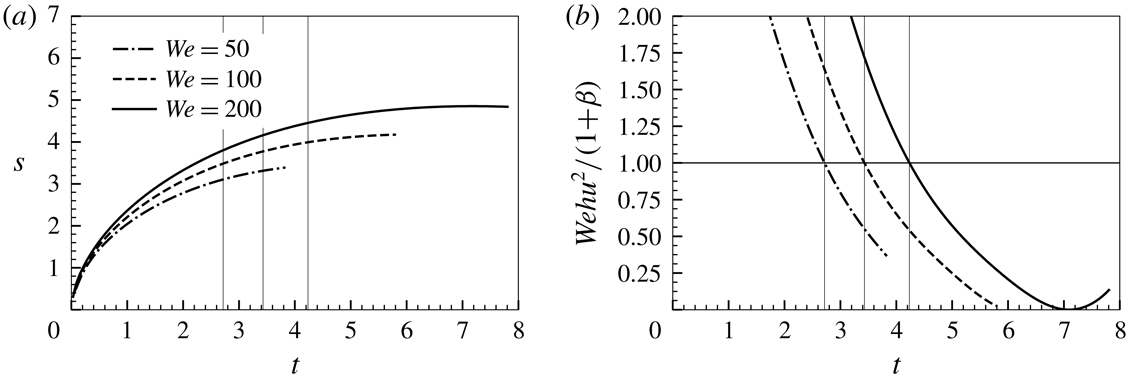
, had to be predicted. Indeed, figure 7 indicates states that, very close to the maximum spreading radius, the rim velocity is zero and also that the value of the local Weber number, defined here as
 $$\begin{eqnarray}We_{local}(t)=We\frac{u^{2}(s,t)h(s,t)}{1+\unicode[STIX]{x1D6FD}},\end{eqnarray}$$
is
 $We_{local}\simeq 1$
. Therefore, the substitution into the momentum equation in (2.1) of
 $v=0$
, of
 $\text{d}v/\text{d}t=0$
and of the values of the functions
 $u(r,t)$
and
 $h(r,t)$
given in (3.12) particularized at
 $r=s_{max}$
and at
 $t=t_{max}$
, with
 $t_{max}$
the instant of time at which
 $r=s_{max}$
yields, to leading order, in the limits
 $We\gg 1$
and
 $Re\gg 1$
, the following equation for
 $s_{max}$
:
 $$\begin{eqnarray}\left.\begin{array}{@{}c@{}}\displaystyle h_{0}u_{0}^{2}+Re^{-1/2}(h_{1}u_{0}^{2}+2h_{0}u_{0}u_{1})-(1+\unicode[STIX]{x1D6FD})We^{-1}=0\\ \displaystyle \;\Longrightarrow \;9h_{a}(x_{max})-3^{3/4}\frac{12\unicode[STIX]{x1D706}x_{max}^{-3/4}}{35}Re^{-1/2}s_{max}^{5/2}-(1+\unicode[STIX]{x1D6FD})We^{-1}s_{max}^{2}=0,\end{array}\right\}\end{eqnarray}$$
with
 $x_{max}=3(t_{max}/s_{max})^{2}$
and where
 $O(Re^{-1})$
terms have been neglected. Moreover, in spite of the value of
 $x_{max}$
depends on
 $We$
,
 $Re$
and
 $\unicode[STIX]{x1D703}$
, we checked that
 $x_{max}$
lies within a limited range of values, such that
 $t_{max}>x_{max}$
, see figure 2(b).
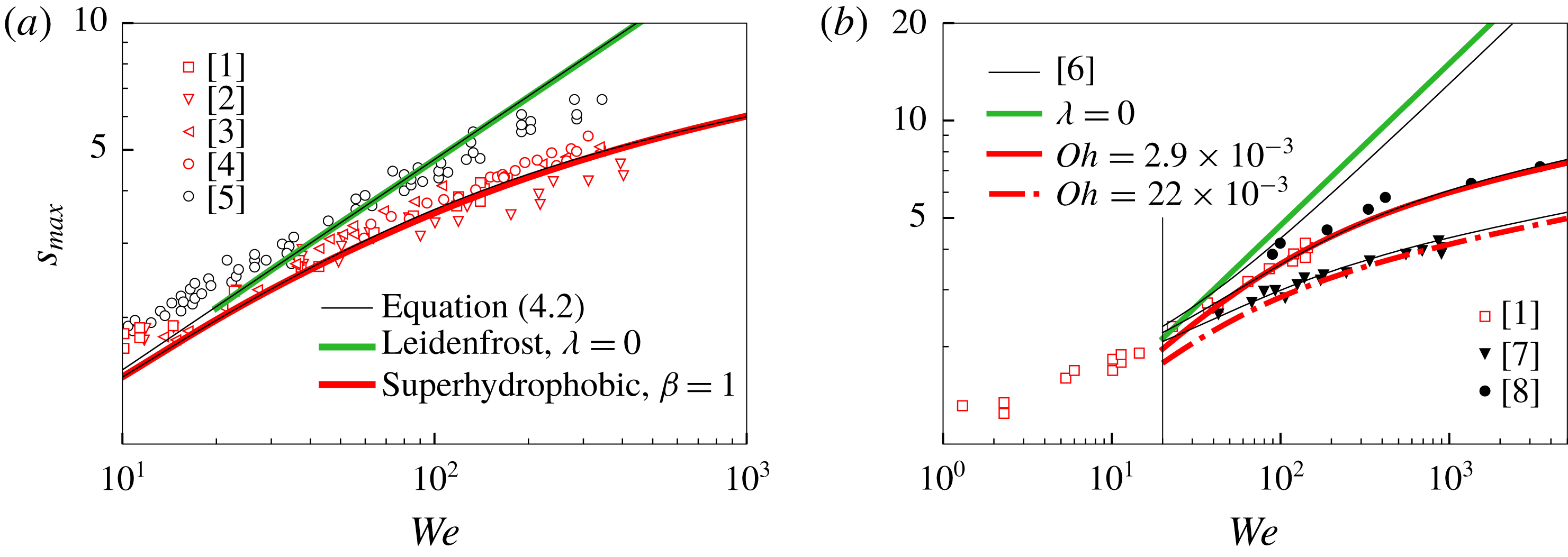
(a) Comparison between the experimental data in [1] Clanet et al. (Reference Clanet, Béguin, Richard and Quéré2004), [2] Tsai et al. (Reference Tsai, Hendrix, Dijkstra, Shui and Lohse2011), [3] Antonini et al. (Reference Antonini, Amirfazli and Marengo2012), [4] Quintero et al. (Reference Quintero, Riboux and Gordillo2019), [5] Tran et al. (Reference Tran, Staat, Prosperetti, Sun and Lohse2012) and the maximum spreading radius calculated solving the algebraic equation (4.3) – continuous lines. (b) Comparison between the experimental data and theory in [6] Wildeman et al. (Reference Wildeman, Visser, Sun and Lohse2016) (thin black lines), [7] Stow, Hadfield & Ziman (Reference Stow, Hadfield and Ziman1981) and [8] Visser et al. (Reference Visser, Frommhold, Wildeman, Mettin, Lohse and Sun2015) and the maximum spreading radius calculated theoretically solving the algebraic equation (4.3) – thick lines. The results have been obtained for the same values of
 $\unicode[STIX]{x1D6FD}$
as in [6] Wildeman et al. (Reference Wildeman, Visser, Sun and Lohse2016),
 $\unicode[STIX]{x1D6FD}=1$
.

Therefore, we could further simplify (4.2) if
 $x_{max}$
is approximated by a constant value which we fix here to
 $x_{max}=2$
, for which
 $9h_{a}(x_{max})\simeq 0.45$
(see (A 20) in appendix A) and
 $3^{3/4}(12x_{max}^{-3/4})/35\simeq 0.45$
. Therefore, equation (4.2) can be written as
 $$\begin{eqnarray}(1+\unicode[STIX]{x1D6FD})We^{-1}s_{max}^{2}+0.45\unicode[STIX]{x1D706}Re^{-1/2}s_{max}^{5/2}-0.45=0,\end{eqnarray}$$
which resembles the equation for
 $s_{max}$
deduced in Wildeman et al. (Reference Wildeman, Visser, Sun and Lohse2016) using energetic arguments. Let us point out here that (4.2) and (4.3) express the same type of balance as that found in the study of Savart sheets: the momentum flux is compensated with the interfacial tension forces at the maximum spreading radius (Taylor Reference Taylor1959; Gordillo, Lhuissier & Villermaux Reference Gordillo, Lhuissier and Villermaux2014).
Figures 8(a,b) shows that our prediction for
 $s_{max}$
calculated using (4.3) compares very favourably with published experimental data, providing further support to our theoretical approach. Another evidence showing the robustness of our analysis is given next. Indeed, a direct comparison of our theoretical result in (4.3) with the equation for the maximum spreading radius in Laan et al. (Reference Laan, de Bruin, Bartolo, Josserand and Bonn2014) – which in our variables can be written as
 $$\begin{eqnarray}s_{max}^{Laan}=Re^{1/5}2^{1/5}\frac{P^{1/2}}{1+P^{1/2}}=Re^{1/5}\bar{f}(P)\end{eqnarray}$$
with
 $P=We\,Re^{-2/5}\!$
– can be easily made once we express
 $s_{max}$
as
 $$\begin{eqnarray}s_{max}=Re^{1/5}f.\end{eqnarray}$$
The substitution of (4.5) into (4.3) yields the following expression for
 $f(P)$
:
 $$\begin{eqnarray}(1+\unicode[STIX]{x1D6FD})P^{-1}f^{2}+0.45\unicode[STIX]{x1D706}f^{5/2}-0.45=0.\end{eqnarray}$$
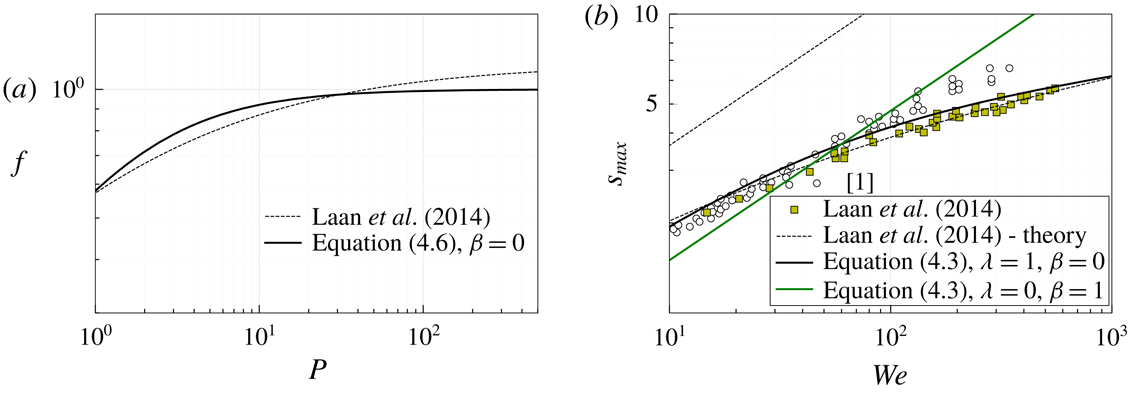
Figure 9, where the functions
 $\bar{f}(P)$
and
 $f(P)$
defined respectively in (4.4) and (4.6) are compared, shows that our theoretical result for
 $f(P)$
calculated solving equation (4.6) is very close to the Padè approximant given in Laan et al. (Reference Laan, de Bruin, Bartolo, Josserand and Bonn2014). However, figure 9 also shows that
 $s_{max}$
calculated using (4.3) is in better agreement with experiments than the prediction in Laan et al. (Reference Laan, de Bruin, Bartolo, Josserand and Bonn2014) for the case of Leidenfrost droplets,
 $\unicode[STIX]{x1D706}=0$
(Tran et al.
Reference Tran, Staat, Prosperetti, Sun and Lohse2012; Wildeman et al.
Reference Wildeman, Visser, Sun and Lohse2016).
(a) Comparison between the Padè approximant in Laan et al. (Reference Laan, de Bruin, Bartolo, Josserand and Bonn2014) and the function
 $f(P)$
predicted by our theoretical result in (4.6). (b)
 $s_{max}$
calculated using (4.3) and the equation in Laan et al. (Reference Laan, de Bruin, Bartolo, Josserand and Bonn2014),
 $s_{max}=2^{1/5}We^{1/2}$
for the case of Leidenfrost droplets,
 $\unicode[STIX]{x1D706}=0$
.

5 Conclusions
In this contribution we have presented a model which is not only able to predict, in a self-consistent way, the maximum spreading diameter of drops impacting a solid wall, but also the time evolution of the position and of the thickness of the rim. Our theory also provides the averaged velocity field and the thickness of the thin film region located upstream the rim for arbitrary values of the advancing contact angle and of the Reynolds and Weber numbers whenever
 $Re\gg 1$
and
 $We\gg 1$
. The good agreement of our predictions with the experimental observations indicates that our results could also be used to determine the time evolution of the diameters and of the sizes of the droplets ejected for drop impact velocities beyond the splashing threshold (Riboux & Gordillo Reference Riboux and Gordillo2015; Quintero et al.
Reference Quintero, Riboux and Gordillo2019).
Acknowledgements
This study has been financially supported by the Spanish MINECO under Projects DPI2014-59292-C3-2-P, DPI2017-88201-C3-1-R and DPI2015-71901-REDT, and partly financed through European funds.
Appendix A
The radial position and the thickness of the rim, indicated here using the time-dependent variables
 $s(t)$
and
 $b(t)$
(see figures 1 and 2), can be calculated from the following balances of mass and momentum at the rim (Taylor Reference Taylor1959; Culick Reference Culick1960)
 $$\begin{eqnarray}\left.\begin{array}{@{}c@{}}\displaystyle \unicode[STIX]{x1D6FC}\frac{\unicode[STIX]{x03C0}}{4}\frac{\text{d}b^{2}}{\text{d}t}=\int _{0}^{h(s,t)}\bar{u}(s,z,t)\,\text{d}z-vh(s,t),\quad \frac{\text{d}s}{\text{d}t}=v,\\ \displaystyle \unicode[STIX]{x1D6FC}\frac{\unicode[STIX]{x03C0}b^{2}}{4}\frac{\text{d}v}{\text{d}t}=\int _{0}^{h(s,t)}[\bar{u}(s,z,t)-v]^{2}\,\text{d}z-(1+\unicode[STIX]{x1D6FD})We^{-1}-f_{\unicode[STIX]{x1D70F}},\end{array}\right\}\end{eqnarray}$$
with
 $z$
the coordinate perpendicular to the wall,
 $f_{\unicode[STIX]{x1D70F}}$
the viscous friction at the wall and
 $\bar{u}(r,z,t)$
and
 $h(r,t)$
in (A 1) the radial velocity and the thickness of the thin film – the lamella – which extends along the spatio-temporal region located in between the impacting drop and the rim, namely,
 $\sqrt{3t}\leqslant r\leqslant s(t)$
(see figures 1 and 2). We will show next that, to solve the system of (A 1), it will suffice to know the values of the height of the lamella particularized at
 $r=s(t)$
and also the averaged value of the radial velocity at
 $r=s(t)$
. Indeed, notice first that, for a given velocity field
 $\bar{u}(r,z,t)$
, the mass balance applied to a portion of the lamella of height
 $h(r,t)$
, width
 $\text{d}r$
and angular extension
 $\text{d}\unicode[STIX]{x1D702}$
yields
 $$\begin{eqnarray}\frac{\unicode[STIX]{x2202}(rh)}{\unicode[STIX]{x2202}t}+\frac{\unicode[STIX]{x2202}}{\unicode[STIX]{x2202}r}\left(r\int _{0}^{h}\bar{u}(r,z,t)\,\text{d}z\right)=0.\end{eqnarray}$$
Defining the averaged velocity
 $u(r,t)$
as
 $$\begin{eqnarray}u(r,t)h(r,t)=\int _{0}^{h}\bar{u}(r,z,t)\,\text{d}z,\end{eqnarray}$$
the mass balance (A 2) reads
 $$\begin{eqnarray}\frac{\unicode[STIX]{x2202}(rh)}{\unicode[STIX]{x2202}t}+\frac{\unicode[STIX]{x2202}}{\unicode[STIX]{x2202}r}(ruh)=0.\end{eqnarray}$$
The application of the momentum balance to the same differential portion of the lamella yields
 $$\begin{eqnarray}\frac{\unicode[STIX]{x2202}}{\unicode[STIX]{x2202}t}(ruh)+\frac{\unicode[STIX]{x2202}}{\unicode[STIX]{x2202}r}\left(r\int _{0}^{h}\bar{u}^{2}(r,z,t)\,\text{d}z\right)=-\frac{r\unicode[STIX]{x1D70F}_{w}}{Re},\end{eqnarray}$$
where we have taken into account that the lamella is slender and, hence, pressure gradients can be neglected; in (A 5)
 $\unicode[STIX]{x1D70F}_{w}$
indicates the dimensionless shear stress at the wall. Since the integral form of the momentum equation (A 5) is not strongly dependent on the specific form of the boundary-layer type of velocity profile (see the discussion in (Batchelor Reference Batchelor1967, pp. 319–320) about the integral method to analyse boundary layers firstly introduced by von Kármán), for simplicity we assume here that
 $$\begin{eqnarray}\displaystyle & \displaystyle \bar{u}(r,z,t)=w_{0}(r,t)-w_{0}F(z)\quad \text{with }F(z)=1-z/\unicode[STIX]{x1D6FF}\text{ for }z\leqslant \unicode[STIX]{x1D6FF} & \displaystyle \nonumber\\ \displaystyle & \displaystyle \text{and }F(z)=0\quad \text{ if }z>\unicode[STIX]{x1D6FF},\hspace{63.00012pt} & \displaystyle\end{eqnarray}$$
with
 $\unicode[STIX]{x1D6FF}$
the boundary-layer thickness. Making use of (A 6) and of the fact that
 $$\begin{eqnarray}\int _{0}^{h}F(z)\,\text{d}z=\unicode[STIX]{x1D6FF}/2\quad \text{and}\quad \int _{0}^{h}F^{2}(z)\,\text{d}z=\unicode[STIX]{x1D6FF}/3,\end{eqnarray}$$
equation (A 3) yields
 $$\begin{eqnarray}\displaystyle u(r,t)h(r,t)=\int _{0}^{h}\bar{u}(r,z,t)\,\text{d}z=w_{0}(r,t)h(r,t)(1-\unicode[STIX]{x1D6FF}/(2h))\Rightarrow w_{0}=\frac{u}{1-\unicode[STIX]{x1D6FF}/(2h)}.\qquad & & \displaystyle\end{eqnarray}$$
Therefore, using (A 6) and (A 8), the momentum flux can be expressed as
 $$\begin{eqnarray}\int _{0}^{h}\bar{u}\bar{u}\,\text{d}z=u^{2}h+\frac{u^{2}h}{(1-\unicode[STIX]{x1D6FF}/(2h))^{2}}\left[\frac{\unicode[STIX]{x1D6FF}}{3h}-\left(\frac{\unicode[STIX]{x1D6FF}}{2h}\right)^{2}\right]\end{eqnarray}$$
and, consequently, equation (A 5) can be written as
 $$\begin{eqnarray}\frac{\unicode[STIX]{x2202}}{\unicode[STIX]{x2202}t}(ruh)+\frac{\unicode[STIX]{x2202}}{\unicode[STIX]{x2202}r}(ru^{2}h)=-\frac{r\unicode[STIX]{x1D70F}_{w}}{Re}-\frac{\unicode[STIX]{x2202}}{\unicode[STIX]{x2202}r}\left(\frac{ru^{2}h}{(1-\unicode[STIX]{x1D6FF}/(2h))^{2}}\left[\frac{\unicode[STIX]{x1D6FF}}{3h}-\left(\frac{\unicode[STIX]{x1D6FF}}{2h}\right)^{2}\right]\right).\end{eqnarray}$$
Using (A 6) and (A 8), the dimensionless shear stress at the wall can be expressed as
 $$\begin{eqnarray}\unicode[STIX]{x1D70F}_{w}=\frac{w_{0}}{\unicode[STIX]{x1D6FF}}=\frac{u}{\unicode[STIX]{x1D6FF}(1-\unicode[STIX]{x1D6FF}/(2h))}\end{eqnarray}$$
and hence, making use of the continuity (A 4), the momentum equation (A 10) can be written as
 $$\begin{eqnarray}\displaystyle \frac{\unicode[STIX]{x2202}u}{\unicode[STIX]{x2202}t}+u\frac{\unicode[STIX]{x2202}u}{\unicode[STIX]{x2202}r}=-\frac{u}{hRe\unicode[STIX]{x1D6FF}(1-\unicode[STIX]{x1D6FF}/(2h))}-\frac{1}{rh}\frac{\unicode[STIX]{x2202}}{\unicode[STIX]{x2202}r}\left(\frac{ru^{2}h}{(1-\unicode[STIX]{x1D6FF}/(2h))^{2}}\left[\frac{\unicode[STIX]{x1D6FF}}{3h}-\left(\frac{\unicode[STIX]{x1D6FF}}{2h}\right)^{2}\right]\right).\qquad & & \displaystyle\end{eqnarray}$$
Let us point out that in the limit
 $\unicode[STIX]{x1D6FF}/h\ll 1$
the boundary-layer thickness does not depend on
 $r$
but, interestingly, there are two different algebraic expressions for
 $\unicode[STIX]{x1D6FF}(t)$
. Indeed, for
 $t\approx t_{e}\ll 1$
, with
 $t_{e}\propto We^{-2/3}$
the instant of time at which the liquid sheet is first ejected, the lamella is fed by the fluid coming from a local region surrounding the root of the lamella; in this case,
 $\unicode[STIX]{x1D6FF}(t)\propto tRe^{-1/2}$
(Riboux & Gordillo Reference Riboux and Gordillo2014, Reference Riboux and Gordillo2015, Reference Riboux and Gordillo2017). However, for larger times, the fluid entering the liquid sheet comes from a stagnation-point type of flow and, in this case,
 $\unicode[STIX]{x1D6FF}\propto \sqrt{t}Re^{-1/2}$
(Roisman Reference Roisman2009; Eggers et al.
Reference Eggers, Fontelos, Josserand and Zaleski2010). Since the time interval during which
 $\unicode[STIX]{x1D6FF}\propto tRe^{-1/2}$
is
 $t\sim t_{e}\ll 1$
namely, much smaller than the time characterizing the drop spreading process, the equation for
 $\unicode[STIX]{x1D6FF}(t)$
used here is
 $\unicode[STIX]{x1D6FF}=\sqrt{t/Re}$
(Roisman Reference Roisman2009; Eggers et al.
Reference Eggers, Fontelos, Josserand and Zaleski2010). Therefore, since the lamella is slender,
 $\unicode[STIX]{x2202}h/\unicode[STIX]{x2202}r\ll 1$
, equation (A 12) can be written as
 $$\begin{eqnarray}\displaystyle \frac{\unicode[STIX]{x2202}u}{\unicode[STIX]{x2202}t}+u\frac{\unicode[STIX]{x2202}u}{\unicode[STIX]{x2202}r}=-\frac{u}{hRe\unicode[STIX]{x1D6FF}}\left[\frac{1}{1-\unicode[STIX]{x1D6FF}/(2h)}+\frac{1}{(1-\unicode[STIX]{x1D6FF}/(2h))^{2}}\left(\frac{1}{3}-\frac{1}{4}\frac{\unicode[STIX]{x1D6FF}}{h}\right)\left(\frac{ut}{r}+2t\frac{\unicode[STIX]{x2202}u}{\unicode[STIX]{x2202}r}\right)\right].\quad & & \displaystyle \nonumber\\ \displaystyle & & \displaystyle\end{eqnarray}$$
In the frictionless case,
 $u=r/t$
(Roisman Reference Roisman2009; Eggers et al.
Reference Eggers, Fontelos, Josserand and Zaleski2010) and hence, the right-hand side of (A 13) verifies, for
 $\unicode[STIX]{x1D6FF}=\sqrt{t/Re}$
 $$\begin{eqnarray}\displaystyle & & \displaystyle \frac{1}{1-\unicode[STIX]{x1D6FF}/(2h)}+\frac{1}{(1-\unicode[STIX]{x1D6FF}/(2h))^{2}}\left(\frac{1}{3}-\frac{1}{4}\frac{\unicode[STIX]{x1D6FF}}{h}\right)\left(\frac{ut}{r}+2t\frac{\unicode[STIX]{x2202}u}{\unicode[STIX]{x2202}r}\right)\simeq G(\unicode[STIX]{x1D6FF}/h)\nonumber\\ \displaystyle & & \displaystyle \quad =\frac{1}{1-\unicode[STIX]{x1D6FF}/(2h)}+\frac{1}{(1-\unicode[STIX]{x1D6FF}/(2h))^{2}}\left(1-\frac{3}{4}\frac{\unicode[STIX]{x1D6FF}}{h}\right)\simeq 2,\end{eqnarray}$$
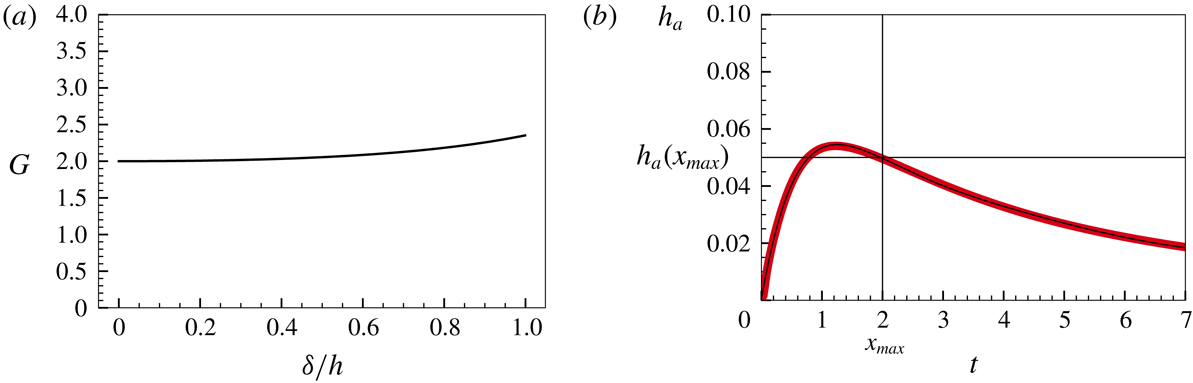
where the function
 $G(\unicode[STIX]{x1D6FF}/h)$
defined in (A 14) and plotted in figure 10(a), is rather insensitive to the ratio
 $\unicode[STIX]{x1D6FF}/h$
. Therefore, the momentum equation (A 12) can be written as
 $$\begin{eqnarray}\frac{\unicode[STIX]{x2202}u}{\unicode[STIX]{x2202}t}+u\frac{\unicode[STIX]{x2202}u}{\unicode[STIX]{x2202}r}=-\frac{\unicode[STIX]{x1D706}u}{hRe\unicode[STIX]{x1D6FF}}=-\frac{\unicode[STIX]{x1D706}u}{h\sqrt{Re\,t}},\end{eqnarray}$$
with
 $\unicode[STIX]{x1D706}$
a constant that will take into account: (i) the prefactor multiplying the ratio
 $\sqrt{t/Re}$
, (ii) the type of velocity profile used to describe the flow field within the boundary layer and (iii) the deviations from the assumption made here that
 $\unicode[STIX]{x1D6FF}=\sqrt{t/Re}$
, a result which is only valid in the boundary-layer approach for a flow field outside the boundary layer of the form
 $u=r/t$
(Roisman Reference Roisman2009; Eggers et al.
Reference Eggers, Fontelos, Josserand and Zaleski2010). It will be shown in the main text the experimental results can be reproduced for a value of the constant
 $\unicode[STIX]{x1D706}=1$
.
(a) Representation of the function
 $G$
defined in (A 14) as a function of the ratio
 $\unicode[STIX]{x1D6FF}/h$
. (b) The polynomial
 $P(x)$
in (A 20) (black line) matches the time evolution of the height of the lamella calculated at
 $r=\sqrt{3x}$
using the boundary integral method described in Riboux & Gordillo (Reference Riboux and Gordillo2016). The function
 $h_{a}(x)$
does not depend neither on
 $Re$
nor on
 $We$
for
 $We\gg 1$
. Here,
 $We=300$
.

The solution of the system of partial differential equations describing both the height of the lamella
 $h(r,t)$
and the averaged velocity
 $u(r,t)$
, given by (A 4) and (A 15),
 $$\begin{eqnarray}\frac{\unicode[STIX]{x2202}(rh)}{\unicode[STIX]{x2202}t}+u\frac{\unicode[STIX]{x2202}(rh)}{\unicode[STIX]{x2202}r}=-rh\frac{\unicode[STIX]{x2202}u}{\unicode[STIX]{x2202}r}\quad \text{and}\quad \frac{\unicode[STIX]{x2202}u}{\unicode[STIX]{x2202}t}+u\frac{\unicode[STIX]{x2202}u}{\unicode[STIX]{x2202}r}=-\unicode[STIX]{x1D706}\frac{u}{h\sqrt{Re\,t}},\end{eqnarray}$$
particularized at
 $r=s(t)$
, permit us to integrate the system (A 1) in time.
Indeed, notice that (A 9) can be accurately approximated as
 $$\begin{eqnarray}\int _{0}^{h}\bar{u}\bar{u}\,\text{d}z=u^{2}h+\frac{u^{2}h}{(1-\unicode[STIX]{x1D6FF}/(2h))^{2}}\frac{\unicode[STIX]{x1D6FF}}{3h},\end{eqnarray}$$
and also that the force exerted by the wall on the rim,
 $f_{\unicode[STIX]{x1D70F}}$
(see (A 1)) is given by
 $$\begin{eqnarray}f_{\unicode[STIX]{x1D70F}}=\frac{w_{0}^{2}\unicode[STIX]{x1D6FF}}{3}+\unicode[STIX]{x1D6FE}\,We^{-1}\,Ca\,v=\frac{u^{2}h}{(1-\unicode[STIX]{x1D6FF}/(2h))^{2}}\frac{\unicode[STIX]{x1D6FF}}{3h}+\unicode[STIX]{x1D6FE}\,We^{-1}\,Ca\,v,\end{eqnarray}$$
with
 $\unicode[STIX]{x1D6FE}\sim O(1)$
. Indeed, the flux of momentum entering into the drop through the boundary layer,
 $w_{0}^{2}\unicode[STIX]{x1D6FF}/3$
, does not contribute to accelerate the rim because the fraction of the momentum injected closer to the solid is decelerated by the wall. The second term at the right of (A 18) is the integral of the viscous shear forces at the wall
 ${\sim}Re^{-1}v/b$
along a region of width
 ${\sim}b$
. Then, taking into account the definition of the mean velocity in (A 3), the system of (A 1) can be written as
 $$\begin{eqnarray}\left.\begin{array}{@{}c@{}}\displaystyle \unicode[STIX]{x1D6FC}\frac{\unicode[STIX]{x03C0}}{4}\frac{\text{d}b^{2}}{\text{d}t}=[u(s,t)-v]h(s,t),\quad \frac{\text{d}s}{\text{d}t}=v,\\ \displaystyle \unicode[STIX]{x1D6FC}\frac{\unicode[STIX]{x03C0}b^{2}}{4}\frac{\text{d}v}{\text{d}t}=[u(s,t)-v]^{2}h(s,t)-(1+\unicode[STIX]{x1D6FD})\,We^{-1}-\unicode[STIX]{x1D6FE}\,We^{-1}\,Ca\,v.\end{array}\right\}\end{eqnarray}$$
We will limit ourselves here to discussing the cases for which
 $Ca\ll 1$
and hence, the last term in (A 19), will be neglected.
Let us finally point out that, in the potential flow case, the thickness of the liquid film at the boundary separating the drop and lamella regions i.e. at
 $r=\sqrt{3x}$
, can be accurately calculated as
 $h_{a}(x)=P(x)$
, with
 $$\begin{eqnarray}\displaystyle P(x) & = & \displaystyle \mathop{\sum }_{i=0}^{9}p_{i}x^{i}\quad \text{with}\nonumber\\ \displaystyle & & \displaystyle \hphantom{with}\quad p_{0}=3.95812707\times 10^{-4},\quad p_{1}=1.22669850\times 10^{-1},\nonumber\\ \displaystyle & & \displaystyle \hphantom{with}\quad p_{2}=-1.04054024\times 10^{-1},\quad p_{3}=4.37229580\times 10^{-2},\nonumber\\ \displaystyle & & \displaystyle \hphantom{with}\quad p_{4}=-1.09184802\times 10^{-2},\quad p_{5}=1.70579418\times 10^{-3},\nonumber\\ \displaystyle & & \displaystyle \hphantom{with}\quad p_{6}=-1.67926979\times 10^{-4},\quad p_{7}=1.01063551\times 10^{-5},\nonumber\\ \displaystyle & & \displaystyle \hphantom{with}\quad p_{8}=-3.39290090\times 10^{-7},\quad p_{9}=4.86535897\times 10^{-9},\end{eqnarray}$$
see figure 10(b).