After he left office in 1968, Lyndon Johnson recounted his difficult political situation to Doris Kearns Goodwin. He mentioned Vietnam, inflation, urban unrest, and student protests, but what he claimed was most “unbearable” was something he “feared from the first day” of his presidency: “Robert Kennedy had openly announced his decision to reclaim the throne in the name of his brother. And the American people, swayed by the magic of the name, were dancing in the streets.”Footnote 1 Johnson’s concerns were referred to by both his aides and by the president himself as the “Bobby problem.” One aide, in fact, contended Robert Kennedy received more attention than any other single issue in the Johnson White House.Footnote 2 The animosity between LBJ and RFK had major ramifications for party unity and domestic and foreign policy. The “Bobby problem” is not an isolated phenomenon. Intraparty competition that reaches this level of intensity is a recurring feature of presidential politics in America. Several other presidents have confronted similar challenges. Although the sources and characteristics of faction differ, it is possible to identify common dynamics in these conflicts as well as strategies employed by presidents to deal with factional challengers.
I
LBJ’s “Bobby problem” was a manifestation of factional competition within the Democratic Party, in this case over leadership of the same faction. While party factions are a recurrent feature of all democratic political systems, the phenomenon has been particularly difficult to define. As “semi-variable” structures beneath the level of political parties, factions can be quite durable or fleeting, based on personality, ideology, clientele groups, or combinations of each. Sometimes factions can lead to party defections, new parties, or social movements.Footnote 3 Factions exist in both parliamentary and presidential political systems and in different electoral structures.Footnote 4 They also appear in authoritarian regimes.Footnote 5 Factional activity seems to increase with modernization, although some observers contend factions can retard further development.Footnote 6 Factions appear in every kind of organization: parties to legislative committees, administrative units, corporations, and churches. Despite their varied forms, factions, nevertheless, are a fundamental feature of politics. As subunits of organizations, factions have an ideological framework, organizational capabilities, and strategic objectives and can be viable for extended periods.Footnote 7 These features may be more or less pronounced, hence the permeable line between factions and terms such as “clique,” “bloc,” “tendency,” or “wing.”Footnote 8 Factional leaders too may regard these units as an ad hoc vehicle for immediate political objectives or permanent base.Footnote 9 Their own source of authority may be ideological, charismatic, or interest based (or as often combinations of each).
Despite Publius’s attempt in the Federalist to reduce factional influence through multiplication, factional politics was a major concern in the early period of the republic. While the founders employed the terms “party” and “faction” interchangeably and in negative terms, they frequently defined both as leader-inspired.Footnote 10 Washington, in his Farewell Address, admitted that factions “may now and then answer popular ends,” but focused on their negative outcomes. Factions are led by “cunning, ambitious and unprincipled men” who would cast away the “very engines which have lifted them to unjust dominion.”Footnote 11
Nevertheless, before the ratification of the Twelfth Amendment, the Constitution seemed to invite Bobby problems. As factional leaders in the new republic, the rivalry between Adams and Jefferson was institutionalized by constitutional arrangements that awarded the vice-presidency to the second-highest vote getter. Although the ratification of the Twelfth Amendment in 1804 significantly reduced one source of faction, multiple access points for factional activity remained.
Sitting presidents who are challenged by critics within their own party are a common feature in national politics. Often these challengers to presidential policies offer their views from the legislative branch. Even the most powerful presidents endure these attacks. Jefferson sustained severe criticism from John Taylor and John Randolph, Jackson from John C. Calhoun, Lincoln from Benjamin Wade in the House and Charles Sumner in the Senate, FDR from Carter Glass and Burton K. Wheeler. Opposition can come too from within the executive branch. Vice presidents and cabinet members have sometimes been highly visible dissenters from presidential policies. Albert Gallatin opposed Jefferson’s embargo. Lincoln’s entire cabinet included high-profile dissidents from many of his policies. William Jennings Bryan resigned as Secretary of State over Wilson’s war policy. John Nance Garner became an open critic of the New Deal. In many cases, these critics were lone dissenters, but some, like Randolph and Wade, became factional leaders within the governing party.Footnote 12
Intraparty opposition to a president, when headed by influential critics in the legislative and executive branches, can lead to stalemates and policy incoherence as the opposition makes temporary alliances with party dissidents. When sustained criticism of the governing party is led by individuals with the capacity to challenge a president’s reelection, the consequences can be even more serious. The governing party can be defeated in the general election as a result of low morale among regulars, perceptions of incompetence by the public, and even by the emergence of third-party alternatives.
In these earlier cases, the Bobby problem is played out in the context of factional politics generally, under initial constitutional arrangements and largely before the development of mass-based political competition.Footnote 13 It is, however, with the emergence of the second party system that the Bobby problem takes full effect as intraparty rivalry produces ad hoc coalitions between a divided party and the opposition, and sometimes new parties, in an expanded political arena.Footnote 14
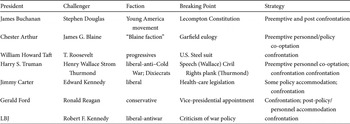
There are six instances of Bobby problems, in addition to the LBJ case, in which factional leadership challenged presidential reelection: Buchanan’s rivalry with Douglas; Chester A. Arthur’s with James G. Blaine; William Howard Taft’s with Theodore Roosevelt; Harry S. Truman’s with Henry Wallace and Strom Thurmond; Jimmy Carter’s with Edward Kennedy; and Gerald Ford’s with Ronald Reagan.Footnote 15 In each case, the factional challenge elicited presidential responses with major electoral and policy consequences (see Table 1).
Let us briefly review the circumstances in each case:
The Buchanan-Douglas rivalry: Buchanan ran for election in 1856 on a theme of national reconciliation. He supported the Kansas-Nebraska Act, sponsored by Senator Stephen Douglas, and endorsed in the Democratic Party platform, despite his personal reservations. Although Douglas was a rival to Buchanan at the nominating convention, he endorsed Buchanan when it became clear he could not win and he vigorously campaigned for the party candidate. Buchanan’s curt note of appreciation to Douglas after the election, which was addressed to the “Hon. Samuel A. Douglas,” signaled an exclusion strategy. Douglas was denied patronage by the new president as well as factional representation in his cabinet. The Buchanan-Douglas relationship reached a breaking point, however, when the senator supported a new constitutional convention in Kansas and made his opposition to the president public in a speech before the Senate.
The Arthur Blaine rivalry: When Chester Arthur took office in 1881 after Garfield’s death, he became the leader of a highly factionalized party. The strongest faction in the Republican Party was the Stalwarts, of whom Arthur was a prominent member. But their stock had fallen precipitously with the public after the assassination. Arthur refused to award its leader, Roscoe Conkling, with a cabinet post. The liberal faction of the party was too small to present a Bobby problem to Arthur. James G. Blaine, Garfield’s Secretary of State, was another matter. Shortly after the 1880 presidential election, he offered an analysis of party factions to the new president, identifying the “Blaine faction” as the most important component of the party. Arthur immediately asked all cabinet members to remain in his administration until the next Congress. Blaine initially agreed, but announced in October that he intended to resign. In February, Blaine delivered a eulogy to Garfield before Congress, Arthur himself, and his cabinet. Blaine’s “national fame soared, never waning during the Arthur presidency.”Footnote 16
The Taft–Theodore Roosevelt rivalry: President Taft was prepared to face open opposition from the former president almost from his inauguration. TR had left the country after the 1908 election in part to give Taft some political space. Despite concerns about the new president’s effectiveness, Roosevelt remained silent. He was outraged, however, upon learning of Taft’s dismissal of Gifford Pinchot and annoyed by Taft’s enthusiastic support of the Payne-Aldrich tariff. Still, Roosevelt openly supported the president, although he told Pinchot that his patience was wearing thin.Footnote 17 Henry Cabot Lodge arranged a meeting between the two men to preserve party unity. The talk went well, although Roosevelt told Taft he intended to testify before a congressional committee investigating policies regarding U.S. Steel during his administration. Taft, instead, asked Roosevelt to lead a peace commission to Europe, which he refused. Roosevelt left the meeting promising to support Taft in 1912. In October, however, Taft announced a suit against US. Steel under the Sherman Anti-Trust Act, raising questions about TR’s role in accepting its acquisition of Tennessee Coal and Iron in the midst of the panic of 1907. Two weeks later, TR published an article in The Outlook defending his past actions and hinting at his availability for the nomination in 1912. When Robert La Follette’s candidacy faltered in February, Roosevelt announced: “My hat is in the ring.”
The Truman-Wallace-Thurmond rivalries: Truman represents an exceptional case since he faced two Bobby problems. When he was selected by FDR for vice president in 1944, Henry Wallace, as well as major portions of the liberal wing of the Democratic Party, regarded the decision as a coup managed by party bosses who took advantage of an ill president preoccupied with foreign affairs. Roosevelt attempted to compensate the former vice president by nominating him as Secretary of Commerce. Truman was given the unenviable task of securing his confirmation. When FDR died, Wallace insisted on attending the funeral alongside Truman and repeatedly questioned the new president’s ability to govern. After Wallace delivered an address criticizing Truman’s foreign policy, the president fired him. For almost a year, Wallace insisted he would not run against Truman and said he only hoped to pressure the administration to alter its policies in regard to the Soviet Union. But on December 29, 1947, he announced his candidacy for president.
Meanwhile, Truman faced a Bobby problem in the South. While Southerners were initially pleased with the new president, discontent openly emerged when Truman appointed a commission to investigate civil rights violations in December 1946 and then spoke to the NAACP at the Lincoln Memorial in June. He incorporated many of the commission’s recommendations in his State of the Union message in January and followed up with another special message devoted exclusively to civil rights in February 1948. The ten-point “minimum” plan included an end to segregation, antilynching legislation, and protection of voting rights. When Southern governors met in February, some advocated leaving the party, but Strom Thurman urged restraint. But when the party adopted a civil rights plank even stronger than Truman’s recommendations at the convention, States’ Rights Democrats met in Birmingham and nominated Thurmond for president with his assent. The president faced two challengers to his nomination in addition to the Republican candidate.
The LBJ–Robert F. Kennedy rivalry: When John F. Kennedy defeated Johnson on the first ballot at the Democratic national convention in 1960, he offered his opponent the vice presidency. Johnson accepted only to be asked by his brother to withdraw. Johnson refused and was successful in keeping his name in nomination. Both during the campaign and after Kennedy’s victory, Johnson felt his contributions were not only ignored but ridiculed. He blamed his low status in the administration on Bobby. Shortly after the assassination, Johnson asked the attorney general to remain in the administration. In his request, however, the new president openly acknowledged the existence of factional conflict. . . .You can’t let your people talk about me and I won’t talk about you.”Footnote 18 This statement with its reference to “your people” reveals a belief on Johnson’s part that RFK was in effect the leader of an opposition, real or potential, within the government. Despite pressure from his own party, Johnson refused to ask RFK to be on the ticket in 1964. So concerned that the convention would draft Kennedy as vice president, Johnson postponed a memorial to JFK until the last day of the meeting. Nine months latter, Kennedy ran for Senator of New York with Johnson’s support. Johnson continued to believe that members of his administration were more loyal to Kennedy than to him. In the Senate, Kennedy supported the president’s domestic policies but called in 1967 for a withdrawal of American forces from South Vietnam. On March 16, 1968, Kennedy announced his candidacy for president. He stated, “I do not run for the Presidency merely to oppose any man, but to propose new policies. I run because I am convinced that this country is on a perilous course and because I have such strong feelings about what must be done, and I feel that I’m obliged to do all I can.” Two weeks later, LBJ withdrew his name for reelection.
The Ford-Reagan rivalry: Gerald Ford decided to seek election about nine months after he became president in 1974. He expected no opposition within his own party despite Republican complaints about his nomination of Nelson Rockefeller as vice president. However, many delegates at the Conservative Action Conference in February 1975 spoke of forming a third party with retired governor Ronald Reagan as presidential candidate. Reagan responded that a new party was not needed. Instead, he called for “a new and revitalized second party.”Footnote 19 In early June, a group of conservative senators proposed an open convention. Reagan was not the only possible Republican challenger as the president attempted to move to the right and hinted that Rockefeller might be removed from the ticket. Moderates and liberals in the party began to explore the possibilities of a candidacy. Aside from Senators Mathias, Baker and Percy, Rockefeller himself intimated that he might also be available. Ford began to compare himself to Truman, complaining to voters about the “do-nothing Congress” much as FDR’s successor had done in 1948. Unlike Truman, Ford did not face two Bobby problems, but he did have one. Ronald Regan declared his candidacy for the presidency in November.
The Carter–Edward Kennedy rivalry: In 1974, Governor Jimmy Carter assumed that Edward Kennedy would be his major opponent in the upcoming Democratic Party primaries. Kennedy’s decision to withdraw enabled Carter to position himself advantageously among a group of liberal candidates. Immediately after his election, however, his advisers warned the president-elect to expect policy challenges from the senator. While their relationship appeared cooperative despite Kennedy’s leads in early 1980 presidential polls, open conflict emerged in the summer of 1978 over health-care legislation. Carter refused to endorse Kennedy’s universal health-care approach, although for the next seven months their respective staffs attempted to reach a compromise. A final acrimonious meeting in July resulted in an open split. In March, Kennedy rejected a compromise proposal and pledged to defeat the president’s plan. Kennedy announced his candidacy for president in November.
II
While factions may be difficult to define generally, a common pattern is observable. In each case, there is a high level of personal animosity between the president and his intraparty challenger. Johnson called Bobby Kennedy a “snot-nosed grandstanding little runt,” and RFK said LBJ was “mean, bitter and vicious—an animal in many ways.”Footnote 20 In general, presidents, like LBJ, regard their challenger as selfish, ungrateful, unprincipled, and/or deluded. Arthur portrayed Blaine as reckless.Footnote 21 Buchanan saw Douglas as ambitious and ungrateful.Footnote 22 Ford described Reagan as narcissistic, disruptive, “shortsighted,” and “narrow-minded.”Footnote 23 These presidential reactions confirm those theories of faction as competitive leadership formations.Footnote 24 Sometimes, however, presidents also contend that their rivals are controlled by other forces, tending to support factional theories that see them as an extension of interest-group tactics.Footnote 25 Truman portrayed Wallace variously as in the hands of New Deal “crackpots,” Eleanor Roosevelt, and the Communist Party.Footnote 26 Carter saw Kennedy as a spokesperson for labor interests.
Challengers, by contrast, describe the president as incompetent, stubborn, often vengeful, and corrupt. Taft, to Roosevelt, was a “fathead” with an intellect “less than a guinea pig’s” who was controlled by conservatives.Footnote 27 Ford, to Reagan, was a weak leader who “had been in Congress too long” to take on deficit reduction.Footnote 28 The tendency of challengers to be charismatic figures facing presidents with a mediocre persona only serves to intensify the Bobby problem. Elihu Root, a friend of TR’s who officially supported Taft, saw both sides when he described the state of the Republican party in 1912 in these terms: “The sordid business of most of the so-called Regulars, who now regard themselves as especially the Taft men, and the wild, irresponsible folly of the ultra-Insurgents, make a situation which is very unpleasant.”Footnote 29 Root’s analysis of dual interpretations applies to other cases as well. To supporters, the challenger is the man of ideas and an agent of change. To the president, he is simply an opportunist. The self-identification of rival Republican delegates in 1976 reveals a pattern similar to 1912: “The Ford people see themselves as regulars; the Reagan people as hacks. Reaganites saw themselves as principled; the Ford people saw them as fanatics.”Footnote 30
These cases of mutual contempt sometimes reach their peak in a confrontation, often in private, in which both parties state their views. These moments themselves become micro narratives or parables that supporters of each utilize. An early exemplary case is Andrew Jackson’s dinner toast in which the president said, “Our federal Union, it must be preserved,” and Calhoun replied “The Union, next to our liberty, the most dear.” The dueling toasts were part of a public event in which civility is barely retained as rivals stated their differences. Calhoun partisans could appreciate the vice president’s quickness in responding to a challenge, for his other options would be to refuse to drink (an open insult to the president) or accept the toast as given (thus accepting rhetorical defeat). The Douglas-Buchanan meeting over the Lecompton constitution was held in private and is particularly revealing about both rivals. Buchanan demanded Douglas’s backing and reminded him of the fate of those Democrats who opposed President Jackson. Buchanan is not the legendary weak president in this narrative when he threatens Douglas: “Mr. Douglas, I desire you to remember that no Democrat ever yet differed from an Administration of his own choice without being crushed. Beware of the fate of Talmadge and Rives.”Footnote 31 Douglas is reported to have replied, “Mr. President, I wish you to remember that General Jackson is dead.” This factional parable has multiple lessons. There is the courageousness of Douglas in the face of a vindictive president and there is Douglas’s own performative that the age of Jackson was over. Secluded in the parable is an alternate message: Douglas was endangering party unity by opposing a president in order to secure his senatorial reelection.
There are numerous variations in these confrontations with other presidents and their Bobby problems. Before Truman called Wallace to ask for his resignation after his speech criticizing American foreign policy, he wrote him an abusive letter. Wallace reportedly told Truman the letter was at such a “low level” that he suggested it be returned to the White House. Truman agreed. Wallace never disclosed its contents either during the campaign or later. Here the incomplete record of the confrontation favors Wallace. Truman was known to write outrageous letters, most undelivered, and the parable lesson here involves a noble challenger and a vituperative president.Footnote 32
After LBJ told Robert Kennedy that no cabinet officer would be eligible for nomination as vice president in 1964, he spent four hours attempting to create his own parable. RFK, according to the president, acted like a “stunned semi-idiot” when he heard his decision. Johnson mimicked Bobby’s “funny voice” as he related how “his face changed, and he started to swallow. He looked sick. His Adam’s apple bounded up and down like a yo-yo.” Perhaps to solidify his version, LJB produced the memorandum he read from at the meeting in his memoir.Footnote 33
The public rupture between Johnson and Kennedy, however, did not occur until February 1967, producing a second micro-narrative. Johnson, with some justification, concluded that Kennedy had interfered with possible peace talks. The meeting made the earlier confrontation over the vice presidency seem like a minor disagreement. Kennedy denied any culpability but offered some proposals for speeding up negotiations. Johnson replied: “There isn’t a chance in hell that I would do that.” He told Kennedy he not only never wanted to hear his views on Vietnam again, but also did not want to ever see him again. “I’ll destroy you and every one of your dove friends in six months,” he threatened. “You’ll be dead politically in six months.”Footnote 34
When Reagan told Ford he planned to run for the nomination but promised not to be divisive, Ford sharply disagreed. He had “done a good job” and a primary fight would “take a lot of money, a lot of effort, and it will leave a lot of scars.”Footnote 35 From the challenger’s viewpoint, there was an effort to keep the competition restrained; from the president’s, Reagan was either blissfully ignorant of the upcoming situation or simply disingenuous.
Carter and Kennedy avoided a personal confrontation but micro-narratives nevertheless emerged, perhaps from misperceptions, since “both sides would regularly read the worst intentions into each other’s actions.”Footnote 36 When the president and Kennedy met several times to discuss health care and Carter finally told him he intended to present a scaled-down version to Congress, Kennedy said he needed to study the proposal before any public announcement was made. According to Carter, he and the senator “shook hands and parted in fairly good spirits.” Within a few hours, Kennedy held a press conference to condemn the president’s proposal. From the president’s vantage point, Kennedy’s action was duplicitous and feckless. There was, in Carter’s mind, “no prospect of Congressional support for his own program.”Footnote 37 To Kennedy, Carter mistakenly believed the senator was angling for signature legislation to challenge him in the 1980 primaries, when, in fact, he missed an opportunity to undermine any such plans.Footnote 38
It was at the 1980 convention itself that this micro-narrative assumed public dramatic proportions. Once again, Carter believed Kennedy would be accommodative. In his diary, he asked for Kennedy’s endorsement and appearance on the convention platform after the senator withdrew. The senator indicated that would depend on the details of various planks; Carter replied that there were many differences between them. No substantial changes could be made that were not already agreed upon. Kennedy left in a “good mood.” Nevertheless, according to Carter, Kennedy made a “stirring and emotional” speech designed to gain support for platform changes. Kennedy did appear on the platform with the president but with a palpable lack of enthusiasm. Carter contended the oversight was purposeful and “was quite damaging to our campaign, and was to linger for a long time.”Footnote 39 It particularly rankled since Kennedy’s speech forced him to accept numerous platform concessions. Kennedy, by contrast, insisted no slight was intended and that, in fact, Carter did not elevate his hand either when they shook.Footnote 40 What rankled him was the president’s continued reference to the incident: “He makes a point of saying so frequently, especially when he speaks in Boston.”Footnote 41
These intense personal animosities are not, of course, acted out in isolation. The president and his challenger represent factional forces within a party and instances of the Bobby problem seem to occur in moments when factional politics are prominent. In most cases, the president holds the position of what Stephen Skowronek calls a “late regime articulator,”Footnote 42 attempting to hold together a once-cohesive, dominant electoral coalition. Often the challenging faction represents a mass movement within or outside the party. Buchanan governed in the context of a party deeply divided sectionally.Footnote 43 Even in the North, the party included “barnburners” and “hunkers.” Blaine’s own analysis of the post–Civil War Republican Party identifies several factions. The Stalwart wing of the party was strong enough to force the nomination of Arthur as vice president in 1880. Intraparty volatility was so high that movement across party lines was a realistic threat. The Democratic Party openly split in the 1860 presidential election and the Mugwumps endorsed Cleveland in 1884. Liberal and conservative factions split both from the Republican Party in 1912 and the Democratic Party in 1948. In both cases, factional disputes led to exits to third parties. Conservative supporters briefly threatened to leave the Republican Party in 1975 if they were not able to become the governing faction, and both LBJ and Carter were regarded by liberal Democrats as interlopers.
Nor can a president be expected to fully anticipate the structure of the faction that will challenge him. As soon as he became president, Arthur recognized that the Stalwart faction needed to be contained, and so too did Buchanan with the Barnburners. Both, nevertheless, faced major challenges from another faction, led by Blaine and Douglas, respectively. In a majority of these cases, factions opposing a president are of the ideological clique variety described by Beller and Beloni as relatively unorganized groups in which the role of a leader is prominent “but in a charismatic, not a clientelist manner.”Footnote 44 But Thurmond may fit more closely to a client-group faction form and a major part of Douglas’s support in the Young America movement and Wallace’s support from the Communist Party resembles the institutional form in which membership is formalized. Both Theodore Roosevelt and Ronald Reagan led mass movements in their attempt to win the nomination.
It is also not surprising that four examples of the Bobby problem occur under accidental presidents, those who assumed the office due to the death or resignation of a president. Without a direct electoral mandate, accidental presidents are especially open to factional challenges.Footnote 45 Indeed, they are regarded as presidents representing a party faction themselves. Arthur was not only a major, controversial figure of the Stalwarts, but his party faction was regarded as indirectly responsible for Garfield’s assassination. Both LBJ and Truman were placed on the ticket to protect the Southern party faction. Ford, the first president to serve under the procedures of the Twenty-Fifth Amendment, was considered unreliable to conservatives.
Given the accidental president’s unique position, he generally lacks the resources to subdue these factional complaints. As Whitelaw Reid wrote to Blaine after Garfield’s assassination, “You are the popular representative of Garfield’s Administration, the residuary legatee of his popularity. You ought to be and can be chosen as his successor.”Footnote 46 Both Johnson and Truman also were faced with the charge that they did not—and could not—represent the “soul” of the party. Henry Wallace, though denied the vice presidency in l944, regarded himself as the rightful ideological heir to FDR. He complained that Truman had begun a “relentless retreat from the New Deal” while “great experiments were now underway in Britain and Scandinavia.” Labor in Britain was “on the march, reactionary America was relying on her wealth alone and living in alarm.”Footnote 47 RFK, as the brother of the slain president, was in an especially favorable position to claim it was he who should “carry the torch,” not Johnson, whom he considered a latecomer to the cause.
It may be, however, that a president’s governance at a particular point in political time as well as his “accidental” status may be instances in which Bobby problems are exacerbated. Numerous scholars have noted that the incentive structure of the presidency encourages aggressive action in order to ensure some measure of autonomy.Footnote 48 Factional challengers and their demands for personnel and/or policy concessions strike at the institutional base of the office. Presidents, much like defenders of a walled city, are reluctant to endorse accommodation and/or co-optation since both are seen as likely precursors to defeat. Johnson’s description of his feelings in 1968 (“I felt that I was being chased on all sides by a giant stampede coming at me from all directions”) is an example of a siege mentality common among presidents with their own Bobby problems. The frequent charges by factional leaders centering on presidential obstinacy is also a conformation of this behavior.
III
Presidents face intraparty challenges from a variety of factional forms, especially when party cohesion is fragile or when their authority is vulnerable. Are presidents with Bobby problems completely prisoners of circumstance? Are presidents simply fated to suffer these challengers, unable to eliminate or control these men they so personally scorn? Are they powerless to check the factions they represent? Sitting presidents are not without resources to deal with a Bobby problem. While rarely are their responses completely successful, presidents have pursued a variety of strategies to resolve their predicament.
One basic approach involves accommodating the challenger either though policy adaptations or co-optation. Another involves a strategy in which a president instead emphasizes his differences with the challenger, perhaps to the point of attempting to destroy his political career, perhaps also wiping out the faction he represents. Timing, of course, is crucial to these efforts. A president may employ one at an early stage of a Bobby problem as a preemptive measure. Once a challenger has openly and irrevocably broke with a president, after one of the confrontations noted above or after he has announced his candidacy, the president can still employ many of the same options.
Preemptive co-optation was an option ignored by three presidents with Bobby problems. Buchanan could have offered a cabinet position to Douglas or given one to one of his factional representatives. Installing Douglas in the cabinet would certainly have raised the stakes for him in challenging the president on the Kansas question. As a cabinet officer, Buchanan would also have taken away a capable factional leader in the Senate as well. More generally, Douglas in 1857 was an extremely popular Democratic leader, even idolized in parts of the country, with a national following that could add to the president’s governing coalition. Denying Douglas any presidential patronage was, in the context of nineteenth-century politics, in itself almost an open declaration of factional war, especially since Buchanan rewarded Douglas’s own factional rival, Jesse Bright.
Johnson too had ample opportunities for co-optation. Not only did he reject selecting Bobby Kennedy as his vice president in 1964, but he also refused RFK’s offer to serve as ambassador to South Vietnam. Either choice would have neutralized or at least reduced intraparty criticism of the war by Robert Kennedy. Had Ford recommended Reagan or another figure in the conservative faction to fill the vice presidential vacancy in 1975, he would have effectively eliminated any Bobby problem from the right.Footnote 49
Why did these presidents fail to select an early co-optation strategy that almost certainly would have prevented the emergence of a Bobby problem? To some extent, these presidents underestimated their adversaries. By refusing to invite their participation in their administration, they assumed that the challengers would be without the resources to confront them. Specific explanations are also possible. Buchanan, who highly valued loyalty, turned to Bright rather than Douglas because he had supported him throughout the nominating convention. “He could not satisfy both Douglas and Bright; and Douglas, therefore, had to be disappointed.”Footnote 50 As an accidental president, Johnson felt that a Kennedy on the ticket would prolong his obeisance to his predecessor’s faction. While LBJ’s extensive reliance on the Kennedy name may have been necessary as long as he was an accidental president, a continued homage might limit rather than enhance his future agenda. Ford may have selected Rockefeller for vice president because his experience and stature in the party and with the press might solidify his legitimacy. Rockefeller was also the only short-listed candidate not associated with the Nixon administration.
On the other hand, presidents attempting to employ the co-optation strategy have not always been successful. Blaine stayed on as Secretary of State just long enough to solidify his foreign policy credentials. He simply ignored Arthur’s attempts to direct his initiatives. Although Truman replaced all of FDR’s cabinet within three months, he retained Wallace (along with Ickes). Personal disagreements with his Commerce secretary were rare. Two weeks into the new administration Wallace noted that “Truman was exceedingly eager to agree with everything I said.”Footnote 51 Even as the positions between the two diverged, first on atomic energy policy and trade relations with the Soviet Union, Truman refused to engage Wallace either in public or private. Consequently Wallace was able to solidify his support among liberals in the Democratic Party. The Progressive Citizens of America (PCA), organized in December 1946, already favored a Wallace third-party ticket. A president with a Bobby problem thus risks enhancing a rival’s position when he selects this strategy.
Preemptive policy accommodation has the advantage of eliminating the need for co-optation and, optimally, removing a rival’s case for challenging a president. Arthur’s support for civil service reform after the party’s losses in the mid-term elections was, in part, an attempt to strengthen his connection with the Garfield agenda, with which Blaine had become so associated. It was extremely difficult for Bobby Kennedy to criticize Johnson’s policies that continued the efforts of his brother until the Vietnam issue arose.Footnote 52 Indeed, part of LBJ’s insistence on continuing the war was based upon his belief that a negotiated settlement would leave an opening for RFK from the right.Footnote 53
Yet preemptive policy accommodation has its risks. Arthur’s case is illustrative. His action merely angered his Stalwart base and left reformers unconvinced of his motives. For a president to adopt the policies of his rival risks alienating his own base of supporters, perhaps making himself more vulnerable to intraparty challenges. For example, Carter’s decision to delay proposing legislation on national health insurance at the beginning of his term is initial evidence, despite Kennedy’s objections, of this dilemma. A comprehensive health-care plan, while long on the Democratic Party agenda, would risk increasing both inflation and deficits. Labor was likely to be a major influence in the formation of a plan and its passage in the legislative struggle. Carter’s legitimacy was based, in part, on his ability to enforce austerity in government and his independence from traditional Democratic constituencies. Carter seemed willing to compromise slightly but ultimately refused Kennedy’s offer for a phased-in plan. As a result, the “Carter-Kennedy breach merely further divided an already fractured party and increased the likelihood of a Kennedy challenge for the party’s nomination in 1980.”Footnote 54 But from the president’s point of view, accommodating Kennedy would have violated his mandate, increased inflation, and threatened his reelection. It is also not even clear that such an accommodation would have eliminated his Bobby problem. Failure to pass the legislation might have raised questions about Carter’s competence or resolve. Credit for a successful bill might go to Kennedy. In addition, Carter was confident that his policies reflected the mood of the country. If Kennedy decided to run against him, he would “whip his ass.”Footnote 55
The same alternatives—co-optation, accommodation, and confrontation both in terms of personnel and policy—remain available to presidents with Bobby problems after an open challenge is made, albeit with more intensity. Gerald Ford moved to the right in his polices and even discarded his vice president. His selection of a new running mate was approved by Reagan. Carter moved in both directions, to the right in foreign policy and the left in domestic programs. Once his renomination was secure, Carter ordered his staff to cease attacks on Kennedy, although he refused to accept his rival’s platform plank on health care. While the success of both of these efforts is arguable, neither produced a faction-free convention. Both presidents blamed their defeat on their Bobby problems.Footnote 56
Aggressive attacks have also been employed by many presidents. Buchanan continued his strategy of open opposition to Douglas even though he was not officially a candidate himself in 1860.Footnote 57 He encouraged Southern delegations at the Charleston convention to oppose Douglas and their secession from the convention. Charleston was the most faction-ridden convention until 1968. Another had to be called, this time in Baltimore to select a nominee. When Douglas was finally nominated, yet a third convention was held in Richmond. The nominee, Vice President John Breckinridge, was openly endorsed by Buchanan. Like Buchanan, who packed the Charleston convention with federal officeholders instructed to oppose Douglas at all cost, Taft in 1912 deftly used the Republican Party machine (ironically created by TR) to deny his challenger almost all the contested delegates, thus denying Roosevelt control of the convention.Footnote 58
Once it was clear to Arthur that Blaine could not be mollified, his new secretary of state withdrew invitations to the upcoming Pan-America conference. Along with Senate opposition to a reciprocity treaty with Hawaii, Blaine saw his foreign policy achievements begin to disintegrate, including the claim that he represented the legacy to Garfield’s Pan-Americanism. Truman largely ignored the Southern-based “Dixiecrat” Party, but he did systematically attack the Progressives. With the aid of his adviser, Clark Clifford, he devised a strategy for attacking Wallace. In his St. Patrick’s Day speech in l948, Truman declared that he would never accept the support of Wallace “and his Communists” even if it meant his own defeat. In Los Angeles, he urged Wallace to reject Communist support and “go to the country he loves so well and help them against his own country if that’s the way he feels.”Footnote 59 The approach was designed to force liberal Democrats to reject Wallace as pro-communist and, at the same time, to solidify support for Truman as the only “responsible” agent for continuing the domestic programs of the New Deal of the 1930s. The tactic worked. The Americans for Democratic Action (ADA), a group of liberal Democrats formed in 1947, who did not initially think Truman could be relied on to continue the New Deal, attacked Wallace for his refusal to renounce communist support of his campaign and supported Truman.
None of these tactics—co-optation and accommodation or direct attack—before or after an open challenge are reliably successful. Buchanan, who consistently employed the most aggressive tactics against his rival, was instrumental in preventing Douglas from winning election, although not in securing his own candidate’s victory. Arthur, Taft, and Truman tried co-optation as a preemptive measure, only to be forced to employ more hard-line tactics later. Only Truman won reelection, although Taft did secure his renomination. Both Ford and Carter attempted to blunt their rivals’ attacks through policy accommodation after their renomination was formally challenged in hopes of an early withdrawal, which did not occur.
As large as a Bobby problem may loom for a sitting president, other factors can also determine his reelection. For example, the pardon and hostage crisis undid Ford and Carter, respectively. This is not to say that it is not possible to identify signature applications of these strategies that did or might have prevented, or resolved, a Bobby problem. Truman’s dual support for civil rights legislation and anticommunism closed off two important constituencies for Wallace. Had Taft not initiated a suit against U.S. Steel, he might have avoided a Roosevelt challenge. Had LBJ selected Kennedy for vice president or had Ford selected a conservative, their problems may have been reduced.
The difficulty with resolving the Bobby problem is that there are costs for a president in pursuing any of these strategies. Sometimes these may be so unacceptable that he just must find a way to live with his Bobby problem. It would have been difficult for Buchanan to reverse himself on the Kansas issue, or for Carter to adopt Kennedy-style liberalism, particularly on an issue as visible as health care. Johnson’s reasons for not accepting RFK on his ticket were understandable ones, especially for an accidental president. RFK, ensconced in the Senate, was safely contained until the Vietnam issue expanded. Ford’s general policy moderation, which so annoyed conservatives, was an almost unavoidable position given his accession to office.
There have been other presidents, of course, who have cut off Bobby problems at a very early stage. Coolidge is one example. He became president with little more than a year before the next presidential election, had little party support, and limited public visibility. There is no more adroit application of a preemptive strategy, however, than Coolidge’s response to the threat from Gifford Pinchot, governor of Pennsylvania. The day after Harding’s funeral, the governor discussed with the new president the strike deadline set by the coal miners. Coolidge listened but appeared disengaged. When Pinchot later complained about his lack of interest, Coolidge invited him to the White House and proposed that Pinchot lead a mediation effort. The governor gladly agreed. Pinchot did settle the strike on September 7 and Coolidge promptly congratulated the governor, as did the national press. On balance, Coolidge’s minimalist response to the strike seemed to play perfectly into Pinchot’s hands. Coolidge did nothing to avert or settle the strike, and Pinchot, who acted much like Theodore Roosevelt, was the energetic executive. The governor, however, in helping the miners reach a contract with a ten-percent wage increase, angered conservatives in his party, especially Secretary of Treasury Mellon, who controlled a large portion of the Pennsylvania delegation. Coolidge often referred to the incident as our “coup.”Footnote 60 It is possible that inventive approaches like this one, which may not be easily generalizable, are the best way to deal with Bobby problems.Footnote 61
IV
It is important, however, to avoid a presidentialist bias in assessing Bobby problems and their resolution. Is it desirable, or always desirable, for presidents to resolve their Bobby problems to their satisfaction? One way to consider this question is to ask another posed by V. O. Key. In his classic work on Southern party factions, Key asked, “Who benefits from political disorganization?”Footnote 62 From a president’s point of view, a Bobby problem not only thwarts the successful pursuit of his policies but gives aid and comfort to the opposing party. He therefore is justified in utilizing co-optation, accommodation, and/or confrontation at his discretion. Thus Buchanan supporters could argue that Douglas prevented a major resolution of the slavery issue and both divided the Democrats and abetted the rise of a new party. Without Blaine, Arthur’s supporters could contend that he might have united the party and enabled the president to give it a reformist cast that could have blunted the Cleveland campaign. Taft, Carter, and Ford followers could make substantially the same arguments about reform and reelection in 1912, 1976, and 1980. LBJ’s supporters, of course, claimed Kennedy was “giving comfort to Hanoi” and had a “vested interest in the defeat of the Democratic ticket in 1968.”Footnote 63 But for those who spoke of the “LBJ problem” in 1968, assessments were different. One Kennedy supporter argued that rather than splitting and hurting the party in 1968, RFK would be saving it: “If we have LBJ for another four years, there won’t be much of a country left. I’ve heard the arguments about the practical politics . . . you will destroy the Democratic Party, you will destroy yourself. I say that if you don’t run, you might destroy the Democratic Party; it will end up nationally, the way it was in New York, a party filled with decrepit old bastards . . . and young hustlers . . . trying to get their hands on highway contracts.”Footnote 64 From this perspective, the failure to present a factional challenge only breeds more factionalism.
It is extremely difficult to determine if a party or the nation as a whole benefits from these intraparty challenges. Who, in fact, does benefit from this kind of conflict? Factional leaders tend to emphasize the necessity of policy corrections and presidents their risks. Yet one can argue that if a party is to perform its role well as a mode of governance, then it must be able to provide representation of factions within it. Factional leaders, for all their personal ambition, offer policy alternatives and corrections. The competing rhetorical symbols employed by the factional challenger and the president’s men reflect this struggle between opportunity and principle, authority and rebellion, innovation and continuity. The contestants themselves personify these options, encased in micro-narratives of confrontation. Presidents who are unable or unwilling to consider these factional claims in their quest for control must face the prospect of dealing with a Bobby problem. For if party factions are the price of democracy, then so are Bobby problems.
“Bobby Problems”