1. INTRODUCTION
G. A. Cohen's campaign against inequality-generating incentive payments (Cohen Reference Cohen2000, Reference Cohen2008) is perhaps the most durably important and original egalitarian critique of John Rawls's theory of justice. Many have taken Cohen's objections seriously (Estlund Reference Estlund1998, Williams Reference Williams1998, J. Cohen Reference Cohen2000, Pogge Reference Pogge2000, Shiffrin Reference Shiffrin2010) but few have been persuaded by his positive proposal. Roughly stated, Cohen proposes to eradicate, or greatly reduce, inequality by relying on an ethos requiring us to pursue the occupations in which we are most socially useful, and work hard at them to promote the expectations of the least advantaged. In situations of peace and reasonable prosperity many find such an ethos implausible because of its implications for individuals’ freedom to choose their occupation. This complaint animates what has been termed the Liberty Objection (Cohen Reference Cohen2008: 181) to the egalitarian ethos, and is the topic of this paper.
In responding to the Liberty Objection, like other egalitarians (Van Parijs Reference Van Parijs1995, Wilkinson Reference Wilkinson2000, Otsuka Reference Otsuka2008), Cohen does not deny the importance of occupational choice. His response rests, instead, on the assumption that moral requirements and prohibitions do not restrict liberty provided they are not enforced (Reference Cohen2008: 181–229). The paper assesses the assumption and examines whether it provides an effective response to the Objection. Section 2 states the difficulty of simultaneously preserving efficiency, equality and liberty, and Rawls's and Cohen's reactions to this apparent trilemma. Section 3 examines the case for concluding that Cohen has solved the trilemma by comparing Cohen's ethos with Rawls's duty of civility. Drawing on Joseph Raz's work, section 4, by contrast, revives the trilemma, raising new difficulties for Cohen. Section 5 reconsiders the content of Cohen's ethos in light of those new difficulties, and section 6 proposes a revision to the content of the ethos that overcomes them. Since Cohen's response to the Liberty Objection rests not on the content of the ethos but its non-enforced character, his argument is not affected by my proposed revisions. Nevertheless these revisions avoid important objections, making some form of the egalitarian ethos more acceptable to those unconvinced by Cohen's response to the Liberty Objection.
2. THE TRILEMMA
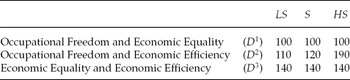
Imagine an initial distribution, D1, where we all work at our preferred occupations and all wages are equal: we enjoy both occupational freedom and income equality. Social planners then discover that if some talented individuals changed occupations we will enjoy greater prosperity in a second distribution, D2. The talented, however, are willing to change occupations only if they are paid more than others. Judging that economic inequality is a price worth paying to boost output whilst retaining occupational freedom, we introduce inequality-generating incentive payments. The planners also inform us of a third feasible distribution, D3, which preserves equality and secures efficiency but does so by conscripting the talented into the required occupations. We thus face a trilemma demanding we sacrifice at least one of three important values: liberty, equality or efficiency (Cohen Reference Cohen2008: 18). Stipulating some wages for the low-skilled (LS), skilled (S), and high-skilled (HS) workers, we may represent our three options as in Table 1.
Responses to the Trilemma

Confronted with these options, Rawlsians reject D3 because they believe (i) that D3 unjustifiably compromises occupational freedom (Rawls Reference Rawls2001: 158), and (ii) that such freedom should not be compromised to secure greater equality in societies that have attained a certain level of material prosperity. In fact, Rawls saw his own endorsement of incentive payments as a direct consequence of his arguing that in developed societies respect for the basic liberties must take priority over the distribution of income and wealth. Thus, he writes that
The priority of liberty means that we cannot be forced to engage in work that is highly productive in terms of material goods. What kind of work people do, and how hard they do it, is up to them to decide in light of the various incentives society offers (Reference Rawls2001: 64).
Rawlsians choose D2 because (iii) compared to D1 it benefits some and is economically detrimental to none, and (iv) they affirm the Difference Principle which rejects economic inequalities detrimental to the worst off but permits inequalities provided they are not to their detriment (Rawls Reference Rawls1999: 65; Reference Rawls2001: 61ff). On this influential view, economic incentives are not detrimental if ‘the greater expectations allowed to entrepreneurs encourages them to do things which raise the prospects of the laboring class’ (Rawls Reference Rawls1999: 65). Lowering those expectations may make things even worse for the worst off because the talented may withdraw their labour in response. Rawls thinks this suffices to make the resulting inequalities just rather than merely tolerable (Rawls Reference Rawls1999: 68). Drawing a sharp distinction between the forum and the market (Elster Reference Elster, Elster and Hyland1986), Rawlsians conclude that as voters designing public policies and institutions we must oppose inequalities harmful to the less advantaged whilst as workers operating in the market we may permissibly disregard this principle.
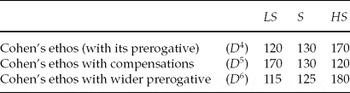
G.A. Cohen famously questions this sharp distinction, and proposes an egalitarian ethos that requires individuals to remain guided by the Difference Principle in the labour market as well as in their political activity (2009:198ff). Cohen argues that his ‘ethical solution’ to the trilemma (2009:188–198, 205, 214–215) jointly secures equality and efficiency by requiring individuals to work hard and to do so at socially usefully occupations without receiving any inequality-generating incentives. Cohen's considered solution, however, is not D3 because his favoured ethos includes an agent-centred prerogative permitting self-seeking market behaviour to some reasonable degree (Cohen 2009: 38). Assuming workers exercise their prerogative, Cohen's solution is consistent with an unequal distribution, such as D4 (120, 130, 170). Moreover, Cohen also favours compensation for special labour burdens, like those incurred in unusually arduous jobs. Thus, his proposal may involve an unequal distribution of wages, such as D5 (170, 130, 120), if less skilled jobs also tend to be more arduous, as various authors report (Jencks et al. Reference Jencks, Perman and Rainwater1988, Robinson Reference Robinson1988).
Finally, whilst in the above story D3 involved individuals being conscripted into productive occupations, and so jeopardized freedom, Cohen argues that his solution preserves freedom because it does not rely on any legal restrictions but only on willing compliance with a moral norm. Thus, Cohen writes that
the ethical solution says that freedom is secured by absence of legal obligation, and equality is secured, consistently with Pareto, through moral and/or quasi-moral commitment (Reference Cohen2008: 194, italics added).
Cohen admits that his favoured ethos involves sacrifices but insists these costs cannot be conceptualized as losses to freedom since ‘the value of freedom lies in the absence of coercion’ (Cohen Reference Cohen2008: 195). The next section draws a comparison between the non-enforced ethical requirements affirmed by Cohen and Rawls, which Cohen could employ to argue that his ethos does not conflict with freedom at least in the sense that Rawlsians tend to attach to the term.
3. APPEALING TO RAWLS'S LIBERAL ETHOS
Rawls's supporters might attempt to challenge Cohen's ethical solution by appealing to Rawls's requirement that institutions are best judged not merely as ‘abstract objects’ but as the concrete ‘[realizations] ‘in the thought and conduct of certain persons . . . of the actions specified by . . . rules’ (Rawls Reference Rawls1999: 48). It is implausible to expect that the ‘concrete realization’ of Cohen's demanding ethos would not include the emergence of moral criticism directed against those individuals who decline to follow its demands. It would be sociologically realistic to expect the ethos to be accompanied by significant non-legal sanctions. This matters since basic civil liberties can be infringed by informal as well as legal sanctions. Like John Stuart Mill (Reference Mill1991: 8ff), Rawls recognizes this neglected but important truth; for example, when he writes that ‘constraints [on liberty] may range from duties and prohibitions defined by law to the coercive influences arising from public opinion and social pressure’ (Reference Rawls1999: 176). In response to Cohen, then, Rawlsians might argue that since the realization of Cohen's ethos will involve informal freedom-restricting sanctions the Liberty Objection still stands.
Cohen could reply that Rawlsians cannot coherently employ the previous argument since it also threatens ethical duties that Rawls himself explicitly includes in his theory. Consider, for example, the so-called duty of civility, which ‘requires us . . . to make our case for the legislation or public policies we support in terms of public reasons, or the political values covered by the political conception of justice’ rather than by appealing to religious convictions or some other sectarian, comprehensive doctrines (Rawls Reference Rawls2001: 90). Despite the fact that the duty of civility prohibits certain forms of political speech, Rawls does not see it as conflicting with the basic liberty of freedom of expression that he also advocates. Cohen might therefore argue that his ethos of self-conscription does not threaten occupational liberty any more than the expressive self-restraint of the duty of civility threatens the expressive liberties.
In response, Rawlsians might note some morally relevant differences between the Rawlsian and Cohenian ethos concerning the form of the duties they involve. The duty of civility, in particular, is more clearly stated than the egalitarian ethos. Moreover, it is more likely to satisfy certain publicity requirements demanding that individuals be capable of securing common knowledge of each other's conformity with their duties (Williams Reference Williams1998). Rawls explains that when rules are ‘public’
a person . . . knows what the rules demand of him and of the others. He also knows that the others know this and that they know that he knows this, and so on . . . The publicity of the rules of an institution insures that those engaged in it know what limitation on conduct to expect of one another and what kinds of actions are permissible (Reference Rawls1999: 48–49).
The egalitarian ethos is not ‘public’ in this sense, and so does not belong to the class of rules which can coexist in harmony with the liberty-protecting rules of Rawls’ theory.
Following the same comparative strategy, Cohen might plausibly counter-argue that the duty of civility is more clearly stated than other Rawlsian duties, such as ‘the duty to support and to further just institutions’ (Rawls Reference Rawls1999, 293ff). But even here there is a debate regarding the obligations Rawls refers to as ‘duties of civility’ (Reference Rawls1999: 312), the range of decisions to which the duty applies (Reference Rawls2001: 117), and even about the very concept of ‘public reason’. Thus, even those who – unlike Cohen – greatly value publicity cannot appeal to its importance to identify the necessary dissimilarity in form.
In order to resist the egalitarian ethos whilst maintaining the duty of civility Rawlsians might instead appeal to content-based differences, and argue that the sort of ethos they favour is more plausible and far less demanding than the one Cohen claims should rule our daily existence and general life-plans. This second charge, which is the paper's main focus, is far more serious, and does not only bear on subsequent sections, but also on the foregoing arguments.
For example, although the ‘concrete realization’ of any ethos is likely to involve sanctions, this risk elicits more concern in the case of Cohen's demanding ethos than in the case of Rawlsian duties, including the duty of civility. The reasons we have to oppose the legal conscription of individuals into useful occupations within developed societies do not entirely wither away when we consider the possibility that informal rather than formal sanctions exert the same influence. When we are considering duties that, unlike the duty of civility, could shape our lives as profoundly and comprehensively as the egalitarian ethos, the possibility that they are accompanied by sanctions is a matter of considerable concern even if those sanctions are informal. As a result, Rawlsians can still contest a Cohenian argument based on a comparison between the duty of civility and the egalitarian ethos. Moreover, even if we granted some limited victory to Cohen by appealing to a certain understanding of the basic liberties and by unrealistically stipulating that there will never be sanctions of any sort, we might still deny not only that the egalitarian ethos avoids all conflict with other plausible conceptions of freedom but also that the ethos has a plausible content. The rest of the paper explores these two possibilities in turn.
4. THE TRILEMMA RESTATED
Different conceptions of freedom will yield different conclusions regarding Cohen's claim to have solved the trilemma. I cannot here survey them all, and will instead focus on a case discussed by Joseph Raz (Reference Raz1986: 379).
Raz asks us to imagine a person, whom I shall call Jack of all Trades, able to perform a wide range of occupations available to him. Different options are offered to him one by one, beginning with an opportunity to become an electrician, which is not what he prefers. Unfortunately, every time Jack declines an occupation, an innocent person is murdered. In Raz's example, Jack must perform the murder himself but the case remains of interest even if somebody else pulls the trigger. Reflecting on this case, Raz compares it to that of the person facing a gunman demanding ‘the money or your life’. He concludes that this person ‘is acting freely if he defies the threat and risks his life’ but that he is not acting freely if, more sensibly, he hands the money over to the gunman. Similarly, Raz claims that
the person of our dilemma is acting freely if he agrees to murder in order to become a dentist rather than an electrician . . . But if he chooses the right way and agrees to be an electrician in order to avoid becoming a murderer then his choice is forced (Reference Raz1986: 379).
To clarify, Raz specifies that ‘no doubt is cast on the fact that the person in the example is a moral agent and fully responsible for his actions’ but notes that so are the inmates of concentration camps (Reference Raz1986: 379). He also compares Jack's efforts to adjust to any occupation to avoid following in the steps of Jack the Ripper, with a man who will die if he ever puts a foot wrong. Raz concludes that if Jack ‘is to be moral then he has no choice, just as the person struggling for physical survival has no choice if he is to stay alive’.
On Raz's plausible account, Jack's choice to become an electrician is not free but forced. Similarly, if Cohen is right about the egalitarian ethos, and talented Jill's moral survival requires her to become a captain of industry, then her choice is free if she ignores the ethos and pursues other careers, but not if she obeys the ethos and delivers what Cohen claims justice demands. Thus, if her career as captain of industry is really a demand of justice, then either equality is preserved (through ethical obedience) but freedom is not, or freedom is preserved (through ethical disobedience) and equality is not. Either way we once again face the trilemma.
It appears then, that whether Cohen's solution works depends crucially on our understanding of certain key concepts. One lesson we may draw from this discussion is that starting with a concept, such as that of acting freely, may not the best way to arrive at a sensible conclusion about what we should do as a society regarding economic incentives or other inequality-generating practices. The same applies to other decisions society must make, such as same-sex marriage. We should decide on it through normative considerations and not by analysing how the term ‘marriage’ is employed.
Reflecting elsewhere on the limitations of conceptual analysis, Raz comes to a similar conclusion:
a concept is a product of a theory or a doctrine consisting of moral principles for the guidance and evaluation of political actions and institutions. One can derive a concept from a theory but not the other way around . . . (Raz Reference Raz1986: 16).
If Raz's view is sound, then an adequate response to the Liberty Objection cannot rely merely on definitional claims about liberty, such as Cohen's proposal that it consists in an ‘absence of legal obligation’ (Cohen Reference Cohen2008: 194). Instead, the rebuttal of the Objection must rest on the reasons individuals have to forsake their vocational ambitions for the sake of improving the material comfort of others who live in developed countries and are not badly off. After all, as earlier suggested, the most pressing worry about the egalitarian ethos is how profound and life-changing are the sacrifices it demands of us, and not how we might conceptualize those sacrifices.
Cohen may well have recognized this problem since he added to his proposal an agent-centred prerogative that permits workers to attach greater importance to their own interests than those of others within some limits. Cohen himself explains that he had to introduce a personal prerogative because ‘each person has a right to be something other than an engine for the welfare of other people’ and that ‘we are not nothing but slaves to social justice’ (Cohen Reference Cohen2008: 10). If the mere fact that the egalitarian ethos is an ethos sufficed to establish it cannot conflict with freedom, then both the rationale for an agent-centred prerogative and the reference to slavery would be harder to understand. Cohen's concession suggests that, for all his emphasis on how a mere ethos could not conflict with liberty, he fears the ethos involved excessive, morally relevant costs, which matter greatly, whether or not we agree to characterize them as costs to freedom. As I noted earlier, our reasons to oppose legal conscription may weaken rather than disappear when we consider obtaining the same results with informal sanctions. And those reasons may not disappear either when instead of informal sanctions we consider an ethos that is to be universally endorsed.
Another lesson we can draw from Raz's treatment of Jack's case is also crucial to the discussion of the Liberty Objection. As Raz observes, our interest in being, in an important sense, the authors of our own lives (Raz Reference Raz1986: 370) explains both our interest in non-interference by others, often referred to as negative freedom, as well as our interest in having an adequate range of acceptable options, a condition often termed positive freedom, autonomy or real freedom (Raz Reference Raz1986: Chs. 14–15). Commenting on Jack's choice to become an electrician or become a murderer, Raz concludes that since autonomy requires a choice of goods, ‘a choice between good and evil is not enough’ (Reference Raz1986: 379). Much the same applies to my example of Jill, who according to Cohen must either lead an unjust life or an unwanted life. Jack and Jill lack autonomy because they chose not between goods but only between good and evil.
The Liberty Objection may thus be re-stated as a complaint about being deprived of a choice amongst goods. Our interest in being self-directing authors of our own lives is threatened when we lack sufficient acceptable options whether this is caused by legal norms backed by formal sanctions, social norms backed by informal sanctions, or an egalitarian ethos of a directive sort, that is, an ethos which requires the performance of the optimal action (Shiffrin Reference Shiffrin1991: 244). Some modifications of Cohen's ethos can, however, make it less vulnerable to this complaint or even enable the ethos to escape it altogether. Pursuing this possibility, the next section questions the specific content Cohen gives to the ethos and proposes an alternative formulation.
5. RECONSIDERING THE EGALITARIAN ETHOS
Cohen's specification of the Egalitarian Ethos
As section 2 explained, Cohen questions the sharp distinction Rawlsians draw between the market and the forum, and insists that the Difference Principle should apply within our everyday lives. As Rawls observes, however, the Difference Principle might be appropriate for the regulation of taxation without also being applicable to other types of decision (Rawls Reference Rawls2001: 10, 73, 163). For example, economic efficiency may matter more in markets than in relations between couples or siblings, where equality may be more important. The Difference Principle may also be too complex and informationally demanding to govern personal behaviour. Finally, it is plausible to assume that the selection of mutually binding public rules requires a degree of impartiality which is not required outside the forum.
Cohen implicitly concedes as much when he affirms an agent-centred prerogative in everyday economic decisions but does not do so for political decision-making. Even for Cohen, then, insistence on one rule for all contexts seems questionable. Furthermore, invoking such ‘rule monism’ (Pogge Reference Pogge2000) is also unnecessary to criticize purely self-seeking market behaviour or theories that permit it, like Rawls's. Both polemical objectives can be pursued by invoking a broad spectrum of non-monist principles. Consider, for example, an ethos prohibiting those more advantaged than most from driving the hardest bargain, fully exploiting their good fortune in the social and natural lottery, or engaging in self-seeking industrial action.
Cohen, however, proposes a far more demanding requirement, and then as a result of commentary from Samuel Scheffler (Reference Scheffler1982: 60) qualifies it by adding an agent-centred prerogative that allows workers to discount the moral value of benefits to others compared with benefits to themselves (Scheffler Reference Scheffler1982: 20). Cohen insists that the relevant discount rate should be ‘modest’ (Reference Cohen2008: 38, 61), which is understandable because the presence of even a modest prerogative can result in some inequality being necessary to secure efficiency, thereby making the trilemma inescapable (as in Table 2): the more heavily can individuals weigh their own interest, the less likely it is that they will, absent economic incentives, renounce their vocations in order to work hard in more socially useful occupations. Society will then need to choose between becoming less efficient or less equal.
Further responses to the Trilemma

Three objections to Cohen's ethos
Cohen's specification of the content of the egalitarian ethos faces three interrelated difficulties. The first is that Cohen's specification makes the ethos so demanding and directive that it may deny some individuals occupational autonomy, leaving them only ‘a choice between good and evil’, as Raz puts it. Rawlsians then will not only object that ‘what kind of work people do, and how hard they do it, is up to them to decide’ (Reference Rawls2001: 64) but raise a related objection: if the ethos sacrifices occupational autonomy for the sake of further material gains, we will be impermissibly trading off a good protected by the basic liberties for economic advantages. Rawls writes that ‘the basic equal liberties protected by the first principle cannot be justified, or compensated for, by greater social and economic advantages . . . they can be limited or compromised only when they conflict with other basic liberties’ (Reference Rawls1999: 54, 266ff; Reference Rawls2001: 47). And even authors who may challenge this general prohibition involving all the basic liberties may still find it problematic to treat occupational choice and additional consumption as fungible.
The third problem is that Cohen does not tell us if this quest for further material advantages at the expense of occupational autonomy will cease when some level of material comfort is reached. Cohen rejects formal sanctions to increase productivity once society has reached a threshold of material comfort but does not similarly tie the moral sanctions to any specific level of advantage. I now explain these difficulties in more detail.
The first two problems
We should begin with the first problem because if the first can be addressed, the second will disappear: if the ethos does not sacrifice occupational autonomy, then it does not sacrifice it for the sake of material comfort.
Cohen could attempt to preserve occupational autonomy by abandoning the claim that the prerogative must be ‘modest’ so that individuals like Jill could have more than one permissible option. This solution is not very satisfactory because it will further increase the need to choose between inequality and inefficiency (as in Table 2) and even then it may still not secure a plurality of valuable occupational options for everyone. Some will have several options and a desire to perform an occupation that happens to be the one that maximizes the material advantages of the least advantaged. Others, like Jill, will be so much more useful if they perform one particular job that, even if they apply some discount rate to benefits to others, they might still become outvoted, so to speak, and have only one option. That particular option, moreover, may not correspond to what this person wants to be in life. Relying solely on the prerogative to render the ethos less implausible is thus insufficient to address the problem of occupational choice. Some may argue, moreover, that appealing to a prerogative is not merely insufficient but inappropriate.
To understand this additional complaint, bear in mind that we all have capacities and limitations that make us thrive in certain occupations and languish in others. Finding what fits us may make all the difference between a life of flourishing and self-fulfilment or one of failure and frustration. There is perhaps no other question quite as important as the one we are often asked in childhood, ‘What do you want to be in life?’ Answering it involves reflecting on almost everything we know about ourselves: our character, talents, flaws, values, commitments and ambitions. It is a choice with far reaching consequences for our chances of self-realization and one that is intimately connected to the development of our potential, our personality and identity, our friends and social network (Williams Reference Williams2006) and our conception of the good. It is a choice that can entirely change our life. These facts lend plausibility to the claim that, like a marriage, an occupation should be chosen freely, without the interference of either legal or moral sanctions. In societies where survival is not guaranteed, concern for material advancement may become an important consideration even in respect to marriage. In developed societies, by contrast, social institutions should disregard such trade-offs rather than induce particular trade-offs through legal or social sanctions and public criticism. The career we decide to pursue and the person we decide to marry can greatly influence our future income and our capacity to benefit the worst off. Most people, however, will not see marrying for love or pursuing one's vocation as mere examples of the selfishness that can be permitted only to a ‘modest’ degree.
Drawing on this sort of considerations, those who think that Jill has the right to choose the career and partner she likes without having to justify herself to society can reasonably argue that the appeal to a prerogative is an implausible way to address their concerns. They will reject the suggestion that the permissibility of pursuing one's vocation depends on what happens when the suitable discount rate is applied. If it turns out that fortunately Jill is not that socially useful after all, then justice permits her to marry Jack and work in his rural dental surgery. But if her usefulness is somewhat greater, building such a life with Jack becomes impermissible. The appeal to a prerogative is likely to be specially resisted among those who, like Rawls, insist on ‘equal basic liberties’ for all rather than for those who are not sufficiently useful for society to have a claim on what they will do with their life. These critics will find the prerogative not only insufficient but inappropriate to discuss occupational autonomy because it cannot guarantee autonomy for everyone.
The problem of ignoring absolute levels of advantage
Turning to the final difficulty, let me now explain why the ethos will be far more plausible if its validity depends on the threat of deprivation rather than mere inequality, and/or its stringency diminishes as that threat declines.
Suppose a natural disaster strikes Jill's town. She would be morally obliged to leave her work and rush out, ready to be conscripted into whatever task is more urgent to tackle. Depending on the severity of the case, she may not be able to return to her normal life for a long time, but as the situation improves it becomes easier to justify her recovering an increasingly large portion of her time. This widely shared intuition lends plausibility to the Rawlsian claim that once a society has reached a certain level of stability and material prosperity it forfeits any right to conscript individuals into useful occupations.
Critics may find it implausible that a gradual increase in material comfort could lead to a complete disappearance of our duty to help rather than merely cause the duty to become less stringent. They may not believe that morality is like physics with increases in temperature turning liquids into gases at specific degrees, and so may deny that our duty to help drops to zero at any given point. Scepticism about moral thresholds is not entirely unfounded (Casal Reference Casal2007: 312ff), and one may claim, for example, that the duty becomes gradually weaker the greater the level of abundance, perhaps approaching zero asymptotically without ever reaching it. Scepticism about thresholds, however, does not justify concluding that the beneficiaries’ level of material comfort makes no difference to how much we should strive to help them. If this was the case, Jill would have to strive in all circumstances just as hard as when a natural disaster hits her town leaving large numbers of people in desperate circumstances. This view is implausible, and far less plausible than either the idea of a threshold beyond which we become liberated from duty or the idea of a duty progressively becoming less stringent the better off the worse off become, and strengthening again during a crisis.
Cohen does not mention any level of affluence beyond which we are no longer obliged to take the occupation that maximizes the material advantages of the worst off. Nor are we told that, or how, the moral requirement weakens (or the prerogative becomes less ‘modest’) as material prosperity grows. It appears then, that obedience to the ethos may deprive Jill of occupational autonomy to benefit others who may be well off in absolute terms, enjoy occupational autonomy, and perhaps are not even much worse off than her. This seems implausible.
Cohen's proposal does not give occupational autonomy any importance in itself, except insofar as this factor could enter the calculations indirectly as one of the many ingredients contributing to ‘advantage’, the heterogeneous standard of interpersonal comparison Cohen favours (Cohen Reference Cohen2011: 3ff). It thus leads to requirements which may be appropriate to some circumstances but appear less credible when we realize they do not vary with absolute levels of advantage, and lack boundaries.
6. HOW A REVISED ETHOS AVOIDS THE OBJECTIONS
Having discussed three objections to Cohen's ethos, this section explains how a revised ethos may be able to escape them. Let me briefly remind readers of the three objections. The first is that a requirement to maximize the expectations of the least advantaged requires the more talented or skilled to take the most useful occupations, depriving them of occupational autonomy. The second is that it impermissibly trades off occupational autonomy for material advantages when they should not be treated as fungible once society reaches some level of prosperity. Finally, the ethos does not take absolute levels of prosperity into account. As a result, the ethos implausibly deprives talented Jill of occupational autonomy to increase the material comfort of individuals who may be very comfortable already and enjoy occupational autonomy themselves.
Protecting occupational autonomy and not trading it for consumption
I shall now consider two revisions which go hand in hand, and in fact can be seen as the same requirement applied both to the more talented or high-skilled and to the less talented or low-skilled. These revisions address the first two problems. There is no additional revision designed to address the third problem because further changes are not necessary for this purpose. I will turn to this third issue later, having introduced the revised ethos and explained how it avoids the first two problems.
Let us return to Jill's case. Both the problem of denying her occupational autonomy and that of trading it for material advantages can be avoided by an ethos designed to secure occupational autonomy for all. This amendment avoids the criticism that the egalitarian ethos does not recognize the distinct value of occupational autonomy and makes two differences to what is required of Jill. First, there is a difference between being asked to make a sacrifice concerning our occupation – whether it is in terms of salary, working hours, or tasks – so that others can have occupational autonomy, and being asked to make the same sacrifice so that others can consume more. So even if the sacrifice required of Jill was identical in other respects, it would still be different because it would have a different justification. For example, Jill could now be expected to rebuild the school in her town, so that local children can have at least as much occupational autonomy as she had. In such a case, her grounds for resisting the expectation will be weaker than if the funds were destined to increase consumption. The second difference is that Jill cannot now complain to have lost her occupational autonomy to others who preserved theirs, for the revised ethos protects the occupational autonomy of all, the more skilled and the less skilled, and so also protects Jill's. The revised ethos will still ask Jill to make sacrifices for others, but it would not be so directive as to leave her no (morally permissible) choice.
Jill cannot, however, insist in improving her options indefinitely, for example, through industrial action or private negotiations. When those who already have ample occupational opportunities insist on extracting even better deals, then it is often the most easily replaceable in each institution that pay the price for them doing so. So, for example, when wealthy airline pilots strike for higher salaries and other privileges, it is often cleaners and luggage handlers that face redundancy, pay cuts or worse working conditions. The constant upward shifting of privileges towards those who are already better off than most results in an enormous misdistribution of occupational autonomy, with some having excellent options while others have none. It is important to promote an ethos that directly impedes this upward migration of advantages, for example, by prohibiting the most occupationally advantaged groups of individuals from engaging in industrial action to extend their advantages further still.
An ethos can also change society indirectly by making possible basic structural changes that will otherwise be infeasible or ineffective; for example, an ethos of concern for universal occupational autonomy may allow job-sharing schemes and substantial reductions in the working week. Such reductions are often opposed by trade unions that, despite their progressive rhetoric, refuse to share the jobs they control with the occupationally frustrated and the unemployed. An ethos can also make these reforms more effective at creating employment because training costs can often be reduced when experienced employees have a positive attitude towards new recruits.
Much the same applies to other attitudinal barriers to universal occupational autonomy, such as those derived from patriarchal family structures. Rawls's insight that ‘what men want is meaningful work in free association with others . . . within a framework of just basic institutions’ (Rawls Reference Rawls1999: 257–258) is not only true of men. As a result, J. S. Mill's The Subjection of Women (1969) is right to condemn the fact that women have historically been left without occupational autonomy so that men could optimally pursue their occupational ambitions, free from childcare and other domestic responsibilities, as well as from female competitors. Mill laments ‘the dull and hopeless life’ to which this has often condemned women ‘by forbidding them to exercise the[ir] practical abilities’ (Reference Mill1991: 580). As he argues,
if there is anything vitally important to the happiness of human beings, it is that they should relish their habitual pursuit. This requisite of an enjoyable life is very imperfectly granted, or altogether denied, to a large part of mankind, and by its absence many a life is a failure, which is provided, in appearance, with every requisite of success (580–581).
Since Mill wrote this, female occupational autonomy has increased but women's jobs remain less well paid than men's and inferior in 12 of the 14 standard non-pecuniary indicators of job desirability (Jencks et al. Reference Jencks, Perman and Rainwater1988).
Again, the proposed ethos could contribute to further increases in female occupational autonomy directly, and could also make possible and effective various basic structural reforms, such as shared parental leave schemes and the harmonization of office and school timetables. In the absence of an ethos of respect for women's occupational autonomy, some of those reforms might make things worse rather than better for women. For example, if fathers use their share of parental leave to catch up with work, mothers will have to compete in the workplace with men enjoying what is, in effect, study leave while also being stressed with a double shift having had their post-partum leave reduced. An ethos, thus, could make a very large difference to the universalization of occupational autonomy.
Some may object that since the ethos prohibits the unlimited exploitation of the advantages nature, or society, arbitrarily confers on some of us, it offers only limited protection to the occupational freedom of talented individuals, like Jill. This, however, is not a conclusive reason to reject the revised ethos if it is more effective than its rivals at securing an adequate range of acceptable options for everyone. Jill's occupational autonomy, for example, is not only likely to be greater under the revised ethos than under Cohen's ethos but also greater than under an ethos of selfish maximization, which might be very detrimental to her in other respects, for example, as a woman.
Rawlsians, moreover, will find it difficult to oppose the revised ethos for prohibiting the unlimited exploitation of one's natural and social good fortune. For Rawls not only questions the legitimacy of inequalities derived from the natural and social lottery (Reference Rawls1999: 13, 245); he also states that justice does not require unlimited but only sufficient or adequate protection of the basic liberties (Reference Rawls1993: 331; Reference Rawls2001: 42, 111). He does so since granting priority to the first principle would be implausible unless it has ‘a limited application and establishes definite requirements which can be fulfilled [or] latter principles will never come into play’ (Reference Rawls1999: 38). Since the ethos grants Jill an adequate range of acceptable and permissible options it arguably provides ‘sufficient’ protection already. There is, in fact, a sense in which the ethos actually goes beyond the Rawlsian requirement insofar as it does not protect a merely formal or negative freedom but a real freedom as well (Van Parijs Reference Van Parijs1995). As a result, one may now also argue that an ethos that protects occupational autonomy for all no longer requires the ad hoc insertion of an agent-centred prerogative to carve out some breathing space for the autonomy of the more skilled. For now nobody needs to have their occupational autonomy protected from the ethos because the ethos itself already protects occupational autonomy for all.
Recognizing the importance of absolute levels
Let us now turn to the final objection to Cohen's ethos, namely that it requires life-changing sacrifices in an unrestricted manner, including perhaps situations of abundance, implausibly granting no importance to absolute levels of advantage. Since the revised ethos is more moderate, the objection already loses force. Moreover, since occupational autonomy is a satiable requirement, the importance of absolute levels of advantage is already built into the ethos. If at some point in the future, everybody enjoys occupational autonomy because of drastic reductions in the working week and machines that perform the undesirable tasks, Jill would no longer need to strive to satisfy the revised principle. In addition, the stringency of the requirement to improve the options of those with fewer and worst occupational choices should diminish as the satiable goal of providing universal occupational autonomy is approached.
Unfortunately, some people may never be able to have an adequate range of valuable occupational options. Such pessimism is most clearly defensible in the case of individuals with certain disabilities. Disabled individuals do not figure in the Cohen–Rawls debate but have some of the strongest claims on our time and effort. And the possibility that we cannot offer them all occupational autonomy strengthens rather than weakens their claims, which we will have to satisfy in some other way. Granting universal protection to occupational autonomy and then making special provisions for those who cannot benefit from this protection, however, is still very different from treating all values as fungible from the start.
A less egalitarian ethos?
Despite the three foregoing advantages, Cohen could reject the revised ethos on the grounds that it will reduce but not eradicate inequality. In response, one may note that the same is true of Cohen's ethos because achieving complete equality without sacrificing efficiency requires rejecting a personal prerogative, and Cohen himself states the prerogative must be retained in order to protect us from becoming ‘slaves to social justice’ (Cohen Reference Cohen2008: 10). Moreover, since those who cannot achieve occupational autonomy would be compensated in a different manner, both principles would not be as different in their operation as may at first appear. Cohen could still respond, however, that even if neither version of the ethos eliminates inequality and the end results of both versions are not very different, his version will achieve equality to a greater extent than the revised ethos. My reply to this counter-argument is that jeopardizing occupational autonomy would be too high a price to pay for the additional reduction in inequality. Moreover, it is possible that in practice Cohen's ethos will not produce more egalitarian results.
Gender equality, for example, is arguably more likely to be secured by women gaining occupational autonomy and participating in the labour market than through greater material comforts or housewife stipends. The same may apply to inequalities between more and less skilled workers, as suggested by the proverb: ‘Give a man a fish, and feed him one day, teach him to fish, and feed him for a lifetime’. Cohen's original ethos, moreover, is also arguably less likely to be widely endorsed. If so, it will also be less effective at reducing inequality in practice.
7. CONCLUSION
Cohen aims to eradicate inequality without loss of efficiency or freedom by relying on an ethos. His proposed ethos requires us to promote the expectations of the least advantaged in our daily activities, taking up socially useful occupations we would rather not pursue and working hard at them, without requesting differential rewards. The ethos faces a Liberty Objection which claims the ethos unjustifiably curtails occupational liberty. Cohen denies this charge arguing that duties restrict liberty only if they are legally enforced (Reference Cohen2008: 181–229).
Having explored what appeared to be the most promising avenue for supporting Cohen's strategy, namely a comparison with an ethos endorsed by Rawls, it emerged that the concerns animating the Liberty Objection could not be addressed adequately through this strategy alone. The strong reasons to oppose the legal conscription of individuals into the positions at which they will be more productive do not vanish when we consider obtaining the same results through informal sanctions or through a fully directive ethos that is to be universally endorsed. The egalitarian ethos, with the specific content that Cohen favours, is ill-equipped to protect occupational autonomy, which it treats as fungible with increases in material comfort. The ethos is also implausible because its stringency does not diminish as material comfort grows. A modification of the content of the ethos, however, allows it to simultaneously surmount all these objections, and become more acceptable to all those unsatisfied with Cohen's response to the Liberty Objection.