When the psychologists Jerome Bruner and George Miller founded the Center for Cognitive Studies at Harvard in 1960, they conceived of it as an interdisciplinary institution. The Center, regarded by practitioners as the first institutional location for the cross-disciplinary field of cognitive science,Footnote 1 included people from the fields of psychology, linguistics, philosophy, biology, mathematics, anthropology, paediatrics, history, psychiatry and psychoanalysis among its researchers, visitors and directors.Footnote 2
Shortly after founding the Center, Miller and Bruner wrote to the dean of the faculty about its guiding principles: ‘It was an essential feature of the Center, as originally conceived, that it would be broadly interdepartmental. The slogan, only half in jest, was that the cognitive processes are far too complex and important to be left to psychologists.’Footnote 3 In this memo, these two psychologists boldly declared the inability of their own discipline to understand the very subject matter of the institution that they directed. By adopting this position, Bruner and Miller situated themselves in an intellectual culture that placed high stock on interdisciplinary social-scientific research. By telling their dean that the Center would be ‘interdepartmental’, Bruner and Miller underlined the point in the following sentence: the Center's business was important. To social scientists, their patrons and university administrators, important issues required interdisciplinary solutions and, conversely, interdisciplinary work indicated the importance of particular research topics.Footnote 4
The Center's ‘interdepartmental’ structure served more than rhetorical purposes. It was also a highly esteemed strategy for acquiring knowledge – in this case, knowledge about thinking. But the Center retained its initial research culture through only about half its decade-long life, despite continued interest by Miller and Bruner in establishing and maintaining the Center's interdisciplinarity and despite the continued membership of scholars from numerous disciplinary backgrounds. Once scholars at the Center had established reliable systems of research, the character of their social and intellectual interaction changed from what I shall call ‘interdisciplinary’ to what I shall call ‘multidisciplinary’. Reflecting this transition, the Center's initial interdisciplinary atmosphere incorporated the view that ‘a Center is a place where people know each other's business’.Footnote 5 On the other hand, a few years later, after the Center's atmosphere had changed to a multidisciplinary research culture, its members would comment on how they no longer knew one another's work and that there was less cross-field communication.
Since the Center for Cognitive Studies had, on the one hand, an interdisciplinary research culture through part of its life, but, on the other hand, had personnel from numerous disciplines and departments for its entire existence, it is a site where the connection between knowledge production and disciplinary structures was complex but not atypical. Despite the fact that organization along disciplinary lines is often treated as the normal state of affairs, through much of the twentieth century a number of countervailing trends have encouraged boundary-crossing and prevented disciplinary crystallization. Numerous factors have worked against disciplinary organization: philosophical motivations, more practical goals of patrons, instrumental demands of wars hot and cold for knowledge and weapons, the establishment of extra-departmental research units and the direction and momentum of research agendas. Thus, within the context of the post-Second World War sciences where extra-departmental, interdisciplinary research groups were common, our understanding of the relationship between knowledge and institutions would benefit from being able to explain the production of knowledge outside power given by departments. Moreover, any such explanation should account for knowledge production and legitimization in research cultures such as the Center for Cognitive Studies that trumpeted their openness to all disciplines.
What is needed, then, is a historical method that accounts for the dynamic development of institutions and knowledge as well as for relationships between them. In the case of the Center for Cognitive Studies, these numerous and changing relationships can be seen through the exchange relations among its affiliated scholars.Footnote 6 The exchange of ideas, suggestions, advice, protocols, instruments, labour, methods and intellectual energy – and the social rituals and obligations that attached to these exchanges – generated the Center's intellectual culture in both its initial and later forms.
The Center's shift from an interdisciplinary to a multidisciplinary research culture resulted from a transformation in the ways its members exchanged their intellectual tools. Its initial interdisciplinary intellectual economy was characterized by researchers acquiring and learning to use unfamiliar tools. In contrast, the subsequent multidisciplinary economy involved researchers working in parallel, using their own tools and rarely peering into someone else's toolkit. For the sake of expository clarity, in this article I will use ‘cross-disciplinary’ as a neutral category to refer to either interdisciplinary or multidisciplinary situations.
Understanding the different research cultures at the Center for Cognitive Studies is not so much a matter of merely identifying or cataloguing all the different departments whence its members originated, but also of investigating the natures and kinds of tool exchange that constituted its intellectual culture. These exchanges were an important part of the Center's intellectual work and the means through which the people at the Center negotiated their social and intellectual lives with one another.
Following common usage by mid-twentieth-century psychologists, ‘tool’ here refers to an individual physical instrument, an assemblage of the same, an experimental method, or an organized way of categorizing, seeing or approaching the world. I use the term so flexibly because experimental techniques in psychology can rely on a range of highly structured systems, from formalized interviews (such as IQ tests) to physical implements for measuring such things as reaction time and rates, skin conductivity, blood pressure, eye movements, heart rate, muscle tension and speed of nerve conductivity. The term and usage is both an analytic and an actor's category. Both historians and social scientists, including those discussed in this article, have made a regular practice of using ‘tool’ to refer to ways of thinking and to organized practices, as well as to physical implements.Footnote 7
As scientists with expertise in how humans think and learn, Bruner and Miller applied their special skills to designing a research environment that would maximize their own chances for acquiring knowledge about the world – specifically about the nature of human thinking. Their brand of cognitive psychology saw human learning as, fundamentally, the acquisition of new structures of thought and of new tools with which to think.Footnote 8 On this account of mind, what was important were the procedures, forms of representation and heuristic methods that enabled individuals to have original forms of thought, novel hypotheses and techniques for investigating the world. Miller and Bruner applied this vision of the human mind in shaping their centre in the hope that the institution they founded would facilitate tool construction and place the disciplined study of human cognition on a stable, scientific foundation. At stake in the Center for Cognitive Studies was not only a programme for studying human cognition, but also the very modes of thought that cognitive scientists would undertake in their search for new tools.
While a primary point of this article is that the intellectual and social world of the Center was embodied in the patterns of tool exchange that occurred there, those tools and the economies of their exchange had a history as well. So before presenting a detailed examination of the research culture at the Center for Cognitive Studies, I begin with a short discussion of the intellectual economies in which Bruner and Miller participated in the years leading up to 1960 as explanation for why they constructed the Center as they did.
Working across departmental and disciplinary lines: tooling-up the social sciences
In founding the Center for Cognitive Studies Bruner and Miller aimed to address what they took to be an imbalance in their field: the neglect of mind produced by behaviourism's hegemonic control of psychology. As the 1950s drew to a close, American experimental psychology had been dominated for several decades by behaviourist theories, methods and rules under which the study of mental phenomena was often, if not always, characterized by behaviourists as sloppy and unscientific.Footnote 9 As Bruner put it in 1955, ‘In recent decades thinking has been neglected as a research area, presumably because behaviourism made no provision for its direct study.’Footnote 10 Miller later echoed this point, explaining, ‘in those days “cognition” was considered a naughty word by most scientific psychologists; under the sway of behaviourism, all mentalistic terms were on a par with phlogiston’.Footnote 11
Bruner and Miller in part constructed their centre as they did because they believed that both the success of behaviourism and its exclusion of mind from experimental psychology resulted from the use of tools imported from physiology, tools originally designed for studying the body and not the mind.Footnote 12 For Bruner and Miller, understanding psychology's history this way implied that their efforts to make a science of mind would depend on finding or inventing new tools to support their work.Footnote 13
Seeing research problems as an issue to be solved by locating or inventing the appropriate tools was itself a (meta-)research strategy that had a history in the personal lives of Bruner and Miller, in the popular philosophy of science of the mid-century social sciences and in the content of their psychologies of thinking. For the generation of natural and social scientists who participated in the Second World War, wartime research projects demonstrated the productivity of solving specific, practical problems by assembling a set of research techniques from a range of disciplines.Footnote 14 Reflecting on his experience with the post-war bombing survey in Japan, the sociologist William Sewell recalled ‘the most innovative and insightful ideas were generated as a result of group discussions in which little regard was paid to the disciplinary origin of the idea’.Footnote 15 Sewell continued, ‘my colleagues … were equally impressed with their experiences and were determined to promote interdisciplinary training and research programs on return to academic life’.Footnote 16
The future directors of the Center for Cognitive Studies had similar reactions to wartime research.Footnote 17 For his part, Miller was engaged in work in Harvard's Psychoacoustic Laboratory during the war. The work there ranged from engineering earplugs to designing codes for best comprehension under conditions of high noise interference. Bruner's own experience had been shaped in the context of morale surveys and public opinion surveys conducted for the Office of War Information (OWI). By the end of the war Bruner was convinced that his wartime experiences pointed the way to conduct research even during peacetime. As he wrote to his doctoral advisor, Gordon Allport, in 1945,
Social scientists have found the task of solving practical problems like morale, readiness to buy bonds, fear in battle, etc. too rich to be tackled with single instruments … To begin to set hypotheses correctly, one must use a variety of related approaches … This is all so utterly obvious, I feel ashamed to labor it. But in practice it is not obvious … The best training a young researcher can get is to be forced to think of all the possible conceptualizations of a problem in all fields of social science, all possible research tools which might be used, and then decide very self-consciously how he wants to conceptualize and limit the problem by choice of method.Footnote 18
So convinced was Bruner of the importance of spanning disciplines that he sought appointment in both the Psychology and the Sociology Departments at Harvard.Footnote 19
In the years following the war, Miller had a sabbatical at the Institute for Advanced Study (IAS), worked in MIT's Lincoln Laboratory,Footnote 20 and spent a year at the Center for Advanced Study for the Behavioral Sciences.Footnote 21 Each of these locations was organized along cross-disciplinary lines and Miller saw his time in those places, particularly his sabbatical years, as an opportunity not only for research and writing, but also for learning new techniques. For instance, his year at the IAS was motivated by his desire to learn mathematics and the techniques of game theory from John Von Neumann.Footnote 22
Although Bruner and Miller's involvement in cross-disciplinary work reflected significant aspects of their personal research styles,Footnote 23 their choices to operate in such a manner were in no way idiosyncratic. Their pattern of cross-disciplinary collaboration was part of the background environment fostered by the structure of government funding, wartime demands, Cold War politics and an intellectual culture that attached high value to interdisciplinary research. Major patrons of the social sciences, including the Ford Foundation, the Carnegie Corporation, the Rockefeller Foundation and the Office of Naval Research, directed their funds towards improving the methodological foundations of the social sciences, which often meant breaking down walls between disciplines.Footnote 24 Indeed, throughout most of the 1950s the only way that social scientists could receive funding from the National Science Foundation was by participating in interdisciplinary projects.Footnote 25
This system provided significant financial, institutional and methodological resources for Bruner and Miller and helped to produce psychological work that took advantage of tools developed in other disciplines. For instance, Miller brought information theory and linguistics to psychology,Footnote 26 while Bruner used his experience in opinion research for research on perceptionFootnote 27 and John Von Neumann's game theory in his work on concept acquisition.Footnote 28 It also conditioned Miller's rejection of behaviourism and his move to adopting a cognitive-psychological view of human nature.Footnote 29
The focus on tools as a means of improving their fields was a common strategy among social scientists as well as their patrons in mid-twentieth-century America. At a conference funded by the Carnegie Corporation devoted to analysing the state of the social sciences, Samuel Stouffer argued that the national strategy for improving the social sciences should revolve around the invention of research tools.Footnote 30 Leonard Cottrell agreed. He noted, ‘The progress of a science is determined in large part by the effectiveness of its tools of research.’Footnote 31 To Charles Dollard, president of the Carnegie Corporation and also a friend of Stouffer, the distinction between the creative, ‘first-rate research men’ and those who merely had the ability to ‘perform useful routine functions’ was that the first-rate social scientists possessed the imagination to invent new methods and techniques for furthering social science.Footnote 32
It should not be surprising that Dollard would be interested in how to distinguish between good and bad researchers, for his job involved regular decisions about the distribution of much of the available private funds for social-scientific research. For our purposes, it is enough that Dollard signalled the capacity to create tools and instruments as a criterion for distinguishing the excellent researcher from those less deserving.
Strategies for making or acquiring tools
While the creation of new tools marked the route to developing the social sciences, the question remained: how best to acquire or produce those tools? For mid-century academics and their patrons, the answer to this question frequently lay in assembling an interdisciplinary community of researchers. Such a community would itself be a tool, more precisely a machine tool, for fashioning the new instruments that would help bring the social sciences into their maturity as sciences.
The Ford Foundation took just this approach in its early years of support of the behavioural sciences. Of the $300,000 the foundation's Behavioral Sciences Division scheduled in 1952 for ‘Improving Content and Methods’, $150,000 was directed towards the ‘Interdisciplinary research and study program’. Moreover, the Behavioral Sciences Division devoted the majority of its support to the Center for Advanced Studies in the Behavioral Sciences (CASBS). In 1952 the CASBS was expected to use $1,150,000 (or 61 per cent) of the $1,900,000 the Foundation's Behavioral Sciences Division would spend that year.Footnote 33 This too was an interdisciplinary project, for a significant part of the Center's mission was exposing its members to disciplinary cross-fertilization that was supposedly impossible at their home institutions.Footnote 34 In addition, programmes not specifically marked as interdisciplinary, such as ‘mathematical training for behavioural scientists’ and a mathematical seminar at Michigan, were also directed towards interdisciplinary ends. This was because mathematical techniques in the behavioural sciences, such as statistics, game theory and set theory, were seen as instruments that crossed disciplinary boundaries.Footnote 35
If at all possible, the Carnegie Corporation pushed interdisciplinarity even harder than other patrons of the social sciences. It identified interdisciplinarity with making social science both more useful and more rigorous.Footnote 36 In 1948 John Gardner, a Carnegie officer and founder of its area studies programme, gave voice to the foundation's preference for interdisciplinary research when he proclaimed, ‘every thoughtful person who has taken a serious look at the whole range of the social sciences is convinced that great gains will come from what has been called the “integration of the social sciences”’.Footnote 37
This preference on the part of patrons for interdisciplinary research was patently obvious to their clients. A self-study report on the behavioural sciences at Harvard commented: ‘There is the belief that the large research project, especially if dressed up as “interdisciplinary,” gets first call on foundation funds.’Footnote 38 Regardless of whether they approved of or were bothered by the bias towards interdisciplinarity, social scientists knew well enough how to cast their research proposals.
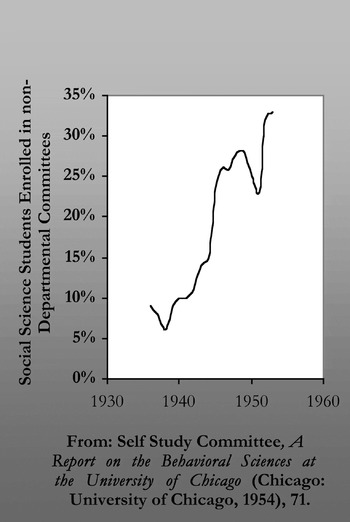
One reason why interdisciplinary research drew such support was that, to social scientists and their patrons, interdisciplinarity and creativity were practically synonymous.Footnote 39 A significant result of the connection between creativity and interdisciplinarity was the creation of new institutions. These included, among others, the Center for Advanced Studies in the Behavioral Sciences in Palo Alto and the Bureau of Applied Social Research at Columbia, as well as other survey research centres at Harvard, Yale, Princeton, Berkeley, UCLA, Illinois, Minnesota and Washington State. By the mid-1950s there were interdisciplinary social science research and training programmes at Harvard, Michigan, Yale, Cornell, Berkeley, Columbia, Chicago, Stanford, Minnesota, Wisconsin and the University of North Carolina, among others.Footnote 40 As Figure 1 indicates, the increase in interdisciplinarity occurred not only in terms of the number of universities that added interdisciplinary programs, but also in terms of growing interdisciplinarity within individual universities.
Interdisciplinarity at the University of Chicago.

At Harvard the interdisciplinary project went the furthest by combining sociology, social psychology, cultural anthropology and clinical psychology within the single Department of Social Relations in 1946. The Department of Sociology disappeared as an independent entity while the Departments of Anthropology and Psychology continued at reduced strength and with a more restricted focus on archaeology, physical anthropology and biological psychology, and on behaviourism and psychophysics, respectively.
To the founders of Social Relations – Talcott Parsons, Clyde Kluckhohn and Gordon Allport – the project of integrating the social sciences on a theoretical level would facilitate both increased rigour and the ‘conceptual schemes’ or tools with which to ascertain the most important facts of the social world.Footnote 41 According to these social scientists, particularly to Parsons, conceptual schemes were critical because there was no such thing as a raw fact. Instead, facts only achieved their status by virtue of their location within such a scheme. While some of these facts were of ‘academic’ interest, others, such as the structure of the German or Japanese ethos, could hold practical use for policy-makers.Footnote 42 Still other social facts, such as the increasing integration of the various social sciences around the nation and the emphasis of the government and private patrons in supporting research of this form, gave the advocates of Social Relations an additional material reason to call for building an interdisciplinary department.Footnote 43
While the Social Relations project proposed to make the social sciences more rigorous on a theoretical level by making them more interdisciplinary, the associated Laboratory of Social Relations aimed to achieve integration through experimental means. Samuel Stouffer leveraged his personal connection with Carnegie president Charles Dollard to secure $250,000 of funding for the laboratory.Footnote 44 Stouffer organized the laboratory to facilitate the creation of experimental tools and techniques. Its funds were devoted to small grants for preliminary or test studies. Support was distributed without requiring researchers to submit either lengthy, detailed grant applications or fully developed research protocols. As the grant proposal to fund the laboratory detailed, the philosophy that underpinned this programme was one that favoured the invention, creation or application of new or untried research tools over the continued use of existing and well-used methods.Footnote 45
In practice, this funding structure meant a real choice of the kinds of knowledge acquisition strategy and research atmosphere that the laboratory fostered. In particular, the laboratory hoped to foster casual exchange of ideas between researchers of different disciplines and it favoured the long-shot, untidy and untried research programme. Giving voice to this attitude, Jerome Bruner and Leo Postman argued that interdisciplinary integration often required ‘tolerance toward chaos and disorder’. They continued by remarking, ‘we can tolerate disorder if we remember that it is often a condition sine qua non of organic growth in science’.Footnote 46 The view that interdisciplinarity, creativity, chaos and tolerance of disorder belonged together was a common trope among social scientists that also played well with the directors of the laboratory. A well-known study by the Berkeley psychologist Frank Barron linked creativity with tolerance of, and even preference for, ambiguity and disorder among creative people. This result built on the even better-known results of The Authoritarian Personality co-author Else Frenkel-Brunswik that established ‘intolerance of ambiguity’ as the distinguishing cognitive symptom of authoritarianism.Footnote 47 Accordingly, in its first few years, Bruner received more support from laboratory funds than any other of its researchers (Postman left Harvard before the tabulation was undertaken).Footnote 48
Founding the Center for Cognitive Studies
In the winter of 1959–60, Bruner joined forces with George Miller and turned these research and fund-raising strategies towards founding a new research centre. The Center for Cognitive Studies they built was specifically aimed to address the limitations of Bruner and Miller's respective Departments of Social Relations and of Psychology as well as to serve as a ‘unifying force, a neutral place where students from both Social Relations and Psychology could meet and educate each other’.Footnote 49 Neither of their departments was concerned with how normal individuals think. The Psychology Department, dominated by the behaviourism of B. F. Skinner on the one hand and the psychophysics of S. S. Stevens on the other, left little room for investigation of mental processes. In Social Relations, Bruner had colleagues interested in what happened among groups of people or, in the case or Henry Murray, in the nature of the abnormal mind.
Their personal preferences for varied approaches to psychological problems encouraged them to cast a wide net in the search for effective research methodologies. Accordingly, they designed their centre around the belief that ‘the study of cognitive processes … [was] clearly not an enterprise that [could] be entrusted to any single discipline, that [could] be developed from any limited or specialized point of view’.Footnote 50
Mutually unhappy with the state of affairs at Harvard, Miller and Bruner sought to build a research centre that, in significant respects, mirrored an industrial research and development group Bruner had previously studied in order to understand the psychological processes of creativity. For the group that Bruner studied, innovation was facilitated by using non-conventional methods and energetic interpersonal interchange, and operating ‘out back’, beyond normal institutional structures.Footnote 51 Likewise, the Center for Cognitive Studies (CCS) that Bruner sought to build with George Miller would operate both methodologically and physically outside the Departments of Social Relations and Psychology. Indeed, the CCS would be located on the periphery of the Harvard campus at 61 Kirkland Street, well away from university offices, laboratories, classrooms and dormitories.
In establishing their centre, Bruner and Miller began by approaching John Gardner of the Carnegie Corporation and Harvard's dean of the faculty, McGeorge Bundy. From Bundy they secured approval and space on Kirkland Street for the Center. Gardner helped them with a grant of unrestricted funds of $250,000 over five years. Bruner and Miller proposed to use Carnegie funds much as the Laboratory of Social Relations had, as a resource that would support ‘exploratory ventures’ and would allow the ‘freedom to gamble’.Footnote 52 They would shortly bring the yearly funding of the Center to over $500,000 with grants from NIH, NSF, the United States Office of Education and the Defense Research Projects Agency. Most of the money went towards equipment, students and post-doctoral fellows. Harvard contributed space and funds (initially $78,000), administrative support and portions of Bruner's and Miller's salaries, as well as portions of the salaries of many of the visiting senior fellows who would frequently hold teaching appointments in the Department of Psychology or in the Department of Social Relations.Footnote 53
As a non-departmental unit, the Center aimed to maintain a research culture distinct from that of the Departments of Social Relations and Psychology. Its wealth allowed rapid investment in personnel and in flexible, multipurpose tools including a PDP-4 computer and a fully operational laboratory inside a twenty-seven-foot, 24,000-lb International Harvester truck that allowed experimentation in the ‘field’. With the flexibility of being a non-departmental unit came the consequent lack of ability to make faculty appointments, to admit students or to confer degrees. Those powers always remained with the Departments of Psychology and Social Relations. Thus, while the Center had members, those members always had student or faculty affiliation within departments at Harvard or other universities. The only exceptions to this rule were post-doctoral researchers whose salaries depended on Center funds or on limited-term fellowships that they brought to Cambridge.
For Bruner, Miller and the other members of the Center in the early 1960s, the effort to find useful methods involved setting up a particular research economy and pattern of intellectual exchange. Without standardized tools with which to study cognition, and working within the pattern of eclectic methodological search as the standard method of research problem-solving, the Center operated with the explicit intention of bringing scholars together. Their proximity would enable psychologists, linguists and philosophers, among others, to learn from one another by trading tools. Such tool exchange fostered an intellectual economy and social culture characterized by negotiation and argument. As the people at the Center traded tools with one another, they redefined both their fields of study and their identities as interdisciplinary scholars.Footnote 54
Interdisciplinary activity at the Center for Cognitive Studies was not, for the most part, conducted by people from departments of different names (e.g. psychology and anthropology) collaborating on single projects. (There were, however, exceptions, for instance the work of Miller and Chomsky.Footnote 55) Rather, interdisciplinary research at the Center for Cognitive Studies mostly occurred as scientists borrowed techniques and learned methodological approaches from their colleagues to apply to their own research problems.
This attitude found repeated expression in public and private forums in the Center's early years. For instance, Jerome Bruner saw the goal of the Center as promoting interaction of close, but autonomous, research programmes:
What we need to do is get together and hammer out not a joint idea, but some pattern in which our various ideas are represented and are rubbed against each other. The important thing about a federation or research cluster, or whatever you want to call it, is that each person do exactly the research that he or she wants to do, but that all the research done be made as related as possible to other work being done.Footnote 56
The relations Bruner advocated, however, were meant not only for the purposes of social and intellectual conviviality, but also to help generate and foster the eclectic methodological sharing and borrowing. In discussing his own field of psycholinguistics, George Miller made a similar point about the importance of methodological exchange. Pointing out how interdisciplinary research operates ‘shoulder to shoulder’, Miller, like Bruner, envisioned interdisciplinary research projects organized in such a way that investigators would be both continually aware of one another's work and seeking to acquire methodological tools from one another.Footnote 57
The Center's annual reports to its patrons noted how such an interdisciplinary research culture based on tool exchange played out at the Center for Cognitive Studies on a daily basis.Footnote 58 The significance of the Center for its many researchers was the opportunity to invent new research practices and to exchange research tools with colleagues.Footnote 59 Indeed, scholars at the Center for Cognitive Studies made a regular practice of peering into and borrowing from their colleagues' toolkits. The work of Jerome Bruner's group on developmental psychology and on perception made use of information-processing models as well as grammatical theory drawn from those in Miller's group. For instance, Rose Olver, a student of Bruner's, investigated the ‘grammars’ that children at different ages use in grouping objects (such as the use of perceptual features versus the use of function).Footnote 60 Similarly, George Miller's research on the psychology of language drew on tools developed in Bruner's group and on those invented by Noam Chomsky. When investigating the way people learn grammars, for instance, Miller relied on Bruner's model of concept acquisition in A Study of Thinking.Footnote 61
In conducting very different research programmes, Miller and Bruner each used a critical piece of Noam Chomsky's linguistic programme, the ‘embedded sentence’. These are grammatical structures in which one or more whole sentences are contained within another sentence. For instance ‘she thanked the producer’ can be inserted in ‘the producer discovered the novel’, as follows: ‘the producer, whom she thanked, discovered the novel.’Footnote 62 This particular structure was a critical part of the argument Chomsky had developed in favour of his own brand of linguistics. Whether arguing for or against particular theories of language, Chomsky made a practice of finding or creating particular sentences, which could be accounted for in one kind of theory, but not in another.Footnote 63 In this instance, Chomsky's target was linguistic theory based on ‘finite-state grammars’. A finite-state language is one that would be produced by a machine (or organism) with a finite number of internal states and which produces a word when it makes a transition from one state to another. If there is a machine for which certain transitions are possible but others are not, then that machine will produce words only in certain orders but not in others. Chomsky identified this machine itself as a ‘finite-state grammar’. Since grammars of this type could not handle embedded sentences, but embedded sentences are a part of English, embedded sentences were the proof that finite-state grammars are insufficient to account for the nature of the English language.Footnote 64 While embedded sentences were a means to decide between two sorts of linguistic theory, these sentences were also a foray into the battle between cognitive scientists and behaviourists. George Miller noted that behaviourist psychological theories that explained learning through the connections between stimulus and response (S-R) fitted extremely well with linguistic theories using finite-state grammars. As he explained to his students, S-R theories would account for a child learning the grammar in such a way that the first word they utter in a sentence is a stimulus and the second word is a response. Similarly, the second word is a stimulus for the third word, and so on. Miller concluded that the phenomenon of embedded sentences undermined both finite-state linguistic theory and behaviouristic psychology.Footnote 65
When Miller used embedded sentences to classify and compare human thinking to computer information-processing, he was making use of a critical piece of Chomsky's instrumentation. As the people at the Center reflected, ‘this grammatical device of embedding a construction inside another of the same type is not merely a linguistic curiosity; Professor Chomsky has shown that it is the essential feature of natural languages that excludes from serious consideration an entire class of simple grammatical theories’.Footnote 66 In addition, Miller knew that those sentences were themselves an argument for the existence of human mental processes and were thus convenient tools for studying those processes in detail. Miller argued that since recursion is necessary for processing embedded sentences, and that since people experienced difficulty in comprehending and correctly remembering these sentences, then, for the most part, human mental processes were non-recursive.Footnote 67
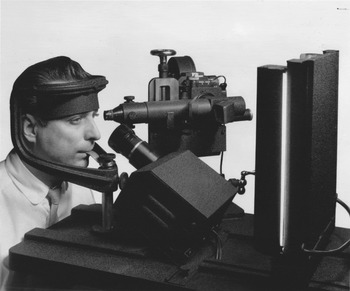
In his own research programme to investigate the psychology of vision, Jerome Bruner took similar advantage of this sentence type. Using a special camera designed by Norman Mackworth for recording precisely where people look (Figure 2), Bruner adapted embedded sentences to develop his long-standing effort to show that vision and what people see are controlled by mental processes.Footnote 68 This research programme was an argument against a more empiricist and behaviourist position on perceptual processes that sought to explain them completely by the structure of environmental factors. For Bruner, Chomsky's embedded sentences and Mackworth's eye camera became tools to demonstrate that patterns of direction of gaze became erratic when reading syntactically complicated material. And since syntax was supposed to be mental rules, this finding could support the longer-term goal of Bruner's research programme: the demonstration that mental processes control vision.
Stand-mounted eye marker camera. Reproduced by permission of Harvard University Archives.

Negotiating and arguing: making the Center's atmosphere
The interdisciplinary exchange of tools that characterized the Center's early years came with a definite social structure and mode of interpersonal interaction. The variety of disciplinary backgrounds represented in the Center's first years, and the intense, ecumenical features of the Center's daily life, produced a multifaceted, if chaotic, intellectual environment. Remarking on the ‘kaleidoscopic quality’ of the Center's activities, an annual report echoed Bruner's earlier application for funding from the Laboratory of Social Relations:
Research at the Center is opportunistic; as good ideas occur, we try to take advantage of them. Freedom and flexibility to explore in whatever appears to be the most promising direction is, we believe, an indispensable factor in good research. It does result, however, in an over-all program that looks somewhat loose and untidy when one tries to summarize it for an outsider.Footnote 69
This eclecticism of research interests when combined with efforts to exchange methods generated a pluralistic research culture that Bärbel Inhelder characterized as pluralist.Footnote 70 An annual report reflected, ‘It may well be that the intensity of discussion and activity reflects the wide spectrum of interests we comprise.’Footnote 71
Arguments formed a central and constitutive feature of the Center's milieu, a characteristic that enhanced the Center's reputation. Recently, Donald Norman recalled that ‘the first couple of people I met I immediately started violent arguments with … We just fought and fought and fought in the most positive of ways. And the end result was a series of quite important papers.’Footnote 72 Bruner has noted that people requested to attend the Center as visitors specifically because of its well-known hallway arguments.Footnote 73
The combination of numerous approaches and intensity of discussion came with a fluid pattern of social interaction. After his visit to the Center, Masano Toda wrote,
Something terribly active was booming at the Center and I have never seen such a noisy place. Besides the weekly colloquiums, the seminars held three times week, the Thursday staff luncheons, which were already lots of activities, informal discussions and debates were going on everywhere – a group of people were talking on cognition in the second floor corridor, one person sitting on the railing precariously keeping his balance, another sitting firmly on the floor, while another group of people was running subjects in the basement.Footnote 74
Movement from the hallway and lab into the lunchroom brought a pause in computer testing or quizzing experimental subjects, but argument did not rest. For instance, recalling Noam Chomsky's visits to the Center, Donald Norman recounts,
Chomsky would have lunch all the time at the Center for Cognitive Studies … There would always be fights over Chomsky's utterances. Chomsky would say something and then [Jerry] Fodor would say ‘What Noam meant was …’ And Jerry Katz would say, ‘No, what Noam meant was …’ And everyone would take their turn saying what Noam must have meant. And Noam would never say a word after that.Footnote 75
Learning from one another involved much arguing. Exchanging and refashioning research ideas, methods and tools involved discussing, fighting about, and negotiating how cognitive scientists or people in general might use ideas, words and concepts.
Underlying this culture of eclecticism and argument was a sense that it was both productive and an essential part of the Center's research programme. They believed so on the basis of their experiences in the daily life of the academy and also through research into the psychology of creativity. Before the Center had been founded, Bruner engaged in research on the psychology of the creative process and, like others engaged in similar research, had determined that creativity in groups is facilitated by free-flowing discussion and argument.Footnote 76
Miller and Bruner repeatedly pointed out that variety and flexibility in communication was an essential feature of their or any research centre. They wrote in a grant application that a centre
is a place where people know each other's business. It is not obvious by what means this is assured. It takes the form of conversation, at lunch, in the corridors, in weekly colloquia, in the two or three informal seminars that are always in being at the Center, organized either around a visitor's interests, around a hot topic, or around some coalition. It is not by chance that some forty of the publications that have come from the Center are collaborations among its members. The Xerox and the mimeograph are probably critical instruments in the exchange that leads to such collaboration.Footnote 77
If they were unsure of the means by which they could assure the success of communication at their centre, Bruner and Miller proceeded by facilitating the forms of communication, seminars and colloquia that they mention in their grant proposal. They were clearly very concerned with the Center's atmosphere and how to generate it. Comments on the Center's culture of ‘flexibility’, ‘freedom’ and ‘intensity’; its ‘energetic’, ‘heated’ atmosphere; its productive arguments; and the ‘kaleidoscopic’, ‘loose’, ‘untidy’, ‘opportunistic’, ‘flexible’ and ‘wide spectrum’ approach to problems appeared repeatedly in grant proposals, annual reports and personal communication.
This spirit of methodological and disciplinary inclusiveness did not mean complete openness, however. The recruiting process involved inviting ‘to the Center only those who eschew intellectual blinders’. Voicing interest in eclecticism, they commented, ‘one mark of our success must be the way few of the research programs we have described fall neatly into any one of our categories’.Footnote 78 This comment, and others made by members of the Center about their efforts to avoid ‘blinders’ and methodological narrowness, could easily have been understood as a means of marking the difference between their work and that of behaviourism. For behaviourism had been one way in which experimental psychology had marked its scientific status and autonomy as a discipline.Footnote 79 By the 1950s, however, behaviourism had come to be labelled by its opponents as a narrow, rigid, dogmatic and authoritarian system.Footnote 80 Thus the Center trumpeted both its openness and its eclecticism, both of which served as rhetorical devices for distinguishing it from behaviourism.
If the Center's culture was internally open, it was not necessarily open to outsiders. The in-group feeling and pattern of behaviour facilitated by closeness and frequency of contact, arguing in the halls and over lunch and regular informal seminars, had the effect of increasing solidarity within the Center while also excluding other people. For instance, when outside speakers visited to give a paper, interaction among audience participants was at least as important as the speakers' presentation. After the presentation was complete, the audience members posed questions, which were directed as much to other audience members as to the speaker. Typifying this mode of interaction, rising from his seat in the front of the auditorium, a senior member of the group would usually pose the first question, facing the audience and with his back to the speaker. Significantly, the speaker's response was considered relatively unimportant.Footnote 81 It was the other members of the Center who were significant. These were the people who would be active as sounding boards for developing research ideas.
There was no substitute for being a fully participating member of this intellectual community. For outsiders, missing out on discussions at the Center meant more than a lost opportunity for early appraisal of research results. It could also mean inability to make use of the research tools used at the Center since some of their methods were never fully and completely discussed in print. The Center's own members were well aware of the difficulty of knowledge transfer through print. For instance, Leo Postman, an early collaborator of Bruner's, complained to Bruner that after moving from Harvard he was unable to get his own instruments to work because of insufficient local technical support in his new location. In addition, Norman Mackworth was invited to become a member of the Center because his published work on eye cameras was not rich and detailed enough for the others at the Center to make use of without his direct involvement. Actually, that extensive help from Mackworth was necessary for others to make use of his tools is indicated by the fact that his working at the Center on a once-a-week consulting basis was eventually converted to full membership.Footnote 82
Even the Center's research results were fully available only to insiders. Published work by the Center's scholars often cited internal unpublished studies, research reports written for patrons, the Center's own annual reports, papers given at the Center, mimeographs distributed at the Center and/or personal communication.Footnote 83 Randy Allen Harris has noted that a similar phenomenon occurred in Chomsky's group at MIT:
Developments spread rapidly. Everyone spoke in the hallways, attended the same colloquia, and saw each other's papers long before they reached publication. They also saw many papers that never reached publication at all, the notorious samizdat literature that still characterizes work at MIT: arguments and analyses circulated in mimeograph (now electronic) underground, never making their way to the formal light of day but showing up in the notes of important works that did. This situation, quite naturally, infuriated (and infuriates) anybody trying to follow the theory but failing to hook into the right distributional network.
He notes in addition that ‘an even more frustrating manifestation of this in-group attitude was the large number of notes referring to remarks made “in a lecture at MIT,” or, even, to observations made in “personal conversation.”’Footnote 84
Thus a critical feature of the Center for Cognitive Studies was its culture of intimate and energetic interpersonal interaction. By all accounts, whether retrospective or from the period of the Center's existence, this self-catalysing atmosphere was one of the Center's most important features.Footnote 85 But the economy of arguing and of rapid tool exchange characterized the Center's research culture for only about half of its life.
The transition from interdisciplinarity to multidisciplinarity
At about the midpoint of its life, the research culture of the Center for Cognitive Studies shifted significantly. This metamorphosis involved both modes of research culture and patterns of interpersonal interaction at the Center. After the first few years of rapid expansion, the initial economy of tool exchange that had been the foundation of the Center's interdisciplinary culture ended. As the workers at the Center began to regularize their research techniques and reduce the types of questions they asked each other, the Center's initial economy was supplanted with a new pattern of exchange: multidisciplinarity. This section describes the new intellectual economy, the associated new kinds of social relations at the Center and several reasons for these transformations.
This shift of culture first appeared with a brief comment in the third annual report: ‘We are aware that our various discussion groups have tended to have less overlap of membership.’Footnote 86 Within a few years this early notice of decreased intellectual cross-fertilization expanded into a more lengthy analysis of difficulties with interdisciplinarity. The Center's members stopped remarking, as they once had, on the frequency of their collaborative work. As Bruner and Miller told the NIH in 1965,
During the past five years we have necessarily condensed and crystallized our interests … So inevitably, the Center has moved increasingly more to concentrated research on fewer topics … The danger of being interdisciplinary is that one ends up a prey to that easy eclecticism by which one swallows all and digests nothing.Footnote 87
This crystallization of research interests and increasingly focused research programmes would bring less communication among the different researchers. As a consequence, research at the Center moved from an interdisciplinary collaborative exploration to a multidisciplinary environment where work was conducted more in parallel than jointly. For instance, research by Bruner's group that had once been interested in the role of language in child development turned in the second half of the 1960s to exploration of the development of skills in infants and toddlers. Bruner himself also invested more time in the practical concerns of designing a social-science curriculum for middle-school students.Footnote 88 This implied greater distance from the work George Miller's group was conducting on language.
As they found reliable research techniques, the practical need for an eclectic spirit at the Center declined. Once the Center's researchers had settled on coherent research tracks, they were no longer as interested in the interdisciplinary exchange that had initially been the foundation of their own research programmes. As this mutual withdrawal and concentration occurred, the Center's members could no longer support the wide variety of activities they had once pursued. No longer would the weekly seminar on research methods in perception spend half a year discussing the book Art and Illusion by the art historian Ernst Gombrich. Significantly, the younger members of the Center began to chafe against the very techniques Bruner and Miller had designed to foster the Center's early eclectic, exploratory and interdisciplinary spirit. They now found the weekly seminars a waste of time and superfluous to their own research activities.Footnote 89
Early on, the Center had sought philosophers to join their ranks, eventually including Nelson Goodman, Israel Scheffler and Marx Wartofsky. But once its research atmosphere had shifted modes, the Center's leadership became less concerned with ‘find[ing] a philosopher with the patience to keep us aware of the epistemological issues we might bark our shins on’.Footnote 90 Bruner noted this change as he turned down a philosopher's application to the Center:
These last several years have been ones of increasing empirical concern and I seriously doubt whether our climate would be right at this juncture for a Goodman, Drebben, or Scheffler. It probably will be again, but for the moment, I think we are so preoccupied with questions about the nature and functions of infancy as to be too pawkish for professional philosophical company.Footnote 91
Without an instrumental need for interdisciplinary discussion, the drawbacks of the Center's initial ‘untidy’ and ‘loose’ intellectual economy began to outweigh the benefits. As the research programmes at the Center gained momentum, the people at the Center focused less on acquiring tools from one another and more on using the tools each already had.
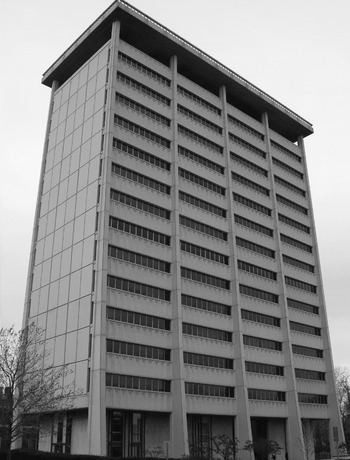
This transformation from an interdisciplinary to a multidisciplinary environment depended on a variety of factors, including changing research priorities, changes in the Center's funding patterns and changes in the Center's location relative to the other behavioural sciences. But perhaps the most tangible basis for the shift in the Center's culture was its physical relocation in January 1965 from its original location at 61 Kirkland Street to the 11th and 12th floors of the newly built William James Hall (see Figures 3 and 4).Footnote 92 The Center's home at 61 Kirkland Street had played an important role in generating its collegial atmosphere. In several significant ways the physical characteristics of the original building helped generate a cohesive social and work culture among the Center's members. From the very start, even before the Center's membership had reached full size, 61 Kirkland Street was small enough to generate a cosy and intimate feeling that produced ‘high morale’.Footnote 93
61 Kirkland Street.

William James Hall.

While the Center's morale depended on an intimate setting, its communal sense was similarly derived from its geographic distance from both the Social Relations and the Psychology Departments. When the Center moved into William James Hall with the other behavioural sciences, it became clear that its communal mood had depended in part on separation from the Departments of Social Relations and Psychology and its location on the periphery of campus. An annual report noted ‘how dependent affective processes are on environmental support’. It continued,
We encounter different people in this building from those we saw before, and our visiting back and forth with them has diminished the sense of social identity – the ‘in group’ feeling – that we had when we worked in greater isolation.Footnote 94
While integration with Psychology and Social Relations had a serious effect on the community ethos of the Center, the physical structure of William James itself also played a significant role in the declining sense of group cohesiveness. As Don Norman recalls,
In the original building of the Center everybody was on different floors but it was such a small building in a house that the stairway was not a barrier. Since there were only a few offices on each floor, you always had to be going up and down the stairs. In William James Hall, however, there were huge floors. And in fact you would seldom move from your end of the floor to the opposite end, let alone up or down the stairs.Footnote 95
Thus the relocation to William James not only ended the Center's isolation, but also, by the very layout of the new offices, drove the Center's members further from one another. In fact, the division between the two floors was severe enough that recently several members of the Center failed to remember that the Center had more than one floor.Footnote 96 Clearly, they did not spend much time moving from floor to floor.
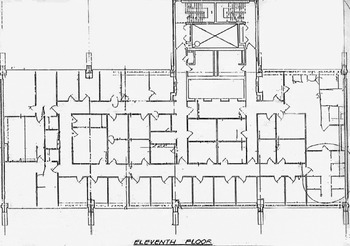
There were several specific architectural features other than lifts that made in-group communication difficult. The most significant was the layout of offices and labs on each floor (Figure 5). Each floor of William James Hall was a long rectangle with windows on the long sides (north and south). Offices were arranged on both north and south walls. Labs and seminar rooms ran up the center of the floor, between the offices on the north and south walls. Consequently there were two long hallways sandwiching the labs. One lay between the north offices and the labs and its counterpart lay between the labs and the south offices.
Floor plan of the Center for Cognitive Studies in William James Hall. By permission of Harvard University Archives. Enhanced by the author for clarity.

This floor plan produced three significant patterns of personnel movement and interaction. First, no one sat in an office across a hall from anyone else: across the hall was always a lab. Second, because the only route from the north to the south hall was a cross-wise hall in the center of the building, there was almost no movement between the two major halls. Third, because the lift bank was in the centre of the building (located on the short hall connecting the long north and south halls), researchers never needed to travel more than one quarter the length of the total hallway space on their way in and out of the building. So even researchers who worked on the same floor would very likely not run into others unless they had specifically made plans to do so.
This floor plan significantly reduced the amount of informal interaction among the Center's researchers. There was also an organizational feature that contributed to the architecturally driven decline of discussions between people who were not working together. Sometime after the move to William James, office occupancy was rearranged so that all of the people working in George Miller's group were on one floor and all of Bruner's people were on the other. For George Miller, in retrospect, the move to William James Hall and the changes it brought ‘destroyed’ the Center's previous collegial atmosphere.Footnote 97
Changes in policy and attitude from the Harvard administration also damaged the Center's interdisciplinarity. Within Harvard, McGeorge Bundy, dean of the faculty when the Center was established in 1960, had been supportive of extra-departmental research groups and of reducing the power of departments – a policy that worked in the Center's favour. On the other hand, Bundy's successor, Franklin Ford, found that his approach was too chaotic and disorganized. Bruner noted in 1971, ‘in all these years, for example, there was never anything except the most grudging willingness to accept the Center for Cognitive Studies and (after Bundy) the Deans always politely inquired how much longer the untidiness would continue’.Footnote 98
If the deans after Bundy were hostile to the Center's independent existence, so too was Harvard's president, Nathan Pusey. In response to a query from Bruner and Miller about making the Center a more permanent entity by establishing it through an action of Harvard's governing body, raising a two-million-dollar endowment and hiring two faculty members in the regular departments who would be contributors to the Center, Pusey expressed in a private note to himself the desire that ‘the Center would not continue to grow, pull away from the Departments and thus to become an independent entity in itself … it should not acquire permanent funds and make appointments’.Footnote 99
Change in patronage policy similarly restricted the Center's members' early opportunity to focus attention on building and exchanging tools. Regretting this change, Bruner wrote to one of his patrons:
I am writing to withdraw our application for renewal of a grant to the Center for Cognitive Studies … In withdrawing the application, I should like to explain a changed policy at the Center …
Typically, research here has been a matter of coalition and collaboration … It was usually the case that a given experiment grew out of discussion in seminars or in the informal give and take of the corridor of a laboratory. In this sense, it has always been difficult for us to carve out a particular study, free from either programmatic or project influence.
… But several things have changed – first is the form of grant giving, with priority given the particular study rather than the more generic program … At the same time, it has been increasingly difficult to find younger colleagues who worked easily into a program of research defined in this way …
In light of these changes, Bruner proposed reshaping the Center so as to
limit research appointments to a smaller number of post-doctoral fellows who come to us with their own grants. In this way, I shall be able to narrow the range of studies being carried out to those that I originate myself and to accept two or possibly three post-doctoral fellows.Footnote 100
These changes in funding, personnel and administration meant a decreased scope of research at the Center, less day-to-day flexibility. With researchers committed ahead of time by their grants to projects originated by Bruner, there would be less opportunity for the interdisciplinary tool exchange of the Center's early years.
While the Center's atmosphere shifted because of a change in departmental politics within the social sciences and because of changes in funding policies at the national level, local political events would also damage its early ‘in-group’ feeling. Drawing on their experiences in Bread and Roses, a community-based feminist consciousness-raising group, the women in the Center, from administrative staff to grad students to post-docs, formed a support group in order to address the sexism they saw in the Center.Footnote 101 This group was possibly difficult for Bruner to cope with since he had been a long-time supporter of and advocate for women in psychology. For instance, one of his students, Rose Olver, reports that it was only through Bruner's efforts at arguing the equality and similarity of women and men that she was able to secure an appointment in 1961 as the first woman on the faculty at Amherst College.Footnote 102 But, in the context of the late 1960s, the arguments that had supported Olver – that female psychologists were essentially no different to male psychologists – had a different valence. By that point, failure to recognize difference could be construed as sexist.
Of course, political mobilization at Harvard was not restricted to the Center. Other events at Harvard would also strain the Center's communal atmosphere. On Wednesday 9 April 1969 Harvard and Radcliffe students occupied the administration building, University Hall, and ejected the administrators in protest against Harvard's involvement in the Vietnam War and its policy of giving academic credit to Reserve Officer Training Corps (ROTC) candidates. The Harvard administration responded by asking the Cambridge police to end the protest. The next morning, the Cambridge police forcibly removed and arrested the students who had occupied the building, clubbing many in the process.Footnote 103 These events were followed by a student strike and several months of strife between the administration and the student body over a variety of issues including the disciplinary measures that would be taken against the students who had occupied University Hall, the reaction of the administration, the violence of the Cambridge police and the original ROTC issue. At the end of the process, bad feelings against Nathan Pusey and his handling of the situation remained. While these events led eventually to Pusey's resignation, their wake also strained relations between the Center's younger members and its leadership. On this note, Bruner remarked to a colleague that the events had led to a loss of the Center's collegial quality, since the ‘younger post-docs are so full of hostility to anybody in a senior role’.Footnote 104
Because of changes in the research space, Harvard departmental politics, protests against the Vietnam War, rising feminist consciousness and changes in funding structures, the group of scholars at the Center for Cognitive Studies spent less time speaking and working with one another than previously. Yet this transformation in the character of the research atmosphere depended as much on developments within the research itself. In fact, as a direct consequence of its research success, the Center lost its in-group spirit, its sense of being arrayed against the world, or of being engaged in a battle of the faithful against oppressive behaviourist dogmatism. If the younger post-docs were ‘hostile to anyone in a senior role’ because they represented the ‘Establishment’, the Center had actually become both intellectually and institutionally part of the mainstream. Just as the Center physically moved from the outskirts of Harvard at 61 Kirkland Street to become an integrated part of Harvard's behavioural sciences in William James Hall, so too did its research agenda move from the edge to the centre of what was seen as acceptable science.
There were several markers of the new success and mainstream status of research on cognition. Ulric Neisser, one of the Center's visiting fellows, published Cognitive Psychology in 1967. As the first textbook on the topic it indicated the newfound confidence held by those working in cognitive science. Neisser opened the book with the comment that ‘a generation ago, a book like this one would have needed at least a chapter of self-defense against the behaviourist position. Today, happily the climate of opinion has changed, and little or no defense is necessary.’Footnote 105 As institutional markers of this success, Bruner and Miller chaired Harvard's Department of Psychology and were elected presidents of the American Psychological Association. In addition, their students secured significant jobs and increasing journal space was devoted to cognitive questions.Footnote 106
Research on cognition had become easier in part because of the Center's success. But with this success came less concern with the interdisciplinary effort involved in learning to use unfamiliar tools. Looking back on these events, Bruner reflected,
In retrospect, I think that as time went on, fatigue pushed toward more intrinsic problems … The task of intrinsic revision was sufficiently demanding to shoulder aside much of the more extrinsic, interdisciplinary preoccupation that had initially inspired us. That extrinsic work took on the character more of an avocation than of vocation.Footnote 107
Once they were faced with several successful research programmes, the Center's directorship could not maintain both group cohesiveness and multiple modes of work. They remarked at the time,
we are suffering the wages of success … We are no longer the closely knit ‘primary group’ that we once were. We no longer know each other's business as well as we once did … There has been more tendency toward autonomy among developmentalists, among psycholinguists, and so on.Footnote 108
This was a remarkable change in a place where the directors had argued that an essential feature of a research centre was precisely the ability of its members to know and participate in one another's work.
Although the research programmes at the Center for Cognitive Studies were successful and played a significant role in making space for discussion of mind within experimental psychology, and although the Center's researchers would go on to leading roles in cognitive science, founding journals and research institutions, the long-term effect of the Center's work would play out outside the Center.Footnote 109 As an extra-departmental research unit, the Center depended on soft money and its leaders' continual grant-raising efforts. Eventually both Bruner and Miller tired of Harvard and their administrative responsibilities as directors of the Center and also as successive chairmen of the Psychology Department. After George Miller departed for Rockefeller University in the autumn of 1967 and Jerome Bruner for Oxford in 1971, the Center, lacking sufficient support from the Harvard administration for continued existence, closed its doors in 1972.
Conclusion
In the arc of its life, the Center for Cognitive Studies embodies several significant transformations in the nature of the academy. Most broadly, the Center for Cognitive Studies is a part of an explosion of interdisciplinary units in universities in the second half of the twentieth century. For these organizations, as for the Center for Cognitive Studies itself, extra-departmental status was linked both to filling the interstices between traditional disciplinary scholarship and to advancing scholarship deemed important, creative and innovative.Footnote 110
This article has offered a framework of economies of tool exchange for analysing research cultures within such cross-disciplinary research units. The Center's history indicates that its research cultures, and perhaps those in other recent cross-disciplinary research units, must be understood through the different ways that their members related to one another and to one another's toolkits. Tracking patterns of tool exchange makes possible the understanding of the rise and fall of interdisciplinarity at the Center for Cognitive Studies, events that would be invisible if one were to focus solely on such factors as rates of interdisciplinary co-authorship or the disciplines from which the Center's members originated.
At the level of its own field of study, the Center at Harvard was instrumental in establishing cognitive science as a permanently multidisciplinary field. Programmes such as that at the University of California at San Diego were built by Center alumni on the model of the Center for Cognitive Studies. Later, George Miller would participate in a study by the Sloan Foundation that both identified interdisciplinarity as a central characteristic of cognitive science and also helped frame the foundation's measuring stick for determining the distribution of the funds it would supply to help establish programmes in cognitive science around the nation. Perhaps because of these trends, cognitive science maintains itself as fundamentally and inherently multidisciplinary. Unlike areas such as molecular biology, which began as interdisciplinary collaborations and then matured into fully fledged disciplines, cognitive science remains proudly multidisciplinary.
The Center's initial interdisciplinary culture came not from the mere collection of different types of people there, but from their sharing, borrowing and learning from one another. Likewise, the Center's later multidisciplinarity was constituted by a different mode of intellectual interaction and exchange. Each form of research culture shaped both the intellectual content of cognitive science and the numerous departmental structures within which the Center's members worked.
Once the Center helped turn cognition into a respectable research topic, its members lost much of the social and intellectual glue that had come from their earlier sense of being embattled. Without this sense, without the intimacy afforded by isolation in a small house at the edge of campus and without funding and administrative support, the Center's members became more multidisciplinary than interdisciplinary in orientation, focused less on one another's toolkits, spent less time exchanging ideas and arguing with each other and concentrated more on pursuing their own research.
Ultimately, the productivity of its researchers eventually played a role in undermining one of the Center's primary purposes – to be a seedbed for the creative fashioning of tools to study the mind. Because of the ethos that equated interdisciplinary tool exchange with creativity, the Center's eventual multidisciplinary research culture represented a failure that was produced in part by the Center's own productivity.