EARLY HISTORY OF THE UNIVERSITY
It might seem strange that there was no separate law library in Oxford until 48 years ago; the first ‘formal’ proposal to the University for one was made in 1878. A couple of things could explain this. The tutorial method of teaching at Oxford lessened the pressure for a centralised facility because undergraduate teaching was provided in the Colleges, where separate small law library collections were established over time. The other reason could be attributed to the nature of the subject of law within the university, and its peaks and troughs, and the fact that the Faculty of Law as an entity was only created in 1876.
Ruth Bird

Oxford University is proud of its position as the oldest university in the English speaking world. Oxford was the sixth largest settlement in Britain by the mid 11th century and although there is no exact date, it was already established as a place of teaching in the last decade of the 11th century. There was a revival in learning which had centred on the monastic and cathedral schools, and the universities were developed from the latter. From 1167, when Henry II, in a dispute with Thomas Beckett, banned English students from attending the University of Paris, Oxford developed rapidly as a centre of learning.
The influx of students in the 12th century led to food shortages in the town, and with this was the start of centuries of conflicts between students and townsfolk (“town and gown”). In 1209 an Oxford student was accused of murdering a townswoman, and because the accused ran away, King John ordered the hanging of 2 of his friends. However, they, and others, decided also to escape and went on to form a learned community that evolved into the University at Cambridge. By this time there were some 1500 and up to possibly 3,000 students at Oxford, being taught by masters, not the religious orders; the first chancellor of the University was appointed in 1214.
After the plague of 1348, the population of Oxford reduced from 30,000 to 5,000 people, which inevitably affected teaching among other aspects of life.
THE STUDY AND TEACHING OF LAW AT OXFORD
Early known law teachers include Roger Vacarius, an Italian authority on canon and civil law, who put together a 9 volume compendium of the Codex Justinianus, and is thought to have been teaching in Oxford in 1149. Copies of this leading work still exist in Prague and Bruges, with fragments in the Bodleian and college libraries.
In the medieval university there were faculties of civil law and of canon law, with study of the latter following on from the former, and concentrating on topics such as papal directions and decisions. The study of the common law, the evolving custom of the king's courts, took place at the legal university of the Inns of Court. The student of canon and civil law had no place in the courts of common law; there were numerous ecclesiastical courts with extensive jurisdiction. Before the Reformation it was an advantage to hold a degree in canon law for those who hoped to win work in royal service and gain honour and wealth.
However, after the Reformation in the 1530's, Henry VIII banned the teaching of canon law at Oxford, and established lectures in civil law to ensure the proper training for matters such as diplomacy in the modern state. All Souls College became the centre of Civil Law at the University. Foreign civil lawyers were welcomed to England.
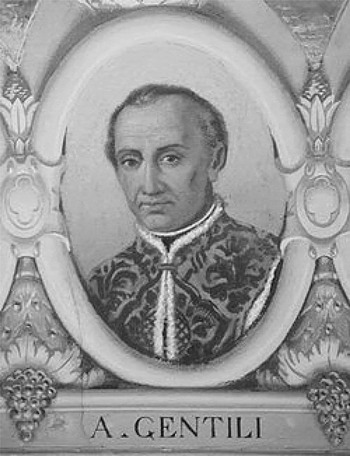
Protestant lawyer Alberico Gentili escaped from Italy to Oxford and in 1580 he became the All Souls Regius Professor of Civil Law at the University. He was one of the first writers on public international law, along with Hugo Grotius in the Netherlands. Canon law's influence declined through the rest of the sixteenth century, and Roman law was assimilated alongside the growth of the system of case law.
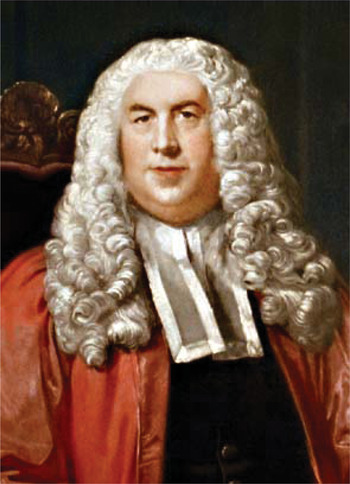
In the later 17th and 18thC, legal education fell into decline, but it did not disappear. By the mid 18th C, the concentration on civil law was re-balanced when William Blackstone inaugurated a series of lectures in the English common law at Oxford; his lectures evolved into the Commentaries on the Laws of England. They were the beginning of a new system of legal education, and were adopted with enthusiasm by lawyers in early America, and in 1755, lawyer Charles Viner left the University £12,000 to endow the Vinerian Chair of English Common Law, and first holder was Blackstone.
Alberico Gentill, Regius Professor of Civil Law

The first Vinerian Chair of English Law, William Blackstone

Viner was the author of the Vinerian Abridgment, he received permission from his legal contemporaries to include the writings of others in this work.
To arrest the steady decline in law teaching in the 18th and early 19th centuries at Oxford, formal university examinations were set in 1850, and the School of Law and Modern History was established. There was, from 1851, a revival of the degree of Bachelor of Civil Laws, with an examination on Justinian and history topics; but it was seen as unsatisfactory. In the 1870s there was split between the faculties of Law and Modern History, with a new School of Jurisprudence being created, with an expanded curriculum, in 1876.
In the School of Law and Modern History in the 1850's, the subjects taught were:
• real property,
• Blackstone's laws of the right of persons and personal property, and
• Justinian's institutes
The honours degree included
• jurisprudence
• the laws of England.
In 1876, the new degree of the Bachelor in Jurisprudence comprised:
• contract law
• real property law
• constitutional law
• Jurisprudence
• history of English law
• Roman law
• international law.
The advanced degree was the BCL - a full examination of 8 written papers and a viva as well.
LIBRARIES AT OXFORD
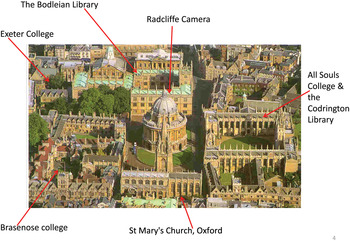
The first library for Oxford University – as distinct from the colleges – was housed in a room above the Old Congregation House, in the University Church of St Mary the Virgin. The building stood at the heart of Oxford's ‘academic quarter’, close to the schools in which lectures were given, which were housed where the Radcliffe Camera stands today. Only teaching masters could borrow books from the library, and they had to leave a deposit pledge of equal value to the book. The room, which still exists as a vestry and meeting room for the Church, was superseded in 1488 by the library known as Duke Humfrey's, the oldest part of the Bodleian complex. It survived in its original form for just over sixty years; in 1550 its books were dispersed or destroyed after legislation passed by King Edward VI was designed to purge the English church of all traces of Roman Catholicism, including, ‘superstitious books and images’.
Oxford was left with a depleted, poor collection not worthy of the university's position as a highly regarded institution throughout Europe.
THE BODLIEAN LIBRARY
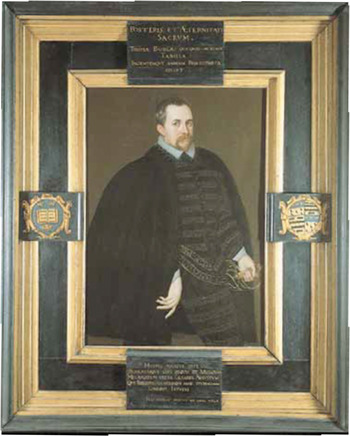
The library was rescued by Sir Thomas Bodley (1545–1613), a Fellow of Merton College who had travelled extensively in Europe and had, between 1585 and 1596 carried out several diplomatic missions for Queen Elizabeth I. He was wealthy, having married a rich widow whose first husband had made a fortune from trading in pilchards. In his retirement from public life, Bodley decided the university deserved a decent library, and he offered a substantial donation to the university. As a result the old library was refurnished to house a new collection of 2,500 books, some of them given by Bodley himself. A librarian, Thomas James, was appointed, and the new library opened on 8 November, 1602. The buildings expanded to include the Schools Quadrangle and Selden End.
Sir Thomas Bodley, by an unknown late-sixteenth-century artist Collection: Bodleian Lirary, Poole 71

In 1610 Bodley, with the support of King James I, entered into an agreement with the Stationers' Company of London under which a copy of every book published in England would be deposited in the new library. This pointed to the future of the library as a comprehensive and ever-expanding collection, different in both size and purpose from the libraries of the colleges.
In 1749 the Radcliffe Library was opened as a specialist science library, autonomous of the Bodleian. Funded by a retired royal physician, it became popular and competed with the Bodleian because it allowed the use of oil lamps in the evenings and allowed access to the local townspeople, and even the undergraduates. It was taken over by the Bodleian in 1860 and became known as the Radcliffe Camera; the Bodleian changed its policies to stay open after dusk and to admit undergraduates.
The Bodleian's collection continued to grow; by 1900 over 30,000 books per year were being added, and the total Bodleian research collection was over one million books. Pressure on space was great; stacks were created under the Radcliffe Camera, and by 1941 a whole new building, the New Bodleian, was opened to accommodate the ever expanding collection.
LAW LIBRARIES IN OXFORD
The first building dedicated to a law library for Oxford University was opened in 1964, a mere 48 years ago. However the collection, which is the raison d'etre of any library, has a longer, and very honourable, life of its own.
The legal deposit status of the Bodleian has meant that there was fairly systematic collecting of English and Scottish law books since 1610. Inevitably there were gaps at times, but they were made up when identified.
As mentioned earlier, by the 19th century the study of law was formalised, as part of the general reforms in the teaching in the university. But there was still no proper law library.
An important development was the establishment in 1867 by All Souls College of a collection of law books in the Codrington Library, open to students and barristers. This became the great standby for Oxford's lawyers until well after the First World War.
Another development was the growth of legal publishing and the writing of textbooks in the latter 19th century, with the establishment of the Incorporated Council of Law Reporting, but even in 1864 there were complaints about the lack of any text books on English Law adapted for University purposes. This contrasts with the United States, where the teaching of law in the universities had, by this stage, produced textbooks of high quality.
By the later 19th C several colleges were offering fellowships and scholarships in law, and some college law libraries were quite well established. From the 1870's efforts were being made to establish a separate university law library; a Miss Rebecca Flower Squire left a large endowment in her will for scholarships or fellowships in divinity and law, and for a Law Library or books for such a library. But the Oxford Law Faculty Board quibbled with the restrictions made by the bequest, fearing it would set a bad precedent, and so Convocation rejected the gift. The endowment went instead to Cambridge, and they created the Squire Law Library; Oxford had to wait another 60 years for adequate law library facilities.
The English law holdings continued to grow in the Bodleian through the late 19th and into the early 20th C. Early in the 20th C the Law Board accepted the need to try to separate the legal materials from the general Bodleian collection, to make them more accessible to the increasing number of students.
By 1923, a separate law section was created within the Bodleian classification. It was housed in a newly established law reading room in the Examination Schools. More colleges also began to buy law resources. Graduate researchers were, however, not well served, with the exception of legal historians.
Commonwealth and foreign law material was not being purchased, and there was no systematic approach to collecting from other jurisdictions. By the 1930s the Law Faculty Board was actively urging the University to provide a law library, and agreement wasn't far off, but the war intervened…
In 1940 the law reading room in the Exam Schools was taken over by the Government for war purposes, and the collection was transferred to the ground floor of the Radcliffe Camera. It remained there until 1955, when it was moved to the refurbished first floor of the Bodleian quadrangle.
Oxford

After the war there was a great increase in the number of undergraduates reading law, and apart from overcrowding in the Bodleian, it was not possible to keep sufficient essential legal material on open shelves for direct access. This was a great obstacle to effective research in law, and exposed more than ever Oxford's failure to provide for graduate and research needs in law.
PLANNING FOR THE ST CROSS BUILDING
In 1956, with the support of the Friends of Oxford Law in the US, the Law Board asked the University to put before the Rockerfeller Foundation a proposal for the establishment of a new University Law Library, (as part of the Bodleian Library), and an associated Law Faculty Building. The Foundation made a gift of £150,000 to the University, more than half the estimated cost of a new building, on condition that the University find other sources of funding and a site, which it did.
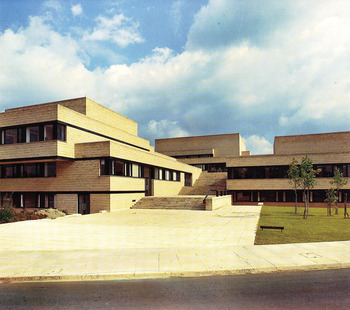
The selected architects were Sir Leslie Martin and Colin St John Wilson. The Law Board appointed Mr Peter B. Carter of Wadham College to be its delegate to ensure faculty co-operation with the Bodleian and other University authorities in the planning and execution of the project.
Building commenced in 1959, and the library was opened on the 17th of October 1964, by Dean Erwin Griswold of the Harvard Law School, with numerous luminaries in attendance.
The Library is on four floors, occupying 5,200 sq. metres, and is still impressive at first glance, but the interior fabric has worn and it is in need of a touch of love and money to revitalize it. Several projects have been undertaken to modernise the facilities, and in the past 12 years we have had some changes to the layout of the original library, creating an IT training room, a study area for the EU collection, a graduate reading room, and an open access rolling stacks and reading room. In the late 90's the whole building was listed by English Heritage as Grade 2* which restricts changes to the appearance of the public areas of the law library. We need approval for the type of lights we put in, the flooring we use, the way we wire the desks, etc. These restrictions did lead us to be the first library in the Bodleian group to install wifi to supplement the network coverage, but have also means that the removal of our built in card catalogue drawers will require listed building consent.
The Bodleian Law Library, built 1964, by Sir Lesile Martin. Thomas-Photos Oxford

The staff
Bodleian Curators appointed E.H. (Ted) Cordeaux as the first holder of the newly created post of Superintendent of the Law Library. His staff of 13 included 3 librarians, one of whom, Mr Michalski, was the foreign law librarian, and though he retired in 1975, lived to April this year, passing away at the grand age of 104.
Of the present staff, none of us are quite that old! We now have around 30 staff, making up about 22 full time equivalent posts; of these, 9 are qualified librarians working in a range of roles, three also have law degrees, and we have a classicist, a couple of teachers, and other useful skills to share. We undertake all our own technical services within the framework of the Bodleian libraries system, and we teach a compulsory first year course in the law degree. We are also part of the Law School's post graduate researchers' methods programme.
The Collection
The Law Library collection policy was designed from the outset to meet some undergraduate, but mainly postgraduate needs, and all books except for rarities were to be on open shelves. Amazingly, the planned capacity from the outset was around half a million volumes; by the beginning of 1966 the library contained 130,000 volumes.Footnote 1
The collection continued to thrive and grow. The Legal Deposit status has given us possibly the most comprehensive collection of law materials published in the UK, because it does not distinguish between academic and professional resources, covering the whole range. There was active collecting for primary materials from the US, Canada, Australia, India, Pakistan, much of Western Europe, New Zealand, South Africa, and to a much lesser extent, a further 70 or 80 jurisdictions. Monographs are also purchased, and we undertook a comprehensive review and purchase policy across ten core legal topics in nearly 100 jurisdictions in 2009 to bring the collection up to date.
The Law Library also has extensive collections in Roman law, jurisprudence, comparative law, criminology and a large international law collection of over 70,000 volumes.
Superseded, rare and special collections
In addition to these current collections, we are very proud of our secondary, or superseded, collection. We retain, on open access, all our superseded editions of all our books, encyclopaedias, digests, etc, not only for the UK, but for the whole collection. This means that scholars and researchers can easily browse and access books no longer available elsewhere.
I doubt many of our American colleagues can boast the full run of the Code of Federal Regulations or the superseded volumes and pocket parts of the USCA on open shelves.
We also hold rare books. All original volumes of English statutes as published since 1540 are in our library, housed in boring grey conservation boxes but in pristine condition, and available to researchers, for use under supervision. We are a working law library, and these precious volumes are part of that tradition.
We also hold several special collections, including the libraries of 2 lawyers.
The first is Viner's collection, comprising the library of Charles Viner from 1756. It is a rare example of an intact eighteenth century lawyer's library and in 1964 the collection was moved to the newly built Bodleian Law Library.
The second special collection is the Kahn-Freund, which contains the extensive range of books on labour law from the library of Sir Otto Kahn-Freund (1900–1979), former Professor of Comparative Law in the University.
Official Papers
The Law Library became a European Documentation Centre in the 1960s, and in 2010 the Official Papers collection was transferred from the central Bodleian site to occupy a newly refurbished reading room on the ground floor of the law library. It holds over 2,500 linear metres of Official Papers, including British parliamentary papers from 1800, our United Nations collection, and a dozen other NGO and official papers collections. These are also openly available to any reader who visits the library.
A link with College of William and Mary

THE USA AND THE LAW BOD
Our connections with the US have been strong all along; we have regular summer schools and proper semester long courses with several American Universities; we have been inspected by, and gained approval from, the ABA as a suitable collection to support the teaching of subjects forming part of the US JD courses, our collection of US law reports, journals, digests, congressional debates, codes and regulations, along with over 7,000 texts (or treatises) is one of the better ones in the country, together with the revitalised Middle Temple collection and the IALS & Squire holdings.
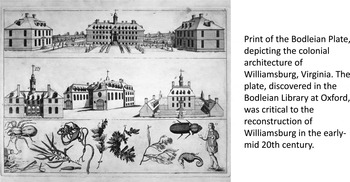
Another link is the Bodleian Plate, an engraved copperplate discovered in 1929 at the Bodleian Library. It is the only known 18th century architectural drawing of Colonial Williamsburg's principal buildings, and so it became the basis for their restoration and the reconstruction of the Wren Building, the Governor's Palace, and the Capitol.
And perhaps the most important connection is that our library's architectural design was created after members of the Oxford Law Faculty went on a field trip to the US to view law libraries in the 1950's, and decided the University of Chicago provided them with the layout they preferred. Imitation is a form of flattery!
Our library has continued to grow in size of collection, in the range of services we provide for researchers and academics, in e-resources available, and in staff to support the research and teaching undertaken by the faculty. We are proud to be part of the Bodleian Libraries, holding about 5 % of its extraordinary collection, and also part of the long and rich history of the University of Oxford.