


INTRODUCTION
Although silicon (Si) is a bioactive element in plants (Fauteux et al., Reference Fauteux, Rémus-Borel, Menzies and Bélanger2005), it is not considered an essential element for higher plants (Richmond and Sussman, Reference Richmond and Sussman2003). Specific beneficial effects of Si have been found in many plant species (Epstein, Reference Epstein, Datnoff, Snyder and Korndörfer2001; Liang et al., Reference Liang, Sun, Zhu and Christie2007; Ma and Yamaji, Reference Ma and Yamaji2006), thus it is now referred to as a ‘beneficial’ or ‘agronomically essential’ element for such species (Savant et al., Reference Savant, Snyder and Datnoff1997; Ma and Takahashi, Reference Ma and Takahashi2002). Rice (Oriza sativa L.), sugar cane (Saccharum officinarum L.), other grasses and some dicotyledons are among the plant species for which Si is beneficial (Ma and Takahashi, Reference Ma and Takahashi2002; Richmond and Sussman, Reference Richmond and Sussman2003; Savant, et al., Reference Savant, Korndörfer, Datnoff and Snyder1999). Among the benefits of Si uptake by plants are increased crop quality and yield, improved insect–pest and pathogen resistance, drought, soil salinity and heavy metal tolerance (Epstein, Reference Epstein, Datnoff, Snyder and Korndörfer2001; Liang et al., Reference Liang, Sun, Zhu and Christie2007; Ma and Takahashi, Reference Ma and Takahashi2002; Marschner, Reference Marschner1995; Romero-Aranda et al., Reference Romero-Aranda, Jurado and Cuartero2006; Savant et al., Reference Savant, Snyder and Datnoff1997).
On the other hand, plant species differ considerably on the Si concentration that can be achieved in their tissues (Ma and Takahashi, Reference Ma and Takahashi2002; Marschner, Reference Marschner1995), although all plants rooting in soil contain some Si in their tissues (Ma and Yamaji, Reference Ma and Yamaji2006). The studies of Ma and Takahashi (Reference Ma and Takahashi2002), which included over 500 plant species, allowed them to make three groups of plants, namely the high, the intermediate and the non-Si accumulators. Their grouping was based on Si concentration and Si to calcium (Ca) ratio in the tissues. Plants with Si concentrations higher than 1.0% and a Si:Ca ratio higher than 1.0 were considered Si accumulators, based on the following arguments: (i) In order for a plant species to accumulate more than 1% Si, it would need to take up Si by an active absorption mechanism; (ii) since previous work has indicated that plants that accumulate Si tend to have low Ca concentration, the Si:Ca ratio can be used as a complementary criterion to identify Si accumulating plants.
The studies of Ma and Takahashi (Reference Ma and Takahashi2002) also allowed to identify a general trend: Monocotyledons generally accumulate more Si than dicotyledons, although exceptions are known and diferences among ecotypes and cultivars of the same species have been documented (Epstein, Reference Epstein1999; Marschner, Reference Marschner1995).
Many soils in Africa, Asia and Latin America, including some on which oil palm (Elaeis guineensis Jacq.) is grown, are highly weathered and desilicated, and as a consequence, a ranking of some soil orders according to increasing weathering (Mollisols > Vertisols > Inseptisols > Alfisols > Ultisols > Oxisols) would coincide with their ranking according to decreasing soluble Si (Savant et al., Reference Savant, Snyder and Datnoff1997). Desilication is a soil process that occurs concomitantly with weathering (Savant et al., Reference Savant, Korndörfer, Datnoff and Snyder1999). On the other hand, soils may be depleted of Si as a consequence of prolonged cultivation with Si accumulating crops if the management practices do not include returning the extracted Si. This has been the case of many soils with a long history of rice cultivation in Japan (Savant et al., Reference Savant, Snyder and Datnoff1997). Based on the above, Si fertilization is a standard practice for some crops in certain regions of the world where available soil Si is below critical levels (Ma and Yamaji, Reference Ma and Yamaji2006) as in the specific cases of rice cultivation in Japan, and rice and sugar cane cultivation in some areas of the United States (Korndörfer and Lepsch, Reference Korndörfer, Lepsch, Datnoff, Snyder and Korndörfer2001). Under these circumstances, yield responses to Si applications have been agronomically and economically important (Korndörfer and Lepsch, Reference Korndörfer, Lepsch, Datnoff, Snyder and Korndörfer2001; Ma and Yamaji, Reference Ma and Yamaji2006). Soil Si depletion due to long-term oil palm cultivation is more likely to occur when crop residues are not recycled, since residues such as empty fruit bunches contain important concentrations of silica, as stated by Law et al. (Reference Law, Daud and Ghazali2007). However, only in a low proportion of oil palm estates in Colombia, empty fruit bunches and mill effluents are returned to the field.
Significant progress has been made in understanding the mechanisms through which Si determines increased plant disease resistance, particularly against pathogenic fungi; both mechanical and physiological mechanisms have been studied (Fauteux et al., Reference Fauteux, Rémus-Borel, Menzies and Bélanger2005). It has been documented that Si elicits the synthesis of low molecular weight metabolites with anti-fungal activity, specifically phytoalexins (Epstein, Reference Epstein, Datnoff, Snyder and Korndörfer2001; Fauteux et al., Reference Fauteux, Rémus-Borel, Menzies and Bélanger2005; Richmond and Sussman, Reference Richmond and Sussman2003). Consequently, a role of Si in systemically acquired resistance mechanisms has been postulated (Fauteux et al., Reference Fauteux, Rémus-Borel, Menzies and Bélanger2005). The above-mentioned research has involved both monocotyledons and dycotyledons (Fauteux et al., Reference Fauteux, Rémus-Borel, Menzies and Bélanger2005).
The literature search (Snyder, Reference Snyder, Datnoff, Snyder and Korndörfer2001) done by the authors and personal communications (with L.E. Datnoff in 2002 and J.F. Ma in 2002) indicate that no information is available related to the above-mentioned aspects regarding oil palm or other palms. Since oil palm is as important for Colombian agriculture as for other tropical countries, establishing whether or not Si is important for the oil palm crop is considered relevant. Several diseases affect productivity and competitiveness of the oil palm crops in Latin America, thus it would be of great practical significance to determine whether or not the beneficial effects of Si that have been identified for other species also occur in the oil palm crop. However, preliminary information about the soil and plant Si status of the oil palm crop is required before more advanced studies are undertaken. Obtaining such preliminary data was the general objective of the present study. Determining the leaf Si concentration and the soil available Si level and their variability among cropping regions in Colombia as well as comparing these results with available data for other crops and regions of the world were the specific purposes of this research.
MATERIALS AND METHODS
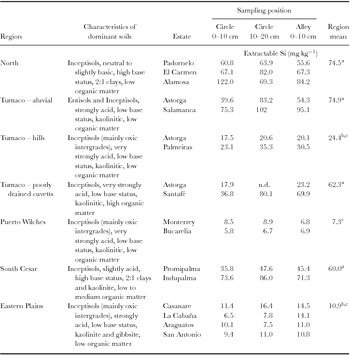
This study had four components, the main one being a survey in which soil and leaf samples were taken from 17 oil palm estates located across the main cropping regions of Colombia. The estates represent different combinations of regions and geomorphologic positions, and as shown in Table 1, their soils differ in fertility-related parameters such as organic matter, acidity and nutrient availability. Two complementary surveys were done: first one in which the variation of soil available Si with depth was examined, and the second one in which the variation of Si concentration with leaf age was determined. In the fourth component, results of chemical analyses of leaf samples sent by farmers to Cenipalma's leaf and soil testing laboratory (LAFS) were used as complementary source of information.
Extractable soil Si in relation to sampling site and region.

Region mean values followed by superscript letters in common are not significantly different at p < 0.05 using Tukey's test.
n.d. = not determined.
Soil sampling and analysis
The identification of the regions and estates from which soil samples were taken in the main survey is given in Table 1, along with a general description of the dominant soils of each location. Within each estate a representative commercial field was selected for sampling, and within each field a sampling station was defined as the area occupied by six adjacent palms distributed according to the standard planting pattern for commercial crops (a triangular array of 9 m left between two adjacent palms). Therefore, the area of each sampling station was about 419.6 m2. Two sampling positions were defined at each station: the ‘circle’, which corresponds to the weeded area surrounding the palm trunks (4 m in diameter), and the ‘alley’, which is the inter-row space not used for harvesting traffic within the fields. In the circles, separate samples were taken from two depths (0–10 and 10–20 cm) whereas in the alleys only one sample was taken (0–10 cm of depth). Two sampling depths were included in the circles because the author's experience indicates that there is a greater variability at that position than at the alleys when oil palm crops have been fertilized for several years. This way three separate soil samples were obtained per sampling station, and since 17 selected combinations of estate, region and geomorphologic position were included (Table 1), a total of 51 soil samples were taken, out of which 50 were analysed (one sample was lost). Each soil sample resulted from combining six sub-samples taken around each palm of the sampling station according to the sampling pattern just described.
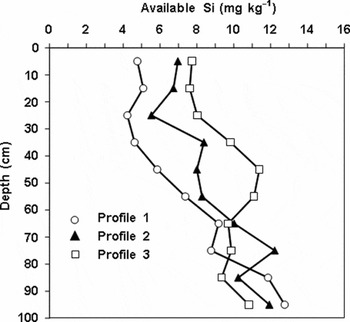
The complementary observations made to study the variation of soil available Si with depth consisted in taking samples at 10 different layers (10-cm increments) from three soil profiles (replications) at La Cabaña estate (Eastern Plains region). Profiles examined corresponded to alley positions. This part of the study did not pretend to include all regions and soil combinations.
To quantify plant available Si in the soil samples, 20 mL of 0.5-M acetic acid solution were added to 2.0-g soil aliquots followed by shaking for 60 min in a reciprocating shaker (145 rpm) and filtering to obtain the extracts. Silicon concentration in the extracts was determined colorimetrically (815 nm) using a Lambda 10 UV/VIS Perkin Elmer spectrometer. Both extraction and quantification procedures are described in more detail under method RA-M30-LAFS/1 contained in the methods manual of LAFS, and have been used by other laboratories (i.e. Snyder, Reference Snyder, Datnoff, Snyder and Korndörfer2001).
Leaf sampling and analysis
Samples were taken from leaves of different ages based on the conventional nomenclature applied to the phyllotaxis of oil palm, according to which the youngest open leaf is given No. 1 and subsequent leaves are numbered thereon consecutively (Ng et al., Reference Ng, von Uexküll, Härdter, Fairhurst and Härdter2003). The time elapsed between the emergence of two consecutive leaves generally varies from 15 to 20 days in adult palms (Ng et al., Reference Ng, von Uexküll, Härdter, Fairhurst and Härdter2003).
Leaf samples in the main survey were taken from the same palms around which the soil samples were obtained. Therefore, 17 sampling sites were included. Separate samples were obtained from leaf No. 3 and leaf No. 17 of palms at each sampling station. Each sample resulted from combining six sub-samples, one from each palm. In turn, sub-samples comprised 20 leaflets detached from the central portion of the corresponding leaf. Samples were taken from crops older than 8 years.
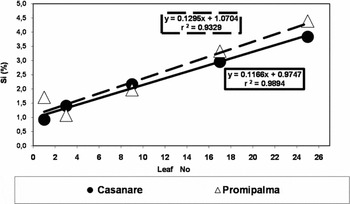
In a complementary survey through which the influence of leaf age on Si concentration was studied, samples were taken from Promipalma and Casanare estates only. Separate samples were obtained from five different leaf ages (leaves No. 1, 3, 9, 17 and 25). In this case the samples from each of the six palms from the sampling stations were not bulked but analysed separately.
All other steps of leaf sample preparation and handling were those described by Munévar and Franco (Reference Munévar and Franco2002).
To determine total Si concentration in leaf samples, 0.30-g ground-tissue aliquots were treated with 20 mL of extracting solution, which was made of 4.5-M HF and 1-M HCl. After shaking for 60 min in a reciprocating shaker (125 rpm), the extracts were filtered through Watman 540 paper. Silicon concentration in the extracts was determined by atomic absorption spectrometry using an Aanalyst 300 Perkin Elmer instrument. This procedure is a slight modification of the one described by Walinga et al. (Reference Walinga, van Vark, Houba and van der Lee1989). Details of the procedure are described under method RA-M12-LAFS/1 contained in the methods manual of LAFS.
Since Si:Ca ratio in the leaves was considered an important variable to be included in the interpretation of the results (Ma and Takahashi, Reference Ma and Takahashi2002), samples were also analysed for Ca. For this, 0.500-g leaf tissue aliquots were digested in a mixture of NHO3 and H2O2 for a total of 3.5 h at an increasing temperature of 70—150 °C. After digestion, Ca concentration was determined by atomic absorption spectrometry with the instrument described for Si analysis in leaves. These procedures are described in more detail as methods RA-M2-LAFS/1 and RA-M5-LAFS/1 contained in the methods manual of LAFS, and are the modifications of the methods described by Walinga et al. (Reference Walinga, van Vark, Houba and van der Lee1989).
Data analysis
In the main survey, soil and leaf date were submitted for analyses of variance using the general linear model procedure of the Statistical Analysis System (SAS) (SAS Institute Inc., Cary, NC). Tests of significance were made to determine the effect of independent variables and their interactions on leaf or soil Si concentration. When main effects were found significant, Tukey's tests were applied to mean values to judge the significance of differences among them.
To determine the significance of differences in Si concentration between leaf No. 3 and leaf No. 17, paired Student t-tests were conducted using ‘Statitix 8.0®’.
In a complementary survey through which the influence of leaf age on Si concentration was studied, data from the two estates included were separately submitted to regression analyses. The regression equations were obtained using the mean value of the six palms analysed.
For the data extracted from LAFS files, descriptive statistics were calculated. Samples were taken directly by the growers but care was taken to assure that these were taken from leaf No. 17 of crops aged 5 to 17 years.
RESULTS
Soil available silicon
Soil available Si determined in the survey that included 50 samples obtained from the combination of locality, depth and sampling site showed a variation of 5.8 to 122.0 mg kg−1 Si with a standard deviation of 31.7 mg kg−1 and a coefficient of variation of 80%. When the results were arranged in seven groups obtained by the combination of geographic origin and geomorphologic position from which the samples were taken, as indicated in Table 1, mean values ranged from 7.26 to 74.9 mg kg−1 Si. Analyses of variance and Tukey's tests applied to the data allowed to detect significant differences (p < 0.05) in available Si status between sampling regions. For this set of data, neither significant differences (p > 0.05) were found between sampling depths nor between sampling positions (clean circle vs. alley), although in most cases Si concentration was higher in the second soil layer than in the superficial one, and in 76% of the cases Si concentration was higher in the alley than in the circle, at 0–10 cm depth.
The preliminary observations of three soil profiles, all of them oxic soils, showed a defined tendency of increasing values with depth, particularly between 15 and 95 cm (Figure 1). The increase was highest in profile 1 (225%) and lowest in profile 3 (31%).
Depth variation of extractable Si in three soil profiles.

Leaf silicon status
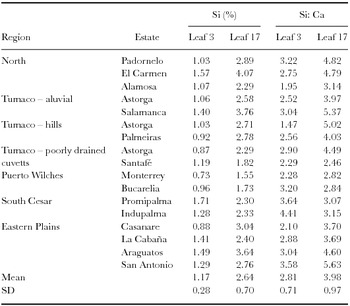
The results from the leaf samples taken from the 17 combinations of estates and regions showed, for every palm sampled and for the average of them, that the Si concentration was higher in leaf No. 17 than in leaf No. 3 (Table 2) and ranges from 0.73 to 1.71% in leaf No. 3 and 1.55 to 4.07% in leaf No. 17. These differences between the two leaf ages were statistically significant (p < 0.001), according to the Student t-test practised. This initial result suggested the convenience of a more detailed study, including a broader range of leaf age.
Silicon concentration and Si to Ca ratio in leaves No. 3 and 17 of palms sampled in several estates and regions.

Variability was also found among estates for a given leaf age (coefficient of variation (CV) of 23.7% and 26.4%), but the analyses of variance practised did not allow to find significant differences (p > 0.05) among regions. No significant correlation (p > 0.05) was found between soil extractable Si and leaf Si concentration neither in leaf No. 17 nor in leaf No. 3.
The Si:Ca ratio in leaf No. 17 also varied between estates (CV of 24.4%), ranging from 2.46 to 5.63 (Table 2).
The study in which Si concentration was determined for five leaf ages at two locations showed a close relationship between these two variables. At both sites, Si concentration increased with leaf age (leaf No.) and the data fit linear regressions with very high r 2 values (Figure 2). These results are consistent with those reported in Table 2.
Silicon concentration as a function of leaf age (number) in two locations.

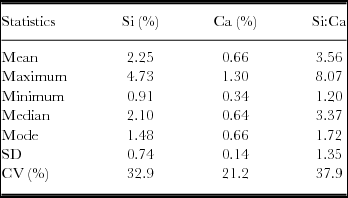
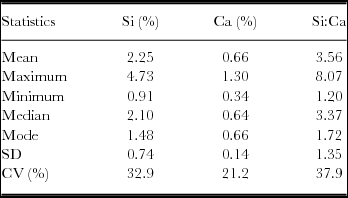
Results of chemical analyses of leaf samples sent by farmers to LAFS were used as complementary source of information. This data set included 418 leaf (No. 17) samples and showed an important variability among samples for Si and Ca concentrations as well as for Si:Ca ratio (Table 3). Silicon concentration was higher than 1% in 99.3% of the samples, and all the samples had a Si:Ca ratio higher than 1.9, results that are consistent with those reported in Table 2.
Descriptive statistics of leaf No. 17 analyses values from a data set of 418 samples.
DISCUSSION
The variation found in soil available Si concentration (from 5.8 to 122.0 mg kg−1) could be of agronomic importance if oil palm was found to be affected by Si availability. Research on critical levels of available Si for rice has suggested that concentrations of 7 mg kg−1 Si could be considered low and values greater than 24 mg kg−1 are to be considered sufficient to attain high yields (Snyder, Reference Snyder, Datnoff, Snyder and Korndörfer2001). Similarly, oriented research for sugar cane indicates that levels below 43 mg kg−1 available Si justify Si fertilization of this crop (Korndörfer and Lepsch, Reference Korndörfer, Lepsch, Datnoff, Snyder and Korndörfer2001). Therefore, if similar criteria could be applied to oil palm, then the soil test values found in this study would range from very low to very high.
The differences found in soil available Si among sampling regions can be explained on the bases of the differences in other soil characteristics, including the degree of weathering, since the lowest values were associated with soils with oxic characteristics (Tumaco-Hills, Puerto Wilches and Eastern Planes), and the highest values with less weathered soils. These results agree with the generally accepted concept, according to which weathering processes remove available Si from soils (Brady and Weil, Reference Brady and Weil1996; Savant et al., Reference Savant, Korndörfer, Datnoff and Snyder1999).
The weathering and leaching processes could also explain the pattern of variation of available Si concentration with soil depth that was determined in three profiles of oxic soils of the Eastern Planes. Therefore, on soils as the ones studied here, the possible influence of available Si on plant growth and behaviour could be expected to be different among plant species according to their rooting patterns and plant age, particularly in perennial tree crops such as the oil palm.
The results of two components of the study consistently showed that leaf Si concentration in oil palms increases with leaf age, which could mean that this element behaves as a non-mobile one in plant phloem, this finding being consistent with the behaviour observed in other plant species such as barley and other cereals (Brown and Hu, Reference Brown and Hu1998; Ma and Yamaji, Reference Ma and Yamaji2006; Marschner, Reference Marschner1995). The practical implications of this behaviour could be varied. When the available Si concentration in the growth medium reached limiting levels, a decrease in Si concentration in the plant would be first observed in young tissues. If Si had an influence on pest or disease problems in the oil palm, younger leaves had a greater probability of being affected under conditions of limited supply of available Si. On the other hand, if the results mean than Si is not mobile in the oil palm and the element plays an important role in plant growth or protection, then a continued supply of the element would be required during practically all growth stages for healthy and productive development of crop, as has been documented for the cucumber (Cucumis sativus) – powdery mildew pathosystem (Fauteux et al., Reference Fauteux, Rémus-Borel, Menzies and Bélanger2005) – and suggested regarding the rice plant (Savant et al., Reference Savant, Snyder and Datnoff1997). If management or environmental changes determined alternating conditions of sufficiency and deficiency of Si, and the element had an influence on plant health, then the variation pattern would explain, at least partially, the occurrence of pest or disease problems as episodes. The concentration gradient that was identified should be kept in mind in determining leaf sampling procedures for specific purposes, and the interpretation of results. Concentration gradients related to leaf age were also found for other nutrients, but those results were published in a separate paper (Munévar et al., Reference Munévar, Romero F., Cristancho R. and Arias A.2005).
When the leaf Si concentration values that we obtained are compared with those reported in the literature for other species, it can be inferred that oil palm would be a Si accumulator. As indicated, all values found for leaf No. 17 were higher than 0.91% with a mean value higher than 2.0% and a maximum of 4.07%. Among the cultivated species, rice and sugar cane are examples of Si accumulators, and for these species typical leaf Si concentrations under adequate Si supply are about 6% and 2.5% respectively (Ma and Takahashi, Reference Ma and Takahashi2002; Savant et al., Reference Savant, Korndörfer, Datnoff and Snyder1999). When the classification scheme of Ma and Takahashi (Reference Ma and Takahashi2002) is applied to the data obtained in the present study, there is no doubt that the oil palm ought to be considered as a Si accumulating species. However, our work does not allow making any conclusions as to whether or not Si is important for or plays a specific role in oil palm behavior or production. Nevertheless, the results allow inferring that the plant available Si form in the soil (silicic acid) will noticeably decrease with time in oil palm crop not receiving Si additions, particularly if the soil has low Si reserves, as occurs in highly weathered soils. If Si played a role, say in regulating disease incidence in oil palm, then excessive net extraction of available Si could occur after certain time of cultivation and the hypothetical disease(s) would appear afterwards.
An unexpected result for the authors was the lack of a statistically significant relationship between soil and leaf Si concentrations, and no obvious explanations of that behavior are available. The result suggests the convenience of further studies, such as determining the seasonal variability of soil and leaf Si, keeping in mind that for this study sampling date was not a variable and Si concentrations may vary through the year as has been documented for other chemical elements (Foster, Reference Foster, Fairhurst and Härdter2003). Another possibility is that the oil palm has the ability of absorbing Si from the soil solution even at concentrations currently considered very low for other plant species. Among the studies required to advance on this subject are also the experiments oriented to determine the effect of Si availability on oil palm growth as could be omission plot trials.
As far as the authors know, these are the first published results regarding Si accumulation and variability in the oil palm cropping system, and as a whole they give importance to future research that may contribute to determine possible roles and effects of Si in oil palm cultivation, as has been done for some other crops. Of particular importance would be studying whether or not Si availability has any influence on the response of the plant to insect pests and pathogenic microorganisms, particularly fungi, which are important biotic stress factors limiting competitiveness of the palm oil industry in Colombia.
Acknowledgments
The authors acknowledge the contributions of the plantations from where the samples were taken. Field sampling was a contribution of Cenipalma's researchers J. A. Cristancho, J. Castillo, N. A. Arias and D. Motta. Thanks to R. Martínez for his suggestions on statistical analyses and to E. M. Garzón and J. I. Sanz for reviewing the manuscript. The research was partially supported by the Fondo de Fomento Palmero and Fedepalma (Colombia).