Introduction
The observation of induced psychiatric side effects in deep brain stimulation (DBS) (eg, changes in mood, hypomania, reduction of anxiety) initiated the attempt to try DBS for psychiatric disorders.Reference Mallet, Mesnage and Houeto 1 Another reason was the fact that the effective but irreversible ablative neurosurgical interventions could now be emulated using DBS with a focused, fully reversible, and titratable technique.
DBS can be seen as an improved alternative to ablative neurosurgical procedures, which are used for well-defined groups of patients with extremely severe treatment-refractory mental disorders, such as anterior cingulotomy (for obsessive-compulsive disorder, MDD, and painReference Greenberg, Price and Rauch 2 ), subcaudate tractotomy (for obsessive-compulsive disorder and MDD), limbic leucotomy (for obsessive-compulsive disorder, MDD, and self-mutilationReference Price, Baral and Cosgrove 3 ) and anterior capsulotomy (for obsessive-compulsive disorder).
For about 10 years, DBS has been researched as a putative treatment for obsessive compulsive disorder (OCD)Reference Greenberg, Price and Rauch 2 and treatment-resistant depression (TRD).Reference Schläpfer and Bewernick 4 , Reference Schlaepfer, Bewernick, Kayser, Hurlemann and Coenen 5 Other psychiatric disorders of interest are addiction, eating disorder, and Alzheimer’s disease.
Because of the high frequency of depression in patients with bipolar disorder (BD), BD is often initially misdiagnosed as major depressive disorder. The difficultiy is that in the absence of prior manic or hypomanic episodes, there are no indicators to allow a reliable diagnostic classification.Reference Angst, Sellaro, Stassen and Gamma 6 Although there are similarities between unipolar and bipolar depression, there are important clinical differences. For example, symptoms of depression in the context of bipolar disorder are generally not the same as in unipolar major depression.Reference Belmaker 7 A couple of studies found a significantly faster onset of depressive episodes in bipolar than in unipolar depression.Reference Hegerl, Bottner and Holtschmidt-Täschner 8 , Reference Gassab, Mechri, Gaha, Khiari, Zaafrane and Zougaghi 9 Further, it has quite consistently been reported that bipolar depressive episodes show a statistical tendency to be briefer in duration than unipolar ones.Reference Abrams and Taylor 10 – Reference Coryell, Keller, Endicott, Andreasen, Clayton and Hirschfeld 15 Bipolar depression tends to be atypical, with prominent fatigue, hypersomnia, and reverse diurnal mood variability,Reference Berns and Nemeroff 16 as well as higher rates of psychomotor retardation, difficulty thinking, early morning awakening, morning worsening, and psychotic features.Reference Mitchell, Frankland and Hadzi-Pavlovic 17 Compared to unipolar depression, bipolar disorder is related to an earlier age of onset and a more rapid recurrence.Reference Cuellar, Johnson and Winters 18
Nevertheless, recent data point to the neurobiology of bipolar depression being very similar to unipolar major depression, mainly regarding striatal dysfunction.Reference Kupferschmidt and Zakzanis 19 , Reference Marchand and Yurgelun-Todd 20 Furthermore, anhedonia and lack of motivation are also prominent in bipolar patients who suffer from treatment-resistant depression.
Despite pharmacological treatment and psychotherapy of chronic bipolar disorder, these methods of treatment do not seem to be effective enough, similar to major depression.Reference Gijsman, Geddes, Rendell, Nolen and Goodwin 21 , Reference Papadimitriou, Dikeos, Soldatos and Calabrese 22 In the face of the remarkable increase in medications in bipolar disorder, treatment is still fraught by inadequate response in acute manic or depressive episodes or in long-term preventive maintenance treatment.Reference Gitlin 23
The approaches for treatment-resistant bipolar depression are almost the same as those used in unipolar depression, with the possible exception of a more prominent place for atypical neuroleptics (with an often underestimated side effect burden), prescribed either alone or in combination with antidepressants.Reference Gitlin 23 , Reference Nemeroff 24 Thus, bipolar patients who suffer from depression, especially anhedonia, could possibly benefit from DBS.
In general, antidepressants should be used with caution in bipolar depression regarding induced mood switches, cycling, or mixed or agitated states.Reference Forty, Smith and Jones 25 As hypomanic symptoms are possible side effects of DBS, it is of great importance to control for manic and hypomanic symptoms in bipolar patients during treatment with DBS.
Psychometric scales such as the Young Mania Rating Scale (YMRS)Reference Young, Biggs, Ziegler and Meyer 26 are sensitive to detect hypomanic symptoms and should therefore be used throughout the therapy. Additionally, regular psychiatric and psychological visits should be carried out to detect hypomanic symptoms as soon as possible.
Previous Studies
Studies in treatment-resistant depression (TRD) have focused on the nucleus accumbens (NAcc),Reference Bewernick, Hurlemann and Matusch 27 , Reference Schlaepfer, Cohen and Frick 28 the anterior cingulate cortex (Cg25),Reference Lozano, Mayberg, Giacobbe, Hamani, Craddock and Kennedy 29 – Reference Puigdemont, Perez-Egea and Portella 31 and the anterior limb of the internal capsule (ALIC).Reference Malone, Dougherty and Rezai 32 These targets are in close anatomical or functional relationship (neural networks), and an overlap of effect is supposable.Reference Coenen, Panksepp, Hurwitz, Urbach and Madler 33 The NAcc and its dopaminergic inputs from the ventral tegmental area (VTA) of the midbrain are some of the important anatomical substrates for drug reward as well as for natural rewards.Reference Nestler and Carlezon 34 This reward pathway evolved to promote activities that are essential to the survival of the species. It consists of the core structures the NAcc, the VTA, the ventromedial and lateral nuclei of the hypothalamus, and the amygdale. All these brain regions are interconnected through the medial forebrain bundle (MFB).Reference Coenen, Schlaepfer, Maedler and Panksepp 35
Encouraging antidepressant results in patients suffering from TRD have lead to a study by Holtzheimer et al,Reference Holtzheimer, Kelley and Gross 36 who included 7 bipolar II patients together with 10 with major depressive disorder (MDD), while stimulating subcallosal cingulate white matter. It has been shown that DBS can possibly induce manic or hypomanic statesReference Bewernick, Hurlemann and Matusch 27 , Reference Haq, Foote and Goodman 37 ; therefore, bipolar patients were assessed carefully for hypomanic symptoms. No hypomanic effects occurred in bipolar patients in this study. It is stated that antidepressant effects in bipolar patients were similar to unipolar depressed patients. A single blind discontinuation (sham stimulation) phase was introduced in the protocol after 24 months of open stimulation, during the course of the study. However, this phase was eliminated due to symptom worsening and distress of the first 3 patients.Reference Holtzheimer, Kelley and Gross 36 Only 3 of 7 bipolar patients finished the second year, thus larger samples are needed to evaluate efficacy and safety of DBS in bipolar disorder.
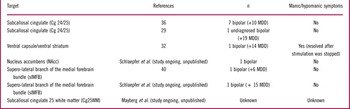
There are only few DBS studies that have included patients with bipolar disorder (see Table 1). All patients experienced significant improvement in depressive symptomatology. In a single case, hypomanic symptoms occured under stimulation but reversed rapidly when stimulation was stopped.Reference Malone, Dougherty and Rezai 32 It should be noted that hypomanic symptoms can emerge as a side effect in general. This is true for patients suffering from MDD as well.
DBS studies in bipolar disorder

Current Studies
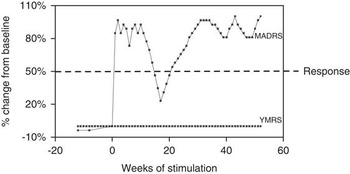
The supero-lateral branch of the medial forebrain bundle (sIMFB) interconnects all previous DBS targets. In previous studies, higher currents were needed, and it is therefore assumed that the sIMFB is co-stimulated.Reference Coenen, Schlaepfer, Maedler and Panksepp 38 It was hypothesized that DBS to the human reward system in closer proximity to the VTA would be efficacious in decreasing ratings of depression by bilaterally stimulating the slMFB, a structure with proven convergence onto the prefrontal cortexReference Schoene-Bake, Parpaley, Weber, Panksepp, Hurwitz and Coenen 39 and close functional connectionReference Schoene-Bake, Parpaley, Weber, Panksepp, Hurwitz and Coenen 39 to previously suggested DBS target sites for depression.Reference Lozano, Mayberg, Giacobbe, Hamani, Craddock and Kennedy 29 This was examined in a recent published study stimulating the slMFB. This DBS study, which was conducted in Bonn, Germany, by Schlaepfer et al,Reference Schlaepfer, Bewernick, Kayser, Mädler and Coenen 40 included 1 bipolar II patient, stimulating the medial forebrain bundle. This patient showed similar and stable antidepressant effects like the patients diagnosed with treatment-resistant depression; no manic or hypomanic states occurred during the observation period (1 year after stimulation onset) and beyond see Figure 1
Weekly MADRS and YMRS % response (week 0=onset of stimulation).

. An ongoing study of this group, targeting the sIMFB and including 1 bipolar patient, shows the same results.
Other ongoing studies are targeting the nucleus accumbens (ClinicalTrials.gov Identifier: NCT01372722) and the subcallosal cingulate 25 white matter (ClinicalTrials.gov Identifier: NCT00367003). The status and DBS target of a third study are currently unknown (ClinicalTrials.gov Identifier: NCT01476527).
Conclusion
Bipolar depression is a mental disease with a high mortality rate (15%–20%), which leads to an immense restriction of quality of life. Because many patients do not profit from any conventional treatment, it is essential to do research about new treatment options. It has been shown that DBS improves depression in BD, decreases suicidality, and improves quality of life; thus the possible stated risks are ethically justifiable. The current results are supporting this hypothesis.
In psychiatric disorders, especially in bipolar disorder at an early stage, the process of diagnosis is less verifiable and observable. Thus it is essential to corroborate the patient’s life history, course of illness, and psychopathology. Each case must be documented according to high scientific and administrative expectations (standardized diagnostic with clinical scales, evaluation of cognitive parameters with psychological tests, quality of life, report of parameter changes, other therapies, etc.).
DBS is a promising treatment option for depression in bipolar disorder. Studies have shown that manic or hypomanic symptoms could occur as side effects of DBS in bipolar disorder. If they occur, they can be resolved by adjusting simulation parameters. To verify these results, larger samples and longitudinal studies are needed.
Disclosures
Sabrina Gippert has the following disclosure: Medtronic, Inc., researcher, research support. Christina Switala has the following disclosure: Medtronic, Inc., researcher, research support. Bettina Bewernick, Sarah Kayser, and Alena Bräuer do not have anything to disclose. Volker A. Coenen has the following disclosures: Medtronic, USA, talks, honoraria, limited funds for two investigator initiated trials, funds. Medtronic, Europe, consultant, consulting fees. Thomas Schlaepfer has the following disclosure: Medtronic, Inc., limited support for 3 investigator initiated studies, talks.