Introduction
The equity of the current basic health insurance reform (BHIR) in China is directly related to the economic accessibility and fairness of basic healthcare for everyone.Footnote 1 The BHIR is an important contribution to healthcare security and health justice.Footnote 2 For the most part, recent research on the fairness of the reform in China has focused on the health economics and management fields, which are primarily concerned with insurance financing, payment, equity, and efficiency.Footnote 3 However, the equity of health insurance is a complex and important topic in ethical discussion.Footnote 4 Several misunderstandings of the reform exist, and many practices hinder achieving the goal of fairness in the reform process.Footnote 5 The purpose of this article is to provide a framework for examining the equity of the health insurance system and to assess the Chinese BHIR based on a case study of the effect of reform implementation in L District of Hunan Province.
In the following sections, we first present a short overview of the history of the basic insurance system and its outcomes to better contextualize the equity issue. We then introduce an evaluative framework of equity and the specific research approaches and parameters that that we use to examine the equity of the BHIR. Next, we demonstrate the health insurance policy design and implementation in Hunan Province from the perspective of the proposed framework. Finally, we analyze and discuss the equity of the effect of the BHIR.
A Brief History of the Health Insurance System in China
Since the founding of the People’s Republic of China, the development of health insurance can be roughly divided into three phases: stage 1 from 1949 to 1979, stage 2 from 1980 to 2002, and stage 3 from the new health reform efforts since 2003 to the present.Footnote 6
During stage 1, the government established three types of insurance to cover almost all citizens in the planned economy period. For China’s urban workers, the health insurance system consisted of two parts: the Government Insurance Scheme (GIS), which covered all government employees, retirees, disabled veterans, and university teachers, staff, and students; and the Labor Insurance Scheme (LIS), which covered all state enterprise employees, retirees, and their dependents.Footnote 7 The Cooperative Medicare System (CMS) was created for rural residents and included farmers’ premium contributions, the village Collective Welfare Fund, and subsidies from higher governments. At the end of the 1970s, the CMS covered more than 90 percent of China’s rural population.Footnote 8 The health insurance system was characterized by a need- and equity-oriented approach, as well as the idea that everyone should be entitled to access healthcare. Because the Chinese government believed that healthcare was an important component of welfare in the socialist system and that medicine must serve the people, it also provided prevention and public health services for the entire population.Footnote 9
By the early 1980s, China had transformed itself to a market-oriented economy, which dramatically affected the health insurance system and health outcomes. With the transition from the collective to the individual household land leasing and farming system in 1979, the CMS also collapsed.Footnote 10 The rural population covered by insurance dropped from 92.6 percent to 6.1 percent between 1976 and 1990.Footnote 11 A survey in 1998 about the China National Health Service indicated that more than 87 percent of farmers did not have any health insurance coverage and had to pay full medical expenses out of pocket.Footnote 12 In addition, in the early 1990s, 30–50 percent of rural families lived below the poverty line as a result of illness.Footnote 13 In the cities, the GIS and LIS were replaced by a city-based social health insurance (SHI) scheme that covered only about half of the urban population, including government employees and employees of both state and non-state sectors. Workers’ dependents and migrant workers, however, were not covered.Footnote 14
By 1993, 79 percent of the total population of China was uninsured.Footnote 15 In addition, drug prices and medical service fees continued to rise,Footnote 16 and many poverty-stricken people had to either avoid seeking medical care or incur financial ruin from the cost of treatment for their illness. “Kan Bing Gui” (“the cost of health care is too expensive to afford”) had become a major problem that restricted healthcare access for most Chinese people.Footnote 17 One reason commonly cited for unaffordable access and household impoverishment was lack of insurance coverage. This health insurance system design severely violated equity principles in two ways: (1) under this scheme, health insurance was considered a privilege allocated to a small percentage of the population, and not a basic right for all people equally; and (2) this differentiated health insurance system was designed to accord support to different groups based on their social status, thus perpetuating any inequality that was already present in the dual urban–rural social structure. The insured were already significantly privileged, superior in social status and income to rural residents and the unemployed, and they also enjoyed the additional benefit of healthcare insurance.Footnote 18 Thus, the system further aggravated the existing health inequity between the rural and urban populations.
This insurance structure persisted to the 2000s. After 2003, to alleviate the heavy burden of medical costs and to provide basic healthcare for the public after the SARS outbreak, the Chinese government initiated its latest reform and began to establish a basic insurance system aimed at covering all citizens and protecting them from financial risk. In this third stage, the health insurance system mainly consisted of three schemes: The Urban Employee Basic Medical Insurance (UEBMI), which targets urban employees with fixed employment and income, a mandatory program that began in 1998; the New Rural Cooperative Medical Scheme (NCMS), set up in 2003 for rural residents; and Urban Resident Basic Medical Insurance (URBMI), piloted from 2007 for those without a stable income or who were unable to find employment, including children, students, the elderly, the disabled, and other unemployed urban residents.Footnote 19 The latter two are voluntary programs. BHIR is committed to providing basic healthcare as a fundamental right and source of well-being enhancement for all residents, stressing equity and social justice, and aiming to narrow the gap in economic access to health services among different groups.Footnote 20
The Framework of Equity in Health Insurance Reform
Because health insurance plays distinct financial and psychological roles in the protection of people’s health and lives,Footnote 21 there is a moral imperative to ensure all citizens a decent level of healthcare to enable them to live a normal life, and the government should bear the main responsibility of assuring access to healthcare for all citizens.Footnote 22 Therefore, primary healthcare insurance entitlement should not be a commodity or privilege only for selected citizens, but a human right for all people.Footnote 23 With the development of the democratic process, the human rights approach has become a widely accepted framework to guide healthcare reform all over the world.Footnote 24 This approach affirms that all human lives have equal value regardless of gender, age, or socioeconomic, labor, or migratory status, and should therefore receive decent basic minimum care.Footnote 25 Therefore, equity is the central ethical concern in benefit/burden distribution in health insurance, and is an important consideration of social justice.Footnote 26
In terms of human rights, there are at least three dimensions promoting equity in health insurance reform: universality, equal opportunity of access to healthcare, and reducing inequality in insurance benefits to improve the health of the vulnerable.
Universality means that the primary insurance system should provide universal and comprehensive coverage for all citizens; no one should be barred or excluded from access to healthcare because of financial obstacles.Footnote 27 This is the first step for people to benefit from insurance, and in China, universality refers to whether people have the opportunity to be enrolled in basic insurance.
Equity has to do fundamentally with a fair distribution of insurance benefits and goes beyond social inclusion.Footnote 28 This concept requires equal opportunity of similar care for comparable needs, which means that similar cases should be treated similarly. “Horizontal equity seems to be widely accepted as a desirable goal for health care system in democratic societies,”Footnote 29 and equity requires fair procedures to guarantee both process and outcome of insurance distributive justice.Footnote 30 We investigate the issues of equal opportunity and procedural justice together from three domains: types of basic insurance, classifying standards of the basic insurance types, and mechanisms for the three basic insurance types.
In addition, reducing inequalities that are avoidable and unfair in health outcomes among different persons and groups is another distinct dimension of social justice.Footnote 31 Because health insurance utilization and health status are influenced by various factors such as education, socioeconomic status, and insurance plan, they can be improved by social reform.Footnote 32 Equity may involve pursuing fairness of health outcomes through unequally improving the health status of those worse off to a higher level, and vertical equity is another dimension of social justice. The essence of insurance is mutual financial aid and support among community members, and solidarity is an important approach to minimizing health disparities and improving common good. Therefore, insurance reform should prioritize and allow more subsidies to the vulnerable.Footnote 33 The key question is to determine who are the most vulnerable for the purposes of this insurance resource allocation. The most widely accepted parameters include life expectancy and mortality.Footnote 34 In this study, we consider insurance benefits as an indicator to show whether the reform enhances the well-being of the disadvantaged and results in fairness.
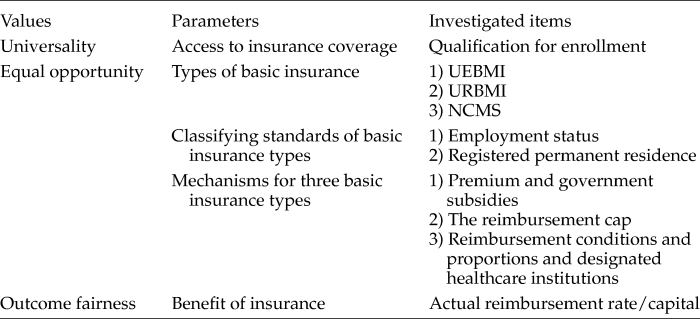
Based on the abovementioned framework, the research approach consists of three parts: underlying ethical values, primary ethically relevant parameters of the basic health insurance, and practical items to investigate (Table 1).
Research Approaches for Analyzing the Equity of the Basic Health Insurance System

UEBMI, Urban Employee Basic Medical Insurance; URBMI, Urban Resident Basic Medical Insurance; NCMS, New Rural Cooperative Medical Scheme.
Case Study: Hunan Province
Method
This study employs the Hunan Province Healthcare Reform Report and the basic medical insurance policies and documents provided by the L District Healthcare Bureau to show the basic insurance system design and implementation. Located in central China and with a moderately high gross domestic product (GDP) level, Hunan Province has a healthcare system and insurance scheme similar to that of the rest of China. L District is in the south of the province and represents an area with an average level of economic development, with experiences similar to those in other areas in terms of implementation of the basic health insurance system.Footnote 35
Results
Universality of health insurance coverage.
In recent years, health insurance enrollment has gradually contributed to protection of life by increasing overall access to healthcare in China. Any Chinese citizen who pays a certain fee is eligible to join the insurance system. The new insurance system provides an opportunity for those who were previously excluded from insurance coverage since the 1980s (e.g., the rural population and nonsalaried urban residents) and ensures them access to primary healthcare. This is a shift that entitles most of the population to enjoy health rights and welfare. Moreover, knowledge of the availability of affordable access can reduce the anxiety and fear of becoming ill.Footnote 36 As the basic medical insurance system continues to develop, total coverage has been achieved for more than 95 percent of the population for 3 consecutive years since 2011.Footnote 37
However, although insurance inclusion is a good start, it does not mean that equal opportunity of healthcare has been achieved. Because the insurance types and regulations are different for different social groups, opportunities are not equal for the entire population.
Insurance mechanisms of three different basic insurances.
In China, the classifying standards of the three types of basic insurance depend on employment status, household registration system (rural or urban), and location of residence.Footnote 38 Inequities in the insurance system design and process are largely the result of these socioeconomic variables.
Premiums and government subsidies.
For UEBMI, the premium is paid jointly by state-owned enterprises and employees. In the 3 years following 2011, the employee paid 550 yuan (US$82.92), while the work unit and the government paid a subsidy of 2,201 yuan ($331.84). For NCMS, the premium increased steadily, from 30 yuan ($4.52) per person in 2011, to 50 yuan ($7.54) per person in 2012 and 60 yuan per person ($9.05) in 2013. For URBMI, the insured person paid 190 yuan ($28.65) per annum over the 3 years. For NCMS and URBMI, government subsidies increased from 200 yuan ($30.15) per person per year in 2011 to 240 yuan ($36.18) per person per year in 2012 and 280 yuan ($42.21) per person per year in 2013.
The data show different premium levels for the three programs, with NCMS being the least expensive and UEBMI being the most expensive. Subsidies for URBMI and NCMS increased over the years, and UEBMI still receives the most aid from the government.
The reimbursement cap.
The reimbursement cap is the annual cumulative maximum limit for reimbursement claims when an individual undergoes hospitalization for severe illness. Under the current guideline, the reimbursement caps are not specific to disease categories. In other words, regardless of the illness in question, patients covered by the same insurance scheme are met with the same annual reimbursement cap. In Hunan Province, the recent economic growth resulted in a steady rise in the reimbursement caps across all three schemes. From 2008 to 2011, the NCMS cap increased from 30,000 yuan ($4,522.98) to 80,000 yuan ($12,061.27); the URBMI cap increased from 50,000 yuan ($7,538.29) to 100,000 yuan ($15,076.59); and the UEBMI cap increased from 100,000 yuan ($15,076.59) to 180,000 yuan ($27,137.86).
Interventions that are adequately covered by UEBMI in hospitals in L district without incurring additional cost to the patient include: renal transplantation, hemodialysis, tumor resection, emergency craniotomy, percutaneous coronary intervention, surgical correction of brain arteriovenous malformation (AVM), and trauma surgery. As of 2011, the costs of none of these interventions exceeded the compensation cap for UEBMI.
More specific data about the cost burden of these procedures are difficult to obtain, because (1) the reimbursement rates vary for patients under NCMS, depending on the location of hospitalization (see the section Reimbursement disparities between urban and floating populations), and (2) the cost of interventions varies considerably depending on the geographical location and the quality/grade of the hospital. What’s clear, however, is that the differential caps are likely to affect healthcare seeking behavior, and influence the outcome of disease.
Reimbursement rates for inpatient service.
Reimbursement regulations have had an impact on the quality of health services. For reasons of cost effectiveness, the L District government encourages people to seek healthcare in primary medical institutions by increasing the rate of reimbursement for service at that level while reducing rates for reimbursement at higher-level hospitals. Using inpatient services as an example, in L District, the rates for NCMS in Grades I, II, and III (from primary to high-level) hospitals are 100 percent, 80 percent, and 60 percent, respectively; for URBMI, the rates are 85 percent, 80 percent, and 75 percent; and for UEBMI, the rate is fixed at 90 percent. It should be noted that under NCMS, the reimbursement caps for every inpatient service utilization in Grades I, II, and III institutions are 800 yuan ($120.61), 3,000 yuan ($452.30), and 4,700 yuan ($708.60), respectively; no reimbursement may be claimed beyond these limits. Under URBMI and UEBMI, the limit is set on total inpatient services in a whole year and is applied to all levels of healthcare providers, with caps of 100,000 yuan ($15,076.59) and 180,000 yuan ($27,137.86), respectively. For most of UEBMI and URBMI, and in most circumstances, the cost of services each time will not exceed the cap level, and the plans provide larger reimbursement amounts than NCMS.
The data show that reimbursement rate is an economic incentive for rural people to opt for lower-level facilities. However, this mechanism does not apply for urban citizens, and especially for UEBMI-contracted people, because their rate is the same in every type of hospital, which may lead to an over-utilization of services and waste of funding.Footnote 39 Moreover, because most high-level hospitals are located in urban areas and provide high-quality care,Footnote 40 those with UEBMI and URBMI plans are likely to get higher quality service, either because they are richer, more educated, or have higher health consciousness, or simply that because of their geographic location, they have more convenient access to better hospitals.Footnote 41
Reimbursement disparities between urban and floating populations.
In recent decades, urban population growth in China has been characterized by considerable rural-to-urban migration.Footnote 42 Given that insurance enrollment is mainly based on place of household registration or work registration, migrants who seek health services in another place, such as the city where they actually work, cannot get their medical expenses covered in that specific place.Footnote 43 Moreover, there are disparities in in-payment mechanisms and reimbursement ratios among different districts even within one province, let alone in different provinces across China.Footnote 44 For example, commuters who work in big cities but are registered in rural environments will get far lower reimbursement ratios if they seek healthcare in the higher level medical institutions in cities, compared with their reimbursement for expenses generated from the local health services where they are contracted.Footnote 45
Benefit of insurance.
According to unpublished data obtained from the Hunan Province Healthcare Reform Report, in that province, reimbursement rates of inpatient services under UEBMI, URBMI, and NCMS have recently experienced a steady increase, from 72.6 percent, 43.5 percent, and 45.96 percent, respectively, in 2008, to 83 percent, 70 percent, and 73.53 percent in 2011, representing increases of 10.4 percent, 26.5 percent, and 27.57 percent. The average reimbursement amounts increased from 4,514yuan ($680.56), 1,517 yuan ($228.71), and 957 yuan ($144.28) to 6,042 yuan ($910.93), 3,003 yuan ($452.75), and 1,624 yuan ($244.84). This shows that insurance greatly reduces the rate of out-of-pocket payment. At the same time, it should be noted that the net amount and the growth rate of NCMS are still the lowest among the three programs.
Discussion
Generally speaking, the BHIR has made significant progress, especially compared with stage 2 of health insurance development in China. Comprehensive insurance coverage entitles all Chinese to basic healthcare provision with financial protection, and this is a good start toward promoting equity. The government subsidies and reimbursement rates and amounts have increased over the years, and can, to some extent, relieve the fiscal burden on patients, especially for those who had previously been excluded from the benefits of insurance. However, universal coverage does not achieve equity if it does not provide better benefits to those of low socioeconomic status and in poor health. We will analyze the reasons for this discrepancy in the following discussion.
Has equal opportunity been achieved?
Currently in China, equal opportunity is no longer an issue between the insured and the uninsured, but arises rather among the three groups of the insured. Strictly speaking, the introduction of insurance for all people does not necessarily ensure equal opportunity of access for all socioeconomic classes. Rather, opportunity is only equal for people who are in the same health insurance scheme, because it is their premium fees, reimbursement rates, government subsidies, and overall healthcare quality that are more or less comparable. However, it is obvious that among the three groups, urban citizens who are contracted to UEBMI enjoy much better healthcare services and more subsidies. There are still very significant gaps among the three types of insurance in the current program design and benefit distribution, especially between NCMS and URBMI. Urban employees with higher socioeconomic status receive more subsidies and higher quality services, not only because they pay higher premiums, but because of the details of bureaucratic insurance mechanisms and other social factors. The abovementioned sophisticated process and the division of the three groups show that individuals do not have access to similar quality care in similar cases.
Because basic health insurance is now provided by the government to all people, it is public-, right-, and equity-oriented and should, therefore, differentiate itself from commercial or private insurance, emphasizing fairness in universal and equal accessibility to government subsidies, reimbursement ratios, and healthcare delivery, all according to need, not ability to pay.Footnote 46 The purpose of protecting life mandates the provision of basic insurance as a right for each citizen, not as a privilege only for urban employees. However, some rich rural residents and urban citizens can afford and are willing to pay the same premium as urban employees, but are not eligible for the same program because enrollment is based on factors such as place of birth, household registration, and employment condition, which may exclude them. Moreover, these enrollment conditions also can prevent commuter citizens from benefitting from basic insurance. The fact that people cannot freely enroll in their preferred program or change their registration when they change location demonstrates that the insurance scheme’s design hinders equity from the very beginning. The dual urban–rural social structure and its accompanying disparities have been deeply embedded for a long time, a historical fact that dramatically influences health insurance policies.
To promote social equity of health insurance security, in January 2016 the state council introduced a policy about the integration of URBMI and NCMS to improve procedural justice and gradually coordinate the three schemes.Footnote 47 For now, consolidation of URBMI and NCMS is feasible because of their similarities in premiums, funding, and benefit packages. Some places with small urban–rural gaps have initiated merging the two types into one; this will not only achieve equal access to healthcare services for both rural and urban participants, narrow the health care gap between different areas, and prove convenient for rural migrants seeking medical care in cities, but will also improve efficiency in administration and use of funds, and the participants should enjoy better healthcare services.Footnote 48
Further efforts needed in improving result fairness.
Equal opportunity and just procedures are necessary to promote horizontal equity in access to insurance, but they are not sufficient to realize fairness in the benefits of insurance and improvement in health status of those worse off. Because the goal of the current insurance reform aims to promote fairness in economic access to basic healthcare services among all classes of people and groups, reducing disparities is a further valuable and inevitable requirement.Footnote 49 Inequalities in insurance benefits among individuals and groups can be categorized as unfair and avoidable if people are put in a disadvantageous condition because of factors such as social class, economic status, or education level, according to Rawls and Norman Daniels.Footnote 50 Therefore, the basic health insurance system, in its very design, should seek to eliminate avoidable unfairness in social mechanisms and procedures. That would serve as an important precondition of equal opportunity of access to healthcare.Footnote 51
In view of the current Chinese situation, the health status and income of the rural population are worse than those of urban populations. In 2000, the average life expectancy in urban and rural areas was 75.2 years and 69.5 years, respectively,Footnote 52 with a difference of nearly 6 years. In 2015, the mortality rates for those under 5 years of age in urban and rural areas were 5.8 permillage and 12.9 permillage, respectively,Footnote 53 with a difference of 7.1 permillage. Also in 2015, the net income in urban and rural areas was 31,195 yuan ($4,532.83) and 11,422 yuan ($1659.69) respectively,Footnote 54 with the former being 2.73 times higher than the latter. Obviously, rural residents need more healthcare services and financial support to improve their health status.Footnote 55 However, the data from L District show that rural residents still receive the fewest insurance benefits. For fair distribution and vertical equity, more subsidies and more favorable reimbursements should be extended to the disadvantaged.Footnote 56
Solidarity is seen as a characteristic that describes the willingness of social members to be committed to the principle of justice.Footnote 57 Health insurance is a pooling risk and involves pooling resources; the essence of mutual help requires the government and society to do more for the disadvantaged. The healthy, wealthy, and young who contribute to health insurance costs but do not need the services subsidize the sick, the poor, and the old. This involves giving extra weight to the needs of those who are disadvantaged in terms of health, social, or economic status. Priority should also be given to more subsidies and more favorable reimbursements benefiting the rural populations.Footnote 58
To what extent should we allocate more funds to the vulnerable to reduce the disparities in health status between them and the rest of society to promote fair distribution? Another challenge in distributive justice comes into play when the health costs of the worse off conflict with collective efficiency.Footnote 59 Therefore, how to balance justice and cost-utility analysis is a complex issue and should be assessed in specific circumstances.
Limitations
Because China is large, and insurance reform measures and development in other provinces and areas differ from those in L District, its policy may not reflect the situation in China as a whole. In addition, as basic health insurance policies continue to change, future studies should follow this situation closely.
Conclusions
Chinese health insurance reform advocates for the transformation of healthcare into a right that is universally exercised, and significant policy changes to this end have been achieved. The abovementioned data and evidence show that the reform has helped to alleviate out-of-pocket payment burdens to a certain degree by increasing coverage rates and access to health services for most people. However, this reform does not completely establish equity; distributive justice will require continuing to improve the insurance system design and management. This process can be aided by an ethical perspective in health insurance policy design, adjustment, and implementation. Our study demonstrates that an ethical platform is a crucial component of reform, and we can reasonably conclude that building on solid ethical pillars will contribute to more positive and fair results in the future. Nevertheless, perfect equity will require additional social reforms beyond those we have discussed in health provision and health insurance.
Future research in this area should conduct outcome-based evaluation for this kind of tiered insurance system, and take into account the considerable variability in service quality and cost that exist in the Chinese medical system. By assessing the rates of conversion between spending and improvement in quality-adjusted life years (QALYs) and other similar measures, further normative evaluation concerning outcome equity of the Chinese insurance scheme can be better achieved.