INTRODUCTION
The longnose spurdog Squalus blainville (Risso, 1827) is a moderate-sized, demersal squaloid shark, widely distributed in the Eastern and Western Atlantic, Mediterranean and Black Sea (e.g. Tortonese, Reference Tortonese1956; Papaconstantinou & Tortonese, Reference Papaconstantinou and Tortonese1980; Papaconstantinou, Reference Papaconstantinou1986; Cannizaro et al., Reference Cannizaro, Rizzo, Levi and Gancitano1995; Massutí & Moranta, Reference Massutí and Moranta2003). It has been reported from the shelf and upper slope, down to 700 m depth (e.g. Tortonese, Reference Tortonese1956; Compagno, Reference Compagno, Fischer and Nauen1984; Whitehead et al., Reference Whitehead, Bauchot, Hureau, Nielsen and Tortonese1984; Massutí & Moranta, Reference Massutí and Moranta2003; Ismen et al., Reference Ismen, Yigin, Alitnagac and Ayaz2009). Specifically for the Ionian Sea, S. blainville has mainly been found between 300 and 500 m depth (Sion et al., Reference Sion, D'Onghia, Matarrese and Mytilineou2003; Mytilineou et al., Reference Mytilineou, Politou, Papaconstantinou, Kavadas, D'Onghia and Sion2005). Knowledge on the biology of S. blainville in the Mediterranean is still very poor. This information is related to reproduction (Capapé & Quignard, Reference Capapé and Quignard1980; Cannizaro et al., Reference Cannizaro, Rizzo, Levi and Gancitano1995; Sion et al., Reference Sion, D'Onghia, Matarrese and Mytilineou2003; Kousteni & Megalofonou, Reference Kousteni and Megalofonou2011, Reference Kousteni and Megalofonou2015), diet (Kabasakal, Reference Kabasakal2002), length–mass relationships (Merella et al., Reference Merella, Quetglas, Alemany and Carbonell1997; Pallaoro et al., Reference Pallaoro, Jardas and Šantić2005; Ismen et al., Reference Ismen, Yigin, Alitnagac and Ayaz2009; Güven et al., Reference Güven, Tebapçioğlu and Deval2012; Bilge et al., Reference Bilge, Yapici, Filiz and Cerim2014) and bathymetric distribution (Massutí & Moranta, Reference Massutí and Moranta2003).
The spiny dogfish Squalus acanthias Linnaeus, 1758 is one of the most widespread shark species, found in the North-east and North-west Atlantic Ocean (e.g. Gauld & MacDonald, Reference Gauld and MacDonald1982; Castro, Reference Castro1983; Compagno, Reference Compagno, Fischer and Nauen1984; Jones & Ugland, Reference Jones and Ugland2001; Compagno et al., Reference Compagno, Dando and Fowler2005), Pacific Ocean (e.g. Camhi, Reference Camhi1999; Orlov et al., Reference Orlov, Kulish, Mukhametov and Shubin2011; Dunn et al., Reference Dunn, Stevens, Forman and Connell2013), Mediterranean Sea (e.g. Filiz & Mater, Reference Filiz and Mater2002; Chatzispyrou & Megalofonou, Reference Chatzispyrou and Megalofonou2005; Serena et al., Reference Serena, Papaconstantinou, Relini, De Sola, Bertrand, Gallucci, McFarlane and Bargmann2009; Capapé & Reynaud, Reference Capapé and Reynaud2011; Yigin & Ismen, Reference Yigin and Ismen2013) and Black Sea (Avsar, Reference Avsar2001; Demirhan & Seyhan, Reference Demirhan and Seyhan2006). It occurs in continental and insular shelf waters and on the upper slope to 900 m depth (Jones & Ugland, Reference Jones and Ugland2001; Soldat, Reference Soldat2002), however, it is most common from 10–200 m (McEachran & Branstetter, Reference McEachran, Branstetter, Whitehead, Bauchot, Hureau, Nielsen and Tortonese1986).
Considering that both S. blainville and S. acanthias exhibit slow growth (e.g. Orlov et al., Reference Orlov, Kulish, Mukhametov and Shubin2011), late age at maturity and low fecundity (e.g. Hoenig & Gruber, Reference Hoenig, Gruber, Pratt, Gruber and Taniuchi1990), they are vulnerable to overexploitation and population depletion (White et al., Reference White, Blaber and Craig2012). Kousteni & Megalofonou (Reference Kousteni and Megalofonou2011) reported that there is evidence that sharks in the Mediterranean Sea are generally declining in abundance, and are possibly facing a worse scenario than shark populations elsewhere in the world. Compared with other shark species, studies on longnose spurdog and spiny dogfish in the Mediterranean basin are very scarce and the knowledge of the biology, distribution and exploitation of these two species is still very poor (Serena et al., Reference Serena, Papaconstantinou, Relini, De Sola, Bertrand, Gallucci, McFarlane and Bargmann2009). Squaliform sharks are expected to be important predators on the continental slope; however their diets are often poorly known (Dunn et al., Reference Dunn, Stevens, Forman and Connell2013).
The main problem in the assessment and management of elasmobranchs is the lack of biological information (even basic biological data) and relevant fisheries data (Pawson & Vince, Reference Pawson, Vince and Shotton1999; Henderson et al., Reference Henderson, Gallucci, Demaster and Burke2010; Martinho et al., Reference Martinho, Sá, Falcão, Nogueira Cabral and Pardal2012). Studies in the central and eastern Mediterranean are sporadic or lacking (Damalas & Vassilopoulou, Reference Damalas and Vassilopoulou2011). Squalus blainville is characterized as a Data Deficient species and S. acanthias as an endangered species for the Mediterranean (Nieto et al., Reference Nieto, Ralph, Comeros-Raynal, Kemp, Garcia Criado, Allen, Dulvy, Walls, Russell, Pollard, Garcia, Craig, Collette, Pollom, Biscoito, Labbish Chao, Abella, Afonso, Alvarez, Carpenter, Clo, Cook, Costa, Delgado, Dureuil, Ellis, Farell, Fernandes, Florin, Fordham, Fowler, Gil de Sola, Gill Herrera, Goodpaster, Harvey, Heessen, Herler, Jung, Karmovskaya, Keskin, Knudsen, Kobyliansky, Kovačić, Lawson, Lorance, McCully Phillips, Munroe, Nedreaas, Nielsen, Papaconstantinou, Polidoro, Pollock, Rijnsdorp, Sayer, Scott, Serena, Smith-Vaniz, Soldo, Stump and Williams2015). Due to their position in the trophic web and their reproductive strategies, they may play an important role in the marine ecosystem of the area, particularly when important multispecies fisheries operate in the Mediterranean.
The objective of this work is to analyse the available information on the two Squalus species from various scientific sampling programmes with different targets carried out in the same area. The main aim is to provide new information on several aspects on the biology and feeding habits of both S. blainville and S. acanthias in the Eastern Ionian Sea, to address the gaps in knowledge and to serve as a baseline for future comparisons.
MATERIALS AND METHODS
Data sources
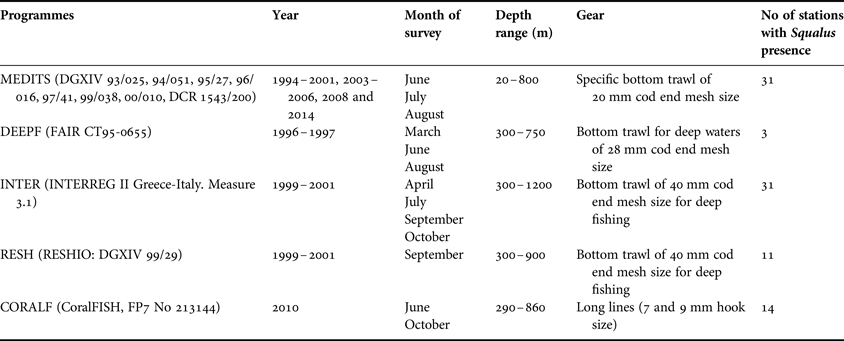
Data were collected from 948 longnose spurdogs and 65 spiny dogfish during five scientific projects carried out at depths ranging from 20 to 1200 m in the Eastern Ionian Sea from 1995 to 2014 using trawl and long lines. Spiny dogfish were only caught in two of these projects. The projects are noted in Table 1. Data were archived in the Fisheries Information System IMAS-Fish of HCMR (Kavadas et al., Reference Kavadas, Damalas, Georgakarakos, Maravelias, Tserpes, Papaconstantinou and Bazigos2013).
Projects carried out in the Eastern Ionian Sea from 1995 to 2014, the data of which were analysed during the present work. The name, the depth range, the sampling year, the sampling month, the sampling gear, the number of station with the two Squalus species presence are given for each programme. All scientific surveys were based on an experimental stratified random design.

Biological analyses
For each S. blainville and S. acanthias individual, biological data including total length (TL, mm), total body weight (TW, g), sex, maturity stage, gonad weight (W G, g), liver weight (W L, g), stomach (W stom, g) and intestine (W int, g) weight were recorded.
The geographic distribution of both species was based on their presence in the sampling stations of all projects.
The bathymetric distribution of the species in relation to TL was examined using the raw data of individual sizes and their related depths from all projects together. Linear regression analysis, based on these data, was used to identify trends in the bathymetric distribution of both species. ANOVA was used to compare the sizes of the species in two depth zones (zone 1: <500 and zone 2: >500 m). These zones were chosen in agreement with depth zones routinely used under the MEDITS survey and the fisheries data collection framework in the Mediterranean (Bertrand et al., Reference Bertrand, Gil de Sola, Papaconstantinou, Relini and Souplet2002) and the understanding that deep-water fish assemblages are grouped differently around the depth of 500 m separating the upper and middle slope assemblages (Politou et al., Reference Politou, Mytilineou, D'Onghia and Dokos2008).
The calculation of length and weight relationship was based on the equation TW = a TL b. This equation was transformed to a linear form: LnTW = lna + b lnTL and the parameters a and b were estimated from the latter regression. The equation was calculated by sex and in total for S. blainville, but only for combined sexes for S. acanthias, because of the limited sample size. The parameters a and b for the female and male power equations were compared statistically using a t-test (Zar, Reference Zar1996). The isometric of b-values was also examined using a t-test (Sokal & Rohlf, Reference Sokal and Rohlf1987).
Sex ratio, expressed as the ratio of females (F) to the total number of females and males (F + M), was examined for 948 individuals of S. blainville and for 64 individuals of S. acanthias. Sex ratio was also examined by station.
Maturity stage examination was based on specimens obtained from four projects. Maturity stage of gonads was determined using the macroscopic sexual maturity WKMSEL (2012) scale (online Appendix Ia & Ib). According to this scale, male maturity stages are defined as follows: 1, immature; 2, developing; 3a, capable to reproduce; 3b, active and 4, regressing. Female maturity stages are defined as follows: 1, immature; 2, developing; 3, capable to reproduce; 4a, early pregnancy; 4b, mid pregnancy; 4c, late pregnancy; 5, post-partum; and 6, regenerating. Gonadosomatic GSI and hepatosomatic HSI indices were studied only for 79 individuals caught within the CoralFISH project, as this was the only project where these data were available. The indices were calculated only for S. blainville by season and sex. ANOVA was used to compare the mean GSI and HSI values.
Size at first maturity L50, at which 50% of individuals are mature, was examined for males and females separately, based on the pooled data of four projects, and using the proportion of mature (stages 3–6 for females and 3a–4 for males) to total individuals per size class. Data were derived only for summer and autumn; there was a lack of samples during winter and spring. Data for S. acanthias were very poor for size at first maturity estimation. The size at first maturity L50 was based on the probability of mature individuals and by TL class using the following logistic model:
 $$P = 1/\left( {1 + {\rm ex}{\rm p}^{- (a{\rm} + b^{\ast}{\rm TL})}} \right)$$
where, P is the balanced probability, a and b are equation parameters estimated by the linear least squares method based on the logarithmic transformation.
Diet analysis was based on 77 S. blainville and 11 S. acanthias individuals collected in deep waters in the framework of the CoralFISH project; their TL ranged between 357–780 and 600–930 mm, respectively. Stomach (W stom, g) and intestine (W int, g) content weight were recorded and prey items were identified to the lowest possible taxonomic level, counted and weighed. The vacuity index VI% (the number of empty stomachs) as a percentage of the total number of stomachs examined was calculated. Four indices (Hyslop, Reference Hyslop1980) were used to describe diet composition by prey: (i) frequency of occurrence F%; (ii) relative abundance N%; (iii) weight percentage W%; and (iv) alimentary coefficient Q (Q = F% × W%). The importance of the prey items was estimated using: (i) Q, considering prey as favourite for Q > 200, secondary for 20 < Q < 200 and incidental or occasional for Q < 20 (Hureau, Reference Hureau1970) and (ii) the index of relative importance (IRI) of Pinkas et al. (Reference Pinkas, Olipham and Iversor1971) [IRI = (N% + W%) × F%]. A cumulative prey curve was constructed for S. blainville to determine whether an adequate number of individuals had been examined to describe the diet precisely with the number of new prey items found in the stomachs plotted against the stomachs analysed (Ferry & Cailliet, Reference Ferry and Cailliet1996).
RESULTS
Spatial and bathymetric distribution
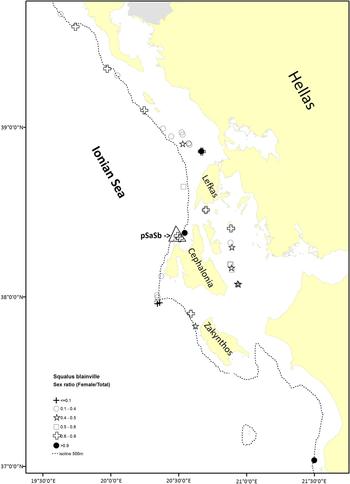
The geographic distribution of S. blainville was ubiquitous in the Eastern Ionian Sea (Figure 1). From the 89 stations examined, the species was present in 84 (94%); 86% of these stations were in less than 500 m water depth. High concentration of small individuals (<300 mm TL) was detected only in two areas; (a) between the islands Lefkas and Cephalonia and (b) NW of Zakynthos island. In contrast, S. acanthias was caught in only 9% of the examined stations. Both species were concurrently present in only three stations (Figure 1, pSaSb).
Map of the study area with the sampling stations from five research projects (see Table 1) carried out in the Eastern Ionian Sea from 1995 to 2014. The sex ratio of S. blainville females to total (males and females) in stations with more than three individuals of the species present. pSaSb, concurrent presence of both species.

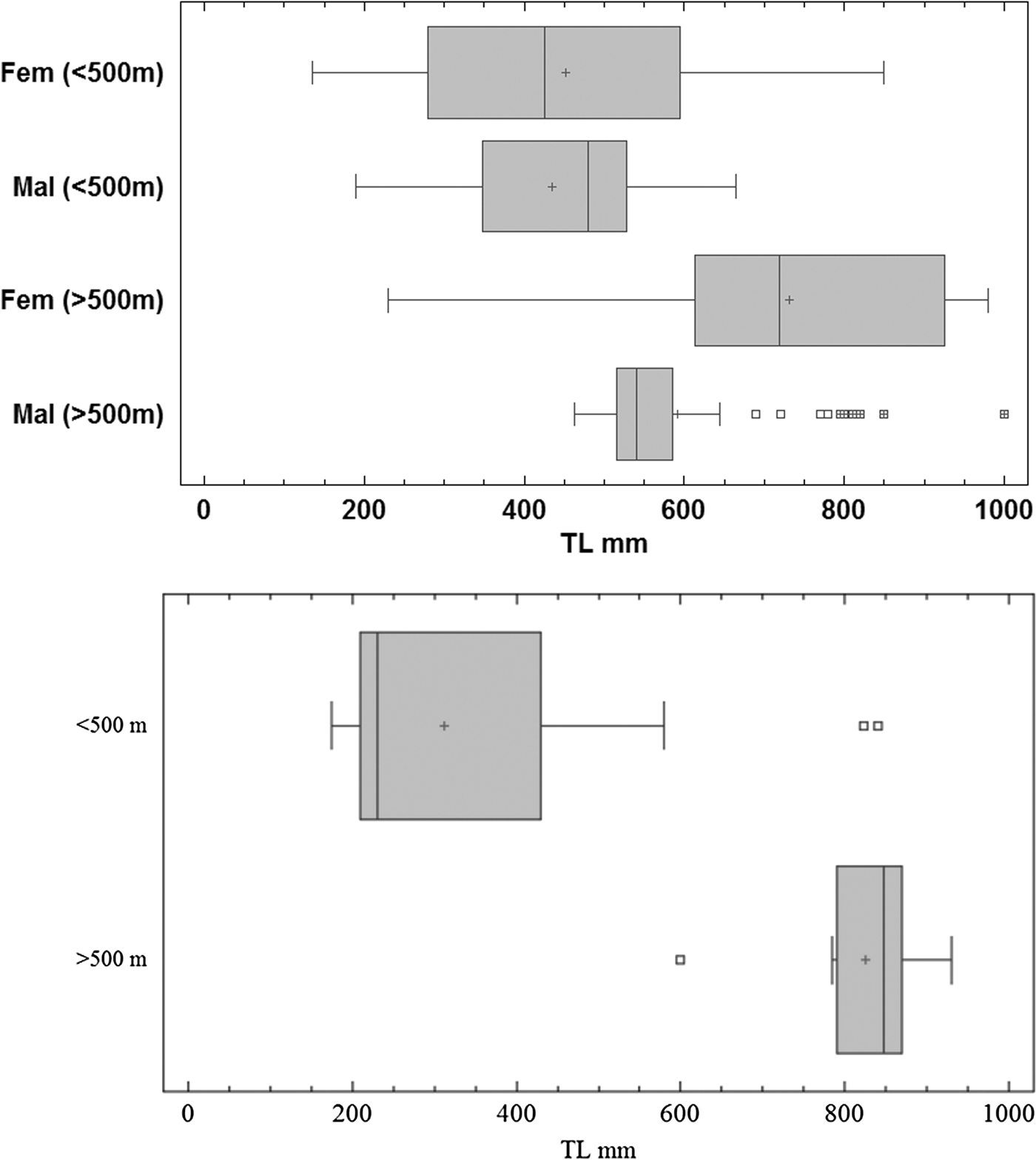
A statistically significant correlation (P < 0.05) was found between TL and Depth (D) for S. blainville. However, because of a weak correlation coefficient (r = 0.26) and the fact that the model explained only a low percentage of the variability (r 2 = 6.32%, N = 947), ANOVA was used to compare the sizes of the species in the two depth zones. The examination of the mean sizes in the two studied depth zones revealed statistically significant differences (F = 74.87, N = 947, P < 0.001) with larger fish found in deeper waters (Figure 2). The depth-size relationship between males and females showed that in the <500 m depth zone their mean sizes were similar (mean TL for females <500 m: 450.2 ± SE 7.9 and mean TL for males <500 m: 434.2 ± 6.8) (F = 2.35, N = 770, P = 0.125) whereas in the >500 m depth zone females were larger than males (mean TL for females >500 m: 731.4 ± 40.9 and mean TL for males >500 m: 591.5 ± 17.7; F = 9.83, N = 76, P = 0.0025). There were statistically significant differences in females mean size in the two depth zones (F = 29.85, N = 340, P < 0.001), with larger females found at greater depths (mean TL for females <500 m: 450.2 ± 173.3 and mean TL for females >500 m: 731.4 ± 233.9). Statistically significant differences were also found for the male mean size in the two depth zones (F = 110.92, N = 419, P < 0.0001) with larger males found at greater depths (mean TL for males <500 m: 426.8 ± 113.9 and mean TL for males >500 m: 591.5 ± 122.0). Immature and mature individuals were found simultaneously in both depth zones. Most of the population was captured in the first depth zone whereas in the deeper zone most of the captured individuals were males.
Box plots of size by depth zone for S. blainville (top) separated by sex (NFem<500m = 331, NMal<500m = 442, NFem>500m = 12, NMal>500m = 64) and S. acanthias (N = 65) (bottom).

The bathymetric distribution of S. acanthias in relation to TL, showed a statistically significant relationship (P < 0.05) with: TL = −167.864 + 1.61731 × D (r 2 = 75.84%, N = 65). The examination of the mean size in the two studied depth zones using ANOVA revealed statistically significant differences (F = 99.22, N = 65, P < 0.0001) with larger fish found in deeper waters (Figure 2). Most of the population was captured in the first depth zone; all specimens captured in this depth zone were immature.
Growth in weight
The total length of female S. blainville ranged between 135–950 mm TL (mean TL ± SE: 457.2 ± 9.7); that of males between 190–1000 mm TL (454.1 ± 5.77). In S. acanthias, females were 175–930 mm TL (363.9 ± 45.2) and males 175–870 mm TL (392.2 ± 39.4).
Length-weight equations by sex (online Appendix II, first row) were found to be greater than allometric for both sexes of S. blainville with heavier females than males. The b-values showed a greater than allometric growth in weight for females (t-test, t = 36.030, P < 0.0001, N = 43) and males (t-test, t = 37.373, P < 0.0001, N = 104). Statistically significant differences were detected between the slopes (b) of male and female equations (t-test, t = 24.080, P < 0.0001) and between their intercepts α (t-test, t = −21.6021, P < 0.0001).
The length-weight relationship for S. acanthias was estimated in total because of the low number of individuals caught (online Appendix III). The b-value showed less than allometric growth in weight (t-test, t = −8.679, P < 0.001, N = 11).
Sex ratio and reproduction
The sex ratio was around 60% in favour of males for both species. The higher presence of S. blainville males was statistically significant (χ2 = 32.57, P < 0.005). Figure 1 shows the female to total (female and male) ratio of S. blainville in the sampling stations of all projects carried out in the Eastern Ionian Sea in which more than three specimens were caught. Higher presence of females was found north of Lefkas and Cephalonia islands and west of Peloponnese.
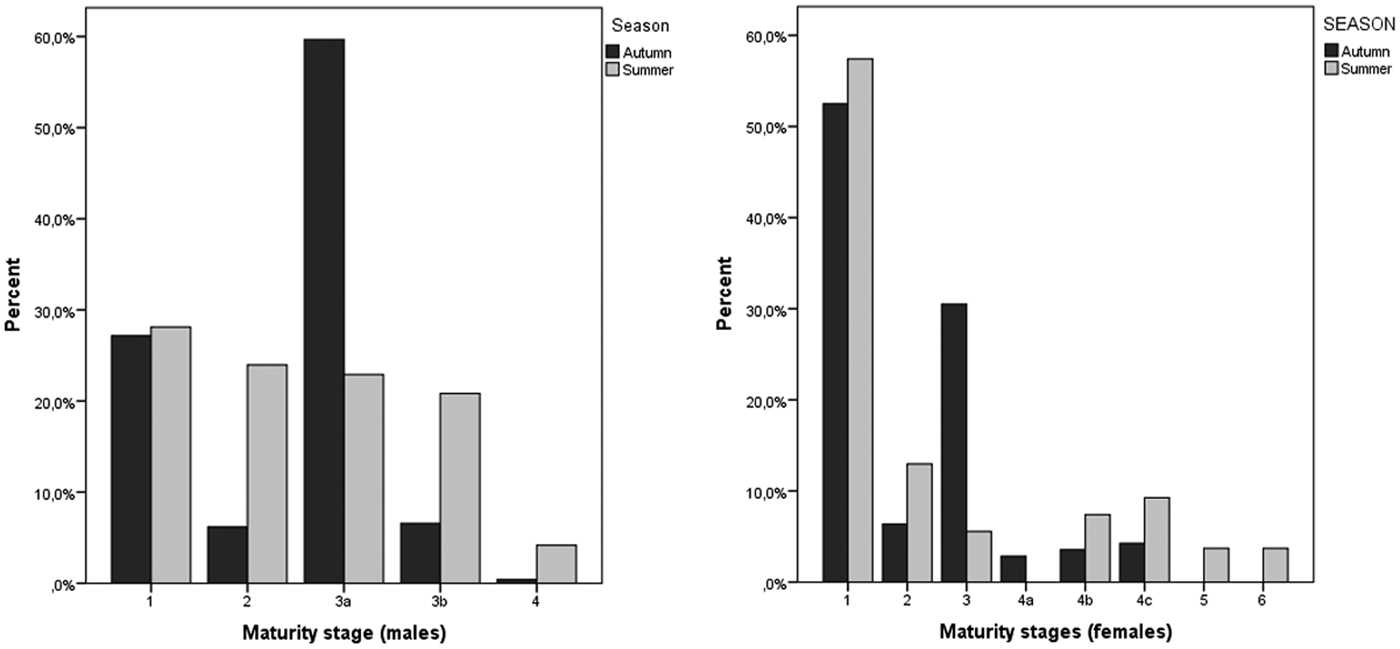
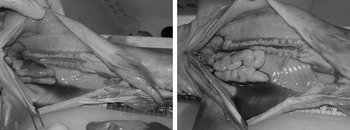
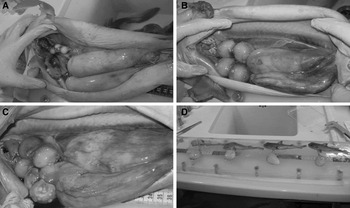
The seasonal cycle of maturity stages for male and female S. blainville, based on 535 specimens, is shown in Figure 3. Males that were either capable of reproducing or active (Figure 4) were observed in summer and autumn, whereas only a few individuals in regressing condition were captured. Females carrying embryos (maternity condition, stages 4a–4c; Figure 5) were found in both seasons. More females in late pregnancy were observed in summer, while post-partum females were found only in summer.
Male (left) and female (right) maturity stages of S. blainville in the Eastern Ionian Sea by season (NMal = 77; NFem = 105; for maturity scales please see M&M).

Reproductive organs of a 3a and 3b maturity stage male S. blainville. 3a: capable of reproduction (left); 3b: active (right).

Reproductive organs of a 4a, 4b and 4c maturity stage female S. blainville. (A) 4a (early pregnancy), (B) 4b (mid pregnancy), (C) and (D) 4c (late pregnancy).

All S. acanthias caught in autumn were males in spent stage, whereas in summer most specimens caught were females. In summer, the only male captured was in spawning condition (maturity stage 3b) and most of the females were carrying embryos (stages 4a, 4b).
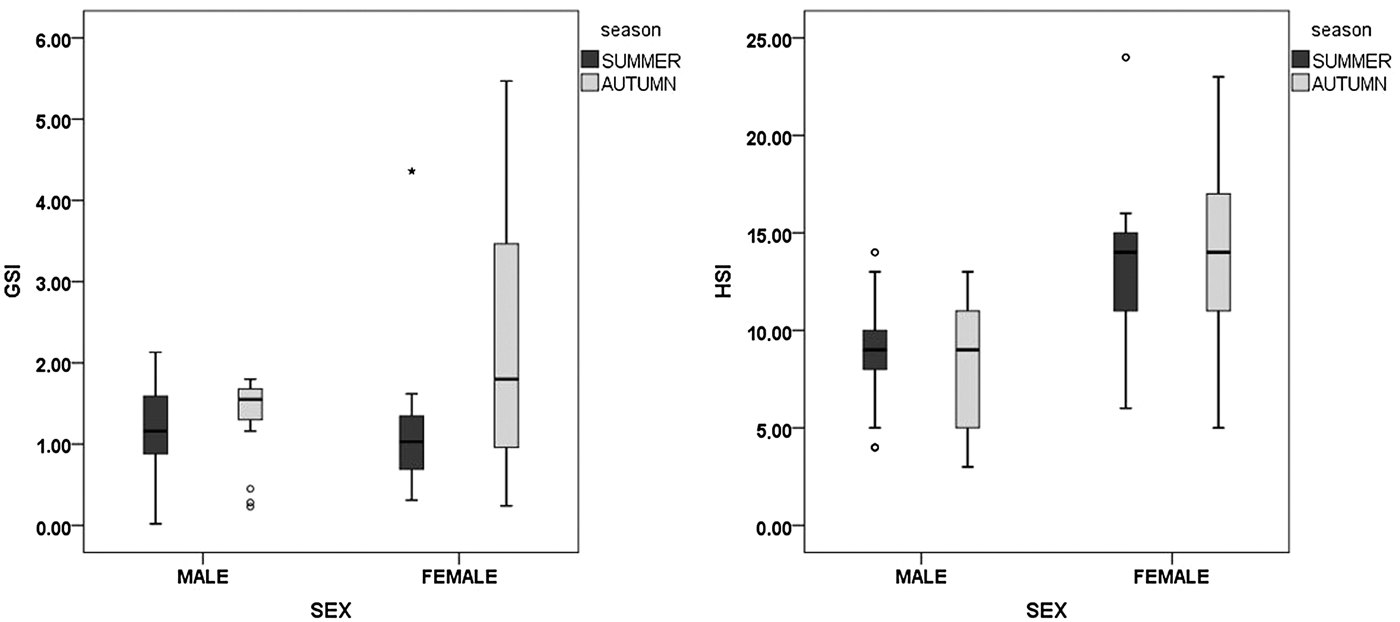
The mean value of male GSI of S. blainville increased from 1.2 (±0.08) in summer to 1.4 (±0.12) in autumn (Figure 6), that of females from 1.4 (±0.52) to 2.3 (±0.51). Statistically significant differences were found between sexes (ANOVA, F = 5.94, P < 0.05, N = 79) but not between seasons (ANOVA, F = 2.95, P = 0.0900, N = 79). The mean value of male HSI was 9.0 (±0.35) in summer and 8.6 (±0.73) in autumn whereas that of females was 13.7 (±2.15) and 13.9 (±1.57), respectively. Statistically significant differences were found between sexes (ANOVA, F = 31.48, P < 0.05, N = 79) but not between seasons (ANOVA, F = 1.12, P = 0.293, N = 79).
Gonadosomatic GSI (left) and hepatosomatic HSI (right) indices for male and female Squalus blainville in the Eastern Ionian Sea by season.

L50 for females and males was estimated to be 603 mm (548.9–629.9 mm) and 413 mm (400.4–472.2 mm) respectively (online Appendix IV). The smallest mature male was 365 mm TL, whereas the smallest mature female carrying embryos was 585 mm TL. The average lengths of active males (maturity stage 3b) and females carrying embryos (maturity stages 4a–4c) were 586.3 ± 18.7 and 698.2 ± 15.6 mm, respectively.
Diet
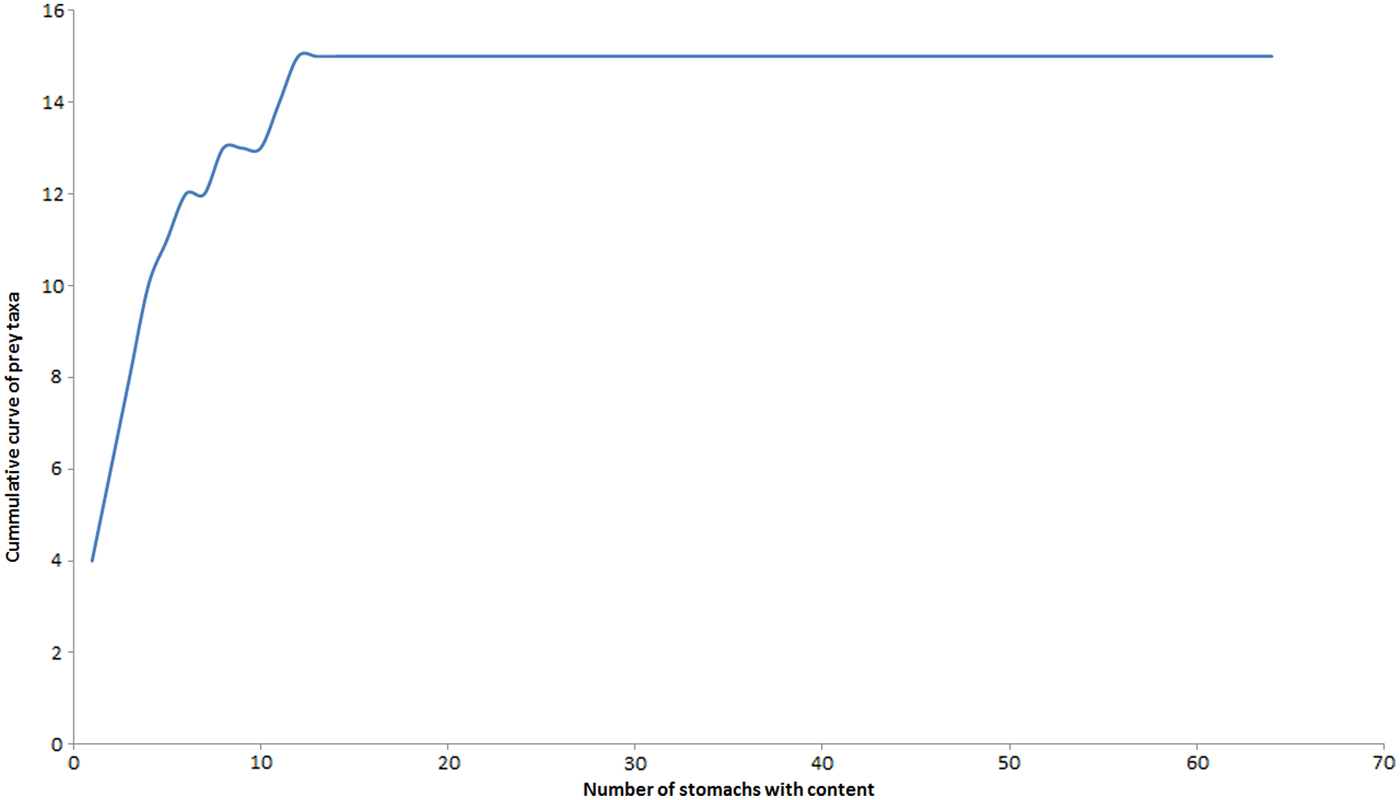
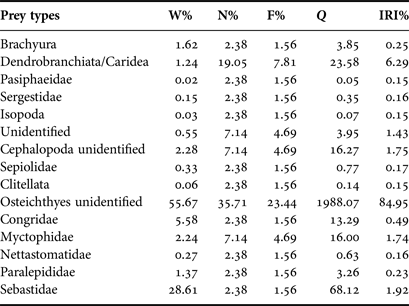
Of the 77 individuals of S. blainville, examined from deep waters, 12 of them had empty stomachs (VI = 16%). In the remaining 65 stomachs, a total of 42 prey items were observed belonging to 15 taxa (Table 2). Fish were the most important group and the main prey (Q > 200) for the species. Shrimps Dendrobranchiata/Caridea were a secondary prey item (20 < Q < 200), whereas Cephalopoda, Brachyura, Isopoda and Clitellata were occasional prey (Q < 20). A cumulative prey curve indicated that the number of stomachs examined was sufficient to characterize the diet of S. blainville in the area (Figure 7). In the intestines of S. blainville, additional prey were identified: Bivalvia, Ascidiacea, cephalopods from the families Octopodidae and Enoploteuthidae, Echiura, Hydrozoa and Opisthobranchia, increasing the number of prey taxa to 22.
Cumulative prey taxa curve of S. blainville in the Eastern Ionian Sea.

Diet composition of 77 S. blainville (357–780 mm TL) with relative trophic indices: mass (W%), number (N%), frequency of occurrence (F%), alimentary coefficient (Q) and index of relative importance (IRI%)

For the diet analysis of S. acanthias, six of the 11 individuals caught in deep waters, had empty stomachs (VI = 55%) and a high proportion of stomach contents were digested and unidentifiable. Prey taxa observed were myctophids, unidentified fish, crustacean remains, polychaetes, cephalopods and holothurians.
DISCUSSION
The present study provides new information on several biological aspects of two species of Squalus in the Eastern Ionian Sea. No other data have been reported for Squalus acanthias populations in this area although some older information is available for Squalus blainville (Sion et al., Reference Sion, D'Onghia, Matarrese and Mytilineou2003). Whilst both species are commercial, as with most elasmobranchs in other parts of the Mediterranean, they are not subject to directed fisheries but constitute part of the by-catch and discards of various artisanal pelagic and demersal fisheries (Bradai et al., Reference Bradai, Saidi and Enajjar2012), and they generally constitute a small fraction of the by-catch of various fisheries and are seldom target species in Mediterranean fisheries (Serena et al., Reference Serena, Papaconstantinou, Relini, De Sola, Bertrand, Gallucci, McFarlane and Bargmann2009).
Spatial and bathymetric distribution
The data for S. acanthias are limited in this study because of the low number of specimens collected. Serena et al. (Reference Serena, Papaconstantinou, Relini, De Sola, Bertrand, Gallucci, McFarlane and Bargmann2009) studying the distribution and abundance of both species in the Mediterranean, found a limited geographic distribution for S. acanthias with two main population areas (the N. Adriatic and S. Aegean) whereas S. blainville had three main areas of presence (Sicilian Channel, Greek waters and Corsican/Sardinian waters). They found only one of the two species to be present in 37 of the 40 sub-areas, indicating potential competition between the species. Similarly, from 89 stations analysed here, both species were concurrently present in only three stations (Figure 1, pSaSb). Similarly, a limited geographic distribution was detected for S. acanthias, although S. blainville presented a relatively ubiquitous occurrence. This may be related to environmental factors. However, it is known that S. acanthias is vulnerable to over-exploitation by fisheries species of sharks because of its late maturity, low reproductive capacity, longevity and long generation time (25–40 years) (Nieto et al., Reference Nieto, Ralph, Comeros-Raynal, Kemp, Garcia Criado, Allen, Dulvy, Walls, Russell, Pollard, Garcia, Craig, Collette, Pollom, Biscoito, Labbish Chao, Abella, Afonso, Alvarez, Carpenter, Clo, Cook, Costa, Delgado, Dureuil, Ellis, Farell, Fernandes, Florin, Fordham, Fowler, Gil de Sola, Gill Herrera, Goodpaster, Harvey, Heessen, Herler, Jung, Karmovskaya, Keskin, Knudsen, Kobyliansky, Kovačić, Lawson, Lorance, McCully Phillips, Munroe, Nedreaas, Nielsen, Papaconstantinou, Polidoro, Pollock, Rijnsdorp, Sayer, Scott, Serena, Smith-Vaniz, Soldo, Stump and Williams2015), which may have been the reason for the low presence of this species in the study area. No similar information on the geographic occurrence of the two Squalus species in the study area has been reported in the literature to date except that of Serena et al. (Reference Serena, Papaconstantinou, Relini, De Sola, Bertrand, Gallucci, McFarlane and Bargmann2009).
The S. blainville population was distributed mostly down to 500 m depth, in agreement with other Mediterranean reports (Papaconstantinou & Tsimenidis, Reference Papaconstantinou and Tsimenidis1979; Cannizaro et al., Reference Cannizaro, Rizzo, Levi and Gancitano1995; Massutí & Moranta, Reference Massutí and Moranta2003; Sion et al., Reference Sion, D'Onghia, Matarrese and Mytilineou2003; Mytilineou et al., Reference Mytilineou, Politou, Papaconstantinou, Kavadas, D'Onghia and Sion2005; Serena et al., Reference Serena, Papaconstantinou, Relini, De Sola, Bertrand, Gallucci, McFarlane and Bargmann2009). The present study indicated that the largest specimens of both sexes were present at the greatest depths but reproductive adults were found together with immature individuals at the same depths. Similar results have been reported by Cannizaro et al. (Reference Cannizaro, Rizzo, Levi and Gancitano1995) and Sion et al. (Reference Sion, D'Onghia, Matarrese and Mytilineou2003). Although both sexes were found together in most stations, their proportion tended to favour one sex (either male or female), indicating a segregation by sex. Sexual segregation by depth or sexual assemblages in different areas is a general characteristic of shark populations (e.g. Sims, Reference Sims, Ruckstuhl and Neuhaus2005) and has been reported by several authors for the squalid sharks (e.g. Avsar, Reference Avsar2001; Bañón et al., Reference Bañón, Piñero and Casas2006; Kousteni & Megalofonou, Reference Kousteni and Megalofonou2011).
An increase in size of S. acanthias with depth was observed. This bigger-deeper phenomenon is a well-known general trend for most demersal fish (e.g. MacPherson & Duarte, Reference MacPherson and Duarte1991; Moranta et al., Reference Moranta, Palmer, Massuti, Stefanescu and Morales-Nin2004). Squalus acanthias is known to be a migratory species that swims towards deeper waters as it grows (Jones & Ugland, Reference Jones and Ugland2001; Soldat, Reference Soldat2002) or migrates offshore as pregnancy proceeds (Jones & Ugland, Reference Jones and Ugland2001).
All S. acanthias specimens caught down to 500 m were immature. This could be related to schooling behaviour by size of the species. Bigelow & Schroeder (Reference Bigelow and Schroeder1953) reported that ‘young spiny dogs school separately from their parents, and it is certain that fish of a size continue to associate together as they grow, the result being that any given school runs very even, consisting as a rule either of the very large mature females, or of medium-sized fish (either mature males or immature females), or of small immature fish of both sexes in about equal numbers’. Schooling by size until they mature and then schooling by size and sex has previously been reported for this species (McMillan & Morse, Reference McMillan, Morse and Stehlik1999 and references therein; Yigin & Ismen, Reference Yigin and Ismen2013).
Growth in weight
The maximum total length for male and female S. blainville (TL 1000 and 980 mm respectively) found in this work was slightly higher than reported from other Mediterranean studies (Cannizaro et al., Reference Cannizaro, Rizzo, Levi and Gancitano1995; Sion et al., Reference Sion, D'Onghia, Matarrese and Mytilineou2003; Pallaoro et al., Reference Pallaoro, Jardas and Šantić2005; Kousteni & Megalofonou, Reference Kousteni and Megalofonou2011, Reference Kousteni and Megalofonou2015). According to Tortonese (Reference Tortonese1956), the maximum total length of this species is 960 mm, while according to Cannizaro et al. (Reference Cannizaro, Rizzo, Levi and Gancitano1995) the largest female measured 920 mm TL and the largest male 735 mm TL.
For S. acanthias maximum length of male and female (TL 870 and 930 mm, respectively) in this study was smaller than the maximum total length of 1600 mm reported by Compagno (Reference Compagno, Fischer and Nauen1984). The maximum size reported by Fischer et al. (Reference Fischer, Bauchot and Schneider1987) for this species in the Mediterranean is 2000 mm, although in the Atlantic this was found to be 1280 mm (McRuer & Hurlbut, Reference McRuer and Hurlbut1996).
Length and weight relationships estimated for S. blainville indicated a greater than allometric growth in mass for both sexes. These relationships between sexes were significantly different (higher females b-values) and are in agreement with those reported by Kousteni & Megalofonou (Reference Kousteni and Megalofonou2011, Reference Kousteni and Megalofonou2015) and Sion et al. (Reference Sion, D'Onghia, Matarrese and Mytilineou2003). The equation parameters estimated from various areas are presented in online Appendix I. Mediterranean b-values were similar and generally >3, with the exception of b-values estimated by Bilge et al. (Reference Bilge, Yapici, Filiz and Cerim2014) and by Ismen et al. (Reference Ismen, Yigin, Alitnagac and Ayaz2009) for males. The difference found for the latter, may be related to the absence of small individuals from their sample or to other factors such as temperature, food availability, differences in growth rates or sampling design.
The b-value from the length-weight relationship estimated for S. acanthias, found to be <3, indicated a less than allometric growth. Less than allometric growth has been reported by many authors, especially for males in the Mediterranean and in the Pacific Ocean (online Appendix III). However, the b-value found in this study was the lowest recorded and may be due to the low number of individuals and the absence of small individuals. Greater than allometric growth has been reported for females in the Mediterranean (e.g. Chatzispyrou & Megalofonou, Reference Chatzispyrou and Megalofonou2005; Ismen et al., Reference Ismen, Yigin, Alitnagac and Ayaz2009) and for combined sexes in the Atlantic (Campana et al., Reference Campana, Joyce, Kulka, Gallucci, McFarlane and Bargmann2009) and New Zealand (Dunn et al., Reference Dunn, Stevens, Forman and Connell2013) (online Appendix III). The high variation observed in b-values for the species as indicated in online Appendix III may indicate different growth rates between sexes or sizes. For this reason, the results of the present work for the species could be considered only as an indication of this relationship for the area.
Sex ratio and reproduction
The sex ratio of S. blainville for this study favoured males whereas Sion et al. (Reference Sion, D'Onghia, Matarrese and Mytilineou2003) found a neutral sex ratio, and Kousteni & Megalofonou (Reference Kousteni and Megalofonou2011) noted predominantly females. The reason for this segregation is unknown, but it may be related to differences in diet and competition, reproduction purposes or even to reduce cannibalism (Stenberg, Reference Stenberg2005). Species aggregations may be influenced by other factors such as behaviour, which can affect pregnancy duration (Jones & Ugland, Reference Jones and Ugland2001) or environment, including temperature which may influence embryonic growth (Jones & Ugland, Reference Jones and Ugland2001) and/or salinity which is often correlated with depth (Shepherd et al., Reference Shepherd, Page and MacDonald2002), rather than any biological phenomenon. However, the limited sample size and extent of the sampling area in the present work may also be affecting our results.
The estimation of the seasonal reproductive cycle for S. blainville was difficult due to the lack of sampling periodicity. However, the occurrence of mature male and female S. blainville, the presence of near-term embryos and the high values of GSI in both summer and autumn, indicate that reproduction occurs during this period and indicates continuous reproductive activity throughout the year, as has been reported by various authors (Cannizaro et al., Reference Cannizaro, Rizzo, Levi and Gancitano1995; Sion et al., Reference Sion, D'Onghia, Matarrese and Mytilineou2003; Kousteni & Megalofonou, Reference Kousteni and Megalofonou2011). Cannizaro et al. (Reference Cannizaro, Rizzo, Levi and Gancitano1995) reported that a regularly high proportion of females (about 14%) are ready for sexual reproduction throughout the year. Statistically significant differences were found in GSI and HSI between sexes in this study but not between seasons. Similar results have been reported by Kousteni & Megalofonou (Reference Kousteni and Megalofonou2011). The higher HSI values estimated for females is considered common in elasmobranchs, because a large liver would allow maximum yolk production during vitellogenesis (Lucifora et al., Reference Lucifora, Menni and Escalante2005; Kousteni & Megalofonou, Reference Kousteni and Megalofonou2011) and the production of more or larger oocytes (Lucifora et al., Reference Lucifora, Menni and Escalante2005). Females need more energy than males during vitellogenesis, oocyte maturation and gestation and store large quantities of lipids in the liver during the reproductive cycle (Lucifora et al., Reference Lucifora, Menni and Escalante2005; Yigin & Ismen, Reference Yigin and Ismen2013).
Spawning season could only be indicative for S. acanthias because of the low number of individuals captured. All males caught in autumn were spent and the only male captured in summer was mature and in spawning condition. In the Black Sea, Demirhan & Seyhan (Reference Demirhan and Seyhan2006) found males with empty ampullae in June and July and noted all maturity stages were different from other populations, possibly related to the special environmental characteristics of the Black Sea. More investigation is required on S. acanthias, as there is no information on the gestation period or the parturition–fertilization interval in the Eastern Mediterranean (Avsar, Reference Avsar2001; Chatzispyrou & Megalofonou, Reference Chatzispyrou and Megalofonou2005; Yigin & Ismen, Reference Yigin and Ismen2013). The pregnancy period of the species is quite long and estimates differ among reports. A gestation period of 20–22 months has been reported by Compagno (Reference Compagno, Fischer and Nauen1984), 12 months by Kirnosova (Reference Kirnosova1989) and 18–24 months and more by Henderson et al. (Reference Henderson, Flannery and Dunne2002). Such prolonged gestation duration makes it hard to accurately understand the reproductive seasonality.
Size at first maturity of S. blainville in the present study is in agreement with previous studies (Cannizaro et al., Reference Cannizaro, Rizzo, Levi and Gancitano1995; Sion et al., Reference Sion, D'Onghia, Matarrese and Mytilineou2003; Kousteni & Megalofonou, Reference Kousteni and Megalofonou2011, Reference Kousteni and Megalofonou2015; Marouani et al., Reference Marouani, Kadri, Bouain and Bradai2013) (online Appendix IV), which confirms that males attains sexual maturity at smaller sizes than females.
Diet
The diet of S. blainville in Eastern Ionian deep waters showed that fishes were the only favourite prey. Crustaceans, especially shrimps, were considered as secondary prey whereas cephalopods were incidental. Crustaceans and fishes were considered as prey of high importance for S. blainville by Kabasakal (Reference Kabasakal2002) and Martinho et al. (Reference Martinho, Sá, Falcão, Nogueira Cabral and Pardal2012) and the latter noted that differences in diet composition might be attributed to distinct foraging areas, food availability and depth characterization. The fish consumed by S. blainville in this study were mostly benthic or demersal indicating that the species forages near the bottom, preferentially targeting benthic prey, similarly reported by Martinho et al. (Reference Martinho, Sá, Falcão, Nogueira Cabral and Pardal2012).
In this study, S. acanthias individuals were caught in deep water (>580 m) with TL 750 mm; their feeding was based almost exclusively on fishes, which are the typical prey for the diet of the species (e.g. McMillan & Morse, Reference McMillan, Morse and Stehlik1999; Avsar, Reference Avsar2001; Pethybridge et al., Reference Pethybridge, Daley and Nichols2011; Dunn et al., Reference Dunn, Stevens, Forman and Connell2013). Although mesopelagic fishes were identified in the diet of this study, the large amount of unidentifiable fishes may also belong to other categories. The overall diet had a very wide range of faunal groups and this opportunistic behaviour has been noted by several authors (McMillan & Morse, Reference McMillan, Morse and Stehlik1999; Avsar, Reference Avsar2001; Dunn et al., Reference Dunn, Stevens, Forman and Connell2013). Dunn et al. (Reference Dunn, Stevens, Forman and Connell2013) suggested that S. acanthias is an adaptive forager, making optimal use of what was available in the environment. The low number of specimens analysed for S. acanthias did not allow accurate conclusions. However, assessing which prey taxa are ingested by this species could be considered as a strong indication about its diet.
Understanding the biology and ecology of sharks is important in managing fisheries. The current state of our knowledge and the practices employed in shark fisheries is problematic for their proper conservation and management, and is characterized by lack of good data on catch, effort, discards and landings as well as basic biological data. Squalus blainville is characterized as Data Deficient and S. acanthias as an endangered species for the Mediterranean (Cavanagh & Gibson, Reference Cavanagh and Gibson2007). Due to their position in the trophic web and their reproductive strategies, they may play an important role in the marine ecosystem of the area, particularly when important multispecies fisheries operate in the Mediterranean. Development of research projects to enhance our understanding of shark biology, ecology and dynamics is a regional conservation priority (Bradai et al., Reference Bradai, Saidi and Enajjar2012). The existing state of knowledge of both Squalus species in the Mediterranean, concerning information on their biology, the size and status of their stocks, the real volume of their captures and their population dynamics should be increased for effective future management and conservation of the species.
SUPPLEMENTARY MATERIAL
The supplementary material for this article can be found at https://doi.org/10.1017/S0025315416001818.
ACKNOWLEDGEMENTS
Authors would like to thank Mrs V. Kousteni for her assistance in processing samples and measuring biological parameters of the species, J. Haralabous for his assistance with graphs and the two anonymous reviewers for their valuable suggestions.
FINANCIAL SUPPORT
The DGXIV 93/025, 94/051, 95/27, 96/016, 97/41, 99/038; 00/010, DCR 1543/200, 94/065, 99/29, FAIR DEERF, INTEREG II INTER and FP7 CoralFISH projects were funded from the European Community with co-financing from the Greek General Secretariat for Research and Technology.