It has long been known that René Descartes (1596–1650) did not deal with plants. Although he occasionally refers to plants (ivy and trees), fruit (a melon pops up in one of his famous dreams) and gardens, and seems aware of the need to eventually include a section on plants in his philosophy of nature, his involvement with the vegetal world is restricted to metaphors and illustrations. There is neither an autonomous nor a subordinate study of plants in Descartes's natural philosophy. Indeed, as Stephen Gaukroger notes, ‘unfortunately, we have no record of his work on botany, and it is unclear how far his interest extended’.Footnote 1 At the time of the development of natural-philosophical investigations into vegetal bodies – that is, the analysis of the inner processes and functioning of plants – Descartes's distance from this field is intriguing.
Descartes's references to the study of plants as a section of his work are few and problematic. In the Regulae ad directionem ingenii, Descartes speaks of ‘the virtue of plants’ as a legitimate object of knowledge.Footnote 2 Given the fact that ‘history’ (including natural history) is not a science according to his methodology, a study of plants must necessarily be separate from natural history, and rather connected with the general project of human wisdom (humana sapientia).Footnote 3 In the Discours de la méthode (1637), botany is a subject for his description of natural bodies, but Descartes brackets plants together with inert bodies.Footnote 4 However, his ontological definition of plants fluctuates. In the Principia philosophiae (1644), Descartes reveals his plans to insert a study of plants together with animals in a section on living bodies. Still, this section was not written because of a lack of observations and experiments.Footnote 5 Although the study of plants was certainly part of Descartes's programme of natural philosophy, we must at the same time conclude that it was never actually realized.
Descartes's attention to vegetation in his work is cursory and mostly extraneous to a study of plants, especially as the latter consisted of focusing on their external features. Two main examples illustrate this. The first is the botanical clock allegedly devised by Athanasius Kircher (1602–1680). Marin Mersenne (1588–1648) informed Descartes in July 1633 about a clock driven by a sunflower seed.Footnote 6 Descartes considered this experience ‘curious’ and asked Mersenne for more details.Footnote 7 Rather than focusing on the nature of the sunflower or the relation between magnets and plants, two captivating topics of early seventeenth-century naturalistic knowledge, Descartes was more attracted by the mechanical cause of this motion.Footnote 8 The second example is in the Principia, where Descartes describes the phenomenon of natural fire that ferments in stored hay.Footnote 9 This effect, he posits, depends on the movement of spirits and juices within the pores of mown grasses. Descartes provides a description of the internal structures of herbs and plants, but he is mostly interested in the natural fire.
These examples reveal that Descartes's interest in plants mainly concerns mechanical features unrelated to the study of vegetation in its own right. He focuses neither on the nature of plants, their physiology, their inner processes, nor on their diversity as collected in catalogues. He finds the study of individual plants uninteresting; and naturalists’ attempts to catalogue the world of plants necessarily fall outside Descartes's scientia.Footnote 10
However, one of Descartes's biomedical manuscripts, the Excerpta anatomica, contains several notes devoted to a physiological study of vegetal bodies. This text has been known since Louis-Alexandre Foucher de Careil (1826–1891) published it in 1859–1860 from some notes he discovered in the manuscripts of Gottfried Wilhelm Leibniz (1646–1716), who copied it in 1676 from the manuscripts that Claude Clerselier (1614–1684) possessed and circulated to his contemporaries. This text has now been edited by Charles Adam and Paul Tannery in volume 11 of the Oeuvres complètes de Descartes, and also in volume 8/2 of Leibniz's Sämtliche Schriften und Briefe – this latter presents a more reliable text.Footnote 11 Descartes's botanical notes concern generation, nutrition and growth, but also record agricultural activities and an analysis of the taste of fruits. In these notes, Descartes's involvement with botany appears as a more consistent contribution to knowledge and makes plants a more significant subject of his philosophy of nature. It is therefore possible (a) to date Descartes's interest in vegetation, which started in 1637, thus differing from what interpreters have usually claimed; (b) to define the nature of his botanical interest, which was not mere curiosity or filling a lacuna in his philosophy; and (c) to shed light on the early modern philosophical approach to the field of botany as a means of describing the nature and living functions of plants.Footnote 12
At the time, botany was a blurred field of investigation with diverse objects and aims. Medicinal herbs or simples were studied for their therapeutic uses. Plants were the objects of natural-historical study for their external features: flowers, fruits, leaves and roots were collected in herbaria and new specimens were planted in botanical gardens. Vegetal bodies were the objects of natural-philosophical investigations, which aimed at analysis of the movement of spirits or juices, and the internal structure, functioning and processes of plants, such as growth, germination and so on. The combination of these areas of study comprises a long path that goes, roughly, from Andrea Cesalpino (1519–1603) and Giambattista Della Porta (1535–1615) to Joachim Jungius (1587–1657), Marcello Malpighi (1628–1694), John Ray (1627–1705) and Nehemiah Grew (1641–1712), and which allowed for the emergence of the new botanical discipline that connected the external and internal nature of plants.Footnote 13 As I ultimately show, Descartes's approach to botany was bound to have a bearing on his natural-philosophical explanation of living bodies, and also represented a step in the path of the early modern study of plants in their own right.
Plants in the correspondence of Descartes
Despite the lacuna in his main work, Descartes's epistolary exchanges testify to a more consistent interest in plants. In October 1639, Descartes writes to Mersenne that ‘a part of [his] speculations concerns plants’.Footnote 14 He is speaking of an ongoing study of plants, as their correspondence makes clear. In this letter, Descartes accepts Mersenne's offer to send him a seed of the Mimosa pudica, a plant they had been discussing since August 1638, when Mersenne first asked Descartes about the curious phenomenon of the sensitive herb.
The Mimosa pudica, a plant native to the American tropics, displays a touch-sensitive phenomenon: it has a tendency to contract its leaves when they are touched by an external agent. Since the Renaissance, as Charles Webster and, more recently, Guido Giglioni have shown, this ability to shrink had attracted the attention of botanists and naturalists.Footnote 15 Antiquarian passions and experimental interests combined in this case, as botanists such as Giacomo Zanoni (1615–1682) tried to explain and reconcile this phenomenon with the botanical knowledge accumulated in books and gardens. Philosophers took antagonistic positions on the topic: while Guillaume du Val (1572?–1646), for example, remained faithful to the Aristotelian framework in explaining this phenomenon, Henricus Regius (or Hendrik de Roy, 1598–1679), though he claimed the presence of a vegetative soul endowing plants, proposed a mechanical explanation of this motion.Footnote 16
In 1638, Mersenne saw this phenomenon in the Jardin des plantes of Paris, where Guy de La Brosse (1586–1641) had cultivated a specimen, and informed Descartes about it. Although Mersenne's letter to Descartes is lost, a description of the plant may be found in a letter from Mersenne to Theodore Haack, dated 31 December 1639. Mersenne writes, ‘when one touches one of its leaves, it curls up [se ramasse] like a snail, and it moves upward [se panche jusqu’à top]’.Footnote 17 Descartes's reply is illuminating:
I do not find anything curious except its rarity; for, having explained the movement of the heart in a way which suits both plants and animals, I will have no difficulty in conceiving how it moves if the same organs can be found in that plant. But I do not want to say more clearly how this movement occurs, if I have not observed or examined it.Footnote 18
Not surprisingly, Descartes reduces Mersenne's curiosity to the plant's rarity, and claims it could be explained in a way that is consistent with his mechanistic framework. He embeds the sensorial experience of the herb within his mechanistic physiology: the cause of all bodily activities resides in the heat excited in the heart.Footnote 19 Insofar as both animals and plants (this herb, at least) perform similar functions, a mechanical identity between these bodies must follow, although no heart could be found in that plant. Descartes is applying a precept of his method, namely his induction. Accordingly, induction operates by collecting bodies into a few classes and finding a point of contact between these classes. Since bodies share a similar activity, there must be a similar physiological explanation. Following this precept, Descartes claims he can explain this phenomenon.
Mersenne was aware of Descartes's interest in plants before August 1638. In two important letters of February and March 1638, Descartes's close friend Henricus Reneri (1593–1639) wrote to De Wilhem and Mersenne revealing that both he and Descartes had been working on vegetal bodies.Footnote 20 These letters importantly testify to Descartes's early experimentation with plants that occurred during the winter vacation of 1637/1638, when Reneri, a good Dutch experimenter, spent several weeks with Descartes in Santpoort. Here, they pursued many observations, especially following Descartes's suggestion that microscopic investigation of natural bodies could prove useful so long as one observes ‘the different mixtures and dispositions of the small parts that make up animals and plants … and thus acquires a great knowledge of their nature’.Footnote 21 Indeed, Reneri had recently invented a microscope, or lunette à puce, which they used to observe plants and animals.
In the letters to De Wilhem and Mersenne, Reneri claims that the pair have studied many things by observing seeds, sprouts, leaves and flowers, and learning more than those who ignored the use of microscopes. Furthermore, they have mixed soils in order to observe the various effects within the seed; they have taken a variety of seeds and examined them from the outside and from the inside. They have also soaked seeds in various solutions and then sown them, observing the ways in which they germinate and their roots, buds, leaves, flowers and fruits.
A valuable collaborator of Descartes, Reneri possessed a well-furnished library. The catalogue of Reneri's book includes volumes describing experiments with plants and seeds, such as Francis Bacon's (1561–1626) Sylva Sylvarum (London, 1627), Daniel Sennert's (1572–1637) Hypomeremata physica (Frankfurt, 1636), and Della Porta's Magia naturalis (Frankfurt, 1607).Footnote 22 For example, Sennert especially focuses on what makes the seed fertile and whether the vegetative soul as the principle of life and function is present in the seed.Footnote 23 In their texts, Bacon and Della Porta propose several compelling experiments, to sow seeds in particular environments (for example, inside a sea onion), or to put some element (such as nitre or salt) on the buds.Footnote 24 In all these cases, the focus is on studying vegetal processes. Presumably, Reneri was aware of some of the experiments contained in these books when he worked on plants with Descartes. Although these texts contain experiments that influenced the later plant studies of Ray and Grew, we regrettably know very little about Reneri's and Descartes's work and their knowledge of these texts.Footnote 25 In their botanical observations they investigated the internal structure, shape and arrangement of particles within the mechanistic framework of Cartesian philosophy.
Descartes's work with Reneri on plants was profitable, since in the letter to Alphonse Pollot (1602–1668) of April or May 1638 Descartes described for the first time the internal structure of plants in detail and related plants to animals. Reneri was the intermediary in the correspondence between them. Pollot had raised several questions about the Discours.Footnote 26 In his sixth remark, he wrote, ‘it is evident that animals achieve their operations by means of a more excellent principle than the necessary disposition of their organs, i.e., an instinct that cannot be found in a machine or in a clock’.Footnote 27
In his answer, Descartes deals with the relationship between automata and natural bodies in a very original way. Here, Descartes describes the industry of nature in constructing plants. Accordingly, nature packs plants ‘with an infinity of tiny invisible ducts through which certain juices gradually ascend to the ends of the branches, where they intermingle and combine and dry out in such a way as to form leaves and flowers and fruits’.Footnote 28 First, Descartes relates plants to animals, as nature composes them, and claims that they differ from machines. This was a new achievement. While in the Discours plants are still completely different from animals, in this letter Descartes brackets them together. Second, Descartes reveals what he had been working on with Reneri: the inner, invisible structure of vegetal bodies, studied in order to understand the internal movements of juices within channels, and the arrangement and mixing of particles. Descartes used this explanatory framework in trying to make sense of the Mimosa pudica and of the two curious phenomena (histoires) that Mersenne asked him about in 1640, concerning the growth of vegetation on the human body.Footnote 29 Descartes reiterated his mechanical explanation in two letters to Regius of May 1641, while rejecting the presence of a vegetative soul within living beings and reducing the latter's activities to the movement and disposition of particles, ultimately claiming an affinity between animals and plants.Footnote 30 Finally, Descartes's structural study of plants explains his judgement upon the botanical catalogue Mersenne had sent him. Descartes considered this catalogue ‘useless for [his] range of enquiry, because it contains only names, whereas [he was] looking for things’.Footnote 31 Instead of a list of names, Descartes wanted a description of things to further his experimentation. The only use Descartes could find for catalogues was to ask Mersenne for the seeds of the plants with which he intended to experiment.Footnote 32
Descartes's study of plants was not a cursory interest, a passing fascination with the phenomenon of the sensitive herb, but a more lasting concern, with different stages and targets. In 1638 Descartes claimed to have performed several experiments in his garden both with seeds and with plants.Footnote 33 In 1641–1642, he was interested in helping his friend Anthony Studler van Zurck (1605–1666) to construct a garden based on French aesthetics.Footnote 34 In 1644, he continued his experimentation on plants.Footnote 35 In his 1645 correspondence with Princess Elisabeth of Bohemia (1596–1662), Descartes identified gardens as places of leisure and study, spaces to free the mind from sad thoughts, to restore a healthy condition and take rest. Rest was one of Descartes's pieces of medical advice, as Steven Shapin has shown.Footnote 36 Going beyond Shapin's claim, this correspondence reveals that gardens are places to take rest and restore a healthy condition, but also to achieve scientific knowledge, according to Descartes. In June 1646, Descartes wrote to Pierre Chanut (1601–1662) that he intended to perform a few botanical experiments to further his natural-philosophical research: ‘I am waiting for the plants to grow in my garden which I need for some experiments to continue my physics’.Footnote 37
Generation in plants
Some of these botanical observations are contained in several notes of the Excerpta anatomica. However, in what follows I will focus on the botanical discussions of these notes, which comprise a section of Descartes's experimentation with living bodies. The first note is contained on page 595 of the Oeuvres de Descartes, but is also present in the Primae Cogitationes on pages 534–535 of the Oeuvres de Descartes.Footnote 38 This is the note according to the text of Leibniz's volume:
The formation of plants and animals is similar by taking place through the circular movement of particles of matter under the force of heat; but it differs in that, in the generation of plants, the particles of matter revolve circularly, while those particles generating animals revolve spherically and in all parts.Footnote 39
Despite never referring to seeds explicitly, in this note Descartes writes of generation and of the foetus, and this part actually describes the formation of living bodies from their seeds.Footnote 40 According to Descartes, analysing how plants gradually grow from seeds is as fundamental to knowing their nature as it is for animals and human beings.Footnote 41
This text presents several issues. First, Descartes claims that the generation of plants and animals relies on the movement and disposition of particles produced by the force of heat. This reveals a great distance from the usual discussions on generation in his time. Traditionally, the main question of generation concerned the reception of a determinate form in matter, or the presence of a soul in the foetus.Footnote 42 This was so in the case of plants, also. Historian Hiro Hirai has highlighted the link between the philosophical debates on the soul and the study of seeds, and has shown the role of seeds in bridging the doctrine of substantial forms and the mechanistic corpuscular theories.Footnote 43 Indeed, Renaissance and early modern natural philosophers mostly focused on the natural faculties, spirits or seminal reasons endowing the seed, a vehicle for the soul.Footnote 44 Pierre Gassendi (1592–1655), for example, explicitly refers to the soul, a seminal force endowing seeds.Footnote 45 In contrast, in his text Descartes does not mention souls or seminal forces, but focuses on the material movement and arrangement of particles to explain generation.Footnote 46
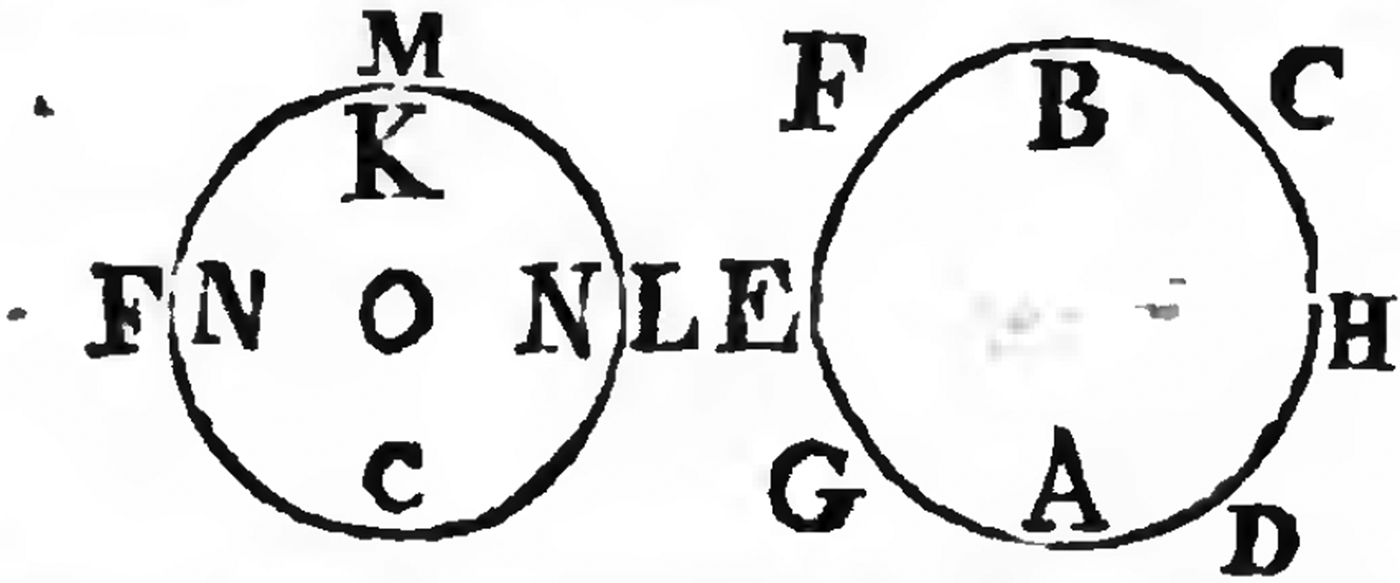
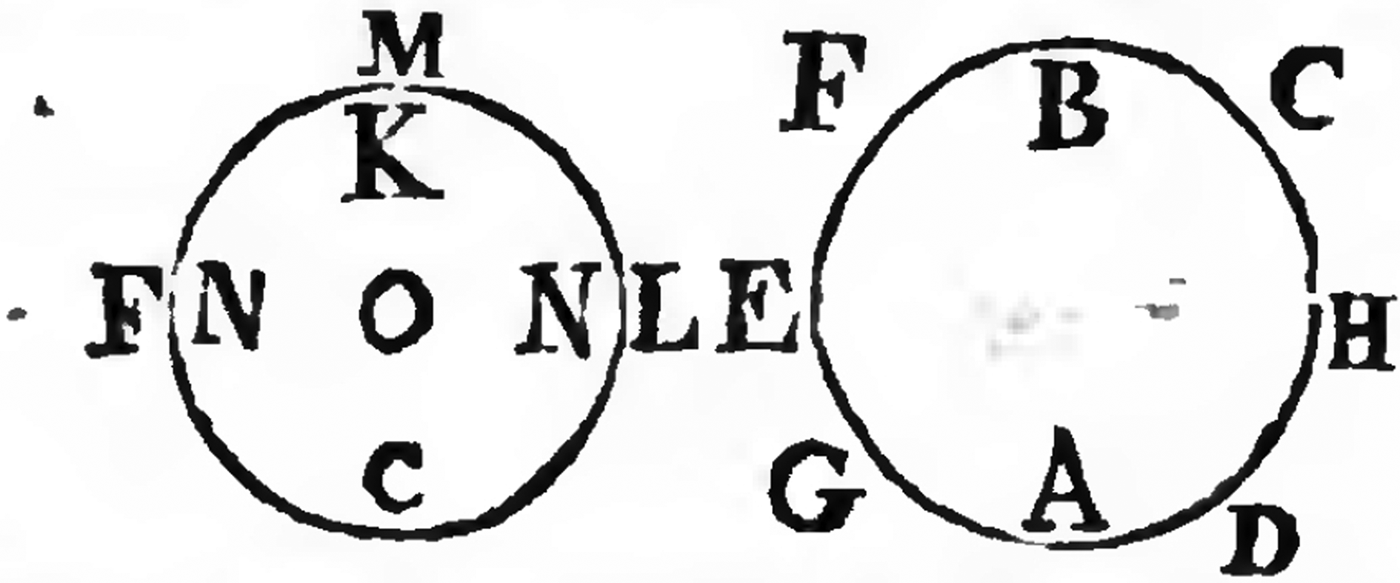
Second, Descartes differentiates the formation of plants and animals following a geometrical distinction. He distinguishes between two movements of particles: a circular motion in the formation of plants, and a spherical motion in the formation of animals. In the first case, particles follow one direction, as they only revolve circularly. In this case, particles revolve from point a to point b (see Figure 1). In the second case, particles follow different directions and revolve spherically, following different lines and therefore composing a more complex body. Since plant particles move in a circle, this movement is consistent with the theory of vortices.Footnote 47 As Richard Carter has shown, a connection between embryology and cosmology surfaces in Descartes's theory of generation.Footnote 48 Vincent Aucante has recently repeated this claim, while stressing the similarity between the motions of particles during generation and the three laws of motion in Le monde.Footnote 49 Still, this note adds something more, detailing the different motions – circular and spherical – that compose bodies. Such a distinction arises in Article 19 of the Fourth Part of the Principes de la philosophie, the French translation of the Principia. Here Descartes claims that ‘movements … must be circular when they occur along a single line, and spherical when they occur toward all sides of some surface’.Footnote 50 This is indeed what he claims in the note. The circular movement of particles occurs along a single line, while the movements of particles in animals occur towards all sides of a surface. Moreover, in the Principia, Descartes defines the second element, the most fluid among the three elements of his physics, as constituted by ‘spherical particles’.Footnote 51 These particles move spherically, while the more solid particles only move circularly. This differentiation corresponds to the structural differentiation between seeds. According to La description du corps humain, the seed of plants is more solid than the seed of animals.Footnote 52 Since the particles in plants have a solid structure, they move circularly, whereas the particles of animal semen move spherically because of their more fluid structure.
The different motions of particles during the generation of living bodies. The figure on the left depicts the generation of animals, while the figure on the right depicts the generation of plants. This figure is taken from René Descartes, Opuscula posthuma, Amsterdam, 1701, and it is now published in René Descartes, Oeuvres de Descartes (ed. Charles Adam and Paul Tannery), 14 vols., Paris: Leopold Cerf, 1909, vol. 11, p. 545.
However, Descartes's description fails to provide a clear explanation of the difference between circular and spherical motions in this particular note. It is possible that this difference belongs to the mechanical degrees of freedom applied to living bodies, because Descartes also differentiates between the animals’ freedom of motion and the limitation of motion in plants. In this note, he writes that ‘the particles of [the foetus] revolve spherically producing a round tunic that includes the foetus, and therefore it does not adhere to the soil, as plants do’.Footnote 53 Since a plant adheres to the soil, its particles move following a circular line, i.e. in one direction, upwards from the ground to the top. In contrast, animal foetuses do not stick in the soil, and their particles move differently. Their formation reflects this structural difference.
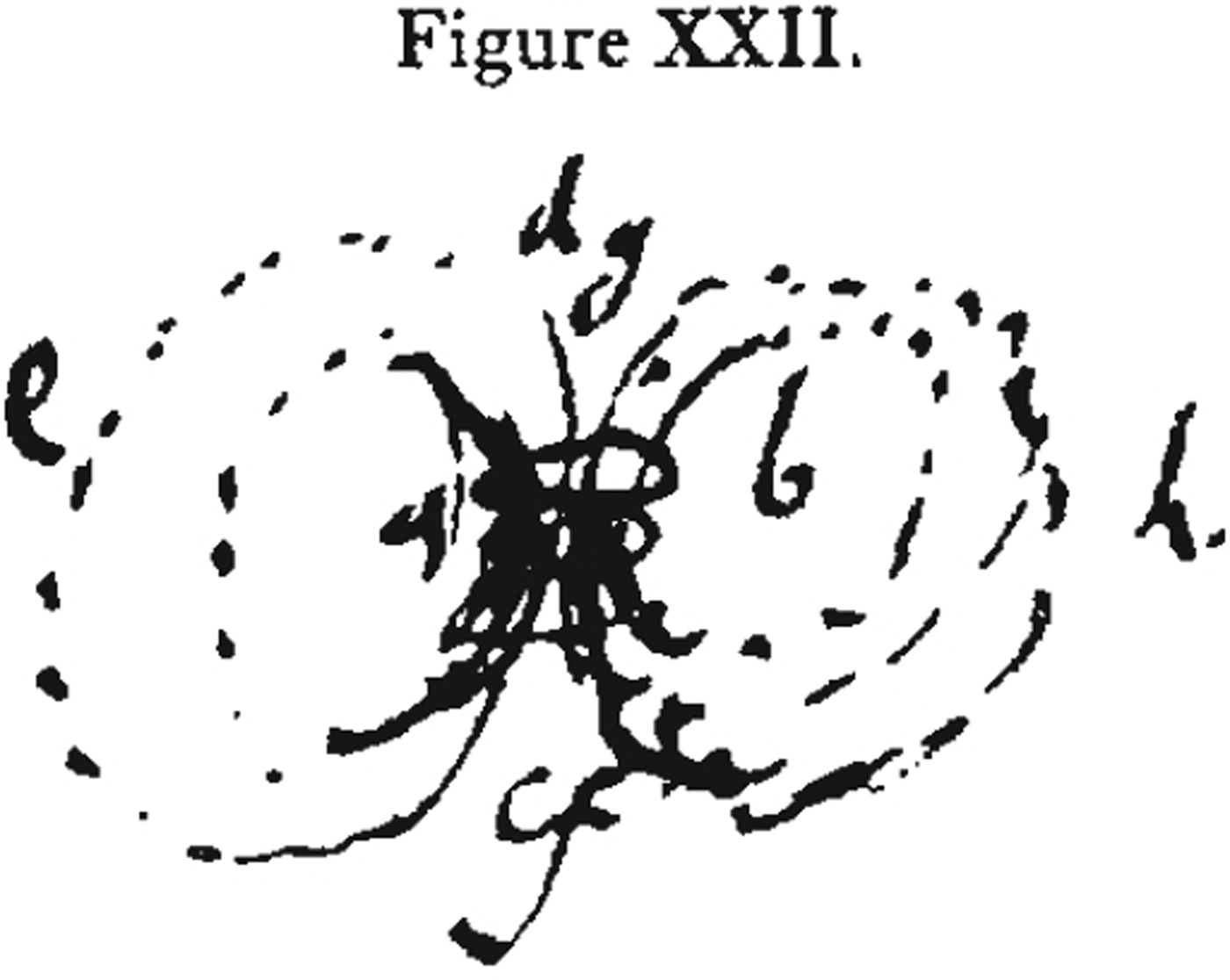
Descartes then explains the movement of particles while composing plants: ‘particles of matter revolve from a to b and a, and from these other particles pass through from c.f towards d.e.c.g.h.f. of which [particles in] c f produce roots, d g [produce] branches and leaves, a b [produce] the trunk of the plant’.Footnote 54 As it stands, this explanation is not particularly clear. Moreover, the image above (Figure 1) does not square with Descartes's description of the movement of particles and fails to clarify the text. However, the Oeuvres de Descartes includes another image in the Appendix, which is the one reproduced in Leibniz's volume (Figure 2), which is much clearer.Footnote 55 In this instance, it is possible to see particles moving circularly from a to b. These particles form the trunk. At the same time, other particles move in circles from c to d e c and from f to g h f. When particles sediment in c and f, they constitute the roots; when they sediment in d and g, they form the branches and leaves.
This is an alternative representation of the movement of particles in the generation of plants. This figure is in the Appendix of the Excerpta anatomica in Oeuvres de Descartes, vol. 11, n.p., where it is labelled Figure XXII.
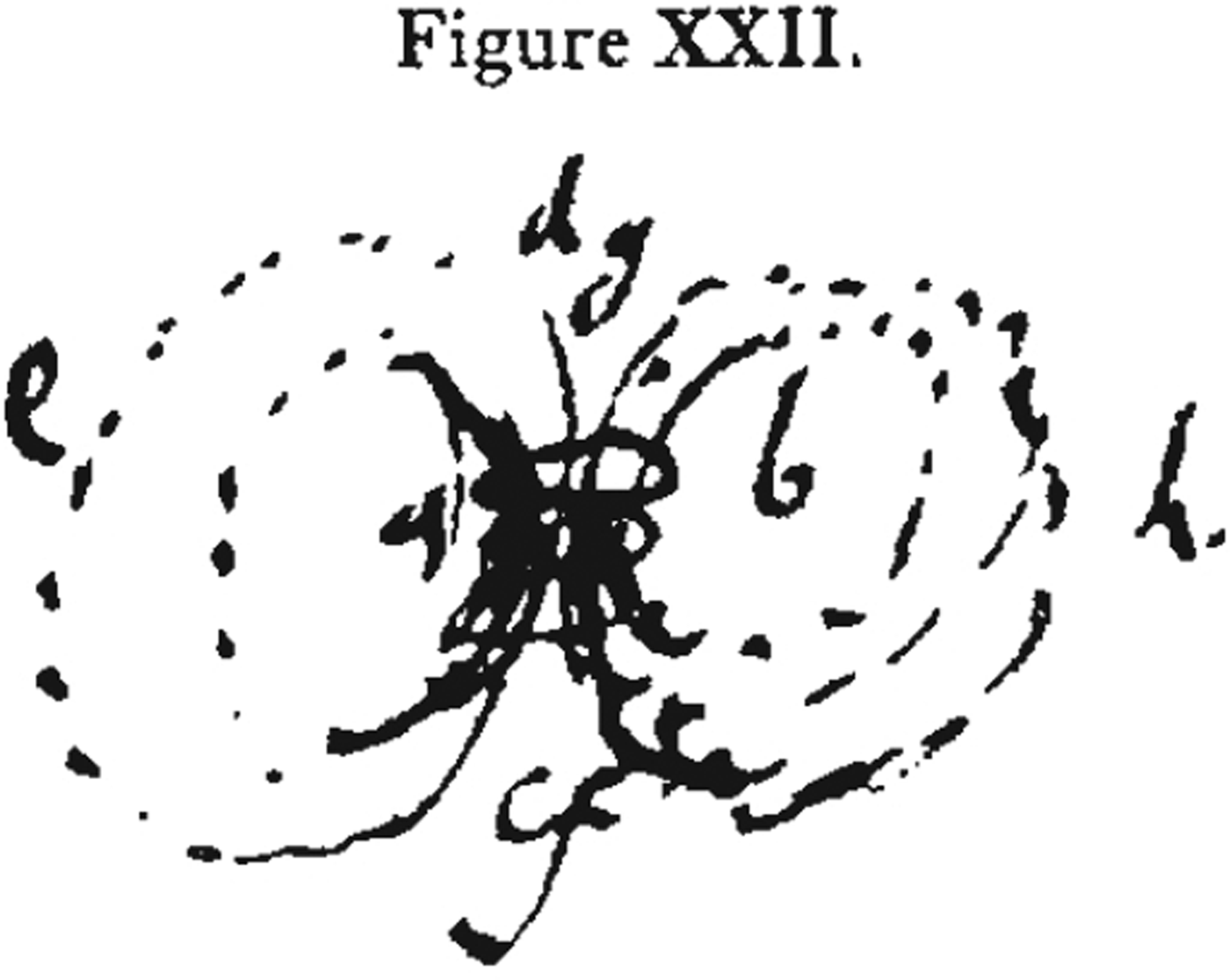
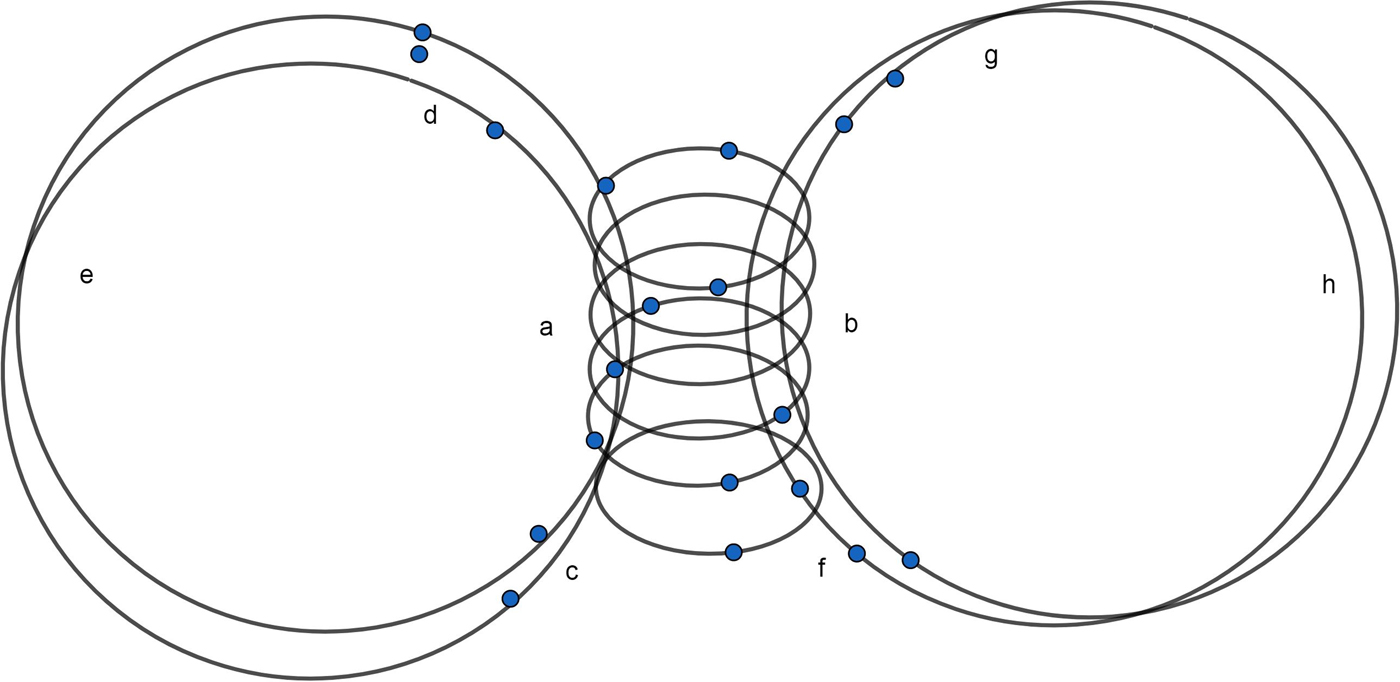
When enlarging the image (Figure 3) things look clearer. Particles (the dots along the lines) move circularly from a to b, and form the trunk or the stem of herbs, while in the other two circular motions particles constitute the roots and branches. From a seed, particles start moving in these ways, forming trees by means of a combination of many circular motions. It is to be noted that in Descartes's view, trees grow both upward towards the branches and downward towards the roots. This description of the movements of particles reveals a direct observation of seeds (and plants), like those Descartes might have been making with Reneri in the winter of 1637/1638.Footnote 56 This note contains a mechanical explanation of the movement and arrangement of particles that constitute vegetal bodies.
Author's representation of the motions of particles during the generation of plants. © 2018 Fabrizio Baldassarri.

A third and final issue of this note concerns heat. It is well known that heat is a source of life in Descartes's physiology, and that fermentations play a role within the bodily functions, as he claims in the Discours.Footnote 57 Yet the reference to heat in this note is relevant. According to the Principia, heat generally operates in separating, purifying, consuming, and corrupting inert bodies, ejecting particles from them.Footnote 58 Heat transforms inert bodies in different ways, and agitates their particles.Footnote 59 Generally for Descartes, heat mainly works as a source of fermentation, as it changes the state of bodies from liquid to aerial, and makes their particles move. In contrast, in this note the force of heat plays a very different role. Here, however, Descartes speaks of a heat that generates bodies, rather than corrupting or consuming them. Nor does he refer to fermentation. In order to understand this heat, it is necessary to look at other notes. While describing the generation of bodies on the first page of the Primae Cogitationes, Descartes claims that the force of the heat stimulates a simultaneous rush of particles together that activates life (efficient vitam).Footnote 60 In the note of the Excerpta anatomica, the force of the heat makes particles rush together and combine in different ways, activating life. This force of the heat plays a different role than the heat that separates and consumes bodies. Such a differentiation between heats is corroborated by Descartes's claim contained in a letter to Vopiscus Fortunatus Plempius (1601–1671) of February 1638: ‘in a few aspects, the heat of fire is dissimilar to the heat of the heart’.Footnote 61 The force of the heat of seeds is dissimilar to the heat of the fire that operates in inert bodies. While the latter separates or changes the state of particles, the former makes particles combine and generates life.
In sum, this note reveals several issues: (1) Descartes makes a comparison of animal and vegetal bodies as having a similar generation. (2) Descartes places the explanation of the generation of living bodies within his mechanical framework, as he focuses on the movement and arrangement of particles activated by the force of heat. (3) Descartes posits a geometrical difference between the generation of plants and animals, following a difference between circular and spherical motions. This distinction entails a mechanical differentiation between plants and animals, which notably corresponds to the diverse complexities of these bodies. (4) Descartes specifies that the force of the heat activates life, distinguishing this heat from the heat in inert bodies. Altogether, then, a mechanical explanation of generation is developed from his observations of plants and seeds, ultimately contributing to mechanically framing living bodies.
Nutrition and growth
In a second set of notes, Descartes explains nutrition and growth in plants. A first note, dated November 1637 and entitled ‘On accretion and nutrition’ (De accretione et nutritione), deals with the activity traditionally attributed to the vegetative soul: nutrition.Footnote 62 Descartes rejects any reference to soul and spirits that characterized the natural-philosophical approach to botany of his time, and explains this function in the mechanistic terms of his own natural philosophy.
Descartes differentiates between inert and living bodies by distinguishing between the ways in which they grow or are nurtured, as Karen Detlefsen has recently noted.Footnote 63 As Dennis Des Chene has pointed out, a similar dichotomy is to be found in several authors of the time, such as Jacopo Zabarella (1533–1589), Francisco Suárez (1548–1617) and Rodrigo de Arriaga (1592–1667), and can be traced back to Aristotle's De generatione et corruptione.Footnote 64 According to Descartes, the accretion in inert bodies occurs ‘by means of a simple apposition of particles without any internal change [immutatione]: in this way … wood is transformed into stone by means of this accretion, as long as the particles of stone enter the pores of the wood and either substitute or assimilate the particles of wood’.Footnote 65 Inert bodies grow through a juxtaposition of particles. This latter also explains fossilization, which is not seen as a transformation of wood into stone, but as a mere substitution or assimilation of mineral or stone particles within the wood. The explanation is consistent with Descartes's mechanistic framework of particles replacing other particles.Footnote 66
In contrast, nutrition in living bodies ‘occurs by means of an internal change [immutatione] of particles’ and through the motions of particles within channels that compose living bodies.Footnote 67 Accordingly, nutrition consists of both the internal change of particles and the movement and arrangement of these particles in the body. More importantly, Descartes claims that nutrition characterizes vegetal bodies. This is clear when he differentiates between perfect and imperfect nutrition, as he states that the latter concerns the formation of ‘hair or fur, nails, horns, mushrooms, tubers’ and those parts of imperfect animals and plants that neither have seeds nor generate other bodies.Footnote 68 By contrast, perfect nutrition concerns animals or plants that produce semen or seed. Additionally, Descartes claims that particles of semen or seed have three different shapes, such as little prisms, or cone shapes, or concave shapes. These particles constitute the wood, the bark, the roots, leaves, flowers and fruits in plants, and all the limbs in animals.Footnote 69
While discussing living bodies, Descartes describes nutrition in plants as a mechanical change of particles, which he calls immutatio, and an internal movement of particles within channels. Presumably Descartes combined his work on the organs of the abdomen at the end of 1637 with the observations on plants and seeds accomplished with Reneri in the same period, since in these observations they focused on the internal structure of plants.Footnote 70 Descartes's mechanical interpretation is original, and influenced Cartesian scholars such as Regius, Florent Schuyl (1619–1669), Jacques Rohault (1618–1672), Antoine Le Grand (1629–1699) and also François Bayle (1622–1709).Footnote 71
In a second note, Descartes presents a theory of the formation of plants in their diverse parts, detailing the arrangement of particles. In Leibniz's volume, this note on plants is collected in a section entitled Meteorologica. This should not be overlooked, as both the pseudo-Aristotelian De plantis and medieval texts on plants refer to Aristotle's Meteorology. The Oeuvres de Descartes, however does not acknowledge this position, but collects this note in the Excerpta anatomica, in volume 11, pages 627–629. Here, I focus on the first subsection of this note on fruit formation, Oeuvres de Descartes, volume 11, pp. 627–628, line 6; on the third subsection, p. 628, line 19–p. 629, line 9; and on the fourth subsection, p. 629, lines 10–19.
In the first subsection, Descartes writes,
Fruits are formed in this way on trees: particles arise in a rectilinear motion from the trunk, which then turn back [and move] in a circle, and there is another crosswise circular motion, through which the particles resulting from the mixture of these movements break more and more, and therefore the fruits ripen.Footnote 72
In these lines, Descartes connects fructification to the movements of particles. Particles arise from the soil following a rectilinear movement within the little channels in the tree. Then, the particles start moving circularly.Footnote 73 When the particles reach the branches, there is a mixture of circular movements. These motions make particles break and combine with other particles. As a result, these particles form fruits.
Three things should be noted: Descartes's differentiation between motions, the combination of different circular movements, and the fragmentation and mixing of particles as the cause of the ripening of fruit. The first two are consistent with his physics, while the third is a new claim in Descartes's philosophy of nature. In this description, Descartes stresses that a change made by the fragmentation and mixing of particles operates in nourishing the plant and producing fruit.
The third part of this note extends this explanation to the formation of plants in their entirety:
Briefly said, all plants originate from the earth in this way: the force of the Sun makes abundant vapour rise from a part of the soil. Since the surrounding air resists to the movement of this vapour, it makes some of the particles of the vapour dry out and arrange diagonally, while other particles rise rectilinearly in the fibres of the tree. Consequently, the bark has diagonal fibres, while the internal parts of plants have rectilinear ones. When some channels occur in the bark, the vapour moving between the bark and the wood and rising through these channels in an oblong manner takes a diagonal shape, thus forming the leaves. Instead, if while spreading through the marrow and the bark, the vapour moves between circular and diagonal fibres and takes a round shape, it then forms the knots of trees, then flowers and fruits, as shown above.
In the middle of all plants, there is a cavity full of either vapour or marrow; since the particles of vapour do not rise rectilinearly, but sideways, moving from one part to another, as the fibres of wood tell us, [this sideways movement results in the fact that] the more solid particles move towards, [and compose,] the bark, [while] the lighter particles remain in the middle, as the Sun does among the planets.Footnote 74
This is a very dense and rather lengthy section with some obscurities. First, Descartes inserts two references to the Sun, one at the beginning of this part, one at the end. The first reference is quite clear and a common topic in texts on plants at the time. Descartes claims that vapours rise within plants due to the attraction of the Sun. However, one should also note that, in a 1638 letter to Plemp, Descartes writes that there is an internal heat in plants that makes vapours move.Footnote 75 The second reference to the Sun is rather obscure. It presumably parallels the explanation of the formation of the heavens in Le monde (1633; published posthumously in 1664), where Descartes claims that some ‘matter of … heaven tends toward the outer surface of its heaven’.Footnote 76 Similarly, the lighter particles remain in the middle of plants and move within it, while the heavier particles are deposited in the external parts of plants.
Second, Descartes focuses on the movement of particles that rise from the earth in the form of vapours. Particles acquire different shapes while being disposed within plants. When reaching the external part of the plant, particles dry and are disposed diagonally. Otherwise, particles continue moving and reach the top of plants, forming the branches, leaves, flowers and fruits. Additionally, particles are arranged according to their different structures: those which are more solid constitute the bark. In this case, the particles of air resist the movement of the particles of plants and force these latter to dry out, sediment and form the fibres of bark. No mixing between the air and the bark is possible, but the particles of the former operate on the latter. The fibres of bark have a diagonal shape and a solid structure.
In contrast, the fibres of the internal parts of plants have a rectilinear shape, for particles move from the bottom to the top of plants. In the middle of plants, however, there is a cavity or a channel with aerial particles (probably the vapour Descartes refers to) and the marrow. Since these vapours do not move completely rectilinearly from the bottom to the top, but sideways, as Descartes claims the fibres of wood make visible, these vapours carry all particles from one part to the other. In this way, particles disperse into divergent parts of the plant: some particles reach the bark, or enter its pores and constitute the leaves; other particles remain within the plant and continue moving upwards. What makes particles take a precise position is their structure: the heavier particles form the bark; the lighter particles constitute the pith. These latter particles move upward, change, and ultimately form flowers and fruits. At this point, Descartes seems to claim that the particles moving between the pith and the wood and the bark meet fibres that are round and diagonal. As particles move within these fibres, they acquire a round shape, and then constitute the eyes (or knotholes) of trees, then flowers and fruits. Descartes also refers (ut supra) to what he has already written, supposedly, in the first part of this long note.
This note is quite complex, but not inconsistent. Descartes traces the ways in which the movement, disposition, shapes and structure of particles form the different parts of plants. Following this mechanical explanation, Descartes differentiates between plants growing in the earth and growing underwater, as he claims in the fourth subsection of this note. This is the only differentiation between plants in Descartes's notes. Still, this difference pertains to the mechanical structure alone. Plants underwater do not exhale vapours, because water surrounds the external pores of these plants. As a result, the structure of these plants is more porous than that of those growing on earth, and their particles have varied shapes.Footnote 77
In sum, in these notes Descartes explains the formation of plants in mechanical terms, attributing the generation, formation and nutrition of plants to the movements, dispositions and shapes of the particles that constitute the various parts of plants and fruits. A heat force is also in operation. Descartes explains the nature and activities of vegetal bodies within the mechanical framework of his natural philosophy, without any appeal to the four elements, vegetative soul or spiritual power, ultimately producing an original description of plants.
Agricultural activities and the flavour of fruit
In a final set of notes, Descartes deals with agricultural activities and some characteristics of plants and fruits which were the subject of contemporary botanical studies. The first case is an extract from the previous note:
Grafting trees and spading and hoeing the soil cause the fruits to be more flavourful, because [in grafting] the particles carried throughout the pores of two trees of different genera change to a greater extent. Likewise, when the soil is frequently hoed, the subtlest particles are attracted; for if the soil remains in the same place for a long time, its little particles gradually come together in the same part to such an extent that the roots of trees become similar. Moreover, if the soil is often hoed, then particles enter in trees in one way, other particles in other ways, and there they mix better. Indeed, dissimilar things need to break into more parts in order to mix. For this reason, fruits from wild trees are unripe.Footnote 78
Several issues arise. The first thing to note is that an internal change in particles is necessary to constitute the parts of plants and, especially, to produce fruit. This is consistent with Descartes's interpretation of nutrition and bodily formation as the change, fragmentation and mixture of particles analysed in the previous notes. The second issue concerns the connection of these results with two agricultural activities: grafting and hoeing. Descartes describes the ways these activities make the particles change within the body. Ultimately, the more these particles change, the more fruits become flavourful.
In the early seventeenth century, grafting received varied attention. Both Aristotelian commentators and alchemists considered grafting as performing a transmutation of vegetal species.Footnote 79 Natural philosophers such as Della Porta considered grafting a form of copulation between bodies. Botanists such as Bartolomeo Taegio (1520–1573) claimed that grafting was an industry constructing a third nature and producing more flavourful fruits. Physicians such as Gaspare Tagliacozzi (1545–1599) parallel the grafting of plants with plastic surgery.Footnote 80 In Sylva Sylvarum, Bacon ceased to claim grafting as a model of copulation between plants, and considered it a type of nourishment.Footnote 81
Descartes was not interested in the idea of producing new species or new fruits, nor did he connect grafting to surgery.Footnote 82 In contrast, he appears to be aware of Bacon's interpretation, and claims grafting eases the nourishment of plants, as it renders the movement and mixing of particles easier. Since grafting makes particles change the more, grafted plants produce flavourful fruits. It is to be noted that Descartes speaks of trees of different kinds or genera, while botanists generally claimed that grafting with trees of the same genus was possible, and sometimes a better solution.
In the case of hoeing, Descartes relates this technique to the internal change particles undergo when entering the plant and forming its parts. The more particles are broken and changed, the more they enter the roots in different ways, as happens when the ground is hoed; the more particles easily mix within the trunk, the better the fruit is. Indeed, these two activities are related. When these activities are missing, the fruits are unripe or sour, a quality he describes in another text, entitled De Saporibus (Of Flavours) published in the Opuscula postuma.Footnote 83
In another note, Descartes discusses pruning:
Several trees have been found underground in Holland all turned upside down in order to make the branches look towards the North. If one wants to have tall trees, one should not cut suckers, because many others would sprout, but instead [one] should overturn and bind the branches to the trunk, so that they will die.
As long as one plants new trees, it is necessary to prune their branches and roots: the roots in a way that makes their fibres touch the largest amount of ground, so that new roots develop and stick more firmly in the soil.Footnote 84
Let us analyse this note sentence by sentence. In the first line, Descartes refers to some trees found underground in Holland, a region of the Dutch Republics that includes Leyden, Santpoort and Alkmaar, the towns where Descartes lived from 1637. Although it is impossible to claim whether this is Descartes's own claim or a sentence he copied from elsewhere, it is possible that Descartes refers to something he saw or that occurred near to him and of which he was directly informed. Still, it is not clear what he means by trees growing underground with the branches directed towards the north.
This phenomenon has various interpretations. Medieval chronicles reported that the beginning of Dutch Christianization was accompanied by a fall of trees, which then began growing horizontally underground.Footnote 85 At the same time, inverted trees (as trees growing underground may indicate) were a mythological and mystical symbol that characterized hermetic traditions. In Neoplatonism inverted trees indicated magic, obscure knowledge, and were related to Rosicrucianism (a sect combining mysticism, hermetism and alchemy, to which Descartes was sympathetic in his youth).Footnote 86 Still, the folkloristic, the historical and the mystical interpretations of trees growing underground are far from Descartes's interest.
Descartes extracts this discovery and embeds the phenomenon within his mechanical explanation of plants. He relates these trees to his explanation of the particles moving within them. Binding the branches towards the north, where the sun does not strike them, is a way to make trees grow taller. Branches do not grow, and all particles proceed to the top of the trees. This is consistent with his mechanical explanation previously discussed. Next, Descartes acknowledges the importance of cutting, or pruning, and binding branches to the trunk. He includes root pruning, as this activity makes the roots stick more firmly in the soil. In this way, more particles could enter the roots and nourish the tree, and new roots develop. In all these cases, the trees grow healthy and fruitful.
The last note I am going to examine develops from the possibility of extracting salt from water, a topic in Les Météores (1637), from which Descartes moves to the presence of salt in vegetal bodies:
There are no salty fruits that I know of, and this sufficiently proves that salt is quite fixed, and that the Sun does not make salt grow in plants …
Several fruits are bitter, in particular those growing in hot regions, like the shells of nuts, oranges [malorum aureorum], and so on. Bitter things usually purge quite violently and dry up, and even irritate and sever the extremities of veins. From this I deduce that heat initially stirs up several particles of smoky vapour that are shaded and black (as in the shell of nuts), so that afterwards these particles are gradually secreted by the rapid movements of fluid particles in the tree, and simultaneously pressed together: thus, the more olives ripen, the more bitter they are. As a result, these particles compose a very thick and wet body, which with respect to human flesh is dry, and so this body purges our limbs; for in fact, what is very thick clings to the humours, and this thick body carries everything with itself with the exception of the most fluid parts that are left to heat up and dry [the human body].Footnote 87
In this note, Descartes expands his study of the structure and formation of fruits. First, he claims that fruits are not salty, because salt does not grow in plants, and nor does the sun elevate salt within plants. Descartes appears unaware of the early modern debate concerning the presence or the preformation of salt in plants that attracted chymists such as Joseph Duchesne (1544–1609), La Brosse, Jan Baptist van Helmont (1579–1644) and, later, naturalists such as Grew, Daniel Coxe (1640–1730) and Martin Lister (1639–1712).Footnote 88 Descartes's experience with salt mostly concerns boiling water, which confirms for him that the salt does not vaporize, because of its steadiness; nor does it move, on account of its dryness.Footnote 89 Descartes claims that only ‘sweet or insipid waters … are distilled from plants’.Footnote 90 By means of distillation, he confirms his theory that salt neither runs within the channels of plants, nor dwells in the solid structure of plants.
Descartes then explains what produces the flavour of fruits. He challenges the idea that flavour and taste are due to qualities such as hot or cold, and explains them instead in the mechanical terms of his physics.Footnote 91 Accordingly, flavour depends on the movement of vapours and particles within plants, which are arranged in determinate ways while composing fruits. In this note, he deals especially with bitter fruits. He starts by claiming that bitter fruits grow in hot regions, as the cases of nuts and oranges reveal.Footnote 92 He then claims that bitter fruits purge human bodies as they dry and irritate them, or even sever the extremities of veins. Since smoke causes similar effects on living bodies, Descartes claims that smoky vapours compose bitter fruits. In hot regions, the sun raises hot and smoky vapours. As a result, bitter fruits grow particularly in hot regions, where smoky particles enter plants and compose the fruits.
Descartes then describes the internal composition of these fruits as he details the movement of particles within them. The most fluid particles in plants push and press these smoky particles together. These fluid particles then compose a thick wet body. Presumably, this body is the fruit. Descartes is probably writing of oranges, whose internal part is juicy, or olives, to which he refers in the note. Apparently, though Descartes's thoughts are not clear in his text, some smoky vapours do, however, remain amongst the fluid particles and take part in composing the fruit. These vapours make the fruits bitter. Despite several obscurities, this note contains an important claim: flavours depend on the disposition of particles. Descartes writes about sour fruits, whose flavour depends on unmixed or unchanged particles, and about bitter fruits, whose flavour depends on the presence of smoky particles that rise from the soil to the top of trees. The mechanical change and disposition of particles compose fruits but also operate in defining qualities such as the flavour of fruits.
This disposition of particles makes fruits harmful or fruitful to human beings, in a manner consistent with Descartes's physiology.Footnote 93 In this case, due to the presence of smoky particles, bitter fruits will dry, heat and irritate the human body, even though they may be juicy and composed of a thick, wet body. This note on the formation of fruits adds something to Descartes's theory of sensation and to his physiological explanation of harmful or nourishing bodies. According to this theory, food which tastes bad signifies that it is harmful to the body. While in L'homme Descartes only explains taste from physiological analysis of the nervous system, in this note he also focuses on the role played by the disposition of particles in fruits that cause the latter to have such a taste. Thus he describes what makes bitter fruits harmful. This note on vegetal physiology is related, if not even preparatory, to Descartes's later study of therapies.Footnote 94
The significance of Descartes's notes on plants
Although a section on vegetation in Descartes's main work is absent, Descartes's correspondence and several notes collected in the Excerpta anatomica reveal his botanical observations and experimentation. This interest dated from 1637 and lasted for several years, though it is not easy to date every stage of his work. It substantially consists in a direct observation of the mechanical structure of plants, and an analysis of the movement, change, shape and disposition of particles which compose plants and activate their living functions, such as growth and the production of fruit. Descartes's study of plants relies on the shape, arrangement and movement of particles that characterize his general philosophy, and fit with his theory of vortices, his study of light, his rules of motion, and his definition of nature as extended matter.Footnote 95 Furthermore, his explanation of the living functions of plants, their generation from seeds, and their nutrition, formation and growth, appears consistent with his physiology of the animal body. By means of his botanical observations, Descartes probed more deeply into the basic functions of life, shedding light on several underspecified subjects in his physiology. Vegetation arises as a fitting means to grasp these activities. In these notes, Descartes importantly differentiates between inert and living bodies and furthers his medical studies, filling the lacunae of L'homme. As a result, these notes provide a significant study of plants in mechanical terms, developing several issues that characterize traditional botanical philosophy and make Descartes's observations and reflections a significant case study in the development of a natural-philosophical approach to the vegetal world.
In the sixteenth and seventeenth centuries, plants were the subject of experiments and observations, which, together with the natural-historical collections, aimed at investigating the nature, anatomical structure and physiological activity of vegetal bodies. With Reneri, Descartes observed the structure of seeds and plants, possibly repeating several experiments proposed by Bacon and Della Porta, and anticipating experiments later done on soil and nitre by Ray, Grew and others.Footnote 96 Additionally, a relationship between plants and animals surfaces in Descartes's studies. This has a direct bearing on Descartes's medical understanding of living functions. As such, it was not uncommon at the time; William Harvey (1578–1657), Francis Glisson (1599–1677) and Malpighi also used plants as models to explain a few animal functions. However, Descartes also anticipated the work done by Grew and Lister concerning the commonalities between animal and plant circulation.Footnote 97 At the same time, Descartes investigated some specific vegetal phenomena that were widely discussed in his context, such as the Mimosa pudica. In all these cases, from his study of trees growing on the ground, underwater or underground, to his explanation of the formation of fruit and his description of agricultural techniques, Descartes proposed an original explanation, consistent with the mechanical framework of his natural philosophy, which anticipated the approach to botany characteristic of the second half of the seventeenth century.
Descartes's mechanical approach to botany paved the way for the work of a few Cartesian scholars who described plants, such as Regius, Schuyl and Bayle, amongst others, although it is unclear how much they knew about the notes which Clerselier possessed. Additionally, Descartes's work anticipated the study of the geometrical structure of plants that characterized the anatomy of plants by Ray, Grew and Malpighi in the second half of the seventeenth century. Indeed, in one note Descartes explains the generation of plants from their seeds following a geometrical reconstruction of the movements of particles; in other notes he describes the arrangement of the particles that form the bark or the leaves or the fruit according to a precise geometrical shape.
Since Descartes's botanical endeavour appears limited to his attention to the internal movement and arrangement of particles in plants, calling him a botanist or a botanical virtuoso is too far-fetched a claim. Indeed, he rejected taxonomies, classifications and herbaria, as well as natural history and catalogues. Nor did he discuss genera, species or specific items, all of which constituted a widespread approach to vegetal bodies at the time, characterizing, for example, John Locke's (1632–1704) attraction to botany.Footnote 98 In contrast, Descartes developed a mechanical study of the nature, activities and functions of plants within his philosophical programme. Still, while differing from either botanical medicine (materia medica) or botanical classifications, Descartes's study of plants developed an incomplete, but ambitiously philosophical, approach to botany that reduced vegetal bodies to a mechanistic framework and investigated the nature of plants in their own right, by means of observations and experimentation. More generally, Descartes's study of vegetation does not appear alien to the aims and investigations of the early modern natural-philosophical study of plants, as it contributed with considerable originality to the efforts that underpinned the emergence of botany as a branch of early modern science.