Carthusians, change and new feasts
From its origins in 1084, the Carthusian Order is generally known for being decidedly conservative in its liturgy. Devoted to austere simplicity, they rejected rich ceremonial and musical novelties.Footnote 1 This particularity is largely the result of insisting upon the specific calling of a Carthusian monk, to live as a hermit for as much of the day as possible. On weekdays, the Carthusians came together in church only twice a day, for Matins and Lauds (celebrated consecutively) and for Vespers. The rest of the office was recited privately in the monks’ cells. Only on Sundays and feast days, the strictures of eremitical life were relieved: all Hours of the Divine Office (except Compline) and Mass were celebrated in church together. In fact, in the early days of the Order, Masses were restricted to Sundays and major feast days – a unique phenomenon for the time.Footnote 2
The relative paucity of Masses in a year required a proportionately smaller liturgical repertory, and this situation was maintained by keeping the liturgical calendar very modest in size.Footnote 3 The Carthusians were especially wary of introducing feasts that would require the celebration of Mass. The liturgical repertory was further affected by a strong adherence to a biblical principle: with few exceptions, chants based on non-biblical texts were removed.Footnote 4 Initally, the Carthusians were even reluctant to include hymns in the Divine Office and sequences were never allowed in Mass.Footnote 5 While liturgical music elsewhere expanded through additional texts, genres, melodies and experiments with polyphony, the Carthusians abstained from any such changes to their plainchant repertoire.
These restrictions notwithstanding, the Carthusian calendar did grow, albeit at a slow pace. In the first century of the Order's existence, only a few major feasts were added: in the first half of the twelfth century, the feast of the Exaltation of the Cross was introduced, followed by Trinity at the end of the twelfth century.Footnote 6 A more significant change occurred, when the Order abandoned its ideal of celebrating Mass rarely. By 1222, daily Mass had become customary.Footnote 7 This seemingly ‘progressive’ development was, however, counterbalanced by the surprisingly late introduction of the feast of the Invention of the Cross, possibly as late as the mid-thirteenth century.Footnote 8
The new Marian feasts that were added to the Carthusian calendar over the fourteenth and fifteenth centuries show a similarly restrained attitude regarding chant repertoire.Footnote 9 In Western Europe, many of these feasts inspired the development of new chant repertories, especially in the Office, often based on non-biblical texts. Looking at the Mass Propers for these later Marian feasts, it can be observed that new chants composed for these feasts were often completely ignored by the Carthusians. The feast of Mary's Presentation (21 November), for example, received newly composed chants for Mass and office by Philippe de Mézières (1327–1405), who had succesfully convinced Pope Gregory XI to promulgate the feast in 1372. De Mézières's Mass Propers were widely diffused in Western Europe, but the Carthusians simply reused the received Mass Propers for Mary's Nativity and Conception instead, when they introduced the feast at last, with a delay of nearly a century, in 1470.Footnote 10
In his study of Mass Propers of early Marian feasts, Todd Ridder comments on the Carthusian tradition: ‘In fact, every chant used for these feasts is found in Hesbert, so that it is difficult to believe that this source comes from the end of the twelfth century.’Footnote 11 At the end of the fifteenth century, the same set of early chants was still used by the Carthusians for the later Marian feasts – proving Ridder's judgement still true several centuries later.
In the context of the general reservation against new feasts and their Propers, the introduction of Corpus Christi is notable for several reasons. First, this was the first really new liturgical feast that the Carthusians had to deal with.Footnote 12 Second, the Order seems to have been unusually quick to introduce it. Third, on the surface it appears that the liturgy and chants that were compiled for Corpus Christi were adopted without many adjustments. This seemingly atypical state of affairs makes the incorporation of this feast an interesting case study, as a specific example of how the Carthusians dealt with change in their liturgy.
The introduction of Corpus Christi in the Carthusian Order
In the mid-thirteenth century, the feast of Corpus Christi emerged in the southern Low Countries. In 1246, it was introduced in Liège, with the first celebration following in 1251, and an official promulgation in 1264 by Pope Urban IV. This promulgation, however, did not have much of an effect. A new effort by Pope John XXII had more impact so that, as Ronald Zawilla put it, ‘To a good part of the Christian world, then, Corpus Christi was a new event in 1317.’Footnote 13 A series of liturgies for Corpus Christi emerged between the mid-thirteenth century and 1317. The relations between these liturgies, and their possible authors, have been scrupulously investigated and debated over the course of the last few decades.Footnote 14 One of the most important sources is a libellus, preserved in the National Library of Paris (F-Pnm, lat. 1143, hereafter referred to as the Paris Libellus).Footnote 15 This libellus, consisting of thirty-three folios, contains the office Sacerdos in aeternum, after its first antiphon, and the Mass Cibavit. In addition to the chants, it contains texts for both lections and prayers. The chants, all of which are contrafacta, are consistently accompanied by annotations in the margin, identifying the source of the melody. While the Office in the Paris Libellus is secular, it provides the user with material to expand the Office to a monastic use (see the section ‘The Office Sacerdos in Aeternum’). Together with the stylistically formal appearance of the Paris Libellus, the comprehensiveness of its contents has led scholars to believe that it was produced by the Roman curia in the second half of the thirteenth century in order to facilitate the transmission of the Corpus Christi liturgy throughout the West.Footnote 16 A comparison of the various Corpus Christi sources and liturgies with the Carthusian one makes it clear that the Carthusians took the Office and Mass in the Paris Libellus as their starting point.
But when was Corpus Christi introduced in the Carthusian Order? In his monumental Annales Ordinis Cartusiensis, the seventeenth-century historian Charles Le Couteulx cites a marginal note, found in a manuscript of the Statuta Nova (1368), saying that the feast was introduced in 1318.Footnote 17 This dating was appropriately challenged by Amand Degand – and, following him, Peter Browe – for two reasons: Le Couteulx did not reference the manuscript in question, which is the witness of this date, and there is no other evidence for it.Footnote 18 Nonetheless, Le Couteulx's date of 1318 is still given, without any qualification, in the reference work on the Carthusian calendar by Benoit du Moustier and Jacques Hourlier, who likewise fail to cite the primary source on which the information is based.Footnote 19
In fact, the historical documentation confronts us with a dearth of useful information. The Carthusian chartae of the Carthusian general chapter published so far are completely silent on the introduction of Corpus Christi between 1263 and 1318.Footnote 20 The earliest reference to the feast occurs in a charter dating from 1332: ‘So that uniformity in the Divine Office, as contained in the Statutes, is adhered to in the Order, all priors and vicars have to acquire the lessons that are read in the Grande Chartreuse on and during the octave of the Feast of the Eucharist; they will find a copy of these lessons in the Grande Chartreuse.’Footnote 21 As an instruction about the celebration of the octave, this citation gives us a terminus ante quem of 1332 for the introduction of Corpus Christi itself.
There is, however, one other – albeit undated – relevant passage from the charters that has not been taken into consideration so far. It reads as follows:
Cum dominus noster summus pontifex ordinaverit & districte preceperit in virtute sancte obedientie sollempniter celebrari ab omnibus festum Corporis Christi, nos obedienter & sancti precepti reverentiam ordinamus & eodem modo quo in decretali precipimus, ut festum predictum fiat in Ordine nostro & tam in officiis quam in missis & aliis, scilicet cum candelis, sollempniter celebretur; scilicet feria Va post octavam Pentecostes. & fiat octava de predicto festo eo ritu & ea sollempnitate quibus octavam Assumptionis Beate Marie celebrantur.
(Because our Lord, the Supreme Pontiff, has ordained and strictly ordered in the virtue of holy obedience that the feast of Corpus Christi is to be solemnly celebrated by all, we also obediently order the respect for this holy precept and prescribe in the same manner as prescribed by decree, that the aforesaid feast be celebrated in our Order, both in the Office and in the Mass and elsewhere, i.e. it is to be celebrated solemnly with candles, i.e. on the Thursday after the octave of Pentecost. And the octave of the foresaid Feast is to be held with the rite and solemnity with which the octave of the Assumption of the blessed Virgin Mary is celebrated.)Footnote 22
The text of this charter is found in a manuscript containing excerpts from the Statuta Antiqua (1271) and the Statuta Nova (1368), and charters from various times and sources.Footnote 23 The series of charters in which this text is found, ‘according to their explicit, circulated under the authority of Matthew de Tito, prior of the Naples Charterhouse and visitor of the Italian province, in 1399’.Footnote 24 Both the general nature of the comments in the passage and the apparent period of its dissemination make this particular text less informative than one would wish.
Because the contents of the chartae usually influenced the formation of new versions of the Carthusian statutes, it is obvious that the Statuta Nova (1368), the first update of the statutes since the introduction of Corpus Christi, needs to be explored.Footnote 25 In part 1, chapter 2 (entitled ‘De officio festivitatum transmutando et quibusdam festis per annum occurrentibus’), we read the following about Corpus Christi: ‘The feast of Corpus Christi is to be celebrated solemnly on Thursday after the octave of Pentecost. And its octave is to be held with these rites and solemnities.’Footnote 26 The next few paragraphs (§20–3) comment on possible concurrences between Corpus Christi and other feasts. Paragraphs 24–9 conclude the discussion with key information about the office, ending with the note that ‘because it was so promulgated by our merciful superior, Pope Urban V’.Footnote 27 It is clear that the passages from the Statuta Nova are not helpful for our purposes.
Still, the date of 1318 need not be put aside entirely. The Carthusian Office for Matins included (reflecting common practice in other liturgies) the text of Urban IV's bull Transiturus in its readings. It was added, for example, to the earliest known Carthusian lectionary.Footnote 28 Originally issued in 1264, the bull received two further editions, the later of which was incorporated into another bull, Si dominus, issued by Clement V after the Council of Vienne and promulgated by John XXII in the Clementines in 1317.Footnote 29 There are several variants between all these versions of Transiturus,Footnote 30 and the text in the Carthusian lectionary shows traces to all of them (up to the version in the Clementines). This suggests a terminus post quem of 1317 for the introduction of Corpus Christi in the Carthusian calendar. Unless further evidence emerges, this is all that can be reasonably said. Thus, at some point between 1317 and 1332, the Carthusians had to deal with an entirely new set of liturgical chants for Mass and the Office of Corpus Christi.Footnote 31
The Mass Cibavit eos
Thanks to the efforts of numerous scholars, the various forms of the Office for Corpus Christi, their history and structure, and the complex relationships between them, are well known.Footnote 32 The several versions of the Corpus Christi Mass (Table 1) have attracted relatively little attention. The most commonly known Mass (named after its introit Cibavit eos) is found in the Paris Libellus and in most medieval sources. This Mass was also adopted by the Carthusians. The alternative Corpus Christi Mass, opening with the introit Ego sum, appears in few medieval sources (none of them Carthusian), especially in a series of manuscripts from the area around Troyes.Footnote 33
Two Corpus Christi Masses

Some variations of these two basic forms existed. One source, for example, gives the Cibavit Mass but with the alleluia Christus est panis and the communion Qui manducavit.Footnote 34 Several of the Troyes sources mentioned previously have the sequence Lauda Sion in the Ego sum Mass. In addition, the plethora of melodic variants have not been studied in depth.Footnote 35
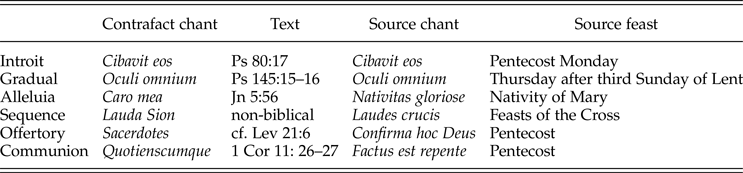
The Cibavit Mass consists of two chants taken from other liturgical occasions, and of four contrafacta (Table 2). The introit Cibavit was taken from Pentecost Monday, the gradual Oculi omnium from the Thursday after the third Sunday of Lent. The melodies for the contrafacts were taken from several occasions, and provided with texts almost certainly selected and edited by Thomas Aquinas.Footnote 36
Sources of the Corpus Christi contrafacta

When surveying this set of chants, the potential issues for Carthusians become clear. First, because the sequence as a genre was not practised by Carthusians when Corpus Christi was introduced, Lauda Sion is absent from Carthusian sources of the Corpus Christi Mass that were inspected for this study; it did not even enter them as a later addition. Because the source melody for the alleluia stems from a chant with a non-biblical text, it does not occur in the Carthusian corpus of alleluia chants. Accordingly, the Carthusians had to deal with a melody they were not familiar with.Footnote 37 Apart from the alleluia and the sequence, the Carthusians probably were not troubled by the selected texts. They are exclusively biblical, with some slight adaptation in the case of the offertory. To see how the Carthusians dealt with this new set of chants, I compared their version of the contrafacted chants with those in the Paris Libellus. In addition, I compared the Carthusian version of the source chants with those in the eleventh-century St Yrieix gradual.Footnote 38 For these comparisons, I made a selection of three Carthusian manuscripts and one print, deliberately chosen from various places and dates of origin to avoid the possibility of any direct influence between them – apart from belonging to the same religious order.Footnote 39
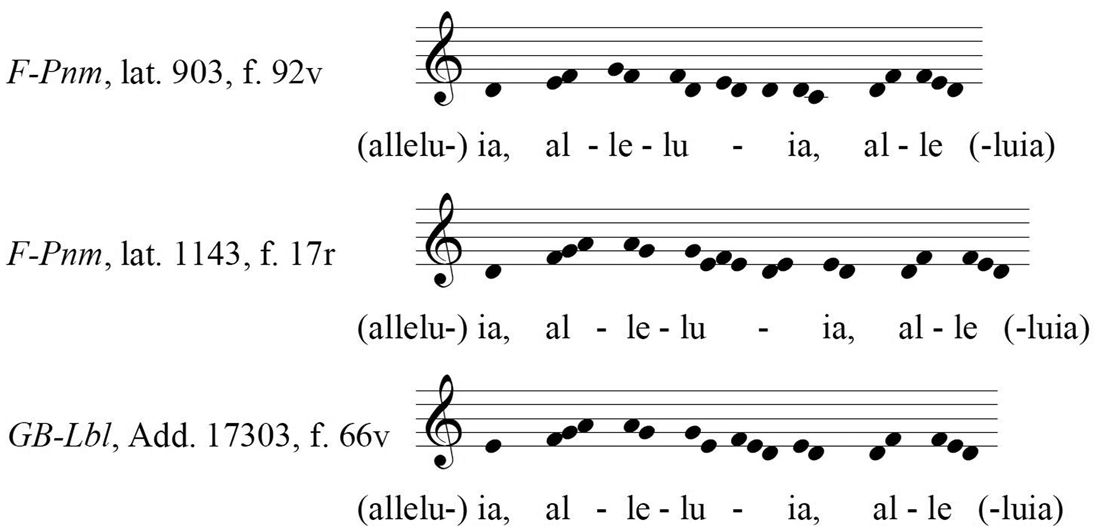
The introit and gradual are chants that were reused, together with their texts, for Corpus Christi. The Carthusians are known for their precision in copying melodies,Footnote 40 and these chants are no exception. The introit's and gradual's transmission within the Carthusian sources is almost completely uniform with only four single deviating notes. In addition, the Carthusian melodies of the introit and gradual are strikingly similar to their ‘mainstream’ melodic tradition. The only notable deviation, which occurs in the introit, is presented in Example 1. In this example, the Carthusian version diverts, together with the Paris Libellus version, from the St. Yrieix version. The melodic line for the second ‘alleluia’ is more or less identical in the three versions, except that the Paris Libellus and Carthusian versions are a tone higher than the St Yrieix version.
Introit Cibavit eos (excerpt from final section). Carthusian gradual (lower staff), Paris Libellus (middle staff), St Yrieix gradual (upper staff).

Before discussing the alleluia in greater depth, I turn to the offertory and communion chants. As contrafacta they allow us to see how the Carthusian melodies deviate in both the source chants and the contrafacta. In the source chant for the offertory, Confirma hoc Deus, the main deviation consists of ten notes that appear transposed up a tone. In the contrafactum Sacerdotes, discrepancies between the Carthusian melodies and the Paris Libellus melodies are minimal: two single notes are one note lower and a group of three notes were transposed up a tone.
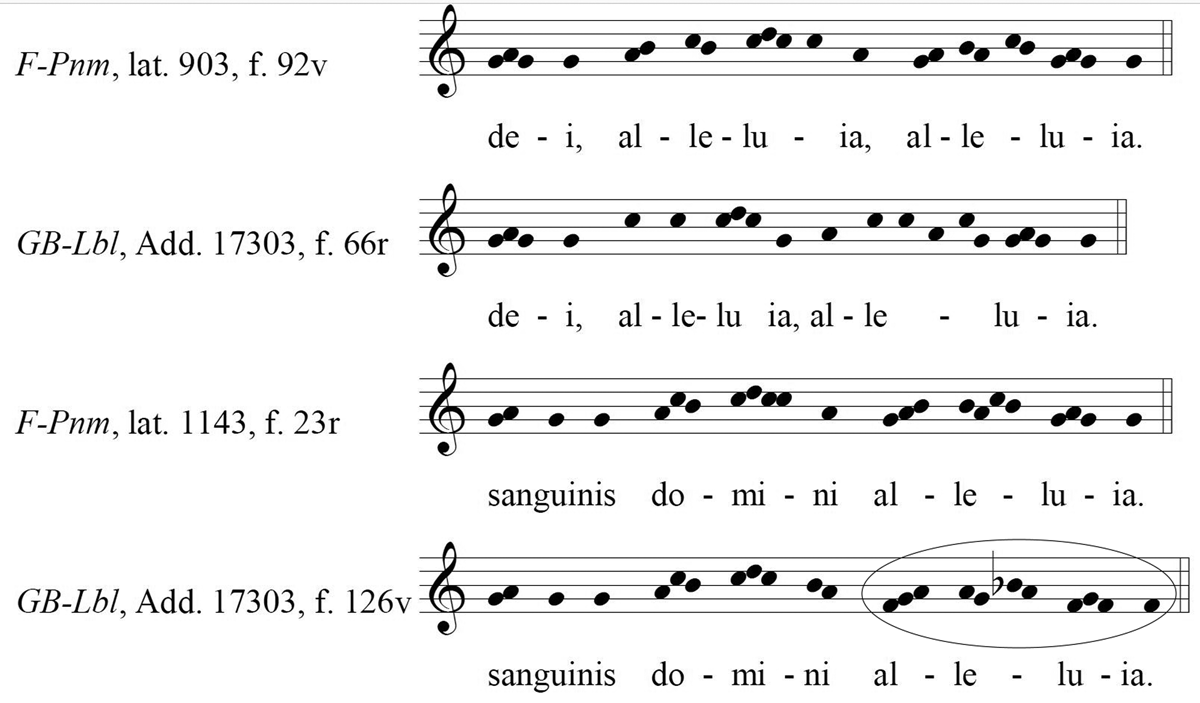
The communion reveals more substantial variants (Example 2). The upper two staves show the ending of the source chant, Factus est repente. This final phrase has been somewhat simplified and edited in the Carthusian version. The lower staves show the ending of the contrafact, Quotienscumque. Here, the last eleven notes have surprisingly been moved down by one tone, changing the mode of the chant from Mixolydian (finalis g) to Lydian (finalis f); this is explicitly confirmed by the notated b flats a few notes prior to the change. It appears, however, that this curious reading is unique to this particular source. The other Carthusian graduals share exactly the melody with the Paris Libellus.Footnote 41
Communion Factus est repente / Quotienscumque (ending). Carthusian gradual (lower staff), Paris Libellus (middle staff), St Yrieix gradual (upper staff).

The variants encountered in these offertory and communion chants can be deemed to be relatively minor. They appear especially in the source chants; the variants in the contrafacta are either minimal or specific to one Carthusian manuscript. This state of affairs may be seen as an indication that melodic changes, made in the transition from the source melodies to the Corpus Christi contrafacta, were almost all taken over by the Carthusians. The Carthusians may even have directly copied the contrafacta without any consideration for the source melodies.
The alleluia merits further discussion. It is the only contrafactum in the Mass Propers, of which not even the source chant had been part of the Carthusian repertory of alleluias. In this case, therefore, the Carthusians really had to incorporate a completely new melody. Compared to the offertory and communion chants, the number of alleluia variants is much higher. Moreover, the longest variant overall (extending over ten notes) occurs in the alleluia.Footnote 42
Despite these variants, the precise manner in which the melodies in the Mass Propers were copied by the Carthusians is striking. The relation to the main tradition in the source chants, and even more so to the new Corpus Christi contrafacta is faithful. The extant variants do not affect the melodies in any significant way. They gain in interest when taken together with the high degree of uniformity within the Carthusian sources. Variants between these and the Paris Libellus, however trivial, occur almost always across four Carthusian graduals – procuded at considerable geographical distance, from the Low Countries to modern Slovenia.Footnote 43 This strongly suggests that the Carthusians had created an exemplar through which the chants of Corpus Christi were to be transmitted within the Order. While it is hard to imagine how this might have been done in any other way, it is noteworthy because it raises an interesting question concerning the transmission of these Mass Propers.
Although it is clear that the melodic tradition of the Paris Libellus served as a point of departure, the variants found unanimously in Carthusian sources are not shared with any other early sources for the Corpus Christi Mass Propers.Footnote 44 This marks these variants, with near certainty, as intentional, made at the stage the (hypothetical) exemplar was produced. It does not seem likely that the scribe responsible for making the exemplar would be so much more careless than the scribes adding the Corpus Christi material to their liturgical manuscripts. On the other hand, the variants might have their origin in the document from which the Carthusian exemplar was copied; it would seem rather unlikely that they used the actual Paris Libellus as their source. Finally, it may very well be that we are dealing with a mixture of variants: both ‘scribal noise’ and intentional changes.
Too little is known about the transmission of these Mass Propers in general to make a robust assessment. While the earliest Corpus Christi sources have been transcribed and published in the recent decades, a critical comparison and analysis of a broader selection of chant sources is still outstanding.
The Office Sacerdos in Aeternum: restructuring and replacing
In addition to the Mass, the Carthusians adopted the Corpus Christi Office from the version presented in the Paris Libellus. This Office, named after the first antiphon for first Vespers, Sacerdos in aeternum (often abbreviated as SIA), developed alongside two major other forms: Sapiencia aedificavit (SAS), as a variant version of SIA, and Animarum cibus (AC), regarded as one of the earliest Corpus Christi Offices.Footnote 45
In the Paris Libellus, the Office for Corpus Christi was compiled in such a way as to be usable in both secular and monastic liturgical uses. The main body of the Office is meant for secular use, with nine readings and responsories for Matins, and five psalms for Vespers. A curiously labelled ‘fourth nocturn’ (a non-existent liturgical entity) at the end of the manuscript contains additional items that permit expanding Matins to twelve antiphons and twelve responsories, as was customary for monastic uses. If one of the Vesper psalms and its antiphon were additionally dropped, it would result in monastic Vespers with four psalms. In what follows, it will become clear that the Carthusians did much more than this.
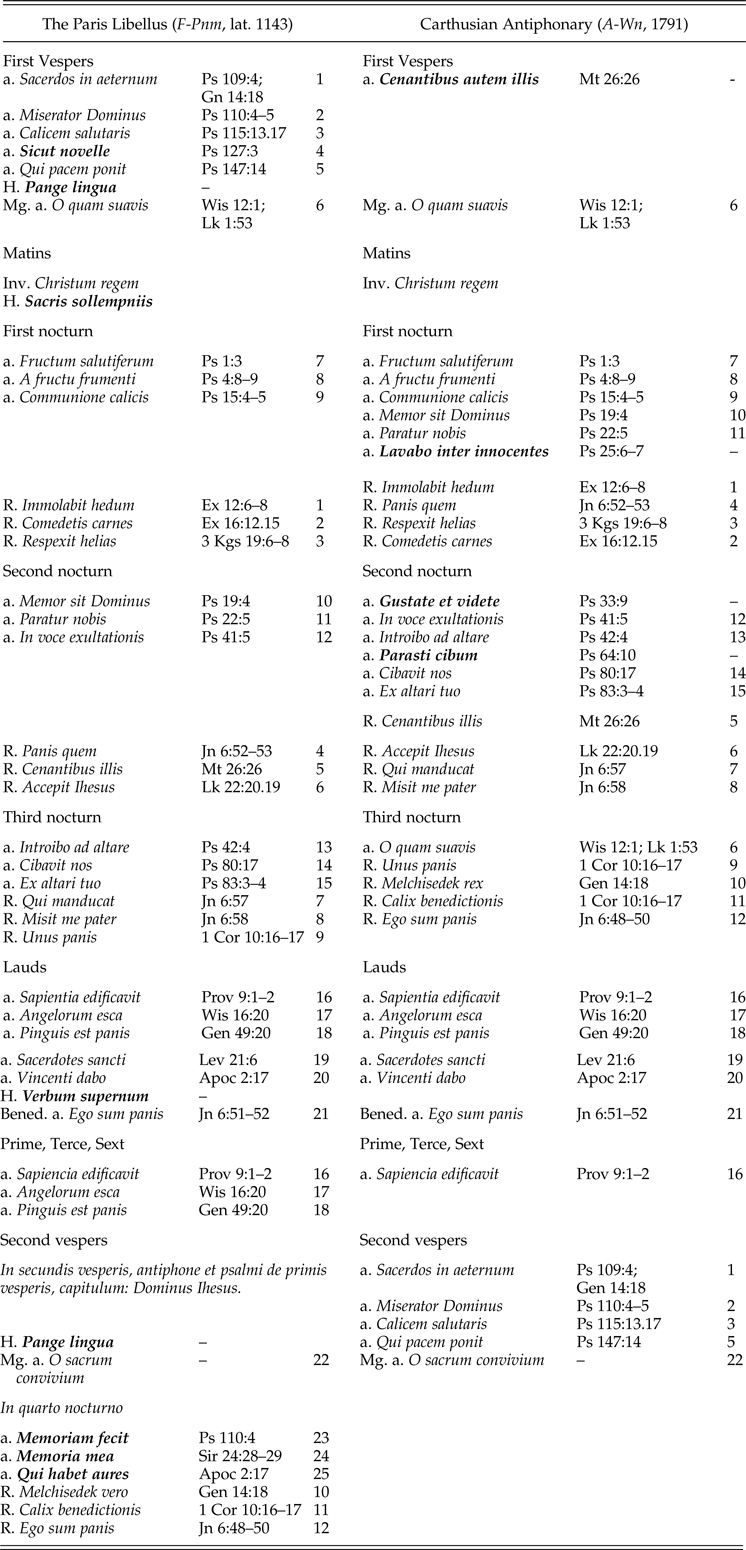
Appendix 1 compares the Office, as recorded in the Paris Libellus, with the Carthusian version.Footnote 46 Antiphons and responsories are numbered according to their position in the Paris Libellus (left column) in order to facilitate tracing movements between the two versions. Incipits in bold indicate chants that are not shared between the two versions.
This synoptic table makes apparent a number of significant deviations. First, the antiphons for first Vespers are replaced by a single antiphon. The Carthusians did not make an exception of their tradition, confirmed still at the beginning of the fourteenth century, to use weekday psalms with just one antiphon in first Vespers on major feasts.Footnote 47 In SIA, the five Vespers antiphons are repeated in second Vespers, and it is here that they can be found in the Carthusian Office as well. To adapt these Vespers to monastic use, one antiphon (Sicut novelle), was sacrificed by the Carthusians. Although it might have served as an antiphon for first Vespers, they adopted instead Cenantibus autem illis, an antiphon originally used as a Magnificat antiphon for the second Vespers of Maundy Thursday, while being extremely rare in Corpus Christi contexts.Footnote 48
A second notable intervention is the exclusion of all hymns. The Carthusian Order had always been reluctant to include hymns because of their non-biblical texts. While they did gradually incorporate hymns into their liturgy, they were hesitant to use the hymns for Corpus Christi, a relatively late addition to the received corpus of hymns.Footnote 49
Third, we can glean from the antiphons for Matins what had motivated the Carthusians to deviate from their source. In the secular office, each nocturn contains three psalms, accompanied by three antiphons. Including the material offered in the ‘fourth nocturn’, the Paris Libellus thus provides the Carthusians with all twelve antiphons required for their first and second nocturn. Surprisingly, the Carthusians disregarded the three antiphons of the ‘fourth nocturn’, while they introduced three antiphons that are otherwise unknown in Corpus Christi contexts: Lavabo inter innocentes (in the first nocturn), Gustate et videte and Parasti cibum (both in the second nocturn). Note that the single antiphon for the third nocturn is a repeat of the Magnificat-antiphon of first Vespers.
The reason for this intervention becomes clear in relation to the psalms that were paired with the antiphons. The Carthusians took over the antiphons together with the entire series of nine psalms as they were prescribed in the Paris Libellus. In line with common liturgical practice, the antiphons took their text from their accompanying psalms. However, this practice could not be extended to the monastic version of the office, because two of the three extra antiphons are not based on texts from the Psalter (Memoria mea, from Ecclesiasticus, and Qui habet aures, from Apocalypse). Nonetheless, the Carthusians evidently wanted to retain the principle, and adopted three new psalmic antiphons and combined them with the corresponding psalm. In addition, they positioned these new antiphons so as not to breach the numerical ordering of the psalms. The Paris Libellus thus had this psalm sequence in three nocturns: 1–4–15, 19–22–41 and 42–80–83. The Carthusian Office changed this to two nocturns with psalms 1–4–15–19–22–25 and 33–41–42–64–80–83 (additions in bold typeface).
But why did they not use the one psalm-based antiphon that was provided for by the Paris Libellus, taken from, and accompanying psalm 110? Possibly they did not consider it appropriate to use this psalm, which is typically associated with Sunday Vespers, for Matins. (Indeed, the psalm appears in second Vespers for Corpus Christi, accompanied by its antiphon Miserator dominus.)
Finally, the responsories show a rather different approach. Here, the Carthusians have used all responsories given in the Corpus Christi Office, simply adding the extra three from the ‘fourth nocturn’ at the end. Here, apparently no reason was found to reorganise the chants, apart from an obscure reordering in the first nocturn.
The Office Sacerdos in Aeternum: refashioning contrafacta
Having observed the Carthusians’ proverbial faithfulness in copying the melodies for the Mass Propers from the Paris Libellus, it is interesting to see how they dealt with the melodies of the office chants. The following comparisons are based on a sample of manuscript sources (using similar principles as in ‘The Mass Cibavit eos’ section).Footnote 50 First and foremost, once again it appears that the office chants for Corpus Christi are found to have been copied in a strikingly uniform manner within the Carthusian antiphonaries that have been inspected. As was the case with the Mass Propers (see the end of ‘The Mass Cibavit eos’ section), this is indicative of how effective the transmission of these chants within the Carthusian Order was. The relation between the Carthusian Office chants and those of the Paris Libellus, however, is of a very different kind.
As the office contains many more chants than the Mass, the results will have to be presented in a more sophisticated form (Appendix 2). The main conclusion of this comparative analysis, however, is straightforward: the Carthusians replaced almost all melodies of the Corpus Christi chants by melodies taken from their own antiphonary, while the texts were left practically untouched.
In Appendix 2, the chants are given in their liturgical order, from the first to second Vespers (antiphons and responsories are separated for reasons of clarity). Most importantly, the table shows which melodies were used for the Corpus Christi contrafacts as found in the Paris Libellus (columns 3/4), and with which melodies these were replaced by the Carthusians (columns 8/9). The contents of the other columns, briefly explained at the heading of the table, will be discussed in the following.
First, it bears calling to mind that the chants from which the original Corpus Christi contrafacta took their melodies are almost all absent from the Carthusian antiphonary. In other words, the melodies of the Corpus Christi chants were largely unknown to the Carthusians (see column 5). Only three of these thirty-three melodies were actually known by the Carthusians; the texts of another three chants are present in the Carthusian corpus but with different melodies. This suggests that the Carthusians replaced all these melodies because they were unknown to them. It is ironic, however, that two of the melodies that the Carthusians were familiar with were nevertheless replaced by new ones (antiphons Introibo ad altare and Vincenti dabo). Thus, only one melody known to them was actually taken over, albeit slightly edited (antiphon Sacerdos in eternum). Conversely, exactly one melody that was unknown, was taken over anyway (the Magnificat-antiphon O quam suavis).
The four additional chants mentioned in the section ‘The Office Sacerdos in Aeternum: restructuring and replacing’ are the chants that the Carthusians themselves introduced to the Corpus Christi Office. The first of these, Cenantibus autem illis for first Vespers, was taken from Maundy Thursday with its text and melody left untouched. The other three, however, merit further attention. These antiphons, Lavabo inter innocentes in the first nocturn and Gustate et videte and Parasti cibum in the second nocturn, have incipits that are without parallel in the Carthusian antiphonaryFootnote 51 and, with but a single exception, in antiphonaries of any other documented tradition.Footnote 52 The antiphon texts in question therefore had to be created for the occasion, when the Carthusian chants for Corpus Christi were constructed. The melodies, however, were not created ex nihilo, but taken over from other chants in the Carthusian antiphonary.
What can be said about the origins of the melodies (columns 8/9) that the Carthusians used to fashion new contrafacta, as they adopted texts from the Corpus Christi chants in the Paris Libellus? Strikingly, almost half of the melodies (seventeen out of thirty-five, underlined in column 9)Footnote 53 were taken from the first section of the antiphonary, that is, from the seasons of Advent and Christmas, up to and including Epiphany. Next are two melodies that were taken from the feast of Michael the Archangel (29 September), one of which was actually used four times, for the antiphons Paratur nobis (1st nocturn), Introibo ad altare (2nd nocturn), Sacerdotes sancti (Lauds) and Qui pacem ponit (2nd Vespers).Footnote 54 Two further melodies were taken from Maundy Thursday, the opening antiphon mentioned earlier, and Calicem… et sacrificabo for second Vespers. The remaining ten melodies were taken from various feasts and seasons. For the chant Lavabo inter innocentes (1st nocturn) no source of the melody could be identified.Footnote 55
At least three melodies were taken from chants belonging to the same feast from which the ‘original’ Corpus Christi contrafacta melodies originated (highlighted in Appendix 2). Thus, the responsory Immolabit hedum borrowed its melody from Te sanctum Dominum, from the feast of the Archangel(s); and the Carthusians replaced this melody with that from In conspectu/tempore, from the same feast. Even more striking is the responsory Misit me pater: here, both the ‘original’ melody used for the Corpus Christi contrafactum and the new melody replacing it in the Carthusian contrafactum were taken from the very same chant, Verbum caro factum, from the Circumcision of the Lord (also used for Nativity in the Carthusian antiphonary). Finally, a possible fourth case is the antiphon for the Benedictus at Lauds, Ego sum panis. Here, however, the melodic source of the Carthusian chant is uncertain. The melody for Non est hic, for the Dedication of a Church, is not very similar to the melody in the Carthusian contrafact of Ego sum panis.
One might believe that the Carthusians chose all the new melodies from chants with some textual relation to Corpus Christi or the Eucharist. This assumption sounds reasonable, as the first antiphon from the whole Carthusian Office, Cenantibus autem illis, was taken from Maundy Thursday, a feast with an obvious link to Corpus Christi. An analysis of a broad sample of the chants in column 8, however, rules out this hypothesis. This concurs with the fact that the collection of feasts from which the melodies were taken (as noted previously) feels haphazard. They do not, by any stretch of the imagination, suggest, to me at least, any thematic-textual motivations for the choices that were made.
Regarding the melodies that the Carthusians adopted to replace the original melodies of the Corpus Christi contrafacts, another possible rationale for this replacement emerges. Keeping in mind the Carthusian propensity for simplicity, it may be that they found the original Corpus Christi contrafacta too long. To investigate this possibility, the new melodies were roughly compared with the original melodies with regard to their length (column 7). As can be concluded from a simple count of the various relationships in this column, length was evidently not an overriding reason for the replacements. In only fifteen cases, the new melodies were clearly shorter than the original ones; in twelve cases, the length more or less remained the same; and in four cases (all of them responsories) the new melodies were actually longer than those of the original contrafacts.
With regard to their modes (not indicated in Appendix 2), the new melodies show some coherence. Antiphons use predominantly modes 1 and 7. Intriguingly, all the antiphons that were inserted by the Carthusians themselves (Lavabo inter innocentes, Gustate et videte and Parasti cibum) are in the first mode. The responsories, on the other hand, represent all eight modes; modes 2, 3, 4 and 8 feature twice. The Carthusian use of modes in their Corpus Christi Office clearly contrasts with the late medieval penchant for putting chants in newly composed offices in modal order.Footnote 56
Some examples will illustrate exactly how the Carthusians edited the chants. Significantly, they show that the idea that Carthusians simply reused melodies familiar to them is insufficiently nuanced. Especially the responsories present examples of editing ‘familiar’ melodies.
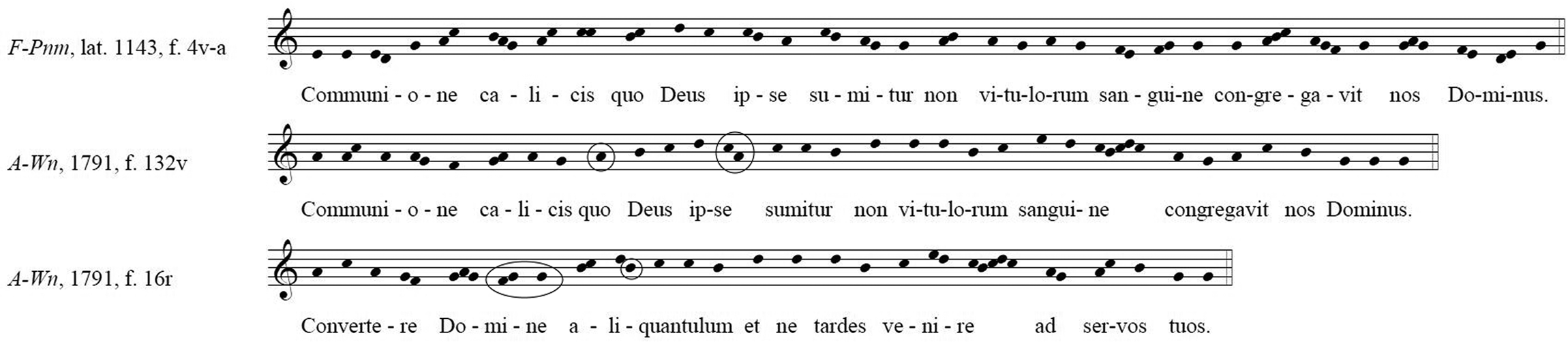
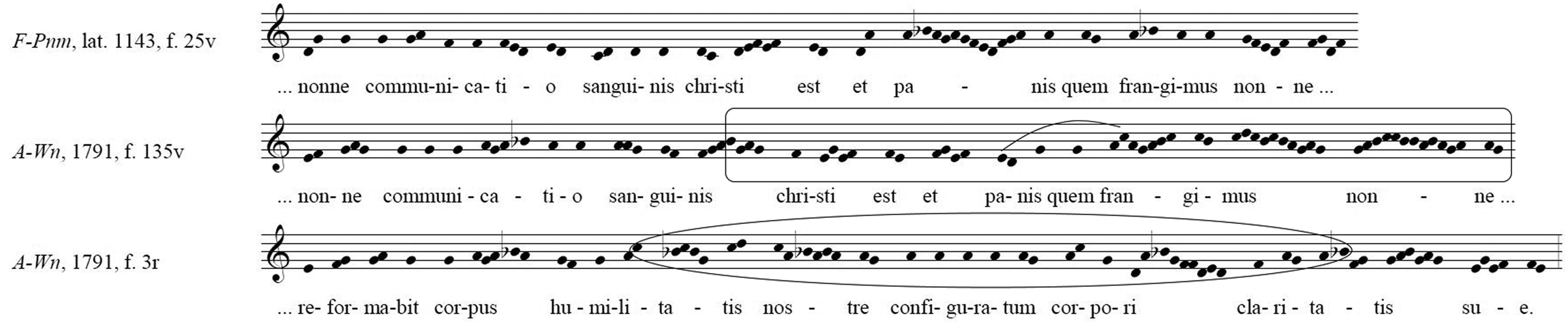
Antiphons are represented with three case studies (Exx. 3–5). Example 3 demonstrates the most typical procedure of adapting melodies within the corpus of antiphons. The upper staff gives the melody of the Corpus Christi antiphon as found in the Paris Libellus; the middle staff gives the melody of the new antiphon as fashioned by the Carthusians; the lower staff gives the chant from which the melody was taken. Leaving aside repeating notes, differences (circled) are minor – a common occurrence in the corpus of antiphons more broadly.
Antiphon Communione.

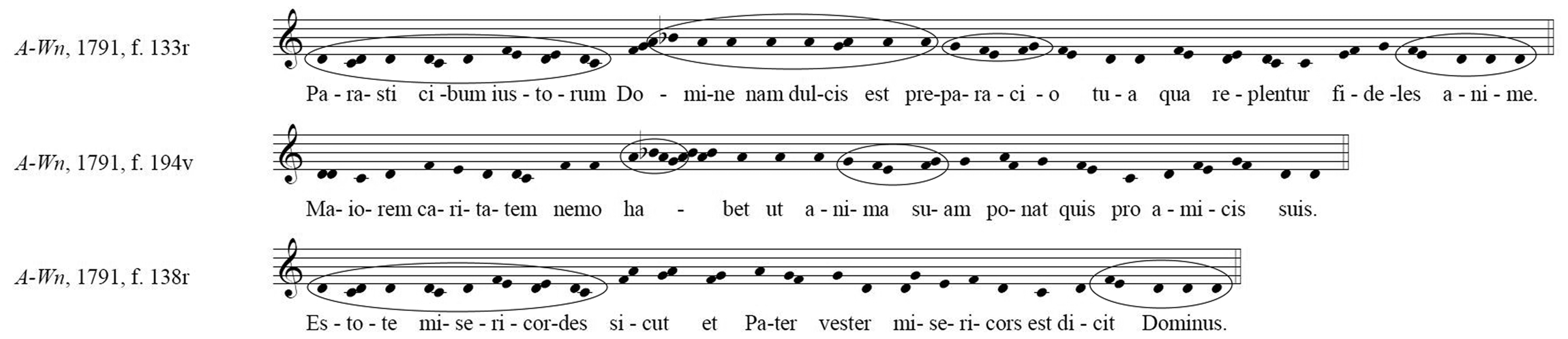
Example 4 presents one of two exceptions (the other being Angelorum esca from Lauds). As this is one of the new antiphons introduced by the Carthusians themselves, no staff for the Paris Libellus is needed. Two melodies were found in the Carthusian antiphonary that are similar to Parasti cibum: Maiorem caritatem (for Lauds in Apostle's feasts) and Estote misericordes (the Benedictus antiphon for the fifth Sunday after Pentecost). Neither are unambiguous sources for the entire new chant. Yet, taken together, they provide most of the melodic material of Parasti cibum.
Antiphon Parasti cibum.

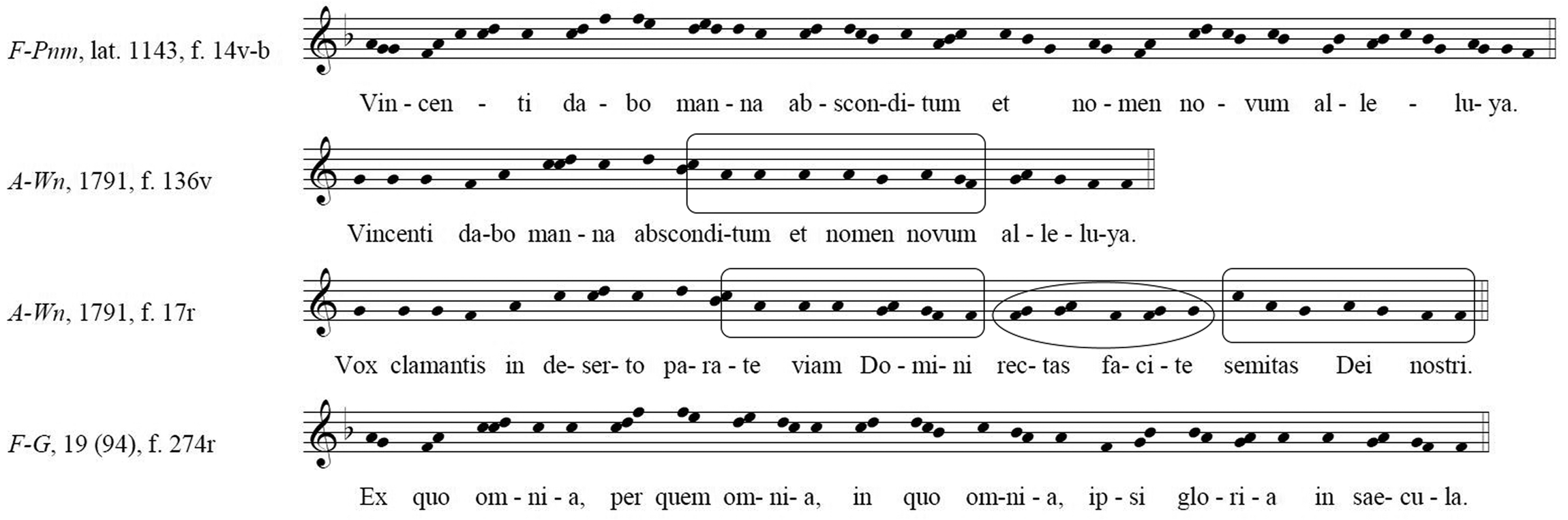
Example 5 represents a curious instance of adopting a new melody for a chant, while the melody used in the Paris Libellus was actually known by the Carthusians. Once again, the upper staff reproduces the chant from the Paris Libellus, the melody having been taken from the antiphon Ex quo omnia from Trinity. The fourth staff presents the identical chant as found in Carthusian sources, designated for the same feast and at the same position.Footnote 57 The editor(s) of the new chant must have missed this concordance (or for some obscure reason intentionally ignored it) and instead took the melody from antiphon Vox clamantis (printed on the third staff), to fashion the new Corpus Christi antiphon (shown on the second staff). In this process, one group of notes was left out (circled), and another (in rounded boxes) was used only once rather than twice.
Antiphon Vincenti dabo.

The responsories generated much more editing, although this activity is largely limited to the responsories proper. The melodies of the responsory verses have been left largely untouched when they were transferred to the new Carthusian contrafacta for Corpus Christi.Footnote 58 In addition, significantly more notes were cut from, rather than added to, the original chants (in a ratio of about 3:2). The addition of notes is also restricted to five out of twelve chants, whereas the removal of notes occurs in almost all the responsories (eleven out of twelve). Finally, it is striking that in the responsories four chants ended up being longer than their counterparts in the Paris Libellus.Footnote 59 Examples 6–8 illustrate the most striking instances of editorial activity. The three chants from which these were taken account for about half of the notes that were removed from all twelve responsories; similarly, they stand for almost three-quarters of all added notes in the twelve responsories.
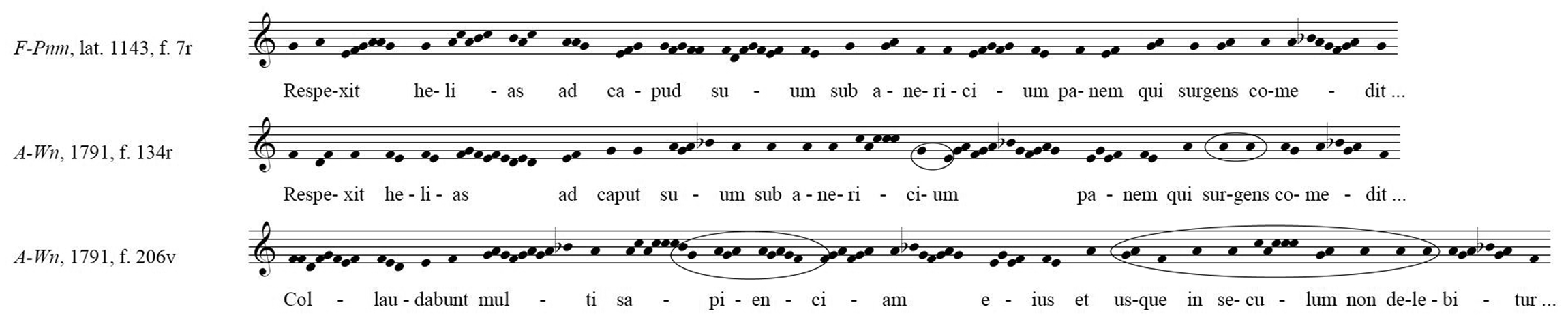
Responsory Respexit helias (opening section).

In Example 6, the upper staff again gives the melody of the Corpus Christi antiphon as found in the Paris Libellus; the middle staff gives the melody of the new Carthusian antiphon; and the bottom staff gives the Carthusian chant from which the melody was taken. The circled passages in the bottom staff were removed and replaced by the circled notes in the middle staff.
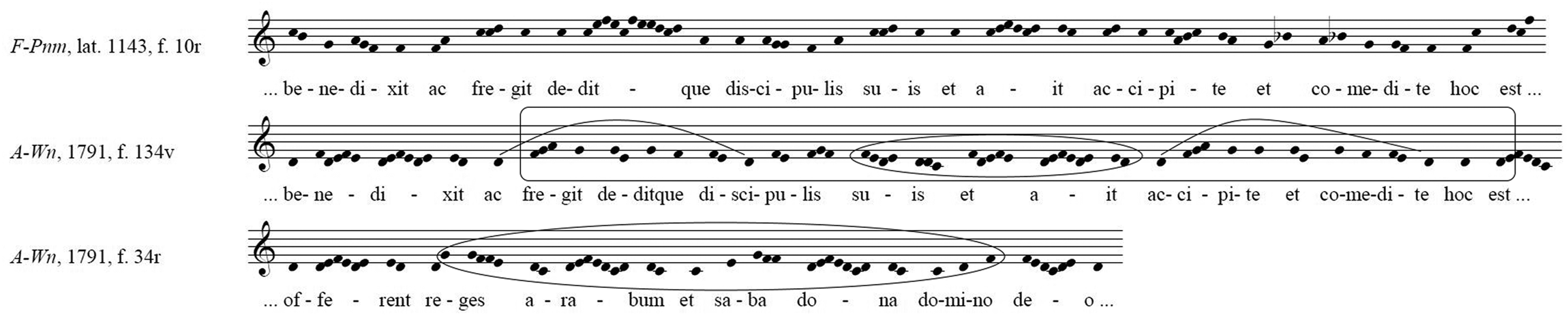
Example 7 demonstrates a more drastic intervention. Whereas the Carthusian version of the responsory Cenantibus illis (middle staff) had up to this point taken its melody almost verbatim from the second mode responsory Reges tharsis (bottom staff), for some reason a large section (circled) was removed and replaced by a completely new melodic section (in rounded boxes). This melodic section, however, largely consists of material typical for responsories in Frere's group IIb, to which Reges tharsis also belongs.Footnote 60 In the middle staff, the encircled notes are clearly similar to Frere's formula D3, which had occurred earlier in the melody. Interestingly, however, another formula (indicated by a slur) can be traced to cadence d 1 in Frere's group IIa, and is used twice in the melodic section that the Carthusians inserted in this responsory.
Responsory Cenantibus illis (excerpt).

Example 8 is taken from Calix benedictionis, the Carthusian version of which (middle staff) is based on the third mode responsory Salvatorem expectamus (bottom staff). In this case, the circled section has been removed and replaced by a long and melismatic section, of which only about half is shown in the example. In contrast to the previous example, no typical third mode phrases can be found (Salvatorem expectamus belongs to Frere's theme IIIa).Footnote 61 The only possible exception is a short phrase (again indicated by a slur), which is very similar to Frere's ƞ4/B1.Footnote 62 At the end of this peculiar insertion, the final cadence of Salvatorem expectamus (immediately following the encircled notes) is picked up. The newly added section is thus significantly longer than the section that had been removed, making Calix benedictionis one of the few chants that exceeds the source chant from the Paris Libellus.
Responsory Calix benedictionis (excerpt).

Reviewing these examples raises the obvious question: were these melodies simply changed to accommodate a longer or shorter text? If there is a significant difference in the amount of text between the chant from which the melody was extracted and the chant for which that melody was used, more melodic editing may be expected. Within the responsories, no evidence for such a correlation appears. The text of Calix benedictionis, for example, is very similar in length to that of Salvatorum expectamus, from which the melody was taken, but it is exactly here that the melody was changed most intensively. Conversely, the text of Unus panis is much shorter than that of Ipse precedet – but its melody has undergone only minor changes.
Dealing with change, changing the deal
It is striking just how much scrutiny the Corpus Christi Office and Mass had been subjected to before being introduced and disseminated in the Carthusian Order. The Mass Propers’ melodies have been edited, albeit only slightly. It is in the Office that the most editorial interventions can be seen. Hymns were ignored, and the repertoire and ordering of antiphons of the various services were changed. First Vespers only received one antiphon, and three antiphons were added to Matins – all of these four antiphons being otherwise unknown in Corpus Christi contexts. The responsories, however, were ordered more or less as they were given in the Paris Libellus. Most editorial energy was invested into the melodic content of these Office chants: all but one have had their melodies removed and replaced by melodies from chants originating in the Carthusian antiphonary. These substitute melodies did not escape editorial changes either, in the process of forming new contrafacta. Notably, the melodies for responsories were edited more radically. These new Carthusian chants for Corpus Christi were then disseminated within the Order in an efficient manner indeed. Relatively few deviations appear in the melodies for Mass and Office as they are found in the Carthusian sources that were examined for this article.
Why were all these changes made? The most radical changes (apart from the sequence in the Mass and the hymns in the office) may just be a result of the Carthusian Order's general musical and liturgical conservatism. The reasons for reordering the office chants, especially the series of antiphons, are less clear. A predilection for traditional practices may be at work in the preference of antiphons with text from the psalms they were to accompany. However, it is hard to fathom exactly for which reasons the Carthusians decided to introduce four new antiphons, two of which of uncertain origins. When dealing with the melodies of all these chants, finding reasons for changes that were made is still more problematic. The massive replacement of melodies in the office chants is probably best understood as an unwillingness to learn new chant melodies. Determining the rationale for both the selection and the additional editing of familiar melodies used to fashion new contrafacta could be like chasing rainbows, and an explanation of the microscopic melodic changes made in the Mass Propers defies a general explanation.
The individual(s) who made all these changes are difficult to identify. It would seem obvious that these would have been monks from the Grande Chartreuse, the motherhouse of the Order. Taking a broad time frame, two general priors of the Carthusian Order may have played a role: Dom Boson (1278–1313) and Dom Aymon d'Aoste (1313–30). For both of these figures, biographical information is scarce, and any special interest for liturgy or music cannot be ascertained.Footnote 63 Sylvain Excoffon gives us a potentially useful list of monks from the Grande Chartreuse from the thirteenth to the fifteenth century.Footnote 64 Unfortunately but unsurprisingly, this list does not yield useful clues to pin down the possible author(s) of the Corpus Christi changes; while the list regularly provides information about a given monk's function within the monastery, more specialised tasks and achievements are understandably lacking. The agents behind the chants for Corpus Christi are thus effectively shrouded in anonymity – a fact which the Carthusians certainly would have enjoyed.
The Carthusian adaptation of the Corpus Christi Office

Appendix 2: The Carthusian Office chants for Corpus Christi and their sources
Columns 1/2 The Carthusian Office chants for Corpus Christi.
Columns 3/4 The source melodies, and the feast from which they were taken, used for composing the Office chants as found in the Paris Libellus.
Column 5 The occurence of these source melodies in the Carthusian corpus of Office chants. No (0), yes, with different melody (1-), yes, with same melody (1+).
Column 6 Melodic relationship between the chants in the Paris Libellus and those in Carthusian sources. Ranging from no correspondence (0) to strong correspondence (4).
Column 7 Relationship between the chants in the Paris Libellus and those in Carthusian sources as to their length. Same length (=), Paris Libellus melody is longer (>), much longer (>>), Carthusian melody is longer (<).
Columns 8/9 If the melodic relationship (column 6) is minimal: source melodies, and the feast from which they were taken, used for composing the Office chants as found in Carthusian sources. Numerals denote the Sunday in the season. Uncertain cases denoted by (~) and unknown cases by (?).