Introduction: gender and proletarianization
A central question in the history of the modern African working class has been when and under what conditions ‘has working class formation and proletarianisation occurred’ (Sandbrook and Cohen Reference Sandbrook and Cohen1975: 16). Debates about this process have centred not merely on timing, economic sector or the nature of the colonial state, but rather have emphasized the incomplete nature of proletarianization and the persistent insecurity of a semi-urbanized working class. As migrants from the countryside, African workers established only a precarious foothold in urban areas and maintained long-term economic, cultural and familial ties to the rural enclaves from which they came. The relative impermanency of these workers and its implication for working-class consciousness have shaped much of the historiography of twentieth-century African labour and what James Ferguson has called ‘expectations of modernity’ (Mamdani Reference Mamdani1996; Ferguson Reference Ferguson1990; Macmillan Reference Macmillan1993; Werbner Reference Werbner2014; Cooper Reference Cooper1996: 273; Reference Cooper and Cooper1983: 15–18). Yet, for the most part, the ‘African worker’ in these discussions, understood as a migrant, has been imagined as a male head of the household. What happens to the model of African ‘working-class consciousness’ when the workers, especially those in manufacturing, are women? Even in South Africa, an area of the continent with a relatively well-developed manufacturing sector, women have often been relegated in working-class history to the role of ‘reproductive labour’ in rural reserves, or petty commodity producers and so-called ‘informal’ traders in urban areas (Berger Reference Berger1992: 4; Bozzoli Reference Bozzoli1983: 164). Indeed, as historian Fred Cooper points out, as late colonial states in sub-Saharan Africa sought to craft labour policies, their ‘gendering of the African worker was so profound it was barely discussed. The entire discussion of danger and of promise – of the African worker becoming productive – assumed a male worker’ (Cooper Reference Cooper1996: 2–3, 266, 463, 468), with women playing only supportive roles in the formation of an urban proletarian household, or, under apartheid, as the reproductive labour force remaining in the reserves. In the latter case, by the 1980s the twin forces of urbanization and the growth of manufacturing had effectively eroded the material basis of this vision of a gendered division of labour and residence, whether apartheid planners admitted it or not.
As Cooper observes, in the immediate post-war period, as in much of British and French colonial Africa, the South African state appeared – for a brief moment – to be prepared to implement ‘policies to stabilize [African] labor and incorporate it into political institutions’ (Cooper Reference Cooper1996: 262–3). Yet the implementation of apartheid after 1948, designed to halt permanent African urban settlement, delayed state incorporation of African labour and official recognition of a non-migratory ‘African working class’ for another three decades (Posel Reference Posel1991; Cooper Reference Cooper1996: 262–3; Lichtenstein Reference Lichtenstein2015). Even then, as Bill Freund points out in The African Worker (Reference Freund1988), despite the growing recognition on the part of employers and even some state planners during the 1970s of the need for a stabilized, urban, African working class, late apartheid reform was ‘held back in critical ways’. In particular, Freund observes, apartheid had reduced avenues of economic stability for African women. Petty commodity traders had a hard time competing with a well-developed monopoly sector; adequate family housing provision remained unavailable; and, as Freund notes, apartheid had ‘intensified the process through which marriages have become more fragile and less effectively a source of security for African women’ (Freund Reference Freund1988: 126–9, quote on p. 128). No longer a functional part of the economy of the impoverished and economically unproductive reserves, yet thrown onto their own devices as urban migrants, by the early 1980s women made up a crucial component of the newly militant African working class that had emerged from the 1970s and helped proletarianize the anti-apartheid struggle. As more of them found their way into factory work, their struggles for dignity and recognition took on a dual character. As part of a growing working-class movement that sought full legal status as employees in South Africa, stable urban residence and union recognition, female African factory workers became part of a dynamic new labour movement emanating from the shop floor. At the same time, as women, this new role allowed them to challenge patriarchal structures of authority in the factory, the community and the home.
Rival unions
When the Congress of South African Trade Unions (COSATU) emerged in 1985, in the wake of apartheid-era reforms incorporating Black trade unions into South Africa's industrial relations machinery, many of its constituent unions had recently done battle with one another on the shop floor – and in the courts – to demand recognition from their employers and to command the loyalty of African workers. At the time, in the enormous Frame textile complex in Pinetown?New Germany just outside Durban, 9,000 workers – about half of them women, and most of them Africans – laboured in a series of five large mills. These women worked in one of the fastest growing manufacturing sectors of the apartheid era, an industry in which the number of workers employed nationally rose from 36,855 in 1958 to 188,400 only fifteen years later (Westmore and Townsend Reference Westmore and Townsend1975: 20). By 1980, one study shows, nearly half the South African textile workforce was female, and two-thirds of these women workers were African (Yawitch Reference Yawitch1983). Throughout the 1970s, following the widespread strikes that rocked the Durban area in 1973, two competing unions had made inroads among these workers. One was the Textile Workers Industrial Union (TWIU), a ‘mixed’ union representing Indian and Coloured workers, and thus officially ‘registered’ with the Department of Labour. Affiliated with the Trade Union Council of South Africa (TUCSA), the TWIU had at one time organized African textile workers in a ‘parallel’ branch union, unrecognized by the state but still aided by the TWIU in negotiations with employers. By the 1970s, however, these efforts had faded away, and African textile workers, barred like all Africans from membership of registered unions, had nowhere to turn for organization. Shortly after the 1973 strikes, however, a new ‘independent’ African union, the National Union of Textile Workers (NUTW), initiated with the TWIU's support but outside the existing structures of TUCSA's crippling paternalism, began to sign up Frame workers. As Worker News noted in 1985, when NUTW workers finally won recognition after a dozen years of struggle at the Frametex mill (with 3,000 workers, the largest in the complex), ‘at that time nobody would have dreamed that they would succeed in their struggle’.Footnote 1
In part this was because, by the end of the 1970s, what had begun as a cooperative endeavour between the TWIU and the NUTW had descended into bitter rivalry, exacerbated by changes in apartheid's labour regime. In an effort to quell labour unrest, co-opt the new independent unions such as the NUTW, and secure international legitimacy, in 1981 the apartheid state agreed to allow independent African unions to register with the government and access collective bargaining mechanisms. By this time, however, the NUTW had rejected cooperation with the TUCSA-affiliated TWIU, which had drawn increasingly close to employers. In November 1979, an NUTW circular to Frame workers asked pointedly: ‘why are your employers so keen that African workers join’ the TWIU? ‘Three forces stand in our way’ in a quest for a non-racial, democratic union, the NUTW insisted at this point: ‘[t]he Government, employers, and [Norman] Daniels’, general secretary of the TWIU.Footnote 2 As the Financial Mail observed, by this time ‘some employers regard[ed] the less aggressive TWIU as a more attractive union’ than the rival NUTW.Footnote 3
The bad blood between the rival textile unions reflected the vastly transformed industrial relations terrain that the NUTW faced at the beginning of the 1980s. By the start of that decade, in response to the recommendations of the government's Commission of Inquiry into Labour Legislation (the Wiehahn Commission), emergent African unions including the NUTW, grouped after 1979 in the new ‘non-racial’ Federation of South African Trade Unions (FOSATU), could choose to register and gain direct access to South Africa's industrial relations machinery, such as Industrial Councils. At the same time, African workers could now directly join registered TUCSA unions rather than be confined to unregistered and subordinate parallels. Thus, even while the NUTW made the controversial decision to register, the union faced a renewed challenge on its right flank from the TUCSA. Led by the Frame Group, many employers in the textile sector realized that they would much prefer to work with the more pliant TWIU, now fully open to African workers, than with what they regarded as the militant upstart NUTW. ‘Now when it is totally unavoidable to recognize a union,’ the FOSATU Worker News pointed out, ‘it is hardly a surprise to find [Frame] trying to force workers into a TUCSA union that relies on management for support.’Footnote 4 In fact, Norman Daniels complained to the Textile Industrial Council that ‘his union [the TWIU] was in the forefront of attacks from outside unions … He asked for support from employers suggesting that they should not have dealings with outsiders who would promote anarchy in the industry.’ Daniels went so far as to tell the government's Industrial Registrar – overseeing union recognition – that only the TWIU should be registered because his union did not ‘believe that it is feasible to have more than one trade union catering for the same interests in a common area’, as this would not be ‘conducive to industrial peace’.Footnote 5 In response, the NUTW pointed out that historically not only had the TWIU excluded Black workers, but it also had opposed strikes and aimed at corporatist negotiations conducted by union bureaucrats such as Daniels at the national level. The NUTW, in contrast, sought to develop shop-floor power by cultivating a strong system of shop stewards.Footnote 6
To complicate matters further, the labour reforms generated by the turmoil of the 1970s included a vastly expanded system of plant-specific ‘liaison committees’, sometimes effectively penetrated by the new unions, but often dominated by management and seen by both the government and employers as a potential workplace barrier to more independent and militant unions (Lichtenstein Reference Lichtenstein2015). As NUTW organizer Chris Albertyn observed, at Frame ‘[t]he liaison committee adopted a supliant [sic] attitude towards the company trusting that by loyalty and hard work they would keep their jobs, and receive the company's blessing, in perks and wage increases. They were not, obviously, keen to see an “outside” body, like a union, disrupt the benefits of paternalism.’Footnote 7 Frame management did its utmost to use the liaison committee to blunt the threat of the independent union, and to speak directly to its workforce while keeping the NUTW outside the factory gates. Finally, the new legislation ushered in by the Wiehahn Commission's 1979 report cobbled together an ‘Industrial Court’ designed to sort out competing notions of how the new labour relations regime would be applied to unions and management alike, and to adjudicate on ‘unfair labour practices’. Thus, in the years between the 1979 founding of FOSATU, the promulgation of a reformed Labour Relations Act and the opening up of state-sanctioned collective bargaining machinery in 1980, and the emergence of COSATU five years later, there was a constant ‘war of position’ inside South Africa's manufacturing plants (Maree Reference Maree1986: 125–30; Landmann Reference Landmann2006; Shafer Reference Shafer1979).Footnote 8
Within South Africa's textile industry, the Frame complex and its large number of African female employees emerged as the central arena of this struggle. The site of large, disruptive and militant strikes in both 1973 and 1980, these integrated factories in the Pinetown–New Germany industrial area on the western outskirts of Durban were owned by one of South Africa's most intransigent employers, the Frame family. By the 1970s, the Durban area had become the heart of the country's textile production, with over sixty plants operating and a total of more than 24,000 workers. Nevertheless, the locally owned Frame group's factories (the Consolidated Frame Cotton Corporation, or CFCC) stood above all others, and indeed employed over a third of the Durban area's textile workforce. While once dominated by Indian and Coloured workers, and then for a brief time by African men, by the 1970s African women had come to constitute 70 per cent of the textile workforce in the region, many of them migrants from the nearby KwaZulu Bantustan who stayed in hostels and townships within commuting distance of the factories. The rapid increase in the number of female workers came as a direct effort on the part of Frame managers to reduce wage costs and to increase control over their labour force in the wake of the 1973 strikes. As organizer Chris Albertyn observed in 1976: ‘Frame has made the employment of women systematic policy. Since the 1973 strike, led by African men … Frame has employed African women to the exclusion of all other groups: this time to break the organization that emerged over 15 years among the African men.’ This seems to have been part of a general trend on the part of Durban manufacturers to hire women after the strikesFootnote 9 (Yawitch Reference Yawitch1983: 82). Thus, by 1980, if a union wanted to organize the Natal textile workforce, its target was clear as day: the thousands of African women working at Frame's Pinetown complex (Copelyn Reference Copelyn2016).
By the early 1980s, a number of other significant structural factors shaped the ongoing battle between the TWIU and the NUTW over who was going to organize these workers. The CFCC itself consisted of five large adjacent factories producing cotton and woollen goods. Although these plants stood in close proximity to one another, the NUTW consistently argued that for organizing and recognition purposes they should be treated as separate entities. As we will see below, however, once the FOSATU union had won over a majority of the largely female and African workforce at the Frametex cotton mill, Frame management suddenly demanded that the five factories be considered as a single unit when it came to recognition. The cotton sector in particular, concentrated at the Frametex plant, proved the most promising terrain for the NUTW for several reasons. Woollen production had long been governed by an Industrial Council agreement, which meant that the registered ‘mixed’ union – the TWIU – had a long-established presence there. The cotton mills, however, had always fallen outside of the state's regulatory apparatus, and thus historically had a very low floor on wages – one of the reasons why it recruited African women. During the 1970s, cotton production in the industry expanded at the expense of wool production, so that only 15 per cent of the labour force was covered by Industrial Council agreements by the end of the decade.
Most significantly, however, the preponderance of African women workers at Frametex in unskilled and semi-skilled production jobs profoundly shaped the struggle there. As Nomatamsanqua Nomvete noted in a 1984 paper, both African men and women had a common set of factory-based grievances in the textile industry. These included low wages, autocratic supervisors, and few outlets for the expression of complaints or to demand improvements. But women had many additional grievances specific to their gender, including lack of medical leave for pregnancy, a company policy that demanded contraception and/or abortion, and the challenge of balancing demands for overtime with domestic obligations. First and foremost, however, they faced a 20 per cent wage differential, a discriminatory policy agreed to by the TWIU in 1972 through an Industrial Council agreement. For those women working in production jobs not covered by the Industrial Council, the government's Wage Board also stipulated a 20 per cent difference in its determination raising wages in the textile industry after the 1973 strikes. This policy was followed by a rapid increase in the number of African women working at Frame, which rose from 40 to 70 per cent during the decade, as the company balanced its wage concessions by hiring more women. While employers and the state (and the TWIU) rationalized the wage differential by the assumption that women remained dependants, in fact many African women working in the textile industry were sole supporters of their families or single women. A study of working women in Durban conducted in the early 1980s discovered that 58 per cent of African women surveyed were single. As one African woman interviewed in 1974 pointed out: ‘They suppose it is the males who support families and that women only work for fancy clothes and other pretty things’ (Meer et al. Reference Meer1990: 97; Nomvete Reference Nomvete1984; Westmore and Townsend Reference Westmore and Townsend1975; NLRC 1980: 29–30).
In contrast to the TWIU, despite its male leadership the NUTW recognized the importance of carefully regulating overtime and avoiding onerous shifts, so that women workers could better meet their domestic obligations (Maree Reference Maree1986: 180–4). Able to pay women less than male workers (a wage differential challenged by the NUTW), and eager to expand in an ungoverned sector, the CFCC (Frametex in particular) increased the number of African women working in its mills. After the 1973 strikes, management imagined that women workers would be more docile than their male counterparts, and thus increased their numbers. This proved to be a serious miscalculation (Meer et al. Reference Meer1990: 259). By the time the possibility of registration opened up to the NUTW in 1980, the growing numbers of African women workers, the expansion of the unregulated sector of textiles, and the TWIU's agreement to a differential wage scale and enforced overtime for women in the woollen industry had all weakened the TWIU's ability to represent female textile workers at Frame (Hirsch Reference Hirsch1979: 32–3; Maree Reference Maree1986: 184) and enhanced the appeal of the new FOSATU union as an alternative.
Gender on the shop floor
Most of the attention paid to the NUTW–TWIU rivalry has focused on the protracted legal wrangling fought out between Frame and the FOSATU union in the courts, with an eye to examining the ability of the new unions to use the newly established Industrial Court to bolster their position in the workplace and in the industrial relations machinery (see, for example, Friedman Reference Friedman1987: 340–1; Kraak Reference Kraak1993: 141). NUTW leaders saw this as a viable alternative to calling a premature strike that could easily be crushed by employers and the police (Copelyn Reference Copelyn2016). These legal cases generated a substantial documentary record of their own, one that offers an unusually fine-grained view of the day-to-day relations on the shop floor. In the remainder of this article, I use some of these documents to sketch out the social dynamics, especially those arranged around gender, that shaped workers’ choices when torn between rival FOSATU and TUCSA unions in the early 1980s. This kind of micro-history reveals the liberatory potential of the emergent shop floor unionism practised by the FOSATU unions, and not just in terms of the new class relations and social possibilities embedded in the independent Black unions of the 1970s and 1980s. In particular, it becomes clear that behind the legal struggle waged in the courts by NUTW lawyer-organizers such as Johnny Copelyn lay a cohort of African women workers with the courage to challenge male authority directly in their workplaces. This meant standing up both to White managers and to other African workers, most of them older men, whose loyalty to Frame and the TWIU derived from their privileged positions in the workplace.
At first glance, this may come as a surprise. In South Africa, ‘the working class family, under acute economic pressure tolerates women in gainful employment, but demands that they remain … subordinate to men, dependent on their decisions, and mindful of their household chores’, concluded a 1984 study of Durban's working women conducted by the Institute for Black Research (IBR) (Meer et al. Reference Meer1990: 163). Based on interviews with hundreds of women workers, the study claimed that these women largely accepted their status, and that ‘entry into production work had brought few changes in their self-perception’. Similarly, African trade unionist Emma Mashinini describes in her autobiography how, when her husband's inadequate wages drove her to take work in a garment factory, he still returned home expecting her to care for him; at work, ‘he had been standing and maybe he reckoned I'd been sitting at the machine’, she wrote. She, too, concluded that ‘it was just the order of the day that I had to do everything’ (Mashinini Reference Mashinini1991: 15–16).
Although such ‘double duty’ and the replication of male authority over women in the workplace (as factory manager), the household (as husband or father), and even in the labour movement (as union officers) is a common experience of women workers the world over, structurally South African apartheid served to reinforce the bonds of patriarchy. As a labour system, apartheid paid male migrant labourers extremely low wages on the assumption that social reproduction rested on the labour of African women who remained behind in the rural reserves. Thus, the state preserved the patriarchal form of African customary law – in Natal, for example, all women were legally defined as the dependants of male kin, no matter their age – even while the relentless demand for migrant labour undermined African family relations (Simons Reference Simons1968: 202–4; Walker Reference Walker1982: 4–7; Meer et al. Reference Meer1990: 96–7, 163). Even as employers began to recruit African women, and the economic basis of the reserves as a source of social reproduction had been eroded, these legal barriers and the legal difficulties women faced in migrating or residing in town increased the pressures and demands on female factory workers, who were paid even less than their male counterparts (Berger Reference Berger1992: 291–330). Employers expected economically desperate women workers to be docile factory charges, but who nevertheless contended with the competing demands of household responsibilities shirked by men (Meer et al. Reference Meer1990: 221–3). Finally, even new unions such as the NUTW that emerged from the shop-floor turmoil of the 1970s elevated male workers into leadership positions, including in workplaces dominated by women and where women were ‘the driving force of shop floor organization’. FOSATU organizer June Nala observed that men became shop stewards, while women were expected to care for their families after their shift was done. Nala even complained that ‘women see men as superior to them. They therefore elect male workers as their leaders’ (Nala Reference Nala1986; Berger Reference Berger1992: 299).
Despite all this, by the 1980s textile employers concluded that, while they had brought African women into the factories in response to the 1973 strikes, a dozen years later ‘they appeared to be faced with a female militancy that they thought was worse than male’ (Meer et al. Reference Meer1990: 259). By the time the emergent African unions banded together in FOSATU, not one but two generations of African women had experienced the effects of industrial labour. As Iris Berger points out, during the 1940s and 1950s, ‘labor migration and the flood of black families moving to the cities had severely eroded rural patriarchal controls over black women’. The subsequent generation of African women ‘drawn into industrial production’ during the 1960s and 1970s ‘were likely to be less well educated and more destitute than their predecessors’, and were either migrant workers or residents of urban enclaves close to or part of the homelands, like Durban's KwaMashu, Ntuzama or Umlazi (Berger Reference Berger1992: 293). Nevertheless, notwithstanding the frequent charge that African women had ‘internalized’ the ideology of male dominance, their participation in the union struggles of the 1970s and 1980s suggests their willingness to challenge patriarchal authority – on the factory floor and in their daily lives – as well as class and race oppression.
The legal challenges brought by the NUTW throughout 1983 turned on a demand that Frame agree to recognize the NUTW instead of the TWIU at the Frametex plant once the FOSATU union had demonstrated that a clear majority of the 3,600 workers there had signed up with the ‘Blue card union’, as the NUTW was referred to. Presented with over 2,400 signed cards in March 1983, Frame proceeded to shift the rules, and decided to recognize the TWIU at the entire complex of five factories, where they claimed the older union maintained a clear majority. When workers at Frametex sought to resign from the TWIU, the company refused their resignations. In addition, Frame challenged the NUTW's alleged subscriptions, insisting that in fact it was the TWIU – the ‘Red card union’ – that commanded a majority, even in the Frametex plant itself. The most controversial aspect of this dispute was the company's charge that over 500 of the signed-up workers had agreed to belong to both the TWIU and the NUTW. Copelyn and the NUTW legal team insisted that Frametex sought to ‘avoid its obligation to recognize NUTW’ by actively helping the TWIU recruit members during working hours, using the existing liaison committee to sign up workers for the TWIU, and by direct intimidation of workers by supervisors. Under the new labour dispensation, this could be charged as an ‘unfair labour practice’ before the Industrial Court.Footnote 10
In order to adjudicate this dispute in the courts, both sides presented affidavits collected from Frame workers. The thirty-two affidavits from NUTW partisans that I have been able to locate, as well as ten additional affidavits from workers who were subsequently retrenched (the South African term for ‘dismissed’ or ‘laid off’) for their loyalty to the NUTW, offer an unusual glimpse of a shop-floor struggle. Nearly all of the affidavits came from African women who had joined the NUTW; more than half of these workers resided in the enormous Kranzkloof hostel in Clermont, described later by NUTW organizer Johnny Copelyn as ‘the heart and soul of our organization’, and the remainder stayed in the surrounding townships.Footnote 11 Set up in the wake of the 1973 strikes, as Frame sought to recoup some of its losses, the hostel allowed Frame to continue ‘the exploitative utilization of migrant labor’ residing in Clermont (NLRC 1980: 33–5). As the centre of the NUTW's organizing drive among migrant workers, mostly from the nearby ‘homeland’ of KwaZulu, Kranzkloof became the site of mass meetings, organizing drives, cultural events, and face-to-face interactions between organizers, shop stewards and production workers (Copelyn Reference Copelyn2016). However, as Iris Berger points out, for those residing in the hostel, ‘a high degree of paternalism regulated women's daily lives’, as they faced restrictions on movement, visitors and behaviour (Berger Reference Berger1992: 283–6; NLRC 1980: 34–6; Westmore and Townsend Reference Westmore and Townsend1975: 20–1). No doubt such paternalism was exacerbated in Natal by the fact that African women migrant workers required permission from a male guardian before they could be issued a work permit to enter a ‘White’ area, as the Natal code stipulated that ‘the African woman is always under the guardianship of a man, either her father or his heir or her husband’.Footnote 12
The 1983 conflict over representation at Frame reflected lingering tensions from an earlier 1980 strike that resulted in police repression and violence between strikers and strike-breakers at the hostel and its bus rank (where an NUTW shop steward, Samson Cele, was assassinated) (Friedman Reference Friedman2011: 106; Copelyn Reference Copelyn2016). In both 1980 and 1983, Kranzkloof proved ‘an important site of communication and mobilization’ for workers, as ‘shop stewards, who constituted a group linking the union leadership and the mass of workers, had a presence in most sections of the hostel’ (NLRC 1980: 36). Nevertheless, for female hostel dwellers it was a site that also reinforced the patriarchal authority they experienced as employees when they walked down the hill to Pinetown's mills. For instance, during the 1980 strike, the women's section of the hostel, while well organized, ‘was the most vulnerable section of the hostel’, subject to invasion by local tsotsis and the sexual assault of female strikers. As an article in the South African Labour Bulletin observed, African women's ‘resistance and solidarity’ flowed, in part, from their resentment of the fact that they were ‘subject to controls far more stringent in nature than those exercised over male residents’ of Kranzkloof. At risk as well to capricious expulsion from the hostel, and thus the loss of their precious residency rights in the township, the Kranzkloof women tended to ‘unite in mutual self-defense’ (NLRC 1980: 38). Clearly, this spirit persisted into the conflict with the TWIU and Frame management a few years later.
Hostel-dwelling women working at Frame found little respite from male authority in the workplace, as ‘management relied on male dominance as a means of enforcing industrial discipline’ and ‘male workers are always overseers over women workers’ (Berger Reference Berger1992: 283; Nala Reference Nala1986: 10). Here again the bitter legacy of the recent 1980 strike conditioned the relationships between workers and supervisors, and thus women and men, on the shop floor itself three years later. Faced with international competition, low productivity and limited technological capacity, Frame coupled its dependence on hostel-dwelling migrant labour with a reliance on low wages and a driven labour force to keep costs down and remain profitable. Frame's authoritarian management style had long been notorious. Even after the 1973 strikes, rather than attempting to secure worker consent by educating them in the increasingly popular language of liberal industrial relations, ‘the “rules” of wage labour [at Frame] is largely achieved by force’ (NLRC 1980: 43). Following the 1980 strike, some women were singled out for firing because of antagonistic relations with their male foremen. This, too, seemed to carry over into efforts to secure allegiance to the TWIU in 1983, as male managers pressured women workers to join the union. Indeed, a key feature of workplace friction came from upper management's appointment of a thin layer of Africans – supervisors, foremen, security guards and company spies, nearly all male – to positions of authority in the workplace. The role of these figures in opposing the 1980 strike bred resentment that emerged again in the battle between the NUTW and the TWIU, especially as female workers found themselves in a position to defy male authority figures in the factory (NLRC 1980: 22, 43, 46). Finally, women – often subjected to shop-floor sexual harassment by both supervisors and co-workers – seemed well aware of the attitudes of their male co-workers, who feared their competition and did not want to lose patriarchal authority in the workplace or the home (Meer et al. Reference Meer1990: 159). The union drives of the early 1980s effectively offered a challenge to these attitudes. As the NLRC study observed, in the Frame factories ‘the sexual relations of dominance are subsumed and reinforced in the relations of industrial discipline’ (NLRC 1980: 29). While these had proven exceptionally difficult to challenge during the 1980 strike, the legal recourse and protection available in 1983 made the recognition struggle more compatible with women's ability to resist their male supervisors’ authority.
The affidavits: defying male authority in the workplace
The women workers who contributed affidavits on behalf of the NUTW in 1983 came from numerous departments in the large Frametex mill, including doffers,Footnote 13 winders, slubbersFootnote 14 and weavers. The stories these workers told illustrate the pressures they faced from the company, the means by which they were forced to join the TWIU, and their clear rationale for choosing the FOSATU union instead, despite the potentially high costs of doing so.
For example, Jabu Dludla, a doffer in the spinning department who stayed at Kranzkloof hostel, claimed that a member of the Frametex liaison committee met with workers in her department to inform them that ‘two bulls [were] fighting in the factory and that the “red bull” had won. Everybody must join the Red Card Union and … anyone who does not … will be fired.’ When Dludla asked if this was compulsory, she was told that ‘just as a woman must obey her husband's rules at home, so must workers obey the rules of the company. Everyone is forced to join the Red Card Union.’ Many other affidavits in the case file confirm this kind of direct intimidation exercised in the language of patriarchy. Drawing on a study conducted through interviews with almost a thousand working women in the factories of the Durban–Pinetown area, the IBR reported that ‘when [women] do enter the factories, they do so after having internalized all the traditional prejudices against women and they meet many workers and “bosses” with similar dispositions’ (IBR 1984: 3). No doubt this was often the case, yet at least some of the women involved in the battle between the TWIU and the NUTW – at the very same time the study was conducted – seemed quite capable of direct confrontation with factory patriarchy, as they challenged the authority of management, male supervisors and male co-workers alike. A nightshift operator in the Frametex spinning department, Mildred Bhengu, reported being called into the plant's labour office when she resisted joining the TWIU. There she was told by Albert Nyembezi, a much-feared induna (or Black assistant labour officer), that there was a ‘red card union’ inside the factory, and a ‘blue card union’ outside its gates. ‘Do you remember the 1973 strikes caused by the blue card union?,’ the induna asked her pointedly. ‘Many of the workers were fired and many of them still have not got their jobs and others are working for Indians,’ he warned her. Bhengu, however, insisted to Nyembezi's face that she ‘stood by the Blue Card Union’. When asked why, she informed him that, unlike the managerial TWIU recruiters, NUTW activists ‘had explained to me what a union was about whereas there was no explanation about the Red Card Union and the workers were being forced to join it’ by management.Footnote 15
Other workers appeared caught between Frametex management and their comrades on the shop floor. Dorothy Mishali, a ‘boss girl’ in the winding department, recalled that a male liaison committee member told her that the ‘Red Card Union’ had been accepted by the company, and that she should tell the workers she supervised that ‘they were required to join the TWIU’. Faced with this command, Mishali claimed that she ‘forgot’ to inform the workers in her section of this mandate. The liaison committee then commanded her to go ‘machine by machine’ and tell the workers to join, which she proceeded to do, with limited results. A few weeks later, Nyembezi called the entire winding department – all women – to the labour office and told them that they must sign TWIU cards or leave the factory, at which point they all complied and ‘joined’ the TWIU rather than lose their jobs. Like many other workers who provided affidavits, Mishali insisted to the court that in fact she was ‘a member of the [NUTW]’ and that her ‘wish is to have the Union recognized as my representative at the Frametex Mill’. Offering a potential explanation for why there were over 500 Frametex workers who appeared to belong to both the NUTW and the TWIU, Mishali insisted that ‘I would not have joined the TWIU but for the pressure put on me by Nyembezi and the impression that Frameco would only recognize the TWIU’.Footnote 16
Other workers, women especially, reported being pressured by (male) liaison committee members to join the TWIU. Anastasia Kongola, in the slubbing department, was told that the TWIU was the only union with representation in the factory. When she refused to join, the White manager and labour recruiter E. F. Ashwell informed her that the NUTW ‘was a dead union and that it was a “bush” union and that I would soon join it’ outside the workplace (i.e. she would be fired) if she did not sign a TWIU card. Other workers reported being informed that the NUTW was the ‘strike union’, and that they had a clear choice: join the TWIU or lose their job. Many workers, such as Annah Kweyame, joined the TWIU when ordered to do so, even though they had previously signed a card for the NUTW. They soon found themselves faced with the demand to sign stop-order forms to pay dues to the TWIU (a facility denied to NUTW organizers). Sylvani Dlamini, an operator in the winding department who stayed at Kranzkloof, claimed that her ‘signature’ on the TWIU card was falsified. She had been asked four times by management to sign a stop-order form, and had refused each time. Her fellow winder and Kranzkloof resident Tokozane Mkhize also signed a card for each union, and was then told by management that she had to choose. Even though they informed her that ‘Blue Card is not allowed at Frametex and is not wanted’, she chose the NUTW, only to be berated by the company labour officer that she was ‘Uyahlothoza’ – confused.Footnote 17
Perhaps she was, and who could blame her? Certainly, the company insisted that election by secret ballot was impossible, given what management claimed was the ignorance of the workers; ‘the workforce concerned comprises largely unskilled and unsophisticated labour’, Frame lawyers told the court, ‘who would tend to distrust the confidentiality of a secret ballot’. To the contrary, Copelyn replied in his own submission to the court that many Frametex migrant workers in fact had electoral experience. After all, he cleverly pointed out, ‘voting is not foreign to the employees. The majority come from Transkei and KwaZulu and have had some experience participating in elections’ in the homelands. Confused or not, many of the women workers at Frametex, like Mkhize, when faced with the intimidating demands of White managers, indunas, security personnel and liaison committee members – nearly all of them men – to join the TWIU and the competing entreaties of union activists beyond the gates and their fellow women workers at Kranzkloof, chose the independent union. Another Kranzkloof resident, Patricia Cebisa, said that she had been recruited by the TWIU inside the factory, but ‘thereafter I read pamphlets given to me outside the factory by the [NUTW] and after discussions with my fellow workers I decided to join the Union’. When faced with the requirement to join, another worker demanded to know: Is the TWIU ‘a management union or a workers union’? Nearly all the affiants insisted that the company had bullied or tricked them into signing TWIU cards; they now wanted to resign from the company union, and intended to remain members of the NUTW. The one exception was Noreen Dludla, a TWIU recruiter who worked in the relatively privileged position of ‘tea girl’ in the winding department, where she had circulated at management's behest to sign up thirty workers in her section to the TWIU.Footnote 18
The company subsequently retrenched half a dozen of these courageous women (no doubt easily identifiable by their initial affidavits in the proceedings). Copelyn soon brought their cases back to the court, using the new labour code to charge this as a clear case of illegal victimization of workers who refused to abandon the NUTW for the TWIU (Copelyn Reference Copelyn2016). This second set of affidavits, many including Copelyn's handwritten notes, provide an equally compelling account of shop-floor relations, particularly between African women workers and male managers, both African and White. Moreover, some of these further affidavits contain some revealing life histories about the African women who worked at Frame.Footnote 19
Zandile Mncube, for instance, had joined the NUTW back in 1977. Able to read and write in Zulu and English, Mncube clearly was insulted that, when pressured to join the TWIU, she was asked to sign her union card with a thumbprint. She soon thereafter quit the company-sponsored union. She informed the ‘boss girl’ in her section that she had only agreed to join in the first place ‘because it was company policy’. Reminding Mncube of the 1980 assassination of NUTW organizer Samson Cele, the boss girl responded that ‘human being[s] are fools because we cannot realize NUTW is taking us to the mud, strikes, dismissals … [NUTW organizer Jabulani] Gwala didn't help … Cele's family’. Called into the Frametex labour office, and confronted by management, Mncube inscribed her TWIU resignation form with the Zulu phrase ‘Ngajoyina ngoba ngesaba umthetho we femu’: ‘I joined because I was scared of the law of the firm’. The managers demanded she tell them who else belonged to the NUTW before she left the office. She refused, retorting: ‘I will sit [here] until sunset. The reason I don't like their union is that they do everything by force. The company forced me to join and now you want to force me again to give you the name of who joined me.’
Phumbele Shange, like Mncube a worker in the warping section and a long-time Kranzkloof resident, where she attended NUTW mass meetings, told a similar story. She began working at Frametex in 1979, and joined the NUTW outside the gates of the plant when asked to by organizer Jabulani Gwala, a former Frametex employee fired for his union activities. After resigning from the TWIU, she was called into the labour office, where a group of male workers loyal to the company confronted her, one of whom shared her surname. ‘My daughter,’ this older Zulu man said to her, ‘there is something I want to talk to you about.’ Unmoved by this appeal to fictive consanguinity, Shange insisted that she preferred the NUTW to the TWIU because she ‘got full explanation from that union, whereas here I was only forced’ to join the TWIU. The next day they called her back to the office. Surrounded by Frametex's White labour officer (Ashwell) and head of security (Albert Luyt), an African security guard and the induna Nyembezi, who reminded Shange that he was the one who hired her, she was warned not to get too ‘deep in politics’. Nyembezi paternalistically informed her that he ‘was only advising me because I'm still young’. They warned her that Jabulani Gwala would lose interest in her once she was fired, and wouldn't help her, just as ‘he did nothing for those who were fired after the strike in 1980. They are still looking for employment even today.’
They went further, and reminded Shange that the state's Security Branch had taped all the NUTW meetings and reported them back to the company (a chilling threat, given the arrest and torture of many union activists at the time). Undeterred, she still maintained that she was ‘not prepared to go back to that union [the TWIU]’. For good measure, she added: ‘I won't sign anything unless they force my hand on the paper.’ Shifting tack, the bosses suggested that she was the only one in her section still willing to stick her neck out for the NUTW. Shange didn't fall for that either, replying that, if this were so, they should call the others into the office to vouch for this fact. When Nyembezi replied that he couldn't do so during a working shift, Shange reminded him that that hadn't stopped him when he wanted to sign them up for the TWIU. Shange's extraordinary boldness was all the more remarkable because her sister worked as a domestic in the home of the company's head security officer, Albert Luyt. Moreover, rumours remained rife in the factory that Nyembezi had personally ordered the assassination of Samson Cele, making such defiance all the more daring (Copelyn Reference Copelyn2016).
Shange was not the only young woman worker who challenged the assertion of male as well as managerial authority to defend her chosen allegiance to the NUTW. Nonhlanhla Msomi, a Frametex spinner who lived in Ntuzuma Township, about 10 kilometres from Pinetown, was asked if her husband knew of her NUTW membership and if he approved. In truth, many of the women working at Frametex might have been immune to such appeals to patriarchal authority. Affidavits from retrenched female workers suggest that women workers often were the sole support of their children, older family members and unemployed partners. Janet Lembede, a thirty-two-year-old operator in the spinning department, had begun working at Frametex in 1964 as a child herself. She had temporarily stopped work in 1967, 1969 and 1973 to bear children, and by 1983 supported five children and her mother on 55 Rand a week before she was retrenched. She gave her address as c/o Mbanjawa's supermarket. Another retrenched worker was a forty-eight-year-old widow who supported six children on her Frametex wages.
In a further series of affidavits submitted to the courts, Copelyn challenged the CFCC's transfer and then retrenchment of several NUTW shop-floor organizers active in the Frametex spinning department.Footnote 20 Although men formed much of the NUTW's leadership, these documents offer an interesting profile of a layer of female union activists who came directly from the workplace itself, rather than as radicals building the union from the outside. Margaret Shezi had worked in the spinning mill for Frame for nearly twenty years, since 1965, and continuously at the Frametex mill since 1968, except during periods of maternity leave in 1969, 1972 and 1980–81. Maureen Khubeka and Violet Luthuli had both been at Frametex continuously since 1964, and, like Shezi, Luthuli had taken three maternity leaves over the years, the last one in 1976–77. Maria Mthembu, who stayed at Kranzkloof hostel, had worked for Frame since 1973, the year in which the NUTW was established following the strikes. Copelyn argued that all four of these women had lost their jobs because of their union activities, something the company was well aware of, and that their obvious seniority should have protected them. Under the new labour law, the union, he insisted, should have been consulted as their representative before they were transferred or retrenched.
Conclusion
The events at Frametex cotton mill in 1983 represent but one small element of the ongoing efforts of the independent Black unions that emerged in South African textile, metal and chemical industries to secure recognition from their employers and institute a democratic collective bargaining regime. These unions, grouped in FOSATU between 1979 and 1985, faced the combined power of state repression, recalcitrant employers, and the TUCSA unions that remained eager to outflank and/or displace them once African workers had been accepted in law as ‘employees’. Yet the new dispensation ushered in by the Wiehahn reform process also provided these workers and their advocates with a new set of tools with which to challenge managerial authority in the legal sphere. Within this context, the NUTW–TWIU rivalry at Frame allows us to draw a few broader conclusions about the process of union struggle in South African manufacturing during the early 1980s, and the important place of women within it.
First, despite the tendency of some South African ‘liberal’ historiography to attribute liberalization of the apartheid workplace to the initiative of far-sighted employers, in fact many employers did all they could to block the emergence of worker-led, autonomous, democratic trade unions. In this regard, while often considered a prime example of employer intransigence, the Frame group was hardly exceptional. The IBR study of women and unions in Durban, for example, noted that of the fifteen firms they investigated (in multiple sectors), even in 1985 all remained ‘fearful and hostile towards the new trade unions’ (Meer et al. Reference Meer1990: 257). In particular, Frame relied on four tactics that seem typical of the post-Wiehahn effort by employers to dominate the terrain of the new labour relations regime. Firstly, where the revised Labour Relations Act potentially opened the way for a militant shop-floor union like the NUTW, employers quickly sought alternatives with which to corral their African workers and immunize them against the FOSATU unions. They did so either by encouraging existing registered TUCSA unions, now fully open to Africans, by expanding the influence of company-dominated workplace ‘liaison committees’, or both. Secondly, employers did all they could to dilute the power of those unions that did gain a significant foothold among workers in a particular factory, as the NUTW had done in Frametex. This could be achieved by insisting on a larger unit of representation, as Frame did; or by pushing as many disputes as possible away from shop-floor negotiation, where African workers wielded power, and up to the level of the Industrial Council, where employers and TUCSA unions continued to dominate. Because Natal's cotton industry was not bound by an Industrial Council agreement, however, Frametex management could not pursue this latter option. The prevalence of female workers in the factory gave management a misplaced confidence that they could directly dominate their workforce on the shop floor.
Of course, the NUTW and other FOSATU unions (including MAWU, the Metal and Allied Workers Union) pressed in the other direction, and continued to demand that factory-specific, local negotiation remain the key focus of labour–management relations. For example, even while taking the controversial step of ‘registering’ in order to gain access to the new tools of industrial conciliation, the NUTW's leadership ‘committed itself to plant-based bargaining and industrial agreements that were negotiated alongside such plant-based agreements’, thus strengthening shop-floor cultures of resistance.Footnote 21 Employers ‘want workers to negotiate at a place where they are weak, and not in individual factories, where they are strong’, FOSATU Worker News pointed out.Footnote 22 Still, that leaves unanswered the reasons for the unions’ shop-floor resilience in the face of an employer offensive backed in the final instance by the power of the security services, always ready and able to ban, arrest, detain, torture and murder union militants. Labour actions deemed by the state to be ‘political’ continued to lie outside the new legal regime governing industrial relations and permitting Black trade union action. While this surely constrained the actions of highly visible activists such as Copelyn and Gwala, the NUTW's real strength lay in its ability to win the loyalty of a large cohort of workers who could serve as activists inside the factory.
Belinda Bozzoli has noted that African women's capacity for resistance derives from ‘a position of comparative power and strength within the domestic sphere’ and ‘their relative absence from the central axis of capitalist exploitation’ (Bozzoli Reference Bozzoli1983: 164–6). Despite their legal vulnerability as migrant workers, the female Frame workers’ claim to independence – from paternalistic employers, from their fathers or husbands, and from the male supervisory layer, both Black and White, in the factories in which they worked – proved a galvanizing force at this crucial moment in South Africa's labour history. Their profile is striking: they were female, Zulu migrant or contract workers, many of them single, residing at Kranzkloof hostel, who had been textile production workers for a very long time (probably because that was a condition of remaining a legal migrant and resident in Kranzkloof hostel). These workers created a dense network of female mutuality and solidarity, rooted in their collective working and living conditions, providing them with the strength and courage to stand up to male White management, Black indunas and security details, and even perhaps their fathers and husbands. Their shop-floor activism spilled over to and was reinforced by the conditions of women's lives at Kranzkloof, which with over 11,000 residents, half of whom worked at the Frame complex, clearly constituted a fruitful recruiting ground for the union. Frametex itself, a large plant ungoverned by an Industrial Council agreement, where women were traditionally paid less than men (with the connivance of the TWIU), became the core of the union's organizing strength, and recruitment spread out from there to the rest of the Frame factories (Copelyn Reference Copelyn2016). As the NUTW reported in 1984, ‘the recruiting battle is being won. From the base area of Frametex recruiters have now won a majority in Pinetex … and in NKM’ mills.Footnote 23
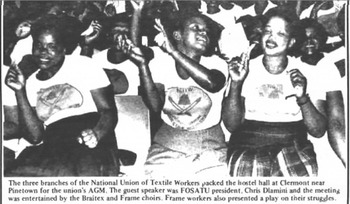
The cultivation of shop-floor strength, however, also required the skills and intervention of a team of ‘outside’ organizers – and lawyers – willing to use the newly opened legal system to represent the claims of Black workers (Copelyn Reference Copelyn2016). As student activists had recognized a decade before when they formed wages commissions and helped organize African trade unions after the 1973 strikes (Hemson et al. Reference Hemson, Legassick and Ulrich2007: 202–9; Moss Reference Moss2014: 147–73; Davie Reference Davie2007), the cracks in apartheid's labour regime could be exploited to advance workers’ struggles. At first, this might entail encouraging union members to join works or liaison committees and work for change from the inside. After 1980, it meant using registration, industrial councils and the new Industrial Court to press workers’ claims, charge employers with unfair labour practices, demand union recognition, shield activists from victimization, and outflank the renewed push by TUCSA to recruit workers with management's help. This tactic proved important not just for the legal victories it might bring – for it certainly did not always succeed – but also to demonstrate to workers that the new unions were willing to defend them and their rights; for women workers, this no doubt gave them added courage to challenge factory-based male authority, even while it enhanced male power within the new union. Indeed, the strategy in this case proved successful, as the CFCC was finally forced to recognize the NUTW at its Frametex plant in 1985, a result that Copelyn recalls as being in ‘its effects on our membership nothing short of transformative’ (Copelyn Reference Copelyn2016).Footnote 24 Most striking is the view expressed by many female Frametex workers that the NUTW showed them what a union was for, and made them feel – as Figure 1 from FOSATU Worker News suggests – that the union belonged to them. The contrast with the TWIU, a union they felt compelled to join because of pressure from their employer – umthetho we femu – could not have been clearer.
FOSATU Worker News, November 1983, p. 4.

Acknowledgements
I would like to thank Bill Freund, Stefano Bellucci, Johnny Copelyn, participants in the University of Johannesburg's History Seminar series, and the anonymous reviewers who helped me improve this article. Finally, a recent interview with NUTW organizer Jabulani Gwala (Ngcobo) confirmed much of what I learned from the documentary record: I thank and salute him.