With the to-ing and fro-ing between orthodox and critical approaches to post-conflict – where a political settlement is holding – peacebuilding in the International Relations (IR) literature, common ground and future policy have yet to be negotiated. The apogee of the debate is marked by the intersection of two ontological vectors. The first reflects the prevailing orthodoxy. This rests on the duopoly of political and economic liberalisation as prerequisite for a wider, international Liberal Peace, in part dictated by the perceived threats to the North that derive from failed, failing and fragile states in the global South.Footnote 1 While proponents of this approach acknowledge certain (limited) technical flaws, their faith in its ontological and epistemological legitimacy is sacrosanct. Proponents of orthodox, ‘Liberal’ peacebuilding consider it to be the best chance to secure a sustainable kind of national peace in fragile, failed and failing states that travels internationally.Footnote 2 It is strenuously asserted and comprehensively debated in the IR literature.
The second ontological vector has been labelled by some as ‘fourth generation’ scholarship,Footnote 3 who accuse the orthodoxy of a range of failures. According to Keith Krause and Oliver Jütersonke, for example, post-conflict peacebuilding ‘is littered with states (Afghanistan, Somalia, Liberia, Angola, Haiti and even Cambodia) in which domestic governance is weak, armed violence remains high, and respect for human rights and the rule of law is questionable’.Footnote 4 Other critics complain the outcome is less liberal democracy and more ‘feckless pluralism’,Footnote 5 an outcome famously characterised by Fareed Zakaria as ‘illiberal democracy’.Footnote 6 Elaborating on such critiques, Marina Ottaway charges that most elites after ‘democratization’ and ‘Liberalization’ are semi-authoritarian rather than democratic or Liberal.Footnote 7 David Chandler and Jens Sorensen illustrate Ottaway's point with regard to the Balkans,Footnote 8 and Pierre Lizee and Stephen Heder affirm the paucity of Liberalism in Cambodia.Footnote 9 Research indicates similar failures in Angola;Footnote 10 the Congo;Footnote 11 Namibia;Footnote 12 Mozambique;Footnote 13 Somalia;Footnote 14 Liberia;Footnote 15 Sierra Leone;Footnote 16 Uganda;Footnote 17 Eritrea and Ethiopia;Footnote 18 and El Salvador.Footnote 19 Indeed, such polities often barely sustain Dahl's (1971) notion of ‘minimal democracy’.Footnote 20 Soberingly, Krause and Jutersonke note that ‘about half of all peace support operations (including both peacekeeping and more expansive peacebuilding operations) fail after around five years’, with recurring violence acting as the key indicator of policy bankruptcy.Footnote 21
By way of alternatives, fourth generation scholarship advances concepts including greater emancipation from structural violence, indigenous autonomy in determining peacebuilding priorities and the idea of the ‘everyday’ as a focal point for ‘post-Liberal’ or fourth generation peacebuilding.Footnote 22 For Oliver Richmond, for example, fourth generation peacebuilding reflects ‘the interests, identities, and needs of all actors, state and non-state’, through ‘the creation of a discursive framework of mutual accommodation and social justice which recognises difference’. Elaborating further, Richmond suggests this departure from orthodoxy focuses ‘on the question of how one can move beyond the installation of a hegemonic peace, and move towards an everyday notion of peace sensitised to the local as well as the state, regional and global […] resting upon a just social order and solidarity, transcending that offered by the liberal peace’.Footnote 23 The ‘everyday’ refers here to the informal social routines of daily existence that people use to get what they need when faced with extreme contingencies. These imaginings ‘offer a vision of an emancipatory, everyday and empathetic form of peace in the context of a post-conventional, post-Westphalian IR’.Footnote 24 They are concerned with the idea of a peace which is not necessarily contingent on sovereign territoriality, does not necessarily privilege the traditional organs and priorities of modern statebuilding, and involves a wider range of ordinary people in the shaping of a more positive and far-reaching peace that reflects their needs and priorities, in whatever peaceful form this takes. Fourth generation perspectives are context-specific, driven by people's needs and prioritise the concept of the everyday.
Key actors in orthodox post-conflict peacebuilding counter that this approach is undermined by a misguided and inaccurate ‘hyper-critical’ bias, and is neither ‘post-Liberal’, since it engages with the Liberal, nor competent, since such critiques have been unable to produce any alternatives that are not too vague or too loosely-defined to be useful.Footnote 25 From this perspective, fourth generation principles are mostly bare of detail, alive primarily at the conceptual level and sometimes unclear as to the extent to which they engage with or dismiss Liberal hegemony in their realisation.Footnote 26 There are no clear formulae or approaches advanced, partly because much fourth generation scholarship rejects the possibility of the universal in peacebuilding on ontological grounds.Footnote 27
It is this impasse that this article addresses. It asks: can fourth generation concepts be brought to life? And, is there a role for global governance (below) in their realisation? Core concepts advanced in and common to fourth generation scholarship are empowerment, emancipation, ownership and the everyday, all of which are inevitably interwoven.Footnote 28 Emancipation empowers and the everyday is meaningless without ownership (since only local people can define the everyday) and without this happening, what they ‘own’ and ‘participate’ in derives from other priorities. I will reconsider these elements before discussing the additional importance of local legitimacy, and the role of ‘just enough’ global governance in efforts to realise all three.
Emancipatory peacebuilding
‘Emancipation’ invokes the freeing of one or more from the power of another or others. Emancipatory peacebuilding involves a process in which ‘marginalised actors and discourses [come to] be recognised and represented, and discourses and practices of domination [come to] be removed through radical reform’.Footnote 29 In this way, local people are empowered and the decisions and choices they make render ownership, participation and stakeholding relevant to them and meaningful.
Whether emancipation is presented as a universal or relative concept, the essence of the notion is clear. The problem is of perspective. Orthodox thinking sees emancipation through a political lens and prioritises political instruments as cures. Fourth generation critiques view this bias as part of the problem, because whilst political instruments like the rule of law may serve to emancipate some from political demagoguery, they make no comment or impact on the role of economic rules in enslaving millions to poverty. Systemic structures like unfair markets instantiated by dominant actors and neoliberal bodies like the European Union (EU) and World Trade Organization (WTO) deploy structural violence of varying forms that oppress very large groups of people en masse, especially poor people whose governments are disconnected from their fates, and the supporting literature denies causal relations of asymmetric power. This denial is adiaphoric: unconscionable impoverishment (for example) is excused by claiming it can't be fixed when it can. For example, easily reducible child mortality, and the simple-to-cure diseases that cause millions of infants unimaginable agony before killing them,Footnote 30 illustrates persistent structural oppression as global norm. This norm is presently both embedded in and denied by mainstream ontology, and is underscored by a prevailing epistemology that denies constructed reality and fails to acknowledge the damage and fix it. Without change to these structures of oppression, there will not be expansive emancipation. From the perspective of fourth generation peacebuilders, orthodox approaches do nothing to change these social rules, or structures, and they seek a form of emancipation which requires a fundamental change to the foundational epistemological positions which undergird dominant orthodoxies and hegemonies. Such emancipation is theorised as a response to the limiting nature of mainstream peacebuilding in the construction of externally-designed and – validated interventions which presently ensure the peace evolved in peacebuilding privileges more the needs of global governance hierarchies and less the need of local people.Footnote 31 If such constraints were removed, it is believed that the space would appear within which a more locally-relevant peace could evolve which was more legitimate locally, rational, and durable for all parties.
In such a framework, people would be stakeholders in their own peace, rather than in an international, Liberal peace. Participation would be more genuinely local and determinative than presently; and ownership would reflect the balance of participation. Presently, what people can participate in is governed from the global and owned by ideology. Emancipatory peacebuilding, hypothetically, implies a different balance, wherein external imposition is reduced and internal determinism is expanded. Without this, local ‘ownership’, ‘participation’ and ‘stakeholding’ are more nomenclature than norm. A genuine form of emancipation, then, is asserted to be essential to rebalancing the current asymmetry in orthodox peacebuilding to ensure a shift from negative to positive peace. It forms an essential element of fourth generation peacebuilding, even if there is no obvious means of realising such priorities.
Mainstream IR journals, to which the study of peacebuilding has been relocated and relegated, are replete with the rhetoric of emancipation, but mainstream schools in IR internalise, project, legitimate and reproduce global architectures and structures in which:
Emancipatory notions of peace cannot escape the dangers of hierarchy [that enable] top-level actors [to] instil in the system their own biases and interests, while arguing that they are constructing a universal system. Any universal peace system is therefore open to being hijacked by hegemonic actors.Footnote 32
In other words, humans en masse can't be emancipated because the international system that disciplines and punishes planetary life is selectively emancipatory – and therefore not universal. Neoliberalism – the ideological value at the heart of global governance – privileges and institutionally supports certain narrower freedoms for fewer people and ignores broader freedoms for a greater number.Footnote 33 It prescribes a version of emancipation that prioritises the removal of structures of oppression characterised by direct violence: the ending of war (whilst continuing to legitimate war as a means of international engagement). In theory, peacebuilding privileges particular approaches such as centring democratic and Liberal values like freedom of speech and association and the rule of law and separation of powers. But with regard to other structures of oppression, like the asymmetrical markets that perpetuate unequal trade regimes and which maintain lethal, mass poverty, it privileges the institutionalisation of commerce under conditions that are inequitable by prescription, prescribes market determinism, and proscribes state intervention and support. The second grouping is far more damaging: millions die from poverty and poverty-related problems, a handful (comparatively speaking) die from direct violence. This comparison has been drawn out in detail in the human security literature.Footnote 34 Indirect violence tyrannises life in post-conflict spaces. People seek emancipation from lives brutally stressed by the avoidable deaths and suffering of their children, or from punishing disease exacerbated by malnutrition; and from external, neoliberal rules that prohibit local solutions in favour of global preferences long before they seek emancipations rendered more abstract and less pertinent by their specific environments and experiences.
Global governance and orthodox peacebuilding, then, advance the rhetoric of selective emancipation in which they privilege freedom from political restraints that harm very few at the expense of freedom from economic restraints that kill millions annually. In this sense, the limits to what emancipation can mean remain constrained by the extent to which the prevailing hegemony determines the nature of peace. It does not see a tension between proposing emancipation as freedom from oppressive structures, while privileging architectures of power asymmetry that depend upon and perpetuate inequality. In this way, emancipation in post-conflict peacebuilding is problematic and requires a more radical critique. As long as such hegemonies remain, it is problematic to advance a notion of emancipation in orthodox peacebuilding. This is not to say it is without virtue, as degrees of emancipation may be negotiated under certain circumstances (below). But there are other challenges to the idea of emancipation that should be noted. One of these involves the concept's negative association with a range of ideologies.
For example, emancipation is associated with Marxism as a means of liberation from capitalism, and as a means of gender emancipation, rhetorical or otherwise, from the strictures of capitalism.Footnote 35 Emancipation's association with various feminisms, as a tool for liberation from patriarchy, also flavours its meaning.Footnote 36 The concept's association with religious movements historically and their relationship with the colonising metropolis brings to the debate further questions of how the concept is perceived in different places by different people. The notion is also associated closely with the emancipation of slaves, and its application to the conditions of people of colour in post-conflict spaces must consider the sense in many postcolonial states that imperialism may be understood or recalled as a form of slavery.Footnote 37 There is also a patrician flavour to the concept, since emancipation refers to the liberation of a child from paternal authority, recalling the paternalist relations reminiscent of centre-periphery relations of the imperial era: colonised and coloniser, parent and child. Despite these perspectives, the idea of emancipation remains attractive to fourth generation thinking partly because it directs a discussion of the presence and role of structure in orthodox peacebuilding propositions, and the extent to which this shapes, dominates and owns peace.
Everyday life
A second core issue appearing in fourth generation peacebuilding is the ‘everyday’. Michel de Certeau wrote that it is made up of ‘the innumerable practices by means of which users reappropriate the space organized by techniques of sociocultural organization’ whether that ‘sociocultural organization’ derives from local government or global governance. For de Certeau, this equated with the ‘surreptitious reorganization of power’.Footnote 38 Boege et al. write that such practices involve ‘customary law, traditional societal structures (extended families, clans, tribes, religious brotherhoods, village communities) and traditional authorities (such as village elders, headmen, clan chiefs, healers, bigmen, religious leaders…)’ in determining ‘the everyday social reality of large parts of the population in [poor] countries […] particularly in rural and remote peripheral areas’.Footnote 39
In this work, I use ‘everyday lives’ to refer to and illustrate the myriad socially-sanctioned ways in which people outsmart their surrounding environments and manage the gaps between constraints and aspirations in the face of inadequate, disinterested or incompetent authority and power, in order to secure their wellbeing. This covers the tactics people use to get what they want or need to live their lives within their changing expectations. People manipulate, with whatever tools and tactics are at their disposal, the surrounding natural, social, economic and political structures that empower or constrain their lived lives. Such structures may be local, global or both. In the vandalised environment of post-war places and in other extreme spaces, it is biopolitical resilience: the application of ‘silent technologies [which] determine or short-circuit institutional stage directions [and] the popular procedures [that] manipulate the mechanisms of discipline and conform to them only in order to evade them’.Footnote 40 We may think of this as the manipulation of disempowering and asymmetrical power reflecting Foucault's ‘technologies of the self and self-care’Footnote 41 in which ‘people are able to adapt and take ownership over structures and institutions so that they begin to reflect their own everyday lives rather than structural attempts at assimilation’.Footnote 42 This process is already active in local, informal institutions and practices which transcend the debilitating effect of inappropriate formal authority, and is practiced routinely before, during and after orthodox peacebuilding operations which continue the extension of inappropriate centralised authority disconnected from the needs of everyday lives among rural majorities and marginalised urbanities. It is immanent, ingrained and legitimated as a routine and central element of life for a substantial majority of a population in post-conflict and very poor places. It lies at the heart of a representative, legitimate, everyday peace. Only a peace that emanates from (without being solely defined by) the everyday will legitimate and sustain post-conflict peacebuilding internally. Not deriving and shaping peace from this perspective would be akin to constituting Liberal democracy in the UK without reference to the will, needs and interest of the people it is meant to serve.
Fourth generation literature has adopted the everyday. For Oliver Richmond, peace associated with the ‘everyday’ leads to:
the possibility of placing the social contract back within the heart of post-conflict states, or of allowing a new, post-liberal, politics, which is more locally ‘authentic’, resonant and agential, to emerge.Footnote 43
The ‘post-Liberal’ peace demands an empathetic engagement between local needs and international peacebuilding institutions and actors like, for example, the UN Peacebuilding Commission, the EU Peacebuilding Partnership or the US Institute for Peace and the International Peace Institute (as agents that influence US peacebuilding policy). These must accept the limitations of existing practices and extend degrees of empathy to relate to everyday lives and basic needs to rebalance the existing emphasis on elite institution-building in order to free local agency from inappropriate and harmful prescription (which may also derive internally, as well as externally).
A problem with this view, however, is that such institutions claim there is no creditable alternative, and have shown little willing to move beyond technical adjustments to what are political challenges. Peace cannot be post-Liberal as long as neoliberal hegemony endures, and the character and content of the social contract is determined by the extent to which its foundations reflect neoliberal preferences. The ‘peace’ people experience is determined by the processes privileged in peacebuilding. Peace cannot be ‘post-Liberal’ since the prevailing hegemony precludes the change this involves. Future ‘peace’ in post-conflict peacebuilding will most likely continue to be disciplined by the hegemony of the Liberal Peace proposition and the primacy of the rhetoric of human rights. It is perhaps around this that a broader peace may be sculpted that synthesises neoliberal rhetoric with everyday reality. I refer to this synthesis as popular peace.
Popular peace
This section sketches the nature of popular peace and the relationships between local and global actors, in post-conflict places where a political settlement holds. The section following this illustrates in some detail the dynamics, mechanics and actors involved. The idea of popular peace binds the everyday to legitimacy, ownership and degrees of emancipation; it is the peace that is relevant, apposite and legitimate to the everyday and to the majority of everyday lives outside metropolitan centres, diverse as they usually are. Popular peace is not to be confused with ‘the everyday’. The ‘everyday’ is a description of the routine mechanics of existence that, when examined, reveal what people prioritise and how they organise the realisation of their aspirations. Popular peace is the outcome of hearing, centring and responding to everyday needs enunciated locally as part of the peacebuilding process, which is then enabled by global actors with congruent interests in stable peace. It is the democratic expression and prioritisation of everyday needs, defined by local people, in the context of peacebuilding. Its priorities, democratically gathered so that heterogeneity is represented and peacefully expressed, explicitly organise – structure – peacebuilding interventions. Popular peace is the peace that results from the mobilisation of the resources to address everyday needs, as defined by substantial tranches of local people, rather than by hegemonic fiat. It lays the framework for the durable protection and provision of diverse and essential everyday needs, directing and engaging formal and informal actors and institutions at local and global levels. It is a peace tailored to diverse local needs, locally identified; it cannot be defined or determined by outsiders, but outsiders can act to remove at least some of the impediments to its realisation. It is a genuinely democratic expression of peacebuilding.
In this sense, it creates conditions for a more emancipatory peace that does not have to be universal. The nature and content of popular peace will change as the everyday needs that define it are met and aspirations incline; in this sense it is momentary but, at levels of development in many post-conflict spaces, these moments will often be lengthy. Desire for particular provision from government, like roads, electricity or water might wane as they are provided; but likely not before the basis of a contract between state and society have been established, and this is largely absent presently. Indeed, all governments have to keep renewing and maintaining their legitimacy. Once initial demands have been catered for, elites will have to find other ways to reproduce their legitimacy through reciprocal, democratic engagement. This is the basis of the social contract; it is not static but constantly renewing. But beginning with basic needs provision, as determined by substantial tranches of a population, which may or may not express similar desires, will likely fuel the process, at least until conditions are less life-threatening.
Popular peace is generalisable, but the forms that it takes are variable and site-specific according to context, determined by the needs of people as well as polities, and those everyday needs will mostly vary, sometimes substantially, sometimes less so. There is, in other words, no standardised blue-print for an everyday peace, since all everyday lived realities are influenced by an enormous range of social factors that differ from landscape to landscape, although this does not mean that there will never be commonalities; there will be, especially in basic needs that are biologically-essential. Its requirements thus differ substantially from what orthodox peacebuilding advances, in that it assumes plural ontologies and social realities. It also differs in accepting that these realities are socially constructed and thus flexible and variable. Whilst the ‘everyday’ cannot be universal, this does not mean to say it cannot be more emancipatory than neoliberal emancipation allows and provides for.
Popular peace reflects the pertinence and legitimacy of behaviours that do not change overnight with peacebuilding interventions. At the same time, however, the limits to orthodox peacebuilding may be overcome with moderate changes in global governance practices that reflect the cooperative nature of transversal peace rather than the hierarchical character of existing provision. The means of connecting the two entail revised practices on the part of peacebuilding actors and institutions like the UN and EU, and an acceptance of the utility and legitimacy of ongoing informal practices as necessary and locally legitimate. The more institutional activity, formal and informal, provides for popular peace, the greater the likelihood of a viable social contract, institutional legitimacy and political stability, all of which are in accordance with both everyday needs and neoliberal peacebuilding concerns.
A popular peace thus evolves at the interface of technologies of the selfFootnote 44 and technologies of government and global governance,Footnote 45 where the former dictates the supply from the latter, rather than the latter determining demand on the part of the former. It relies on a meaningfully-democratic process that ensures heterogeneous groups are included and their preferences directed to enabling actors like governments, Non-Governmental Organisations (NGOs) and International Non-Governmental Organisations (INGOs) to support them. This heterogeneity of groups, interests and capacities will inform and focus more precise responses from global and local governance where it matches core Liberal values concerning, for example, basic needs.
The objective is a form of peace that is broader than the orthodox model permits. That is, whereas prevailing peace approaches are concerned first with centralising the ‘legitimate’ use of force in the hands of the State under construction (via Security Sector Reform, SSR) and creating elite political institutions in metropolitan centres, a ‘popular peace’ is broader. Given the detritus of conflict and the shambolic state of local security in most post-war spaces, it would fully recognise the need to restrain any post-settlement use of direct violence. But in addition, and as a priority, rather than an adjunct, it would reflect what substantial tranches of the population prioritise, whatever those priorities are, as long as they are peaceful. Rather than the locus of such discussion involving primarily elite institutional democratisation, it would in addition be concerned with matters identified by groups of the population, from below.
Presently, this is attempted from above by the rebuilt State. Sanctioning this hierarchy, Lakhdar Brahimi urges that ‘there is no substitute for viable and accountable state institutions able to provide services, build the rule of law and support economic development’.Footnote 46 But as we have seen, governments and State institutions are ineffective at, or prohibited by international financial institutions (IFIs) from supplying, broad public service provision, and only rarely effectively control or serve society beyond metropolitan limits. The post-conflict State to date has been largely ineffective in national provision of most of the components of governance identified by Brahimi, and decentralised and disparate informal social systems routinely continue to provide more essential needs than central States. For example, in Vietnam and Cambodia, this is often undertaken by Monks.Footnote 47 In the Middle East, Hamas has responded to social necessity in the absence of formal State capacity or interest.Footnote 48 In South America, the Sandinistas provided a range of social services.Footnote 49 This has happened because State institutions have rarely been designed to serve, or to respond to, everyday lives and needs, privileging instead international and metropolitan interests. Stanley Tambiah's work on Southeast Asia illustrates the incapacity and unwillingness of elite actors and institutions to extend their power far beyond their metropolitan locales, except when they needed boys and men to fight their wars, or when they demanded taxes to finance them.Footnote 50 This was common too in Sub-Saharan Africa and South America.Footnote 51 Social memory of the State tends routinely to recall its institutions as self-concerned and remote, characterised by authoritarian dictat. The habits and priorities of State that evolved in the colonial era were not dislodged in the post-colonial experience of much of Africa, Southeast Asia and the Middle East to any degree that resulted in social responsibility for society.Footnote 52 Brutal kleptocrats supported by East and West were the norm. Public life has rarely been the rationale of such governmentality, and the biopolitical preference that perpetuates the vulnerability of millions of everyday lives ensures that those people will need to retain and evolve alternatives for their everyday needs. This said, there are elements of society that gain from employment by the State, like the military, constabulary and civil service, but it is often the case that they are not regularly or reliably paid, which forces informal behaviours like petty corruption and street bribery as part of everyday life. These complicating matters have been ignored or denied in the IR literature because the evidence does not fit the model the mainstream paradigm favours; it is the story of paradigm challenge. Boege et al express this well when they declare that orthodox peacebuilding remains ‘guided by Western political thinking that […] entertains a deep-rooted horror vacui’ of anything other than state-centric imaginings.Footnote 53 Similarly, Tobias Hagman and Markus Hoehne write that scholars ‘from traditionally state-centred disciplines such as political science or international relations have a hard time imagining that life can continue in the absence of the State’.Footnote 54 There is a missed opportunity to serve both local and global peace better with only minor modifications to existing approaches if policy can be detached from privileging formal centralised institutions of state as the only means by which peace can be built.
Three things are inevitable at this point. The first is that the predominance of the existing peacebuilding approach excludes the possibility of solely autonomous indigenous post-conflict peacebuilding. In the foreseeable future, it is not conceivable that the opportunity for cosmopolitan conversion presented by the statebuilding moment will be missed by those either openly advancing the Liberal peace as a means to the end of universal peace, or by those who manipulate forceful interventions to facilitate the same. Second, the rhetorical or placebo State – by which I mean a State that claims or implies much and delivers little – will likely remain one of form over function in the face of merging formal (Liberal) and informal (traditional) political practices during Statebuilding efforts. It is routinely a manufactured chimera, composed primarily of Weberian nomenclature constituting a hollowed out State in which reside predominantly elite informal practices which in turn further invigorate parallel informal practices in everyday lives.Footnote 55 Third, such institutions and practices will likely persist as elites exploit them to manage the conflicts left unresolved by the peace agreement, which is normally a compromise that sacrifices detail for closure.Footnote 56 And at the broader level, informal associations and practices will normally persist as long as populations are ignored by metropolitan elites, global governance and their combined priorities. None of this will change in the short to medium term; successful peacebuilding requires the transmission and absorption of new norms, which may take years or decades to habituate. Twenty years after the UN Transitional Authority in Cambodia (UNTAC) peacebuilding operation attempted to democratise Cambodian politics, the country is still run by elite factions more concerned with maintaining their privileges and which routinely ignore the needs of their population. Peacebuilding policies did not act to support the growth of national social institutions that would benefit that society, favouring instead a doomed attempt to manipulate entrenched and misunderstood elite interests.Footnote 57 Nor did the institutions of global governance, over the coming decades, prioritise a broader and more positive peace for a majority, directing instead much of their substantial potency, over eleven years, towards the trial of one low level actor (‘Comrade Duch’) for the genocide years of the Khmer Rouge.
Global governance and popular peace
By global governance, I mean the full panoply of international actors and institutions concerned with transmitting neoliberal practices globally, in general and more specifically to post-conflict spaces.Footnote 58 This includes ideologues and scholars, public bodies like the UN and EU, private transnational actors like Transparency International and Lawyers for Human Rights, and smaller charities in the field. It therefore is more than the sum of its parts for most critical theorists, and the concept is divided and divisive.
The significance of ideational power and hegemony in global governance is central to a consideration of power and influence in peacebuilding. Global governance possesses the potential for enabling a range of institutions to reduce the consequences of exposure to some of the most serious structures of violence. It should not be forgotten that post-conflict spaces beyond metropolitan centres are routinely extreme spaces inhabited by millions of very vulnerable people and there is only so much that can be done at the local level with existing resources. Within this overarching structure, however, lies great diversity: different places have experienced different modes of war (for example, some suffer from unexploded ordinance more than others), some have more public capacity left over than others (perhaps because of pre-war levels of development or the constructive influence of a concerned Diaspora), and some are more strategically important to outside actors interested in and capable of sustaining their recovery. In this sense, the potential for peace is enabled or constrained by the degree to which global structures favour or neglect everyday needs and an associated popular peace, and the extent to which existing social capacity and agency can democratically engage with the post-conflict rebuilding/building process.
Global governance has at least three contributions to make to a popular peace that also sustains various Liberal values and hemispheric security concerns. One such role involves responding to everyday needs enunciated locally. This might include, for example, the World Health Organisation (WHO) and Western development charities which might facilitate water, sanitation and hygiene (WASH) for local people beyond the current rate. A second role for global governance might involve extending State capacity beyond elite political bodies to rebuild/build national agencies to provide for basic needs with a view ultimately to autonomous provision, eventually ending the need for the first role outlined above. This was the tradition in Europe and North America regarding health (for example). The national institutions in question could be evolved in parallel with those that are ordinarily prioritised but which neglect life and everyday life. Boege et al. note in this respect that:
Strengthening central state institutions is unquestionably important, but if this becomes the main or only focus it threatens to further alienate local societies […] [and] weakening both a sense of local responsibility for overcoming problems and local ownership of solutions.Footnote 59
A third role for global governance involves the discipline and punishment of those State edifices, via their monitoring, conditioning and auditing, so they provide resources, delivered via global governance and market solutions, equitably to people without excessive diversion of funding through corruption or duplication of provision. This might be achieved by tying the provision of political institution building in metropolitan centres to the successful establishment of broader-reaching social bodies across the country. Thus, in addition to privileging wider peace outside the capitals, global governance bodies concerned with traditional institution-building could use their disciplinary and punitive powers to condition elite peace and social provision. Their influence and funding could be made conditional upon elites making peace amongst themselves and also extending their institutional capacity effectively towards the rural areas. This is not new; conditional aid has been and remains a hallmark of Western lending policy, and there seems to be no good reason that its rationale should not be directed to conformity with various Western social conventions like basic public healthcare, in addition to the more routine auditing for conformity with mainstream neoliberal preferences like the rule of law. Indeed, it might be directed to the enforcement of key Liberal rights like the right to life, since there is no more important, more central right than this. Without it being enforced, all others are meaningless.
Overall, this constitutes a rebalancing of emphasis, from a process that focuses on top-down but not bottom-up, neglecting local interests and needs; from formal Weberian institutions and the criminalisation of the informal, without understanding its local legitimacy; from a limited peace for a limited metropolitan minority to a post-metropolitan majority peace; and from a process that fails to realise its own objectives whilst diminishing its own potential for Others. It requires a departure from the conventional thinking that has largely failed to date into arenas that have until recently been prohibited. People and processes do not suddenly become democratic or Liberal simply because we may wish them to. Global governance institutions can work with the informal. Many NGOs already do, having realised the efficacy and practicality of some local structures used to managing the local environment. There is no reason International Governmental Organisations (IGOs) and INGOs cannot adapt to the reality that their practices and preferences may not suit aspects of the post-conflict space, and that hybridity is in any case inevitable. The formal State is not the be all and end all of peacebuilding. It has not and does not hold ‘a privileged position as the political framework that provides security, welfare and representation’. Instead, it must ‘share authority, legitimacy and capacity with other structures’.Footnote 60 The post-conflict formations that routinely appear in peacebuilding interventions present an opportunity for a popular peace based on hybrid organisation and functionalism that better serves a wider range of everyday lives.
Thus, rather than the existing assumptions of key actors and institutions like the EU, US or UN governing what should be privileged, ‘just enough’ global governance reacts and responds to local demands and simultaneously delivers and disciplines State provision for democratically-determined needs. It is at this nexus, between the local and ‘just enough’ global governance, that popular peace resides and local legitimacy is fostered. It is clear that people in post-conflict spaces need water, food and shelter, for example, long before they need and benefit from the rule of law, political rights and associated frameworks. Liden reminds us that the orthodoxy ‘sidelines’ the basics of everyday life ‘unnecessarily […] for the institutionalization of the fuller set’ of rights associated with the liberal State.Footnote 61 Global governance does little for these basics by comparison with the degree to which it emphasises the rebuilding/building of courtrooms in capital cities. A shift of the proposed nature would contribute to the legitimacy lacunae that characterises many post-conflict peacebuilding interventions and help provide much needed internal stability in the process.
How might it work? Dynamics and mechanics of popular peace
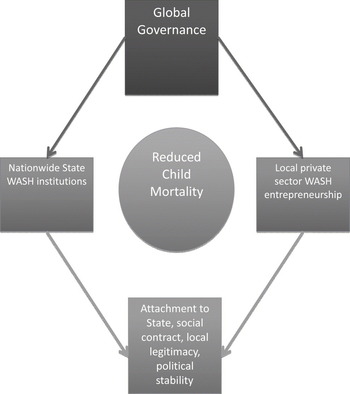
The idea is not complex. It involves a relationship between the local, the State and the global. Local, democratic and representative priorities, advanced by substantial heterogeneous population tranches, and heard through democratic forums, determine the international supply of technology, information and material aimed at developing a national State-based infrastructure of public institutions in line with the Liberal European model. Public global institutions like the WHO, UN and EU act to support both public and private sectors in areas prioritised by local people. In this way, if the State is seen as enabling popular demands, it is not unreasonable to expect that, at the early stage of provision, a social attachment to and contract with the State may emerge. I will address both in greater detail below.
To illustrate and describe how popular peace might work, I use the provision of water, sanitation and hygiene (WASH). This is not prescriptive, since everyday needs and popular peace can only be determined by local people democratically engaged in determining the kind of peace they want. The choice of WASH may or may not be the local people's preference, but it is needed by everyone, is normally in short supply and serves in this instance to demonstrate how a popular peace could evolve in conjunction with ‘just enough’ global governance. We may start with the assumption that people live near water, dirty or clean. This applies even when the water is 20 miles away: nobody lives permanently where there is no water at all. They can therefore access it in raw form. The technical processes that are then required involve cleaning dirty water and venting human waste hygienically. Both can be easily achieved with only limited provision.Footnote 62 Local people's knowledge forms the basis of this approach, deployed in what Paul Richards calls ‘people's science’;Footnote 63 but it is not the be all and end all. Local knowledge may in fact be very poor indeed regarding cleanliness, or the equipment needed to make basic water filters from locally-available materials. For example, although a market in Mondulkiri, north-eastern Cambodia contained materials to make cheap water filters, the residents were unaware of this until informed by the Bangladeshi Battalion, sent by the UN to help with elections in 1993. Drinking water was quickly and easily rendered safer and local people profited from the awareness. Expert support, already available in NGOs and INGOS, can be made available to source fresh supplies where people are unaware of either the means of cleaning water, or can provide the technical knowledge required to safely vent waste. Expert support may take a range of forms, and assumptions should not be made about what people know and do not know. People can be shown the relationship between dirty water and ill-health if educators use simple microscopes to reveal water-borne microbes in the local water. Improving clean water supply also involves bore holes, existing, broken or new, all of which require basic raw materials and knowledge to maintain and repair. Some of those will be present, others will not. The same applies with sanitation, which requires awareness and materials.
In both cases, it is the gap between what people have and what they need to secure WASH that determines the degree and nature of external support. At the local level, that support could come from local and international NGOs with a focus on WASH. But it could also come from small-scale investment that would support people seeking to adapt existing skills and knowledge to the provision of clean water for local profit. For example, someone skilled as a mechanic could be trained to repair and support the technical side of water wells and pumps. Experience shows that the lack of materials may be resolved by local networking. Often, it is cement, spades, wheelbarrows and other small items that are needed to create dramatic changes in WASH. Where such provision is lacking, it is to be found elsewhere, or a market will arise, according to neoliberal philosophy. Such mobilisation was evident around Cambodia in the years after the UN departed; it is common practice in Vietnam; and it was evident in Sierra Leone in 2009.Footnote 64 The model is practiced daily in everyday routines; but where there are gaps in need and provision is where external support merges with everyday needs in transversal fashion. In mobilising such existing capacity, the enterprise is in local people's hands, directed by their needs which in turn are supported externally.
How are such priorities to be communicated? Most societies have structures in place that communicate interests, although they may have been compromised by conflict and asymmetries of power.Footnote 65 Community-Based Organisations (CBOs) and Provincial-Based Organisations (PBOs), amongst others, are forums for mobilising political processes. In Afghanistan, Community Development Centres (CDCs) act as a relevant vessel; in Cambodia, village councils; in Somaliland, Councils of Elders. These bodies can communicate democratic preferences to the State and to external actors, and they can be aided in this process with relatively cheap technology, as wireless networks in Sierra Leone attest (for example). Where they are weak, they may be supported by interest groups. This already happens in democracy-building ventures; presently the emphasis tends towards building political parties,Footnote 66 but this could be expanded to supporting broader civil society forums for democratically hearing and communicating peaceful, diverse preferences with international cooperation, and there are numerous international actors already concerned with democratic oversight which could act to ensure that the process is not exclusive. Conditional lending and other incentives could be applied to ensure that local elites do not exclude minorities, and could discipline destructive behaviour by threatening to withhold inducements.
These needs could be communicated through digital bulletin boards interfacing between internal demand and external supply. PBOs and CBOs would be equipped with laptops, generators and fuel, wirelessly networked to Internet Service Providers using 3G technologies to connect the Internet to people through mobile phone networks upgraded with amplifiers and boosters for regional reach. If there is no electricity in one area, needs can be communicated by motos or other locally-accessible communications. International institutions could provide what was missing and needed, rather than what they would like to provide. Such relationships and mechanisms could cut waste and duplication of provision. In the competitive spirit of neoliberalism, suppliers could bid for contracts, increasing efficiency and service, matching provision to locally-determined need. This has the added advantage of overcoming the patrician nature of governance characterised by a fluctuating supply-side mentality that too often verges on the whimsical.
At the national level, global governance bodies could support formal institutionalisation of WASH through State bodies for nationwide delivery over the longer term. Public infrastructure is normally the ambit of government initiatives for nation-wide projects, from street lighting to motorways. So it can be with the post-conflict State, with the emphasis in this illustration on WASH provision. The State, with appropriate-to-needs external support, has the potential to organise and mobilise substantial public labour, generating jobs sustained by international institutions like the World Bank, the Asian Development Bank, the African Development Bank and EU peacebuilding funds. In this process, the State acts in consultation and deliberation with society to determine demand and need for WASH, and global governance takes up the slack between public demand and State capacity.
Normally, some degree of capacity is present, either from colonial periods or from other interventions, most likely round large urban conurbations, and unless elites have been the subject of extermination strategies, it is reasonable to assume some degree of expertise will be present (and that Diasporas will be involved). The gap between what the State can rebuild/build and what society asks of the State, based on broadened awareness of WASH, becomes the focus of neoliberal interventionism. The institutions of global governance have already demonstrated the ability to disseminate enormous sums of money for a variety of projects not aimed at the essence of life. This proposal suggests that global governance emphasis on national WASH structures and provision would render the State relevant to large segments of society (since the need for WASH and for children cuts across all identities and gender, providing some foundations for the crucial social contract upon which stability rests). In short, exogenous supply is attuned to endogenous needs, rather than external interests defining internal outcomes. In moving towards policy enablement that impacts constructively on everyday life, global governance actors might also evolve the relationship between society and state that lies at the heart of the social contract, local legitimacy and political stability.
There is some limited evidence of the process at work already; the paucity of data is in large part attributable to Liberalism's epistemological dominance of policy consideration, which shapes what is researched, as per Abigail Fuller's dictum. Footnote 67 However, we might refer to Afghanistan and Somaliland to interrogate the mechanics and viability of a popular peace approach. For example, the National Solidarity Programme (NSP) in Afghanistan engages rural communities in determining priorities for local development which are then, to varying degrees, mobilised by the State with various external and internal donor support, reflecting the transversal, or horizontal connectivity between local, State and global levels central to the idea of popular peace. Recent critiques are encouraging. For example, the Center for a New American Security claims that the NSP ‘has to date proven to be one of the more successful methods of generating links between the government and Afghan citizens’. This is because of ‘the degree to which Afghans are personally invested in its projects’ and because ‘project results are tangible and of immediate use’.Footnote 68 The conclusions clearly map a relationship between local utility and relevance, engagement, participation and legitimacy in the process of Statebuilding. A not dissimilar outcome has evolved in Somaliland, where local communities have been represented by locally-elected Elders whose authority and capacity to respond to local priorities has elicited persistent legitimacy and thence stability, although it is too early to imply that this is conclusive.Footnote 69These approaches are not formalised as popular peace, but they do deploy some of the ingredients and offer some indication of relevance and effectiveness.
To some, there may be an unbridgeable tension between orthodox peacebuilding's emphasis on privatisation, deregulation and the shrunken state, on the one hand, and on the other, the suggestion that basic needs provision should come through the State and global donors. But popular peace is not particularly or necessarily post-Liberal. There is no exclusion in the popular peace approach of local markets in basic needs provision. There is no reason that various external and internal agencies cannot encourage and nourish local businesses in water provision, when it is supported in conjunction with State provision for those who cannot afford essential basics like clean water and electricity. Popular peace involves subsidies for the most vulnerable; but it does not exclude all market processes. It centres local markets connected to existing and enhanced skills development leading to job creation and basic needs provision.Footnote 70 What it distinctly rejects is the hegemony of World Bank-subsidised transnational corporations (TNC)s monopolising essential provision in metropolitan centres making extortionate profits from locally-unaffordable prices that move offshore rather than being reinvested in the local economy, whilst ignoring the development of local mechanisms and opportunities for rural majorities.Footnote 71 Popular peace does not exclude dimensions of Liberalism, it seeks a rebalancing to enable and mobilise existing capacity around local priorities that are aligned in many respects with Key Liberal values. The State being built is one that is able to legitimate itself with external help aimed at internal needs. It is a mixture of ideologies, like most States. The gap between the orthodoxy and popular peace is not that big, especially in terms of the desired objectives of institution-building, legitimacy, stability and peace. It just proposes different ways of going about achieving these outcomes.
Two obvious, related issues arise here. The first is the vulnerability of the process to local corruption, and the second is the extent to which international donors will cede control over this potentially malleable process, when they will be held accountable at home. These are not easy questions. In the first instance, corruption is inevitable. It will happen and it does happen. It has indeed been a hallmark of development, and Western lenders have been both ignorant of and also complicit in corruption on a colossal scale, both during the Cold War and more recently. Second, corruption has not been eliminated in mature democracies, where it is increasingly rife and exposed as such. Third, the orthodoxy that promotes Liberal restraint has failed to eradicate either grand or petty corruption, and has in some instances advanced the problem itself, especially regarding reconstruction and security contracts in Iraq and Afghanistan, both very high profile spaces. In other words, there has always been explicit or tacit acceptance of the presence of elite larceny, by insiders and outsiders. Given that this has been accepted in the past and even condoned by numerous global actors, it seems both harsh and hypocritical to reject from all consideration an alternative approach that may achieve what the orthodoxy has demonstrably failed to achieve, namely, local legitimacy, on the grounds that there might be some corruption present.
This is not to suggest that nothing can be done. Various global governance actors like Transparency International and Physicians for Human Rights (for example) have the capacity and the interest to moderate local government perversion of the process through influencing conditional lending based on carrots rather than sticks. That is, Liberal behaviour could be audited and encouraged by offering more support to local elites, including some sweeteners, for projects that concord with local people's needs. But some relatively small scale ‘corruption’ will persist, and this must be accepted, as larger scale corruption has been. Ultimately, donors will still have oversight: they can refuse if there are good reasons not to provide for local initiatives, especially where ongoing tensions and asymmetries attempt to exclude or marginalise others. The nature of all governance is fluid and subject to construction and reconstruction. Global governance is an adaptable force and individual agencies can shape and reshape their own interventions depending on their preferences at the time.
Another key challenge involves ensuring inclusion and representation of heterogeneous groups whilst undermining the capacity to threaten and marginalise less powerful identities. The role of global governance actors in this begins early. In the same way that UN peacekeepers and UN volunteers (UNVs) facilitated democratic practices amidst civil society in Cambodia, external involvement could help shape and condition the democratic locus of listening in more contemporary scenarios. Hearing heterogeneous groups fairly could be encouraged though democratic institution building across civil society. But exclusion, intimidation and other illiberal behaviours could also be discouraged through negative conditionalities, or threats of withheld favours and funds. This might reduce the extent to which local power-brokers dominate the process, although their influence will not be entirely eradicable. The effort that is normally expended on election organisation might be redirected to developing new or existing community forums like Community Based Organisations and Provincial Based Organisations (PBOs) in which preferences are democratically expressed and negotiated, before being uploaded to key local actors and international counterparts for consideration.
The role of global governance in its biopolitical form in the peacebuilding arena has traditionally been to discipline and punish elites. There is no good reason this capacity cannot be redirected constructively to encourage representative deliberation and communication at grass roots level, even where such processes throw up confrontation and conflict. It will not be perfect but it will open channels of communication that are presently under-utilised, whilst offering the potential to disrupt some negative behaviour. The outcome will present different preferences of people who will likely identify basic needs that are shared in common with substantial numbers of people. At the early stage of post-conflict intervention, there is a clear possibility that commonality of biological needs and the routine absence of provision in post-conflict spaces might momentarily and initially displace some of the distinctions between otherwise heterogeneous social groupings, ethnicities or castes, but this cannot be predicted. It is partly because of this commonality and its potential for communitarian cohesion that I use the example of WASH to illustrate the mechanics of popular peace.
WASH and the mechanics of popular peace

Conclusion
Fourth generation scholarship represents a concerted critique of the prevailing, and failing, orthodoxy. Its ontological challenge is rooted not simply in terms of a ‘hyper-critique’ of the orthodoxy, but also in an alternative that engages people in the equation of peace, rebalancing the existing asymmetry. But it lacks a viable and legitimate means to translate concept into practice. Whilst the ideas of emancipation and the everyday are the outcome of a more nuanced and thorough interrogation of the pluralities of peace, the former is unrealisable locally whilst global authority and power are ordered around hierarchies of power and knowledge that are not sensitive to the ideas of everyday life and local legitimacy that lie at the heart of the social contract and political stability. A rebalancing of emphasis between the local and the global is apt. A fusion of global and local in greater balance, accepting the concomitant hybridity of formal and informal social, political and economic institutions and practices accommodates the inevitable whilst pluralising the possible. The horizontal fusion of top-down and bottom-up merge in formal and informal institutions privileging mass need and generating local legitimacy. Instead of the requirements of global governance determining institutional preferences serving a minority and defaulting on local legitimacy, the multiple requirements of a diverse postconflict society, if met by appropriate and relevant institutions, will more likely engender the local legitimacy presently eluding orthodox peacebuilding. Global intervention moderated by local demand and composed of ‘just enough’ global governance regulated by its own values, including the right to life (for example) could support both formal and informal institutions aimed at basic needs provision. It could grow state institutions common to the global North, like national healthcare and education, whilst sustaining the organs it traditionally privileges, but not to the exclusion of life-saving biopolitics. This marks a small shift in emphasis towards broad provision for a post-metropolitan majority but does not compromise key Liberal normative commitments to elite institutionalism and traditional Liberal values.
Popular peace is particular to context and messy in make-up, rather than formulaic, reactive rather than rigid, and better suited to spontaneous contingency, circumstance and complexity than the rehearsed rhetoric and ready rubric of neoliberal universalism. For popular peace to be most effective, two agendas require consideration. The first is everyday need, the second is neoliberal exceptionalism. The two are not necessarily mutually exclusive, even if neoliberal determinism is considered by some to be counter-intuitive to local needs. Everyday needs, identified locally, are more likely to be endorsed by global governance when those needs reflect broad Liberal values. Ultimately, peace of this kind could be ‘emancipatory’ not just for people in post-conflict spaces, but also for the neoliberal project, morally distressed and devalued by the distance between what it preaches in human rights rhetoric, and the practices it privileges in reality that deny key life rights to millions.