‘Wallah! If we had the means, we would flood the world with our free literature’.Footnote 1
This essay is concerned with the role of Islam in local public sphere dynamics in KwaZulu-Natal in the aftermath of Apartheid and its sequel, the transition to constitutional democracy in 1994. It looks at the prominence of religious and cultural debates in a situation where structures of ‘struggle civil society’ that were ‘vibrantly’ active in mobilizations against Apartheid have ceased to exist or been absorbed by the state. This is a situation characterized by a certain deficit in substantial democracy and democratic political culture, indicated by the dominant-party nature of governance at all levels of South African society. To an important extent discussions of morality, the health of society and community have come to stand in for debates in more explicitly political terms. In this process churches, mosques, institutions and practices of ‘customary’ culture have come to figure prominently in the make-up of ‘actually existing’ local public spheres, and have provided frameworks for debate and challenges to the power of the state.
Contestations around the nature of citizenship have been central themes within such debates, as well as the relationship between different levels of identity, and the overcoming of the legacies of Apartheid multiculturalism. In terms of post-Apartheid political reform, a primary strategy has been the creation of new municipality and ward boundaries to break up the divisions created by group areas and other instruments of segregation. This is a complicated process, inasmuch as it also involves the breaking up of accustomed fora and spatial fields for public debate and self-definition, and the attempt to establish new channels for articulation and contestation of aspirations. Graphic examples of this can be found in the municipal wards bringing together black African and Indian South African citizens in Inanda on the peri-urban outskirts of Durban – in areas like Amaoti or Bhambayi, for example, which straddle the buffer zone between African ‘urban informality’ to the west and the 1970s Indian suburb/township of Phoenix to the east. In Inanda, too, Mohandas Gandhi's Phoenix Settlement and printing press – where the Indian Opinion newspaper had been produced – were caught up in the middle of serious instances of racial antagonism and political violence in 1949 and later in the mid-1980s (Dhupelia-Mesthrie Reference Dhupelia-Mesthrie2004: 335; Kaarsholm Reference Kaarsholm2008a: 11).
These surroundings witness the continuing impact of an Indian Ocean history of indentured labour and ‘passenger Indian’ trade immigration, of the interaction between different forms of religious discourse, and of the aspirations of Gandhi and his Phoenix associates towards a common understanding and recognition of South African ‘Indianness’. We find living legacies of the ways in which such aspirations were caught up in ambiguities related to Empire, segregation and the development of nationalist struggles in South Africa, and of clashes between Indian and African identity strategies and struggles for recognition and citizenship (Dhupelia-Mesthrie Reference Dhupelia-Mesthrie2004: 59ff., 68; Marks Reference Marks1986).
In scholarship, South Africa has been regarded as lying outside or being marginal to the Indian Ocean world, whose historical boundaries were linked to patterns of travelling and trading made possible by monsoon winds, and to the reach of Swahili culture down to Sofala/Beira on the Mozambican coast (see Pearson Reference Pearson2003). South Africa was involved in exchanges with the Indian Ocean world through Cape Town and the activities of the VOC – the Dutch East India Company – and from the late nineteenth century through immigration from India into Natal. But between Beira and Durban there seemed to be a rupture of links and communication, with the Zulu state and British–Portuguese rivalries blocking the continuum. More recent research – by Anne Bang and Shamil Jeppie – tries to show that there were indeed connections penetrating the blockage, and that Islamic networks reached into South Africa – not only across the Indian Ocean from South Asia, but also down the African seaboard from Hadramawt through Zanzibar, the Comoros Islands, Madagascar and Mozambique.Footnote 2
In the context of Durban as an Indian Ocean port city – as demonstrated by Goolam Vahed – Islam came to play a special role as a crucible for debates on Indianness, and aspirations to be all-embracing in terms of Indianness helped Islam in KwaZulu-Natal attain its ‘multiple communities’ character, marked by debates between different schools and orientations, and presenting democratic potentials through constant challenges to dogmatism and narrow-mindedness (Vahed Reference Vahed2002; Reference Vahed2005; 2007; Kaarsholm Reference Kaarsholm2008b; for an interesting comparison between ‘marginalized’ Islam in South Africa and Islam in government in Sudan, see Simone Reference Simone1994). Within this context, also, print cultures came to the fore not least importantly as alternatives to oral debates and competition between religious positions within local public spheres. Print culture, and the cultivation of reading and writing as the way forward to self-improvement, were important in the agenda of the old Christian missionizing churches – of Anglicanism, Catholicism and Methodism – just as they were within the madrassahs of Muslims, as other ‘People of the Book’. The orality of Zionist churches – which continue to be statistically the most popular in black African informal settlements like Amaoti and Bhambayi – has in recent decades come under increasingly efficient attack from ‘born-again’ Evangelical or Pentecostal churches, who have used print literature as an important weapon to boost authority, underline modernity, and gain ground in religious competition.
It is into this field of public cultural contestation that Ahmed Deedat and the Islamic Propagation Centre International (IPCI) entered from the 1970s onwards, in what became an interestingly orchestrated conjunction of transnational and localized religious debates (see Westerlund Reference Westerlund2003; Sadouni Reference Sadouni2007b and Vahed Reference Vahedforthcoming). Internationally – through tours to the United States, to South and South-East Asia, to the Middle East, and to a range of African countries – it involved Deedat in a global effort to counteract the crusades mounted by the ‘born-agains’ (famously through big-scale public confrontations with ‘televangelists’ like Jimmy Swaggart). Locally, it meant missionizing also, in the sense of stepping up dawah efforts to share the Islamic faith with as many ‘reverts’ as possible, and to democratize Islam in two respects: first, by reaching out to a broader range of population groups – and black Africans in particular – as potential ‘reverts’; and second by spreading the word through argument and reference to the texts of the Book themselves. This included translating parts of the Qur'an into Zulu, which happened in the late 1980s (I-Kur'an Eyingcwele n.d.), and involved the publication of masses of printed pamphlets and booklets (and subsequently audio and video tapes and DVDs), centring upon speeches and writings by Ahmed Deedat himself (cf. Sadouni Reference Sadouni2007b). One of the most famous and most quoted of the Deedat publications is The Choice (1993), which sets out the arguments for persuading readers as rational beings to accept the logical superiority of representations in the Qur'an to the ones contained in the Bible.
Deedat's and the IPCI's efforts to spread the word and win new proselytes through argument were paralleled from the 1970s by those of the Muslim Youth Movement in both Natal and the Cape (cf. Tayob Reference Tayob1995) and taken further by the Call of Islam and the alignment of Muslim political aspirations with those of the United Democratic Front from 1983 (cf. Esack 1988; Nadvi Reference Nadvi2008). All of this took place within a context of confrontations with conservative imams and contestations between different schools of Islam in South Africa, as demonstrated by Abdulkader Tayob and Lubna Nadvi. It provided the background to a post-1994, post-democratic transition situation in which debates among South African Muslims have centred increasingly on political participation and the public role of religion, issues that are also of increasing concern after the PAGAD (People against Gangsterism and Drugs) incidents of the late 1990s, the 9/11 attacks on New York, and GWAT – the global ‘war on terror’ (Vahed Reference Vahed2007).
In the specific context of Durban's townships and urban slums, this has involved debates on how Islam may contribute to social development and democracy, and to the working out of deracialized and post-multicultural understandings of citizenship in the aftermath of Apartheid. It has also involved contributions from Muslims and Islamic organizations to debates with other voices – Zionists, ‘born-agains’, adherents of the Shembe churches and supporters of traditionalist rearmament (schools of virginity testing, for example) – on how best to promote moral regeneration within families, communities and society more broadly in the face of poverty, unemployment, homelessness and the scourges of local crime and the HIV/AIDS epidemic.
My essay explores features of the interaction between different strands of Islam as practised by both Indians and Africans within this context, examines two different varieties of Islam represented in the local public sphere of a black informal urban settlement in Inanda on the outskirts of Durban, and discusses examples of print literature deployed. I am not putting these forward as instances of a particularly ‘African Islam’ (cf. Westerlund and Rosander Reference Westerlund and Rosander1997), but rather as examples of understandings and exegeses of Islam by African Muslims in South Africa. The two positions discussed are very different, and both address issues of reform and of coming to terms with cultural context, language and traditions that are strongly present in other Islamic environments. At the same time, they are also both concerned with the uplifting and access to rights and dignity of Africans, and thus involve reflections on African political aspirations (for political uses and understandings of ‘African Islam’ as either non-violent and non-militant Sufism or – alternatively – as an underpinning of nationalism, see Tayob Reference Tayob2009). I begin, though, with an outline of some of the specificities that have marked the development of Islam in KwaZulu-Natal since the nineteenth century.
ISLAM IN SOUTH AFRICA AND IN KWAZULU-NATAL
Islam in South Africa has multiple historical origins and in a contemporary perspective, too, stands out as anything but monolithic (see Vahed and Jeppie Reference Vahed, Jeppie, Daniel, Southall and Lutchman2005). In the Cape, Islam made its entry through the importation during Dutch colonial rule of slaves from the East Indies and India – what came to be known as the ‘Malay’ population, who extended their pattern of residence alongside British colonization during the nineteenth century. According to Tayob (Reference Tayob1999) a particular tradition of imam-led and mosque-centred Islam developed in the setting of the Cape, and out of this emerged powerful forms of political engagement, both in the context of the anti-Apartheid struggle, and – after 1994 – of violent moral awakening and vigilante mobilizations against crime and drugs such as PAGAD (Vahed and Jeppie Reference Vahed, Jeppie, Daniel, Southall and Lutchman2005).
A second distinct tradition of South African Islam emerged around mosques established by Indian traders in the Transvaal from the 1880s (Tayob Reference Tayob1999), but the most important alternative to Islam in the Cape developed in Natal, where Indian indentured labourers recruited for the sugar plantations started to arrive in 1860. Most indentured Indian immigrants were Hindus from Tamil Nadu and Bihar, but they included Muslims, and Islam was reinforced by the subsequent immigration of Muslim ‘passenger’ Indians from Gujarat and Western India (Swan Reference Swan1985; Vahed Reference Vahed2002; Desai and Vahed Reference Desai and Vahed2007). Though important mosques were quickly established in Durban – including the West Street Mosque and the Jumuah Musjid or Grey Street Mosque, said to be ‘the largest in the southern hemisphere’ (Vahed 2006: 3) – Islam in Durban and what is now KwaZulu-Natal came to be more closely linked to community groupings and less imam-centred than was the case in the Cape.
Though there were differences between a ‘high’ Islam tradition with a background in trader circles and more ‘popular’ varieties among the communities of indentured labourers and their ‘free’ descendants, a high degree of undogmatic tolerance and ‘fuzziness’ seems to have prevailed. This also allowed for the syncretistic incorporation of Hindu-inspired elements of ritual in festivals such as the Islamic New Year Muharram festival – or ‘coolie Christmas’, as it was derogatorily called by the racist white officials of the Durban Corporation (Vahed Reference Vahed2002). Muharram became an important popular cultural vehicle for establishing cohesion among Indians in Durban and defining a community based on Indian national identity (Vahed Reference Vahed2002), which could be used variously for a bolstering of diaspora politics, for the development of South African Indian Congress nationalism, and later on for manoeuvring and accommodation within the tri-cameralism of ‘high’ Apartheid.
This also affected the practice of Islam, which tended from the inside to be seen as an Indian religion – or as restricted to a community of ‘born’ Muslims, who were predominantly Indian – and who therefore did little to proselytize among other groupings. Among Africans – apart from minority groups – Islam tended to be written off as a religion which had no relevance for Africans, and from which they were excluded. Minority groups of African Muslims with a background in Malawi and Mozambique, however, have been significant, and represent linkages with African Islamic traditions going back to pre-colonial times and connected to the Swahili culture of the African Indian Ocean coast. From the late nineteenth century, African Muslims in both Cape Town and Durban have had connections with Sufi brotherhoods like the Alawiyya, the Shadhiliyya and the Qadiriyya that have been important in northern Mozambique.Footnote 3 Durban has thus been home to two different confluences of Sufi networks with little contact between them – one stretching across the Indian Ocean to South Asia, and another through Mozambique along the Indian Ocean coastline of Africa to the Swahili and Arab worlds of the north.
Hybridism and syncretism within Islam came under attack in Durban and Natal from the 1970s with the rise of Deobandi revisionism and battles between Sunni and Tablighi Muslims (Vahed Reference Vahed2003 and 2005). The tolerant unity of highly varied and broadly, but undogmatically, Sunni Islam was broken up by new ‘scripturalist’ demands to discard elements of ritual that were not directly based on instructions in the Qur'an and on sunnah and hadith, including celebrations of the Prophet's birthday (moulood) and worship centring on the tombs of holy men. The latter in particular were of importance in and around Durban, where Sufi orientations were powerful, and much ritual centred on locations such as the graves of saints like Badsha Pir and Soofee Sahib (Vahed Reference Vahed2003: 321). This was paralleled in significant respects by the thanksgiving festivals and celebrations of moulood – including ratiep dancing and recitals of the Qur'an – among the African ‘Zanzibari’ Muslims of Durban (interview with E. M. Osman, Bayview, Durban, 11 February 2010). Attacks by the Tabligh Jama'at and other ‘revisionists’ were also directed against the pollution represented by the incorporation of Hindu and other non-Islamic elements into ritual practice and festivals, and the preparation and celebrations of Muharram came to represent a major battleground (Vahed Reference Vahed2005).
Battles between ‘fundamentalist’ or ‘scripturalist’ Islam and more hybrid and popular varieties did not, however, involve the politicization of Islamic mobilization. Deobandi ‘fundamentalism’ in Durban was predominantly apolitical, was concerned with moral reform and the improvement of individual and community lives, and discouraged Muslims from involvement both in the struggles to end Apartheid and in politics more generally (Vahed Reference Vahed2005). Similarly, in the case of the ‘Islamic resurgence’ represented by the Muslim Youth Movement in Durban, for example, ‘politics’ was predominantly concerned with religious and theological matters and the practice of Islam – challenging the hegemony of imams, turning mosques into more public spaces and involving women in public life, taking issue with conservative interpretations of Muslim Public Law, and engaging in educational missionary activity (Tayob Reference Tayob1995: 113).
Historically, adherence to Islam among Africans in Durban and KwaZulu-Natal has been limited, and often seen as restricted to particular groups. Whereas in the Cape the ‘Malay’ population among whom Islam proliferated came to include families of slave descent from Mozambique and Madagascar, Islam among Africans in Durban was often identified with the so-called ‘Zanzibaris’. In the narrow sense, ‘Zanzibaris’ is a term that refers to 352 people who were ‘liberated’ from Arab dhows by British Navy anti-slavers between 1873 and 1875, and whose freedom took the initial form of being indentured to labour-hungry white farmers and entrepreneurs around Durban. They were referred to as Zanzibaris because some of them – but not all – came to South Africa via Zanzibar, from where the British anti-slavery campaign was being coordinated, but most of them had origins on the northern Mozambique coast (Seedat Reference Seedat1973). At the end of their contracts of indenture, the Zanzibaris were settled on the Durban Bluff, and later – with the implementation of the Group Areas Act – removed to the Indian township of Chatsworth in the 1960s, where they managed to obtain for themselves the favourable racial classification of ‘Other Coloured’. This made them an attractive grouping to seek to join, and over the years they came to incorporate through marriages and immigration numbers of other African Muslims of Mozambican or Malawian background. At the same time, groups of African Muslims around Durban of Malawian background would refer to themselves as ‘Zanzibaris’ – for example, the first mosque established in Amaoti in the 1960s (to which I shall return in the following discussion) was built by the Amaoti Zanzibar Muslim Society (interview with L. S. Banda, 25 September 1999). In this way, in a broader sense, the term ‘Zanzibari’ came to be used to designate more generally Africans who practise Islam (cf. Kaarsholm Reference Kaarsholm2008a).
Relations between Indian and African Muslims under Apartheid were complicated, and Indian Muslims made little effort, though dawah required it, to spread and share the faith with less advantaged brothers and sisters in the black townships. Deobandi fundamentalism in this respect meant little change – the emphasis here was on purism and scripturalism in rituals and personal lives, and on the eradication of elements of hybridism from the practice of Islam, and there was little motivation to encourage the development of African understandings, or reconciliation between Islam and notions of African cultural tradition. There were attempts at changing this from the 1970s, and Ahmed Deedat's Islamic Propagation Centre International in particular became active in supporting the spread of Islam in African townships and communities. The Muslim Youth Movement followed this lead, launching an extensive mission campaign, setting up the al-Qalam newspaper in 1974, and establishing the As-Salaam Educational Institute south of Durban for the training of black African Muslims (Tayob Reference Tayob1995: 113). The Muslim Youth Movement – in spite of the ‘general conservatism’ of its political agenda – ‘was inspired by the same trend of indigenization as the Black Consciousness Movement’, but ‘sexist and racist perceptions among the membership persisted’ (Tayob Reference Tayob1995: 122–3), and its focus on making Islam a ‘“way of life” insulated the MYM against political developments in the wider South Africa’, and made its missionary work among Africans inefficient (Tayob Reference Tayob1995: 130).
Today a whole range of initiatives and organizations are pursuing efforts of Islamic proselytization among Africans, including the Southern African Dawah Network and the World Assembly of Muslim Youth, which raise funds for charity and missionizing from both inside and outside South Africa – donors include governments in the Middle East (on Islamic NGOs and developments in strategy, see Sadouni Reference Sadouni, Soares and Otayek2007a). There are different lines of approach to dawah work among Africans, and the Islamic Propagation Centre International has led the way in seeking innovative approaches. An important figure in the campaigns of the IPCI was the African lawyer Dawood Ngwane, who ‘reverted to’ Islam in 1992, having been a Roman Catholic for sixty years of his life. Ngwane, mourned by many on his death in 2009, wrote about his reversion in Ubhaqa: the Instrument of Light (Ngwane Reference Ngwane2003). Another prominent African working for the IPCI between 1987 and 1991 was Adam Mncanywa – an associate of Omar Moleleki, who translated parts of the Qur'an into Zulu – who is today an imam and Islamic community activist in Amaoti in Inanda. Mncanywa fell out with Ahmed Deedat and the IPCI in 1991, and formed his own organization, the African Islamic Propagating Mission, which was active until 1996, when his present movement – the Islamic Nation Foundation – was launched.
I shall return to the print publications of Dawood Ngwane and Adam Mncanywa below, but let me first give examples of the theological positions of two different interpretations of Islam among African practitioners in the local context of the Inanda-Phoenix border zone, and of the ways in which they address urgent contemporary moral debates.
ISLAM IN AMAOTI: A TALE OF TWO MOSQUES
In other writings, I have looked at ways in which moral debates around HIV/AIDS, crime and the health of the community are entered into by schools of virginity testers and different Christian groupings in Amaoti and Inanda (Kaarsholm Reference Kaarsholm2005; Reference Kaarsholm2006). The number of Muslims in Amaoti is small – there are four mosques, and among these the two most active ones are said to enjoy the support of about 80 and 40 believers respectively. The total population of Amaoti is around 50,000. They hold Sunday prayers and run madrassahs and educational activities for the young and for women, but the congregations are too small for the holding of Friday prayers, and people go to a mosque in the neighbouring Indian suburb of Phoenix for this, or sometimes to the town of Verulam, which is an older Indian urban centre to the north-east of Inanda, though relations with Phoenix are closest. By most Africans in Amaoti, Islam is seen as an amakulah – a ‘coolie’ – religion – something that belongs to the Indians, and efforts to spread the faith in the area struggle to break this perception.
One mosque belongs to the Amaoti Islamic Society, which used to be called the Amaoti Zanzibar Muslim Society, and whose history goes back to the 1930s. The society has drawn its following primarily from people of Malawian or ‘Nyasa’ descent, and prominent among them for three generations have been the Banda family – the secretary today is Leonard Sphiwe – or Cassim Suleiman – Banda (interviews, 25 September 1999 and 17 August 2006). Until 2009, the imam for the society's mosque in the Amaoti sub-section called Cuba was Twaib Ismael, who was brought in from Malawi in 1999. The congregation retains some diaspora characteristics, and there are many stories of persecution and prejudice being displayed against ‘Nyasas’ by ‘Zulus’ and ‘Pondos’ in the locality. A stereotyped perception of ‘Nyasas’ is that they have access to powerful medicines and witchcraft, and that they indulge in human sacrifice and the eating of human flesh (interview with L. S. Banda, 25 September 1999). But the ‘Nyasas’ have also tended to become increasingly integrated and intermarried with ‘Zulus’ and ‘Pondos’. Leonard Banda's mother – who is extremely knowledgeable about Islam in Amaoti, and whom he refers to as his ‘encyclopaedia’ – is of Zulu-speaking descent: ‘You can say I am a Coloured,’ he joked in an interview in August 2006.
Being closely linked to the Malawian diaspora in Amaoti, the Cuba mosque has tended to lead a quiet existence, to be politically conservative, and to avoid involvement in politics. In the 1980s, mosque leaders were close to the chiefly induna, who was supported by the Inkatha Freedom Party, and at that time controlled local government structures. An uncle of Leonard Banda's – who is still prominent in the Amaoti Islamic Society – fled Amaoti for Verulam when the UDF ‘comrades’ chased out the induna and the IFP after violent battles in 1989–90. The society's right to the land its mosque occupies was approved in a title deed issued by the KwaZulu homeland government in 1987.
In recent years, the Amaoti Islamic Society has increasingly sought funding through transnational and Indian Ocean networks – from Indian and Pakistani businessmen and from Islamic charities. For the construction of the present mosque and educational facility buildings, which began in the late 1980s, contributions were collected from Muslims all over South Africa, and funding today is provided both by private business people as charities, and through the Southern African Dawah Network. The Cuba mosque and the Amaoti Islamic Society have also become increasingly involved in propagating Islam, and – according to Leonard Banda – 18 families have embraced Islam since 1987. These are predominantly Zulu-speaking families, who before conversion belonged to Zionist churches, and who have thus been used to significant ingredients of African traditional beliefs in spirits, witchcraft and healing in their religious practice. The strategy for proselytization is strongly materialist – people are persuaded to come into the fold by being offered access to such benefits as education, food parcels and money for school uniforms – and it is hoped that a spiritual and moral breakthrough will follow.
According to Twaib Ismael – the imam at the Cuba mosque, who is married to a Zulu-speaking convert woman – the Amaoti Islamic Society does not put pressure on converts to give up their ‘traditional’ beliefs, but its conception of Islam does not accommodate such beliefs (interview, 20 August 2006). He emphasizes that the outlook of the mosque is strongly modernist and developmentalist, and it is assumed that people will gradually realize through being educated and enlightened that their ‘traditional’ beliefs are not up-to-date.Footnote 4 Among such beliefs are also counted efforts at reinventing ‘tradition’ such as virginity testing – attempting to return to the past in this way, according to Twaib Ismael, would be like going back to wearing skins, or living naked in the forest:
Traditional life was very hard, but this is a new generation, and we are not using the traditions … we must live in a garden, and not in the forest, and both the society, the family, and the individual should be cultivated like a garden and a nursery. People must be educated … . (Interview, 20 August 2006)
Respect should be based on insight and education, not on blind obedience. It is the absence of this kind of enlightened respect which makes young people criminals, and Amaoti such a violent and dangerous place:
People ask you – how can you stay in Amaoti? How can you stay in a dangerous place like that? But those children, those criminals, they did not learn, they did not get any education. … If your parents do not teach you, then you become an animal … you become an elephant … you kill other people, you steal from other people … like an animal. But this place is quiet now – quiet, because most of the people, they now know God, either through Islam or through their Christian churches. Most people go to church, they hear preaching now – ‘You must not kill! You must not take drugs!’ Even this place, Amaoti, is now becoming a good nursery. … It is a better place now. (Interview, 20 August 2006)
Islam is a cure against immorality and dissolution in a number of ways. It teaches people to look after themselves – it prohibits the use of alcohol and drugs, and thereby helps people stay out of crime and promiscuity, and away from HIV/AIDS. But perhaps even more importantly – in this understanding – it helps people live modern lives, and allows young people to marry and establish families at the proper time in their lives. It is African traditionalism in the form of lobola – bride price – and greedy parents which, according to Twaib Ismael, stand in the way of marriage and carry a large part of the responsibility for teenage pregnancies, fatherless homesteads, and the spread of HIV/AIDS.Footnote 5 By embracing Islam, young girls are protected, and young people given the chance to marry, reach adulthood and live healthily and respectably. Muslim parents are not allowed to demand lobola – to do so would be in conflict with Shari‘a, Islamic law.
Islam, then – in this presentation – is shrouded in discourses of modernization and agendas for the moral reform of the individual, of families and of the community. Becoming Muslim involves a break with tradition, though this should not be brought about forcibly, but through persuasion and enlightenment. The insistence on a breakthrough is not dissimilar to what is often required by Evangelical churches as a mark of the fundamental experience of being ‘born again’ to Christianity (on similar parallels between Pentecostalist and Islamic anti-traditionalist agendas in West Africa, see Meyer and Larkin Reference Meyer, Larkin and Akyeampong2006; on Islamic reform movements in Africa in comparative perspective, see Loimeier Reference Loimeier2003; on East African Islamic movements of ‘enlightenment’, see Kresse Reference Kresse2003 and 2007).Footnote 6
The outlook and dominating discourse at another mosque in Amaoti are very different and much more syncretistic as regards the relationship between Islam and African cultural tradition. According to Adam Mncanywa of the Islamic Nation Foundation – which has its community and its mosque in the Amaoti sub-section of Angola – you cannot teach young people to be respectful, if you do not teach them about ‘tradition’. And you cannot expect of anyone that they should treat with respect a marriage concluded among Zulu-speaking families without lobola being paid. Lobola, though, must be negotiated down to reasonable and affordable levels – it is the responsibility of Muslim parents to accomplish this. The emphasis on Zuluness here is important – Adam claims that in 1977 he became the first Zulu in Amaoti to embrace Islam – and he emphasizes that the 40 people who have converted to Islam in his congregation are all ‘Zulus’. Before this happened, according to Adam, Islam belonged exclusively to the Indians in Phoenix and to the Malawians – neither of whom wanted to share it with Zulu speakers. It has been this foreignness of Islam that has been its greatest weakness. It continues to be the weakness of most of the dawah work among Africans – that it is imposed from outside, that it reduces African Muslims to beggars dependent on handouts from outside, and that it does not encourage the creative amalgamation of Islamic and local African cultural traditions. He sees many of the conversions that are brought about by handouts and educational offers as opportunistic and short-term – people can be ‘Muslims by day and Zionists by night’. The Islam they subscribe to is merely ‘religious’, while true Islam involves a much more fundamental transformation of outlook and way of life – it is not enough to speak of ‘Islam, Islam, Islam’ all the time, to which people will simply respond ‘Indian religion, Indian religion, Indian religion’ (interview, 23 August 2006). According to the Qur'an, the faith must be communicated to people in their own languages – how can an Indian convey the message to Africans? Or a Tanganyikan to people in KwaZulu-Natal? Islam must be indigenized and propagated from the inside – being ‘with the people’ is the mission and strength of the Islamic Nation Foundation: ‘Nothing will happen until black people do it for themselves.’
The INF therefore does not shrink from politics:
When people died, I was amongst the people. Everybody knows I fought with the UDF. But Inkatha is also with the people – I am not taking sides. Even today, we are living with these people in Amaoti – there is ANC there, there is Inkatha here, there is UDM in that spot … we live together, and we have shared good things and bad things. (Interview, 23 August 2006)
Working with the Indians in Phoenix is difficult, and Adam Mncanywa does not really believe that Islam can help to bridge the differences that divide Africans in Amaoti and Bhambayi from their Indian neighbours in Phoenix, all of whom are now in the post-Apartheid scenario expected to come together as citizens within the new electoral wards. Indians ‘used to be our second masters – our mothers worked for them’. Indian Muslims from Phoenix are afraid to visit Amaoti, which they think is full of criminalsFootnote 7 – and they continue to think ‘that they are “born” Muslims and we are converts – that they have ownership to the faith’. Adam thinks that this is historically untrue, and that it is important for African Muslims to engage in historical research, which will prove that it was indeed the other way round: Indians were Hindus and idol worshippers, who first had Islam brought to them by black people – Islam was originally an African religion.
What is therefore needed is creativity and cultural entrepreneurship, which will re-establish the organic relationship between Islam and African cultural traditions. This must be based on research and a true understanding of both. A lot of reinvented ‘traditions’ today have no real foundation, and can be dangerous. Adam Mncanywa thinks this applies to the schools of virginity testing that are active in Amaoti. He thinks virginity testing was historically something that was done discreetly and within families by grandmothers, and that it does not belong in the context of large public cultural festivals. He has a lot of respect for the Shembe church and its efforts to reconcile Christianity and African culture – ‘we saw the beauty of it when we were growing up. You could find 80-year-old virgins there, and men of 50 or 60, who were still with the boys, because they had never married or had sex.’ But he thinks this is now a thing of the past, and that the Shembe church is hopelessly divided and without the influence it once wielded.
According to Mncanywa, Islam must reintroduce the kind of respect for African culture which the Shembe church used to instil. Adam thinks historical research shows that circumcision was once a common cultural practice among all Africans, including Zulus, and it is therefore important for African Islam to emphasize this. At the time of the interview in August, he was preparing a group of 15 boys for circumcision; in November he would take them to a Muslim doctor in Durban, who would carry out the operation free of charge. He said that it was important for him to be ‘preaching circumcision’ also because of HIV/AIDS, and believes that ‘you have a very small chance of catching AIDS, if you are circumcised’ (interview, 23 August 2006).
Adam knows he is ‘a very controversial person – I disagree with a lot of things’. He thinks that the most important thing is to be with the people, speak their language, and then work with them and spread the faith from there. At the INF community centre in Angola, there are pool tables and football machines, discos are held, and people are allowed to drink beer. According to Adam, there is no harm in this, as long as beer drinking does not coincide with religious functions or meetings. While he believes that traditional culture must be mobilized to combat AIDS, he is not against the promotion of condom use, and had acquired three big boxes of condoms for an AIDS awareness campaign which the INF's youth branch – the Abangoni Youth Development Organization – was in the process of preparing. In Adam's view, some of the main roots of the HIV/AIDS crisis are embedded in the lifestyles of modernity, which ‘make our blood hot’. We eat the wrong things, people dress wrongly, and television teaches young people to be rude and violent – ‘just watch the way young people speak in soap operas like The Bold and the Beautiful or Isidingo – there is no respect! White people created all this’ (interview, 23 August 2006).
The road to Islam, then, goes through ‘teaching people about their own African culture – teaching them about respect and about what is right and wrong. Only when this leads people to ask about Islam, will I start telling them about it.’
AFRICAN INTELLECTUALS, ISLAM AND PRINT CULTURE
If adherence to Islam among Africans is a limited – though increasing – phenomenon in urban border zones of KwaZulu-Natal like Amaoti, an Islamic print culture is even more so. Religious life and moral debate conducted through cultural institutions and discourse in an area like this are tremendously important, and impressive amounts of time, energy, resources and entrepreneurship are invested in them. The public life of major parts of this world – like those taken up by Zionist churches or by traditional Apostolic ‘water’ churches like the St John's Faith Mission Church, which has one of its regional headquarters and healing compounds next door to the police station in Amaoti – are predominantly oral and based on communications and interaction through ritual and the living word, as well as song and music. The same goes for the majority of the strong and rich voices participating in local moral debates on a ‘traditionalist’ background, though writing, if not print, may sometimes appear as in the case of the handwritten book of sermons by the virginity tester Sibongile Khumalo, which I have written about elsewhere (Kaarsholm Reference Kaarsholm2005; Reference Kaarsholm2006).
By contrast, the weakening voices of the old Christian missionary churches – Anglican, Catholic and Methodist, locally now often referred to as ‘churches for old people’ – will have newsletters, distribute Bibles, and encourage reading and writing as central elements of schooling or of campaigns such as HIV/AIDS prevention. Publications may also be used to raise funds, as for example when the Diakonia Council of Churches asks people to pay a subscription fee for their newsletter Inselelo, which is distributed free. Print literature is also seen as an important weapon for missionizing and respectability boosting by the more trendy, up-and-coming ‘born-again’ Evangelical or Pentecostal churches, though the more recent and not yet so prosperous ones, based on local cultural entrepreneurship, may not have resources for producing their own materials.
As far as print culture among African Muslims is concerned, a lot of materials are coming in from the outside and are the productions of national or international religious NGOs – examples include WAMY News, published by the World Assembly of Muslim Youth, or the IPCI News, brought out by the Islamic Propagation Centre International. The most impressive arsenal in the field is indubitably that of the IPCI, whose scores of published books, booklets and pamphlets for free distribution or for sale as part of fund raising are backed up by tapes and, increasingly, DVDs and internet publication through the website http://www.ahmed-deedat.co.za/. Writings and speeches by Ahmed Deedat – who died in 2005 – still dominate the fare offered, and many other IPCI publications develop themes introduced in Deedat's writings. Many of these are concerned with a comparison between Islam and Christianity – aimed at demonstrating through argument and comparative exegesis of the Qur'an and the Bible the superiority in terms of logic, rationality, moral outlook and spirituality of Islam (Deedat Reference Deedat1993; Reference Deedat2000; n.d./a; n.d./b). These claims are repeatedly made in Deedat's speeches and famous polemics with Jimmy Swaggart or Billy Graham, available as videos through the website and now also in great numbers on YouTube.Footnote 8
The Islamic Propagation Centre International has made its particular impact in terms of producing an Islamic print culture in English – as an alternative to Arabic and Urdu – but has also been significant in promoting translation into and the publication of an Islamic printed literature in Zulu, as exemplified by the Qur'an translation project mentioned above. At the same time, Ahmed Deedat and the IPCI in important respects – as Shamil Jeppie has shown – grew out of the Islamic reform activities of the Arabic Study Circle in Durban (Jeppie Reference Jeppie2007; cf. Vahed Reference Vahedforthcoming). Deedat thus simultaneously favoured language teaching and the opening up of access to the Qur'an and religious instruction in Arabic, on the one hand, and the broadening of access through translation on the other. Both strategies were aimed at strengthening the directness of relations between the individual believer and the holy text, and at circumventing intermediaries, thus giving the reform effort ‘an almost Protestant quality’ (Loimeier Reference Loimeier2003: 260). Another feature of Deedat's writing and of IPCI print publications is a moralistic and puritanical discourse, attacking a range of targets including drunkards, gamblers and sodomites, and providing a paradoxical ‘similarity between Deedat and Christian fundamentalists whom he otherwise strongly polemicizes against’ (Westerlund Reference Westerlund2003: 274).
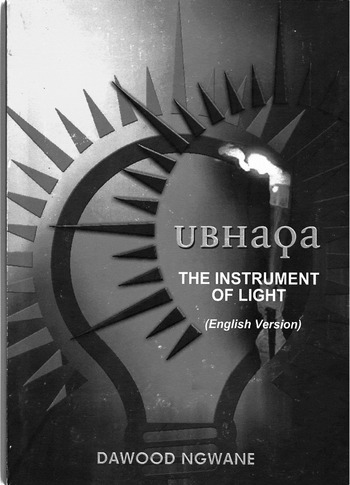
Dawood Ngwane is an African Muslim intellectual very much in the mould of Ahmed Deedat. Ngwane's book Ubhaqa: the Instrument of Light (Ngwane Reference Ngwane2003) has been published in tens of thousands of copies in both Zulu and English for free distribution by the IPCI with the support of the Southern Africa Dawah Network and the Ministry of Endowment and Islamic Affairs of the State of Qatar. The book is partly a personal story of conversion from Catholicism to Islam, partly a theological treatise. It contains a brief autobiography, which in its essence is a story of aspiration and achievement. Ngwane describes growing up in humble conditions, first in rural Maphumulo and then in peri-urban Amaoti, within a family of high Roman Catholic respectability, who made sure that he was educated as far as was within their means, allowing him to get a job with BP Petroleum. From here he went on through self-study to qualify as a lawyer quite late in life, setting up a firm with his daughter Lindiwe in 1993, and prospering as a legal practitioner in the township of Umlazi. It is the story of the religious life of a Catholic, from bare-footed choirboy to middle-aged dignitary, who then in 1996 – at the age of 66 – ’reverts’ from Catholicism to Islam, having been convinced of the superiority of its message as ‘a religion without mysteries’ (Ngwane Reference Ngwane2003: 14) through religious study and – in particular – his encounter with Ahmed Deedat's writings as published by the IPCI (cf. Vahed Reference Vahed2004).
Ubhaqa: the Instrument of Light quotes Deedat extensively – especially Crucifixion or Cruci-fiction (Deedat, n.d./a) – and like much of Deedat's writing focuses on the figure of Jesus, the accounts of his life in the Qur'an and the Bible respectively, and the question of the status of Jesus as either prophet or the son of God. His account repeatedly directs a polemic against ‘the born-again’ – the new Evangelical and Pentecostal churches making headway in the townships – and aims at convincing township audiences that the Islamic understanding of Jesus as a major prophet – and not as weakling God who let himself be executed on the cross – is both more logically convincing and theologically correct than the claims of the massive apparatus of Christian ‘indoctrination’ with its ‘blasphemous’ notions of the Trinity and the Holy Spirit (Ngwane Reference Ngwane2003: 53, 55, 65). Those, Ngwane writes, ‘who have read this book will have no excuse on the Day of Judgement’ (Ngwane Reference Ngwane2003: 64).
The importance of acknowledging the superiority of the understanding of Islam is underlined by the great moral crisis in which society, local communities and families find themselves:
Since the time Jesus (PBUH) left this world has the Holy Spirit taught the world anything? The world is plunging down, down, down into an abyss of self-destruction. Look at the problems facing the world today:
The problem of Alcoholism
The problem of Idolatry
The problem of Illegitimate children
The problem of Immorality
Witchcraft, Gambling, Excess of women over men
The list goes on and on.
We have not received any guidance from the Holy Ghost to solve these problems. (Ngwane Reference Ngwane2003: 41)
The global problem of ‘the excess of women over men’ is also presented with statistical arguments in Deedat's The Choice (Reference Deedat1993), writes Ngwane, and ‘It is said that New York City alone has a surplus of one million. … Nowadays the problem is much more serious as the law now permits men to find solace in other men, thus adding to the number of women, who cannot find a husband. … During the eighties, in South Africa, there were five women to one man’ (Ngwane Reference Ngwane2003: 46). The solution to the problem lies in making polygamy legal – in this Islam and African tradition agree (though the Islamic notion of ‘regulated’ polygamy represents a superior form of social responsibility): ‘Our forefathers in this land of South Africa had several wives (their polygamy, though, was an uncontrolled one). … In those days there were no street children nor were there many divorces’ (Ngwane Reference Ngwane2003: 48). Thus Islam is not only reconcilable with African tradition but also the way forward towards a restoration of traditional African cultural values.
The cover of Dawood Ngwane's autobiographical treatise Ubhaqa: the Instrument of Light (English version)

A similar point is at stake in the criticism of the notion of the Trinity and of Jesus as the Son of God – a son cannot be equal to his father, and therefore by emphasizing belief in one undivided God, according to Ngwane, Muslims are undermining the respect and notions of generational hierarchy that are also fundamental to African traditional cultural beliefs (Ngwane Reference Ngwane2003: 52). It is therefore wrong and a misunderstanding, when ‘most people of my country, South Africa, through ignorance, believe [Islam] to be a religion of “Indians” or “Malays”’ or think that ‘Allah is a God of the “Indians” because the first Muslims in South Africa were people who came from India about three hundred years ago and they were known to worship Allah’ (Ngwane Reference Ngwane2003: 14, 109).
Writings by Adam Mncanywa are also available as print publications in the form of pamphlets in Zulu and English, which he publishes himself on behalf of the Islamic Nation Foundation, and which are produced by a printing workshop (Impress Forms – Islamic Movement Press) established in 1979 as part of ‘Islamic resurgence’ (Tayob Reference Tayob1995: 144ff.). Again, as in Dawood Ngwane's book, we find a reiteration of central themes in Ahmed Deedat's theological polemics against the ‘born-agains’, centring on the understanding of Jesus, but also an engagement with traditional spirit beliefs and with the spiritual heritage of Shaka and Zulu cultural tradition – as well as a more general call to black African people to arise and use Islam to take responsibility for their own destinies (see the five pamphlets listed as references under Mncanywa n.d./a–e). In this way the political sub-texts entering into the print literature of Dawood Ngwane and Adam Mncanywa relate not only to Christian proselytization from the ‘born-agains’, or to issues of rightful Indian or African ‘ownership’ of Islam, but also to debates between different strands of African nationalist discourse as represented by the African National Congress, the Inkatha Freedom Party and Black Consciousness respectively.
The cover of Adam Mncanywa's Ujesu (uk. k. k.) Kwikurani Namasulumane (left)

The cover of Adam Mncanywa's Ukufa Nokuvuka kukaJesu (right)

Two of Adam Mncanywa's printed pamphlets – Jesus in the Qur'an/Ujesu Kwikurani NamasuLumane, published in both English and Zulu, and Ukufa Nokuvuka kukaJesu: ngabe kwenzeka na? (‘The Death and Resurrection of Jesus: did it really happen?’) published only in Zulu – are very close to the Deedat mould.Footnote 9 They more or less reiterate the arguments of Deedat in Crucifixion or Cruci-fiction? and Resurrection or Resuscitation? – aiming to show that Jesus was a human being and a prophet, who did not die on the cross, thus vindicating the narrative of the Qur'an over that of the Bible. But Mncanywa goes about this in a particularly energetic style of his own:
If you were to arrive home and find that they had killed your father by shooting him with an AK-47 rifle, would you make a sculpture of him or take a photo of him and hang it on your bosom or in the house, saying the picture reminds you of him? As for the firearm with which he was shot and killed, would you say it is good and you love it? And his shed blood, would you keep praising it as good because it was shed because of you? (Mncanywa n.d./c).
The cover of Adam Mncanywa's Usiko Lweqiniso (left)

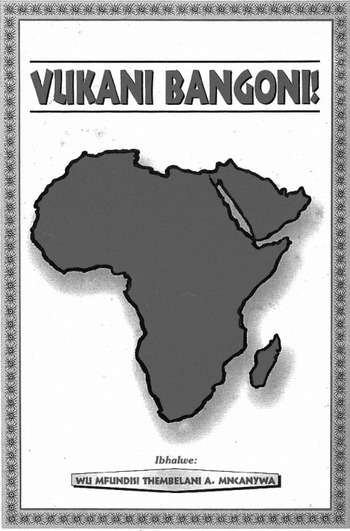
The cover of Adam Mncanywa's Vukani Bangoni! (right)

In other Zulu pamhlets like Usiko Lweqiniso (‘The true culture’) and Vukani Bangoni! (‘Arise, Ngoni people!’) Mncanywa engages more directly with Zulu history and African culture, and attempts to show that a correct understanding of African culture is a unified and monotheistic one that makes it perfectly reconcilable with Islam. He is thus drawing the contours of an African theology of a highest being (Mvelingqangi) and of angels of rain and fertility (Nomkhubulwana), of death (Noluhamba), of destruction (Kubhubha), and of revelation (Zambulo), who ‘brought revelations or messages to the Creator's messengers like Noah, Abraham, Moses, Jesus, Mohammed – peace and grace of the Creator be upon them and their families always’ (Usiko Lweqiniso). Such true understandings of culture, however, have been corrupted through the harmful influences of sangomas and Zionists, who have transformed angels into ancestral spirits and brought about an array of superstition, which people tend to believe in as African custom and tradition:
Please take note – among us are those who call upon the departed in supplication and wear iziphandla [skin amulets worn on the wrist as bangles]. Nearly all those that practise this will say it is our culture and even go on to allege that it is the culture of the Zulu people in particular, implying that if you do not live by this code you are either not a Zulu or a renegade. There are preachers and directors of this philosophy everywhere, and you never run short of advocates of this school of thought in buses, trains, taxis, shebeens, or on the street. (Mncanywa n.d./d)
Through such corruption of belief has also resulted division, tribalism and conflict that were alien to the original people, the Ngoni – ‘the people who did not do wrong’ – who were ‘the progenitors of Shaka, the builder of the Zulu nation’ (Mncanywa n.d./e). These ancient models, the ‘doers of no wrong’, lived in village societies of natural patriarchal hierarchy, but ‘nobody was classed as better than another … the leaders would constantly get together for an interchange of views and opinions’, and the young would be instructed through ‘positive and constructive folktales’. This happy state, however, did not last, and was replaced by one in which
false stories were now told, ‘people’ started hating and killing one another, witchcraft proliferated, diseases and scourges took root, and ‘people’ started devouring one another. Alas, how the children of one man are being wiped out. Gone are families, communities and respect. I would like to know, where are fathers and mothers? Where is the pride of granaries? Where are maidens and virgins and young men?… Where are human beings? Arise, you people who do no wrong, and re-establish what is rightfully yours, arise! (Mncanywa n.d./e)
After the fall, the meaning of ‘culture’ also changed, and ‘the genuine culture of ubuntu … tradition [as] the force that unified all the people of society’ became replaced with understandings of culture as distinction and division:
Family customs such as ukugcaba [cutting of incisions in skin, believed to ward off misfortune], cutting off of a finger, and piercing of ears were things done by those who wanted to break away from the rest for some reason. It is these practices that people now call cultural customs. … Today we are fragmented and thrown about. We call ourselves Zulus, Xhosas, Sothos, and so forth, and our cultures are diverse and dissimilar … we must refrain from saying, ‘This is our culture,’ because it is these family customary practices that keep us fragmented. … We are captives, slaves and zombies right in the land of our forefathers. We have no land to live on, water and firewood we have to buy. … They sowed hatred among us to divide and rule us. (Mncanywa n.d./e)
So the true culture which needs to be restored is a pan-African one, which in its contemporary form is articulated through Islam. This is needed in order to counter moral decadence and physical decay: ‘The food we eat is deadly poison. Just look at the varieties of illness and disease that we are grappling with – sugar diabetes, TB, HIV/AIDS, and many others. Where were these diseases during the life and times of our forefathers?’ (Ibid.) The political implications here are not those of an IFP-like Zulu nationalism or the ‘secular’ nationalism of the ANC, but rather a reactivation of Black Consciousness thinking, which is also found in other registers of the local public sphere in KwaZulu-Natal – in the preachings of schools of virginity testing, for instance (see Kaarsholm Reference Kaarsholm2005; Reference Kaarsholm2006), or in a more youthful and less patriarchalist version in the writings of the Muslim poet Mphutlane Wa Bofelo (Bofelo Reference Bofelo2008).
What we find in Adam Mncanywa's publications, then, can be seen as an instance of pan-Africanism, rather than African Islam, which is inspired possibly also by Louis Farrakhan and the American Nation of Islam movement. But it is also related to Black Consciousness in a way, which – despite Mncanywa's falling out with the Islamic Propagation Centre International in the early 1990s – is still closely linked to Ahmed Deedat's efforts and impact within the specific context of South Africa. In his biography of Deedat, Goolam Vahed concludes:
Deedat's mission must be seen in the context of white domination in South Africa and Western hegemony internationally. Black South Africans experienced perpetual humiliation. When Deedat stood on the platform and debated with Christians, a ‘heroic’ figure full of ‘valour’ as Fuad Hendricks described him, he was taking on the ‘white man’. It was exhilarating, as many testified, for ordinary Muslims to see him ‘browbeat’ his opponents. This explains why his audiences applauded and shouted ‘God is Great’! … Deedat's debates with evangelists, while an exception in Islam, appealed to many Muslims because they felt disempowered through colonialism and the seeming religio-cultural hegemony of ‘the West’ (Vahed, forthcoming).
CONCLUSION
In statistical terms, the print publications and religious voices of African Islam in KwaZulu-Natal may not count for very much – in the 2001 South African census, Muslims made up only 1.46 per cent of the population, and the total number of African Muslims in KwaZulu-Natal was counted as 2,987, as against 117,424 Indian Muslims in the province (Vahed and Jeppie Reference Vahed, Jeppie, Daniel, Southall and Lutchman2005: 253). Even if these figures are too low, and even if they have since gone up, as they probably have, we are certainly dealing with minority groups and cultural positions as compared with those of other denominations and self-definitions.
All the same, studies of Islam among Africans in KwaZulu-Natal help us to understand developments that are important in contemporary South Africa as well as in more global contexts. The broadening of the appeal of Islam in urban informal settlements is interesting. What makes conversion to Islam and an Islamic way of life – taking on a new Islamic identity – attractive to different types of people – to the young, and to young women in particular? Why do people prefer Islamic positions and views to those offered by Christian churches or movements calling for a resurrection of customary cultural beliefs, and what is at stake when people make a choice between different varieties of Islam, as presented above?
We need to understand better the dynamics of religious competition, but also more generally the functioning and make-up of local public spheres, the ways in which debates, contestations and deliberations are acted out, and what local media and fora exist and are used in the process. This will help us to understand better the meanings of what is being said and contested, detecting the layers and the hidden and indirect political implications of cultural, moral and religious debates. At the same time, studies of the layout, media and articulations of local public spheres will tell us about inclusion and exclusion, about voices that are represented and those that are not – that is, about the progress (or lack) of democratic consolidation and political cultural development, and about different modes of and possibilities for performing citizenship.
The voices of KwaZulu-Natal Muslims as represented in the print publications and interview statements discussed above are saying different things and cannot be reduced to a particular position attributable to ‘African Islam’. They also relate in different ways to strategies for Islamic propagation and Islamic reform as encountered in other African countries, and demonstrate some of the ambiguities at stake in the context of reform and in discussions around ‘tradition’ and ‘modernity’. In the essay, I have not used ‘tradition’ and ‘modernity’ as analytical concepts, but rather looked at ways in which such notions have been deployed discursively within the public debates studied. One position here – as represented by the Amaoti Islamic Society imam Twaib Ismael – represents the attractiveness of Islam as involving a complete break with African ‘tradition’ and cultural ‘custom’ in a way that resembles the approach of Pentecostalist and ‘born-again’ Christian churches. Another position – represented by Adam Mncanywa and promoted in his printed pamphlets – puts forward Islam as a programme for the rejuvenation and cleansing of a unified pan-African ‘tradition’. While this is clearly in some ways a conservative and patriarchalist agenda, it is also in its own right one of ‘modernization’.
These positions are then again related in intricate ways to Islamic reform efforts – as represented by Ahmed Deedat and the Islamic Propagation Centre International – whose emphasis on the direct access of the individual believer to the sacred texts and questions of exegesis and interpretation through translation has been important in the incorporation of new groups of African Muslims. At the same time, these efforts have opened up a new field for debating more fundamentalist understandings of Islam as against its reconcilability with – or indeed embeddedness in – elements of African culture. The Sunni–Tablighi contestations in Durban of the 1970s are thus in a sense being re-enacted as theological debates within publics of African Muslims that have been boosted significantly recently through immigration. This means that older practices of Sufism among African Muslims in Durban are given new vitality. It also means that the Tabligh Jama'at and other ‘reformationist’ movements are now moving into African townships and giving new attention to Islamic practices in these contexts which have otherwise lived a life of their own, sustained by brotherhood linkages with Mozambique and the Swahili world.
While representing a minority position, the significance of Islam within public debates and the public sphere of Durban and KwaZulu-Natal is thus clearly growing. The same goes for the centrality of Durban and KwaZulu-Natal's Indian Ocean linkages – both across the Ocean to South Asia and to the north along the African seaboard through East Africa to the Arab world. As debates and contestations take on an increasingly transnational character, older networks of interaction become significant in new ways, and old identities become transformed. Where African Muslims in Durban – like the Zanzibaris – would earlier have tended to emphasize their ‘Arab’ and non-African characteristics, they are today keenly engaged in demonstrating their African roots as Muslims and Makua speakers (Kaarsholm Reference Kaarsholm2009).