Introduction
Telepsychiatry
The American Telemedicine Association defines telemedicine as the use of medical information exchanged from one site to another via electronic communications to improve patients’ health status (American Telemedicine Association (ATA), 2007).
One of the fields where telemedicine has had greater development has been mental healthcare (Frueh et al., Reference Frueh2000; Monnier et al., Reference Monnier, Knapp and Frueh2003; Wootton et al., Reference Wootton, Yellowlees and McLaren2003; McGinty et al., Reference McGinty, Saeed, Simmons and Yidirim2006). Among the reasons explaining this, we may cite the following:
-
– The very nature of the specialty: Most information can be gathered in an audiovisual manner. In addition, laboratory tests or physical examination are not often necessary (Norman, Reference Norman2006).
-
– Accessibility: There are isolated areas or communities that have difficulty in gaining access to mental health services (Schopp et al., Reference Schopp, Johnstone and Reid-Arndt2005; Hilty et al., Reference Hilty, Yellowlees and Nesbitt2006b). This isolation may not be just geographically based but also cultural, as is the case, for instance, in areas with a significant immigrant population (Shore and Manson, Reference Shore and Manson2005; Hilty et al., Reference Hilty, Yellowlees, Cobb, Bourgeois, Neufeld and Nesbitt2006a; Shore et al., Reference Shore, Savin, Novins and Manson2006).
-
– Cost-effectiveness: The aim is to reduce the need for specialists to travel to these areas. Thus, a more efficient use of professional time is achieved and expenses deriving from traveling are reduced.
-
– Importance of general practitioners’ role in the care of mental health problems (due to its high prevalence). Videoconferencing is a meeting point between these professionals and specialists, thus improving doctor's training and patient's understanding (Norman, Reference Norman2006). It is an opportunity for the general practitioner to treat the patient acting in collaboration with the psychiatrist (Hilty et al., Reference Hilty, Yellowlees, Cobb, Bourgeois, Neufeld and Nesbitt2006a). Patient referral that overloads specialized care is thus prevented and a communication channel is established through which the general practitioner may acquire new clinical skills (Hilty et al., Reference Hilty, Yellowlees and Nesbitt2006b).
Telepsychiatry is that area of telemedicine which has explored the use of communications technology in mental health service delivery, and the technology most often used has been videoconferencing (Wootton et al., Reference Wootton, Yellowlees and McLaren2003; Melaka et al., Reference Melaka, Edirippulige and Appendices2009). The first telepsychiatry programs date back to the 1960s (Wittson and Benschoter, Reference Wittson and Benschoter1972). These programs were not continued mainly due to technical and financial constraints. Its application was considered financially unfeasible until not long ago (Werner and Anderson, Reference Werner and Anderson1998).
As a result of technical progress over the last two decades, together with the improvement of communication technology and the reduction in transmission costs and equipment, telepsychiatry programs have emerged again. Until recently, most ongoing projects use videoconference with ISDN (Integrated Services Digital Network) technology. However, the use of IP (Internet Protocol) network technology, with suitable security measures and guaranteed service quality, may lead to a cost reduction (Hilty et al., Reference Hilty, Marks, Urness, Yellowlees and Nesbitt2004; McGinty et al., Reference McGinty, Saeed, Simmons and Yidirim2006).
This care modality has been utilized in large regions with scattered population, where rural areas may be underserved regarding mental health (for instance, in the USA (Cruz et al., Reference Cruz, Krupinski, Lopez and Weinstein2005), Canada (Urness et al., Reference Urness, Hailey, Delday, Callanan and Orlik2004), Australia (Clarke, Reference Clarke1997; Janca, Reference Janca2000)); in islands, due to the limited accessibility to specialized care and the high cost of traveling (De las Cuevas et al., Reference De las Cuevas, Artiles, De La Fuente and Serrano2003a; Reference De las Cuevas, Artiles, de la Fuente and Serrano2003b); for the care of more or less closed communities where it is preferable to see the subjects in their environment (such as prisons (Leonard, Reference Leonard2004) and nursing homes for the elderly or veterans’ homes) or for specific population groups (such as immigrants or certain ethnic groups (Shore et al., Reference Shore, Savin, Orton, Beals and Manson2007; Mucic, Reference Mucic2010)).
Existing research on the application of telepsychiatry to the general population shows that it is well accepted by users (De las Cuevas et al., Reference De las Cuevas, Artiles, De La Fuente and Serrano2003a; Greenwood et al., Reference Greenwood, Chamberlain and Parker2004; Hyler and Gangure, Reference Hyler, Gangure and Batchelder2005; Urness et al., Reference Urness, Wass, Gordon, Tian and Bulger2006), that diagnoses are reliable, that it is possible to provide treatment (Fortney et al., Reference Fortney2007; O'Reilly et al., Reference O'Reilly, Bishop, Maddox, Hutchinson, Fisman and Takhar2007), and that there is good cost-effectiveness (Hyler and Gangure, Reference Hyler and Gangure2003). However, more studies are necessary so as to prove that remote consultation by videoconferencing is equivalent to face-to-face consultation and in order to assess the clinical course under this care mode. Furthermore, ethical and legal issues regarding its application (Frueh et al., Reference Frueh2000; Monnier et al., Reference Monnier, Knapp and Frueh2003) must be solved. Nowadays, its use is only recommended when there are considerable difficulties in carrying out face-to-face consultation (Janca, Reference Janca2000).
Telepsychogeriatrics
The application of telepsychiatry to elderly care has been the object of special interest for a number of reasons. Old age groups account for an important proportion of the population in rural and geographical areas distant from centers where specialized care is provided (Liu et al., Reference Liu2006). These individuals are frequently afflicted by more than one condition, the problems are often of chronic nature requiring repeated monitoring but they cannot usually travel on their own, which makes traveling difficult and expensive (Wootton et al., Reference Wootton, Yellowlees and McLaren2003). This, together with other prejudices regarding elderly mental health that attribute certain disorders to normal aging, leads to a failure in referring them for specialized consultations. Unrecognized depression, behavioral aspects of dementia, multiple medical and psychiatric comorbidities, and treatment complications are very common among nursing home residents. In these facilities, difficulty gaining access to specialized attention is also a common occurrence (Jones, Reference Jones1999). Thus, we are faced with a situation where the most vulnerable subjects are the ones facing the greatest difficulties to gain access to mental health services (Jones and Colenda, Reference Jones and Colenda1997; Jones and Ruskin, Reference Jones and Ruskin2001; Sumner, Reference Sumner2001; Jones, Reference Jones2002; Snowdon, Reference Snowdon2010).
The capacity of telepsychiatry to overcome geographical distances, to render travel unnecessary, and to act as a support to the professionals practicing in remote areas makes it a solution worth looking into. The main applications of telepsychogeriatrics up to now have been the provision of care to the elderly in rural areas in the context of major telepsychiatry programs, care to nursing homes located in remote areas, or with poor access to specialized care and conducting diagnosis assessment programs, mainly focused on detecting dementia (Shulman et al., Reference Shulman, Conn and Elford2006; Vilalta-Franch et al., Reference Vilalta-Franch, Garre-Olmo, Lopez-Pousa, Coll-De Tuero and Monserrat-Vila2007).
Objectives
The overview described above on the possible applications of telepsychogeriatrics poses challenges and specific research questions in this field of telemedicine that can be summarized as follows:
-
(1) Are telepsychiatry programs used for general population care applicable to the elderly? What are the main applications of videoconferencing in psychogeriatric care at present?
-
(2) Is it feasible to render psychogeriatric services to nursing homes for the elderly via videoconferencing?
-
(3) What is the validity of psychopathologic assessments made via videoconference? And specifically, are cognitive assessments made through this system reliable?
-
(4) Has the geriatric population more difficulty accepting care through this system? How will subjects with cognitive impairment respond to the videoconferencing situation?
The purpose of this paper was to review existing literature on these questions and to sketch a general overview of the current situation in this field, paying special attention to psychogeriatric care via videoconferencing in nursing homes for the elderly.
Search procedure
A search for references was carried out in the Web of Knowledge (including Medline, PsychInfo, and ISI Web of Science) in May 2008 and updated in July 2011 including the following expression in the field “topic”:
-
(1) (Telepsy*) yielding 361 records,
-
(2) (Teleconferenc* or teleconsult* or telediagnos* or telehealth* or telehomecare or telemed* or videoconferenc*) AND (mental* or psychiatr* or psychol* or psychos* or psychot* or dement* or alzheimer* or “cognitive impairment” or depress* or personalit* or neuros* or neurotic* or anxiety or somatoform or obsessi* or bipolar or dissociative or “sleep disorder*” or ((alcohol or drug* or substance*) and (abuse or misuse or dependen* or consumption))) with 1489 records and
-
(3) (Telepsych* or teleassistance or telecare or teleconferenc* or teleconsult* or telediagnos* or telehealth* or telehomecare or telemed* or videoconferenc*) AND (telenurs* or “long term care” or “care home” or “nursing facilit*” or “nursing home*”) yielding 199 references.
On the basis of the title and abstract content, research papers that focused in the use of videoconferencing for providing psychiatric care or assessment to a geriatric population were selected. Also, other types of papers (including editorials or letters), dealing with the development of telepsychiatry programs in adult community population or telemedicine in institutionalized population, were considered. Papers that focused in the use of telemedicine with other specific populations (like children or prisoners, for example) and those based in the use of other technologies (like telephone) were excluded for analysis or more detailed description, preferring to restrict the review to videoconferencing because of its growing interest and the lack of previous review papers on this field. A total of 241 papers were found; 45 of these focused specifically in the application of telemedicine to geriatric populations, whether institutionalized or not.
The search was completed by using Google Scholar and manual review of information from scientific meetings and crossed references, which resulted in 15 additional references.
It was not feasible to carry out a meta-analytic review to answer the questions regarding applicability and validity of telepsychogeriatrics because of methodological heterogeneity of the studies included, the lack of consistent quantitative data in some of them, different types of information reported in the original papers, different scales applied to the samples, and outcome measurements considered. So the results of the review are presented in a narrative way.
Results of the literature study
Telepsychiatry in community elderly populations
No references to specific telepsychogeriatric programs with elderly populations living in the community were found in the literature reviewed. Attention was paid only to community patients and their caregivers at a day care center for patients with dementia described below (Lee et al., Reference Lee2000). Data on geriatric consultations in some of the major telepsychiatry programs can be obtained although it accounts for only a small part of the total consultations carried out. For instance, it amounts to 10% of the teleconsultations made in the telepsychiatry service in Alberta (Canada) (Simpson et al., Reference Simpson, Doze, Urness, Hailey and Jacobs2001) or 11.4% of a telepsychiatry program with rural areas conducted at the University of California, Davis, between 1996 and 2002 (Hilty et al., Reference Hilty, Yellowlees and Nesbitt2006b).
The Conn and Patterson group at Baycrest in Toronto has been providing psychogeriatric care to a community population and, to a lesser extent, to institutionalized elderly individuals via videoconference since 2000 in Northern Ontario (Canada) (Conn and Bilas, Reference Conn and Bilas2000; Conn and Bilas, Reference Conn and Bilas2001; Bilas and Conn, Reference Bilas and Conn2002). At the beginning of this program, patients were referred by primary care doctors for specialized consultations. The two doctors involved were asked to assess this experience using a 5-item Likert scale. They were quite satisfied with it and they also had the impression that patients, in turn, were quite satisfied with the consultations. Since 2002, they have been responsible for providing this service in a region with a radius of 750 miles with a highly scattered and aged population with no access to a specialist in geriatric psychiatry. This region is divided into areas where community workers provide a link between community demands and the telemedicine service. The aim of the program was not only to provide access to specialized consultation but rather to provide support and training to caregivers and to the different sociohealth service providers. During the first six years of the program, evaluations of both clinical consultations and educational sessions have remained consistently positive.
Psychogeriatric care in nursing homes for the elderly
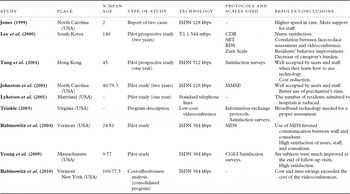
Among the telemedicine programs developed in the last decade, care in nursing homes for the elderly has figured prominently. This system is believed to decrease costs and inconvenience resulting from patients having to travel to hospitals where specialized consultations are located, presentations to emergency rooms, and hospital admissions. It is well-known that there is a high prevalence of mental health problems in nursing homes, which makes the involvement of specialists to provide proper diagnosis and care of these patients necessary (Jones, Reference Jones1999). In many cases, psychiatric care to these centers has consisted of onsite visits by a psychiatrist, which involves a high cost and is inefficient. Thus the need, both of nursing homes and specialists, to optimize, simplify, and reduce costs of psychogeriatric care explains the interest in developing liaison programs between specialized services and nursing homes via videoconferencing (Table 1).
Telepsychiatry studies in nursing homes for the elderly

BDS = Blessed Dementia Scale; CDR = Clinical Dementia Rating; CGI-I = Clinical Global Impressions-Improvement Scale; MDS = Minimum Data Set; MMSE = Mini-Mental State Examination; SBT = Short Blessed Test.
Jones (Reference Jones1999) reports her experience in telepsychiatry care in a nursing home and presents a brief summary of two cases. She emphasizes how apart from reducing the need to travel, this care modality is an important support for professionals at the nursing homes. This can be done since a quick answer is provided and consultations are held more frequently. The fact that a nurse or someone from the staff must be present in the teleconsultation emerges as a negative aspect as staff is already overburdened.
Lee et al. (Reference Lee2000) published the results of a telemedicine program for patients with dementia conducted in Korea. Videoconference consultations were provided for two years in two places: a nursing home for the elderly (160 patients) and a day care center with an average of 20 patients per day, where other community patients and/or their families were also cared for. As well as diagnostic interviews and therapeutic actions, psychoeducation, and advice to professional caregivers and families were provided. The main purpose of the study was to assess the functioning of the program by focusing on the following variables: degree of acceptance by users, reliability of diagnostic assessments conducted, and effectiveness of the interventions carried out via videoconference. Despite the fact that patients with dementia were tense or frightened at the beginning of the examination, they progressively appeared to be more comfortable with this system. The nursing staff soon became accustomed to videoconference and was satisfied with the mode in which information was transmitted. Among caregivers who attended classes through videoconference, 46% were of the opinion that this modality was as effective as or more effective than face-to-face classes. Results for the scales applied from videoconference and face-to-face interaction were compared and significantly correlated. A complete concordance was obtained for dementia diagnosis. Two measurements were made regarding the assessment of clinical outcome. In the case of patients from the nursing homes, the assessment of a daily behavior check list made by caregivers was gathered at the beginning and was compared with the one produced after six months in the program. Eighty-two percent of patients showed an improvement in scores for that scale after receiving treatment. In the case of patients in the outpatient facility, the Zarit scale for caregiver burden was applied. Half of the patients who were administered the scale showed a reduction in scores after six months.
Tang et al. reported the results of psychogeriatric care carried out in the context of a pilot telemedicine study carried out in a nursing home for the elderly in Hong Kong (Hui et al., Reference Hui, Woo, Hjelm, Zhang and Tsui2001; Tang et al., Reference Tang, Chiu, Woo, Hjelm and Hui2001; Hui and Woo, Reference Hui and Woo2002) where geriatric, dermatology, nursing, physiotherapy, occupational therapy, and podology consultations were offered. One hundred forty-nine psychiatric assessments of residents in the nursing home were done via videoconference. After each interview, the elderly resident was questioned about their satisfaction with the interview. Among those who answered, 80% stated that they were satisfied with the consultation. There were no differences regarding interview acceptance between dementia subjects and non-dementia subjects who were able to answer the questions. This result is consistent with the result of another study which found similar satisfaction levels between these two groups, though the possibility that dementia subjects may be more uncomfortable in the videoconference situation is acknowledged (Jones et al., Reference Jones, Cavanaugh and Reboussin2002). At the end of the study, the nursing staff filled in a questionnaire on their satisfaction with the program resulting in a positive evaluation. Financially, emphasis was made on the considerable cost reduction, which was even higher than that reported by other telepsychogeriactric programs; one of the explanations that authors suggest for this is the use of the connection for consultations in other specialties (a total of 1,001 telemedicine consultations were done in a year).
Johnston et al. reported their two-year care experience in a nursing home for the elderly in a rural area (Johnston and Jones, Reference Johnston and Jones2001; Johnston, Reference Johnston2003). This paper provides important lessons about the application of a telepsychogeriatrics program. Prior to the start of the program in the nursing home, care was being provided in the form of a monthly visit that required traveling time and that was sometimes cancelled due to weather conditions. These circumstances favored the development of a telepsychiatry project at the nursing home. A protocol was agreed with the nursing home staff to request consultations. The staff decided which patients needed a consultation and also requested their checkups. A nurse – generally the same person – accompanied the patient to the interviews. At the beginning, clinical data were obtained through an interview with staff before the patient came in. Later, clinical material was faxed prior to the consultation, and the interview with the nurse had the purpose of completing those data that the psychiatrist considered necessary after reading the material sent. The presence of staff in the room with the patient not only helped carry out the interview, but it also allowed observation of how the patient interacted in a face-to-face situation. Whenever possible, relatives of the patient were also invited to take part and they provided valuable information for the medical record. After the consultation, as well as the instructions given orally, a written copy was sent to be included in the patient's record. Seventy-one consultations were carried out to 40 patients. More frequent reasons for the consultation were behavior disorders associated with dementia, and second, affective disorders. Most patients, including those with cognitive impairment, were able to focus their attention on the screen; only advanced dementia patients showed difficulty, since they already had difficulty in paying attention to staff members at the nursing home or responding to any command. The program was favorably assessed by all the parties involved. Psychiatrist's time was used more efficiently and a higher frequency of consultations was attained and patients included in the program were properly diagnosed and treated.
Lyketsos et al. (Reference Lyketsos, Roques, Hovanec and Jones2001) reported a videoconferencing program linking a long-term care facility for patients with dementia and the inpatient psychiatric care unit where they were admitted when presenting with significant behavior disorders that could not be handled at the long-term facility. The purpose of this program was to reduce the number of admissions and the duration of patients’ stays in the acute psychiatric unit, as well as improving the continuum of care. The number of admissions and the total number of stays in hospital were reduced in the first year of operation. Mean stay only increased due to the admission of more serious patients.
Trinkle described his experience in implementing a telepsychiatry project with rural nursing homes in the state of Virginia (Mitka, Reference Mitka2003; Trinkle, Reference Trinkle2003). Written forms to ease information transmission between nursing home staff and the doctor were developed. Surveys to assess the results of teleconsultations including satisfaction of patient, caregivers, and staff at the nursing homes and comparison to actual onsite visits were administered. The need to use broadband technology to achieve a transmission quality that allows for the interview to be properly carried out was emphasized in this experience.
Rabinowitz et al. (Reference Rabinowitz2004) reported their experience in care at a rural nursing home in the state of Vermont, which had no access to psychiatric care. The role of protocols to assess the resident's functional and clinical state for the application of telepsychogeriatric care is emphasized as a facilitating resource. The Minimum Data Set (MDS) was used in this case. A total of 31 consultations were done. Resident, nursing staff, and consultant satisfaction was high. Even dementia patients accepted the interview and were properly assessed. The use of MDS improved communication between nursing home staff and consultant, since they were using a common language, thus facilitating early identification of residents’ problems. A study of cost-effectiveness was published by the same group reporting the activity carried out between November 2002 and July 2008 (Rabinowitz et al., Reference Rabinowitz, Murphy, Amour, Ricci, Caputo and Newhouse2010). Costs of equipment, line fees, travel time, fuel cost, personnel costs (attendants required to transport the nursing home resident), and physician visits cost were taken account in the analyses. Authors calculate that at least $13,000 would have been saved if the residents had been taken to the psychiatrist's consulting room and up to $232,000 if the psychiatrist traveled to the nursing home. In the study, reference was also made to the fact that the scheme was very favorably accepted by residents, relatives, and nursing home staff. They furthermore note that there were fewer than ten significant technical problems.
Yeung et al. (Reference Yeung, Johnson, Trinh, Weng, Kvedar and Fava2009) studied the application of telepsychiatry to provide linguistically and culturally appropriate mental health services to Chinese immigrants in a nursing home in the USA. Nine subjects were enrolled and it was feasible to use videoconferencing to provide follow-up interviews for eight of the nine enrolled subjects (88.9%). Efficacy of interventions was also assessed with good outcomes. Patients (or their families) and the nursing staff were highly satisfied. Authors stated that videoconferencing could be the best means for ethnic minority elderly adults to gain access to appropriate mental health assistance and emphasize a multidisciplinary approach and educative interventions as determining factors of the success of the study.
Although it does not deal with telepsychiatry in nursing homes for the elderly, but rather with the general telemedicine framework in these type of facilities, it is interesting to cite the work carried out by Sävenstedt and colleagues in a telecare program in nursing homes for the elderly in northern Sweden in view of the reflections they make on communication and interactions among geriatricians, nurses, the elderly, and their families in the videoconference. In order to assess the interaction between the geriatrician and nurses, several consultations were recorded and their content analyzed (Sävenstedt et al., Reference Sävenstedt, Bucht, Norberg and Sandman2002). It is worth emphasizing that one of the conclusions is that the role of nurses takes on an increased importance in telemedicine programs, as mediators between the patient, who frequently has communication problems, and the doctor. Nurses also adopt a more active position by preparing clinical material before the interview and identifying the most useful information for the consultant doctor. The importance of mutual trust between nursing staff and the geriatrician is also highlighted.
Later studies analyzed the content of communications between family members or nursing staff and institutionalized patients with cognitive impairment or dementia (Sävenstedt et al., Reference Sävenstedt, Zingmark and Sandman2003; Sävenstedt et al., Reference Sävenstedt, Zingmark, Hyden and Brulin2005). It was found that teleconference interaction could increase the attention of cognitively impaired persons and also increase focus and communication, concluding that videoconference is possible with dementia patients and that there are a series of factors facilitating it.
Diagnostic assessment via videoconference
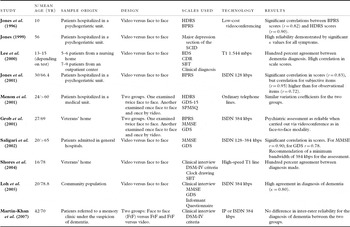
Although there is extensive experience on diagnostic assessment via videoconference in adult populations (Matsuura et al., Reference Matsuura2000; Kobak, Reference Kobak2004) and available evidence shows that good communication between doctor and patient is possible in most cases (Wootton et al., Reference Wootton, Yellowlees and McLaren2003; Anthony et al., Reference Anthony, Nagel and Goss2010; Garcia-Lizana and Muñoz-Mayorga, Reference Garcia-Lizana and Muñoz-Mayorga2010), studies aimed at geriatric population are scarce (Table 2). This issue is important since it is not possible to extrapolate those results to this population due to the difficulties that diagnosing depression or cognitive impairment may impose, as these conditions need a greater amount of visual information (behavior assessment, facial expression, psychomotility) (Alessi, Reference Alessi2001; Jones, Reference Jones2003; Cruz et al., Reference Cruz, Cruz, Krupinski, Lopez, McNeeley and Weinstein2004). Moreover, high prevalence of visual and hearing impairment in these patients (Ball et al., Reference Ball, Franco, Tyrrell and Couturie1998) and frequent fluctuations of consciousness level can make the assessments difficult (Jones, Reference Jones2001). These subjects also are particularly vulnerable to the side effects of drugs. The possibility of carrying out a neurological examination through videoconferencing, particularly the assessment of Parkinson's symptoms, is of special interest (Hubble et al., Reference Hubble, Pahwa, Michalek, Thomas and Koller1993).
Diagnostic assessment studies in geriatric populations via videoconference

BDS = Blessed Dementia Scale; BPRS = Brief Psychiatric Rating Scale; CDR = Clinical Dementia Rating; GDS = Geriatric Depression Scale; HDRS = Hamilton Depression Rating Scale; MMSE = Mini-Mental State Examination; SBT = Short Blessed Test; SCID = Structured Clinical Interview for DSM Disorders; SPMSQ = Short Portable Mental Status Questionnaire.
In a meta-analysis of 14 studies with a total of 500 patients where the diagnostic interview done via videoconferencing was compared to the in-person interview, only three of them included geriatric patients (72 patients) (Montani et al., Reference Montani1997; Grob et al., Reference Grob, Weintraub, Sayles, Raskin and Ruskin2001; Jones et al., Reference Jones, Johnston, Reboussin and McCall2001; Hyler and Gangure, Reference Hyler, Gangure and Batchelder2005).
Jones et al. (Reference Jones, Exum and McFarlane1996) reported the results of the first study carried out to demonstrate the possibility of making psychiatric diagnostic assessments in a geriatric population. Using a low-cost videoconferencing system, the Hamilton Depression Rating Scale and the Brief Psychiatric Rating Scale (BPRS) were administered; scores obtained via videoconference and those rated by an examiner in the same room as the patient were compared. Significant correlation coefficients were obtained for all measures. This group later administered the major depression subsection of the Structured Clinical Interview for DSM Disorders (SCID) to a larger sample, demonstrating the reliability of the interview (Jones et al., Reference Jones, McCall and Melton1997; Jones, Reference Jones1999). As to acceptance by patients, they stated that they were comfortable with the interview and thought that the psychiatrist was able to understand their problem. However, they said that they preferred the face-to-face consultation.
These studies have already suggested that interviews based on the oral account of symptoms by the patient would be more reliable than the assessment of other types of information requiring visual evaluation of behavior and subject's attitude. A subsequent study where BPRS scores obtained via videoconference and face to face were compared goes into these issues in depth (Jones et al., Reference Jones, Johnston, Reboussin and McCall2001). Two types of items were distinguished in the interview: those only requiring oral information provided by the patient and those requiring the observation of their behavior. Inter-rater reliability for total BPRS score was similar for the examiners. However, it was lower for observational items. The conclusion was drawn that the use of narrow-band technology did not guarantee enough image quality to conduct a satisfactory diagnosis assessment of elderly patients. This same group later used broadband technology in a small sample of 20 patients in a nursing home for the elderly. They achieved an acceptable accuracy in the assessment of depression, cognitive impairment, and movement disorders (Jones, Reference Jones2003).
Menon et al. (Reference Menon2001) carried out a study to evaluate the reliability of depressive symptoms and cognitive function assessment by using a low-cost videophone system. They administered the short version of the Geriatric Depression Scale (GDS-15), the Hamilton Depression Rating Scale (HDRS), and the Short Portable Mental Status Questionnaire (SPMSQ) for cognitive assessment. The coefficients of variation for GDS and HDRS were similar for the two groups. This was not the case, though, for SPMSQ, although agreement was higher in the videoconference group.
As to satisfaction with the consultation, most subjects did not show any preference between the two assessment systems. They admitted, though, that should they live in a distant place, they would prefer videoconference.
Saligari et al. (Reference Saligari, Flicker, Loh, Maher, Ramesh and Goldswain2002) reported the results after a first-year implementation of a cognitive assessment program in an elderly population in Western Australia, a very large territory with highly scattered population. In the first trial, conducted with 20 patients admitted to two general hospitals, the goals were to demonstrate the validity of Mini-Mental State Examination (MMSE) and the GDS via videoconferencing as assessment tools in subjects with cognitive impairment, and to establish the necessary technical requirements to carry out the examination. Videoconferencing and face-to-face consultations were performed by two geriatricians on the same day. Although high correlations in MMSE scores and GDS were obtained via videoconferencing, a statistical analysis applied to these results to evaluate the degree of concordance between the two examinations (Loh et al., Reference Loh, Ramesh, Maher, Saligari, Flicker and Goldswain2004) concluded that there were differences between the two assessment methods that may have repercussions on clinical decision-making. One of the explanations provided by the authors for these results are the fluctuating level of functioning of patients included, coming from medical wards, with cases under the suspicion of delirium. Thus, it is emphasized that assessment was possible and that it was probable that in many common clinical situations, as opposed to medical patients admitted to hospital, differences with teleconsultation are not relevant. It was also concluded that a minimum bandwidth of 384 kbps was necessary for the audio and image quality to be adequate for the examination.
Later, this group conducted a study to demonstrate the accuracy of dementia diagnosis made via videoconferencing (Loh et al., Reference Loh, Maher, Goldswain, Flicker, Ramesh and Saligari2005). A group of geriatricians conducted face-to-face and videoconference assessments of 20 patients. Ten patients were diagnosed with Alzheimer's disease at the face-to-face consultation and nine of them were detected via videoconference. Taking face-to-face assessment as the golden standard, it resulted in a κ coefficient of concordance between the two methods of 0.80 (Loh et al., Reference Loh, Donaldson, Flicker, Maher and Goldswain2007).
Demonstrating the reliability of diagnostic interviews conducted via videoconference seems to be a pre-requisite for the implementation of care programs to specific populations, such as nursing home population. This need led Grob et al. to conduct a study in order to establish the validity of the MMSE, the BPRS, and the GDS in a veterans’ home in Maryland (USA) (Grob et al., Reference Grob, Weintraub, Sayles, Raskin and Ruskin2001). Test–retest of the three scales, measured using a correlation coefficient, had statistical significance in the two groups formed. Authors conclude that the psychiatric assessment was as reliable when conducted via videoconference as face to face.
Shores et al. (Reference Shores2004) carried out a prospective study with two Washington State veterans’ homes that compared the diagnostic reliability of videoconference to an in-person examination for dementia. Those residents that had already been diagnosed with dementia were excluded from the study. An initial screening with the 7-minute Screen (n = 83) was conducted. Subjects who screened positive were included in the study. Geriatric psychiatrists carried out a videoconference assessment and another, who was blind to the result of the previous one, an in-person assessment. Telemedicine diagnoses were in 100% agreement with the diagnoses from in-person clinical examinations, including the dementia subtype. Twelve of the 16 residents were diagnosed with dementia, so it was concluded that there was a 14.5% prevalence of undiagnosed dementia in residential care (12/83). This relatively high prevalence of undiagnosed cases, together with the fact that there was an admission protocol to these facilities which included MDS and MMSE and that patients’ mean scores in the MMSE were 22.4 ± 3.9, reveal the capacity of telemedicine to diagnose dementia at early stages. It also supports one of the hypotheses underlying the development of this kind of program, namely, that lack of access to specialist care results in many psychiatric diagnoses going unnoticed in residential care facilities.
They also reported data on satisfaction and acceptance. All the residents participating in the study agreed that they preferred this system to traveling to visit the psychiatrist in person and stated that they would like to have further care through videoconference. Staff at the facilities that took part in the program valued the project as highly positive since their communication and access to specialist services improved. It was so positive that once the research funds were finished, the decision was made to finance this service.
Martin-Khan et al. (Reference Martin-Khan, Varghese, Wootton and Gray2007) conducted a pilot study comparing inter-rater reliability for the diagnosis of dementia via videoconference with inter-rater reliability in a face-to-face assessment. Moderate concordance between diagnoses conducted in person (κ = 0.53) was found. Concordance was slightly higher between diagnoses conducted in person and remotely (κ = 0.63). The inter-rater reliability achieved in both cases was regarded as good since these were dubious cases referred to assessment under the suspicion of incipient dementia. An IP connection and an ISDN connection at 384 kbps were used alternatively in this study. The image quality was poor in two video consultations using the IP connection.
This same group later examined whether there was any change in the diagnoses made when conducting a complete physical and neurological examination (Martin-Khan et al., Reference Martin-Khan, Varghese, Wootton and Gray2008). All the dementia diagnoses were confirmed. The physical examination resulted in a change in the dementia type diagnosis (between Alzheimer's disease and vascular dementia) only in two cases. Authors conclude that there seems to be no great differences between face-to-face assessment and videoconference assessment and that physical examination is not essential to make a diagnosis of dementia, but it is indeed necessary to define dementia type.
Cognitive assessment
When using telecommunication technology to provide care to the geriatric population, one of the issues raised is whether it is possible to apply cognitive assessment tests or whether their results will be contaminated by this approach (Jacobsen et al., Reference Jacobsen, Sprenger, Andersson and Krogstad2003). The possibility of using videoconference to carry out this type of assessment takes on a special relevance due to the need to make dementia screening as widely available as possible, particularly since the introduction of anti-Alzheimer drugs which are believed to be more efficient in early stages of the disease (Ball and McLaren, Reference Ball and McLaren1997). Another difficulty when assessing patients in remote areas or rural nursing homes is the lack of professionals trained in administering neuropsychological tests. This forces them to travel long distances to have their diagnostic assessment fulfilled (Schopp et al., Reference Schopp, Johnstone and Merrell2000; Brebner and Seymour, Reference Brebner and Seymour2001).
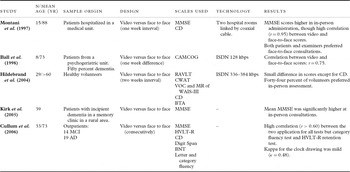
For these reasons, it is interesting to review studies focusing on this aspect, although these are scarce at present and their interpretation is limited by small sample sizes (Table 3). Most of them have focused on screening tests, and more studies aimed at demonstrating the reliability of more complex neuropsychological batteries are needed (Tyrrell et al., Reference Tyrrell, Couturier, Montani and Franco2001).
Cognitive assessment studies in geriatric populations via videoconference

AD = Alzheimer's disease; BNT = Boston Naming Test; BTA = Brief Test of Attention; CAMCOG = Cambridge Cognitive Examination; CD = Clock Drawing test; CWAT = Controlled Word Association Test; HVLT-R = Hopkins Verbal Learning Test-Revised; MCI = Mild Cognitive Impairment; MMSE = Mini-Mental State Examination; RAVLT = Rey Auditory Verbal Learning Test; VOC and MR of WAIS-III = Vocabulary subtest and Matrix Reasoning subtest of the third edition of the Wechsler Adult Intelligence Scale.
The first study on remote cognitive testing was conducted in 1993 in a sample of 11 adult psychiatric patients to which MMSE was applied in person and over videoconferencing. A strong correlation between the two tests was obtained, which was encouraging for test application via videoconferencing (Ball et al., Reference Ball, Scott, McLaren and Watson1993).
Three groups reported their results in the application of screening tests through videoconferencing. Montani et al. (Reference Montani1996) compared the results obtained in the MMSE and the clock drawing test via a closed television circuit and in a standard consultation. A decreased performance in both tests was observed in the video consultation context and though there were minor differences, these were significant. It was pointed out that a decrease in attention that mainly interfered with recall tasks and in the clock drawing test was one of the main difficulties. Hearing impairment also influenced the test, which was particularly observed in repetition items. However, the conclusion was that if technical difficulties were solved, audio and image quality were optimum and patient's sensory impairment were taken into account, it would be possible to apply these tests to these subjects.
This same group later published their opinion on the psychological impact of this assessment modality (Montani et al., Reference Montani1997). It was found that in a phrase writing item in the MMSE in the video consultation situation, phrases were more descriptive and did not express emotions, which, however, was frequent in the face-to-face consultation. Ten patients stated they preferred face-to-face consultation, as it was more personal. Six patients felt uncomfortable by the presence of the equipment. On the positive side, four patients found the video entertaining or that it had a magical appeal. Both the interviewer and the room observer considered the patient was more anxious in the video consultation context and their general impression in a ten-point scale on the course of the interview was significantly higher in the case of the in-person consultation. From the examiner's point of view, it was pointed out that poor audio quality meant that some instructions had to be repeated; that attention was reduced by the need to operate the equipment and by the strategy chosen to create a false sensation of eye contact (directly looking at the camera on top of television).
Kirk et al. (Reference Kirk2005) obtained significantly lower mean scores in the MMSE when administered at distance as compared to conventional application. The conclusion was drawn that this variation in results should be taken into account when conducting this assessment via videoconference.
One retrospective study, using the tests of 99 patients from the records of a Geriatric Psychiatry unit, was designed to verify how assessment via videoconference may influence scoring in written parts of the MMSE (Ball and Tyrrell, Reference Ball, Tyrrell and Long1999). The item of phrase writing and pentagons were scored on paper in a faxed copy and via videoconference (ISDN line with a bandwidth of 128 kbps). Sentences were reliably scored over the fax (κ = 0.80) and over videoconference (κ = 0.70) as compared to the face-to-face modality. However, though reliability over the fax was acceptable in the case of the drawing (κ = 0.71), the same did not happen over videoconference (κ = 0.47). These results warn us of the possibility of bias in test scorings that require pencil and paper, when assessed via videoconference, particularly when it is a low-cost system. Such a limitation should be taken into account and alternatives should be suggested to overcome it, for instance, the auxiliary use of a fax or a scanner for these remote assessments.
Ball and Puffett (Reference Ball and Puffett1998) conducted a small study to demonstrate the applicability of the Cambridge Cognitive Examination (CAMCOG) test, the cognitive assessment section the Cambridge Index of Mental Disorder in the Elderly (CAMDEX), via videoconferencing. It was taken into account that one of the major difficulties would be the need to present image material to complete several test tasks. For this reason, among others, there was an assistant in the same room as the patient, who would show the material to the subject again, should the patient make a mistake when shown on the screen. Fairly high correlations were found in the scores obtained by both systems (r = 0.75), even when results that had been improved by repetition in the presentation of visual stimuli (r = 0.72) were not included. Authors concluded that despite the small sample size and the technical difficulties they faced, the CAMDEX seems to be an applicable interview via videoconference without major modifications.
Only two studies centered on the feasibility of neuropsychological batteries via videoconference. Hildebrand et al. (Reference Hildebrand, Chow, Williams, Nelson and Wass2004) administered a selection of tests and subtests where a series of functions the authors deemed significant for daily living activities were evaluated. Volunteers were randomly distributed to receive the test first via videoconference or face to face. Except for the case of the clock drawing test, mean difference between scoring in the two examinations was minor. Closer limits of agreement in most measures were reported in the subgroup to which face-to-face tests were first applied. This result may be explained by decreased performance owing to the fact that newness of doing the tests is coupled with the newness of video consultation. It was concluded that assessment results were reliable in those tests evaluating verbal skills, whereas major differences emerged in the visual-spatial test.
Another study was performed to evaluate the possibility of using a brief battery of neuropsychological tests to assess patients with cognitive impairment via videoconference (Cullum et al., Reference Cullum, Weiner, Gehrmann and Hynan2006). The mean scores were similar for all tests in the two situations with the exception of the retention percentage in the Verbal Learning Test which was higher in its in-person modality (but it was statistically non-significant). A high correlation was obtained (r > 0.60) between the two applications for most of the tests selected. No participant expressed any difficulty or concern regarding teleconsultation, although several indicated a preference for personal contact. The authors conclude by pointing out that it is possible to successfully and reliably administer multiple brief neuropsychological tests other than the ones commonly used for the assessment of patients with Alzheimer's disease (AD) or Mild Cognitive Impairment (MCI).
Discussion
-
(1) The application of videoconferencing for the psychiatric care of geriatric population is a new emerging field with limited studies available. Most of them focused on the development of liaison programs with nursing facilities and in the feasibility of the assessments performed on hospitalized patients. Few studies were carried out in the community (Conn and Bilas, Reference Conn and Bilas2001; Loh et al., Reference Loh, Maher, Goldswain, Flicker, Ramesh and Saligari2005). There is a lack of studies assessing the outcome of the interventions (Lee et al., Reference Lee2000) or focusing on specific tasks such as providing support to caregivers (other than nurses) (Lee et al., Reference Lee2000; Bilas and Conn, Reference Bilas and Conn2002). There are inherent difficulties to assessing this population group that only seem to be overcome by technological advances that are taking place in recent years. Among these, it is worth mentioning the importance of assessing psychomotility, attitude, and behavior in the interview, which was poor with narrow-band systems (Jones et al., Reference Jones, Johnston, Reboussin and McCall2001; Saligari et al., Reference Saligari, Flicker, Loh, Maher, Ramesh and Goldswain2002; Trinkle, Reference Trinkle2003). New studies showing optimization with current technologies are necessary. While IP is the connectivity of the future, one must consider the availability of broadcast bandwidth in an IP or ISDN format in both sending and receiving locations (Martin-Khan et al., Reference Martin-Khan, Varghese, Wootton and Gray2007).
Another difficulty is the high frequency of communication problems in the elderly population, such as visual or hearing impairment. Further studies that evaluate their results in these patients are required to provide an answer to the question of whether it is possible to generalize telepsychiatry programs to the whole of this population group.
-
(2) There are important needs regarding psychiatric care in nursing homes for the elderly which are noted by psychiatrists, nursing homes’ staff, and users. Telepsychiatry is a possible option to meet these needs. Initial experiences are highly positive to the extent that these are feasible and are quite valid in diagnostic terms. Only two studies report quantitative data of cost-effectiveness (Tang et al., Reference Tang, Chiu, Woo, Hjelm and Hui2001; Rabinowitz et al., Reference Rabinowitz, Murphy, Amour, Ricci, Caputo and Newhouse2010), although with the information available, it is not risky to forecast that they are reasonably cost-effective, since after the initial cost of buying equipment, the reduction of traveling costs and the better use of time devoted by the geriatric psychiatrist compensate for the implementation of these programs (Johnston and Jones, Reference Johnston and Jones2001). Another reason to think that they will be efficient is that using videoconferencing is economical and easy to organize when users are located in only one place. One possibility to improve its cost-effectiveness is the multidisciplinary use of telecare equipment installed in nursing homes for other specialties (Tang et al., Reference Tang, Chiu, Woo, Hjelm and Hui2001; Rabinowitz et al., Reference Rabinowitz, Murphy, Amour, Ricci, Caputo and Newhouse2010). From the staff's standpoint, the advantages are not only reducing the need to travel and waiting time for consultation, but also allowing better communication with the consultant, higher involvement in decision-making, and increased support (Jones, Reference Jones1999; Lee et al., Reference Lee2000; Tang et al., Reference Tang, Chiu, Woo, Hjelm and Hui2001; Sävenstedt et al., Reference Sävenstedt, Bucht, Norberg and Sandman2002; Yeung et al., Reference Yeung, Johnson, Trinh, Weng, Kvedar and Fava2009). It is interesting to note the opinion of some professionals in this field who state that despite limited data on the effectiveness, efficiency, and acceptability by patients and staff of this care modality, this option is preferable to the current reality where a great part of the geriatric population having mental health problems, that is, the institutionalized population, has great difficulties accessing specialized care (Mitka, Reference Mitka2003; Wootton et al., Reference Wootton, Yellowlees and McLaren2003; Snowdon, Reference Snowdon2010).
-
(3) There are several studies on the validity of specific diagnostic interviews for the elderly (Table 2) and on cognitive tests (Table 3). In general, they conclude that they seem to be both feasible and fairly reliable; but their interpretation is limited because of the small size of samples used (range 8–56 with a median of 24 subjects assessed) and their origin, mainly psychogeriatric inpatients (Jones et al., Reference Jones, Exum and McFarlane1996; Ball et al., Reference Ball, Franco, Tyrrell and Couturie1998; Jones, Reference Jones1999; Jones et al., Reference Jones, Johnston, Reboussin and McCall2001) or medical geriatric hospitalized patients (Montani et al., Reference Montani1997; Menon et al., Reference Menon2001; Saligari et al., Reference Saligari, Flicker, Loh, Maher, Ramesh and Goldswain2002). More studies must be conducted on the validation of larger-size clinical and community samples where a more varied clinical sample is reflected and bias due to random and other circumstances beyond the test are minimized. Only four studies (Lee et al., Reference Lee2000; Shores et al., Reference Shores2004; Loh et al., Reference Loh, Maher, Goldswain, Flicker, Ramesh and Saligari2005; Martin-Khan et al., Reference Martin-Khan, Varghese, Wootton and Gray2007) informed on the reliability of diagnoses made via videoconference. So, similarly, further studies are needed on this issue that will ultimately determine whether this care modality turns into a common clinical practice.
-
(4) Regarding the satisfaction with and acceptance of teleconsultation by patients, the few papers that focused on this issue (Saligari et al., Reference Saligari, Flicker, Loh, Maher, Ramesh and Goldswain2002; Trinkle, Reference Trinkle2003) or presented quantitative data (Tang et al., Reference Tang, Chiu, Woo, Hjelm and Hui2001; Shores et al., Reference Shores2004, Yeung et al., Reference Yeung, Johnson, Trinh, Weng, Kvedar and Fava2009) concur that in general they accept it. Studies also indicate that although they prefer face-to-face interviews (Montani et al., Reference Montani1997; Hildebrand et al., Reference Hildebrand, Chow, Williams, Nelson and Wass2004), most patients will opt for it rather than having to travel (Menon et al., Reference Menon2001). Instead of limited data (Tang et al., Reference Tang, Chiu, Woo, Hjelm and Hui2001), it seems that there are no important differences between subjects with or without dementia who are able to answer questions and most dementia patients accept the interview and can be assessed via videoconference (Lee et al., Reference Lee2000; Jones et al., Reference Jones, Cavanaugh and Reboussin2002; Rabinowitz et al., Reference Rabinowitz, Murphy, Amour, Ricci, Caputo and Newhouse2010). In the cases of advanced dementia, there is no consensus about the possibility of directing their attention with existing divergent opinions (Johnston and Jones, Reference Johnston and Jones2001; Sävenstedt et al., Reference Sävenstedt, Zingmark and Sandman2003; Sävenstedt et al., Reference Sävenstedt, Zingmark, Hyden and Brulin2005). Anyway, the participation of a caregiver familiarized with the patient is needed as in in-person consultations.
Conclusion
At a practical level and by way of summary upon reviewing the literature on the field, the following recommendations could be made:
-
– For clinicians: The use of telepsychiatry, and specifically, videoconferencing in psychogeriatrics entails a number of challenges and a greater complexity than in the case of its application with other patients. Cognitive deficits and somatic pathologies have a greater bearing, which means that the procedure may not be confined to medical teleconsultation with the patient. When designing telepsychogeriatric programs, a method for obtaining a medical, psychiatric, and social history must be designed as well as allowing for other essential individuals who are involved in the assessment (family caregivers, formal caregivers, nurses, primary care and nursing home doctors, other consultants, and social workers). The objective is holistic diagnosis and treatment recommendations and that as much information is garnered via teleconsultation as possible in the case of a specialist face-to-face consultation. If well designed forms are used, data are adequately transmitted through telematic channels (fax and the Internet) and those providing care to patients participate in the consultations, the quality of the information obtained, the care provided, and the satisfaction of the persons involved may be even greater than in the case of face-to-face consultations (Lee et al., Reference Lee2000; Rabinowitz et al., Reference Rabinowitz, Murphy, Amour, Ricci, Caputo and Newhouse2010). Therefore, the care model required in telepsychiatry should not be simply consultation by the psychiatrist (which could be adequate in other applications of telepsychiatry where the patient has greater autonomy) but consultation-liaison and collaboration with other care providers (Hilty et al., Reference Hilty, Yellowlees and Nesbitt2006b). For greater efficiency in these programs, it should be borne in mind that these patient are often in day care centers or nursing homes (Lee et al., Reference Lee2000) and that they often have multiple pathologies that must be assessed by different professionals (Tang et al., Reference Tang, Chiu, Woo, Hjelm and Hui2001). Furthermore, we should not lose sight of the fact that for telepsychogeriatrics not every technology is valid and there is consensus on the need to resort to broadband (Jones, Reference Jones2003). Even using cutting-edge technology, care should be administered cautiously in the case of advanced dementia patients, patients with serious sensory deficits or those having disorders affecting psychomotor activity (Jones and Ruskin, Reference Jones and Ruskin2001).
-
– For researchers: More studies using larger sample sizes are required, thus allowing the application of stronger statistical methods, using long-term longitudinal follow-up and assessment of the clinical outcome, with the emergence of specific protocols to develop telepsychogeriatric programs and to evaluate satisfaction of all persons involved and with more information on cost-effectiveness (Hilty et al., Reference Hilty, Marks, Urness, Yellowlees and Nesbitt2004; Shulman et al., Reference Shulman, Conn and Elford2006).
Among the different possibilities offered by telepsychiatry, it seems likely that the field of psychogeriatrics will be at the forefront experiencing greater growth in the foreseeable future. This is partly due to the increase in the geriatric population, partly due to the fact that the next generation forming this group will be more technologically literate, and also thanks to the progressive development of technologic systems, the purpose of which will be to eventually increase the autonomy of the elderly (Pulier, Reference Pulier2007). Ultimately, the important practical question is not whether to use telepsychiatry instead of traditional in-person assessment and therapy. Rather, the questions to ask are, when, where, for whom, and how to blend these technologies with traditional treatment in order to provide better access and quality to mental health services (Maheu et al., Reference Maheu, Pulier, Wilhelm, McMenamin and Brown-Connolly2005).
Conflict of interest
None.
Description of authors’ roles
This research has been done as part of a research-action pilot study on telepsychogeriatrics conceived and led by Raimundo Mateos. Raimundo Mateos designed the literature search and all authors worked in the literature review; Drs. Raimundo Mateos, Ramón Ramos-Ríos, and David Conn focused on the clinical aspects and David Lojo and Tim Patterson on the technical aspects of the reviewed papers. Ramón Ramos and Raimundo Mateos drafted the paper; all the authors reviewed and contributed to the final version of the publication.
Acknowledgments
The research-action project on telepsychogeriatrics has been founded by the Servicio de Saúde Mental, Subdirección Xeral de Saúde Mental e Drogodependencias, Xunta de Galicia (Galician Ministery of Health) with the involvement of the Higher Systems and IT Government Body of the CHUS University Hospital. Authors are particularly grateful to Dr. Fernando Marquez for his continuous support to this project.