CHD is among the most common birth defects, representing a major global health problem. In the last century, improvement in the field of cardiovascular diagnostics and surgery has provided us a better understanding about its global prevalence and composition; however, these figures are from countries or regions at low altitude. Tibet is the highest region on earth with an average altitude of 4500 m. Until recently, several studies have described varying prevalence of CHD in school children on the Tibetan Plateau, according to the surveying altitudes.Reference Chen, Wang and Qi 1 , Reference Zheng, Tian and Zhu 2 Astonishingly, complex cardiac defects were less represented in previous studies and need further investigation.
In 2012, the Chinese Navy General Hospital and the Health Department of Tibet Autonomous Region conducted a collaborative charitable campaign to examine and treat children with CHD in different regions of Tibet. On the basis of data from this cross-sectional survey, we aimed to illustrate the prevalence and composition of CHD in Tibetan children according to their altitudes of residence and presenting ages, as well as comment on issues related to CHD prevalence in Tibet.
Materials and methods
Definition of CHD
According to the definition of Mitchell et al, CHD is a gross structural abnormality of the heart or intrathoracic great vessels, which is actually or potentially of functional significance.Reference Mitchell, Korones and Berendes 3 This definition excluded patent ductus arteriosus in premature infants, Marfan syndrome, uncomplicated bicuspid aortic valve without stenosis or insufficiency, mitral valve prolapse, cardiomyopathies, and congenital arrhythmias.Reference Mitchell, Korones and Berendes 3 , Reference van der Linde, Konings and Slager 4 A patent foramen ovale or atrial septal defect measuring <5 mm in diameter was not considered as a cardiac abnormality because of its innocent nature and tendency for spontaneous closure.Reference Hanslik, Pospisil, Salzer-Muhar, Greber-Platzer and Male 5 Idiopathic pulmonary arterial hypertension with or without atrial septal defect was also excluded from the spectrum of CHD. We defined pulmonary valvular stenosis as a transvalvular systolic pressure gradient >25 mmHg, and classified this condition into three grades on the basis of pressure gradients: mild, 26–49 mmHg; moderate, 50–79 mmHg; and severe, ⩾80 mmHg. Severe pulmonary valvular stenosis with significant subvalvular obstruction and a right-to-left interatrial shunt was considered as a complex cardiac defect.
Study design
This cross-sectional study consisted of a prospective survey on CHD prevalence in school children in south-west regions of Tibet according to their altitudes of residence, and a retrospective analysis on the composition of all CHD diagnosed in multiple regions of Tibet during this campaign based on altitudes and presenting ages.
In the first part of the study, we prospectively recruited unselected Tibetan children aged 4–17 years from six counties of Tibet from October, 2012 to November, 2012. Children were recruited from schools, kindergartens, and nearby villages, and had not been examined or treated by cardiovascular specialists. To study the effect of altitude on CHD prevalence, we arbitrarily divided the study population into three groups: living above 4700 m, in the range of 4200–4700 m, and below 4200 m. Regions above 4700 m were considered as very high areas in Tibet, and the altitude of 4200 m roughly divided the pastoral – above – and arable areas – below – in this district.
We performed cardiac auscultation and peripheral artery palpitation for each child. Special attention was paid to growth condition and cyanosis. Children with abnormal signs suggestive of a possible cardiac defect – for example, growth retardation, cardiac murmurs, fixed splitting of the second heart sound, and clinical cyanosis – were subjected to a subsequent echocardiographic examination to confirm the diagnosis. Echocardiography was performed with the children in left recumbent and supine position using the Vivid i cardiovascular ultrasound system (GE Healthcare, Horten, Norway). The examination protocol included two-dimensional scanning and color Doppler imaging with appropriate gain and filter settings from parasternal, apical, subcostal, and suprasternal views.
In the second part of the study, we retrospectively enrolled all Tibetan children who were diagnosed with CHD by our team using the same protocol from May, 2012 to December, 2013, including those in the prospective survey. The entire screening population involved all available children at each screening site who were willing to receive a diagnostic examination. Particular attention was paid to those critically ill or with other major extracardiac diseases, in order to examine as many children as possible and not to miss children with severe CHD. The total number of the screening cohort was missing, however; therefore, we could not present a detailed prevalence of this disease, and only the composition of CHD could be illustrated in this analysis. Children with CHD were assigned to three altitude groups as in the former section – group H1, H2, and H3 in an ascending order. We also enrolled a group of children with CHD in some remote regions of Yunnan Province (1000–2000 m) for comparison as a low-altitude control group (Group L).
Statistical analysis
All statistical analyses were performed using SPSS version 15.0 (Chicago, Illinois, United States of America). The prevalence of CHD was expressed as cases per 1000. We compared continuous variables using two-independent samples t-test or one-way analysis of variance, and categorical variables using the χ2 or Fisher’s exact test. A two-sided p-value <0.05 was considered to be statistically significant.
Results
Part I: CHD prevalence at different altitudes
A total of 7088 children (male, 50.6% and female, 49.4%) were recruited for the prospective study. Approximately 22.2% of children lived in regions above 4700 m, 56.2% between 4200 and 4700 m, and 21.6% below 4200 m. About 8.4% of children were younger than 7 years of age, 47.0% between 7 and 12 years, and 44.7% older than 12 years. Echocardiography was performed in 631 (8.9%) children, and 71 (21 males, 29.6% and 50 females, 70.4%) were diagnosed as having CHD. No cases of complex or cyanotic defects were found in the study population. All children with CHD had complete left-to-right shunt without cyanosis. All isolated ventricular septal defects were perimembranous with membranous aneurysm formation.
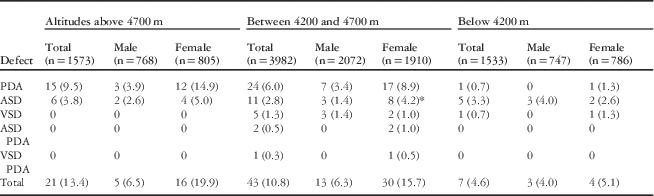
Table 1 shows the prevalence of CHD and its major subtypes, classified according to different altitudes. The total prevalence of CHD increased substantially from 4.6/1000 below 4200 m to 13.4/1000 above 4700 m, with the female-to-male ratio increasing from 1.3 to 3.1. Sex difference in prevalence was significant at all altitudes expect for below 4200 m. The total prevalence and female prevalence of patent ductus arteriosus increased more than 10-fold from below 4200 m to above 4700 m, with a more remarkable female preponderance. The prevalence of atrial septal defect, isolated or in combination with other defects, was comparable among different altitudes (3.3–3.8/1000). Isolated patent ductus arteriosus was the most common cardiac defect in areas above 4200 m (60.9%) followed by isolated atrial septal defect (26.6%), whereas atrial septal defect accounted for 71.4% of all CHD below 4200 m. Isolated ventricular septal defect comprised 14.3 and 11.6% of total CHD below 4200 m and at 4200–4700 m, respectively, but was not found in children at altitudes above 4700 m.
Prevalence of CHD and its major subtypes classified by living altitudes above sea level.

ASD=atrial septal defect; PDA=patent ductus arteriosus; VSD=ventricular septal defect
Data are expressed as number of cases (prevalence per 1000). Prevalence at altitudes above 4700 m, 4200–4700 m versus below 4200 m: significant differences (p<0.05) are present in total prevalence and female prevalence of CHD and total and female prevalence of PDA
* A spontaneously closed perimembranous VSD was observed
Part II: CHD composition at different altitudes in Tibet versus Yunnan
A total of 383 children (150 males, 39.2% versus 233 females, 60.8%) in Tibet Autonomous Region (Group H1: n=135; H2: n=150; H3: n= 98) and 73 children (30 males, 41.1% versus 43 females, 58.9%) in Yunnan Province were diagnosed as having CHD and constituted the study population. Age (8.6±4.6 versus 8.0±4.4 years, p=0.305) and sex ratio (p=0.757) did not differ significantly between children in Tibet and Yunnan Province. The most common cardiac defect was patent ductus arteriosus (54.3%) in Tibet compared with ventricular septal defect (54.8%) in Yunnan Province. The most common complex cardiac defect was tetralogy of Fallot (30.0%) in both populations.
In Tibet, 52 (86.7%) perimembranous, six (10.0%) subarterial, and two (3.3%) trabecular ventricular septal defects, isolated or combined, were observed, whereas the proportions in Yunnan were 97.9, 2.1, and 0%, respectively. Spontaneous closure of a perimebranous ventricular septal defect was observed in two Tibetan children – one with atrial septal defect and the other with dextrocardia situs inversus and patent ductus arteriosus. All atrial septal defects, isolated or combined, in both populations were of ostium secundum type except for sinus venosus type in two Tibetan cases. Atrial septal defect was complicated with hepatic segment defect of the inferior caval vein in a Tibetan child. In Tibet, pulmonary valvular stenosis was mild and isolated in three cases, and severe and associated with right-to-left interatrial shunt and clinical cyanosis in another two. In Yunnan, only one case of severe isolated pulmonary valvular stenosis was observed.
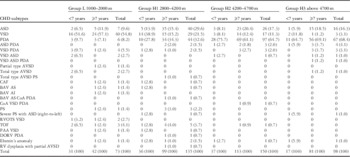
All altitude groups had more females (Group L: 58.9%, H1: 57.8%, H2: 64.0%, H3: 60.2%, p=0.736) than males. Table 2 shows the CHD composition at each spectrum of altitudes. The proportion of ventricular septal defect decreased and patent ductus arteriosus increased substantially with increasing altitudes. Isolated patent ductus arteriosus made up ~2/3 of total CHD above the altitude of 4200 m. Group L (13.7%) and H1 (10.4%) had a significantly larger proportion of complex CHD than Group H2 (2.0%) and H3 (3.1%, p<0.05). Of the 20 Tibetan children with complex CHD, 14 (70.0%) lived in regions below 4200 m. In Tibet, preschool children (<7 years) had similar prevalence of isolated patent ductus arteriosus (54.4 versus 53.9%, p>0.05) and a higher percentage of ventricular septal defect (isolated or combined, 23.3 versus 13.7%, p=0.028) compared with school children (⩾7 years). This difference was significant only in regions below 4200 m (41.7 versus 16.2%, p=0.002).
CHD composition at different altitudes.

AI=aortic insufficiency; AS=aortic stenosis; ASD=atrial septal defect; AVSD=atrioventricular septal defect; BAV=bicuspid aortic valve; CAF=coronary artery fistula; CoA=coarctation of the aorta; DORV=double-outlet right ventricle; PAA=pulmonary artery atresia; PDA=patent ductus arteriosus; PS=pulmonary valvular stenosis; RVOTS=right ventricular outlet tract stenosis; TOF=tetralogy of Fallot; VSD=ventricular septal defect
Data are expressed as number of cases (percentage)
Discussion
In a recent review by van der Linde et al, the birth prevalence of total CHD stabilised at 9.1 (9.0–9.2)/1000 worldwide after 1995Reference van der Linde, Konings and Slager 4 ; however, geographical and ethnic differences exist, with Asia having the highest prevalence of 9.3 (8.9–9.7)/1000 births.Reference van der Linde, Konings and Slager 4 Most previous studies on Chinese CHD prevalence were conducted in the central and eastern coastal regions with prevalence ranging from 3.7 to 26.6/1000,Reference Sung, So, Ng, Ho and Fok 6 – Reference Zhao, Ma, Jia and Huang 11 depending largely on the age at diagnosis and the screening protocol. In this study, we found that the total prevalence of paediatric CHD in south-west Tibet varied widely from 4.6/1000 below 4200 m to 13.4/1000 above 4700 m, with a more remarkable female preponderance with increasing altitudes. This disease distribution suggests that the low oxygen tension at high altitude had a profound effect on the prevalence of some major CHD subtypes.
Patent ductus arteriosus
In this study, the prevalence of patent ductus arteriosus below 4200 m (0.7/1000) showed no significant difference from that at sea level (0.87 [0.83–0.91]/1000)Reference van der Linde, Konings and Slager 4 and at an average altitude of 3600 m (0.96/1000), and increased substantially above 4200 m (6.0–9.5/1000). The total prevalence of CHD at different altitudes was related to the relative frequency of patent ductus arteriosus.
The high prevalence of patent ductus arteriosus at high altitudes proved oxygen tension to be a major determinant of patency and spontaneous closure of the ductus arteriosus. The low fetal oxygen tension is essential for patency of the ductus arteriosus.Reference Schneider and Moore 12 After birth, the abrupt increase in oxygen tension inhibits the voltage-dependent potassium channels within the ductal smooth muscles, which results in an influx of calcium and ductal constriction and closure.Reference Michelakis, Rebeyka, Bateson, Olley, Puttagunta and Archer 13 At high altitude, low oxygen tension could inhibit the spontaneous closure, and the ductus arteriosus remains patent. With increasing altitudes, oxygen tension decreased and the prevalence of patent ductus arteriosus increased.
Atrial septal defect
The prevalence of atrial septal defect in south-west Tibet varied slightly between 3.3 and 3.8/1000. Altitude also had an effect on the prevalence of atrial septal defect, although to a much lesser extent than on patent ductus arteriosus.Reference Jin, Chen and Tong 14 The prevalence in Tibetan children was higher than that in school children of Taiwan (2.32/1000)Reference Wu, Chen, Lu, Wang, Huang and Huang 7 and the birth prevalence worldwide (1.64 [1.61–1.67]/1000),Reference van der Linde, Konings and Slager 4 but similar to that in neonates unselectively assessed by echocardiography in recent studies (3.9/1000).Reference Ishikawa, Iwashima, Ohishi, Nakagawa and Ohzeki 15 The difference in atrial septal defect prevalence in previous epidemiological studies depends primarily on the observed number of asymptomatic atrial septal defects and diagnostic criteria. Considering the benign nature of small atrial septal defects, we adopted more strict criteria than other studies.Reference Wu, Chen, Lu, Wang, Huang and Huang 7 , Reference Zhao, Ma, Jia and Huang 11 , Reference Jin, Chen and Tong 14 In addition, we measured the defect size in two-dimentional view and avoided using flow width on Doppler imaging, which has been shown to overestimate the true defect size.
The reason for the high prevalence of atrial septal defects in Tibetan children is unknown. Miao and ZuberbuhlerReference Miao, Zuberbuhler and Zuberbuhler 16 speculated that the persistence of high pulmonary vascular resistance and right heart pressure at high altitudes inhibited early closure of the foramen ovale. Subsequent growth might result in stretching of the fossa ovalis, incompetence of the flap, and formation of an atrial septal defect.
Ventricular septal defect
As the most common cardiac defect at sea level,Reference van der Linde, Konings and Slager 4 , Reference Wu, Chen, Lu, Wang, Huang and Huang 7 , Reference Yang, Li, Lu and Liu 8 ventricular septal defect accounted for a minor proportion (8.5% in the prospective survey and 12.8% in the retrospective analysis versus 54.8% in Yunnan Province) of total CHD in Tibet and occurred more commonly in younger children and at relatively lower altitudes. This phenomenon suggested high early mortality with unrestricted ventricular septal defects. The prevalence of ventricular septal defect was 1.3/1000 below 4700 m. In contrast, the birth prevalence of ventricular septal defect was 2.62 (2.59–2.65)/1000 worldwideReference van der Linde, Konings and Slager 4 and 2.3/1000 in Beijing.Reference Yang, Li, Lu and Liu 8
In our study population, a large ventricular septal defect with bidirectional shunt and severe pulmonary hypertension was observed in a 6-month-old Tibetan infant; however, his pulmonary artery pressure decreased to normal with complete left-to-right interventricular shunt when transferred to our centre for surgical correction. The regression suggested a susceptibility to develop pulmonary hypertension in children with unrestricted ventricular septal defect at high altitude compared with sea level.Reference Chen, Lu, Qi, Jin, Wang and Qi 17 Persistence of pulmonary hypertension placed the affected infants at high risk for right heart failure and early death. Formation of membranous aneurysms may be protective for early survival as demonstrated in this study.
Complex cardiac defects
No complex or cyanotic CHD was observed in the prospective survey; however, it comprised 5.2% of total CHD in the Tibetan population of the retrospective analysis as opposed to 13.7% in Yunnan province and 18.0% in Beijing.Reference Yang, Li, Lu and Liu 8 It was unknown whether an ethnic difference existed. The greater prevalence at relatively lower altitudes suggested a high mortality during early childhood at higher altitudes. We speculated that the low oxygen level at high altitudes greatly aggravated hypoxia of cyanotic individuals, and in extreme cases caused early death shortly after birth.
Right ventricular outflow obstruction – for example, tetralogy of Fallot, severe pulmonary valvular stenosis, and pulmonary artery atresia – was much more common than left heart obstructive lesions – for example, aortic stenosis and coarctation of the aorta – in this study population. This finding is consistent with an international meta-analysis, which demonstrated that Chinese children had more right ventricular obstructive lesions, whereas children in western countries had more left heart obstructive lesions.Reference van der Linde, Konings and Slager 4 , Reference Jacobs, Leung and Karlberg 18 Only two children in this population had patent ductus arteriosus-dependent pathology: pulmonary atresia with ventricular septal defect and patent ductus arteriosus and severe coarctation of the aorta with ventricular septal defect and patent ductus arteriosus. Interestingly, Han et al previously described a Tibetan girl with aortic valve atresia and ventricular septal defect, and her dysplastic ascending aorta and coronary circulation were supplied by a giant patent ductus arteriosus.Reference Zhao, Zheng and Du 19 This suggests that children with patent ductus arteriosus-dependent complex heart disease can survive at high altitudes because of persistent patency of a large ductus.
Study limitations
Our study has some limitations. First, the prevalence we assessed in this study was not CHD incidence at birth in this region, which is the most practical and accurate measurement of CHD occurrence. This inconformity makes it difficult to compare the true incidence at birth at different altitudes because of unknown deaths from untreated conditions and medical interventions; however, evaluation of birth prevalence of CHD in Tibet is rather difficult, owing to the cold climate, harsh natural environment, scattered population distribution in an extremely large area – that is, less than three persons per square kilometre – communication inconvenience, electricity shortage, and people’s attitude on childbearing. The majority of them are shepherds, who are highly mobile without fixed residence, especially at very high altitudes. The women do not know when they are pregnant and when they will deliver, and are willing to deliver at home instead of at a local hospital. These factors greatly hamper neonatal examination.
Second, some mild defects – for example, small atrial septal defects and silent patent ductus arteriosus – and severe cases – for example, critical aortic stenosis in early infancy – might be missed, resulting in an underestimation of true prevalence. We included very mild cardiac murmurs and significant splitting of the second heart sound as indications for echocardiography to reduce the underestimation to minimum. The vast majority of children identified as having CHD in this study had heart dilation or dysfunction and needed early intervention. The prevalence obtained could be useful to estimate the total number of children with CHD who need early treatment at each altitude. Finally, CHD prevalence in south-west Tibet is not totally representative of that in the entire territory of Tibet, because of unknown regional differences in this vast land with diverse climates and topographies.
Study implications
Elevation in environmental oxygen levels of neonates may be effective in promoting spontaneous closure of ductus arteriosus and normal decline in pulmonary artery pressure, thereby reducing the prevalence of patent ductus arteriosus and early mortality from unrestrictive ventricular septal defect. Precautionary use of prostaglandin inhibitors such as indomethacin or ibuprofen during the neonatal period may also be helpful in closing the ductus arteriosus in non-patent ductus arteriosus-dependant full-term infants. Particular attention should be paid to the exceptionally high female prevalence of patent ductus arteriosus, which might increase maternal mortality at childbearing ages because of the possible development of heart failure or Eisenmenger’s physiology with a large patent ductus arteriosus.
Conclusion
In this cross-sectional study, a wide variation in CHD prevalence was present in Tibetan children at different altitudes, leading to distinctive CHD compositions, compared with low attitude.
Acknowledgements
The authors sincerely thank all recruited children, school personnel, and hospital staff for participating in this study and their support. They particularly thank Duoji Ciren, an experienced driver in the administration of Shigatse, for his escort and guarantee of our safety during the whole journey. The authors appreciate the help of Min Xu (Health Bureau of Saga County), Suolang (Health Bureau of Zhongba County), and Shu-Bin Liang (Xinhua News Agency) for their active cooperation during the study period.
Financial Support
This study obtained grants and support from Beijing Municipal Science and Technology Commission (Grant number: Z151100004015205).
Conflicts of Interest
None.
Ethical Standards
The authors assert that all procedures contributing to this study comply with the ethical standards of the Chinese guidelines on human experimentation and with the Helsinki Declaration of 1975, as revised in 2008, and has been approved by the ethics committees of PLA Navy General Hospital.