During the 1970s and 1980s, the Iraqi health system was known as one of the most advanced in the Eastern Mediterranean Region. Its health indicators were among the best of the area. However, the last 30 years of communal tensions, wars, terrorism, and embargos destroyed facilities and shattered the whole health system. Reference Ross, Moore and Hilborne1 Health infrastructures were left in a state of abandonment, and medical personnel were killed or forced to flee. Consequently, Iraq experienced a steep increase in mortality, which can be attributed to direct violence but also to indirect causes, such as failures of health, sanitation, and other systems. Reference Hagopian, Flaxman and Takaro2 Since May 2014, Iraq’s precarious political balance has been made even more unstable by the conquest of entire regions by the so-called “Islamic State” (ISIS). In 2017, the Iraqi state resumed the initiative, reconquesting the areas held by ISIS. During the struggle, the Kurdistan Region of Iraq (KRI) – an autonomous region of Iraq since 1991 – became a safe haven for hundreds of thousands of refugees and internally displaced people (IDPs). This has caused consistent pressures on local services, as well as on health system performance. When the government of Iraq retook the areas previously held by ISIS, IDPs started to return to their homes. Nevertheless, at the beginning of 2019, KRI was still hosting large numbers of IDPs. 3 The complex political framework has not yet allowed to fully rebuild those institutions necessary to administer the country, including the public health system.
NARRATIVE
The actual health situation of the Iraqi population is poorly documented, particularly because health data are not systematically collected and are mostly on paper rather than collected electronically, with few non-aggregated data available or in a format suited for analysis or management Reference Ross, Moore and Hilborne4 and with little health-related and epidemiological information. Data are not being routinely used for health planning, and the impact of the provided care is not efficiently monitored or evaluated. Reference Webster5 In Iraq, as well as in KRI, there is no formal and institutionalized structure with the task of monitoring diseases and analyzing health care needs. 6 This results in inadequate knowledge on the population’s health and insufficient understanding of its needs, limited public health vision and organization, as well as lack in prevention activities and in preparedness response plans. Reference Al Hilfi, Lafta and Burnham7 Wherever possible, data are deduced from sporadic surveys, 8 United Nations estimates, figures collected from neighboring countries, or from countries with similar health profiles. Reference Mokdad, Forouzanfar and Daoud9 The absence of data collection systems is one of the reasons for the lack of “the capacity to deliver services that address the major health problems faced by the majority of the population in an equitable and sustainable manner.” 10 In order to start rebuilding a functioning public health system, there is the need to develop adequate epidemiological surveillance and health monitoring systems. Reference Emberti Gialloreti, Moramarco and Palombi11 These are the foundations deemed necessary to create a health system capable of responding promptly to present and emerging needs, as well as to adequately inform the health policies of a country or region. Reference Massoudi and Chester12
To respond to this health priority, the University of Rome Tor Vergata (Italy) and the Ministry of Health of KRI have started a collaboration to implement an electronic system for epidemiological monitoring and health surveillance. The system has been designed to manage health care data by collecting, storing, managing, and transmitting patients’ electronic medical records, as diagnoses, vaccinations, births, and deaths.
The project began with a pilot in KRI in June 2015, as this Iraqi region had not been occupied by ISIS; however, the aim of the project is to set up the system in the whole country. By December 2017, 29 health centers and hospitals of KRI have been networked (about 5% of all health facilities in the region) and are routinely collecting diagnoses of all referred patients, using a data system put up on the District Health Information System 2 (DHIS 2) platform. 13 DHIS 2 is an online, open-source software for the reporting of routinely collected health data, which is in use by 67 low- and middle-income countries. Within DHIS 2, data elements are organized by a geographic unit, such as district or region, and can be pooled to develop indicators, which can be displayed by means of tables, figures, or maps. The platform is extremely flexible, and, as soon as the necessary legal permissions have been obtained, the platform can be adapted to interact with other already existing international databases and surveillance systems, such as, for example, the Global Health Observatory Data Repository. Interoperability with other systems is further enhanced by the fact that disease coding is based on the 10th revision of the International Statistical Classification of Diseases and Related Health Problems (ICD-10), the internationally recognized medical classification of the World Health Organization. In order to construe the diagnosis, even if the doctor did not use English and instead Arabic or Kurdish Sorani, an ad hoc software to automatically translate and code the diagnoses has been developed. Data can be easily entered through laptops, tablets, or smartphones.
In the framework of the project, a team of local collaborators has been established. Additionally, about 700 medical doctors, statisticians, and public health officials of the region have been trained on the use of health information and epidemiological surveillance systems, as well as the ICD-10.
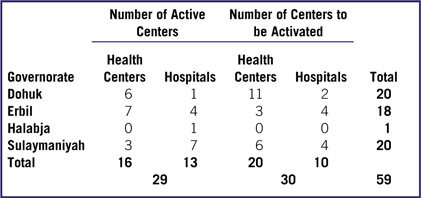
After having considered and evaluated the positive results obtained by the pilot project, the implementation phase of the comprehensive program was started in 2018. Beyond the 29 already active centers, 30 new ones will start collecting data by the end of 2019 (Table 1). The health and administrative personnel of all of these centers have already been trained in data collection, analysis, and disease classification. By April 2019, more than 300,000 disease events have been recorded in the 4 Governorates of KRI – Dohuk, Erbil, Halabja, Sulaymaniyah – and stored in the system.
Number of Centers Already Active and in the Process to be Activated in 2019, Distributed by Governorate

The aim of the full-fledged program is (1) to expand the health monitoring system already activated through the pilot project, so to network by 2021 the approximately 120 main health centers and hospitals of the region; (2) to train health and administrative staff in the management and analysis of health monitoring system data; (3) to train highly specialized personnel on public health and computer science, to guarantee the continuity and future sustainability of the health monitoring system by handing it over in 2021 to the local Ministry of Health; and (4) to include also in the health monitoring system the private facilities, especially hospitals, which still play a significant role in the Iraqi health system. A subsequent expansion of the health monitoring system to whole Iraq is foreseen in the following years.
DISCUSSION
Amid long-lasting conflicts, Iraq and KRI have experienced rapid demographic, economic, and social changes, especially after the 2003 war, with massive consequences on the public health sector. This has led to poor health outcomes, when compared with some of the neighboring countries. 14 Overwhelmed by continuous emergencies, the country could not set up a functioning health information system, making it difficult to develop health policies that meet the actual needs of the population. In fact, the main problem of health care in Iraq is the absence of planning, so that health care is still oriented toward short-term objectives, mainly focused on combating emerging diseases, without systematic prevention and health promotion activities. The few existing statistical data are mostly sample data, which cannot be used to inform health policy, to plan or identify the key issues to be addressed. A data and information system providing reliable health indicators is necessary for modern policy developments, as it is essential to support evidence-based decision-making and to address humanitarian help, allowing also a prompt response to future emerging needs. 15 Therefore, electronic systems for epidemiological surveillance are essential to support local governments during the effective rebuilding of an efficient public health system. Those systems can act also as early warning systems, paramount for both disaster preparedness and effective post-war resilience. As the fight for the liberation of Mosul from ISIS has shown, such events can rapidly change the health picture of both the affected and neighboring areas. During the Mosul fight, hundreds of thousands of IDPs flooded in KRI from surrounding areas, adding a new burden to the public health system of the region. Only with a rapid alerting of suspected cases of diseases, especially when talking about outbreaks, the country can implement response measures to mitigate their negative impact. However, an alert system can work only if data have been regularly collected for years, so that a sudden change in disease prevalence can be immediately detected, forming the basis of an adequate evidence-based response.
CONCLUSION
A functioning health monitoring system is essential in guiding the development of appropriate public health interventions and is a key instrument to prepare the health system to respond and to cope with future emergencies. For a country like Iraq, such a system – alongside the necessary early-response interventions – is the only way to manage in the medium- and long-term complex and open-ended social situations that affect population health.
Acknowledgments
The program is funded by the Italian Agency for Development Cooperation (AICS) and is developed in cooperation with the Kurdistan Regional Government and its Ministry of Health.
Conflict of Interest Statement
The authors have no conflicts of interest to declare.