Introduction
The genus Parerigone was erected by Brauer (1898) for a single species, P. aurea, from Ussuri in the Russian Far East. Later, two species were added to the genus from Myanmar by Mesnil (Reference Mesnil1953, Reference Mesnil1957) and one from Japan by Herting (Reference Herting1981). More recently Chao et al. (Reference Chao, Sun and Zhou1990) described two new Chinese species of Parerigone and three new Chinese species of Parerigonesis, the latter being a newly proposed genus. Parerigonesis was later syonymized with Parerigone by Tschorsnig and Richter (Reference Tschorsnig, Richter, Papp and Darvas1998). Consequently, there are presently 10 species of the genus known from the eastern Palearctic and northeast Oriental regions. In the course of studying Oriental tachinids I have found an undescribed species of the genus in the Canadian National Collection of Insects, Arachnids and Nematodes from the Canadian Nepal Expedition in 1968, and I describe it here. This is the westernmost distribution record of this genus.
The subfamiliar assignment of Parerigone has been discussed by various authors (e.g., Mesnil Reference Mesnil1957, Reference Mesnil1970Reference Mesnil and Lindner1975; Crosskey Reference Crosskey1973, Reference Crosskey1976). The genus is now considered a member of the Phasiinae despite its aberrant appearance in that subfamily, such as the resemblance of its head to that of Linnaemya Robineau-Desvoidy, and its bristly body that is sometimes covered with dense yellowish hairs. However, its morphological features, especially of the terminalia, are not well known. Here I try to show peculiar male and female genitalic structures that I consider autapomorphic of the genus. A key to the known species is provided.
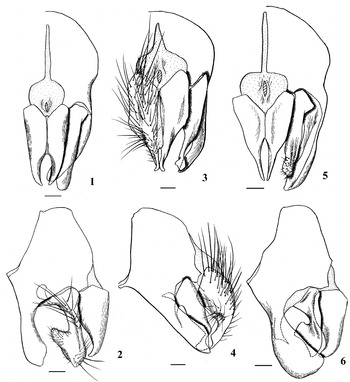
Epandrium, surstylus, and cerci in dorsal view (1, 3, 5) and lateral view (2, 4, 6). 1, 2, Parerigone aurea (hairs omitted in 1, those on epandrium and cerci omitted in 2); 3, 4, P. brachyfurca (hairs omitted on epandrium, surstylus, and right cercus in 3, those on epandrium and surstylus omitted in 4); 5, 6, P. tianmushana (hairs omitted except on right surstylus in 5). Scale bars =0.2mm.

I am pleased to dedicate this paper to the coordinators of the Manual of Nearctic Diptera for their contribution to Diptera systematics and their efforts in building the enormous Diptera collection in the CNC.
Material and methods
This study was based mainly on specimens from the collection of the Kyushu University Museum, Japan. The collections cited in this work are as follows:
- BLKU
Biosystematics Laboratory, Graduate School of Social and Cultural Studies, Kyushu University, Motooka, Fukuoka,Japan
- CNC
Canadian National Collection of Insects, Arachnids and Nematodes, Agriculture and Agri-Food Canada, Ottawa, Ontario, Canada
- FMNHH
Zoological Museum, Finnish Museum of Natural History, University of Helsinki, Helsinki, Finland
- IZCAS
Institute of Zoology, Chinese Academy of Sciences, Beijing, People's Republic of China
- KUM
Kyushu University Museum, Kyushu University, Hakozaki, Fukuoka, Japan
- NHMW
Naturhistorisches Museum Wien, Vienna, Austria
Terminology used in the description follows McAlpine (1981). In the male terminalia, the terms phallus, pregonite, and postgonite are adopted following Sinclair (Reference Sinclair, Papp and Darvas2000) instead of aedeagus, gonopod, and paramere as used by McAlpine (Reference McAlpine, McAlpine, Peterson, Shewell, Teskey, Vockeroth and Wood1981). Measurements were made in a similar manner to Shima (Reference Shima1996).
Parerigone Brauer
Parerigone Brauer, Reference Brauer1898: 540. Type species: Parerigone aurea Brauer, Reference Brauer1898, by monotypy.
Parerigonesis Chao and Sun in Chao et al., Reference Chao, Sun and Zhou1990: 236. Type species: Parerigonesis huangshanensis Chao and Sun, by original designation.
Medium-sized to large flies; head dichoptic; eye with dense fine hairs; frontal vitta widened anteriorly; inner vertical seta well developed; outer vertical seta absent; 1 reclinate orbital seta in male; 1 outwardly directed prevertical and 1 proclinate orbital seta in female; parafacial weakly narrowed below, bare; face weakly convex, lower margin strongly produced forward and extending well beyond base of vibrissa; 3–5 subvibrissal setae; occiput without black setulae. Antenna rather short, falling short of lower margin of face; arista bare or pubescent, 2nd aristomere short. Proboscis shorter than eye height; labella large; palpus slender and long, longer than antenna.
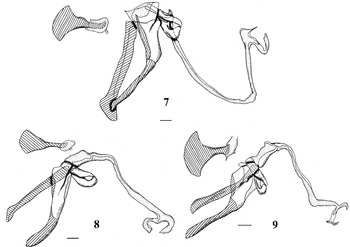
Hypandrium, pregonite, postgonite, and phallus in lateral view. 7, Parerigone aurea Brauer; 8, P. brachyfurca; 9, P. tianmushana. Phallus extracted in 8 and 9. Scale bars=0.2mm.

Prosternum and proepisternum bare; postpronotal lobe with 4 strong setae, of which 3 basal setae are set in a triangle; 2 presutural and 2–3 postsutural acrostichal setae; 3 presutural and 3 postsutural dorsocentral setae; 0 presutural and 2 postsutural intra-alar setae, postsutural setae rather widely separated; 3 supra-alar setae, anterior seta fine; anepimeral seta present or absent, if present, then fine and not extending beyond posterior margin of upper calypter; 3 katepisternal setae; anatergite bare or with fine hairs; metathoracic spiracle large, larger than apex of halter, posterior lappet rounded and covering posterior half of spiracle; scutellum with 3 or 4 marginal setae, of which the apical setae are crossed horizontally, and 1–2 pairs of discal setae. Wing hyaline, at most weakly tinged with pale yellowish brown; tegula black; basicosta black or reddish yellow; costagial setae fine and short, not extending beyond humeral crossvein; costal spine short, at most 1.5 times as long as costal setae; costa setulose ventrally from base to vein R1; base of vein R4+5 with 1 or 2 setulae dorsally; bend of vein M rounded, closer to wing margin than to dm-cu crossvein; vein CuA1 not reaching wing margin. Legs with claws and pulvilli very long in male, short in female; fore tibia with 2 posterior setae, 3 preapical dorsal setae, inner seta fine, and 1 apical ventral seta; mid-tibia with 2 or 3 anterodorsal, 0–3 ventral, and 2–3 posterodorsal setae; hind tibia without apical ventral seta.
Abdomen long ovate; mid-dorsal excavation of syntergite 1+2 at most extending to anterior margin of median marginal setae; syntergite 1+2 with 2 strong median marginal and a strong lateral marginal setae; 3rd and 4th tergites with 2 median discal and 4–8 median marginal setae; 5th tergite with rows of discal and marginal setae.
Male terminalia: Fifth sternite U-shaped or broadly V-shaped, broadly excavated posteromedially, usually without membraneous area anterior to the excavation; 6th tergite entire, free from syntergosternite 7+8; 6th sternite subsymmetrical, articulated with syntergosternite 7+8 on left side and narrowly separated from it on right side; intersegmental membrane between 6th sternite and hypandrium forming a large anteriorly concave pouch in which apical part of phallus is set when resting; epandrium large, with dense hairs, anteroventral invagination at most only weakly developed; hypandrium broadly membraneous on posteroventral portion, hypandrial arm short or absent, hypandrial apodeme long; pregonite short, rod-like, weakly swollen at apex, at most narrowly fused with hypandrium at base; postgonite narrow, rod-like, closely associated with pregonite; cerci separated or fused dorsally, with dense hairs; basiliform sclerite small or absent; basiphallus short; epiphallus absent; distiphallus very long and curved dorsally, flattened and rather broad, narrowly sclerotized on lateral portion, apex enlarged and varied in form; aedeagal guide undeveloped; ejaculatory apodeme large or small; ejaculatory duct short.
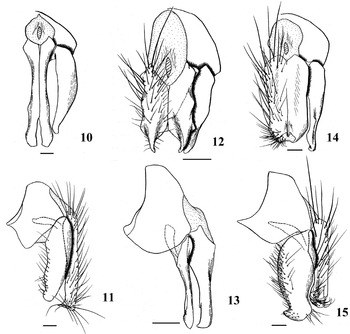
Epandrium, surstylus, and cerci in dorsal view (10, 12, 14) and lateral view (11, 13, 15). 10, 11, Parerigone huangshanensis (hairs omitted in 10, omitted on epandrium in 11); 12, 13, P. macrophthalma (hairs omitted except on right cercus in 12); 14, 15, P. takanoi (hairs omitted on epandrium, surstylus, and right cercus in 14, omitted on epandrium in 15). Scale bars=0.2mm.

Female terminalia: Sixth tergite long and broad; 6th and 7th abdominal spiracles on 6th tergite; 6th sternite long and broad, narrowed posteriorly; 7th tergite long and broad; 7th sternite long, divided into two rounded or elongate lobes on posterior portion, anterior portion invaginated and articulated with anterior invagination of 6th sternite; 8th tergite of small hemitergites; 8th sternite long and strongly sclerotized, posterior portion strongly curved ventrally and forming a piercer; epiproct absent; cercus small.
Remarks
Parerigone may be distinguished from other genera of Tachinidae by the combination of the following characters: 2 postsutural intra-alar setae rather widely separated; 3 basal postpronotal setae arranged in a triangle; metathoracic spiracle large, larger than apex of halter; prosternum and proepisternum bare; eye densely haired; occiput without black setulae; abdominal syntergite 1+2 not excavated to posterior margin, with strong median marginal setae.
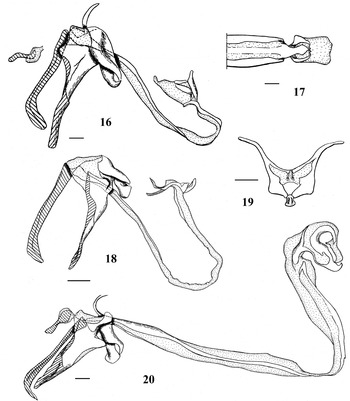
Hypandrium, pregonite, postgonite, and phallus in lateral view (16, 18, 20) and apex of phallus in posterodorsal view (17, 19). 16, 17, Parerigone hunangshanensis; 18, 19, P. macrophthalma; 20, P. takanoi. Scale bars=0.2mm.

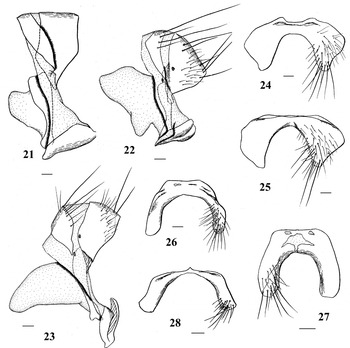
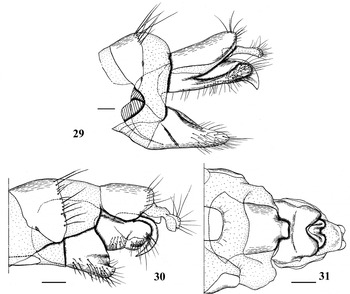
This genus is very characteristic in the structure of the male terminalia: 6th abdominal tergite long and entire, free from syntergosternite 7+8 (Figs. 21–23); pregonite and postgonite small and rod-like, closely associated, the former narrowly connected with hypandrium on posterodorsal margin; phallus elongate and curved dorsally in resting position, broadly membraneous, with a complex apical structure; epiphallus absent; aedeagal guide absent (Figs. 7–9, 16, 18, 20, 36). Although the free 6th abdominal tergite is not known in other phasiine genera (Tschorsnig Reference Tschorsnig1985), the structure of the pregonite, postgonite, and phallus shows the characteristics of the subfamily Phasiinae. In the female terminalia the 7th abdominal tergite and sternite are long and broad and the 8th sternite is long and modified into a piercer (Figs. 29–31). These features are found only in members of the Phasiinae. The long and dorsally curved, broadly membraneous phallus, which is set in a well-developed pouch of intersegmental membrane between the 6th sternite and the hypandrium when resting, may be a synapomorphy of members of this genus.
Chao et al. (Reference Chao, Sun and Zhou1990) proposed a new genus, Parerigonesis, for three new Chinese species, P. flavihirta Chao and Sun, P. nigrocauda Chao and Sun, and P. huangshanensis, mainly because of differences in the number of marginal setae on the scutellum. Tschorsnig and Richter (Reference Tschorsnig, Richter, Papp and Darvas1998) treated Parerigonesis as a junior synonym of Parerigone without giving a reason. Differences in the number of marginal scutellar setae do not appear sufficient for recognizing a genus separate from Parerigone. Many other characters, including the male terminalia, suggest that the species of Parerigonesis are better included in Parerigone, and I agree with Tschorsnig and Richter's (Reference Tschorsnig, Richter, Papp and Darvas1998) treatment of Parerigonesis.
Male 5th sternite, 6th tergite, 6th sternite, and syntergosternite 7+8 in lateral view (21–23) and male 5th sternite in ventral view (24–28) (hairs on left side omitted in 24, 25, and 27 and those on right side omitted in 27). 21, Parerigone brachyfurca (hairs omitted); 22, P. flavipes (hairs on 5th sternite omitted); 23, P. takanoi; 24, P. aurea; 25, P. tienmushana; 26, P. huangshanensis; 27, P. macrophthalma; 28, P. takanoi. Scale bars=0.2mm.

The male terminalia of P. aurea, P. brachyfurca Chao and Zhou, and P. tianmushana Chao and Sun are distinct in that the epandrium is strongly expanded posteroventrally, forming a long, flattened lobe (Figs. 1–6). This structure is not found in P. flavihirta and P. huangshanensis (assigned to Parerigonesis by Chao et al. Reference Chao, Sun and Zhou1990) or in P. macrophthalma Herting, P. takanoi Mesnil, and the new species described here (Figs. 10–15). Chao et al. (Reference Chao, Sun and Zhou1990) described and illustrated this peculiar epandrial outgrowth but did not appear to pay much attention to it, even though it has not been found in other Tachinidae. The first three species share a similar structure of the phallus and male 5th sternite (Figs. 7–9, 24, 25) and are considered to be closely related to each other, even though their cerci and surstylus are fairly different in structure. Despite the peculiarity of the epandrium and similarity of the phallus, the structure of the male terminalia in these species is fundamentally the same as that of other species of this genus, such as P. huangshanensis, P. macrophthalma, P. takanoi, and the new species described here (the male of P. nigrocauda is unknown and the terminalia of P. eristaroides and P. malaisei have not been examined).
Parerigone flavihirta (Chao and Sun) appears to be very similar to the Japanese species P. takanoi Mesnil. They are possibly conspecific, based on the original description of the former, the illustration of its male genitalia, and the key to species by Chao et al. (Reference Chao, Sun and Zhou1990) (cf. Figs. 12, 13, 20, and Chao et al. 1990, figs. 5c, 5d), but a final decision must await an examination of the holotype in IZCAS. I have identified a Japanese specimen as P. huangshanensis because of very similar male terminalia. This species resembles P. takanoi very closely and they are difficult to discriminate on the basis of superficial appearance, the only difference between them being male vertex width, as shown in the key presented here. In the original description Chao et al. (Reference Chao, Sun and Zhou1990) also mentioned a close resemblance between P. flavihirta and P. huangshanensis, but their key to species is misleading.
Based on the male terminalia, Parerigone appears to be most closely related to Zambesomima Mesnil, as it has a long, curved, and broadly membraneous phallus.
Known species of Parerigone
Parerigone aurea Brauer
(Figs. 1, 2, 7, 24, 29)
Parerigone aurea Brauer, Reference Brauer1898: 540. Holotype male (NHMW).
Type locality: Russia, Primorskiy Kray, Khasan District, Narva Peninsula.
Materials examined
RUSSIA. 1 female, Ussuriysk Reserve South Central, 140m, Primorskiy, Russia, 16.vii.1990, T. Saigusa. CHINA. 1 female, Wangkoushang, 1400–1500m, Fuping, Shaanxi, 25.v.1997, H. Shima; 1 male, 1 female, 3km NW Donghetai, 1500m, Fuping, Shaanxi, 25–26.vii.1995, A. Nakanishi and T. Saigusa; 1 female, Shuimoping, 1500m, SSW of Banfangzi, Zhouzi, Shaanxi, 3.vii.1995, H. Shima (KUM).
Distribution
Russia (southern Far East), China (Heilongjiang, Shaanxi*, Sichuan). *Newly recorded.
Parerigone brachyfurca Chao and Zhou
Parerigone brachyfurca Chao and Zhou in Chao et al., Reference Chao, Sun and Zhou1990: 234. Holotype male (IZCAS).
Type locality: China, Sichuan, Luding Co., Moxi.
Female terminalia in lateral view (29, 30) and ventral view (31). 29, Parerigone aurea; 30, 31, P. takanoi (hairs omitted). Scale bars=0.25mm.

Materials examined
CHINA. 4 males, W of Hetaoping, 1500–1550m, Zuoshui, Shaanxi, 18.vi.1997, H. Shima; 1 male, Hetaoping, 1650–1700m, Zuoshui, Shaanxi, 18–20.vi.1997, H. Shima; 3 males, Yingpao-linchang, 1800m, Zuoshui, Shaanxi, 10.vii.1997, H. Shima (KUM). VIETNAM. 1 female, Tam Dao, 900m, Vinh Phu Province, 28.iv.2000, R. Matsumoto (OMNH).
Distribution
China (Shaanxi, Sichuan), Vietnam*. *Newly recorded.
Parerigone eristaloides Mesnil
Parerigone eristaloides Mesnil, Reference Mesnil1953: 156.
Holotype male (FMNHH).
Type locality: Myanmar, Kambaiti.
Material examined
MYANMAR. Holotype male, Kambaiti, 2000m, 24.v.1934, Malaise (FMNHH).
Distribution
Myanmar.
Parerigone flavihirta (Chao and Sun)
Parerigonesis flavihirta Chao and Sun in Chao et al., Reference Chao, Sun and Zhou1990: 237. Holotype male (IZCAS).
Type locality: China, Yunnan, Lushui Co., Pianma.
Distribution
China (Yunnan).
Parerigone huangshanensis (Chao and Sun)
(Figs. 10, 11, 16, 17, 26)
Parerigonesis huangshanensis Chao and Sun in Chao et al., Reference Chao, Sun and Zhou1990: 238. Holotype male (IZCAS).
Type locality: China, Anhui, Huangshan.
Material examined
JAPAN. 1 male, Sakurabayashi, Mt. Iwaki, Aomori, 5.viii.1971, S. Fukushi (KUM).
Distribution
China (Anhui), Japan* (Honshu). *Newly recorded.
Parerigone macrophthalma Herting
(Figs. 12, 13, 18, 19, 27)
Parerigone macrophthalma Herting, Reference Herting1981: 16. Holotype female (BLKU).
Type locality: Japan, Fukuoka, Aburayama.
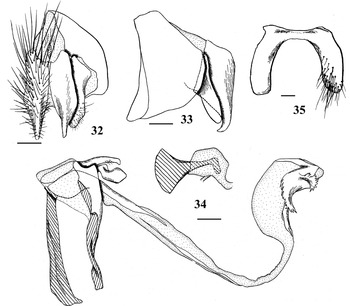
Male terminalia of Parerigone flavipes. 32, epandrium, surstylus, and cerci in dorsal view (hairs on right cercus omitted); 33, epandrium, surstylus, and cerci in lateral view (hairs omitted); 34, hypandrium, pregonite, postgonite, and phallus in lateral view; 35, 5th sternite in ventral view (hairs on left side omitted). Scale bars=0.2mm.

Materials examined
JAPAN. 1 male, Onagawa, Miyagi, 18.v.1974, S. Shinonaga; 1 male, Mt. Iozan, Ishikawa, 15.vi.1973, H. Kurahashi; 1 female, Furutone, Chiba, 28.vi.1996, R. Kano and H. Kobayashi; holotype female, paratype male and 3 males, Aburayama, Fukuoka, Japan, 11.vi.1979, H. Shima (BLKU); 14 males, same locality as holotype, 17.iv.1987, 23.iv.1983, H. Shima; 1 female, same locality as holotype, 21–28.iv.1983, yellow pan trap, H. Shima; 1 male, Takeda, Ohita, 1.vii.1970, Kano and Shinonaga (KUM).
Distribution
Japan (Honshu, Kyushu).
Parerigone malaisei Mesnil
Parerigone malaisei Mesnil, Reference Mesnil1957: 61. Holotype male (FMNHH).
Type locality: Myanmar, Kambaiti.
Material examined
MYANMAR. Holotype male, Kambaiti, 7000 ft., 28.v.1934, R. Malaise (FMNHH).
Distribution
Myanmar.
Parerigone nigrocauda (Chao and Sun)
Parerigonesis nigrocauda Chao and Sun in Chao et al., Reference Chao, Sun and Zhou1990:239. Holotype female (IZCAS).
Type locality: China, Zhejiang, Tianmu Shan.
Distribution
China (Zhejiang).
Parerigone takanoi Mesnil
(Figs. 14, 15, 20, 23, 28, 30, 31)
Parerigone takanoi Mesnil, Reference Mesnil1957: 62. Holotype male (CNC).
Type locality: Japan, Hokkaido, Obihiro, Kawanishi.
Material examined
JAPAN. Holotype male, Kawanishi, Obihiro, Hokkaido, 15.vi.1950, H. Ono (CNC); 2 females, Imperial Palace, Tokyo, 18.iv, 20.v.1986, S. Shinonaga; 1 male, Kirigamine, Nagano, 25.vii.1971, S. Shinonaga; 1 female, Mt. Asama, Nagano, 21.vii.1971, R. Kano; 1 female, Nasu-shiobara, Tochigi, 14.v.2007, T. Matsumura; 1 male and 2 females, Oike, Shonai-machi, Ohita, 14.v.1998, R. Matsumoto (KUM).
Distribution
Japan (Hokkaido, Honshu, Kyushu).
Parerigone tianmushana Chao and Sun
(Figs. 5, 6, 9, 25)
Parerigone tianmushana Chao and Sun in Chao et al., Reference Chao, Sun and Zhou1990:231. Holotype male (IZCAS).
Type locality: China, Zhejiang, Tianmu Shan.
Material examined
CHINA. 1 male, 5km N of Donghetai, 1650–1800m, Dadianzi, Fuping, Shaanxi, 26.vi.1997, H. Shima (KUM).
Distribution
China (Shaanxi*, Zhejiang). *Newly recorded.
Parerigone flavipes sp. nov.
Type material
Holotype male, Nepal, 28°00′N, 85°00′E, 10,500 ft., 31.v.1967, Malaise trap. (CNC).
Recognition
This species is easily distinguished from other congeners by its yellowish legs, which are not otherwise known in this genus. This species is also characteristic in having only 2 postsutural intra-alar setae. This character state is also known in P. nigrocauda Chao and Sun from China, but that species has black legs and only 3 pairs of marginal setae on the scutellum.
Description
Male. Head black in ground color, reddish on parafacial obliquely from upper anterior margin to lower eye margin and gena except genal dilation, pale yellowish on lower face and brownish on frontal vitta; dense golden yellowish pruinosity on fronto-orbital plate, parafacial, and gena except genal dilation, grayish white on face, genal dilation, and occiput; antenna brown, apices of scape and pedicel and basal 1/3 of 1st flagellomere reddish brown; palpus reddish yellow. Vertex about 0.13 times as wide as head width; frontal vitta subequal in width to fronto-orbital plate at middle; parafacial weakly narrowed below, slightly wider than 1st flagellomere at middle height; face weakly convex, lower margin extending beyond base of vibrissa by about length of pedicel; gena about 0.3 times as wide as eye height. Inner vertical seta fine but long, about 3/5 as long as eye height; 1 fine and long outer vertical seta, about 2/3 as long as inner seta; ocellar seta indistinct; 1 rather fine reclinate orbital seta, about 2/3 as long as inner vertical seta; 9–10 long fine frontal setae, lowest seta nearly level with middle of pedicel; fronto-orbital plate with only a few short fine black hairs among row of frontal setae; vibrissa inserted well above level of lower margin of face by about length of pedicel; facial ridge with only several fine short hairs just above vibrissa; 3 long subvibrissae; genal dilation with several black hairs on anterior portion mixed with reddish yellow hairs; postocular setae fine and long, longer on upper portion; occiput with yellowish pile. Antenna falling short of lower margin of face by about length of pedicel; pedicel bearing black hairs and a long seta, the latter longer than pedicel; 1st flagellomere about 2.5 times as long as pedicel. Palpus weakly clavate, longer than pedicel and 1st flagellomere combined (6:5).
Thorax black in ground color, with rather dense grayish white pruinosity; dorsum with 4 narrow longitudinal vittae, inner vitta about 1/2 as wide as outer vitta and stopped at anterior 1/4 of postsutural area of scutum. Dorsum with black hairs and pleura mostly with pale yellowish hairs; 2 presutural and 2 postsutural acrostichal setae; 3 presutural and 3 postsutural dorsocentral setae; anepimeral seta fine but easily distinguishable, black; some hypopleural setae yellowish; anatergite bare; scutellum with 2 rather fine discal and 4 rather strong marginal setae, discal seta about 1.2 times as long as scutellum; basal, lateral, and subapical setae subequal in length and slightly more than twice length of scutellum; apical scutellar seta rather fine, about 1.5 times as long as scutellum. Posterior spiracle large, its long diameter subequal in length to distance between anterior and posterior katepisternal setae.
Wing hyaline, evenly but weakly tinged with pale brown; basicosta black; lower calypter translucent pale brown. Costa between subcosta and vein R1 about 1/3 as long as that between R1 and R2+3; base of vein R4+5 with 1 fine and rather long setula dorsally and ventrally; bend of vein M about 2 times closer to wing margin than to dm-cu crossvein. Lower calypter with rather long fringe.
Legs broadly reddish yellow, base of fore coxa, entire mid and hind coxae, and trochanters brownish, base of tibiae darkened, tarsi black, claws brown and pulvilli pale grayish white. Coxae, trochanter, and ventroproximal portions of femora with pale yellowish hairs; mid-tibia with 2 anterodorsal setae, without ventral seta; hind tibia with 2 preapical dorsal setae; claws and pulvilli very long, almost as long as combined length of 4th and 5th tarsomeres.
Abdomen black in ground color, entirely covered with rather dense grayish white pruinosity, a pair of irregular oval spots appearing with direction of light on dorsum of 3rd and 4th tergites. Syntergite 1+2 excavated dorsally on anterior 1/2; hairs on dorsum black except on basal excavation of syntergite 1+2, yellowish on basal excavation of syntergite 1+2 and most of venter; yellowish hairs on venter dense and long on basal portion; syntergite 1+2 with 4–6 fine lateral discal, 2 median marginal, and 1 lateral marginal setae; 3rd tergite with 2 strong median discal, 1 fine lateral discal, 2 strong median, and 2 strong lateral marginal setae; 4th tergite with 2 strong median discal, 1 fine lateral discal, and a row of strong marginal setae; 5th tergite with rows of discal and marginal setae.
Body length: 8.6mm.
Distribution
Nepal.
Etymology
The specific name is taken from the yellowish legs of this species.
Key to species of Parerigone
1. Scutellum with 3 pairs of marginal setae; male mid-tibia without ventral seta (male of P. nigrocauda unknown); anatergite with fine hairs (unknown in nigrocauda)………2
— Scutellum with 4 pairs of marginal setae; male mid-tibia with or without ventral seta; anatergite bare………4
2. Mid-tibia with only 1 anterodorsal seta; 5th abdominal tergite broadly shining black; 2 postsutural acrostichal setae………nigrocauda (Chao and Sun) (after Chao et al. Reference Chao, Sun and Zhou1990)
— Mid-tibia with 2 anterodorsal setae; abdomen evenly covered with yellowish or grayish pruinosity; 3 postsutural acrostichal setae………3
3. Male vertex about 1/5 of head width, about 1/4 in female; gena about 0.42 times as wide as eye height in both sexes; male cerci broad, nearly rectangular (Fig. 14); phallus long and broad, flattened (Fig. 20) .............takanoi Mesnil (?=flavihirta (Chao and Sun))
— Male vertex about 1/8 of head width; gena about 0.36 times as wide as eye height in male; male cerci narrow, apex sharply down-curved (Figs. 10, 11); phallus somewhat shorter, at most 2 times as long as cerci (Fig.16)………huangshanensis (Chao and Sun)
4. Hairs on thorax and abdomen black; hind tibia with 3 preapical dorsal setae; gena narrow, about 1/5 of eye height in lateral view; mid-tibia with 2 ventral setae………macrophthalma Herting
— At least pleural region of thorax and abdominal venter with yellowish or pale yellowish white hairs; hind tibia with 2 preapical dorsal setae; gena wider, more than 1/4 of eye height; mid-tibia with only 1 ventral seta or seta absent………5
5. Legs reddish yellow except dark brown on mid and hind coxae and tarsi; 2 postsutural acrostichal setae; mid-tibia with 2 anterodorsal setae, without ventral seta in male; male vertex narrow, slightly more than 1/8 of head width; thoracic and abdominal dorsa mainly with black hairs, reddish yellow hairs confined on thoracic pleura and abdominal venter………flavipes sp. nov.
— Legs black, at most tibia reddish yellow; 3 postsutural acrostichal setae; mid-tibia with 1–2 anterodorsal seta, with or without ventral seta in male………6
6. Body mostly covered with dense yellowish or golden yellowish hairs, postsutural scutum and abdominal dorsum sometimes with black hairs; mid-tibia with 1 ventral seta………7
— Thoracic and abdominal dorsum with black hairs, pale yellowish hairs confined to thoracic pleura and anteroventral portion of abdomen; mid-tibia with or without ventral seta in male………8
7. Mid-tibia with 1 anterodorsal seta; parafacial slightly wider than 1st flagellomere at mid-height; 1st flagellomere about 3 times as long as pedicel in male; pedicel with short yellow hairs; palpus black or dark brown; gena slightly less than 1/2 of eye height; tibiae black………eristaloides Mesnil
— Mid-tibia with 2 anterodorsal setae; parafacial slightly narrower than 1st flagellomere at mid-height; 1st flagellomere about 2.5 times as long as pedicel in male and female; pedicel with black hairs; palpus reddish yellow; gena about 2/5 of eye height; tibiae reddish brown, darkened basally and apically………aurea Brauer
8. Basicosta reddish brown; tibiae reddish yellow, mid-tibia without ventral seta in male; mid-dorsal excavation of syntergite 1+2 extending to anterior edge of median marginal setae………malaisei Mesnil
— Basicosta black; tibiae black, at most dark reddish brown on middle portions; mid-tibia with 1 2 ventral setae; mid-dorsal excavation of syntergite 1+2 at most extending to its anterior 2/3………9
9. Thorax and abdomen with dense pale yellowish gray white pruinosity; gena about 2/7 of eye height; vertex 1/5 of head width in male; 1st flagellomere about 3 times as long as pedicel in male (female unknown)………brachyfurca Chao and Zhou
— Thorax and abdomen with dense grayish pruinosity; gena about 1/3 of eye height in male, 1/5.5 in female; vertex 1/6 of head width in male, 1/4.5 in female; 1st flagellomere about 2.5 times as long as pedicel………tianmushana Chao and Sun
Acknowledgements
I am indebted to J.E. O'Hara, Agriculture and Agri-Food Canada, Ottawa, P. Vilkamaa, Finnish Museum of Natural History, Helsinki, and W.-x. Zhang, Peking University, Beijing, for their help in examining specimens. I am grateful to D.M. Wood, Agriculture and Agri-Food Canada, and J. Ziegler, Natural History Museum at Humbold University, Berlin, for their suggestions.