Introduction
The first 1,000 days of life have been shown to be important for adult health. According to the Development Origins of Health and Disease theory, exposure to certain conditions in this period may trigger metabolic programming that could increase susceptibility to chronic diseases, such as obesity, diabetes and cardiovascular disease later in life.Reference Rich-Edwards, Colditz and Stampfer1–Reference Gluckman, Hanson and Beedle3 In this context, type of early feeding (breast milk or formula) is potentially associated with long-term health outcomes.Reference Singhal and Lucas4,Reference Kelishadi and Farajian5 The World Health Organization’s breastfeeding recommendation until 24 months of life6 coincides with the end of the 1,000-day period. In Brazil, approximately 40% of children aged 9–12 months are no longer breastfed,Reference Venancio, Escuder, Saldiva and Giugliani7 and this scenario seems to be even worse in high-income countries, where more than 70% of 12-month-old children are not breastfed.Reference Victora, Bahl and Barros8
The development of food preferences and dietary habits in the short and long run could be influenced by breastfeeding.Reference Cooke, Wardle, Gibson, Sapochnik, Sheiham and Lawson9–Reference Robinson, Ntani and Simmonds13 Proposed underlying mechanisms are related to the presence of leptin in human milk but not in infant formulas, which plays a role in hypothalamic programming of satiety,Reference Palou and Picó14,Reference Gardner and Rhodes15 and to the central reward systems.Reference Ong, Gugusheff and Muhlhausler16 Additionally, being exposed to the flavors from the maternal diet during breastfeeding or even earlier during gestation via amniotic liquid may be important for the development of food preferences and propensity of accepting new foods in early life.Reference Ong, Gugusheff and Muhlhausler16,Reference Mennella, Jagnow and Beauchamp17
Longer breastfeeding has been associated with lower consumption of processed foods,Reference Scholtens, Brunekreef and Smit10 preference for natural sources of animal proteinReference Yuan, Rigal and Monnery-Patris11 and higher adherence to healthy dietary patternsReference Lioret, Betoko and Forhan18 in 2–8-year old children. Although these findings probably reflect the mother’s lifestyle, a Finnish cohort suggested reasonable stability of dietary patterns identified throughout infancy, adolescence and adulthood.Reference Mikkilä, Räsänen, Raitakari, Pietinen and Viikari19 In adult life, this association is scarcely reported and controversial.Reference De Kroon, Renders, Buskermolen, Van Wouwe, van Buuren and Hirasing12,Reference Robinson, Ntani and Simmonds13,Reference Victora, Barros, Lima, Horta and Wells20 As far as we know, only one study used the dietary patterns approach to assess the relationship between former habits and diet during adulthood.Reference Robinson, Ntani and Simmonds13 Among 3,217 adults, those who were bottle-fed compared to those only breastfed during the first year of life had lower adherence to the prudent pattern. Despite limitations (different composition of infant formula in the 1930s, lack of information about breastfeeding duration and possible residual confounding), these findings raised the need to deepen knowledge in this issue.
Since dietary patterns analysis allows a broad evaluation considering synergism and cumulative effect of nutrients in the same pattern, this has been preferred in nutritional epidemiology. This approach is more appropriate than evaluating isolated nutrients or food groups when the objective is to identify associations between diet and health outcomes. Dietary patterns are population-specific, although similar food groups may be used to characterize patterns across different populations.Reference Hu21,Reference Wirfält, Drake and Wallström22
The Nutritionist’s Health Study (NutriHS) is a web-based study conducted on nutrition undergraduates and nutritionists that represents a unique opportunity to obtain good quality dietary information and to test association with early life events. We aimed to identify a posteriori dietary patterns of adult women from the NutriHS and examine if adherence to the identified patterns is influenced by breastfeeding duration, independent of maternal socioeconomic characteristics.
Methods
Design and participants
This is a cross-sectional analysis of NutriHS baseline data. Briefly, the NutriHS is a cohort conducted with the main objective of assessing predictors of cardiometabolic outcomes, retrospectively and prospectively, in non-pregnant undergraduates or nutrition graduates.Reference Folchetti, Silva, Almeida-Pititto and Ferreira23 Those who met the eligibility criteria and signed electronically the informed consent were invited to fill out structured questionnaires using the e-NutriHS system (http://www.fsp.usp.br/nutrihs/index.html). Questionnaires were presented in several blocks of questions whose filling was time-consuming. For the purpose of the present study, sociodemographic data, early life events, health aspects, physical activity and dietary intake questionnaires were considered. Participants were also invited to a face-to-face visit for physical examination and collection of biological samples at the São Paulo University health care center.
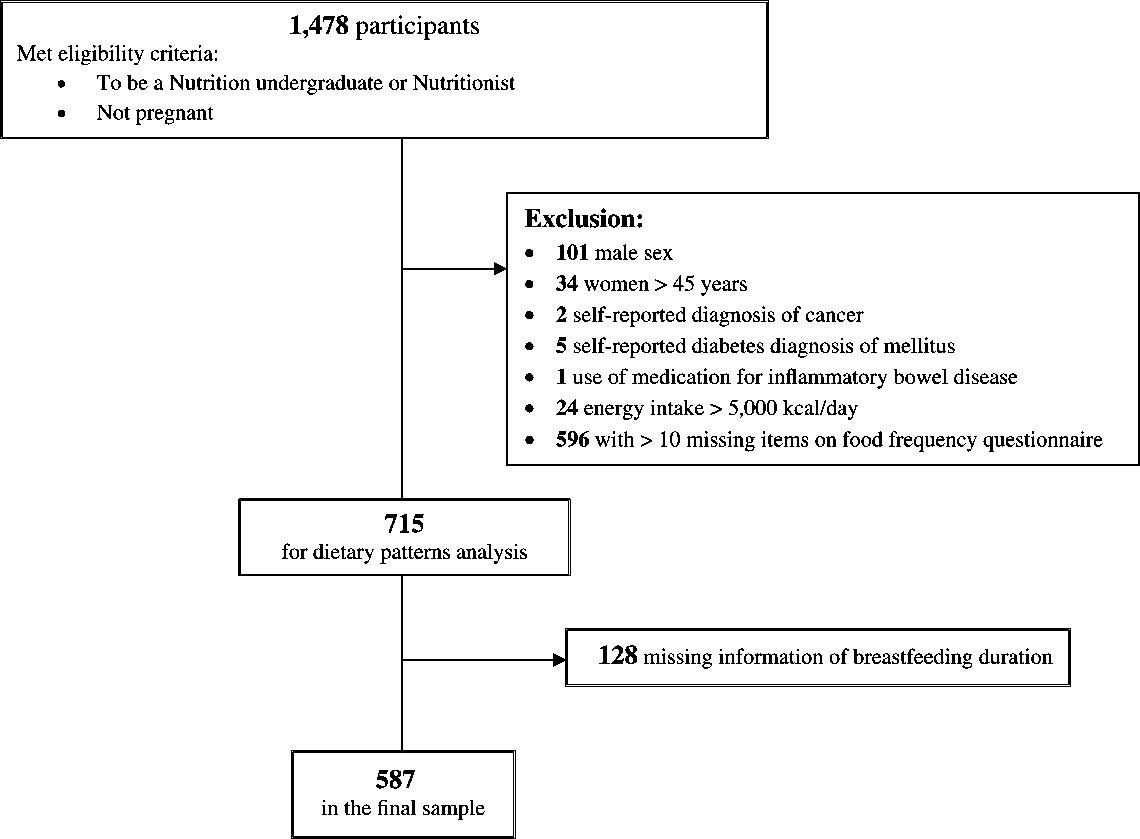
A total of 1,478 participants were recruited between March 2014 and October 2017. Inclusion criteria for the present analysis were female sex, age ≤ 45 years, without cancer, diabetes, or use of medication for inflammatory bowel disease. Only women were included in our analyses due to the scarcity of men in the NutriHS.Reference Folchetti, Silva, Almeida-Pititto and Ferreira23 Daily energy intake >5,000 kcal/day (percentile 97 of energy intake distribution) or <500 kcal/day,Reference Shlisky, Durward, Zack, Gugger, Campbell and Nickols-Richardson24 or missing information for more than 10 items in the food frequency questionnaire (FFQ) were exclusion criteria. Therefore, 587 women composed the final sample (Fig. 1).
Flow chart of NutriHS participants included in the present study, São Paulo, Brazil.

Dietary intake assessment
Dietary intake was assessed using a validated FFQ for adult population living in São Paulo.Reference Selem, Carvalho and Verly-Junior25 The FFQ had the previous year as the time frame and was composed of 101 food items with frequency options (0–10 times), and their respective time units (day, week, month or year) and portion options (described in three household measures and grams or milliliters). For statistical analysis, we standardized frequency in week times (since it was the time unit of frequency most reported), multiplied by quantitative portion, then we considered the weekly amount consumed (in grams or milliliters) to identify dietary patterns. Daily energy intake was estimated considering the USDA National Nutrient Database for Standard Reference.26
Participants with up to 10 food items with missing information regarding frequency but having fulfilled at least one of the three FFQ variables had median values inputted. If the three variables of a given food item were missing, absence of consumption was interpreted and zero was attributed.Reference Gaard, Tretli and Løken27,Reference Parr, Hjartåker, Scheel, Lund, Laake and Veierød28
Items were grouped into the following 36 food groups according to nutritional similarities, frequency of consumption and regional eating habits: bean; white rice; brown rice; lentil (lentil/dry and pea/chickpeas); noodles or pasta; roots; tubers and soups (cooked, baked or mashed potato/cassava/yam, cassava or maize flour, mayonnaise salad, vegetable soup and cream soup); fried fish and chicken; roasted fish and chicken; eggs; beef; processed meat (ham/mortadella/salami, nuggets/meatball, dried meat, sausage and bacon); pork meat (loin/steak); offal (chicken or bovine heart/liver); vegetables; olive oil or oil for salad dressing; salt; baked salted pastries; fast food (French fried potato or cassava, fried salted pastries, pizza and hot dog/hamburger); snacks (salty snacks and popcorn); industrialized sauces (shoyu and ketchup/mustard); sweets/desserts (biscuit without filling, stuffed/wafer/buttery, simple or stuffed cake, morning cereal, candy/lollipop, whipped cream/condensed milk, chocolate/bonbon, fruit jam, jelly, confectionery pie, pudding or mousse and ice cream); fruits; natural juice; oats; nuts (peanut/cashew/Brazil nuts/walnuts); white bread; whole grain bread; yogurt and fruit vitamin; whole milk; skimmed milk; spreading fat (mayonnaise, butter/margarine); white and yellow cheese; tea; coffee; industrialized beverages (industrial juice, soda, chocolate milk and soy-based drink); and alcoholic beverages (beer, wine and distilled ones).
Early life events and current life characteristics
Participants were instructed to request help of their mothers/guardians or to consult their birth cards before answering the early life events questionnaire. Breastfeeding duration (main exposure) was categorized as: <6; ≥6–<12; ≥12 months, the last being considered as the reference. We also obtained information about maternal education (<11; ≥11 years of education); pre-pregnancy body mass index (BMI) (<18.5; ≥18.5–<25; ≥25 kg/m2); mode of delivery (vaginal; C-section); and birthweight (<2.5; ≥2.5–<4.0; ≥4.0 kg).
Selected data regarding participants’ current life were employed in the analyses of this sub-study. Age (continuous and categorized as: ≤19; 20–34; ≥35 years), skin color (white; non-white), alcohol intake (never; <1 time/week; ≥1 time/week), graduation in nutrition (first half of the course; second half of the course; or graduates), family income (<6; 6–10; >10 minimum wages) and self-reported BMI (continuous and categorized as: <18.5; ≥18.5 and <25; ≥25 kg/m2) were described according to dietary patterns adherence.
Statistical analysis
Dietary pattern analysis
Factor analysis by principal component analysis (PCA) was employed to identify participant’s dietary patterns, which were the outcomes of main interest. Based on the correlation among food groups, food data were reduced to factors or ‘dietary patterns,’ facilitating the interpretation of dietary intake.Reference Hu21,Reference Wirfält, Drake and Wallström22 The number of factors identified was defined according to Kaiser criteria and scree plot (Supplementary Figure 1), in which eigenvalues ≥1.5 were considered, as well as personal interpretability. Before applying PCA, Kaiser–Meyer–Olkin (KMO) test and Bartlett’s test of sphericity were used to verify the sample adequacy (KMO > 0.5 and p-value of Bartlett’s test <0.05).Reference Castro, Baltar, Selem, Marchioni and Fisberg29 After factors extraction, orthogonal varimax rotation was applied. Although all factor loadings contributed to the dietary patterns scores, only food groups with factor loadings higher than |0.2| in a given pattern were considered relevant to characterize it; positive loadings indicated direct associations between food group and dietary pattern, while negative loadings meant inverse associations.Reference Newby, Weismayer, Akesson, Tucker and Wolk30 Each participant received a score of each dietary pattern. Dietary pattern scores were categorized into tertiles; the first was considered as the reference (low adherence) and the two highest tertiles were grouped as moderate-to-high adherence.
Descriptive and association analyses
Absolute and relative frequencies were described and chi-squared test used to compare dietary patterns adherence (low vs. moderate-to-high adherence) according to current life characteristics. The Kolmogorov–Smirnov test was used to evaluate normal distribution of continuous variables. Medians and interquartile ranges (IQRs) of energy intake (kcal/day), age and BMI were described and compared using the Mann–Whitney test, since these variables were not normally distributed.
Logistic regression models were employed to verify the association between breastfeeding duration and dietary patterns adherence during adult life. Confounding variables were selected according to the minimal sufficient adjustment recommended by the Directed Acyclic Graph (DAG), created in the online software DagittyReference Textor, Hardt and Knüppel31 (Supplementary Figure 2). Model 1 was adjusted for maternal education, pre-pregnancy BMI and mode of delivery. Considering energy intake as a competing exposure (i.e., it predicts the outcome but not related with any other variable in the model), a second model was adjusted for variables in model 1 plus daily energy intake in order to improve the precision. Hosmer–Lemeshow test was applied to verify the goodness of fit and all models met the criterium of p > 0.05.
All analyses were conducted using Stata statistical software (release 12, 2011, StataCorp LP, College Station, TX) and statistical significance considered at the level of 5%.
Results
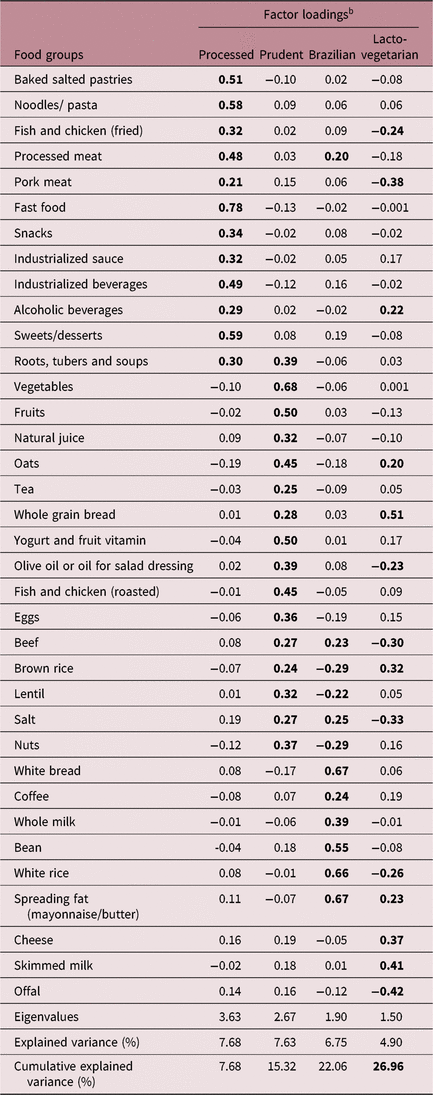
In a total of 715 participants, four dietary patterns were identified, which explained 26.7% of the total variance of food intake. Participants who were excluded from dietary pattern analysis due to missing dietary data were similar to those who were included, except for a higher percentage of graduate participants among the excluded ones (Supplementary Table 1). The first pattern, labeled Processed, was characterized by a high intake of baked salted pastries, noodles, roots/soups, fried white meat, processed and pork meat, fast food, snacks, industrialized sauces and beverages, alcoholic beverages and sweets. The second pattern, named Prudent, was characterized by a high intake of fruits (whole and juice), yogurt, oats, nuts, vegetables, oil for salad, salt, roots/soups, roasted white meat, beef, eggs, brown rice, lentil, whole grain bread and tea. The third pattern was named Brazilian since it was directly associated with the consumption of traditional foods such as white rice, bean, processed meat, beef, salt, white bread, spreading fat, whole milk and coffee, and inversely associated with brown rice, lentil and nuts. These three patterns showed the major contribution for the diet explained variance. The fourth pattern, Lacto-vegetarian, was associated with a high intake of alcoholic beverages, brown rice, whole grain bread, oats, spreading fat, cheese and skimmed milk and a low intake of animal protein sources (fish, chicken, pork, beef and offal), oil for salad dressing, salt and white rice (Table 1).
Factor loadings distribution for four dietary patterns identified in women from the NutriHS (n = 715), São Paulo, Brazila

a KMO test = 0.727; Bartlett’s test of sphericity, p < 0.001.
b Dietary pattern labels were informed by the food groups/items with factor loadings higher than |0.20| and in bold, all factor loadings contributed to the dietary patterns scores.
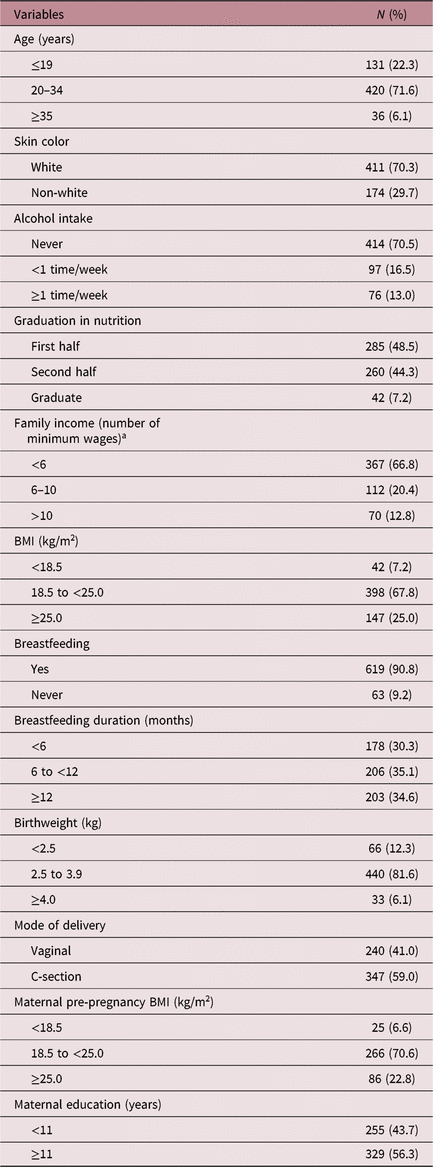
Among the 587 participants with information of food intake and breastfeeding, the majority was aged 20–34 years (median age 22; IQR 20–27 years) and reported white skin color and monthly family income lower than six minimum wages. Approximately 93% were undergraduates (49% of total sample had completed less than half of the course). A quarter of the sample was overweight or obese (median BMI 22.2; IQR 20.4–25.0 kg/m2). Regarding early life events, more than 90% of participants had been breastfed and, among these, 35% for at least 12 months. Almost 82% had adequate birthweight, 41% were born by vaginal delivery and 23% had mothers with excessive pre-pregnancy BMI (Table 2).
Current and early life characteristics of women from the NutriHS, São Paulo, Brazil

a One minimum wage is equivalent to 724.0 Brazilian real (or US$ 212.9).
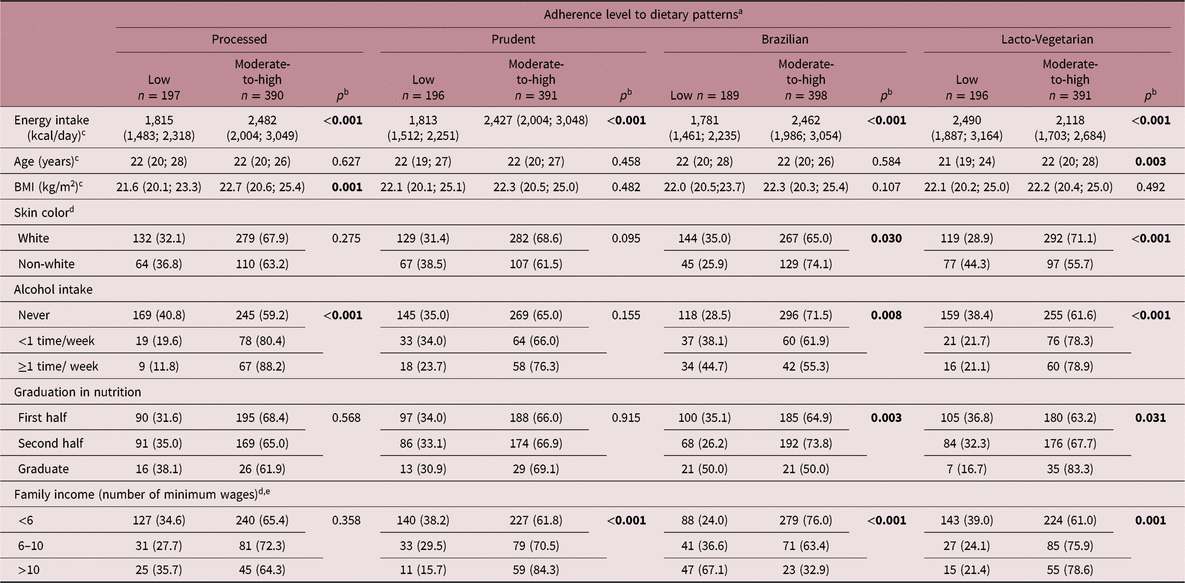
Median BMI was higher among women who presented moderate-to-high adherence to the Processed pattern compared to those with low adherence to this pattern. Women with higher adherence to the Lacto-vegetarian pattern had higher median age compared to those with lower adherence to this pattern. White women had higher probability of having moderate-to-high adherence to Lacto-vegetarian and lower to Brazilian patterns compared with non-white women. Participants who reported regular alcohol intake had higher probability of being classified into the two highest tertiles of adherence to Processed and Lacto-vegetarian pattern, and lower probability of moderate-to-high adherence to the Brazilian pattern. The subgroup of graduates was more likely to adhere to the Lacto-vegetarian pattern and less likely to the Brazilian one. Family income was directly associated with adherence to Prudent and Lacto-vegetarian patterns and inversely associated with adherence to the Brazilian one (Table 3).
Frequencies of dietary patterns adherence levels according to current lifestyle characteristics in women from the NutriHS, São Paulo, Brazil

a Dietary patterns adherence classified according to score tertiles (low adherence = 1st tertile; moderate-to-high adherence = 2nd + 3rd tertiles);
b p-value refers to chi-squared test;
c Continuous variables described as median (IQR); p-value refers to Mann–Whitney test;
d Sample reduction due to missing information (skin color: n = 585; family income: n = 549);
e One minimum wage is equivalent to 724.0 Brazilian real (or US$ 212.9).
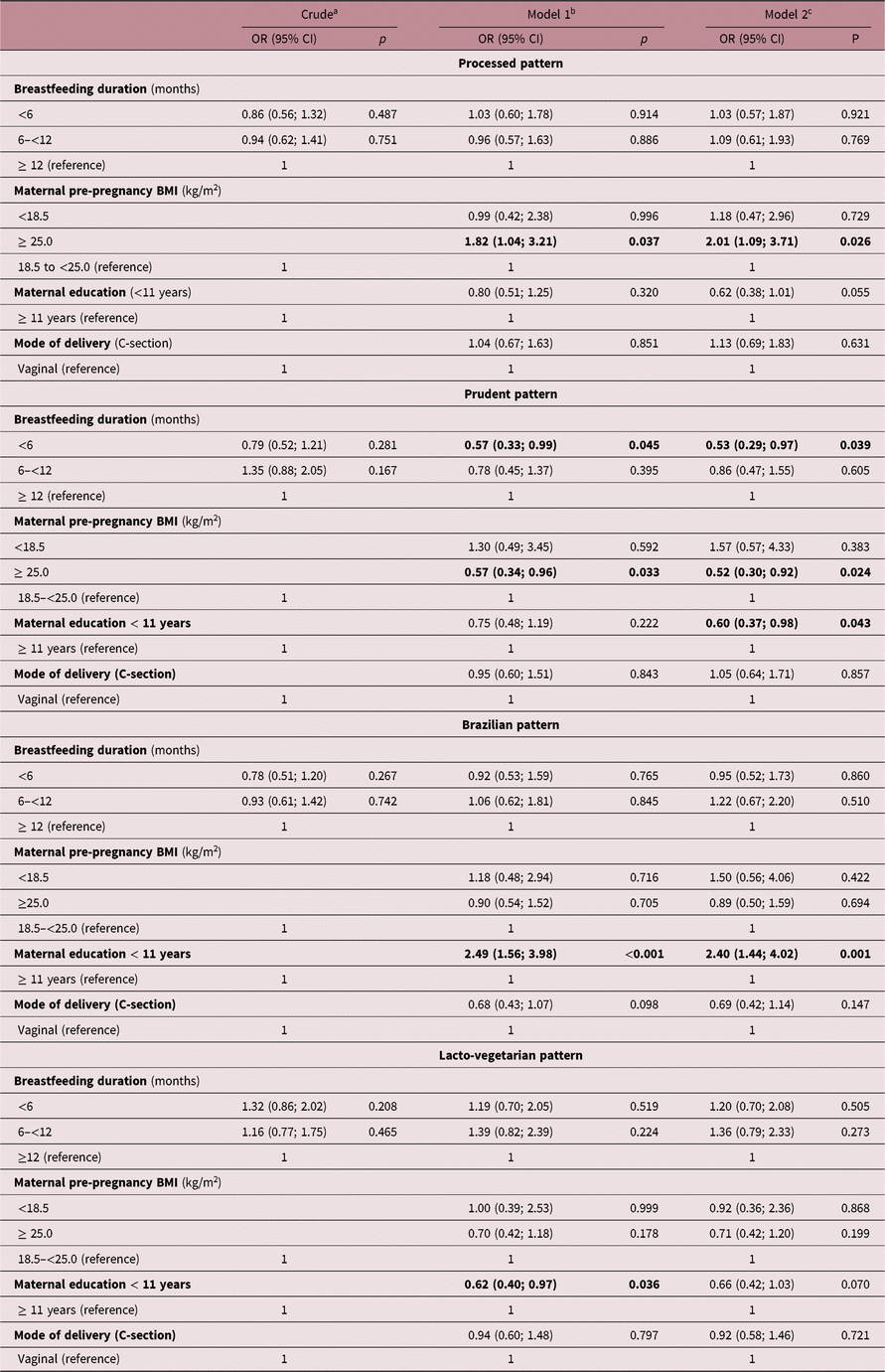
Participants who were breastfed for <6 months had approximately 47% lower chance of having moderate-to-high adherence to the Prudent pattern (odds ratio (OR) 0.53; 95% confidence interval (CI) 0.29; 0.97) during adult life compared to those breastfed for ≥12 months. Breastfeeding duration was not associated with adherence to Processed, Brazilian or Lacto-vegetarian patterns. Additionally, low maternal education was directly associated with adherence to the Brazilian pattern (OR 2.40, 95% CI 1.44; 4.02), and inversely associated with the Lacto-vegetarian one. The latter association showed to be dependent of energy intake. Offspring of mothers with excessive weight at conception had a higher chance of moderate-to-high adherence to the Processed (OR 2.01, 95% CI 1.09; 3.71) and a lower chance to the Prudent (OR 0.52, 95% CI 0.30; 0.92) pattern (Table 4).
Odds ratio (OR) of being classified into moderate-to-high adherence to dietary patterns according to breastfeeding duration in women from the NutriHS, São Paulo, Brazil

a n = 587;
b Model 1: adjusted for pre-pregnancy BMI, maternal education and mode of delivery (n = 376);
c Model 2: adjusted for variables from model 1 plus energy intake (n = 376);
BMI, body mass index.
Discussion
Using dietary pattern analysis, our study investigated the hypothesis that early feeding could be associated with food consumption later in life. This approach, compared to the traditional ones, has contributed to the knowledge about the relation between nutrition and diseases.Reference Wirfält, Drake and Wallström22 We identified four dietary patterns – Processed, Prudent, Brazilian and Lacto-vegetarian – in a special sample of young women with knowledge in nutrition. Only 35% of our sample was breastfed for at least 12 months, and compared to these, those who have received maternal milk for less than 6 months were less likely to adhere to the Prudent pattern in adult life. Offspring of mothers with pre-conception excessive weight had a higher chance of moderate-to-high adherence to the Processed dietary pattern, and a lower to the Prudent, while low maternal education seems to be directly associated with adopting traditional Brazilian dietary habits, and inversely associated with the Lacto-vegetarian pattern. Our findings are relevant since they reinforce the need of encouraging long breastfeeding which may have beneficial impact in further dietary habits, potentially conferring protection or risk for multiple diseases.
The Processed pattern was the one that most explained the diet variance and was similar to previously reported in Brazilian adults.Reference Olinto, Willett, Gigante and Victora32–Reference Arruda, da Silva, Kac, Goldani, Bettiol and Barbieri34 Such patterns have been associated with unfavorable health outcomes, such as type 2 diabetes and cardiovascular disease.35 Our Prudent pattern resembles those pre-pregnancy pattern named ‘seasoned vegetables and lean meats,’Reference Teixeira, Castro and Grant33 or adult’s patterns named ‘vegetable/fruit,’Reference Olinto, Willett, Gigante and Victora32 or ‘healthy.’Reference Arruda, da Silva, Kac, Goldani, Bettiol and Barbieri34 In addition to fruits, vegetables and lean meats, commonly present in these patterns, ours also included oats, nuts, olive oil for salad dressing, yogurt, brown rice and lentils, thus combining characteristics of a Mediterranean-style diet (except for the absence of wine intake) and the Dietary Approach to Stop Hypertension, both associated with metabolic health benefits.Reference Grosso, Mistretta and Frigiola36–Reference Park, Steck and Fung38
Adoption of certain dietary patterns has been associated with sociodemographic data both in high-Reference Peltner and Thiele39–Reference Bertin, Touvier and Dubuisson42 and low-middle income settings.Reference Mayén, Marques-Vidal, Paccaud, Bovet and Stringhini43,Reference Mayén, Bovet and Marti-Soler44 Commonly, healthier dietary habits imply higher income and access to health care information.Reference Chor, Cardoso and Nobre45 Despite the homogeneous education level of our sample, we observed that women with a higher family income were more likely to adhere to the Prudent pattern, which is in line with the positive association between education (as a proxy of economic status) and adherence to healthy dietary patterns found in other studies.Reference Teixeira, Castro and Grant33,Reference Arruda, da Silva, Kac, Goldani, Bettiol and Barbieri34 In contrast, participants with a lower socioeconomic status (lower family income, lower maternal education, non-white and undergraduates) had a higher probability to adhere to the Brazilian pattern. These findings corroborated studies that had identified inverse associations of the educationReference Olinto, Willett, Gigante and Victora32 and family incomeReference Arruda, da Silva, Kac, Goldani, Bettiol and Barbieri34 and direct associations of mulatto skin colorReference Arruda, da Silva, Kac, Goldani, Bettiol and Barbieri34 with adherence to previously described ‘Traditional/Common-Brazilian’ patterns. In a probabilistic sample from the National Survey of Households, the traditional pattern was inversely associated with excessive body weight.Reference Sichieri46 We speculate that populations with Brazilian-like diets should have advantages in preserving their typical dietary habits.
Our less explanatory pattern was the Lacto-vegetarian, which we believe to be specific of the sample studied including women with knowledge in nutrition. The name was attributed considering that this pattern was inversely associated with animal protein sources. We speculate that adherence to this pattern was related to more conscious food choices such as, oats, whole bread and brown rice instead of refined versions and low-fat milk rather than whole milk. Curiously, this pattern was also directly associated with alcoholic beverages intake; we believe this could be a particularity of our young sample. Having a bachelor’s degree in nutrition, a higher educated mother, white skin color and higher family income increased the probability of being classified into the two highest tertiles of adherence to this pattern.
Our most interesting finding was related to the association of early life feeding and current dietary patterns of participants. Thirty-five percent of our sample was breastfed for at least 12 months, which is lower than seen in 2008 in São Paulo city (49% of 9–12-month children were breastfed),Reference Venancio, Escuder, Saldiva and Giugliani7 but higher than that observed in most high-income countries where breastfeeding prevalence was lower than 20%.Reference Victora, Bahl and Barros8 The education level of NutriHS participants might be indicative of a better socioeconomic condition than the general sample from São Paulo city. Based on data from 153 countries, an inverse association between the gross domestic product per head and breastfeeding prevalence was reported.Reference Victora, Bahl and Barros8
Participants breastfed for less than 6 months, compared to those breastfed for 12 months or longer, had a lower chance of moderate-to-high adherence to the Prudent pattern in adulthood. Our finding is in agreement with other studies conducted in childrenReference Lioret, Betoko and Forhan18,Reference Abraham, Godwin, Sherriff and Armstrong47,Reference Grieger, Scott and Cobiac48 and with the only one in which the association was evaluated in adults.Reference Robinson, Ntani and Simmonds13 These authors observed an association between type of feeding and a ‘Prudent’ score in adulthood, that is, having been exposed only to breast milk instead of having received bottle feeding, combined or not with breast milk, was associated with greater intake of fruit, vegetables, whole meal cereals and oily fish and lower intake of refined cereals, sugar and full-fat dairy products. A study, in which eating behavior was evaluated, also supports our findings since longer exclusive breastfeeding was associated with healthier behaviors later in life.Reference De Kroon, Renders, Buskermolen, Van Wouwe, van Buuren and Hirasing12 On the other hand, in a Brazilian study conducted in adult men, no association between breastfeeding and a score of dietary fat content was detected.Reference Victora, Barros, Lima, Horta and Wells20
We found that maternal excessive pre-pregnancy BMI was also associated with dietary patterns in early adulthood, increasing chance of adherence to the Processed and decreasing adherence to the Prudent pattern. However, this finding needs to be confirmed in studies with appropriate theoretical model to infer causality regarding these variables. Literature has indicated that maternal BMI might be a proxy of intergeneration transmission of healthier lifestyle, in terms of diet, physical activity, smoking or adiposity.Reference Cooper, Hyppönen, Berry and Power49–Reference Cadenas-Sanchez, Henriksson and Henriksson51 At this context, associations between parental and offspring BMI could be explained by shared familial genetic and environmental factors.Reference Fleten, Nystad and Stigum52 Among these factors, food availability could represent an environmental issue, while changes in leptin gene, which is related with satiety programming, might be one of the genetic pathways. A study in mice verified that a high-fat diet before and during pregnancy, which we could speculate to be usual among overweight and obese mothers, resulted in epigenetic changes in leptin gene expression.Reference Masuyama, Mitsui, Nobumoto and Hiramatsu53
Flavors present in breast milk represent a potential mechanism to explain the association between breastfeeding and adherence to the Prudent pattern. Longer exposure of newborns to flavors from maternal diet through breast milk could enhance the acceptance of new foods during the weaning period, and it could be translated into lower food neophobia throughout infancy and adolescence.Reference Roßbach, Foterek, Schmidt, Hilbig and Alexy54,Reference Beauchamp and Mennella55 In fact, our Prudent pattern is the one characterized by the largest number of food groups with positive factor loadings, suggesting a non-monotonous diet. Such a finding reinforces the hypothesis that food choices established early in life could be associated with later food habits.Reference Mikkilä, Räsänen, Raitakari, Pietinen and Viikari19 In addition, the presence of leptin in human milk could play an important role in food intake regulation.Reference Palou and Picó14 Previous studies conducted on normal-weight mothers have shown that breast milk leptin was directly correlated to maternal leptin concentrations in blood and both with the maternal BMI. Also, breast milk leptin level during early lactation phase was associated with infant BMI and weight gain.Reference Miralles, Sánchez, Palou and Picó56,Reference Schuster, Hechler, Gebauer, Kiess and Kratzsch57 Our findings of inverse association of adherence to the Prudent pattern and direct association of the Processed pattern with excessive maternal BMI support a role for maternal adiposity in the relation between breastfeeding and offspring dietary habits.
Our study has limitations regarding the retrospective design that implies recall bias. Breastfeeding duration and pre-pregnancy BMI were long-termed recall by participants with mother’s help. However, previous studies pointed out that these variables, as well as birthweight and gestational age, were reported accurately 20 years after birth.Reference Natland, Andersen, Nilsen, Forsmo and Jacobsen58,Reference Chin, Baird, McConnaughey, Weinberg, Wilcox and Jukic59 The FFQ used to assess dietary intake of the previous year could also involve recall bias although this tool has been used widely in nutrition epidemiology, allowing classification according to diet exposure level.Reference Liu, Hickson and Musani60–Reference AlEssa, Malik and Yuan62 The dichotomization of the dietary pattern scores and the consequent reduction of statistical power should be another limitation. This statistical approach was used due to the lack of a linear relation between breastfeeding and the scores.
This study has methodological strengths such as the dietary pattern analysisReference Hu21,Reference Wirfält, Drake and Wallström22 and the use of DAG to perform regression models avoiding under or over adjustments.Reference Textor, Hardt and Knüppel31 The possibility of residual confounding exists since direct measures of mother’s lifestyle and health consciousness, such as the mothers’ diet and child feeding practices, were not available. However, it was minimized since we included the pre-pregnancy BMI taken as proxy and employed an a priori theoretical model to account for major confounders in our analysis. The fact that the sample had been composed of female undergraduates or nutrition graduates, who were aware of the relevance of providing reliable data and had familiarity with tools for dietary assessment, is a strength of our study. However, such homogeneity does not permit generalization of our results to male sex and other samples. Despite providing reliable data which could ensure internal validity, external validity is still a concern in our study.
In conclusion, association of longer breastfeeding with moderate-to-high adherence to the Prudent pattern in adult life suggests that early life feeding practices may have long-term impact on offspring dietary habits. The associations found need to be confirmed in prospective studies, which would be of interest to reinforce the importance of looking at early feeding practices to improve interventions against nutrition-related diseases in adulthood.
Supplementary material
To view supplementary material for this article, please visit http://dx.doi.org/10.1017/S204017441900031X
Acknowledgements
The authors acknowledge the NutriHS research team for collecting data.
Financial Support
This work was supported by the São Paulo Foundation for Research Support-FAPESP, Brazil (grant numbers: 2015/10045-7 and 2017/13087-8).
Conflict of Interest
None.
Ethical Standards
The authors assert that all procedures contributing to this work comply with the Helsinki Declaration of 1975, as revised in 2008, and has been approved by the institutional research ethics committee of the School of Public Health from University of São Paulo.