INTRODUCTION
Rafting on objects which are floating at the sea surface is a common mechanism for the dispersal of marine species. Rafting dispersal is supported by a great variety of natural and anthropogenic floating items in the world's oceans. The most common floating objects in temperate waters are buoyant macroalgae (Thiel & Gutow, Reference Thiel and Gutow2005a, Reference Thiel and Gutowb). Many seaweed species (mainly Phaeophyceae) possess pneumatocysts that keep submerged algal fronds in an upright position and allow them to float after detachment. When detached from their substratum by wave action (Seymour et al., Reference Seymour, Tegner, Dayton and Parnell1989), herbivorous feeding activity (Duggins et al., Reference Duggins, Eckman, Siddon and Klinger2001), or as a natural event in the alga's life cycle (Thomsen et al., Reference Thomsen, Wernberg and Kendrick2004) buoyant macroalgae rise up to the sea surface and carry with them a diverse epifaunal community from the benthic habitat.
The associated organisms can experience severe changes in their living conditions after detachment of their benthic algal substratum. Pressure and light conditions change during the ascent to the sea surface. At the surface, organisms are exposed to harmful UV-radiation and strong temperature fluctuations (Cheng, Reference Cheng1975). Floating patches of macroalgae attract seabirds and predatory fish that forage intensively on associated organisms (Vandendriessche et al., Reference Vandendriessche, Messiaen, O'Flynn, Vincx and Degraer2007a, Reference Vandendriessche, Stienen, Vincx and Degraerb). Many algae are washed onto nearby shores quickly after detachment (Harrold & Lisin, Reference Harrold and Lisin1989). While sessile epifaunal organisms are unable to leave their algal substratum mobile animals can rapidly abandon detached macroalgae. Kingsford & Choat (Reference Kingsford and Choat1985) observed that ‘invertebrates streamed off and fish darted away from the plants as they began their ascent’. Caprellid amphipods have been seen to leave detached Sargassum sp. and descend back to the sea floor when the algae started to float (Takeuchi & Sawamoto, Reference Takeuchi and Sawamoto1998). Boring limnorid isopods quickly leave their holdfast burrows after experimental detachment of kelp holdfasts from the benthic substratum (Miranda & Thiel, Reference Miranda and Thiel2008). Based on reports of low numbers of echinoderms, decapod crustaceans and gastropods on detached algae (Kingsford & Choat, Reference Kingsford and Choat1985), Thiel & Gutow (Reference Thiel and Gutow2005b) suggested that particularly large organisms fall off quickly due to their incapability of holding onto floating objects. As a consequence, total densities of epifaunal invertebrates on macroalgae may significantly decrease during the first few minutes after detachment (Kingsford & Choat, Reference Kingsford and Choat1985) resulting in substantial changes in the composition of the epifaunal community.
The composition of rafting communities on macroalgae collected from the sea surface after extended floating periods has been studied by Stoner & Greening (Reference Stoner and Greening1984), Hobday (Reference Hobday2000) and Tsikhon-Lukanina et al. (Reference Tsikhon-Lukanina, Reznichenko and Nikolaeva2001). Similarly, experimental investigations have focused on later successional stages of the rafting community on detached and tethered macroalgae that had been suspended in the water column or at the sea surface for weeks to months (Edgar, Reference Edgar1987; Vásquez, Reference Vásquez1993; Ingólfsson, Reference Ingólfsson1998). However, there is a lack of knowledge about changes in the epifaunal community of macroalgae immediately after detachment. We, therefore, investigated the immediate effects of algal detachment on the composition of the mobile epifauna in an intertidal kelp bed at the southwest coast of Iceland. We hypothesized that substantial changes in the rafting community occur immediately after algal detachment. In order to test whether particular size-classes or life history stages react to the detachment of their algal host, the size spectra of a common rafter on macroalgae in waters around Iceland, the gastropod Littorina obtusata, were compared between attached and floating macroalgae.
MATERIALS AND METHODS
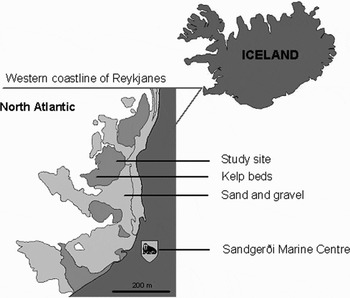
Experiments were carried out in August 2004 on two successive days of calm weather in the intertidal at the Sandgerði Marine Station located at the exposed west coast of Reykjanes peninsula (south-western Iceland). The sandy intertidal at Sandgerði is interspersed with extensive rocky lava fields (Figure 1) covered by dense canopies of fucoid brown algae, mainly Ascophyllum nodosum (L.) Le Jol. 1863. According to Espinosa & Guerra-García (Reference Espinosa and Guerra-García2005) the study site is largely controlled by natural biological and physical factors without significant effects of pollution. The tides around Iceland are semi-diurnal (Anonymous, 1993 cited in Ingólfsson Reference Ingólfsson1996) and the tidal range at the south and south-west coast varies between 2.5 and 3.8 m (Ingólfsson, Reference Ingólfsson1996). Water temperatures during the study period were about 12°C (data kindly provided by Heðinn Valdimarsson, Marine Research Institute, Reykjavik).
Structure of the coast and location of the intertidal study site at Sandgerði on the west coast of Reykjanes peninsula (south-western Iceland).

Randomly chosen complete thalli of the brown alga A. nodosum were cautiously detached from their rocky substratum in about 1.5 m depth by a person standing in the submerged kelp bed. Each thallus was detached by a careful and quick cut with a knife immediately above the substratum keeping physical disturbance at a minimum. After one minute of floating freely (treatment: 1 minute) the detached algae were enclosed in plastic bags. We used plastic bags which were open at both ends. The bags were unfolded in the water and each alga was slowly dragged into a bag. When the alga was inside the bag the ends were closed quickly and tied with rubber bands. No organisms were observed to escape while the algae were enclosed in the bags. Following the procedure applied in previous studies on the succession of the epifaunal communities on floating macroalgae (Edgar, Reference Edgar1987; Vásquez, Reference Vásquez1993; Ingólfsson, Reference Ingólfsson1998), individuals of A. nodosum were tethered with ropes and were left floating at the surface for two hours after detachment (treatment: 120 minutes). In contrast to previous studies, however, detached algae were not tethered to bottom weights but to attached conspecifics by thin ropes which were 3–4 m long. As a control, algae were placed in plastic bags before detachment. Control and 1 minute algae were collected at high tide. In order to perform the 120 minute treatment evenly around high tide, the algae were detached one hour before high tide and the experiment was finished 1 hour after high tide. For each treatment five individual algae served as replicates.
The plastic bags containing the algae and enclosed seawater were immediately transferred to the laboratories of Sandgerði Marine Station. There the mobile epifauna was carefully washed from the fronds with warm tap water and collected over a 0.5 mm sieve. After removal of excess water by shaking the fronds the algal wet weight (WW) was determined to 10 g accuracy. Algal wet weight ranged from 160 g to 1780 g. Due to the large variability within the treatments, however, the average algal WW did not differ significantly between treatments (one-way ANOVA: F2,12 = 0.52, P = 0.61). All animals were identified to species level when possible. Numbers of epifaunal individuals were standardized to 1 kg of algal WW. As the number of species is likely to vary with sample size, diversity was calculated as expected number of species per 20 individuals (ES(20)) to account for variations in algal WW among replicates (Hurlbert, Reference Hurlbert1971). This parameter calculates the number of species that would be expected on larger samples that are scaled down to the size of the smallest sample taken.
To test if particular life history stages of associated species react differently to the detachment of their algal host we measured the size of each individual of the gastropod Littorina obtusata (Linnaeus, 1758). As the apex of the shell of L. obtusata is flattened and does not clearly protrude, we measured shell diameter instead of shell height. The maximum shell diameter as viewed from the apex was measured by a ruler to 0.5 mm accuracy and rounded down to the lower 0.5 mm.
Statistical analysis
For all tests we considered the effect of the fixed factor ‘time since algal detachment’ with three levels (control, 1 minute and 120 minutes). We tested for treatment effects on the macro-zoobenthic assemblage using a PERMANOVA (permutation-based multivariate analysis of variance: Anderson, Reference Anderson2001, Reference Anderson2005) with 4999 permutations. Weight of the algal fronds served as covariate. Additionally, a canonical analysis of principal coordinates (CAP: Anderson, Reference Anderson2003; Anderson & Willis, Reference Anderson and Willis2003) was performed. Multivariate tests were based on Bray–Curtis similarities (Legendre & Legendre, Reference Legendre and Legendre1998) of previously fourth root transformed data. A test of heterogeneity in dispersion was applied with the test of multivariate dispersion using the PERMDISP program by Anderson (Reference Anderson2004) proving multivariate dispersion to be not significantly heterogeneous (P > 0.05). Treatment effects on the total number of individuals and the expected number of species (E(20)) were evaluated by a one-way ANOVA followed by a Student–Newman–Keuls (SNK) post-hoc test.
The individuals of L. obtusata of each treatment were classified in three size-classes (0–4, 4.5–8 and 8.5–12 mm). Size-class distributions were compared among the treatments by a 3 × 3 contingency table.
RESULTS
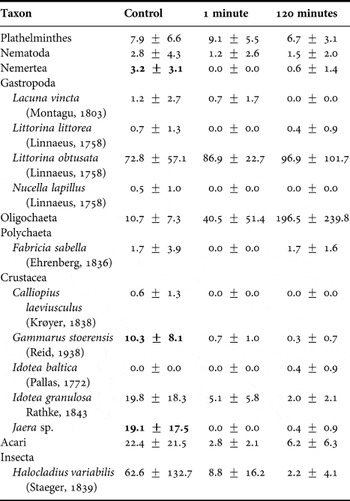
A total of 16 taxa occurred on the thalli of Ascophyllum nodosum (Table 1). All of these taxa were present on attached as well as on detached algae. The only exception was the isopod Idotea baltica of which only a single individual was found on a detached thallus of the 120 minute-treatment. The most abundant species on attached A. nodosum was the gastropod Littorina obtusata followed by larvae of the chironomid Halocladius variabilis. Littorina obtusata dominated also on detached fronds together with an unidentified oligochaete species.
Mean abundance ± SD (N = 5) of mobile epifauna taxa on attached Ascophyllum nodosum (control) and on thalli that had been floating for 1 minute and for 120 minutes after detachment. Bold values denote significantly higher abundances evaluated by Student–Newman–Keuls test at α = 0.05 after one-way ANOVA. Other significant treatment effects were not detected on the species level.

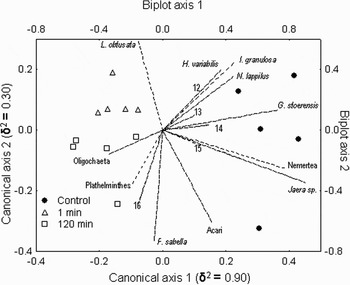
The effect of algal detachment was significant at the community level (PERMANOVA F2,11 = 2.33, P < 0.05) with the control treatment differing from the detachment treatments. Weight of algal fronds (covariable) did not significantly affect the composition of the faunal assemblage (PERMANOVA F1,11 = 1.50, P > 0.05). Abundance was correlated with clump size only in the isopod Idotea granulosa in the control treatment (r = 0.96, P < 0.05). The ordination given by CAP showed that 73% of the replicates were correctly classified into their groups: all replicates of attached algae were grouped while the detached replicates were less clearly separated. Control and detachment treatments were clearly separated in the CAP plot (Figure 2): control replicates grouped in the positive section of the first canonical axis while the detached replicates grouped in the negative section of this axis. Most taxa correlated positively with the first canonical axis indicating a reduction in abundance after detachment. This was particularly evident for Jaera sp., Nemertea and Gammarus stoerensis that showed the highest correlations with the first canonical axis (Figure 2). These were the only taxa that were significantly less abundant on detached algae (Table 1). Other taxa such as H. variabilis, I. granulosa, and Acari also decreased strongly in abundance after detachment of the algae. Due to strong variations among replicates, however, these changes were statistically not significant.
Canonical analysis of principal coordinates (CAP) ordination with projection of individual taxa onto the ordination axes. The analysis was performed after Bray–Curtis distance of fourth root transformed data. CAP selected the first four principal coordinates that explained 79% of the total variation. Individual taxa with low correlation coefficients are given as numbers as follows: 12, Calliopius laeviusculus; 13, Lacuna vincta; 14, Littorina littorea; 15, Nematoda; 16, Idotea baltica.

Few taxa were negatively correlated with the first canonical axis, but the absolute values of the correlation were low (r < 0.40). The average number of oligochaetes was four times higher on 1 minute algae than on control algae and 20 times higher on 120 minute algae. Similarly, the density of L. obtusata was 15 to 25% higher on detached algae. But again, for both species the differences were statistically not significant because of strong variations among the replicates.
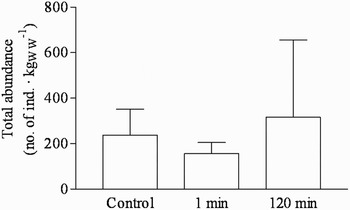
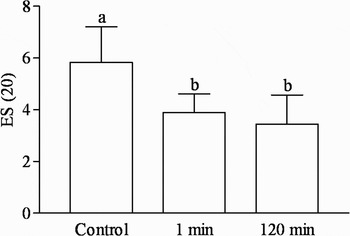
Due to the high number of oligochaetes on the floating algae, detachment and subsequent floating of A. nodosum had no significant effect on the total abundance of the epifaunal organisms (ANOVA: F2,12 = 0.72, P > 0.05) (Figure 3). The expected number of species was reduced by algal detachment (ANOVA: F2,12 = 6.69, P < 0.05) (Figure 4). ES(20) was higher on attached A. nodosum than on 1 minute algae (SNK test: q = 3.94, P < 0.05) and on 120 minute algae (SNK test: q = 4.87, P < 0.05). ES(20) remained constant during subsequent floating of the algae (SNK test: q = 0.92, P > 0.05).
Total abundance of mobile epifauna on attached Ascophyllum nodosum (control) and on thalli that had been floating for 1 minute and for 120 minutes after detachment. Error bars denote standard deviation (N = 5).

Expected number of species (ES(20)) of mobile epifauna on attached Ascophyllum nodosum (control) and on thalli that had been floating for 1 minute and for 120 minutes after detachment. Different letters denote significant differences among treatments evaluated by Student–Newman–Keuls test at α = 0.05 after one-way ANOVA. Error bars denote standard deviation (N = 5).

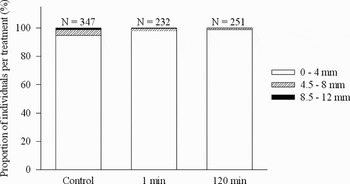
The size of L. obtusata ranged from 0.5 to 12 mm. In each treatment more than 90% of the individuals were ≤ 4 mm (Figure 5). The size-class distributions did not differ significantly among the treatments (P = 0.058, χ2 = 9.109, df = 4). The proportion of individuals with a shell diameter > 4 mm, however, tended to decrease after algal detachment and during subsequent floating.
Littorina obtusata. Proportions of individuals classified into one of three size-classes for each treatment.

DISCUSSION
The detachment of benthic Ascophyllum nodosum was accompanied by a significant change in the community composition of the associated mobile epifauna. During the subsequent two hours of floating at the surface, however, the community composition remained stable. Although the total abundance of associated organisms was not affected by algal detachment the tendency towards lower abundances on detached algae, as previously observed by Kingsford & Choat (Reference Kingsford and Choat1985), was evident in most taxa. These results confirm our hypothesis that substantial changes in the community of mobile organisms occur immediately after detachment of benthic algae.
Emigration from detached algae
The strongest decrease in abundance was observed in peracarid crustaceans such as Gammarus stoerensis, Jaera sp. and Idotea granulosa. The densities of these species dropped from some tens of individuals per kg algal WW to almost zero after detachment of the algae. Kingsford & Choat (Reference Kingsford and Choat1985) observed a similar loss of phytal amphipods from macroalgae immediately after detachment. This observation was surprising since peracarids are among the most common rafting invertebrate species in the world's oceans (Thiel & Gutow, Reference Thiel and Gutow2005b) indicating their high potential for persistence on floating items. The number of peracarids decreased drastically after detachment of the algae despite their high capability of clinging efficiently to their algal host (Dommasnes, Reference Dommasnes1968). We, therefore, assume that these animals leave the algae actively immediately after detachment. A similar rapid and strong reaction was observed for holdfast-boring isopods Limnoria spp. in a Chilean kelp forest, which quickly abandoned their burrows after detachment of the holdfast from the substratum (Miranda & Thiel, Reference Miranda and Thiel2008).
Edgar (Reference Edgar1987) expected that organisms on floating holdfasts of the giant kelp Macrocystis pyrifera experience greater water motion than on attached holdfasts. Accordingly, Thiel & Gutow (Reference Thiel and Gutow2005b) suggested that some of the original inhabitants of the algae are lost from the community immediately after detachment because of their incapability of holding onto floating items. The majority of the taxa found in our study, however, have been repeatedly recorded as rafting organisms on macroalgae in coastal and offshore waters around Iceland (Ingólfsson, Reference Ingólfsson1995, Reference Ingólfsson1998), which confirms their general ability of clinging efficiently to floating algae. We, therefore, consider it unlikely that these animals are unable to hold onto detached algae especially under the calm weather conditions during the experimental period. Individuals of these taxa rather abandoned the algae actively after detachment, similar to the peracarids. Kingsford & Choat (Reference Kingsford and Choat1985) assumed that a large number of organisms will probably be removed from their host under stormy conditions when the algae tumble over the rocky substratum after detachment. Particularly large organisms such as gastropods will be shaken off from their algal host under rough conditions. Our comparison of the shell size-distributions of the gastropod L. obtusata showed a tendency towards lower proportions of larger individuals, which was, however, statistically not significant. The overall very small proportion of large individuals even on attached A. nodosum, however, did not allow for reliable conclusions concerning size-specific clinging capacities.
Immigration onto floating algae
It might be possible that the observed slight increase in the proportion of small L. obtusata on detached A. nodosum was simply an experimental artefact. The density of L. obtusata increased after algal detachment and was highest after two hours of floating. An even stronger increase in density on detached algae was observed for the oligochaetes. Juveniles of various gastropod species perform tidal migrations by entering the water column by the use of mucus threads (Martel & Chia, Reference Martel and Chia1991). It is unknown if small L. obtusata perform pelagic dispersal. Post-metamorphic drifting via mucus threats was, however, reported for the congener Littorina sitkana (Martel & Chia, Reference Martel and Chia1991). Similarly, benthic oligochaetes suspend in the water column and use tidal currents for migrations between intertidal and subtidal habitats (Nilsson et al., Reference Nilsson, Levinton and Kurdziel2000). Suspended individuals might have been sieved out of the water column and become concentrated on the tethered algal fronds that were floating for one hour at the surface in the ebb tide.
Causes and implications of rapid migration after algal detachment
The exact signal, which induces the observed rapid reaction of the associated organisms is unclear. It is unlikely that the active escape from the detached plants was induced simply by the presence of a field investigator shadowing the algae like predatory fish or seabirds do. This effect should have been observed on attached algae as well. Phytal animals avoid exposure to visually hunting predators by hiding on their algal host during daytime (Taylor, Reference Taylor1998). Migration is, thus, unlikely to be induced by the presence of a potential predator.
Phytal organisms might be deterred by chemicals released by the algae after detachment. Indeed, wounded A. nodosum releases chemicals that attract predators. The release of such infochemicals is, however, induced by grazing herbivores and not by artificial damage of the alga (Coleman et al., Reference Coleman, Ramchunder, Davies, Moody and Foggo2007).
The epifaunal organisms may perceive changes in their physical environment after the detachment of the benthic macroalgae. Due to the shallowness of the study site (i.e. ~1.5 m depth) the changes in light intensity and pressure during the ascent of the algae to the surface seem negligible. The altered movement pattern of the algae after detachment and the changed drag forces might form a signal of habitat modification that induces the reaction of the animals.
By escaping from the detached algae the animals avoid displacement from the structurally complex phytal habitat that provides efficient shelter from visually hunting predators (Nelson, Reference Nelson1979). The isolation of a detached alga from the benthic assemblage will affect the structural complexity of the floating habitat and reduce the protective efficiency. Many floating macroalgae end up on nearby beaches shortly after detachment (Harrold & Lisin, Reference Harrold and Lisin1989). Therefore, Miranda & Thiel (Reference Miranda and Thiel2008) suggested that rapid emigration from detached macroalgae reduces the risk for associated organisms to become deposited on the shore.
For most species the decrease in abundance after detachment of the algal host was statistically not significant indicating that a substantial number of individuals remain associated with floating algae. Obviously conspecific individuals differ in their readiness for active migration. Differential migratory activity among life history stages has been described for various species including peracarids (Johnson & Menzies, Reference Johnson and Menzies1956), bivalves (Lane et al., Reference Lane, Beaumont and Hunter1985), and gastropods (Martel & Chia, Reference Martel and Chia1991). The individuals that hold onto their algal raft after detachment have a considerable chance of being carried out of the local kelp forest and enter large scale offshore currents. Low migratory activity can, thus, increase the probability for long distance dispersal. Efficient rafting dispersal can result in natural range expansion (Johannesson, Reference Johannesson1988), colonization of new areas (Ó Foighil et al., Reference Ó Foighil, Marshall, Hilbish and Pino1999), and connectivity among local populations allowing for regional persistence of species through metapopulation effects (Thiel & Haye, Reference Thiel and Haye2006).
In conclusion, our experiments showed that the moment of detachment of benthic macroalgae has a substantial effect on the composition of the epifaunal community and, thus, the future succession of the rafting community.
ACKNOWLEDGEMENTS
This study was funded by a grant of the EU–IHP programme ‘Access to Research Infrastructures’ to R.S. We gratefully acknowledge the support of G.V. Helgason and the staff from Sandgerði Marine Centre. Helpful comments of an anonymous referee and especially Martin Thiel improved the manuscript.