

The first days of the new U.S. administration have been characterized by the adoption of a number of new Executive Orders (EOs), many of which have elicited skeptical reactions in part of the public opinion, and even more in academia. One good example is EO 13771 adopted on January 30, 2017, titled “Reducing Regulation and Controlling Regulatory Costs”, which introduced a new regulatory budgeting system. The goal pursued by the new EO is to reduce regulation, i.e. reducing the number of regulations; and to control regulatory costs, i.e. avoiding new regulation if it leads to an increase in the costs imposed by the existing stock of federal regulation. The new rule was later accompanied by EO13777 on “Enforcing the Regulatory Reform Agenda”, which aimed at strengthening the governance of regulatory reform inside the administration, in particular by mandating the creation of Regulatory Reform Task Forces in each agency. Overall, the new EOs introduce a radically new system in federal agencies, with substantial consequences for the regulatory process and oversight.
This paper discusses the likely impact of the new EOs on the U.S. regulatory management and review systems and in particular on the practice of benefit-cost analysis, and seeks to draw a comparison between the new system and the international experience on the use of similar rules in a number of countries. The paper finds that the new U.S. system differs substantially from what other administrations have done to date: still, existing national experience allow a certain degree of lesson-drawing on what may work, as well as what problems may arise in the coming months. Accordingly, Section 1 below briefly describes the new system, whereas Section 2 surveys some of the regulatory budgeting and cost reduction models already tested in other countries, as well as the available evidence on the results obtained by the administrations that have adopted them. Section 3 discusses the features of the new rules, as well as recommendations on how to make them compatible with the long-standing experience of the United States in regulatory review, and in particular in the ex ante analysis of the costs and benefits of economically significant regulatory actions.
1 A brief description of the new system
EO13771 introduces a number of new features in the U.S. federal rulemaking process:
-
∙ A so-called “stock-flow linkage rule”, which combines a “one-in–two-out” rule in terms of number of regulations and a “one-in–one-out” rule in terms of volume of incremental regulatory costs. The rule mandates that “any new incremental costs associated with new regulations shall, to the extent permitted by law, be offset by the elimination of existing costs associated with at least two prior regulations” (Section 2c).Footnote 1
-
∙ A regulatory budgeting system, based on which from 2018 onwards the U.S. Office of Management and Budget (OMB) will attribute specific incremental cost allowances to each federal agency, with a view to reaching an overall target for the reduction of incremental costs, which can change every year.
EO13771 was accompanied by an interim guidance document issued by the Acting Director of the Office of Information and Regulatory Affairs (OIRA), which clarified a number of aspects but also left a lot of room for interpretation.Footnote 2 Such guidance was later replaced by an updated Q&A document issued on April 5, 2017, which provides a number of useful clarifications, and even thoroughly revisits the initial interim guidance.Footnote 3 Below, a brief description of the new system is provided, based on the updated guidance document released by OIRA.
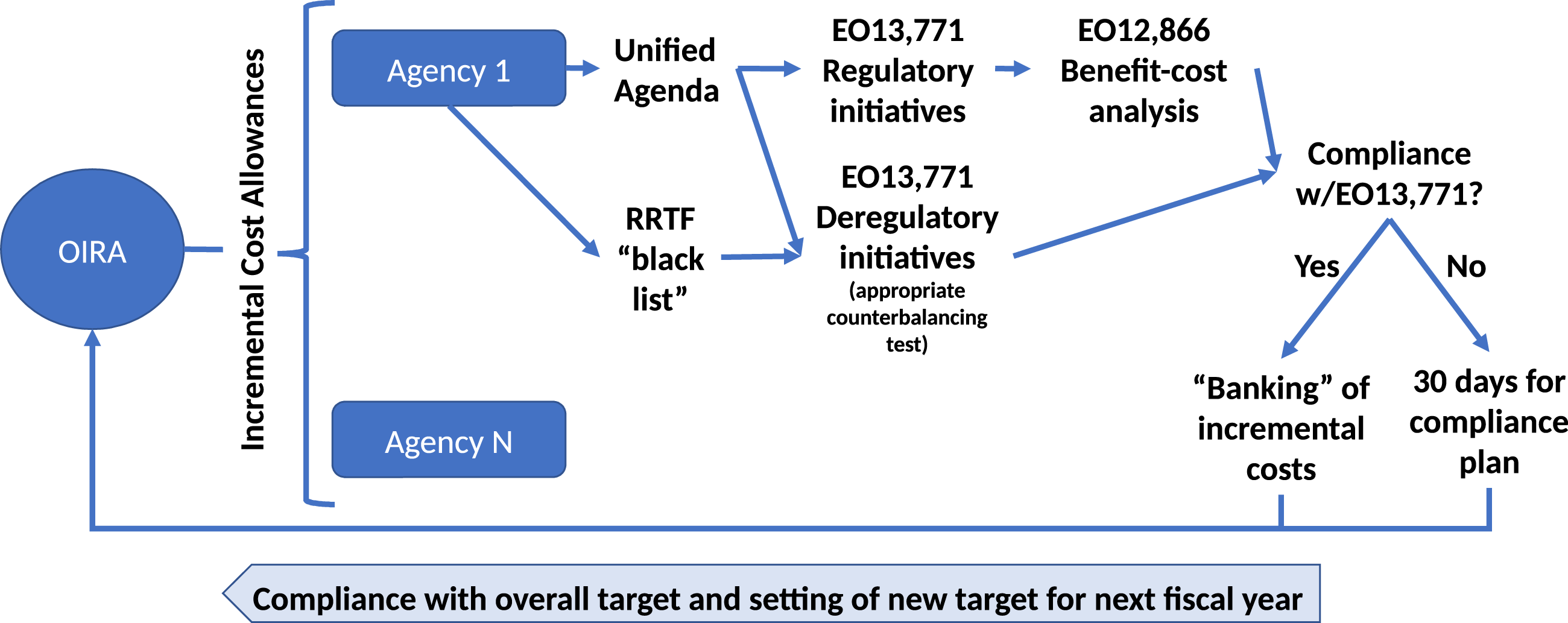
From fiscal year 2018 onwards, the OMB will attribute an incremental cost allowance to each agency. Each agency will then have to draft a yearly Unified Agenda of Regulatory and Deregulatory Actions, in which foreseen actions leading to qualifying regulatory and deregulatory actions are identified. As clarified by OIRA, the rule will be applied (at least for the “one-in” part) only to “significant regulatory actions”, as defined in Section 3(f) of EO 12866 (which continues to apply);Footnote 4 as well as to “significant guidance documents”, as defined in OMB’s Final Bulletin for Agency Good Guidance Practices.Footnote 5 For each new such initiative planned, agencies have to issue and finalize during the fiscal year at least two “EO13771 deregulatory actions”, which have total incremental costs less than zero and qualify both as “two-out” measures; and also for the purposes of meeting the overall incremental cost allowance attributed to the agency by the OMB. Importantly, the new guidance document clarifies that deregulatory actions may lead to either repealing, or also merely revising existing regulations to reduce incremental costs, contrary to what the previous interim guidance document implied.Footnote 6 All in all, it seems that the two offsetting requirements (“one in–one out” in terms of incremental costs, and “one in–two out” in terms of number of regulations) will be separable at the time of adopting new significant regulations, but will have to be jointly met by the end of the fiscal year.
It is important to recall that the new qualifying regulatory initiatives will not only have to comply with the offsetting requirement: they will also need to comply with EO 12866, which means that they will have to produce net benefits, or at least have benefits that justify the cost. OIRA has also confirmed, in this respect, that the definition of incremental cost to be used for the purposes of EO13771 is the same that is contained in Circular A-4 and applied to EO 12866;Footnote 7 and that the focus on incremental cost shall not lead to neglecting or downplaying regulatory benefits.Footnote 8 Agencies will thus be confronted with what could be defined as a double constraint, since they will be allowed to propose new significant regulatory actions only after two basic preconditions are met: (i) that the benefits of the new rule justify the costs (to comply with EO12866); and (ii) that the incremental costs are offset (or appropriately counterbalanced, see below) by at least two qualifying deregulatory actions, which have to be identified and finalized at the time of adoption of the regulatory action, and certainly by the end of the fiscal year (to comply with EO13771).
The new guidance document explains that the term “offsetting” implies that the cost of new significant regulatory initiatives will have to be “appropriately counterbalanced” by incremental cost savings generated by the deregulatory actions, consistently with the agency’s total incremental cost allowance. Depending on the agency’s incremental cost allowance, the rule might thus not take the form of a precise “one-in, one-out” rule based on the volume of incremental costs, but rather lead to different constraints and objectives for each agency. Imagine, for example, that the EPA has been given a mandate to reduce regulatory burdens by 25% (or a nominal amount, say $500 million) in 2018: then, rather than simply offsetting the incremental cost of each new qualifying regulatory initiative, the EPA will have to ensure that the sum of all “ins” and “outs” is consistent with the negative incremental cost allowance. This, as will be discussed below, could lead to cases in which an agency abandons the adoption of potentially welfare-enhancing regulatory initiatives since they comply with EO12866, but not with the specific incremental cost allowance attributed to the agency by the OMB. In this respect, the new guidance document clarifies that the “two out” may be chosen from a list to be compiled by the Regulatory Review Task Force (RRTF) of each agency, which will include i.a. those rules that eliminate jobs or inhibit job creation; rules that are outdated, unnecessary, or ineffective; and rules that impose costs that exceed benefits. RRTFs will be asked to consult stakeholders in this respect, and to use recent RIAs where available, or discuss with OIRA possible methodological enhancements (such as excluding sunk costs) whenever estimates in less recent RIAs are thought to need a revision.Footnote 9
Figure 1 above, shows a sketch of the new system. Agencies that do not comply with the incremental cost allowance by the end of fiscal year will be given a deadline of 30 days to develop a compliance plan.Footnote 10 If they comply, or go beyond the allowance, they will be able to “bank” incremental cost allowances for the subsequent fiscal years. They will also be able to request, whenever appropriate, that some of the incremental cost allowances be transferred to or from other agencies, subject to approval by the OIRA.
Figure 1

2 The international experience with cost reduction targets and stock-flow linkage rules
Many commentators found the new system to feature similarities with the experience of other countries, in particular in Canada and the United Kingdom. In this respect, the origins of stock-flow linkage rules and reduction targets can indeed be found in Europe, and more specifically in the Netherlands. There, since the 1990s the government has designed and launched a methodology aimed at offering a relatively quick, admittedly inaccurate, standardized way to look at specific costs imposed by legislation, termed administrative burdens, initially referred exclusively to businesses, not citizens.Footnote 11 The original Dutch methodology, named Standard Cost Model, required a so-called “baseline measurement”, and was accompanied by a political commitment to reduce the resulting stock of administrative burdens by 25% within five years. The introduction of a tangible political commitment at the outset, even before the “100%” was known to the administration, was paradoxically the most successful element of the SCM. Many European governments, starting with Denmark, the United Kingdom and the Czech Republic, turned to the Standard Cost Model as a pragmatic alternative to the more ambitious, but less easy to implement (and communicate) ex ante regulatory impact analysis (Boeheim et al., Reference Boeheim and Renda2006; Renda, Reference Renda2017). And indeed, most of them ended up using the Standard Cost Model as the only tool in regulatory management, rather than seeking to appraise both the costs and the benefits of regulation.
The Dutch experience has had an enormous influence in international regulatory reform practices. Among OECD countries, only the United States remained virtually unaffected by it. From Australia’s business cost calculator to Germany’s regulatory cost model, Mexico’s SIMPLIFICA and Portugal’s SIMPLEX, elements of this methodology can be traced almost everywhere around the globe. The OECD celebrated the Standard Cost Model in two series of “cutting red tape” publications and countless country reports. The World Bank incorporated the Standard Cost Model in its more general Ease of Doing Business program. The Inter-American Development Bank has trialled simplified versions of the model in several Central and Latin America countries.
However, very soon European governments realized that the SCM was not accurate enough to enable a real monitoring of the stock of regulatory costs over time. Furthermore, it was too costly, insufficiently comprehensive, and very difficult to combine with ex ante, full-fledged regulatory impact analysis.Footnote
12
Even more importantly, it became clear that the inaccuracy of the SCM made it impossible to monitor the evolution of the baseline through a second baseline measurement. This realization led many countries to develop new, significantly different strategies. In the Netherlands, the government gradually expanded the scope of the measurement to cover also direct compliance costs for businesses and citizens; and abandoned the baseline measurement to replace it with a politically set, “net” reduction target, according to which the level of direct compliance costs in 2017 should be lower than the respective 2012 value by 2.5 billion Euros. This implies a general, government-wide reduction of half a billion Euros per year over a five-year time frame.Footnote
13
Similar targets exist in Denmark (2 billion DKK by 2020 compared to 2015); Norway (15 billion crowns compared to 2011); and the United Kingdom (10 billion pounds over the 2015–2020 period). At the same time, several countries, including Canada, France, Spain, Portugal, Germany, South Korea and the United Kingdom, have introduced so-called “one in,
 $x$
out” rules (with
 $x$
most often being equal to one) similar to the one introduced by EO13771 in the United States.
Against this background, the legal systems that can provide the most relevant lessons for the new U.S. administration are Canada and the United Kingdom. The reason is that both countries have introduced stock-flow linkage rules with a full-fledged regulatory impact analysis system based on benefit-cost analysis, like the United States. In Canada, a Red Tape Reduction Commission detailed in 2012 15 systemic changes and 90 department-specific solutions to reduce or remove “regulatory irritants”, promoting i.a. the introduction of a one-for-one rule by the government.Footnote 14 Based on this rule, regulators are required to provide offsets within two years of receiving final approval of regulatory changes that impose new administrative burdens on business. The offset consists in removing at least one regulation. Between 2012 and June 2014, this Rule reportedly “reduced the net annual administrative burden on business by over $22 million, resulting in an estimated annual savings of 290,000 hours in time spent dealing with regulatory red tape, and has achieved a net reduction of 19 regulations taken off the books.Footnote 15 ”
The UK system is broader in scope and more ambitious than the Canadian, and looks at “regulatory costs”, including compliance and enforcement costs, not just administrative burdens. However, the rule still focuses exclusively on the direct costs imposed by regulation on businesses. The government has adopted a “one-in, two-out” rule (after a “one-in, one-out” system launched in 2011), based on which for every £1 in regulatory cost introduced by domestic regulation, departments must find twice the volume of savings.Footnote 16 Currently a “one-in, three-out” rule is being introducedFootnote 17 . Within this context, in March 2016 the Government has set a target to reduce regulatory costs to business by £10 billion over the period 2015–2020.
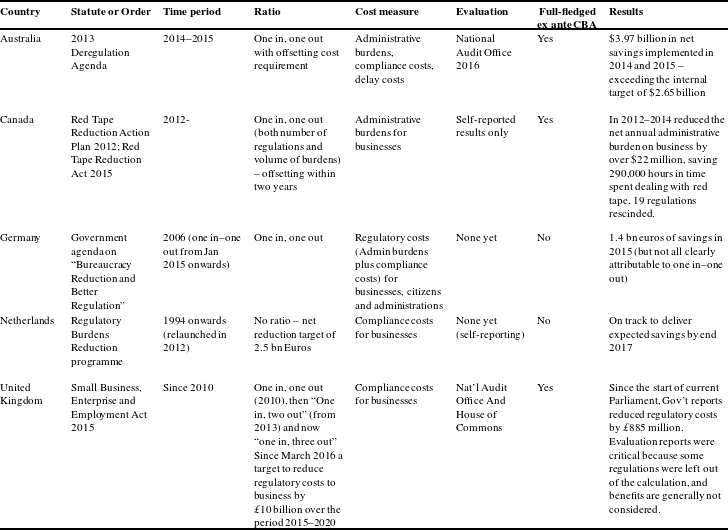
Table 1 below compares the features and results of the national systems described in the previous section. As shown in the table, most countries operate a “one-in, one-out” rule based on the volume of regulatory costs, rather than the number of regulations (Canada being an exception). Most countries focus exclusively on administrative burdens, and no country goes beyond direct costs by adopting more “economic” notions, e.g. targeting incremental costs or social opportunity costs. Also, most countries rely on an independent body to oversee the cost reduction process. The international experience suggests that implementing a stock-flow linkage rule and a regulatory budget is possible, although success requires strong political commitment and adequate governance, scope, methodology and resources. Many countries still focus essentially on administrative burdens, although there is a tendency toward extending the scope of the reduction strategy to broader cost categories, such as substantive compliance costs (Netherlands, Portugal) or more generally regulatory costs (Germany). Of these, all countries focus on direct costs, mostly for businesses, and only one country (the UK) includes some notion of benefit (but limited to so-called “transfers”).
An overview of five national system featuring stock-flow linkage rules.

On the positive side, the practice of target setting seems to have created more cost awareness in some of the administrations that have implemented it. In particular, the UK and German experiences suggest that targets can have a significant behavioral impact on the officials in charge of policy assessment and evaluation. Rather than requiring extensive prior data collection, often targets can lead to better data and methodological improvements. Establishing a whole-of-government target can motivate officials to look more carefully for possible cost reductions and provide them with a general obligation to quantify and monitor the costs that regulation generates for stakeholders.
However, there has been no lack of criticism on the soundness and impact of these rules and strategies. In particular, the UK system, overseen and managed by a public department (Better Regulation Executive) and by an independent oversight body (Regulatory Policy Committee), has been criticized by other UK institutions, and remains very controversial today. The criticisms raised are related both to the representativeness of the costs included in the analysis, and to the overall salience and soundness of the whole exercise. The UK National Audit Office (NAO 2016) reviewed the system in 2016 and concluded that while the system has successfully raised the profile of regulatory costs imposed on businesses across government, the bulk of regulatory costs had not been included in the analysis, and departments had not done enough to appraise the wider impacts of their decisions, or to evaluate their effects.Footnote 18 This, the NAO added, “harms the credibility of claimed savings and reduces opportunities to learn from past experience” (NAO 2016). Even more negative was the comment of the House of Commons’ Committee on Public Accounts, which released in September 2016 a rather critical report on the UK better regulation agenda, including the regulatory budgeting and “one-in, two-out” system.Footnote 19 The Committee observed i.a. that the whole exercise failed to consider the wider costs and benefits of regulation.
3 Will the new system work, and in what direction?
The new system introduced by EO13771 and EO13777 is substantially different, and in many respects, more ambitious and complex than the regulatory budgeting and stock-flow linkage rules that have been tested in other countries. In particular, the United States would be the first country to seek the implementation of such rules without narrowing down the scope of the system to compliance costs or administrative burdens for businesses. This is a very critical choice since all comparable systems have significantly departed from the notion of opportunity cost that typically backs economic analysis of the social welfare impacts of regulation. Many of these countries have adopted simpler and narrower cost definitions and rely on financial analysis as opposed to economic analysis, with the clear intent to simplify the whole exercise and avoid having to engage in complex calculations of opportunity costs, in particular ancillary or indirect ones, or distributional impacts of regulation. To the contrary, the U.S. system promises to remain in line with a more economically sound approach to regulation, but it is difficult to foresee whether this methodological choice will prove sustainable.
Among the most relevant question marks that surround the new system are thus the following: whether the U.S. administration will manage to reconcile benefit-cost analysis with the regulatory budgeting system introduced by EO13771 and EO13777; whether the new rules will incentivize more meaningful retrospective review of regulation in each agency; whether the new system could lead to strategic behavior both on the side of agencies, and OIRA (Mendelson & Wiener, Reference Mendelson and Wiener2014; Livermore, Reference Livermore2014); and whether the combined effects of budget cuts and regulatory cuts could really undermine the stability and soundness of the U.S. regulatory state. These aspects are briefly discussed below.
For what concerns the coexistence of the new system with benefit-cost analysis, and in particular the appraisal of regulatory benefits, one key issue that was raised by authoritative scholars is that while new regulatory initiatives will have to comply with EO12866, no benefit-cost analysis was initially required for the “EO13771 deregulatory initiatives”; this in turn might lead agencies to identify existing regulations that are beneficial to society, and repeal or revise them in a way that leads to important foregone benefits.Footnote 20 This could be a problem also since the “black list” that each agency’s RRTF will have to compile can include, besides regulations that produce more costs than benefits, also other rules that more generally interfere with the government’s agenda or are generically termed as ineffective or unnecessary. However, the latest guidance issued by OIRA now clearly states that “agencies must continue to assess and consider both the benefits and costs of regulatory actions, including deregulatory actions, when making regulatory decisions, and issue regulations only upon a reasoned determination that benefits justify costs”.Footnote 21 All in all, OIRA’s ability to maintain consistency across agencies and avoid that the new rules lead to welfare-decreasing deregulatory initiatives will be key to the overall functioning of the system: and given the emerging approach of the new administration toward regulation, exemplified by the stated intention to engage in the “deconstruction of the administrative state”, there seems to be little reason to expect self-restraint on the side of the oversight body when considering massive deregulatory measures.
Second, in principle the new rules should motivate agencies to engage in more systematic retrospective review of existing regulations. This could happen since the agencies’ RRTFs would need, as a precondition for future regulatory actions, to draft a list of regulations that eliminate jobs, or inhibit job creation; are outdated, unnecessary, or ineffective; impose costs that exceed benefits; or create a serious inconsistency or otherwise interfere with regulatory reform initiatives and policies. This would be a welcome development, also considering that so far the adoption of retrospective regulatory review in the federal agencies has been far from satisfactory, despite repeated attempts since the Carter administration (Wiener & Ribeiro, Reference Wiener and Ribeiro2017). However, given time constraints it is likely that agencies will end up simply asking stakeholders where to cut regulation. In addition, the possible advantages in terms of “learning”, which materialize whenever the ex post review looks back at ex ante regulatory impact analyses to review their accuracy, may only materialize when agencies request permission to review regulatory cost estimates for an existing piece of regulation.
More generally, it would be naïf to a priori discard the risk that the new system will end up reinforcing, on the regulatory side, what the new administration is already trying to achieve on the federal budget side. The unprecedented cuts to some of the agencies proposed for fiscal year 2018 (e.g. the EPA would see its budget cut by nearly a third and the workforce reduced by 20%Footnote 22 ), coupled with possible negative incremental cost allowances under EO13771, may effectively lead to a massive reduction of regulatory and spending powers in key policy areas such as health, safety and the environment. Against this background, optimists may see the new rules introduced by EO13771 and EO13777 as pioneering and well-designed, especially if they will be meaningfully managed by OIRA in cooperation with agencies, with due account for regulatory benefits alongside with costs. At the same time, much more sinister consequences are possible, and appear consistent with the current administration’s dismissive approach toward certain areas of regulation. Should this more dystopian view materialize in the coming months, the United States will risk an overall worsening of the regulatory stock, to the detriment of American citizens and businesses.